
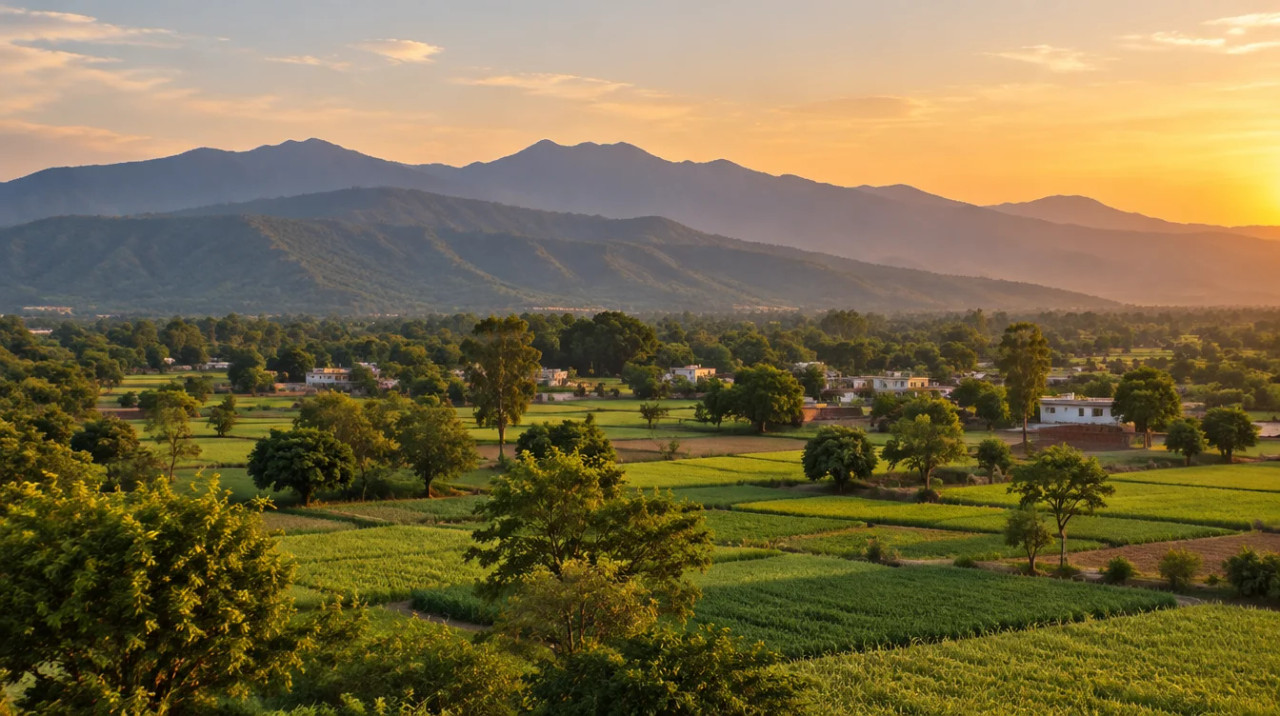
Area guide
Buying Land in Chandigarh Villages and Periphery
Farm land in the villages merged into Chandigarh, estimated at ₹5–9 crore per acre*: Periphery Act limits, shamlat and pooling status and the checks before any payment.
₹5–9 cr/acre*
Estimated price*
13
Merged villages
50,135
Population of the 13
1,666 acres
Cropped area (2019)
*Indicative range across districts and land types. Stamp duty, registration and conversion charges are additional. Local measurement units vary — every listing states the unit it is priced in. Not a valuation or an offer.
Micro-market record — Chandigarh Villages and Periphery
Rev. 2026 · Farmland India desk
District
Chandigarh, a Union Territory that is a single district and the shared capital of Punjab and Haryana
Merged villages
13 villages brought into the Municipal Corporation (administration approval reported Oct 2018); population 50,135 (The Tribune)
Periphery law
Punjab New Capital (Periphery) Control Act, 1952: building outside the village habitation boundary needs the Deputy Commissioner's written permission
Planning
Chandigarh Master Plan 2031, notified 23 Apr 2015 (Supreme Court, Jan 2023); plan text not read
Land use
Total cropped area 1,666 acres (2019); annual rainfall 974 mm (2017) (Chandigarh ENVIS)
Collector rates
Revised from 1 Apr 2026 (reported by The Tribune, 28 Mar 2026); official schedule not opened
Estimated land price*
₹5–9 crore per acre*
Land law is state law. These rules are maintained on the Chandigarh page and apply to every district within it.
Chandigarh Villages and Periphery — land purchase legal rules
⚠ Chandigarh is not a farmland market. The sectors are a planned city, mostly on Estate Office leases. What agricultural land remains sits in the UT villages and in the Punjab and Haryana periphery, and several overlapping rules decide whether any parcel can be built on or even transferred. Read the rules before the price.
Which office decides what: Transfers of leasehold sector sites need the Estate Officer’s permission (Supreme Court, September 2021). Building in the controlled belt around the capital needs the Deputy Commissioner’s written permission under the Periphery Control Act (India Code text). Village land records are covered under Local revenue offices below.
Leasehold and freehold sectors: Most sector holdings are leasehold. Under Rule 17(10) of the Chandigarh Lease-hold of Sites and Buildings Rules, 1973, a transfer needs the Estate Officer’s permission, and for allotted or concessional sites one-third of the unearned increase (the rise in value since allotment) is payable (Supreme Court, Estate Officer v. Charanjit Kaur, 7 September 2021). The Chandigarh Estate Rules, 2007 now also apply, and we have not confirmed which set governs a given site. Conversion to freehold runs under the 1996 conversion rules. Since 2025 the charge follows the collector rate for residential urban plots, and the Tribune reported a 150 sq m house in Sector 16 moving from about ₹10 lakh to about ₹19 lakh, with EWS holdings exempt (Tribune, September 2025). Ask for the lease terms, a no-dues position and the conversion status of any site.
Village agricultural land: Land outside the village habitation boundary, the lal dora, is farmland held in the village revenue records and not by the Estate Office (Tribune, August 2024). A Tribune report says nearly 1,000 farmers own nearly 2,800 acres of cultivable land in the UT; it gives no source or method, so treat it as a press figure and not an official statistic (Tribune, November 2025). The Chandigarh Master Plan 2031 was notified on 23 April 2015 (Supreme Court, January 2023). We have not read the plan text, so check how any village parcel is classified before treating it as buildable.
Periphery Control Act, 1952: The controlled area is the land within ten miles (about 16 km) of the outer boundary of the land acquired for the Capital (section 2(2), Punjab text on India Code). Section 5 bars building or excavation without written permission, the Deputy Commissioner grants or refuses it under section 6, and an appeal lies to the Commissioner under section 7. Section 15 exempts buildings in village abadi that are residential or serve agriculture, existing places of worship, agricultural excavation and unmetalled farm roads. The Punjab text sets a penalty of up to two years’ imprisonment and a fine of up to ₹5,000, plus ₹50 a day for a continuing breach (section 12(1)). We have not found a UT-specific amendment, so check which text the Administration applies. In 2019 the Tribune reported that the Act still covered the villages merged into the Municipal Corporation while farm-plot construction went unchecked (Tribune, February 2019).
Small plots and power-of-attorney sales: The Tribune reported in February 2019 that dealers were selling 2-3 kanal farm plots through General Power of Attorney documents to get around an administration ban on selling agricultural land in small plots, and that buyers were told the structures would be regularised later (Tribune, February 2019). We found no legal basis for that ban, so check whether any minimum-size rule applies now. A power-of-attorney document is not a registered sale deed and should not be treated as passing title.
No land-pooling or CLU route yet: The UT Urban Planning Department said in August 2024 that a land-pooling policy for the villages outside the lal dora “does not seem feasible”, citing a Supreme Court order, a Home Ministry decision on freehold rights and the Master Plan 2031 (Tribune, August 2024). Farmers were still asking for a pooling and change-of-land-use policy in November 2025 (Tribune, November 2025). Land priced on the hope of a conversion route carries that risk.
Shamlat (village common) land: The Tribune reported in September 2023 on a Supreme Court order, the case not named, holding that land set aside for common purposes belongs to the gram panchayats and cannot be re-partitioned or sold. About 200 acres of the 351 earmarked across 17 UT villages were still to be taken over, and a draft amendment was with the Legal Remembrancer (Tribune, September 2023). Any offer of common land is a title defect.
Sukhna Lake and the sanctuary edge: On 5 November 2019 the Supreme Court quashed the clearances for a housing project whose site lay in the lake’s catchment on a 2004 Survey of India map and about 123 m from the sanctuary (Civil Appeals 8398-8399 of 2019). The same judgment records a Ministry of Environment notification of 18 January 2017 widening the Chandigarh-side eco-sensitive zone from 2 km to 2.75 km. A draft zone for the Haryana side dated 22 March 2024 was reported by The Week, and we have not confirmed that it was finalised. Check any parcel near the northern edge against both.
NRI and OCI buyers: The Reserve Bank’s Master Direction under FEMA 1999 excludes agricultural land, plantation land and a farmhouse from what NRIs and OCIs may buy, in Chandigarh as elsewhere (RBI Master Direction FED 12/2015-16, updated to September 2022). They can buy other immovable assets such as residential or commercial sites, and the Direction treats inherited holdings separately. The benami-law position was not checked against the Act text for this page, so take legal advice before using a nominee.
- Union Territory
- Estate Office leasehold
- Periphery Act 1952
- No land pooling yet
- Sukhna catchment
- NRI agri: barred (FEMA)
- Collector rates Apr 2026
Sub-area overview
Chandigarh Villages and Periphery — controlled village farm land inside a planned capital
Buying farm land in the Chandigarh villages means buying inside the Union Territory but outside its planned sectors. The administration approved merging 13 villages into the Municipal Corporation in October 2018: Behlana, Raipur Khurd, Raipur Kalan, Makhan Majra, Daria, Mauli Jagran, Kishangarh, Kaimbwala, Khuda Ali Sher, Khuda Jassu, Khuda Lahora, Sarangpur and Dhanas, with a population of 50,135 (The Tribune); nine villages were already in the Corporation. Manimajra and Burail also appear in the 2026 collector-rate schedule. The farm land that remains lies outside each village's lal dora, the habitation boundary. Our estimate for controlled farm land in these villages is ₹5–9 crore per acre*, indicative only, and the market is thin.
The land is small and controlled. Chandigarh ENVIS gives the UT's total cropped area as 1,666 acres in 2019, while a farm leader told The Tribune in November 2025 that about 1,000 farmers hold roughly 2,800 acres of cultivable land; the report gives no source, so treat both as indicative. Local units matter: on Punjab usage 1 acre is 8 kanal and 1 kanal is 20 marla, so 1 kanal is 605 sq yd (our arithmetic), and small plots are often quoted per kanal or marla. Confirm the unit on every offer.
We found no sourced market evidence for individual villages such as Dhanas, Sarangpur or Kaimbwala, so this page covers the whole belt rather than writing thin village pages. Buyers who want a farmhouse plot usually have to look across the boundary. Read the Chandigarh page for the UT-wide rules, the Mohali page and the Panchkula page, and the state-wise land laws guide. Our estimate is ₹5–9 crore per acre*; rely on registered deeds and the collector rate.
- 13 merged villages
- Lal dora
- Periphery Act 1952
- No land pooling
- NRI barred
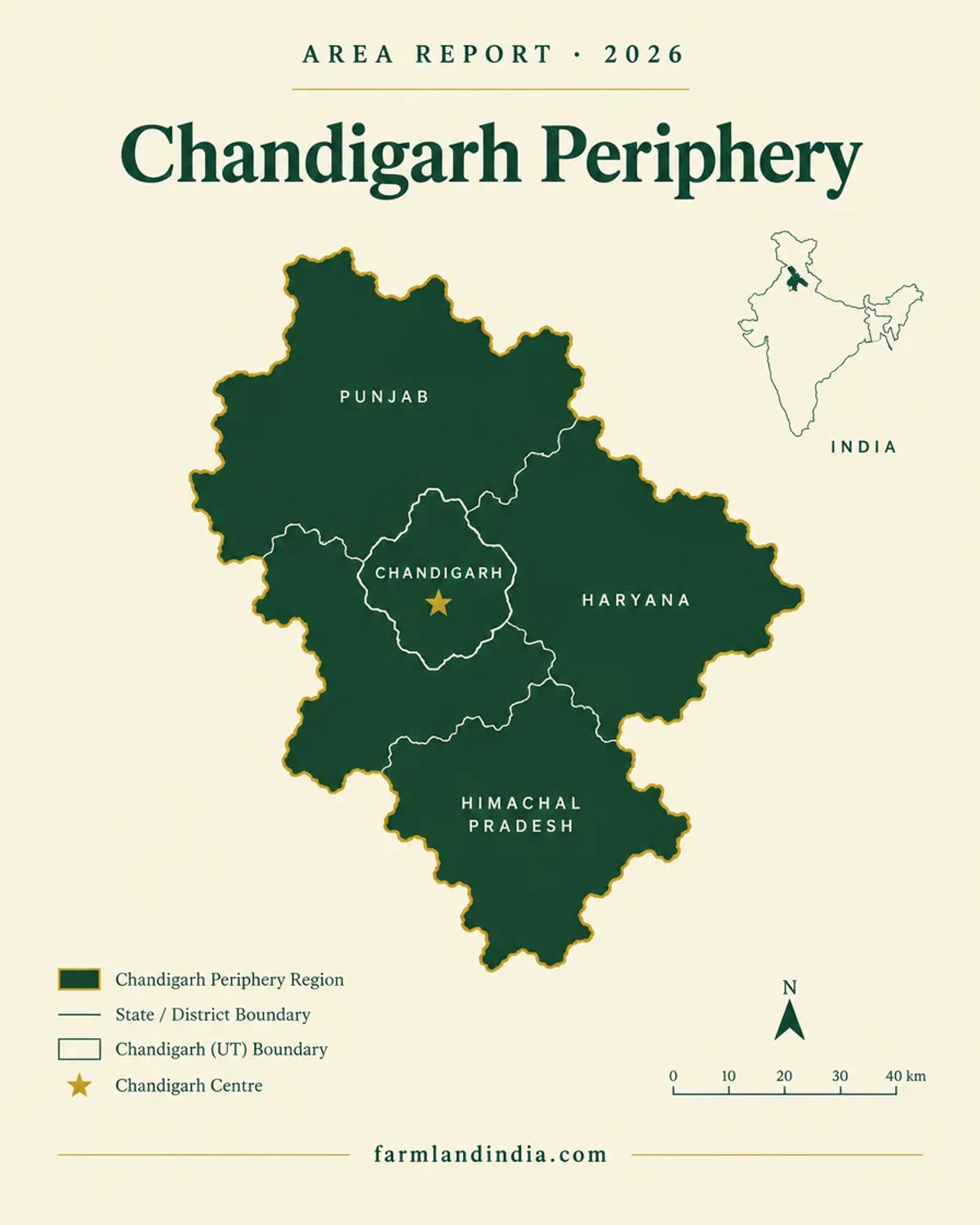
Connectivity
How the Chandigarh villages connect
The villages are inside the UT, close to the city, but access depends on the village and its lanes. Distances are not route-checked.
By road and rail
Read this before relying on access
Village roads, lal dora lanes and farm tracks are not city roads. A member of the Administrator's Advisory Council said many people outside the lal dora had electricity but no water connection (The Tribune, 28 Aug 2024). Ask for the legal status of the approach road and where water and sewage for a plot will come from. The Tricity metro has not been approved.
Growth catalysts
Upcoming developments, orders & pending decisions
Status labels maintained by the Farmland India research desk. These are policy and court items, not built projects; timelines are not guaranteed.
01Court order
Mohali side
03Pending or undecided
Confirm status
Agriculture & terrain
Soil, crops & water in the Chandigarh villages
A small cropped area on the edge of a city, with no sourced village-level crop data.
Farmland and holdings
Chandigarh ENVIS gives total cropped area as 1,666 acres (2019) and forest cover as 48.03 sq km. A farm leader said in November 2025 that about 1,000 farmers hold roughly 2,800 acres (The Tribune, no source given). We found no crop, soil or yield data for the villages, so check the land-use entry in the revenue record and a Soil Health Card report for the plot. Data: Soil Health Card site[1].
- Village farming
- Small holdings
- Periphery-controlled
Water and drainage
ENVIS reports annual rainfall of 974 mm (2017) and available groundwater resources of 3,794 ham (2019) for the whole UT. Outside the lal dora, water connections have lagged electricity (The Tribune, Aug 2024). Ask where a plot's water and sewage will come from. Groundwater categories: CGWB[2].
Mandi price reference
Wholesale prices for the nearest regulated market are published on Agmarknet; we have not confirmed which mandi best serves these villages. Live prices: Agmarknet[3].
Farmland India view
Why buyers look at the Chandigarh villages
Reasons buyers look at this micro-market, stated with the evidence we have. Not a price forecast.
Next to the Tricity core
The villages are inside the UT, near the city's jobs, schools and airport, which is why demand exists at all.
Scarce, controlled supply
The Master Plan and the Periphery Act limit what can be built, so land with clean title and documented permissions is hard to find.
A rule set that can be read
The Periphery Act, the shamlat rule and the UT's pooling position are all documented, so due diligence can be specific.
Honest limits
Nothing here suggests an easy farmhouse route. This is a market for patient buyers who check permissions before paying; our estimate of ₹5–9 crore per acre* is not a promise of resale value.
Listing data is not legal advice. Confirm title, land use and permissions with the Revenue Department and the Deputy Commissioner.
STRAIGHT TALK
Risks & challenges specific to the Chandigarh villages
Specific to this micro-market, beyond the Chandigarh-wide points.
Building needs written permission
Section 5 of the Punjab New Capital (Periphery) Control Act, 1952 bars building or excavation in the controlled area without written permission; the Deputy Commissioner decides under section 6. The Tribune reported in February 2019 that structures were still going up on 2–3 kanal farm plots without a check. Do not assume an existing building is authorised.
Power of attorney and small plots
The same report said dealers sold small farm plots through General Power of Attorney documents to get around an administration ban on selling agricultural land in small plots, with buyers told regularisation would follow. We found no legal basis for that ban, and the report is more than seven years old. A power of attorney does not pass title (Supreme Court, Suraj Lamp, 2011).
Shamlat land
Common land cannot be re-partitioned among owners or sold under the Supreme Court ruling the Tribune described (Sep 2023). Check the revenue record to be sure a plot is not recorded as shamlat.
No pooling or conversion route
The UT said in August 2024 that land pooling does not seem feasible, and we found no notified change-of-land-use policy for farm plots. Prices that assume one carry that risk.
Catchment and neighbouring orders
The UT-side Sukhna eco-sensitive zone is 2.75 km under a 2017 notification (Supreme Court judgment of 5 Nov 2019, carried), and we could not tell which villages fall inside it. The High Court freeze on 16 Mohali-side villages shows how fast a belt can stop. Do not use Mohali-side listings to price UT land.
Duty and collector rates
The Tribune's explainer of 28 March 2026 reports stamp duty at 5% of the registration value, which cannot fall below the collector rate, and farm-land collector rates from 1 April 2026 of about ₹4.62 crore per acre at Manimajra and ₹4.01 crore per acre at Raipur Khurd and Behlana; Burail and Dhanas farm rates were not stated. We did not open the official schedule. Collector rates are floors for duty, not market prices, and our estimate is ₹5–9 crore per acre*.
NRIs and OCIs cannot buy this land
The Reserve Bank's Master Direction under FEMA excludes agricultural land, plantation land and a farmhouse for NRIs and OCIs anywhere in India, the UT included. Confirm your status with a lawyer before paying a token amount.
COMMON QUESTIONS
Frequently asked questions
Everything buyers, NRIs and investors ask before their first reviewed farmland purchase in Chandigarh Villages and Periphery.
Visit full wiki01 of 04
What does farm land in the Chandigarh villages cost?
Our estimate for controlled farm land in the UT villages is ₹5–9 crore per acre*, indicative only. The market is thin; check registered deeds and the collector rate with the Sub-Registrar.
02 of 04
Can I build a farmhouse on farm land in a Chandigarh village?
Not without the Deputy Commissioner's written permission under the Periphery Control Act, 1952, which bars building in the controlled area without it. Unchecked building was reported in 2019, but that does not make it lawful, so ask for documents, not assurances.
03 of 04
Can the UT villages' land be pooled or converted?
Not yet. The UT Urban Planning Department said in August 2024 that land pooling for villages outside the lal dora does not seem feasible, and we found no notified change-of-land-use policy for farm plots.
04 of 04
Is a power-of-attorney purchase of a farm plot safe?
No. A power of attorney does not transfer title, and the Tribune reported dealers selling small farm plots on such documents in 2019 with promises of later regularisation. Insist on a registered sale deed and a permission trail.
Transparency
Sources for this page
- Merged villages and population — The Tribune, 15 Oct 2018; unchecked building and power-of-attorney sales — The Tribune, 21 Feb 2019
- Land pooling position — The Tribune, 28 Aug 2024; farmers' demand and acreage claim — The Tribune, 18 Nov 2025; shamlat land — The Tribune, 10 Sep 2023
- Collector rates and stamp duty — The Tribune explainer, 28 Mar 2026 (official schedule not opened)
- Area, population, rainfall, cropped area and groundwater — Chandigarh ENVIS, opened Oct 2026
- High Court order on 16 villages — LiveLaw, 24 Jul 2026, and The Tribune, 23 Jul 2026; Tricity metro — The Tribune, 18 Jun 2025
- Periphery Act text, Master Plan 2031 notification, Sukhna zone and the RBI NRI rule — carried from our Chandigarh state research (India Code; Supreme Court judgments of 10 Jan 2023 and 5 Nov 2019; RBI), not re-opened for this page
- Prices — Farmland India estimate*; collector rate to be obtained from the Sub-Registrar
- Full UT-wide sourcing: see the Chandigarh page. Sources read October 2026.
- [1]soilhealth.dac.gov.in: Soil Health Card site — soilhealth.dac.gov.in
- [2]cgwb.gov.in: CGWB — cgwb.gov.in
- [3]agmarknet.gov.in: Agmarknet — agmarknet.gov.in
General information, not legal advice. Report inaccuracies to wiki@farmlandindia.com.
For developers
Ready to explore Chandigarh Villages and Periphery farmland?
Browse reviewed projects and individual land parcels across Chandigarh Villages and Periphery — or if you own land here, list it with platform review and reach serious buyers.