.png)

State guide
Farmland in Himachal Pradesh
India's strictest land market for outside buyers — Section 118 permission required everywhere, now at a doubled 12% stamp duty since March 2025.
12
Districts
Section 118 Required
Access
12% (Section 118)
Stamp Duty
6–12 Months
Process Time
State land record — Himachal Pradesh
Rev. 2026 · Farmland India desk
Divisions
3 (Shimla · Kangra · Mandi)
Total districts
12
State area
~55,673 sq km
Net sown area
~10% of state area
Land records portal
Himbhoomi / IGRS HP
Governing act
HP Tenancy & Land Reforms Act, 1972
Stamp duty (Section 118)
12% (raised from 6%, Mar 2025)
Access
Restricted — Section 118 permission required
Himachal Pradesh — land purchase legal rules (Section 118)
⚠ Himachal Pradesh has the strictest, most process-heavy land purchase rule in the Farmland India corridor. Non-agriculturists cannot buy agricultural or horticultural land without prior State Government permission under Section 118 — and the government just doubled the stamp duty on such transfers in March 2025.
Who can buy freely? Only a bona fide agriculturist of Himachal Pradesh — defined as a landowner who personally cultivates land within the state — can buy agricultural or horticultural land without prior permission. This applies to non-Himachali Indian citizens, out-of-state companies, and even Himachali residents who are not classified as agriculturists.
Section 118 permission — the gatekeeper for everyone else: a non-agriculturist must obtain prior State Government permission via an essentiality certificate before acquiring, leasing or mortgaging-with-possession any agricultural or horticultural land. The Supreme Court (Ajay Dabra v. Pyare Ram, 2023) confirmed a sale without this permission is void from the start. Processing typically takes 6–12 months through the emerginghimachal.hp.gov.in portal.
The March 2025 stamp duty hike: the state government doubled the stamp duty on Section 118-permitted transfers from 6% to a uniform 12%, specifically to raise revenue from non-agriculturist land transactions — regardless of buyer gender or transaction value. This dramatically changes the cost calculus for anyone considering an HP purchase through the permission route.
Sale-deed splitting is now checked: transactions between the same buyer and seller within a one-year period are aggregated for stamp-duty purposes, closing a common workaround where a large purchase was split into smaller deeds to reduce duty.
NRI & OCI buyers: FEMA 1999 bars NRIs and OCIs from agricultural, plantation or farmhouse land anywhere in India — Section 118 permission would not override this federal restriction even where a state permission is otherwise available.
- Section 118 required
- Stamp duty: 12% (Section 118)
- 6–12 month process
- No open-district carve-out
- NRI agri: barred (FEMA)
- Himbhoomi
State overview
Himachal Pradesh — the hardest entry, the highest ceiling
Himachal Pradesh is entirely Himalayan and, unlike Uttarakhand, offers no plains-district exception to its outsider restriction — Section 118 applies uniformly across all 12 districts. What it does offer is India's best-known apple economy, Shimla and Kullu-Manali's tourism infrastructure, and among the highest per-acre orchard values in the Himalayan belt.
Only ~10% of the state is net sown area — the rest is forest, alpine pasture and permanent snow. This scarcity, combined with the Section 118 barrier, is precisely why HP land carries a premium once permission is secured: supply cannot expand and demand cannot flow in freely.
For a Farmland India buyer, the realistic path is either partnering with or acquiring through a bona fide HP agriculturist, or budgeting the full 6-12 month Section 118 timeline and the new 12% duty into any purchase plan from day one — not discovering it midway through a transaction.
- Section 118
- Apple Economy
- Shimla
- Kullu-Manali
- 12 Districts
- Himbhoomi
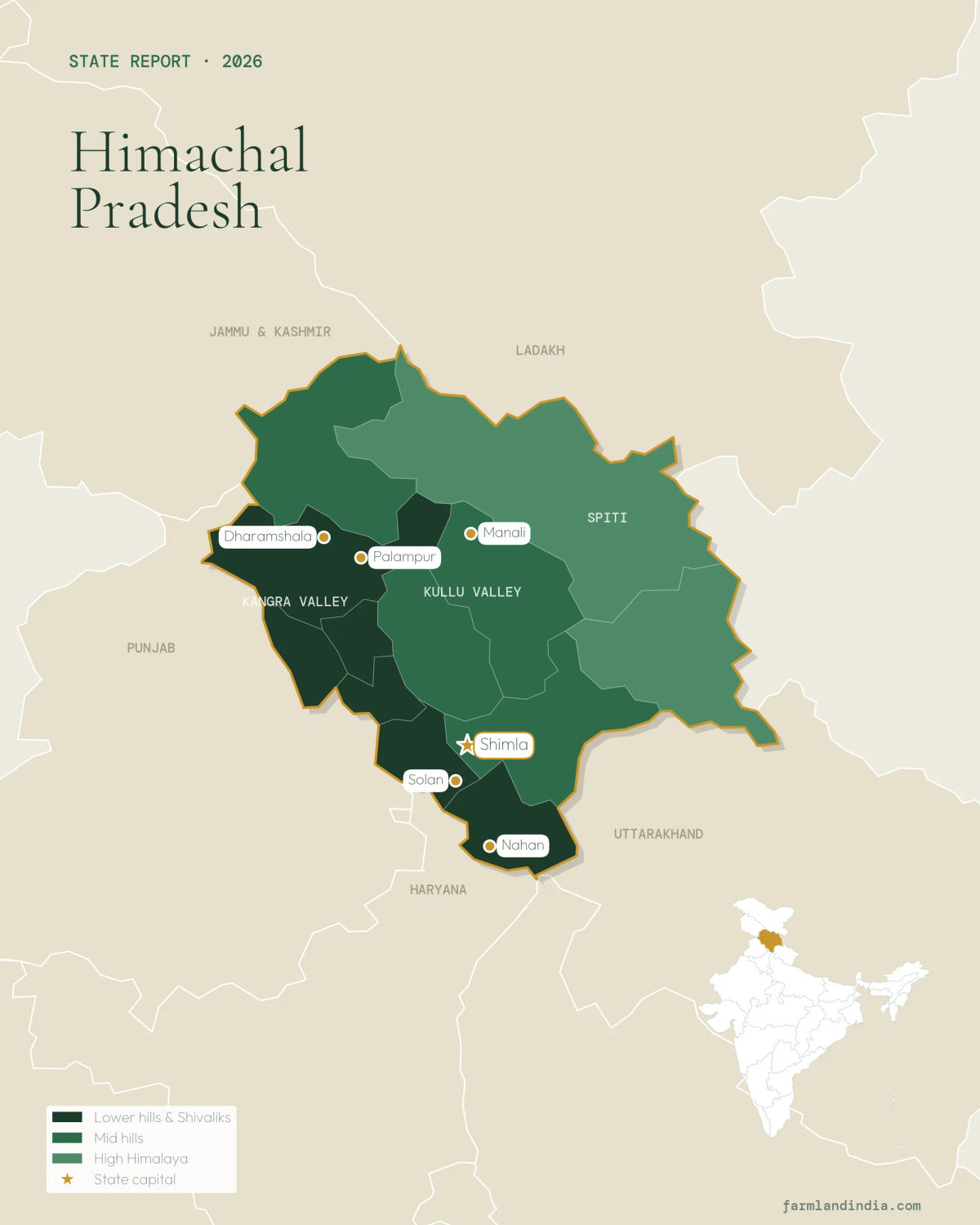
Market bands
District price bands — Himachal Pradesh
All bands assume Section 118 permission is either already held or being applied for. Prices without a permission pathway confirmed are not comparable to these figures.
| District | Zone / belt | Market band* (₹/bigha) | Land type |
|---|---|---|---|
| Shimla | Shimla periphery / Kufri belt | ₹20–60L | Orchard / resort |
| Kullu | Manali corridor | ₹25–70L | Orchard / tourism |
| Kangra | Dharamshala / Palampur tea belt | ₹10–30L | Agricultural / tea |
| Solan | Kasauli / Baddi industrial belt | ₹15–45L | Agricultural / industrial-adjacent |
| Sirmaur | Nahan / lower-hill belt | ₹8–20L | Agricultural |
*Indicative bands; the new 12% Section 118 stamp duty, 2% registration and permission-processing costs are additional and substantial. Confirm the current rate on the IGRS HP portal before pricing an offer. Past movement is historical, not a projection.
Transaction costs
Stamp duty & registration in Himachal Pradesh
5%
Standard stamp duty
agriculturist-to-agriculturist or already-eligible transactions
12%
Section 118 transfers
doubled from 6%, effective March 2025 — uniform regardless of gender
2%
Registration fee
capped at ₹25,000, applies to all buyer types
Duty is calculated on market value or the government guidance value, whichever is higher, and further varies by road-proximity category (abutting road, within 50m, or beyond 50m). Physical stamp papers have been invalid in HP since April 2024 — payment is via e-stamp only, through IGRS HP or the NGDRS HP portal. Confirm the current category and rate before budgeting.
Connectivity
How Himachal Pradesh connects — road, rail, air and terrain
HP's tourism and orchard belts draw buyers from across India, not just Delhi/NCR — Chandigarh and the Punjab plains are the more immediate gateway for most districts. Journey times vary with monsoon and winter road conditions.
🚗 By road from Chandigarh
🚗 By road from Delhi
✈️ By air
🚂 The rail alternative
The UNESCO-listed Kalka-Shimla narrow-gauge railway remains a tourist and heritage route rather than a practical freight/commute link — road is the only realistic access for land buyers across all 12 districts.
Growth catalysts
Upcoming infrastructure & developments
Status labels maintained by the Farmland India research desk. Government-announced timelines — not guaranteed.
Bhanupli–Bilaspur–Leh Rail Line
A planned broad-gauge line that would bring rail into Bilaspur district for the first time — a long-horizon catalyst, still in the survey and planning phase.
Kullu-Manali Airport (Bhuntar) expansion
Runway and terminal upgrades aimed at year-round scheduled service — currently seasonal, weather-dependent operations limit reliable connectivity.
Section 118 stamp duty doubled (March 2025)
Not physical infrastructure, but the single biggest recent change to the HP land-buying economics — every cost projection for a Section 118 purchase needs updating to the 12% rate.
Agriculture & terrain
Soil, crops & water across Himachal Pradesh
Himachal's farmland economics are built almost entirely on horticulture, not grain — apple above all else.
🍎 Apple belt (Shimla, Kullu)
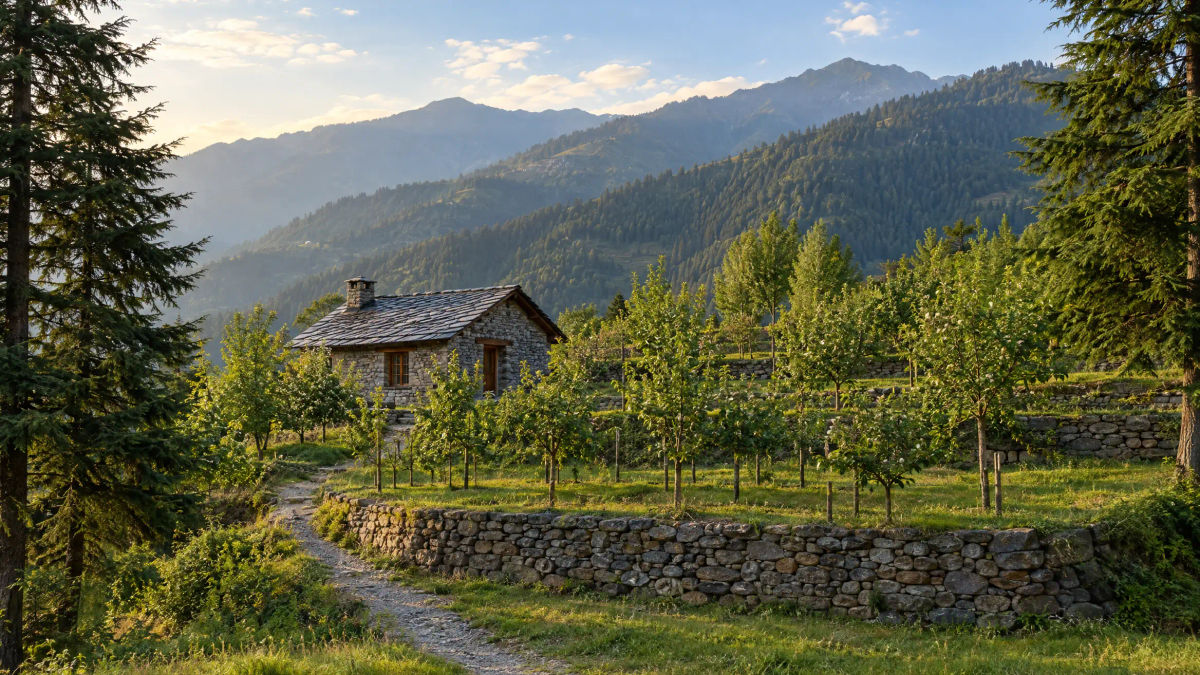
Terraced, well-drained loamy soils at 1500–2700 m. India's largest apple-growing tract by value. Data: Soil Health Card portal.
- Apple
- Stone Fruit
🍵 Tea belt (Kangra)
Lower-altitude, high-organic soils around Palampur — a distinct GI-tagged tea economy separate from the apple belt.
- Kangra Tea
🌾 Lower-hill belt (Sirmaur, Solan)
Below the apple altitude band — maize, wheat and vegetable cultivation on terraced hillsides, less premium but more accessible.
- Maize
- Vegetables
🍎 Mandi price reference
Live wholesale prices for apple and other horticultural produce across HP's regulated markets are published daily on Agmarknet — check the Shimla or Kullu mandi. HPMC (Himachal Pradesh Horticultural Produce Marketing Corporation) also publishes apple procurement rates separately each season.
💧 Water & rainfall
Highly altitude-dependent — snowmelt and monsoon feed most orchards; assured irrigation is rare above 2000m (IMD normals). Ask directly about the parcel's water source and test it before relying on it for orchard establishment.
📐 Measurement units
Land in HP is measured predominantly in Bigha and Biswa, with local variation by district — always confirm the specific district's conversion factor before comparing prices.
At a glance
Shimla vs. the other major HP belts
| District | Price band* | Primary economy | Access |
|---|---|---|---|
| Shimla | ₹20–60L/bigha | Apple / tourism | Section 118 |
| Kullu | ₹25–70L/bigha | Apple / tourism | Section 118 |
| Kangra | ₹10–30L/bigha | Tea / agriculture | Section 118 |
*Same indicative-band caveat as the district price table above. All three districts carry identical Section 118 requirements — none has an open-access exception.
Farmland India view
Why investors look at Himachal Pradesh
Four structural reasons this desk still underwrites Himachal Pradesh despite the entry barrier.
Barrier-driven scarcity value
Section 118 restricts supply flowing to outside buyers, supporting long-run price stability once permission is secured.
Genuine, high-value horticulture income
Apple economics in Shimla/Kullu are among the most productive per-acre in the Himalayan belt.
Tourism income floor
Shimla and Kullu-Manali give resort/homestay land a rental-income thesis beyond appreciation.
Under-penetrated by organised platforms
The entry barrier that deters casual buyers also keeps out most organised competition — genuine early-mover space for a verification-first platform.
Section 118 status is not certified by Farmland India's review — confirm eligibility and permission status directly before any advance.
STRAIGHT TALK
Risks & challenges in Himachal Pradesh
Read these before shortlisting — HP's risks are dominated by the legal barrier itself, not market fundamentals.
Void-from-the-start purchases
A sale to a non-agriculturist without Section 118 permission is void — not voidable, void — from the moment of execution. Never treat possession or a registered-looking deed as proof of a valid purchase.
The 12% duty changes the math
Older cost projections assuming 6% Section 118 duty are now wrong by a factor of two. Rebuild any HP purchase budget against the current rate before proceeding.
6–12 month process risk
A Section 118 application can take up to a year. Do not commit to a timeline-sensitive plan (construction, resale) before permission is actually granted.
Fraudulent "nominee" arrangements
Buying through a local agriculturist as a nominee is a common, legally risky workaround that can leave the real buyer with no enforceable ownership claim.
Seasonal access and construction constraints
Winter snow closes many hill roads for weeks at a time, and construction seasons are correspondingly short. Factor this into any development timeline.
Landslide and terrain instability
Steep-slope Himalayan terrain carries genuine slope-stability risk. Assess drainage and slope angle before committing to any construction plan.
Who to contact
Local revenue & registration offices
Section 118 applications route through the Deputy Commissioner / District Collector office of the relevant district, with final approval from the State Government Revenue Department via emerginghimachal.hp.gov.in. Sale-deed registration is handled by the local Sub-Registrar through IGRS HP.
KEEP EXPLORING
Districts & guides in Himachal Pradesh
Districts
COMMON QUESTIONS
Frequently asked questions
Everything buyers, NRIs and investors ask before their first reviewed farmland purchase in Himachal Pradesh.
Visit full wiki01 of 07
Can I buy agricultural land in Himachal Pradesh as an outsider?
Only with prior State Government permission under Section 118 of the HP Tenancy and Land Reforms Act, 1972. Without it, a non-agriculturist cannot legally purchase agricultural or horticultural land anywhere in the state.
02 of 07
How much does Section 118 permission cost now?
Stamp duty on Section 118 transfers was doubled from 6% to 12% in March 2025, applying uniformly regardless of buyer gender or transaction value.
03 of 07
How long does Section 118 permission take?
Typically 6 to 12 months, processed through the state government's emerginghimachal.hp.gov.in portal.
04 of 07
What happens if I buy without Section 118 permission?
The sale is void from the start, confirmed by the Supreme Court in 2023. Possession or a signed deed does not create a valid purchase.
05 of 07
Can NRIs get around Section 118 for a farmhouse?
No. FEMA independently bars NRIs and OCIs from agricultural, plantation or farmhouse land anywhere in India, regardless of any state-level permission.
06 of 07
हिमाचल में जमीन खरीदने के लिए धारा 118 क्यों जरूरी है?
गैर-किसान व्यक्ति बिना राज्य सरकार की अनुमति के हिमाचल में कृषि या बागवानी भूमि खरीद नहीं सकता। मार्च 2025 से इस पर स्टाम्प ड्यूटी 6% से बढ़ाकर 12% कर दी गई है।
07 of 07
शिमला-कुल्लू में जमीन का रिकॉर्ड कैसे देखें?
Himbhoomi पोर्टल पर खसरा नंबर और जमाबंदी ऑनलाइन देखी जा सकती है। खरीदने से पहले धारा 118 की अनुमति की स्थिति खुद जांच लें — बिना अनुमति के सौदा शुरू से ही अमान्य होता है।
Ready to look at what is available?
Browse reviewed listingsTransparency
Sources for this page
- Himachal Pradesh Tenancy & Land Reforms Act, 1972, Section 118 — India Code; Ajay Dabra v. Pyare Ram (2023) Supreme Court
- Section 118 stamp duty revision (6% → 12%, effective March 2025) — Indian Stamp (HP Amendment) Bill 2025, HP Revenue Department
- Stamp duty & registration — Indian Stamp Act 1899 (HP schedule), IGRS HP
- Soil data — Soil Health Card portal; Rainfall — India Meteorological Department (IMD)
- Apple/horticulture prices — Agmarknet; HPMC seasonal procurement rates
- Administrative data — Census of India 2011
Data-currency note: Census figures reflect 2011, the most recent full Census. Section 118 fees and processing times change — always verify directly with the District Collector's office. Report inaccuracies to wiki@farmlandindia.com.
For developers
Ready to explore Himachal Pradesh farmland?
Browse reviewed projects and individual land parcels across Himachal Pradesh — or if you own land here, list it with platform review and reach serious buyers.