
District guide
Buying Land in Sri Sathya Sai District
Dry Rayalaseema district on the Karnataka border around Puttaparthi: rules, belts, water checks and risks for land buyers in Sri Sathya Sai.
3
Revenue divisions (district website)
29
Mandals (district website)
1 Feb 2022
Notified (district website)
Puttaparthi
Airport (district website)
District land record — Sri Sathya Sai
Rev. 2026 · Farmland India desk
State
Andhra Pradesh
Formation
Notified under Gazette notification No. 154 dated 1 February 2022, with headquarters at Puttaparthi, out of the former Ananthapuramu district.DSS[5]
Area and people
The district profile gives no area or population figure, so we quote none.DSS[5]
Key markets
Puttaparthi · Hindupur · Penukonda · Kadiri · Dharmavaram · Madakasira
Administration
Three revenue divisions and 29 mandals: Kadiri (8), Penukonda (13) and Puttaparthy (8).DSS[5]
Demand anchors
The Puttaparthi pilgrim economy and its airport · the Karnataka border and the Bengaluru side · dry-land and horticulture farming
Land records
Meebhoomi (adangal and 1-B) and Resurvey 2.0 land-parcel numbers; deeds at the sub-registrar office
Groundwater
Only the state figure is sourced: 29.83% stage of extraction in 2024.[3]
Pricing
No official price series is published. Market values were revised statewide from 1 February 2025.N1[6]
Land law is state law. These rules are maintained on the Andhra Pradesh page and apply to every district within it.
Sri Sathya Sai — land purchase legal rules
Andhra Pradesh lets any Indian resident buy farmland, but four separate laws decide whether a given plot can be sold at all: the 1973 ceiling Act, the 1977 Assigned Lands Act, the Scheduled Areas regulation and the 22-A prohibited list at the registration office. The state also repealed its farmland conversion law in 2025. This block applies to every district page in the state.
Who can buy: Andhra Pradesh has no farmer-only rule. The state’s land laws do not limit the purchase of agricultural land to agriculturists, so an Indian resident who does not farm can buy and register farmland. The limits run through the size of the buyer’s holding, the type of land and where it lies.
Ceiling on holdings: Under the AP Land Reforms (Ceiling on Agricultural Holdings) Act, 1973, a family unit of up to five (a person, spouse and minor children) may hold one standard holding, with a fifth more for each additional member up to two. A standard holding is 10 to 18 acres of double-crop wet land, 15 to 27 acres of other wet land, or 35 to 54 acres of dry land, depending on class. A purchase that takes a family above the ceiling must be declared within 60 days, and transfers by a holder who already exceeds it are void until the surplus is settled.
Assigned land: Government land granted to landless families, usually on a D-Form patta, is governed by the AP Assigned Lands (Prohibition of Transfers) Act, 1977. A transfer in breach is void, registering officers must refuse it, the Collector can resume the land, and the buyer faces up to six months in jail. A 2023 amendment let assignees sell agricultural assigned land 20 years after assignment, but registrations of this “freehold” land were frozen in 2024 for review. In September 2026 the government cleared about 9 lakh acres for registration and kept about 4 lakh acres under inquiry (Deccan Chronicle, 10 September 2026). Treat any plot that began as assigned land as unsafe until the sub-registrar confirms it is cleared.
The 22-A prohibited list: Section 22-A of the Registration Act, added by the state in 2007, lets the government list survey numbers that sub-registrars may not register: assigned land, government land, endowment and Wakf land, ceiling-surplus land and other notified land. About 28 lakh acres put on the list in 2022 have since been taken off, and new orders (GO 444 and GO 445) set the procedure for removals and additions. Ask for a written 22-A check on the exact survey number.
Scheduled Areas: In the Agency tracts of the Eastern Ghats, the AP Scheduled Areas Land Transfer Regulation, 1959 makes any transfer void unless it is to a member of a Scheduled Tribe or a tribal society, and presumes that land held by a non-tribal came from a tribal owner. Most of Alluri Sitharama Raju and Parvathipuram Manyam districts and hill mandals of Srikakulam, Vizianagaram, Anakapalli, the Godavari districts and the new Polavaram district are Agency areas. A non-tribal cannot validly buy land there, whatever the seller says.
Conversion after NALA: The AP Agricultural Land (Conversion for Non-Agricultural Purposes) Act, 2006, the NALA Act, was repealed by Act 20 of 2025, deemed in force from 3 September 2025. Tax already assessed is still payable and pending cases are decided under the old law, but there is no longer a separate conversion fee. Repeal does not mean freedom to build: zoning and layout approval still come from the development authority or the panchayat.
Registration and records: Deeds are registered at the sub-registrar office through the Registration and Stamps Department, which sends registered sales to the Tahsildar for mutation. Check the Adangal and ROR 1-B on Meebhoomi, then confirm that the name, extent and survey number match the deed; our stamp duty guide covers the charges.
NRI and OCI buyers: Under the RBI Master Direction on immovable property, NRIs and OCIs may not acquire agricultural land, a farmhouse or plantation property in India except by inheritance. Our NRI guide covers the options.
- No farmer-only rule
- Ceiling: 1973 Act
- Assigned land barred
- 22-A prohibited list
- Agency areas: tribal only
- NALA repealed 2025
- Meebhoomi records
- NRIs: inheritance only
Sri Sathya Sai — district-specific notes
Sri Sathya Sai is a dry Rayalaseema district on the Karnataka border, centred on the pilgrim town of Puttaparthi. The state block rules apply, and water access and assigned-land history are the checks that matter most on dry land.
No farmer-only rule applies, so an Indian resident who does not farm can buy and register land in Sri Sathya Sai. Before you pay an advance, have the survey number checked against the Section 22-A prohibited list at the sub-registrar office and ask for the assignment history.L2[1]
This is not a Scheduled (Agency) district; the Agency tracts lie in the hill districts of the north-east. Ask the Tahsildar to confirm in writing that the village you are looking at is outside any Scheduled Area.
Land use is controlled by the development authority or the panchayat, not by a conversion permit. The 2006 conversion Act was repealed in 2025, but that does not approve a layout; check approvals separately.L4[2]
The Andhra Pradesh state page carries the full legal block, and the NRI land guide explains the FEMA position. Confirm each point with the Tahsildar and the sub-registrar before paying anything.
- No farmer-only rule
- Ceiling: 1973 Act
- Assigned land bar
- 22-A prohibited list
- NRIs: inheritance only
District overview
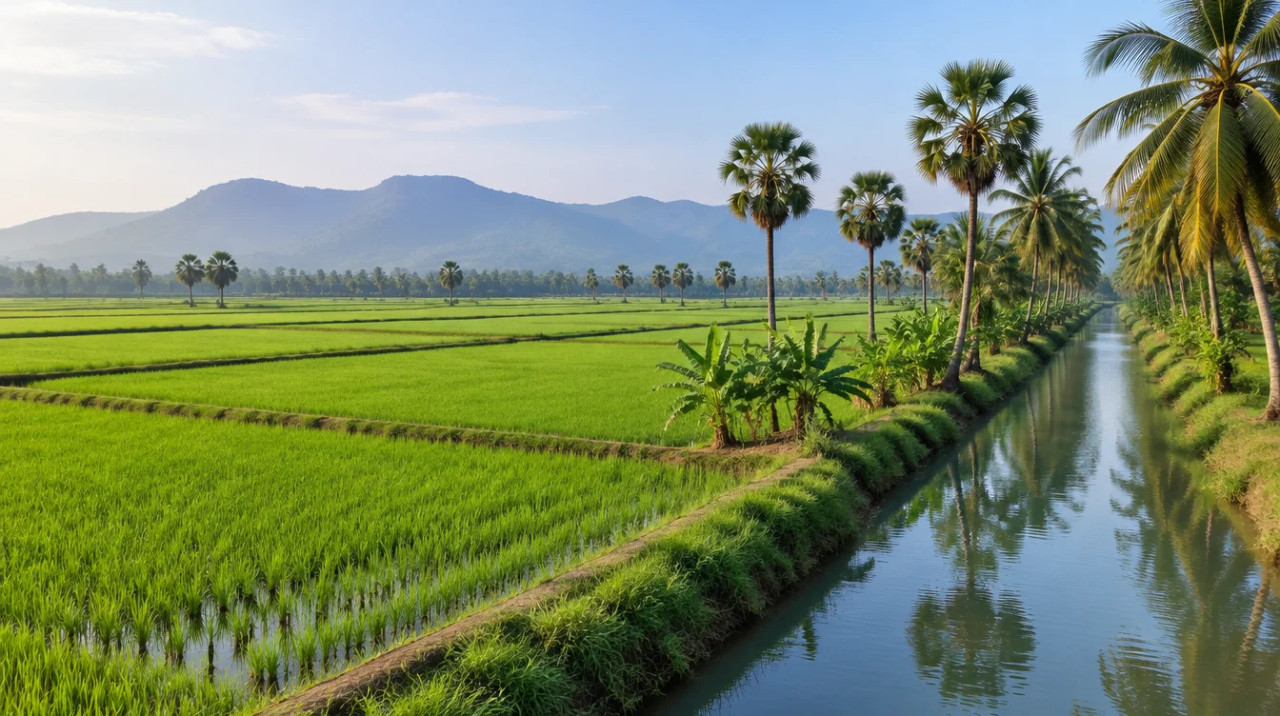
Sri Sathya Sai — a dry Rayalaseema district on the Karnataka border around Puttaparthi
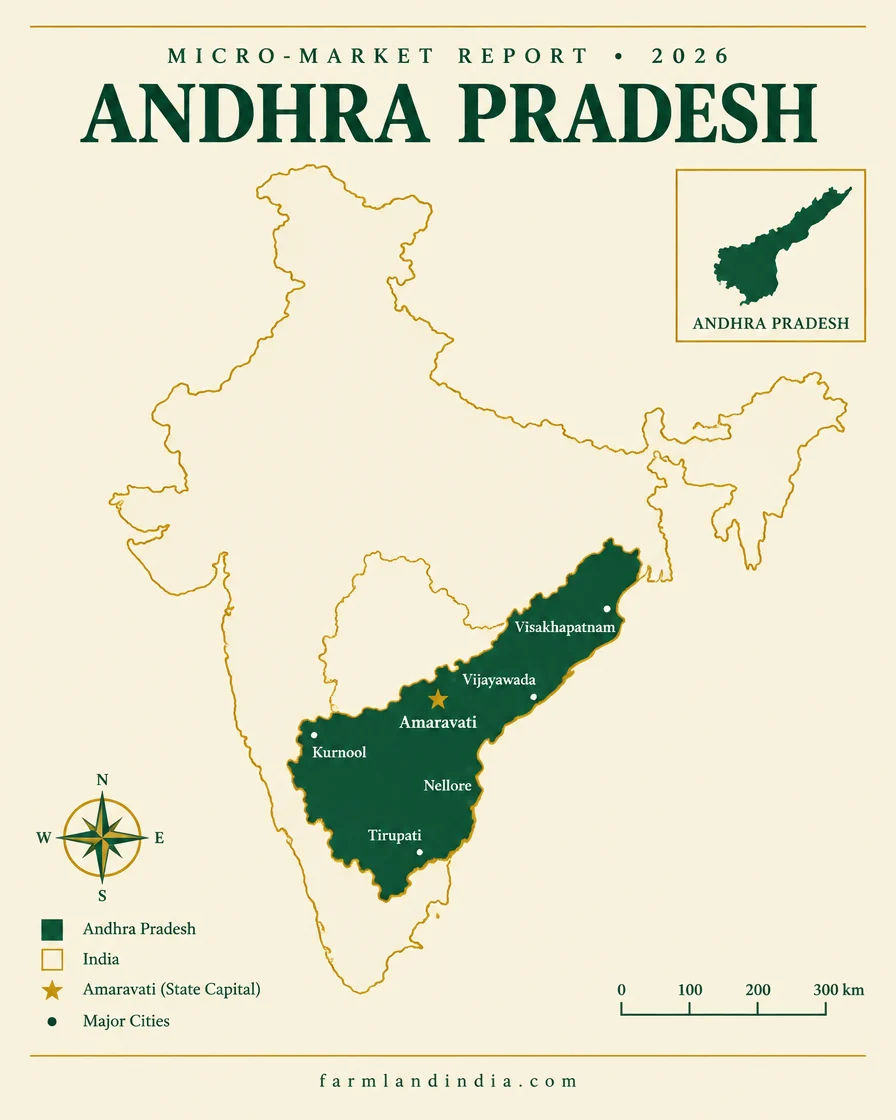
Sri Sathya Sai district was formed under Gazette notification No. 154 dated 1 February 2022, with its headquarters at Puttaparthi, the town where Sri Sathya Sai Baba was born.DSS[5] It has three revenue divisions and 29 mandals: Kadiri with 8, Penukonda with 13 and Puttaparthi with 8, the last made up of 4 mandals from Dharmavaram and 4 from Kadiri.DSS It was split from the former Ananthapuramu district, which had 5 divisions and 63 mandals.DSS
The district is bounded by Ananthapuramu to the north, YSR Kadapa and Chittoor to the east, and Karnataka to the west and south-west.DSS[5] That Karnataka frontier shapes its land market: the southern and western mandals, such as Hindupur and Madakasira, are close to the Bengaluru side and draw demand from there.
The land is dry. The profile describes the northern mandals of Dharmavaram, Bathalapalli, Tadimarri and Mudigubba as arid and treeless with poor red soils, and the higher land around Penukonda, Hindupur and Madakasira as sandy red soil of normal productivity.DSS[5] The Chitravathi river flows past Gollapalli, the original site of Puttaparthi.DSS The profile gives no rainfall or irrigation figures, but this is Rayalaseema, where the monsoon is weak and farming depends on borewells and tanks.
The pilgrim economy is the anchor in the town itself: Prasanthi Nilayam, built in 1950, is a major devotee site, and Puttaparthi has an airport.DSS[5] Buyers are mainly local farming families, Bengaluru buyers looking at border land, and Puttaparthi service and hospitality owners. NRIs and OCIs cannot buy agricultural land under FEMA but can inherit it and can buy residential and commercial land.
This page sets out the legal checks for a purchase, the belts to look at, the infrastructure that is moving land and how firm each project is, and the risks. No official farmland price series is published for Sri Sathya Sai. Ask the sub-registrar for recent registered sale values in the village you are looking at Use the government market value for the survey number and recent registered deeds nearby. NRIs and OCIs cannot buy agricultural land under FEMA but can inherit it; see the NRI guide.
Read the state page for the rules that apply across Andhra Pradesh, and the Meebhoomi guide to check an adangal or 1-B yourself.
- Puttaparthi
- Hindupur
- Penukonda
- Kadiri
- Dharmavaram
Transaction costs
Stamp duty & registration in Sri Sathya Sai
7.5%
Total on a sale deed
5% stamp duty, 1.5% transfer duty and 1% registration fee on the higher of price and market value.G2[4]
1 Feb 2025
Market value reset
Village and ward values were revised statewide from this date.N1[6]
Repealed
Farmland conversion Act
The 2006 conversion Act was repealed with effect from 3 September 2025.L4[2]
Andhra Pradesh charges 7.5% on a sale deed: 5% stamp duty, 1.5% transfer duty and a 1% registration fee, on the deed price or the government’s market value, whichever is higher.G2[4] The state revised village and ward market values from 1 February 2025.N1[6] Values near Puttaparthi and along the Karnataka-border highways can differ sharply from those in the dry interior, so ask for the value by survey number. See the Andhra Pradesh stamp duty guide and check the exact value for your survey number at the sub-registrar.
Know the belt
What is moving prices in Sri Sathya Sai
Belts where land demand differs
Puttaparthi and the Chitravathi side
District headquarters and the pilgrim town
Puttaparthi is the headquarters and the pilgrim centre, with an airport.DSS[5] Land near the town is mostly plotted or in layouts for housing and services.
Check: Ask for the layout approval, the master-plan zone and two recent registered deeds in the same village.
Hindupur and Madakasira
South and south-west, near Karnataka
These higher-ground mandals have sandy red soils of normal productivity and are the closest to the Bengaluru side.DSS[5] Border demand is the main outside influence.
Check: Ask whether the parcel is assigned land and for the adangal over several seasons.
Penukonda and Kadiri
The two other revenue division centres
Penukonda is the largest division with 13 mandals and Kadiri has 8.DSS[5] Both are older market towns with dry-land farming around them.
Check: Ask for the water source and the mutation history.
Dharmavaram and the northern arid mandals
North, arid and poor red soils
The profile calls the northern mandals of Dharmavaram, Bathalapalli, Tadimarri and Mudigubba arid and treeless with poor red soils.DSS[5] Farm yields are low and water is the deciding factor.
Check: Ask for a borewell record and past yield, not only the survey extract.
Asking prices
Treat any per-acre figure you hear as a rumour until it matches registered deeds nearby.
Connectivity
How Sri Sathya Sai connects — road, rail and air
Road, rail and air access to Sri Sathya Sai
🚗 By road
✈️ By air
🚆 By rail
Distances to the Bengaluru side are an advantage for border mandals. Check the actual drive from the survey number.
Growth catalysts
Upcoming infrastructure & developments
Works in Sri Sathya Sai
02Open
00Catalysts
Agriculture & terrain
Soil, crops & water in Sri Sathya Sai
Dry red-soil farming; figures for rainfall and crops not available
Soils
Northern mandals have arid, treeless terrain with poor red soils, while the higher land around Penukonda, Hindupur and Madakasira has sandy red soils of normal productivity.DSS[5]
- Groundnut on red soils
- Millets and pulses
- Horticulture and mulberry in the south
- Borewell-irrigated vegetables
- Fodder and sheep rearing
River
The Chitravathi flows past Gollapalli, the original site of Puttaparthi.DSS[5]
Rainfall and water
The district profile gives no rainfall or irrigation figures. Rayalaseema farming depends heavily on borewells and tanks, so check the water source and the groundwater category.
Crops
The profile does not list crops; the entries above are typical dry-land crops and should be checked against the adangal.
At a glance
Sri Sathya Sai vs. nearby districts
| District | Land and water | What links it to Sri Sathya Sai |
|---|---|---|
| Ananthapuramu | North, parent district | Larger town market around Anantapur |
| YSR Kadapa | East | Dry Rayalaseema land |
| Chittoor | South-east | Closer to Bengaluru and Tirupati |
| Karnataka | West and south-west | State border; Karnataka’s land rules differ from Andhra Pradesh’s |
These districts do not share price levels. Compare registered deeds village by village.
Farmland India view
Why investors look at Sri Sathya Sai
Five reasoned points for Sri Sathya Sai.
Water first, then location
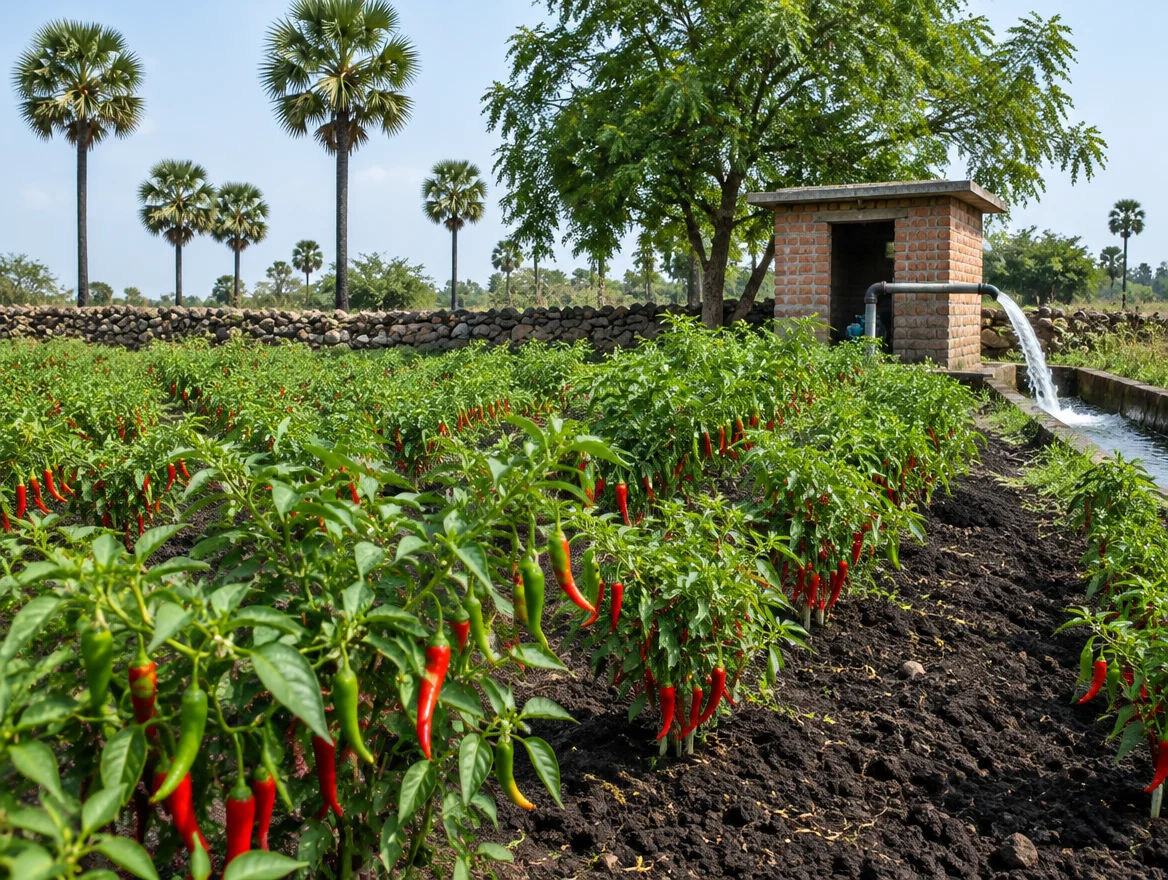
On dry red soils a parcel with a dependable borewell or tank is worth far more than one without. Test the water before the title.
The Karnataka border matters
Hindupur and Madakasira are nearest the Bengaluru side, and outside demand comes from there. No official price series is published.[5]
Pilgrim demand is local
Puttaparthi’s economy supports housing and services in the town but does not lift farm values across the district.DSS[5]
Test any assigned-land claim
The 2023 amendment makes assigned land freehold after 20 years, but registration of such land has been under review since 2024. Ask for the assignment history of any parcel the seller calls freehold.N2[7]
Plan for a long hold
Infrastructure announcements move slowly and nothing guarantees a return. No official price series is published.
Confirm the title chain, the 1-B and adangal entries, the 22-A status and any assignment history with the Tahsildar and sub-registrar; these are not certified by Farmland India’s review.
STRAIGHT TALK
Risks & challenges in Sri Sathya Sai
District-specific risks. Read the Andhra Pradesh state page for the general risks on assigned land, ceiling and records.
Section 22-A prohibited list
Registration offices refuse to register land that sits on the state’s prohibited list, which covers assigned, government, endowment, Wakf and ceiling-surplus survey numbers. Ask for the survey number to be checked against the list before you pay an advance.
Assigned land sold as freehold
Land assigned to the landless could not be sold at all under the 1977 Act. The 2023 amendment ends the bar after 20 years, but registration of such land has been under review since 2024. Ask for the assignment history, not just the seller’s word that it is freehold.
Ceiling and excess holdings
A purchase that takes your family’s total above the ceiling must be declared within 60 days, and transfers by excess holders are void. Ask the seller for a ceiling declaration and check your own holding.
Survey and title mismatches
Resurvey is renumbering parcels with new land-parcel numbers, so old survey numbers, Meebhoomi entries and the registered deed can disagree. Match the 1-B, the adangal and the deed before you sign.
Layouts after the conversion repeal
With the 2006 conversion Act repealed in 2025, unauthorised layouts can be treated as converted on payment of tax. That does not make a layout approved. Check the development authority or panchayat approval separately.
Drought and dry borewells
Dry years and falling water tables are the biggest farming risk. Ask neighbours how deep the borewells go and how reliable they are.
Assigned land on dry plots
Dry areas have a lot of assigned land. Check the assignment history and the 22-A status of every survey number.
Who to contact
Local revenue & planning offices
Collectorate: Puttaparthi, with revenue divisions at Kadiri, Penukonda and Puttaparthi.DSS[5] Register deeds at the sub-registrar office for the village, and use Meebhoomi for the adangal and 1-B. Ask the Collectorate.
COMMON QUESTIONS
Frequently asked questions
Everything buyers, NRIs and investors ask before their first reviewed farmland purchase in Sri Sathya Sai.
Visit full wiki01 of 04
Can a non-farmer buy land in Sri Sathya Sai?
Yes. Andhra Pradesh has no farmer-only rule, so an Indian resident can buy and register land. The checks that matter are the Section 22-A list, assigned-land history and the status of the village.
02 of 04
Is land near Puttaparthi a good buy?
Demand is local, built on the pilgrim town and its services. Check layout approvals and registered deeds before paying.
03 of 04
Why does water matter so much in Sri Sathya Sai?
The northern mandals have arid, poor red soils and the district profile gives no irrigation figures. A dependable borewell or tank decides a farm’s value.
04 of 04
Can an NRI buy land in Sri Sathya Sai?
An NRI or OCI cannot buy agricultural land under FEMA but can inherit it and can buy residential and commercial land.
Transparency
Sources and references
Law and courts
- [1][1]Andhra Pradesh Assigned Lands (Prohibition of Transfers) Act, 1977 (India Code)— indiacode.nic.in — indiacode.nic.in
- [2][2]Andhra Pradesh Act 20 of 2025 repealing the farmland conversion Act (PRS India)— prsindia.org — prsindia.org
Government
- [3][3]CGWB: Dynamic Ground Water Resources of Andhra Pradesh, 2024— cgwb.gov.in — cgwb.gov.in
- [4][4]CAG: Compliance Audit Report, Andhra Pradesh, Chapter IV, Registration and Stamps— saiindia.gov.in — saiindia.gov.in
- [5][5]Sri Satya Sai District (Andhra Pradesh): district profile— srisathyasai.ap.gov.in — srisathyasai.ap.gov.in
News
- [6][6]Deccan Herald (PTI): revised land values take effect in Andhra Pradesh, 1 Feb 2025— deccanherald.com — deccanherald.com
- [7][7]Deccan Chronicle: AP clears registration of 9 lakh acres of freehold lands, 10 Sep 2026— deccanchronicle.com — deccanchronicle.com
Data-currency note: Sources reviewed in November 2026. Fees, rules and infrastructure timelines change often; check the linked source and the relevant office before relying on any figure.
For developers
Ready to explore Sri Sathya Sai farmland?
Browse reviewed projects and individual land parcels across Sri Sathya Sai — or if you own land here, list it with platform review and reach serious buyers.