

Owner listed
The Socorro
North Goa, Goa
₹4504.00 AcreView

State guide
A coastal state of three districts where Portuguese-era codes, village comunidades and zoning cases decide what land can be bought, converted and built on.
3 (from Dec 2025)
Districts
~3,702 sq km
Area
1.46 million
Population (Census 2011)
3% to 6% (reported)
Stamp duty slabs
State land record — Goa
Rev. 2026 · Farmland India desk
Status
State · three districts since 31 Dec 2025 (Government of Goa, Kushavati)
Districts
3: North Goa, South Goa and Kushavati (The Goan, January 2026)
Area
About 3,702 sq km (Directorate of Information and Publicity, Goa)
Population (Census 2011)
1,458,545 (Directorate of Information and Publicity, Goa)
Land administration
Mamlatdar (land records, tenancy) · Collector (conversion) · Sub-Registrar (deeds) · Administrator of Comunidades (village common land)
Stamp duty (sale deed)
3% to 6% by value slab, as reported by The Goan, July 2026; notification text not seen
Land rates
Taluka base rates raised in Sept and Oct 2024, as reported by The Goan, November 2024
⚠ Goa’s land rules are layered, and they are being rewritten in the Assembly and the courts as this page is written. Paddy land, tenanted land, comunidade land and coastal land each follow a different rule set, and a zoning certificate can change the picture. Read the rules before the price.
Which office decides what: The Mamlatdar decides whether a parcel counts as agricultural land under the 2023 Act (section 3(4), India Code) and hears tenancy matters under the 1964 Act (India Code). The same office issues the public notices of mutation on the Directorate of Settlement and Land Records site. Conversion of land use under section 32 of the Goa, Daman and Diu Land Revenue Code, 1968, and any permission to sell paddy land to a non-agriculturist, go to the Collector. Sale deeds are registered at the Sub-Registrar office of the taluka (Goa registration department). Zoning sits with the Town and Country Planning Department, and comunidade land with the Administrator of Comunidades under the Code of Comunidades.
The Portuguese Civil Code and spouses: The 1867 Code is still in force in Goa, but only in part. On 13 September 2019 the Supreme Court held that it applies because the Goa, Daman and Diu (Administration) Act, 1962 kept earlier laws alive until a competent legislature changed them, and that it governs succession for people domiciled in Goa to their land and other assets across India (Supreme Court, September 2019; see also Bar and Bench, September 2019). Parts were later replaced by the Goa Succession, Special Notaries and Inventory Proceedings Act, 2012, in effect from 22 December 2016. For a land buyer the working point is the marital regime: the judgment describes spouses as joint owners of the couple’s assets and records a rule against disposing of them without the other spouse’s consent, on pain of nullity. Whether a particular seller falls under that regime depends on the marriage and any ante-nuptial agreement, so ask for the marriage details and have both spouses sign where the seller is married.
Paddy land and the 2023 Act: The Goa Restriction on Transfer of Agricultural Land Act, 2023 (Goa Act 18 of 2023) defines agriculture as the cultivation of paddy and agricultural land as land currently used for it, leaving out land earmarked for non-agricultural use in a plan under the Town and Country Planning Act (section 2, India Code). Under section 3 an owner or occupant may not sell, gift, exchange or lease such land to anyone but an agriculturist who cultivates it personally. The Collector can allow exceptions, for example for a non-agriculturist who means to farm it, who then has three years to start or the land vests in the Government. A transfer in breach is void (section 3(3)), seller and buyer each face a fine equal to the land’s market value (section 5), and after notice the Collector can forfeit the land without compensation (section 6). The Goan reported the Act as notified in April 2023 (The Goan, April 2023). Because the definition covers paddy only, orchard, cashew and fallow land fall outside this Act, as HSA Advocates point out (HSA Advocates, May 2023), though they remain subject to the conversion, tenancy and zoning rules below.
Conversion under section 32: Moving land from agricultural to non-agricultural use needs the Collector’s permission under section 32 of the Land Revenue Code, which also requires the Collector to acknowledge an application within seven days (India Code). The decision period was 60 days. An ordinance of 2 December 2025 cut it to 45 days (Ordinance 5 of 2025), and the Assembly passed the bill on 15 January 2026 with effect from that date over Opposition objections to the retrospective clause (Bill 8 of 2026; The Goan, January 2026). A separate amendment, Goa Act 20 of 2024, requires an application to carry a certificate from the Director of Agriculture that the land is not agricultural land under the 2023 Act (Government of Goa gazette text). The Goa Investment Promotion Board’s own page lists the documents asked for, including Form I and XIV mutated in the applicant’s favour, and stage timings that add up to 68 days against a stated 60 (Goa-IPB). We found no source for a 3 to 6 month approval wait, so none is quoted here, and we have not seen the notification that brings the Director of Agriculture certificate into force, or the assented 2026 Act, so ask the Collector’s office about both.
Tenants, mundkars and tenanted land: Under the Goa, Daman and Diu Agricultural Tenancy Act, 1964 a tenant is deemed to have bought the land held on the “tillers’ day” (section 18A), and land bought that way cannot be sold, mortgaged or leased without the Mamlatdar’s prior sanction (section 18K). A landlord selling tenanted land must first offer it to the tenant in writing, who has 90 days to reply, and a sale made without that notice or below the notified price is void (section 13A) (India Code). The Goa Land Use (Regulation) Act, 1991 bars use of land vested in a tenant for anything but agriculture despite the planning and revenue codes (India Code); Goa Act 10 of 2024 added exemptions for public acquisition and for use by local authorities and educational institutions (Government of Goa gazette text). The copy of the 1964 Act we read is a scanned text and may not show every later amendment.
Zoning, sections 17(2) and 39A: Section 17(2) of the Goa Town and Country Planning Act, 1974, inserted in 2023, let the Government correct what it called inconsistent zoning in the Regional Plan. On 13 March 2025 the Bombay High Court at Goa struck down the 2023 rules made under it, read the section down and barred fresh approvals (LiveLaw). The Supreme Court refused a stay in July 2025 but ordered status quo, as the petitioners described it (The Goan, July 2025). Section 39A allows zone changes on individual applications after board approval and public notice; a challenge to it is pending in the High Court (The Goan, September 2025; The Goan, July 2026). Former High Court Chief Justice Ferdino Rebello said in February 2026 that 342 parcels had been converted under section 17(2) up to 31 December 2025 and 199 proposed under 39A, covering 1,726,902 sq m; these are his figures as quoted (The Goan, February 2026). Buy only against a current zoning certificate, and ask whether the zone was changed under either section.
Comunidade and Government land: Comunidade land is village common land governed by the Code of Comunidades (Legislative Diploma 2070 of 15 April 1961). Its sale or exchange is decided by the comunidade and has no force without Government approval, and land granted for one purpose may not be used for another (articles 30, 31, 31-A and 36, India Code). Building on Government, local-authority or comunidade land without written permission is an offence under section 4 of the Goa Land (Prohibition on Construction) Act, 1995, punishable by up to three years in prison and a fine of up to ₹50,000 (India Code). In 2025 Goa Act 16 inserted article 372-B to let people regularise houses built on comunidade land before 28 February 2014, with a cap of 300 sq m in the Cabinet-approved bill (The Goan, August 2025); petitions against it were reported in the High Court in May 2026, with no interim order mentioned (The Goan, May 2026). Treat an offer of comunidade land as a title defect unless the Government approval is in the papers.
Forged records and the land-grab inquiry: A one-man commission under retired Justice V K Jadhav found organised grabbing of Government, institutional and private land, officials colluding with fraudsters and Portuguese-language documents forged; the report was tabled in the Assembly in February 2025 (The Goan, February 2025). Two sessions courts, in Panaji and Margao, were designated for land-grab cases by a notification dated 24 February 2025 (The Goan, July 2025). The Crime Branch’s Special Investigation Team had filed its 13th chargesheet by September 2025 (The Goan, September 2025), and the Herald reported the Enforcement Directorate’s attachment of 19 assets from two comunidades, valued by the agency at about ₹1,268.64 crore, on 27 November 2025 (Herald Goa, November 2025). A further-investigation order in an Anjuna forgery case was reported in April 2026 (The Goan, April 2026). Trace the chain of registered deeds and the Form I and XIV mutation history, and ask the Sub-Registrar for a nil encumbrance certificate (₹100 plus ₹20 for each year searched, Goa registration department).
Coastal zone, and the 500 m figure: The 500 m often quoted is the landward limit of the regulated coastal zone from the high-tide line, not the no-development distance (The Goan, November 2023). The 2019 notification (G.S.R. 37(E), 18 January 2019) sets the no-development zone at 50 m in densely populated rural areas and 200 m elsewhere, and along tidal-influenced water bodies at 50 m or the width of the creek, whichever is less; until a state’s plan is approved, 200 m and 100 m apply (CRZ 2019 text; LiveLaw, January 2019). Goa has not finished its plan, so the 2011 notification still governs (The Goan, February 2025). The draft reached the State in January 2026, and public consultation is not expected before the next Assembly elections (The Goan, June 2026). Read the CRZ clearance and the plan map for the parcel itself.
NRI and OCI buyers: The Reserve Bank’s Master Direction under FEMA 1999 excludes agricultural land, plantation land and a farmhouse from what NRIs and OCIs may buy or receive as a gift, in Goa as elsewhere (RBI Master Direction FED 12/2015-16, updated to September 2022). Other land, such as a residential or commercial plot, is not excluded. At registration the Sub-Registrar’s checklist asks for certified OCI or PIO card copies, and for a FEMA committee order where a foreign national without such a card executes a deed (Goa registration department). Take legal advice before using a nominee, since the benami-law position was not checked for this page.
State overview
Goa covers about 3,702 sq km, with a coastline of around 105 km, and had 1,458,545 residents at the 2011 Census (Directorate of Information and Publicity, Goa). Its land law is unlike the rest of the North India corridor. Portuguese-era codes still apply in part, village common land is held by comunidades, and zoning is argued in court as often as in the planning office. Official rate notifications are in square metres.
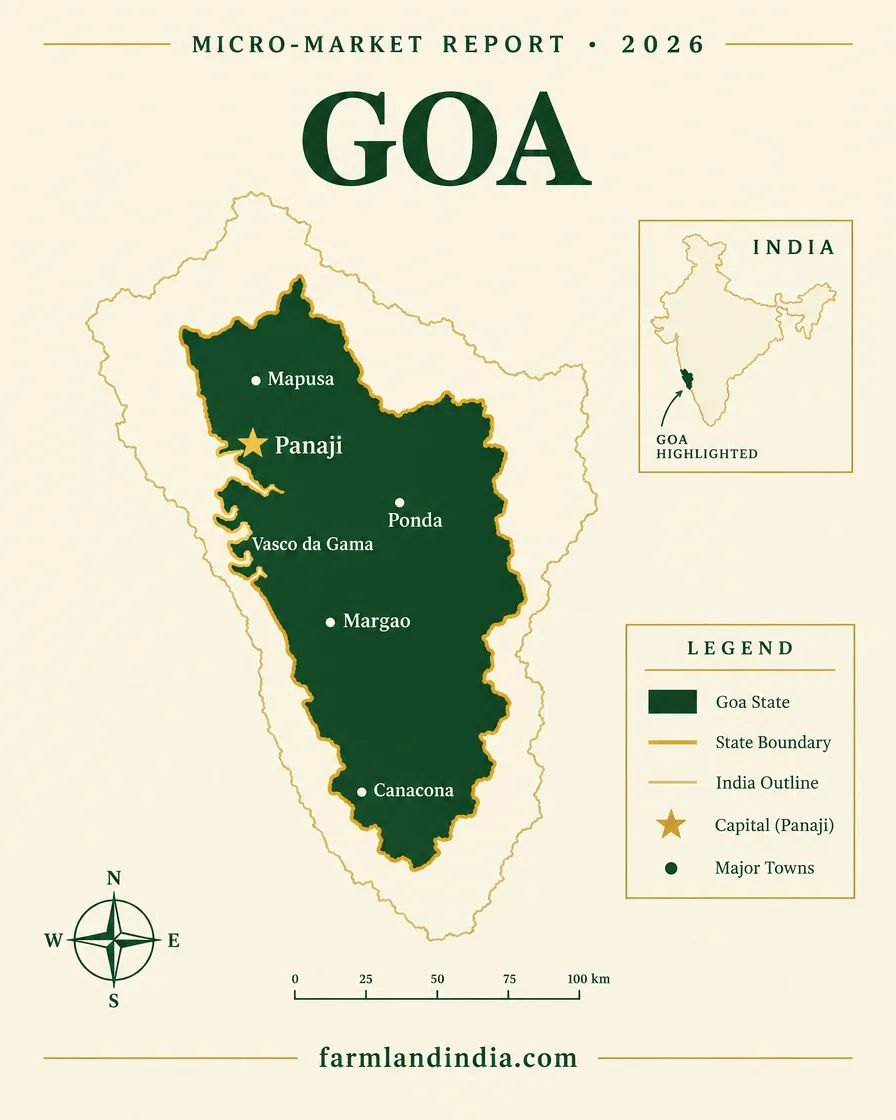
On 31 December 2025 the Government notified a third district, Kushavati, carved out of South Goa, with the talukas of Dharbandora, Sanguem, Quepem and Canacona (Government of Goa). North Goa keeps Pernem, Bardez, Bicholim, Sattari and Tiswadi, and South Goa keeps Ponda, Salcete and Mormugao (The Goan, January 2026). The older description of two districts is out of date, although by June 2026 the new district was still run from the South Goa Collectorate (The Goan, June 2026).
For a buyer the useful split is by rule set and not by district. Settlement-zone plots near the coast trade against taluka base rates and a zoning certificate. Paddy fields and tenanted land sit under the 2023 and 1964 Acts. Comunidade land is a regime of its own, and the coast adds the CRZ layer. This page is a rulebook and a signpost, not a listing of farmland for sale.
Districts at a glance:
North Goa: Pernem, Bardez, Bicholim, Sattari and Tiswadi; headquarters Panaji, with the Mopa airport in the north of the state
South Goa: Ponda, Salcete and Mormugao; headquarters Margao
Kushavati: Quepem, Sanguem, Dharbandora and Canacona; headquarters Quepem
Sources: Directorate of Information and Publicity, Goa; Government of Goa, Kushavati; The Goan, January 2026; The Goan, June 2026
Price evidence
No dated asking-price series was sourced for Goa land. The rows below are taluka land rates as reported by The Goan: a valuation floor for duty, not a market price. Asking prices belong on listing pages.
| Zone | Basis | Reference | Land type |
|---|---|---|---|
| Pernem and Bardez | Minimum land rate, revised Sept 2024, as reported | ₹8,000 per sq m (was ₹3,000) | Mainly commercial use; residential plots up to 500 sq m kept the old rate |
| Tiswadi | Base rate for 1,000 sq m settlement-zone plots, notified Oct 2024, as reported | ₹5,000 to ₹25,000 per sq m (was ₹600 to ₹6,000) | Settlement zones S1 to S4 |
| Salcete | Base rate, notified Oct 2024, as reported | ₹5,000 to ₹20,000 per sq m (was ₹480 to ₹10,906) | Settlement zones S1 to S4 |
| Mormugao | Base rate, notified Oct 2024, as reported | ₹8,000 to ₹25,000 per sq m (was ₹420 to ₹4,200) | Settlement zones S1 to S4 |
| Zone and size adjustments | Tiswadi, Salcete and Mormugao, as reported | Plots up to 500 sq m: 30% lower; larger plots 10% to 30% lower; commercial zones double; industrial zones 40% lower | Applies to the base rates above |
| Other talukas | No revised rate found | Not sourced | Bicholim, Sattari, Ponda and the four Kushavati talukas |
Sources: The Goan, September 2024 (Pernem and Bardez) and The Goan, November 2024 (Tiswadi, Salcete and Mormugao). The Revenue Department’s own write-up for the 2024-25 Economic Survey lists revisions for five talukas by orders dated 13 September and 30 October 2024 (Government of Goa, Revenue Department); we did not find the gazette text of the orders, so the figures are as reported. The reports say the rates do not apply to purchases by mundkars and tenants from landlords, and we found no rate for agricultural or orchard land. One hectare is 10,000 sq m, so ₹8,000 per sq m equals ₹8 crore per hectare (our arithmetic); check the unit on every listing. Past movement is not a forecast.
Transaction costs
3% to 6%
Stamp duty slabs, reported
by value, from ₹50 lakh upwards the rate steps up; The Goan, July 2026
Market value
Duty base
Taluka rates are notified each year and low declared values can go to the Collector; Government of Goa order, April 2023
Separate
Registration fee
reported at 3% in April 2023; the Sub-Registrar page says only “as prescribed”; The Goan, April 2023
The Goan reported on 8 July 2026 that the Revenue Department had notified a slab-based duty on conveyance, replacing a 2017 order with immediate effect: 3% up to ₹50 lakh, 4% to ₹75 lakh, 4.5% to ₹1 crore, 5% to ₹5 crore and 6% above (The Goan, July 2026). Neither the earlier rates nor any change to registration fees appears in the report, and we did not find the notification text. Adjoining land conveyed between the same parties within a year of an earlier conveyance is counted with the earlier land when the duty is worked out. Earlier orders show the pattern of short concessional windows, such as the 1% rate for certain conveyances in 2023 and early 2024 (Government of Goa order, April 2023; January 2024). Confirm the slabs and the registration fee with the Sub-Registrar before budgeting (Goa registration department).
Connectivity
NH-66 runs along the coast and the Mopa airport has been inaugurated in the north. Journey times vary with season and road works.
An airport and a wider highway change how far a parcel is from a gateway. They do not decide whether it can be built on. The Tribune put phase 1 of Mopa at a stated capacity of 4.4 million passengers a year, expandable to 33 million (Tribune, December 2022); check the zone, conversion status and tenancy record of each parcel before paying for access.
Growth catalysts
Status labels reflect sources read in October 2026. Government-announced timelines are not guaranteed, and several items rest on a single press report.
01Rate revision
Reported July 2026
02Pending or contested
Agriculture & terrain
Goa’s farmland story is paddy fields, tidal creeks and orchard slopes squeezed between the Western Ghats and a heavily regulated coast.
Goa has about 105 km of coast on the Konkan, and the Terekhol, Chapora, Mandovi, Zuari, Sal and Talpona rivers run to the sea (Directorate of Information and Publicity, Goa). Land near the shore or a tidal river carries coastal-zone limits, and the plan that would fix them is unfinished (The Goan, June 2026).
The 2023 Act protects land under paddy, and tenancy law protects those who farm it (India Code). A Khazan Management Plan has been prepared as part of the coastal framework (The Goan, June 2026). We found no sourced acreage for paddy or orchard land.
The state profile places the Western Ghats on the eastern side, but it gives their height as nearly 1,200 m in one place and 1,022 m in another, so no spot height is quoted here (Directorate of Information and Publicity, Goa). Slopes and ridge land are zoned by the Town and Country Planning Department; the zone on the certificate decides what can be built.
We did not source a crop pattern for Goa. The 2023 Act defines agriculture as paddy cultivation, and the Director of Agriculture is the officer who certifies land for conversion under the 2024 amendment (Government of Goa gazette text). A parcel’s entry in Form I and XIV shows how it is recorded.
The state profile gives annual rainfall of about 2,500 mm, mostly June to September, though its own table says 300 cm (Directorate of Information and Publicity, Goa). The Central Ground Water Board’s 2024 assessment, published in March 2025, puts groundwater extraction at 22.91% with all 12 taluks Safe (CGWB, March 2025). A 2025 national compilation gives 23.3%, and the Jal Shakti ministry noted that hard-rock aquifers store little water (The Goan, February 2026).
Goa’s land-rate notifications are in square metres, and the state profile’s area is in sq km. One hectare is 10,000 sq m, so a base rate of ₹8,000 per sq m is ₹8 crore per hectare (our arithmetic). Check the unit on every listing before comparing prices.
At a glance
| Area | Governing authority | Land character | Where to read |
|---|---|---|---|
| North Goa | Collector, North Goa (Panaji) | Pernem, Bardez, Bicholim, Sattari and Tiswadi; Mopa airport in the north; Pernem and Bardez minimum rate ₹8,000 per sq m, as reported | Goa parcels |
| South Goa | Collector, South Goa (Margao) | Ponda, Salcete and Mormugao; Dabolim airport; Salcete and Mormugao base rates raised in Oct 2024, as reported | Goa parcels |
| Kushavati | Run from the South Goa Collectorate as of June 2026, as reported | Quepem, Sanguem, Dharbandora and Canacona; no revised land rate found; NH-66 four-laning sanctioned on the Margao–Canacona link | This page |
Prices are not compared here because the bases differ: a base rate is a floor, a listing is an asking price. Authorities are as reported by The Goan, June 2026 and January 2026; the groundwater assessment cited above predates the new district and counts 12 taluks.
Farmland India view
Four reasons this desk looks at Goa, and the checks that go with them. Not a price forecast.
Paddy land cannot be sold to a non-agriculturist without the Collector’s permission, and the coast is held back by the coastal-zone rules (India Code). Land with clean title and the right zone is therefore scarce, and a buyer who can document both is better placed than one relying on a seller’s promise.
Mopa was inaugurated in December 2022, Dabolim stays open to civil flights, and NH-66 is being widened in the south (Tribune, December 2022; All India Radio, January 2026; The Goan, May 2026). That widens the set of places within reach of a gateway.
Taluka base rates and duty slabs are set by notification, which gives a clearer cost basis than many rural markets (The Goan, November 2024; The Goan, July 2026). They are not market prices.
The High Court has tested the zoning route and special courts now hear land-grab cases (LiveLaw; The Goan, July 2025). That gives a buyer remedies, and it also shows how often records have been forged.
Check zoning, conversion status, tenancy and comunidade records directly; these are not certified by Farmland India’s review.
Read these before shortlisting. Goa’s risks are mostly about land category, zoning and title, and they stack.
A sale of paddy land to a non-agriculturist without the Collector’s permission is void and can lead to forfeiture without compensation, with a fine on both seller and buyer (sections 3, 5 and 6, India Code). Ask for the Mamlatdar’s finding on the land’s status.
A landlord who sells tenanted land without offering it to the tenant first makes the sale void, and land bought by a tenant needs the Mamlatdar’s sanction to be resold (sections 13A and 18K, India Code). The tenancy column of the record shows who is in occupation.
Zone changes under sections 17(2) and 39A are before the courts, and a parcel priced on a converted zone can lose that status (LiveLaw; The Goan, July 2025). Ask which section, if any, changed the zone.
Building on comunidade or Government land without permission is an offence, and the new route to regularise old houses is under challenge (India Code; The Goan, May 2026). A comunidade sale needs Government approval.
The Jadhav commission found forged Portuguese-language documents, and the Special Investigation Team reported tampered deeds in the Anjuna case (The Goan, February 2025; The Goan, April 2026). Trace the chain of title through registered deeds.
Goa is still under the 2011 coastal notification because its 2019 plan is not final, so distances and clearances can shift when it is (The Goan, February 2025; The Goan, June 2026). Do not price land on the 2019 distances yet.
Under the Portuguese Civil Code regime described by the Supreme Court, a married seller may not dispose of joint assets without the spouse’s consent (Supreme Court, September 2019). A deed signed by one spouse can be challenged.
The duty slabs of July 2026 rest on a press report, the 45-day conversion limit was passed with retrospective effect, and the 2024 Director of Agriculture certificate has no commencement notification we could find (The Goan, July 2026; The Goan, January 2026). Budget on the current figures only.
Who to contact
Sale deeds are registered at the Sub-Registrar office of the taluka, under the Registration Act, 1908 and the Goa, Daman and Diu Registration Rules, 1965; the department describes a computerised process and lists the identity, PAN or Form 60, power-of-attorney and OCI or PIO papers it asks for (Goa registration department). The Mamlatdar decides tenancy and agricultural-status questions and issues mutation notices, which can be searched by taluka and village on the Directorate of Settlement and Land Records site. Applications to convert land use go to the Collector, or to the Goa Investment Promotion Board for notified investment areas, and are filed on the state’s online portal (Goa-IPB). A July 2025 revenue circular routes certain structure-rebuilding certificates, based on Form I and XIV and the survey plan of about 1970 to 1972, to the Deputy Collector and Sub-Divisional Officer (Government of Goa circular, July 2025). We could not open the Directorate’s online land-record services themselves, so confirm which extracts are available online with the Mamlatdar’s office.
DEVELOPER PROJECTS · TRUST SCORE
Developer projects carry the platform Trust Score and a reviewed document set.
Reviewed projects have completed Farmland India's document and site review. Individual land parcels are listed by their owners and are not reviewed to the same standard. Always complete your own legal due diligence.
COMMON QUESTIONS
Everything buyers, NRIs and investors ask before their first reviewed farmland purchase in Goa.
Visit full wiki01 of 04
Not if it is paddy land. The Goa Restriction on Transfer of Agricultural Land Act, 2023 bars sale, gift, exchange or lease of land currently used for paddy to anyone but an agriculturist, unless the Collector allows it; a transfer in breach is void and the land can be forfeited without compensation (India Code). Orchard, cashew and fallow land are outside that Act but still need the right zone, conversion permission and a check for tenants. Ask the Mamlatdar for a finding on the land’s status.
02 of 04
In part. The Supreme Court held on 13 September 2019 that the 1867 Code remains law in Goa under the 1962 Administration Act and governs succession for Goan domiciliaries, though parts were replaced by the Goa Succession Act, 2012 from 22 December 2016. The judgment also describes the shared ownership of spouses and a rule against disposing of joint assets without consent, so have both spouses sign where the seller is married and ask for the marriage details.
03 of 04
The Goan reported on 8 July 2026 that the Revenue Department notified conveyance duty of 3% up to ₹50 lakh, 4% to ₹75 lakh, 4.5% to ₹1 crore, 5% to ₹5 crore and 6% above, replacing a 2017 order (The Goan, July 2026). We did not find the notification text. The registration fee is separate and was reported at 3% in April 2023, so confirm both with the Sub-Registrar before budgeting.
04 of 04
Not agricultural land, plantation land or a farmhouse: the Reserve Bank’s Master Direction under FEMA 1999 excludes them for NRIs and OCIs everywhere in India, Goa included. Other land such as a residential or commercial plot is not excluded, and the Sub-Registrar asks for certified OCI or PIO card copies when documents are presented.
Ready to look at what is available?
Browse reviewed listingsTransparency
Law and courts
Government
News
Further reading
Data-currency note: sources were read in October 2026. The Goa Directorate of Settlement and Land Records home page and the stamp-duty notification of July 2026 could not be opened, so those points rest on the pages named above. Land rates, duty slabs, court orders and coastal rules change often. Prices are base rates, not valuations or asking prices. General information, not legal advice. Report inaccuracies to wiki@farmlandindia.com.
For developers
Browse reviewed projects and individual land parcels across Goa — or if you own land here, list it with platform review and reach serious buyers.
Farmland India ("the Platform"), operated by Bulk Procure Private Limited, is a digital marketplace for listing agricultural land, farmhouse and plotted development projects. The Platform is not a real estate broker, agent or intermediary under RERA or any other applicable law, and does not act for either party to a transaction.
Listings are submitted by developers, owners and their authorised representatives. Before publication, the Platform carries out a documentary review of the material supplied and records what was sighted. That review is limited to the documents made available to us at that time. It is not a title investigation, not a legal opinion, and not a warranty of title, approvals, or the accuracy of any information supplied by a lister. The Trust Score is an internal assessment produced from that review and is intended as a research aid, not as a guarantee of outcome.
Every buyer must carry out independent due diligence before any transaction — including verification of land records, encumbrance searches, approvals and regulatory compliance — through their own advocate and chartered accountant. Any legal or advisory professional introduced through the Platform is engaged directly by the user, on that professional's own terms; the Platform does not employ, supervise or accept responsibility for their work.
Nothing on the Platform is investment advice. Land values can fall as well as rise. The Platform is not liable for any loss, dispute or damage arising from a transaction between parties.