.png)

Owner listed
25 acres highway access parcel ideal for residential project on NH9
Sikhauda Muradabad, Hapur, Uttar Pradesh
121000000025.00 AcresView
State guide
Open to every buyer since 2014 — but the Jewar corridor carries an active purchase freeze in 84 villages that changes everything about timing.
75
Districts
Open Since 2014
Access
12.5 Acres/Family
Ceiling
84 Villages (DNGIR)
Active Freeze
State land record — Uttar Pradesh
Rev. 2026 · Farmland India desk
Divisions
18
Total districts
75
State area
~2,40,928 sq km
Net sown area
~68% of state area
Land records portal
UP Bhulekh / IGRS UP
Governing acts
Ceiling Act 1960 (amended 2014) · ZALR Act 1950
Stamp duty (agri, M/F)
7% / 6% + 1% reg
Active purchase freeze
84 villages, DNGIR
⚠ Uttar Pradesh is open to all buyers, but a specific area around the Jewar airport corridor carries an active purchase freeze — this is the single most important fact for anyone looking at Gautam Buddh Nagar land right now.
Who can buy agricultural land? Any Indian citizen — a March 2014 amendment to the UP Imposition of Ceiling on Land Holdings Act, 1960 removed the earlier non-agriculturist bar. No domicile or residency test applies.
Ceiling limit: a family (self, spouse and minor children) may hold up to 12.5 acres of agricultural land in aggregate across UP under the 1960 Act. The Sub-Registrar cannot register a deed that pushes a buyer above this ceiling. Residential, commercial and industrial land carry no ceiling.
DNGIR purchase freeze — Jewar corridor: 84 villages inside the Dadri-Noida-Ghaziabad Investment Region carry a temporary purchase freeze while development planning is finalised; RERA-registered projects are exempt. Confirm a parcel's DNGIR status directly on the UP Board of Revenue portal before proceeding — a freeze means the Sub-Registrar will not register a private sale deed at all.
SC/ST allotted land: land originally allotted to an SC/ST beneficiary requires District Magistrate permission before transfer to a non-beneficiary, via the same UP Board of Revenue portal (typically a ~45-day process). A transfer without this permission is void.
NRI & OCI buyers: FEMA 1999 prohibits NRIs and OCIs from purchasing agricultural land, plantation property or farmhouse land anywhere in India, UP included. NRIs may purchase residential or commercial property.
State overview
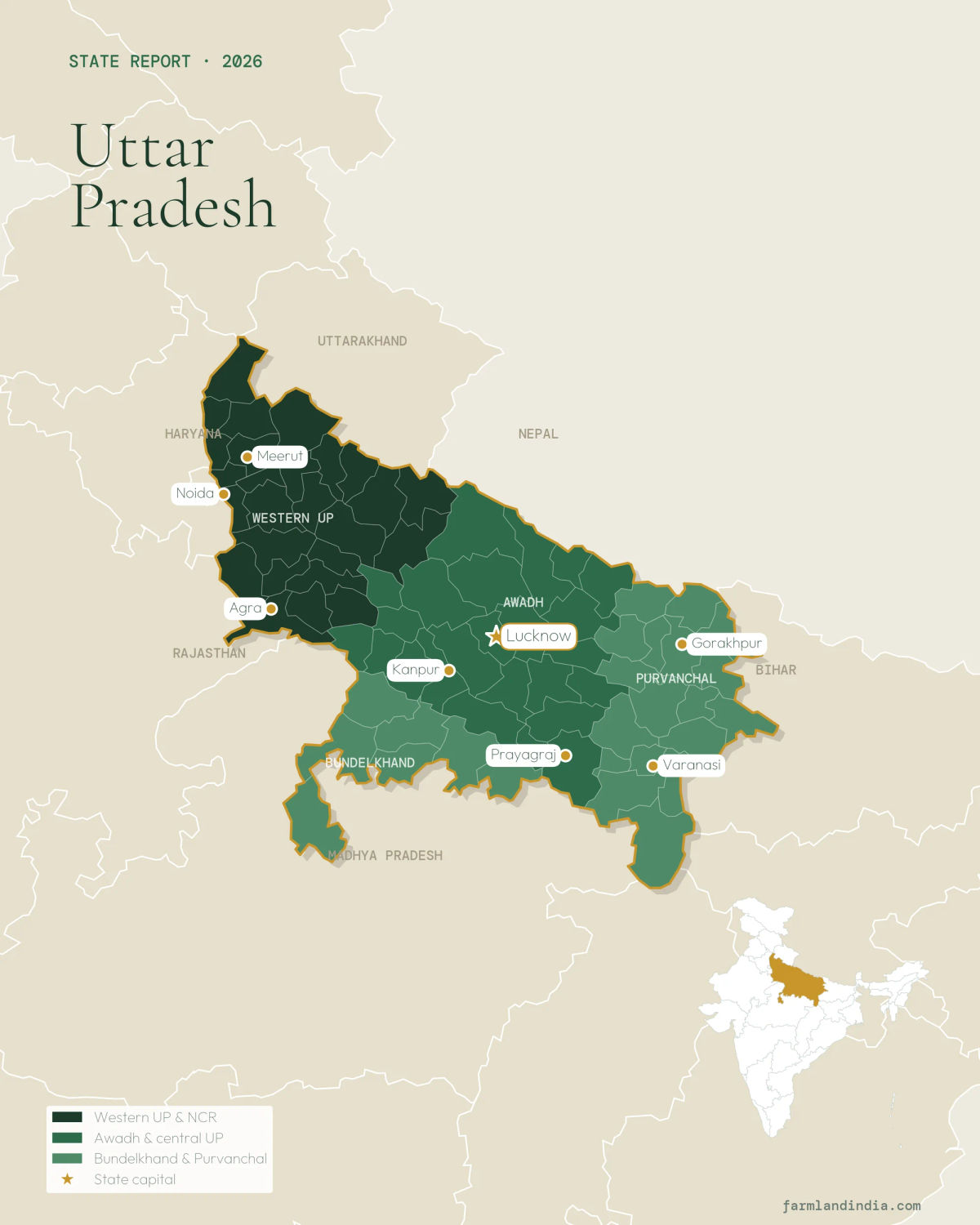
Uttar Pradesh is India's most populous state and, for the Farmland India corridor, its most fragmented by opportunity — 75 districts across 18 divisions, but land-market activity concentrated almost entirely in the western NCR belt: Gautam Buddh Nagar (Noida, Greater Noida, Jewar), Hapur, Ghaziabad and Meerut.
The Yamuna Expressway and the under-construction Noida International Airport at Jewar are reshaping this belt faster than anywhere else in the corridor. The state government's response — freezing private transactions across 84 villages in the DNGIR while development plans are finalised — is itself a signal of how much land-value change is expected once the freeze lifts.
Outside the NCR belt, UP's agricultural core (Meerut, Muzaffarnagar sugarcane belt) offers a genuine commodity-farming thesis distinct from the speculative Jewar story, at a fraction of the price.
Market bands
Bands are compiled from registered-transaction references and broker quotes. The Jewar/DNGIR belt is under an active purchase freeze in specific villages — confirm freeze status before treating any band here as actionable.
| District | Zone / belt | Market band* (₹/bigha) | Land type |
|---|---|---|---|
| Gautam Buddh Nagar | Jewar / Yamuna Expressway | ₹25–70L | Agricultural (freeze applies in parts) |
| Hapur | NH-9 periphery | ₹15–35L | Agricultural |
| Ghaziabad | NCR periphery | ₹30–90L | Agricultural / peri-urban |
| Meerut | Sugarcane belt | ₹10–25L | Agricultural |
| Agra | Tourist / heritage belt | ₹8–20L | Agricultural |
*Indicative bands; stamp duty and registration additional. Cross-check current circle rates on the IGRS UP portal before pricing an offer. Past movement is historical, not a projection.
Transaction costs
7%
Stamp duty — male buyer
of market value or circle rate, whichever is higher
6%
Stamp duty — sole female
1% concession, capped at ₹10 lakh of transaction value
1%
Registration fee
uniform for all buyer categories
Joint male-female ownership attracts 6.5%. Family/blood-relative transfers attract a flat ₹5,000 stamp duty. Source: Indian Stamp Act 1899 (UP schedule), administered via IGRS UP. Circle rates are set per locality — confirm the current rate before budgeting.
Connectivity
Western UP's corridor districts are a Delhi/NCR market — the buyer base for Gautam Buddh Nagar, Hapur and Ghaziabad genuinely originates in Delhi/Noida. Journey times vary with traffic.
The Yamuna Expressway and Jewar Airport together are the single biggest land-value driver in the corridor right now. See the full status and land-impact analysis in our Jewar Airport land guide.
Growth catalysts
Status labels maintained by the Farmland India research desk. Government-announced timelines — not guaranteed.
The single largest infrastructure catalyst in the UP corridor, driving the DNGIR planning freeze and the entire Gautam Buddh Nagar re-rating thesis.
Full Jewar Airport land guide →Already operational Greater Noida-Agra link — the backbone connectivity the Jewar catchment is built around.
A master-planned industrial region under development — 84 villages currently frozen for private transactions while the plan is finalised. Confirm freeze status village-by-village before treating any parcel here as purchasable.
Agriculture & terrain
Western UP splits between the speculative Jewar/NCR belt and a genuine, high-yield sugarcane and wheat economy further out.
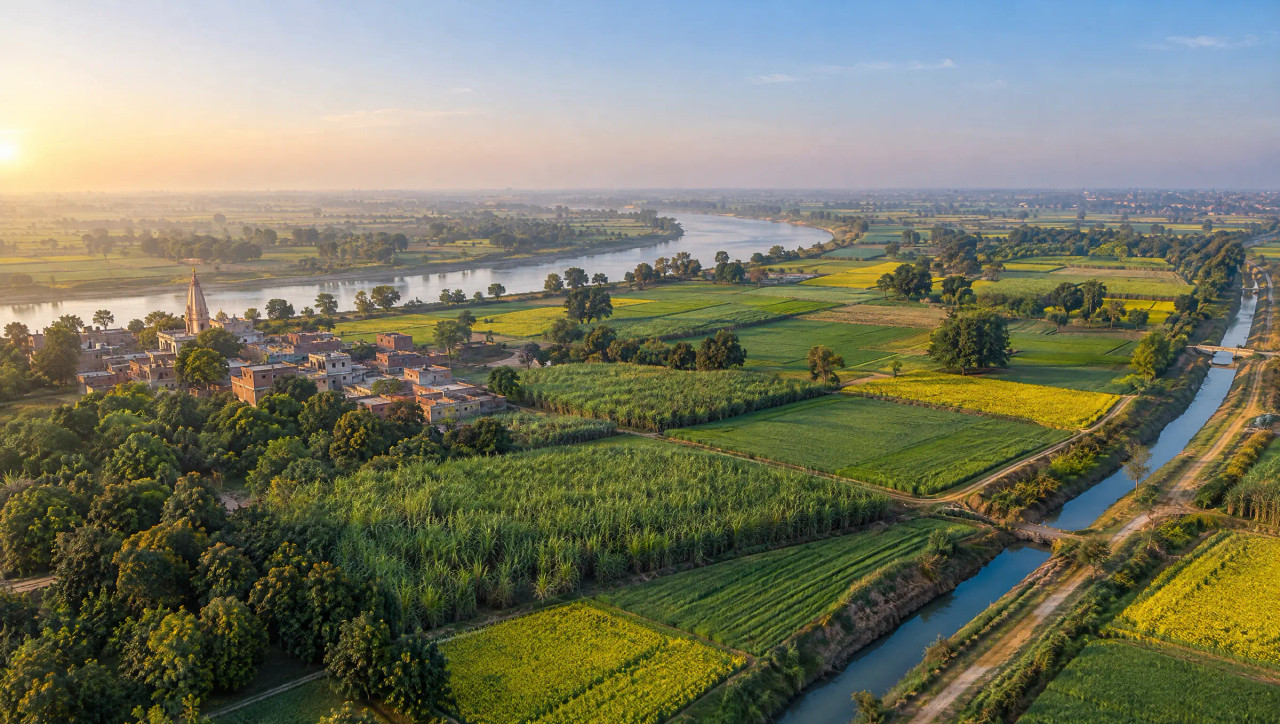
Deep alluvial, canal- and tubewell-irrigated. One of India's densest sugarcane-growing tracts, with wheat in rotation. Data: Soil Health Card portal.
Fertile Gangetic alluvium, historically wheat-rice, now increasingly held for appreciation rather than cultivation given the Jewar/DNGIR thesis.
Yamuna Expressway's southern terminus, tourism-adjacent land with mustard and horticulture on the productive side.
Live wholesale mandi prices for wheat, sugarcane and mustard across UP's regulated markets are published daily on Agmarknet — check the Meerut or Muzaffarnagar mandi for the sugarcane belt.
State average ~800–1000 mm/year across western UP (IMD normals), well-served by canal and tubewell irrigation from the Ganga-Yamuna system. Verify borewell yield and canal access directly for a specific parcel.
Land in western UP is transacted predominantly in Bigha (~27,000 sq ft, 20 Biswa = 1 Bigha), a different Bigha from Rajasthan's. Always confirm the unit and its sq-ft equivalent on a listing.
At a glance
| District | Price band* | Delhi distance | Freeze status |
|---|---|---|---|
| Gautam Buddh Nagar | ₹25–70L/bigha | ~25–75 km | Partial (DNGIR) |
| Ghaziabad | ₹30–90L/bigha | ~25 km | Open |
| Hapur | ₹15–35L/bigha | ~65 km | Open |
*Same indicative-band caveat as the district price table above.
Farmland India view
Four structural reasons this desk underwrites Uttar Pradesh's western NCR belt.
No other project across all six states matches the airport's scale of announced land-value impact.
No non-agriculturist bar — the compliance risk is the DNGIR freeze, not eligibility.
The Meerut sugarcane belt gives a real commodity-income alternative at a fraction of Jewar pricing.
UP's land market beyond the NCR belt remains largely uncharted for organised platforms — an early-mover advantage as coverage expands.
Confirm DNGIR freeze and SC/ST permission status directly — these are not certified by Farmland India's review.
STRAIGHT TALK
Read these before shortlisting — the DNGIR freeze specifically has caught buyers off guard.
84 villages around Jewar/Noida/Ghaziabad are frozen for private sale-deed registration while development planning proceeds. A "deal" in a frozen village cannot actually be registered — confirm freeze status before paying any advance.
Buying multiple parcels across UP can silently push a family above the 12.5-acre ceiling. The Sub-Registrar will refuse registration once the limit is crossed — track aggregate holdings before acquiring more.
Land originally allotted to an SC/ST beneficiary voids on transfer without District Magistrate permission. Check the land's allotment history in the khatauni before proceeding.
Jewar-adjacent prices already reflect significant future expectation. The airport's commissioning timeline is government-announced, not contractual.
Joint family khatas with unclear mutation trails are common. Insist on a current khatauni and clean mutation chain.
Registering near circle rate while paying market price creates downstream capital-gains complications — plan the structuring in advance.
Who to contact
DNGIR freeze status and SC/ST transfer permissions route through the District Magistrate / Tehsildar office via the UP Board of Revenue portal. Sale-deed registration is handled by the local Sub-Registrar through IGRS UP.
INDIVIDUAL LAND · LAND VERIFICATION SCORE
Individual listings carry the auto-calculated Land Verification Score (LVS).
Reviewed projects have completed Farmland India's document and site review. Individual land parcels are listed by their owners and are not reviewed to the same standard. Always complete your own legal due diligence.
KEEP EXPLORING
COMMON QUESTIONS
Everything buyers, NRIs and investors ask before their first reviewed farmland purchase in Uttar Pradesh.
Visit full wiki01 of 07
Yes. A March 2014 amendment removed the non-agriculturist bar. Any Indian citizen may buy, subject to a 12.5-acre family ceiling.
02 of 07
84 villages inside the Dadri-Noida-Ghaziabad Investment Region are currently frozen for private land registration while development planning is finalised. RERA-registered projects are exempt. Confirm a parcel's freeze status directly before paying any advance.
03 of 07
12.5 acres per family (self, spouse, minor children) in aggregate across the state. The Sub-Registrar cannot register a deed that breaches this.
04 of 07
NRIs cannot buy agricultural land under FEMA regardless of location. They may buy residential or commercial property once such projects exist in the area.
05 of 07
7% for male buyers, 6% for sole female buyers (concession capped at ₹10 lakh of value), 6.5% for joint ownership, plus 1% registration.
06 of 07
डीएनजीआईआर (DNGIR) क्षेत्र के 84 गांवों में निजी रजिस्ट्री पर अस्थायी रोक है। खरीदने से पहले संबंधित गांव की स्थिति bor.up.nic.in पोर्टल पर खुद जांच लें।
07 of 07
IGRS UP पोर्टल पर खतौनी, भूलेख और रजिस्ट्री विवरण ऑनलाइन देखे जा सकते हैं। SC/ST आवंटित भूमि के हस्तांतरण के लिए जिलाधिकारी की अनुमति आवश्यक है।
Ready to look at what is available?
Browse reviewed listingsTransparency
Data-currency note: Census figures reflect 2011, the most recent full Census. DNGIR freeze status changes as planning progresses — always verify directly. Report inaccuracies to wiki@farmlandindia.com.
For developers
Browse reviewed projects and individual land parcels across Uttar Pradesh — or if you own land here, list it with platform review and reach serious buyers.
Farmland India ("the Platform"), operated by Bulk Procure Private Limited, is a digital marketplace for listing agricultural land, farmhouse and plotted development projects. The Platform is not a real estate broker, agent or intermediary under RERA or any other applicable law, and does not act for either party to a transaction.
Listings are submitted by developers, owners and their authorised representatives. Before publication, the Platform carries out a documentary review of the material supplied and records what was sighted. That review is limited to the documents made available to us at that time. It is not a title investigation, not a legal opinion, and not a warranty of title, approvals, or the accuracy of any information supplied by a lister. The Trust Score is an internal assessment produced from that review and is intended as a research aid, not as a guarantee of outcome.
Every buyer must carry out independent due diligence before any transaction — including verification of land records, encumbrance searches, approvals and regulatory compliance — through their own advocate and chartered accountant. Any legal or advisory professional introduced through the Platform is engaged directly by the user, on that professional's own terms; the Platform does not employ, supervise or accept responsibility for their work.
Nothing on the Platform is investment advice. Land values can fall as well as rise. The Platform is not liable for any loss, dispute or damage arising from a transaction between parties.