


✓ Reviewed
National Highway Front land in Chhata, Kosi Kalan on NH 44, Delhi-Mathura Highway
Chhata, Mathura, Uttar Pradesh
108000000015.44 AcreView
District guide
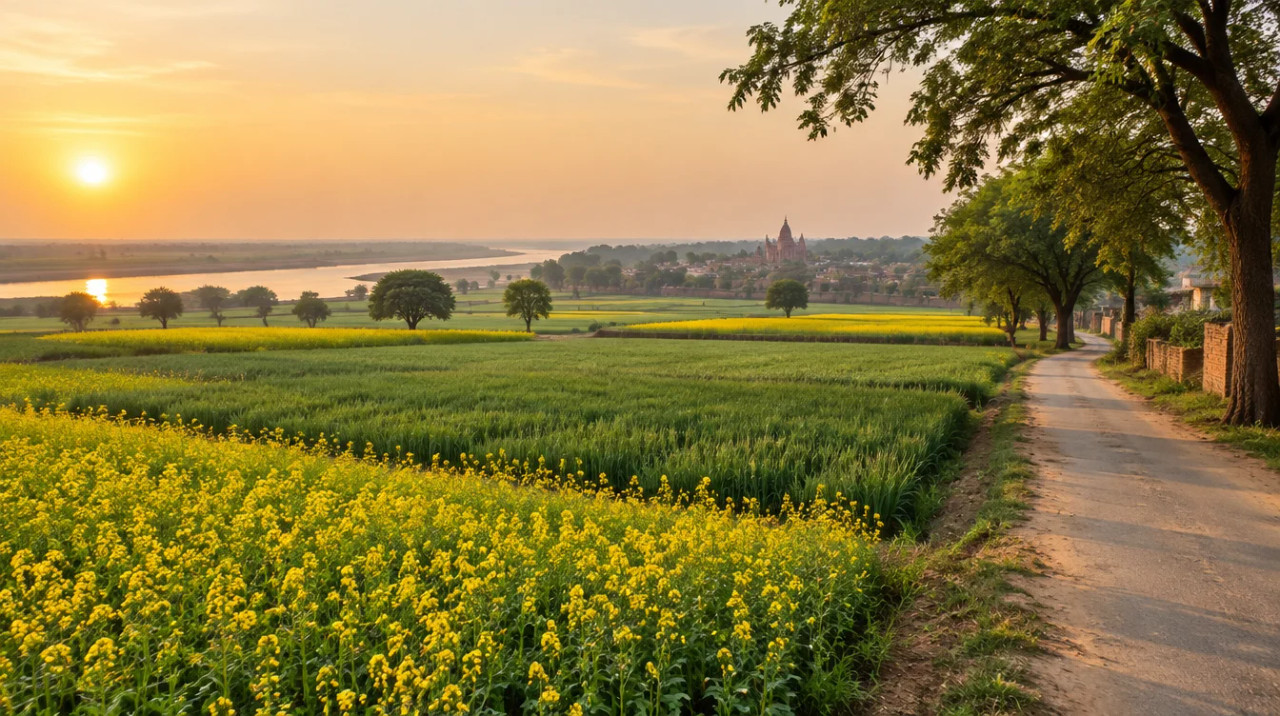
A pilgrim district on the Yamuna: wheat and mustard farmland, Taj Trapezium Zone and flood-plain checks, a link road and expressway belt still in progress.
₹40 lakh–8 cr/acre*
Estimated land price*
3,340 sq km
Area (district portal)
25,47,184
Population (district portal)
431
YEIDA notified villages
*Indicative range across districts and land types. Stamp duty, registration and conversion charges are additional. Local measurement units vary — every listing states the unit it is priced in. Not a valuation or an offer.
IGRS UP — Registration & Land Records PortalDistrict land record — Mathura
Rev. 2026 · Farmland India desk
State
Uttar Pradesh
Sub-divisions
10 development blocks: Nandgaon, Chhata, Chaumuha, Govardhan, Mathura, Farah, Nohjhil, Mat, Raya, Baldeo (CGWB district brochure, 2012-13). The district portal home page lists no tehsils, and the brochure itself gives conflicting tehsil counts, so take the tehsil of a parcel from the revenue record.
Key markets
Mathura city · Vrindavan · Raya · Chhatikara · Govardhan · Mant · Baldeo · Chhata
Demand anchors
Pilgrim-town second homes and farmhouses · Yamuna Expressway and the Delhi–Agra highway · Noida International Airport flights since 15 June 2026 · YEIDA and Mathura–Vrindavan planning areas
Rail
Mathura Junction is the main railhead on the Indian Railways network (timetable and platform details not opened for this page)
Size and population
3,340 sq km · 25,47,184 people (Mathura district portal, October 2026; the page does not state the Census year). The CGWB brochure gives 3,303 sq km in its text.
Position
About 145 km south-east of Delhi and about 50 km north of Agra; Vrindavan is about 11 km and Govardhan about 22 km from Mathura (district portal)
Estimated land price*
₹40 lakh–8 crore per acre* by belt (see the price table; indicative only)
Pricing unit
₹/acre (farmland) · ₹/sq yd (town plots)
Local units
Records use hectares and square metres; sellers may quote older local units that vary by tehsil and village, so convert every figure to acres or hectares before comparing.
Land records portal
UP Bhulekh and IGRS UP (not opened for this page; check records there)
*Indicative only, not a valuation or an offer; prices vary by plot, road access and title. Check the guideline or ready-reckoner rate with the Sub-Registrar.
Land law is state law. These rules are maintained on the Uttar Pradesh page and apply to every district within it.
⚠ Two checks come before any advance in Uttar Pradesh: the Revenue Code limit of 5.0586 hectares (about 12.5 acres) on what one person can acquire by purchase or gift, and the registry position in the DNGIR villages near Noida, where a purchase halt was reported in January 2024 and no later word was found. UP Revenue Code 2006, section 89; Sakshi Post, January 2024.
Who can buy agricultural land? The Revenue Code sections we read set a size limit (section 89) and special rules for land held by Scheduled Caste and Scheduled Tribe members (sections 98 and 99). None asks the buyer to be a farmer or to live in the state (UP Revenue Code 2006, IGRS UP). We did not read the whole tenure chapter, so ask the Sub-Registrar whether anything further applies. The Code repealed the Zamindari Abolition and Land Reforms Act 1950 when it was enforced on 18 December 2015 (SCC Online, February 2016).
Holding limit: section 89(2) of the Code bars a purchase or gift that would take the buyer's total holding in Uttar Pradesh above 5.0586 hectares, about 12.5 acres on our conversion (UP Revenue Code 2006). Under the earlier Act the Supreme Court read a company as a person for this limit and let the excess vest in the State (Oswal Fats and Oils, April 2010). The separate 1960 Ceiling Act caps total holdings; the India Code text gives 7.30 hectares of irrigated land for a family of five or fewer, with additions for larger families, and the text mixes acres and hectares, so the current schedule needs checking (India Code).
DNGIR villages: the Dadri-Noida-Ghaziabad Investment Region covers 84 notified villages, 63 in Bulandshahr and 21 in Gautam Buddh Nagar, notified in October 2024 (Swarajya, July 2026). In January 2024 a Noida Authority letter to the Stamp Department halted purchase and sale in the proposed villages, with registration of agricultural land needing the Authority's consent (Sakshi Post, January 2024). Two July 2026 reports on acquisition by mutual consent do not mention the halt (Millennium Post, July 2026), so ask the Noida Authority or the District Magistrate's office whether it still applies to a given village.
Scheduled Caste and Scheduled Tribe land: a Scheduled Caste bhumidhar needs the Collector's previous written permission to transfer land to a non-Scheduled Caste buyer (section 98), and a Scheduled Tribe bhumidhar may not transfer to a non-Scheduled Tribe buyer (section 99) (UP Revenue Code 2006). The Allahabad High Court described a transfer without the permission as void in Omwati v District Collector, Pilibhit, November 2022.
NRI & OCI buyers: the Reserve Bank's Master Direction under FEMA 1999 excludes agricultural land, plantation land and a farm house from what NRIs and OCIs may buy or receive as a gift (paragraphs 3.1.1 and 3.1.2). Inheritance is covered separately in paragraphs 3.1.3 and 3.1.4, without that exclusion (Reserve Bank of India Master Direction FED 12/2015-16).
The Uttar Pradesh state page applies to Mathura in full. The notes below are specific to this district and are not repeated from the state page. Law was read from the Revenue Code text on India Code, court reports and the YEIDA page; where an official page did not open, the note says so.
⚠ Mathura is reported to lie inside the Taj Trapezium Zone, about 10,400 sq km across Agra, Firozabad, Mathura, Hathras and Etah in Uttar Pradesh and Bharatpur in Rajasthan (ETV Bharat, May 2025). We did not read the Supreme Court orders and could not check which Mathura villages fall inside the boundary, so ask the District Magistrate or the Taj Trapezium Zone authority about the khasra. Two reported rules matter to a land buyer. On 1 May 2025 the Court reiterated that no tree may be felled within 5 km of the Taj Mahal without its approval, and said that elsewhere in the zone prior permission from the divisional forest officer is needed (ETV Bharat, May 2025; LiveLaw, March 2025). On 23 July 2026 the Court allowed the authority to process about 410 pending applications for new or expanded industries, which had been barred without its approval since an October 2024 order (LiveLaw, July 2026; Free Press Journal, July 2026). Whether a farmhouse, shed or small unit on farmland needs clearance from the authority was not found in these reports.
⚠ Farmland becomes non-agricultural land through a declaration under Section 80 of the UP Revenue Code, 2006. A bhumidhar with transferable rights applies to the Sub-Divisional Officer, who must decide within 45 working days; the India Code copy of the Code carries a proviso that treats the declaration as made if the officer does not decide in that time, subject to the prescribed fee and no objection from co-tenure holders, and a declaration for a future use lapses if the activity does not start within five years (UP Revenue Code 2006, India Code). Older sale papers and sellers still cite section 143 of the Zamindari Abolition and Land Reforms Act 1950, which the Code repealed when it came into force on 18 December 2015 (SCC Online, February 2016). The copy of the Code hosted by IGRS UP was read earlier without that proviso, and Ordinance 14 of 2026 changes Section 80 for plans approved by a development authority (PRS Legislative Research), so ask the SDM office which text applies. Inside the Mathura–Vrindavan or YEIDA planning areas, also ask that authority about the khasra.
⚠ Three overlays can sit on one parcel: YEIDA, which lists 431 notified villages in Mathura district (tehsils shown as Sadar and Math) across 75,751 hectares (YEIDA overview page, updated 8 October 2026), the Mathura–Vrindavan Development Authority, and NHAI for the approved Vrindavan link road (The Week/PTI, April 2025). We could not obtain a list of the YEIDA villages by name, so check the khasra against current notifications before paying any advance.
⚠ The Yamuna runs through the district, entering at Chaundras village in Chhata tehsil and dividing it into an eastern and a western tract (CGWB district brochure). Under the Revenue Code the beds of rivers vest in the State (section 54), no bhumidhari rights arise on river-bed land used for casual or occasional cultivation (section 77(1)(c)), and the Collector’s register of villages must note areas liable to fluvial action (section 29(1)(a)) (UP Revenue Code 2006, India Code). We found no dated flood-level report for Mathura, so ask the seller for flood history and the khatauni entry for any parcel near the river, and read the Yamuna flood-plain land as a title and use question, not only a price one.
⚠ Section 89(2) of the Code bars a purchase or gift that would take a person’s total holding in Uttar Pradesh above 5.0586 hectares, about 12.5 acres on our conversion (UP Revenue Code 2006, IGRS UP). The separate 1960 Ceiling Act caps total holdings; its India Code text gives 7.30 hectares of irrigated land for a family of five or fewer, and the current schedule needs checking (India Code, 1960 Act). The Code sections read set no farmer test and no residence test for a buyer; they do protect land held by Scheduled Caste members (section 98, Collector’s permission) and Scheduled Tribe members (section 99), and the Allahabad High Court has described a transfer made without that permission as void (SCC Online, November 2022). NRIs and OCIs may not buy agricultural land, plantation land or a farm house (RBI Master Direction FED 12/2015-16).
Read the full Uttar Pradesh land buying guide for buyer eligibility, stamp duty and NRI rules, and the Uttar Pradesh state page for the statewide picture.
District overview
Mathura district covers 3,340 sq km and the portal gives it 25,47,184 people, without stating the Census year (Mathura district portal, October 2026). The Ground Water Board brochure lists ten development blocks (Nandgaon, Chhata, Chaumuha, Govardhan, Mathura, Farah, Nohjhil, Mat, Raya, Baldeo), puts the area at 3,303 sq km in its own text and gives the Yamuna as the main river (CGWB district brochure, 2012-13). Mathura city is about 145 km south-east of Delhi and about 50 km north of Agra, with Vrindavan about 11 km and Govardhan about 22 km away (district portal).
The land market splits into belts. Vrindavan and the Delhi–Agra highway villages such as Chhatikara are pilgrim-town edge land; see the Vrindavan and Chhatikara pages. Raya, Baldeo and the Yamuna Expressway belt sit under YEIDA’s notified villages, covered on the Raya page. Govardhan, Chhata and Mant are pilgrim-circuit and farming land. We estimate farm and fringe land from ₹40 lakh to ₹8 crore per acre* depending on the belt; this is a desk estimate, not a registered-deed price. *Indicative only, not a valuation or an offer; prices vary by plot, road access and title. Check the guideline or ready-reckoner rate with the Sub-Registrar.
Mathura is a working farm district: the ICAR-CRIDA contingency plan lists 196,300 hectares of wheat, 48,000 of rice, 44,500 of mustard and 41,200 of bajra in 2013-14 (ICAR-CRIDA Mathura plan), and about 56.5% of the gross irrigated area comes from tubewells. Groundwater and the Yamuna’s flood plain matter as much as the highway.
Transaction costs
7%
Stamp duty — male buyer
as commonly quoted; not confirmed from the Stamp Department
6%
Stamp duty — sole woman buyer
as commonly quoted; concession cap reported to be under change
1%
Registration fee
as commonly quoted; not confirmed from the Stamp Department
Duty is charged on the higher of the deal value and the circle rate. We could not open the Stamp and Registration Department’s rate schedule, so 7%, 6% and 1% are the figures commonly quoted for agricultural land and are repeated from the state page. Deccan Herald reported on 9 May 2025 that women would get a 1% duty cut on registrations worth up to ₹1 crore, against a previous ₹10 lakh limit, without saying whether it was notified (Deccan Herald, May 2025); Outlook Money described it as a proposal (Outlook Money, May 2025). The Allahabad High Court held in September 2024 that duty on a sale deed for agricultural land cannot be raised by reference to its future commercial potential (India Legal, September 2024). Ask the Sub-Registrar for the schedule and the Mathura circle rate in force.
Know the belt
Four belts, each with an estimated band marked *. The circle rate for a village was not opened, so these are desk estimates to test against registered deeds.
Estimated ₹1.5–8 crore per acre*
Supply near the temple area is tight and the Delhi–Agra highway frontage at Chhatikara is priced as road-edge land. A 15 km six-lane link road costing ₹1,645 crore, approved on 31 March 2025, runs from Jaint (Km 129.32) near Ramtal in Vrindavan across the Yamuna to the Yamuna Expressway, with NHAI to start land acquisition in the first phase (The Week/PTI, April 2025; NBM&CW, April 2025). A parcel on the alignment may be acquired.
Check: the NHAI alignment, the Mathura–Vrindavan zone and Taj Trapezium Zone status for the khasra.
Estimated ₹50 lakh–1.5 crore per acre*
This is the lower-entry belt. YEIDA lists 431 notified villages in Mathura district (YEIDA overview page), and a trade-outlet report of October 2024 said the YEIDA Master Plan 2031 includes a Raya urban centre of 9,366.2 hectares on both sides of the expressway, with acquisition to follow board and committee reviews (The Realty Today, October 2024; reported). Land inside a notified area can be acquired.
Check: whether the village is on the YEIDA notification and the compensation basis.
Estimated ₹1–2.5 crore per acre*
Both sit on the Braj pilgrimage circuit. The Chief Minister announced a ₹30,000 crore master plan for Braj on 16 August 2025, naming Mathura, Vrindavan, Barsana and Gokul but not itemising land needs (Morung Express, August 2025), so treat it as direction, not a parcel-level catalyst.
Check: the circle rate and recent registered sales in the same village.
Estimated ₹40 lakh–1 crore per acre*
Away from the highway and the temple towns, land is priced as irrigated farmland: wheat, rice, mustard and bajra dominate (ICAR-CRIDA Mathura plan). Clay, kankar and saline reh patches are recorded in parts of Chhata, Nandgaon, Govardhan, Mathura and Farah blocks (CGWB brochure).
Check: soil, borewell yield and canal access before paying a premium for road frontage.
Revenue records use hectares and square metres, and sellers may quote older local units that differ by tehsil, so convert to acres (1 hectare is about 2.47 acres) before comparing. *Indicative only, not a valuation or an offer; prices vary by plot, road access and title. Check the guideline or ready-reckoner rate with the Sub-Registrar.
Connectivity
Only distances from the district portal are given; other journey times were not sourced and vary with traffic and festival days.
The practical question is the last leg from the highway to the parcel; a field track and a metalled village road are different assets. See the Uttar Pradesh land rules before relying on a distance.
Growth catalysts
Status labels reflect sources read in October 2026. Government-announced timelines are not guaranteed; items marked reported or confirm have a single or an older source.
02Open or inaugurated
03In progress or pending
Agriculture & terrain
A wheat, rice and mustard district on the Yamuna plain, where tubewells supply over half the irrigation and the river, saline pockets and groundwater need checking.
The ICAR-CRIDA plan, using 2013-14 crop areas, lists wheat on 196,300 hectares, rice on 48,000, mustard on 44,500, bajra on 41,200, potato on 11,500 and barley on 4,300 (ICAR-CRIDA Mathura plan). Net sown area is 269.3 thousand hectares of a 330.3 thousand hectare district, at a cropping intensity of 140%. Village-level soil data sits on the Soil Health Card portal, which was not opened for this page.
The Yamuna enters at Chaundras in Chhata tehsil and splits the district into eastern and western tracts, with the Patwaha as a tributary (CGWB brochure). The CRIDA plan classes 37% of the district’s soil as eroded and its flood contingency tables are largely blank, so we found no sourced flood history. River-bed land vests in the State under section 54 of the Revenue Code.
The CGWB brochure records silty, sandy and loamy soils, with clay, kankar and saline reh predominant in Chhata, Nandgaon, Govardhan, Mathura and Farah blocks (CGWB brochure). A salt-affected field can look the same as a good one in the dry season, so test the soil and the borewell water before paying for farming potential.
The CRIDA plan gives normal annual rainfall of 591.4 mm, 518.7 mm of it in June to September, while the CGWB brochure gives both 826 mm and 620 mm, so the figure depends on the source and period (ICAR-CRIDA Mathura plan; CGWB brochure). Of a gross irrigated area of 329.7 thousand hectares, canals supply 43.5% and tubewells 56.5%. The brochure’s block stages at 31 March 2009 put Nohjhil (124.49%), Raya (119.52%) and Baldeo (108.19%) over-exploited, Farah and Mat semi-critical, and the district at 83.33%; the CRIDA plan also lists three over-exploited and two semi-critical blocks. These are old figures: we did not obtain a Mathura block table from the CGWB 2024 assessment, which reports 59 over-exploited blocks statewide (CGWB, December 2024). Check the borewell yield and permission for any parcel in Raya or Baldeo.
Records use hectares and square metres; a hectare is about 2.47 acres. Sellers may quote older local units that vary by tehsil and village, so ask for the area in the khatauni and convert before comparing offers. For crop income, wholesale prices are published on Agmarknet (not opened for this page); crop income is modest next to the land values in the pilgrim belts.
At a glance
| District / belt | Price band* (per acre) | Basis |
|---|---|---|
| Mathura — Vrindavan and Chhatikara | ₹1.5–8 crore* | Estimate; temple-town edge and Delhi–Agra highway frontage |
| Mathura — Raya and Baldeo (expressway belt) | ₹50 lakh–1.5 crore* | Estimate; YEIDA-notified villages possible |
| Mathura — Mant and interior fields | ₹40 lakh–1 crore* | Estimate; irrigated farmland, soil and water vary |
| Agra | Not shown here | See the Agra page |
| Gautam Buddha Nagar | Not shown here | See the Gautam Buddha Nagar page |
*Indicative only, not a valuation or an offer; prices vary by plot, road access and title. Check the guideline or ready-reckoner rate with the Sub-Registrar. See the Agra page for the next district down the Yamuna Expressway and the Gautam Buddha Nagar page for the airport end.
Farmland India view
Five reasoned points, with an honest note that price figures are desk estimates and several catalysts are still pending.
Mathura, Vrindavan, Govardhan and Barsana draw visitors through the year, and the state announced a ₹30,000 crore Braj plan in August 2025. That supports second-home and farmhouse interest near the temple towns, and it keeps their land priced well above farmland value.
The Delhi–Agra highway passes Mathura and the 165 km Yamuna Expressway runs along the district, so access exists today. A ₹1,645 crore link road between them was approved in March 2025.
Noida International Airport has had commercial flights since 15 June 2026. The road time to Mathura was not sourced, so check the real journey before assuming an hour.
Our estimates run from ₹40 lakh per acre* in the interior to ₹8 crore* near Vrindavan. A buyer can choose between a low-entry farm and a scarce temple-town parcel, and should expect to test each against registered deeds.
The Taj Trapezium Zone, YEIDA and NHAI overlays, Yamuna flood-plain land, the 12.5-acre purchase limit and Section 80 conversion all depend on the khasra, so the careful buyer gains from checking each one in writing.
Confirm Taj Trapezium Zone, YEIDA, flood-plain and circle-rate status directly; these are parcel-specific.
STRAIGHT TALK
Read these before shortlisting in Mathura specifically.
Mathura is reported to be inside the zone, which has tree-felling rules and, until the 23 July 2026 order, a bar on new industries without Court approval. We could not check the boundary village by village.
River-bed land vests in the State under section 54 of the Revenue Code, and no bhumidhari rights arise on river-bed land used for casual cultivation. Ask for flood history and the khatauni entry before paying for land near the river.
The 2009 stage figures put Raya, Baldeo and Nohjhil blocks over 100% of the recharge, and the CRIDA plan lists three over-exploited blocks. We have no 2024 block table for Mathura, so check borewell depth and permission.
YEIDA lists 431 notified villages in the district, NHAI is to acquire land for the Vrindavan link road, and a development authority covers the temple towns. A parcel can sit under more than one, and land inside an alignment can be acquired.
A farmhouse or any non-agricultural use needs a Section 80 declaration, and the India Code copy and the IGRS UP copy of the Code were read with different provisos on a deemed declaration. Ask the SDM office for the text in force.
One person cannot take total holdings above 5.0586 hectares by purchase or gift, land held by Scheduled Caste or Scheduled Tribe members has its own bars, and temple, trust or servitor land can be disputed. Read the khatauni, not the seller’s summary.
Our bands are desk estimates* without a registered-deed series behind them. Several catalysts are approved or announced, not built: the link road, the Raya urban centre and the Braj plan.
Who to contact
Mutation and revenue-record matters go through the Tehsildar of the relevant tehsil, Section 80 declarations go to the Sub-Divisional Officer, and sale deeds are registered at the Sub-Registrar’s office, all under the District Magistrate of Mathura (Mathura district portal). Records and circle rates are on UP Bhulekh and IGRS UP (Revenue Code text hosted by IGRS UP). For a parcel in the temple towns, ask the Mathura–Vrindavan Development Authority; for the expressway belt, YEIDA (YEIDA overview page); for the link road, NHAI; and for Taj Trapezium Zone status, the zone authority or the District Magistrate. We could not open the Bhulekh and IGRS UP portals or list the tehsil offices, so office addresses and hours are not given.
INDIVIDUAL LAND · LAND VERIFICATION SCORE
Individual listings carry the auto-calculated Land Verification Score (LVS).
Reviewed projects have completed Farmland India's document and site review. Individual land parcels are listed by their owners and are not reviewed to the same standard. Always complete your own legal due diligence.
KEEP EXPLORING
Micro-markets in Mathura
Other districts in Uttar Pradesh
Guides & research
COMMON QUESTIONS
Everything buyers, NRIs and investors ask before their first reviewed farmland purchase in Mathura.
Visit full wiki01 of 04
We estimate farm and fringe land at about ₹40 lakh to ₹1 crore per acre* in the interior, ₹50 lakh to ₹1.5 crore* in the Raya and Baldeo expressway belt, ₹1 to 2.5 crore* around Govardhan and Chhata, and ₹1.5 to 8 crore* near Vrindavan and Chhatikara. These are indicative desk estimates, not a valuation or an offer; check the circle rate with the Sub-Registrar.
02 of 04
ETV Bharat reported in May 2025 that the zone, about 10,400 sq km, spreads across Agra, Firozabad, Mathura, Hathras and Etah in Uttar Pradesh and Bharatpur in Rajasthan. We did not read the Supreme Court orders or check village boundaries, so ask the District Magistrate or the zone authority whether a given khasra is inside it.
03 of 04
Through a declaration under Section 80 of the UP Revenue Code 2006: the bhumidhar applies to the Sub-Divisional Officer, who must decide within 45 working days. Older papers cite section 143 of the repealed 1950 Act. The India Code copy of the Code has a deemed-declaration proviso that another copy did not show, so confirm the text in force with the SDM office.
04 of 04
Section 89(2) of the Revenue Code bars a purchase or gift that takes a person’s total holding above 5.0586 hectares, about 12.5 acres. The 1960 Ceiling Act separately caps total holdings, and NRIs and OCIs may not buy agricultural land. The sections we read set no farmer test; ask the Sub-Registrar whether anything further applies.
Ready to look at what is available?
Browse reviewed listingsTransparency
Law and courts
Government
News
Further reading
Data-currency note: area and population are district-portal figures without a stated Census year; crop and groundwater data come from documents dated 2009 to 2014; infrastructure statuses were read in October 2026 and change quickly; price bands are Farmland India desk estimates* and are not taken from any price series. Pages not opened (Bhulekh, IGRS UP rate schedule, Agmarknet, Soil Health Card, Indian Railways) are named only as places to check. This is a general guide, not legal advice. Report inaccuracies to wiki@farmlandindia.com.
For developers
Browse reviewed projects and individual land parcels across Mathura — or if you own land here, list it with platform review and reach serious buyers.
Farmland India ("the Platform"), operated by Bulk Procure Private Limited, is a digital marketplace for listing agricultural land, farmhouse and plotted development projects. The Platform is not a real estate broker, agent or intermediary under RERA or any other applicable law, and does not act for either party to a transaction.
Listings are submitted by developers, owners and their authorised representatives. Before publication, the Platform carries out a documentary review of the material supplied and records what was sighted. That review is limited to the documents made available to us at that time. It is not a title investigation, not a legal opinion, and not a warranty of title, approvals, or the accuracy of any information supplied by a lister. The Trust Score is an internal assessment produced from that review and is intended as a research aid, not as a guarantee of outcome.
Every buyer must carry out independent due diligence before any transaction — including verification of land records, encumbrance searches, approvals and regulatory compliance — through their own advocate and chartered accountant. Any legal or advisory professional introduced through the Platform is engaged directly by the user, on that professional's own terms; the Platform does not employ, supervise or accept responsibility for their work.
Nothing on the Platform is investment advice. Land values can fall as well as rise. The Platform is not liable for any loss, dispute or damage arising from a transaction between parties.