

Area guide
Buying Land in Alibaug
Agricultural land in Alibaug, Raigad, estimated at ₹1.5–6 crore per acre*: Atal Setu access, CRZ, tenancy law and corridor checks.
₹1.5–6 cr/acre*
Estimated price*
1–1.5 hrs
Mumbai by road (reported)
80 km
Corridor phase
40 guntha = 1 acre
Local unit
*Indicative range across districts and land types. Stamp duty, registration and conversion charges are additional. Local measurement units vary — every listing states the unit it is priced in. Not a valuation or an offer.
Micro-market record — {{Alibaug}}
Rev. 2026 · Farmland India desk
District
Raigad (Alibaug taluka)
Corridor
Mumbai Trans Harbour Link (Atal Setu), operational; Virar–Alibaug multimodal corridor, under land acquisition
Sea link
Mandwa jetty on the north coast of Alibaug taluka (ferry timetable not checked)
Terrain
Konkan coastal plain with beaches, creeks, paddy fields and laterite hillocks
Mumbai access
About 1 to 1.5 hours by road via Atal Setu (reported, May 2026)
Coastal rules
CRZ and Coastal Zone Management Plan checks apply near the shore; confirm per survey number
Estimated land price*
₹1.5–6 crore per acre*
Land law is state law. These rules are maintained on the Maharashtra page and apply to every district within it.
Alibaug — land purchase legal rules
⚠ Maharashtra reserves agricultural land for agriculturists. Section 63 of the Tenancy Act voids a sale to anyone else unless an exception or a Collector’s permission applies, and in July 2026 the Revenue Minister repeated that only recognised farmers may buy. Several other statutes then decide whether a parcel can be split, converted or built on. Read the 7/12 before you read the price.
Who may buy agricultural land: Section 63 of the Maharashtra Tenancy and Agricultural Lands Act makes a sale, gift, exchange or lease of agricultural land invalid in favour of a person who is not an agriculturist. It also bites where an agriculturist buyer would end up holding more than two-thirds of the ceiling area (Indian Kanoon text of section 63). The Collector, or an officer the State authorises, can permit a transaction on conditions, but not where the buyer would farm the land and has other income of Rs 12,000 a year or more, according to the same text. In Gundaji Satwaji Shinde v. Ramchandra Bhikaji Joshi (Supreme Court, December 1978) the Court held that whether a buyer is an agriculturist is for the Mamlatdar, not the civil court (Manupat case guide). On 8 July 2026 the Revenue Minister told the Assembly that only recognised farmers may buy agricultural land and that buyers must show proof of farmer status; IANS named no new statute (IANS, July 2026).
Where the bar does not apply: Maharashtra Act I of 2016 inserted sub-section (1C), which switches off the bar for land inside a Municipal Corporation, subject to conditions: non-agricultural use within a fixed time, with the Collector able to extend by up to five years (Acts of 2016 and 2018, PRS). Section 63-1A separately lets a buyer, farmer or not, take land for bona fide industrial use without prior Collector permission (Indian Kanoon text of section 63-1A). The Maharashtra Tenancy and Agricultural Lands Laws (Amendment) Act, 2026, effective 15 April 2026, narrows that route to occupancy class-I land, replaces the old non-agricultural assessment and nazarana with a one-time conversion premium under section 47 of the Land Revenue Code, and caps the penalty for late notice at five times that premium (JSA, June 2026). JSA describes no change to the general bar in section 63(1).
Tenant-purchased land and wills: Land a tenant bought under the Act cannot be sold, gifted, mortgaged or leased without the Collector’s prior sanction. After ten years the sanction falls away if the seller pays nazarana of forty times the assessment, the buyer is an agriculturist and the buyer stays within the ceiling (Indian Kanoon text of section 43). The 2026 amendment deletes the nazarana (JSA, June 2026). A will does not get round the bar: in Vinodchandra Sakarlal Kapadia v. State of Gujarat (15 June 2020) the Supreme Court read “assignment” in section 43 to include a bequest to a non-agriculturist (LiveLaw, June 2020; Supreme Court judgment). That appeal came from Gujarat, which applies the same 1948 statute, and the Court disapproved an earlier ruling under the separate Vidarbha Act. Marathwada and Vidarbha run on parallel Acts that the 2026 amendment also touches.
Fragmentation and minimum plot size: The Maharashtra Prevention of Fragmentation and Consolidation of Holdings Act, 1947 restricts sales of land below a notified standard area. A notification of 8 August 2023 set it, outside municipal corporation and council limits, at about a quarter acre for bagayat (irrigated) land and half an acre for jirayat (dry-crop) land, which is roughly 10 and 20 gunthas on our arithmetic of 40 gunthas to the acre (Cyril Amarchand Mangaldas via Conventus Law). The 2024 amendment moved the regularisation window to 15 October 2024 at a premium of up to 5%. A further Act notified on 31 December 2025, deemed in force from 3 November 2025, deletes the proviso to section 8B and adds section 9(4): past transfers and partitions from 15 November 1965 to 15 October 2024 are regularised without premium where the land is used for bona fide non-agricultural purposes inside listed urban, planning-authority, cantonment and regional-plan zones (TeamLease RegTech; Bill text, PRS). The bill did not change the standard area or the general restrictions. In July 2025 the Revenue Minister said plots up to one guntha subdivided before 1 January 2025 would be treated as legal, and a committee was set up the following week (The Week, July 2025; The Week, July 2025). Plain farm land outside those zones is still bound by the standard area.
Non-agricultural conversion: The Maharashtra Land Revenue Code (Second Amendment) Act, 2025, notified on 31 December 2025, substituted section 42. The Collector’s permission is no longer needed to use agricultural land for a purpose that a draft or final Development Plan or Regional Plan allows; the planning authority’s development permission or building plan approval is enough, and sections 42A to 42D, 44 to 46 and the old assessment chapter were deleted (JSA, March 2026). The yearly non-agricultural assessment gives way to a one-time premium under section 47 on the Ready Reckoner value: 0.1% up to 1,000 sq m, 0.25% from 1,000 to 4,000 sq m and 0.5% above 4,000 sq m. A government resolution of 10 February 2026 implements the change (Khaitan & Co, February 2026). Neither note says the reform alters section 63, so our reading is that a non-farmer still cannot buy agricultural land first and convert it afterwards.
Ceiling on holdings: The Maharashtra Agricultural Lands (Ceiling on Holdings) Act, 1961 caps what one family unit may hold, from 18 acres of assured-irrigation land to 54 acres of other dry-crop land in a 2011 summary (Bombay Chartered Accountant Journal, April 2011). Section 63 uses two-thirds of that ceiling as the test for a buyer who is already a farmer.
Tribal land: Where the seller belongs to a Scheduled Tribe, the sale also falls under the Land Revenue Code and the Restoration of Lands to Scheduled Tribes Act, 1974 (section 63-1A text). Ask for the seller’s status in writing.
Land records: Digitally signed 7/12 (record of rights), 8A (khata) and ferfar (mutation) extracts now carry legal validity under rules made under the Maharashtra Land Measurement and Record Keeping Act, 2025, with a QR code and a 16-digit verification number, no Talathi stamp and a fee of Rs 15 each (Free Press Journal, December 2025). About 2.57 crore signed 7/12 records existed by June 2024, and e-Mojani 2.0 handles measurement (Elets, February 2025). Read the occupancy class, the holder’s name and the land-use entry before paying a token.
NRI and OCI buyers: The Reserve Bank’s Master Direction lets NRIs and OCIs buy immovable assets in India but excludes agricultural land, plantation land and a farmhouse, and its inheritance paragraphs carry no such exclusion (RBI Master Direction FED 12/2015-16, updated to September 2022). A farmhouse plot is therefore out of reach by purchase, wherever it sits in Maharashtra. Anyone relying on a later circular should read it directly. We did not open the 2023 standard-area notification, the text of section 63A or the current ceiling schedule, so have an advocate check all three against the survey number.
- Section 63 farmer-only bar
- NA reform Dec 2025
- Fragmentation Act 1947
- Ceiling Act 1961
- Digital 7/12 and 8A
- NRI agri: barred (FEMA)
- RR rates unchanged 2026-27
Sub-area overview
Alibaug — the weekend-home coast of Mumbai, where the link road is open and the corridor is not
Agricultural land in Alibaug is Mumbai's nearest large coastal farmland market. It is the Raigad taluka across the water from Mumbai, with paddy fields, coconut and betel-nut gardens, creeks and beaches, and it sells mostly to buyers who want a weekend home or a garden plot. Our estimate for agricultural land in Alibaug is ₹1.5–6 crore per acre*, indicative only, and the spread is wide because the north coast near the Mandwa jetty prices very differently from inland and eastern areas.
Access has changed. A May 2026 research-firm release carried by The Tribune (a press release, not independent reporting) says the Mumbai Trans Harbour Link, also called Atal Setu, is operational and cuts road time from Mumbai to Alibaug to about 1 to 1.5 hours. The same release says tourist visits rose from 2.2 million in 2020 to 4.5 million in 2025 and that the proposed Revas–Karanja Bridge, not yet built, is projected to cut Navi Mumbai–Alibaug travel from about 2 hours to 30 minutes. Treat these as reported claims, not confirmed figures.
Buyers should price the road that exists today and read the rules before the brochure. Maharashtra restricts who may buy agricultural land, coastal land has its own approvals, and a weekend-home plan needs a non-agricultural permission. Land here is measured in guntha locally (40 guntha make one acre), so convert to acres when you compare quotes. Read the Raigad district page and the state-wise land laws guide first. Ask the Talathi and the Sub-Registrar for the 7/12 extract, the mutation entries and the zone, and ask a lawyer whether the survey number falls inside CRZ, a corridor alignment or a forest or hill-slope zone.
- Coastal farmland
- Atal Setu access
- Weekend homes
- CRZ check
- NRI barred
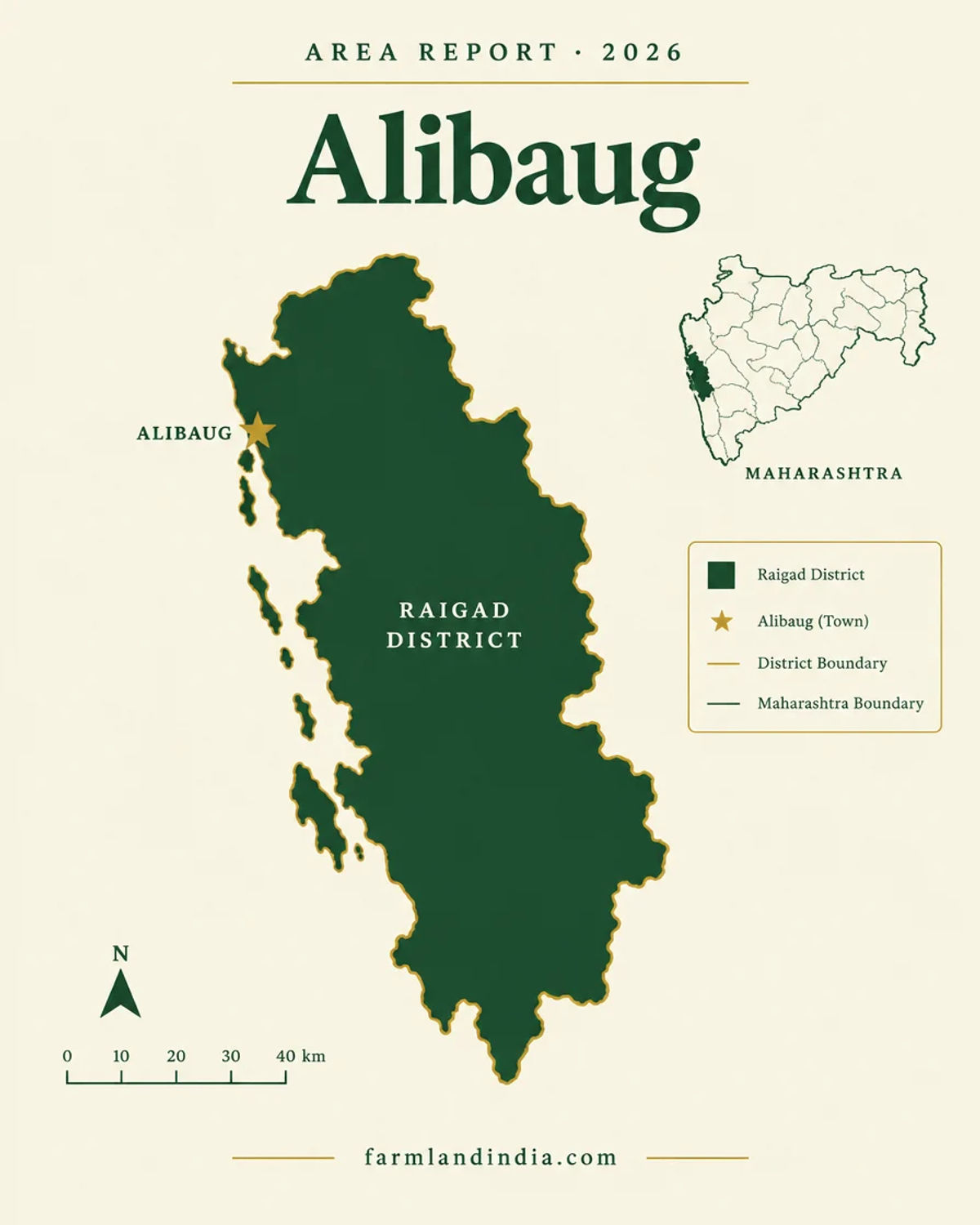
Connectivity
How Alibaug connects
Alibaug is reached across the harbour from Mumbai by road after the Atal Setu opening, and by sea through the Mandwa jetty. Times are reported and not route-checked.
By road and sea
Read this before relying on distances
Coastal travel times swing with the tide, the monsoon and weekend traffic on the approach roads. A bridge or corridor that is proposed or under land acquisition is not a road you can drive. Check the actual approach to the survey number, because a plot on a village track and one on a made-up road differ a lot even a kilometre apart.
Growth catalysts
Upcoming infrastructure & developments
Status labels maintained by the Farmland India research desk. Government-announced timelines — not guaranteed.
02Corridors
Road and bridge
01Operational link
Atal Setu
Agriculture & terrain
Soil, crops & water in Alibaug
Alibaug is Konkan coastal farmland: paddy on the low fields, coconut and betel-nut gardens near the villages, and laterite on the rises.
Soil & crops
We found no Raigad or Alibaug soil or crop figures in the sources we opened. Konkan coastal belts are generally known for paddy, coconut, betel nut and mango on laterite and coastal alluvium, but treat this as general background (CONFIRM against the district agriculture office) and test the soil of any plot. Data: Soil Health Card site.
- Paddy
- Coconut
- Betel nut
- Mango
Water
We did not open a groundwater category for Alibaug taluka. Near the coast, borewells can turn saline, so ask for a water test and the depth and yield of any existing well before you pay. Groundwater categories: CGWB.
Mandi price reference
We have not read a local mandi price for Alibaug. Compare any farm-income claim with the full land cost before buying. Live prices: Agmarknet.
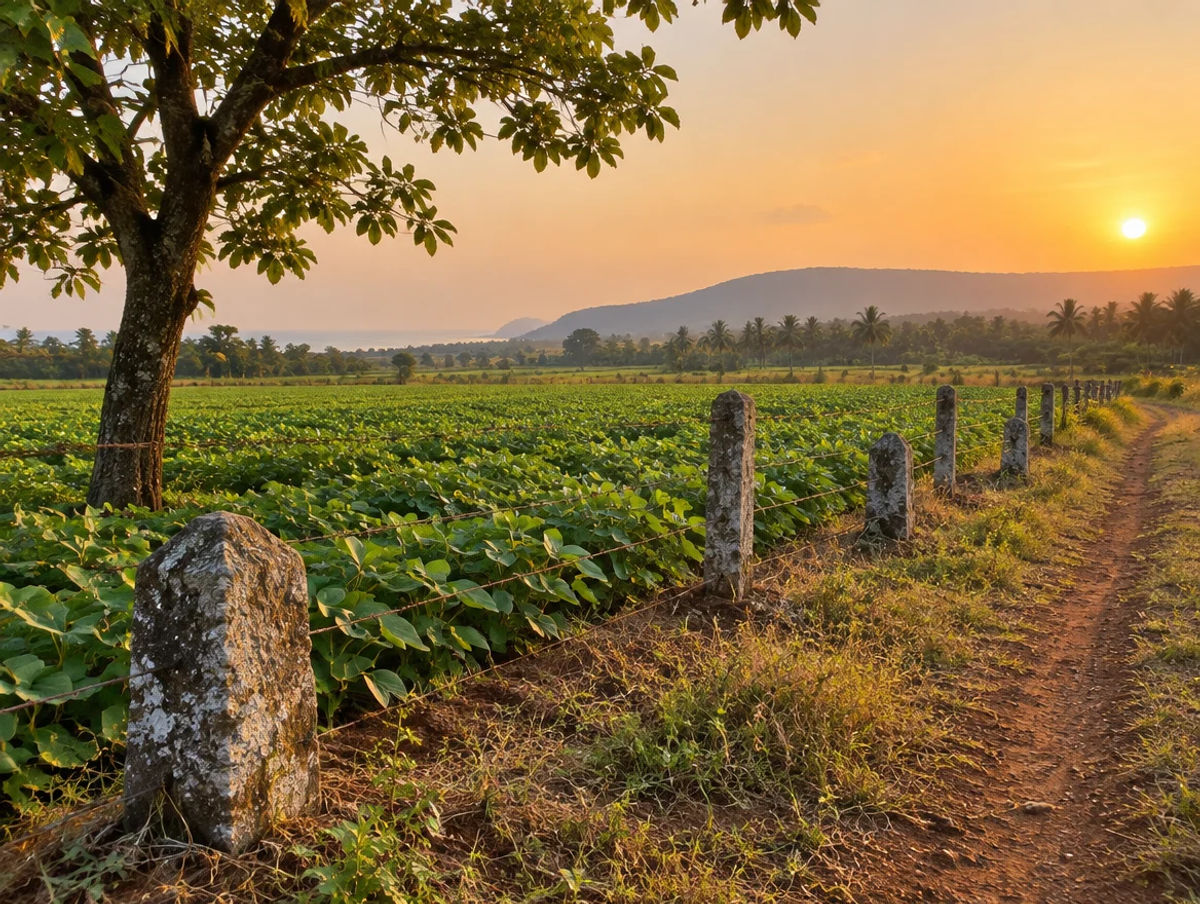
Farmland India view
Why buyers look at Alibaug
Reasons buyers look at this micro-market, stated with the evidence we have. Not a price forecast.
A land-limited coast
A research-firm release reported in The Tribune on 29 May 2026 says limited developable land is the main driver of Alibaug prices. It is a press release, so treat it as a claim.
Open sea-link access
Atal Setu is operational and, per the same release, brings Mumbai to about 1 to 1.5 hours by road. Check the real approach time at your own hour.
A large corridor is in motion
The Virar–Alibaug multimodal corridor has an 80 km phase from Navghar to Chirner, and 30 hectares of state land were cleared for forest compensation on 3 July 2026 (reported). It is not built.
Different belts, different prices
North Alibaug near Mandwa is described as the priciest belt and East Alibaug as a longer-term land-holding belt (same release). Our estimate is ₹1.5–6 crore per acre*.
Listing data is not legal advice. Confirm title, zone and CRZ status with the Talathi, the Sub-Registrar and a local lawyer.
STRAIGHT TALK
Risks & challenges specific to Alibaug
Specific to this micro-market, beyond the Raigad and Maharashtra-wide points.
Corridor timing and land taking
The Virar–Alibaug corridor was estimated at ₹55,000 crore with 360 of 1,000 hectares acquired and completion expected by 2030 (NBM&CW, 11 Sep 2024). On 3 July 2026 the state cleared 30 hectares of land for compensatory afforestation (reported). Ask whether any part of the survey number falls inside the alignment.
Proposed bridges are not built
The Revas–Karanja Bridge is described as proposed. Do not price land on a time saving that has no opening date.
Who may buy agricultural land
Maharashtra law restricts the transfer of agricultural land to non-agriculturists under the Bombay Tenancy and Agricultural Lands Act (CONFIRM the section and the latest amendments with a Maharashtra lawyer). A buyer who is not an agriculturist may be barred or need permission. Do not pay a token amount before this is answered.
Coastal zone rules
Land near the shore may fall under the Coastal Regulation Zone, which restricts building. Ask for the CRZ status of the survey number and the approved Coastal Zone Management Plan map. We did not read the map for any village.
Non-agricultural permission
A weekend home on farmland needs a conversion to non-agricultural use and a building permission. Ask for these in writing and confirm the zone of the survey number in the Raigad plan (CONFIRM).
Prices vary widely
North-coast land and inland land can differ by several times. Our estimate of ₹1.5–6 crore per acre* is indicative, so rely on the guideline rate and recent registered deeds.
NRIs and OCIs cannot buy this land
FEMA bars NRIs and OCIs from buying agricultural land, plantation land or a farmhouse in India, Maharashtra included. A farmhouse or farm-land listing is not a route for them. Confirm your status with a lawyer.
COMMON QUESTIONS
Frequently asked questions
Everything buyers, NRIs and investors ask before their first reviewed farmland purchase in Alibaug.
Visit full wiki01 of 04
What does agricultural land in Alibaug cost?
Our estimate for agricultural land in Alibaug is ₹1.5–6 crore per acre*, indicative only. North-coast land near Mandwa and inland land price very differently. Check the guideline rate with the Sub-Registrar and recent registered deeds.
02 of 04
Is the Virar–Alibaug corridor built?
No. An 80 km phase between Navghar and Chirner is at land and clearance stage; on 3 July 2026 the state cleared 30 hectares for forest compensation (reported). An earlier report targeted completion by 2030, so confirm progress with MSRDC.
03 of 04
Can I build a weekend home on agricultural land in Alibaug?
Not directly. You need the land to be convertible to non-agricultural use, a building permission, and, near the shore, CRZ clearance. Ask for each in writing per survey number.
04 of 04
Can an NRI buy land in Alibaug?
An NRI or OCI cannot buy agricultural land, plantation land or a farmhouse under FEMA. Residential or commercial land in approved areas is a separate question for a lawyer.
Ready to look at what is available?
Browse reviewed listingsTransparency
Sources for this page
- Atal Setu access, tourism figures, price discussion, Revas–Karanja Bridge — a research-firm press release carried by The Tribune (PTI), 29 May 2026 (a press release; claims not independently confirmed)
- Virar–Alibaug corridor land clearance, 80 km Navghar–Chirner phase — news report, 3–4 Jul 2026 (reported; not read on a government page)
- Corridor cost, hectares acquired, completion target — NBM&CW, 11 Sep 2024
- Maharashtra tenancy restriction and CRZ — general law, to be confirmed with a Maharashtra lawyer and the Coastal Zone Management Plan
- Local units — guntha explained for convenience; convert to acres
- Prices — Farmland India estimate*; the guideline/collector rate is to be obtained from the Sub-Registrar
- Full district and state sourcing: see the Raigad page and the Maharashtra page. Sources read October 2026.
General information, not legal advice. Report inaccuracies to wiki@farmlandindia.com.
For developers
Ready to explore Alibaug farmland?
Browse reviewed projects and individual land parcels across Alibaug — or if you own land here, list it with platform review and reach serious buyers.