
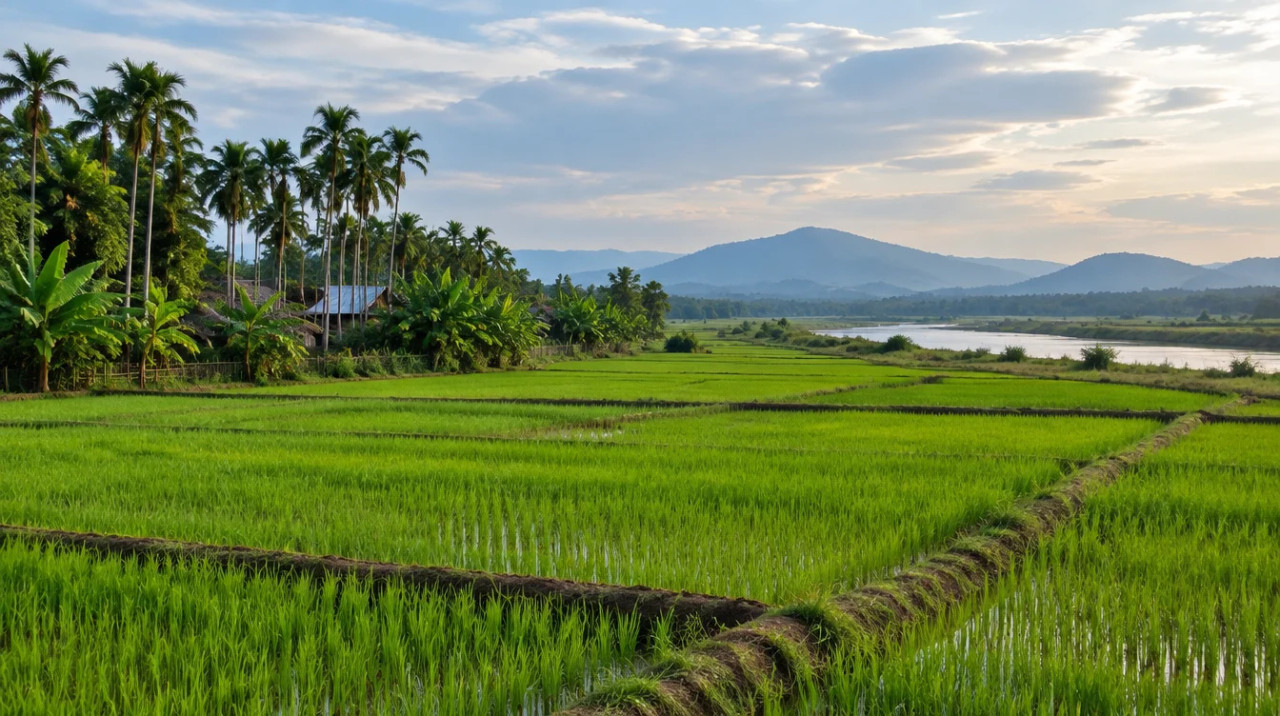
District guide
Buying Land in Kakching
A small valley district carved out of Thoubal in 2016: paddy plain, a GIS master plan in preparation and the same closed buyer pool as the rest of the valley.
1,35,481
Population (Census 2011, estimate)
December 2016, from Thoubal
Created
In progress
GIS master plan
16
Sub-registrar offices, Manipur
District land record — Kakching
Rev. 2026 · Farmland India desk
State
Manipur
Land system
Valley district: the Manipur Land Revenue and Land Reforms Act, 1960 applies
Key markets
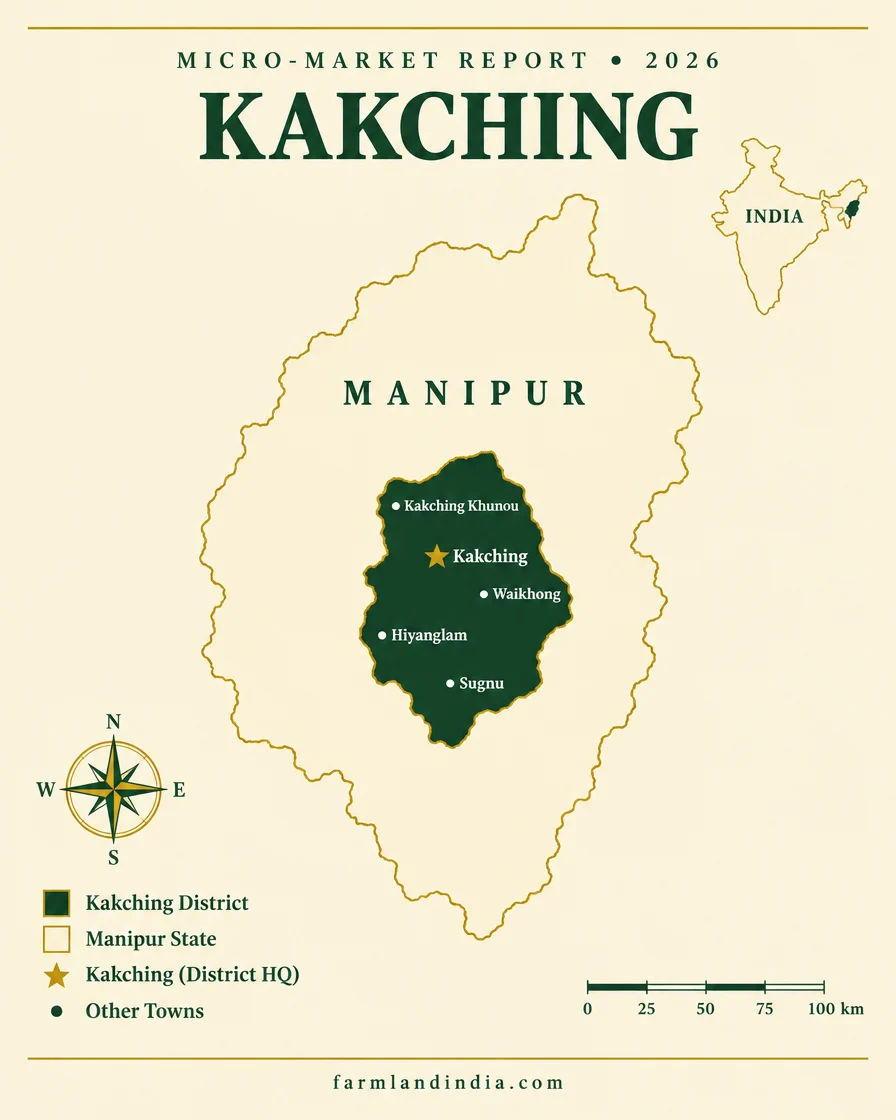
Kakching · Kakching Khunou · Waikhong · Hiyanglam · Sugnu
Demand anchors
Kakching GIS master plan · water-supply project · road links to Thoubal and Imphal
Location
South-east of Imphal on the valley floor, formerly part of Thoubal
Size and population
1,35,481 people at the 2011 Census, computed for current boundaries (City Population[3])
Outside buyers
Generally cannot buy: deeds from indigenous to non-indigenous persons have not been registered since September 2025 (Outlook[6])
Pricing unit
No official farmland price series is published; quote any land per acre or per sq yd and compare with the registered deed and any rate the sub-registrar quotes
Land records
Manipur is digitising cadastral maps and records under DILRMP (state presentation, September 2024); ask the sub-registrar and the Sub-Divisional Collector’s office which record exists for the plot
Land law is state law. These rules are maintained on the Manipur page and apply to every district within it.
Kakching — who can hold land
Manipur has two land systems side by side. In the Imphal valley and the plains, land is held under a revenue law with pattas, a ceiling and mutation; in the hills, which cover most of the state, the same law does not apply and land belongs to tribal communities under custom. On top of both, a 2025 notification stops the registration of land transfers from indigenous owners to non-indigenous buyers. This block sets out the rules as written, without legal conclusions. Take advice from a lawyer in Imphal and confirm the position with the Deputy Commissioner before you pay anything.
Valley law, not hill law: Section 1(2) of the Manipur Land Revenue and Land Reforms Act, 1960 extends it to the whole state except the hill areas, which are declared by notification. In the valley districts the Act governs ownership, revenue, ceiling, mutation and the diversion of farmland. In the hill districts, land is held by villages, clans and chiefs under the custom of each community, and there are generally no revenue records of the valley kind.
Scheduled Tribes: Section 158 of the Act is a special provision for Scheduled Tribes. Commentators describe it as the protection that stops tribal land in the areas covered by the Act from passing to non-tribals (The Sangai Express, February 2021). Check its operative text with a lawyer before dealing with a tribal owner in the valley.
The 2025 registration bar: In September 2025 the Land Resources Department notified that deeds transferring land by gift, sale or mortgage from an indigenous person to a non-indigenous person will not be registered. Registration can be allowed where both parties are permanent residents of Manipur, on an application through the Deputy Commissioner that is checked by a departmental committee and a panel of officers before the government decides (Outlook, 19 September 2025). Sale deeds above Rs 2 lakh must be paid by account transfer or cheque.
Article 371C: Article 371C of the Constitution lets the President provide for a committee of the Assembly made up of members elected from the Hill Areas, with changes to the government’s rules of business and a special responsibility for the Governor to make it work. The Hill Areas Committee is the constitutional voice of the hills in matters that affect them, including land.
Inner Line Permit: Manipur came under the Inner Line Permit regime on 1 January 2020, when the Bengal Eastern Frontier Regulation, 1873 was extended to the state (India Today NE, January 2020). Indian visitors from outside the state need an ILP. Section 7 of the same Regulation requires government sanction before a person who is not a native acquires any interest in land beyond the Inner Line. An ILP is a travel permit; it gives no right to land.
Ceiling and holdings: Section 136 of the 1960 Act caps holdings at 25 acres for a person and his family, with five more acres for each member beyond five, up to 50 acres. The Act defines a basic holding as 2.5 acres and a family holding as 7.5 acres.
Diversion and mutation: Under Section 20, a holder who wants to use farmland for a non-agricultural purpose must apply for permission, which can be refused on grounds such as public nuisance or the public interest. Under Section 46(2), anyone who acquires a right in land must report it to the competent authority within three months so that the mutation register can be updated.
NRI and OCI buyers: Under the RBI Master Direction on immovable property, NRIs and OCIs may not acquire agricultural land, a farmhouse or plantation land in India except by inheritance. Our NRI guide covers the national rule.
- Valley: 1960 Act
- Hills: customary land
- 2025: no transfers to non-indigenous
- Article 371C
- ILP since 2020
- Ceiling 25 acres
- NRIs: inheritance only
Kakching — district-specific notes
Kakching lies in the valley, where the Manipur Land Revenue and Land Reforms Act, 1960 applies. The notes below sit on top of the Manipur state page, which covers the two land systems and the ceiling; read it first.
⚠ Outsiders generally cannot buy. Since September 2025, deeds that transfer land by gift, sale or mortgage from an indigenous person to a non-indigenous person are not registered, except where both parties are permanent residents of Manipur and the government grants permission after checks by the Deputy Commissioner, a departmental committee and a panel of officers (Outlook, 19 September 2025[6]). A buyer from outside the state should treat farmland in Kakching as closed to them and confirm with the Deputy Commissioner before paying any token.
⚠ Scheduled Tribe owners. Section 158 of the 1960 Act is described as stopping tribal land in the areas covered by the Act from passing to non-tribals (The Sangai Express, February 2021[2]). Take legal advice before dealing with a tribal owner of a valley plot.
⚠ Ceiling, conversion and mutation. Section 136 caps a person or family at 25 acres, rising to 50 for large families; section 20 requires permission before farmland is used for anything else; section 46(2) requires anyone who acquires a right in land to report it within three months so the record can be updated (Manipur Land Revenue and Land Reforms Act, 1960[1]).
NRI and OCI buyers should read can NRIs buy agricultural land in India first: the RBI rule bars them from agricultural land, farmhouses and plantation land except by inheritance. An Inner Line Permit is a travel permit and gives no right to land.
- Valley revenue law
- 2025 registration bar
- Scheduled Tribe land
- Ceiling and mutation
- Record of rights
District overview
Kakching — A newer, smaller valley district south of Thoubal
Kakching is one of the seven districts created in December 2016, carved out of Thoubal, and lies on the valley floor south-east of Imphal. Its 2011 Census population, computed for today’s boundaries, is 1,35,481 (City Population[3]) Kakching town is the headquarters, with Kakching Khunou, Waikhong, Hiyanglam and Sugnu among the other places.
Land is held under the Manipur Land Revenue and Land Reforms Act, 1960. The buyer pool is set by the September 2025 registration rule: deeds from indigenous owners to non-indigenous buyers are not registered unless both are permanent residents and the government permits it (Outlook, 19 September 2025[6]). Readers from outside Manipur should read this page for the rules and the risks, not as a list of plots they can buy.
The Town Planning Department reports a GIS-based master plan in progress for Kakching and names it, with Thoubal, as an AMRUT 2.0 water-supply project town (2025-26 report[4]). No notification date is given. Because Kakching was part of Thoubal until 2016, older records, maps and farm data often still carry the Thoubal name.
- Valley district
- Kakching
- Created 2016
- Paddy plain
- GIS master plan
- Closed to outside buyers
Transaction costs
Stamp duty & registration in Kakching
Stamp duty
Conveyance of land
No percentage is quoted.
Registration fee
Sale deed
Ask the sub-registrar.
Rates online
Circle rate and calculator
The state registration report (undated) lists circle rates and an online stamp duty calculator as available
The rules that are confirmed concern who may register a deed and how money moves: since September 2025 deeds from an indigenous person to a non-indigenous person are not registered except between permanent residents with government permission, and sale deeds above Rs 2 lakh must be paid by account transfer or cheque (Outlook, 19 September 2025[6]). The same state report records 16 sub-registrar offices covering Manipur, with online payment of stamp duty and fees available.
Know the belt
What is moving prices in Kakching
Three pockets that shape land interest in the district
Kakching town
Headquarters
The district’s main town and the subject of the GIS master plan in progress (Town Planning Department[4]). Land around it is the most settled and the most likely to be rezoned.
Check: draft plan status, road width and mutation history
Kakching Khunou and Waikhong
Town edge villages
Villages close to the town where farmland meets built-up land. Conversion permission under section 20 matters for any change of use.
Check: record of rights, conversion permission and drainage
Hiyanglam and Sugnu
Paddy belt
Farming areas further from the main road, where land is still agricultural in the record.
Check: access, flood history and canal or lift irrigation
Asking prices
Plots near Kakching town are likely to be quoted above interior paddy land; compare any quote with registered deeds for the same locality.
Connectivity
How Kakching connects — road, rail and air
Road, rail and air links for the district
🚗 By road
✈️ By air
🚆 By rail
Kakching depends on valley roads that are exposed to floods and bridge failures; see the Thoubal page for the September 2025 damage in the neighbouring district.
Growth catalysts
Upcoming infrastructure & developments
Projects that touch the district, each with its status and source
00Open
02Catalysts
Agriculture & terrain
Soil, crops & water in Kakching
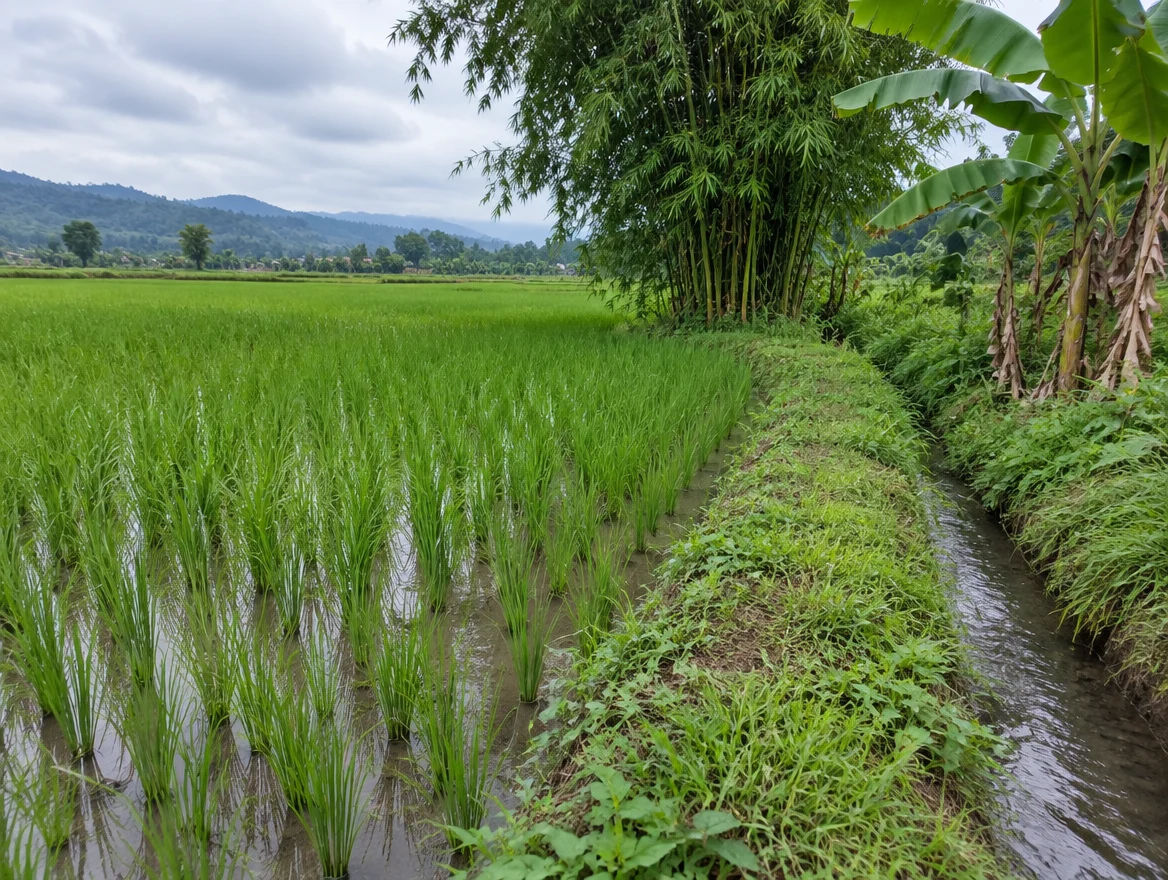
Paddy plain with older district data
Land and crops
The ICAR plan for the older Thoubal district, which included Kakching, shows pre-kharif rice on about 28,260 ha, pulses, oilseeds and sugarcane, and pineapple as the main fruit (ICAR KVK, Thoubal[5]). Use it as regional context only.
- Paddy is the dominant crop in the older district
- Pineapple, pulses and oilseeds
- Cropping intensity near 150% in the old district
- No Kakching-only table found
Soil and water
The same plan shows clay loam to clay, peat and silty clay soils and 33 lift irrigation schemes across the older district (ICAR KVK[5]). Manipur’s 2024 groundwater stage was 8.00% with all units safe.
- Clay, peat and silty soils
- Lift irrigation in the older district
- State groundwater stage 8.00% (2024)
- No Kakching block table found
Rainfall
The older Thoubal plan gives a normal annual rainfall of 905 mm.
Hazards
Peat and clay soils and river flooding are the main land concerns for the plain; the September 2025 floods are reported for Thoubal and Imphal East (India Today NE, 15 September 2025[7])
At a glance
Kakching vs. nearby districts
| District | Land and water | What links it to Kakching |
|---|---|---|
| Thoubal | Valley district to the north | Kakching was carved out of it in 2016; same plain |
| Imphal East | Valley paddy and river land | Same law and registration rule |
| Bishnupur | Valley district around Loktak Lake | Same valley law; wetland rules near the lake |
| Chandel | Hill district to the south and east | Customary hill land; outside buyers generally cannot buy |
Kakching is the smallest of the five valley districts by 2011 population in the table (City Population[3]). It shares the soils, flood risk and registration rule of Thoubal, so read the Thoubal page and the Manipur state page alongside this one.
Farmland India view
Why investors look at Kakching
Five reasoned points for Kakching, each tied to a source on this page.
Small, settled and thinly documented
Kakching has little published district-specific data, so any claim about prices or growth should be checked against registered deeds and the sub-registrar.
Plans may change zoning
The Kakching GIS master plan is in progress (Town Planning Department[4]). Land near the town may be rezoned once it is notified.
A closed buyer pool
Deeds from indigenous to non-indigenous persons are not registered (Outlook[6]), so only residents transact.
Confirm the record of rights (record of rights and patta), mutation, zoning and acquisition status directly — these are not certified by Farmland India’s review.
STRAIGHT TALK
Risks & challenges in Kakching
District-specific risks. Read the Manipur state page for the general risks on ceiling, conversion and records.
Registration refused
A deed to a non-indigenous buyer will not be registered unless both parties are permanent residents and the government permits it (Outlook[6]).
Old records under the Thoubal name
Because Kakching was part of Thoubal until 2016, check that the plot’s record and map are under the right district and sub-registrar.
Peat, clay and flooding
The older district plan shows peat and clay soils (ICAR KVK plan[5]), and the neighbouring plain flooded in September 2025. Ask for soil and flood history.
Plans not yet notified
The master plan is in progress, so reservations for roads and public use may appear later.
Who to contact
Local revenue & planning offices
Start with the Deputy Commissioner of Kakching and the Sub-Divisional Collector for the plot’s revenue record; the sub-registrar for the deed and the payment mode; and the Town Planning Department, Manipur, if the plot may fall inside a planning area. Use the Manipur government directory.
COMMON QUESTIONS
Frequently asked questions
Everything buyers, NRIs and investors ask before their first reviewed farmland purchase in Kakching.
Visit full wiki01 of 04
Can an outsider buy farmland in Kakching?
Generally no. Deeds from an indigenous person to a non-indigenous person have not been registered since September 2025 unless both are permanent residents and the government permits it. Confirm with the Deputy Commissioner first.
02 of 04
Is there a master plan for Kakching?
A GIS-based master plan for Kakching town is reported as in progress in the Town Planning Department’s 2025-26 report. No notification date is given, so zoning may change when it is issued.
03 of 04
Where do the farm figures come from?
The ICAR plan for Thoubal covers the older, larger district that included Kakching, so its figures are used as regional context only.
04 of 04
Is there a per-acre price for Kakching?
None is shown. Compare any quote with registered deeds for the same locality.
Transparency
Sources and references
Law and courts
- [1]Government of Manipur: Manipur Land Revenue and Land Reforms Act, 1960 (High Court copy) — thc.nic.in
- [2]The Sangai Express: Kachui Timothy Zimik, IRS, on the 1960 Act and hill areas, 11 Feb 2021 — thesangaiexpress.com
Government
- [3]City Population: Manipur districts, Census 2011 figures — citypopulation.de
- [4]Town Planning Department, Manipur: administrative report 2025-26 — tpmanipur.mn.gov.in
- [5]ICAR KVK: District agriculture contingency plan, Thoubal — kvk.icar.gov.in
News
- [6]Outlook: Manipur bans land transfer from natives to outsiders, 19 Sep 2025 — outlookindia.com
- [7]India Today NE: Two rivers overflow in Imphal valley, 15 Sep 2025 — indiatodayne.in
- [8]India Today NE: Rs 12,000 crore highway upgrade in Manipur, 12 Nov 2025 — indiatodayne.in
Project status, the benchmark valuation and land rules change often; check the linked source and the relevant office before relying on any figure.
For developers
Ready to explore Kakching farmland?
Browse reviewed projects and individual land parcels across Kakching — or if you own land here, list it with platform review and reach serious buyers.