
State guide
Buying Land in Mizoram
Article 371G, the Section 98 bar on tribal-to-non-tribal transfers, LSCs and pattas, e-Ram records, 11 districts and the Sairang railway.
11
Districts
Aizawl
Capital
3.95% (CGWB 2024)
Groundwater use
Generally barred
Outside buyers
State land record — Mizoram
Rev. 2026 · Farmland India desk
Regions
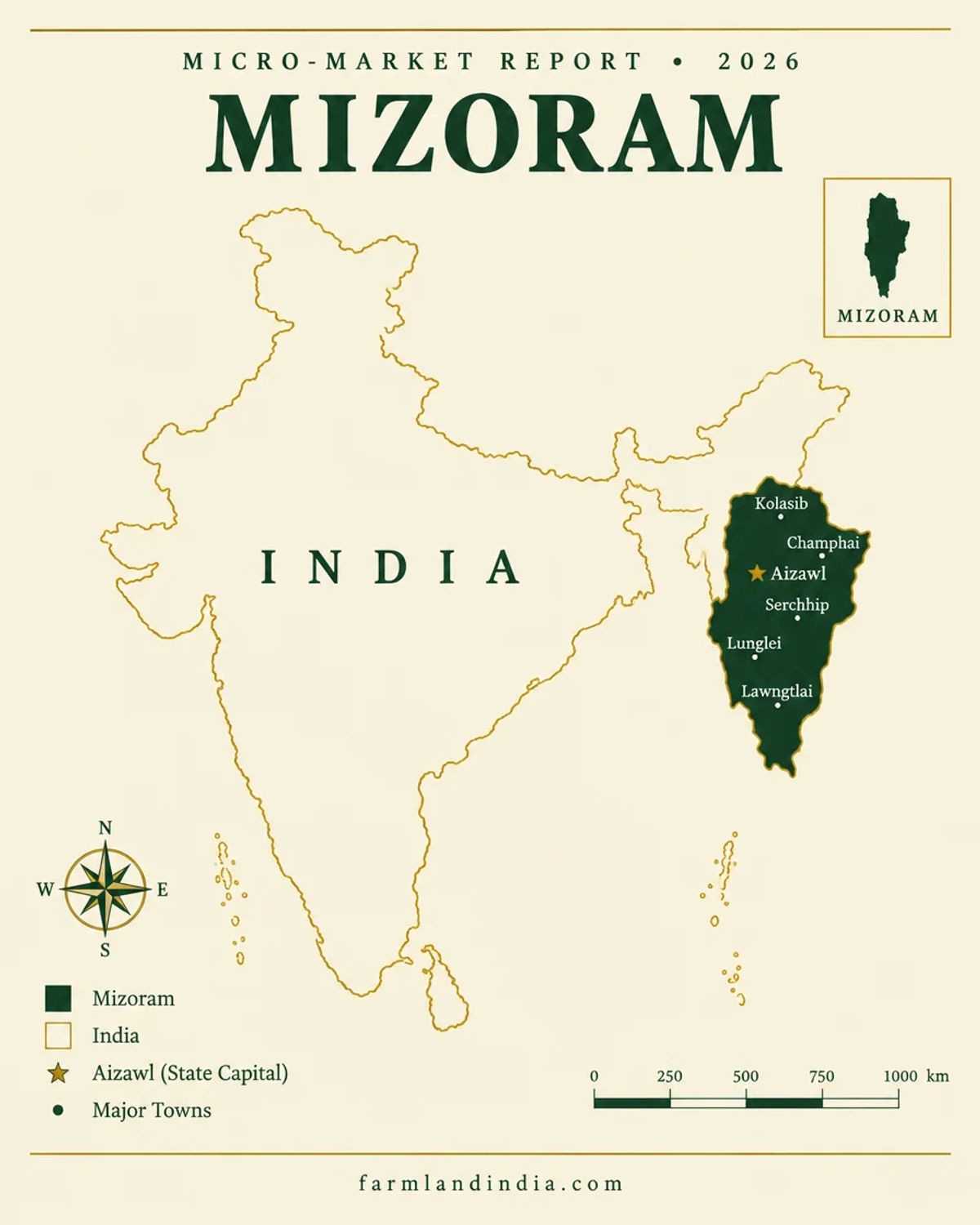
11 districts: Aizawl, Saitual, Kolasib and Mamit in the north and west, Champhai and Khawzawl along the Myanmar border, Serchhip, Lunglei and Hnahthial in the centre, and Lawngtlai and Siaha in the south
Total districts
11, after Saitual, Hnahthial and Khawzawl were made full districts in 2019 (EastMojo[10])
Who holds land
Mizo and other tribal residents, under Land Settlement Certificates (permanent, heritable and transferable) or Periodic Pattas (temporary)
Outside buyers
Generally cannot buy. Section 98(2) of the Mizoram (Land Revenue) Act, 2013 says no land shall be transferred by a tribal to a non-tribal, and registering officers must not register a transfer that breaks the section
Governing law
Article 371G of the Constitution and the Mizoram (Land Revenue) Act, 2013, amended in August 2025; a new Land Revenue Bill was being drafted in 2026
Land records
e-Ram portal (eram.mizoram.gov.in) for registration, periodic pattas, leases, house sites and name transfers, launched in November 2024
Groundwater
Stage of extraction 3.95% in 2024; all 26 blocks safe (CGWB)
Stamp duty
A 2024 amendment bill proposed 3% of market value on conveyance; ask the sub-registrar whether it was enacted
Mizoram — who can hold land
Mizoram reserves land for its tribal residents by statute as well as by the Constitution. Article 371G keeps Parliament’s laws on the ownership and transfer of land out of the state unless its Assembly decides otherwise, and the state’s Land Revenue Act says plainly that a tribal may not transfer land to a non-tribal. This block sets out the rules as written, without legal conclusions. Take advice from a lawyer in Aizawl and confirm the position with the Deputy Commissioner before you pay anything.
Article 371G: Under Article 371G(a) of the Constitution, no Act of Parliament on the religious or social practices of the Mizos, Mizo customary law and procedure, civil and criminal justice under Mizo customary law, or the “ownership and transfer of land” applies to Mizoram unless the Legislative Assembly so resolves. Central Acts already in force in the Union territory before the 1986 amendment that created the article are not affected.
No transfer from tribal to non-tribal: Section 98(2) of the Mizoram (Land Revenue) Act, 2013 says that no land within the area to which the Act extends shall be transferred by a tribal to a non-tribal. Transfers from a tribal to a tribal who is not domiciled in the state, and between non-tribals, need prior approval, and the government can bar transfers altogether in notified areas. For this purpose “non-tribal” includes companies, firms, societies, religious institutions and government bodies.
Void and unregistrable: Under Sections 98(4) and 98(5), a registering officer must not register a transfer that breaks these rules, and such a transfer is void and cannot be enforced. Section 100 makes registration compulsory for every valid transfer. A court sale of a domiciled tribal’s land to a non-tribal or non-domicile buyer also needs prior permission (Section 102), and a lender holding land as security still needs sanction before passing it to a non-tribal (Section 105).
Who counts as domiciled: Section 2(16) defines a domicile of the state as a resident whose family lived in Mizoram before 26 January 1950. Even a domiciled holder needs the competent authority’s prior permission to transfer, after which a new certificate or patta is issued in the buyer’s name.
Certificates and pattas: The Act recognises several kinds of holding. A Land Settlement Certificate (LSC) gives a permanent, heritable and transferable right; a Periodic Patta gives a temporary right with no transfer of ownership or inheritance beyond its term, and a patta granted for reclamation lapses after five years if the land is not developed. Ask which document the seller holds before anything else.
Changing land use: Under Section 18, using land for a different purpose needs an application and the government’s sanction, and unauthorised diversion can lead to eviction and a penalty of at least Rs 1,000 per square metre (Section 19). Amendments in August 2025 let Deputy Commissioners approve diversions of up to 5,000 square metres and replaced Settlement Officers with Assistant Commissioners (NE Now, May 2026).
Inner Line Permit: Mizoram lies beyond the Inner Line under the Bengal Eastern Frontier Regulation, 1873, and Indian visitors from outside the state need an Inner Line Permit. The permit allows entry and stay; it gives no right to land.
NRI and OCI buyers: Under the RBI Master Direction on immovable property, NRIs and OCIs may not acquire agricultural land, a farmhouse or plantation land in India except by inheritance. Our NRI guide covers the national rule.
- Article 371G
- Section 98(2): no tribal-to-non-tribal transfer
- Barred deeds void
- LSC vs Periodic Patta
- DC diversion up to 5,000 sq m
- ILP to enter
- NRIs: inheritance only
State overview
Mizoram — ridges, bamboo and a new railway
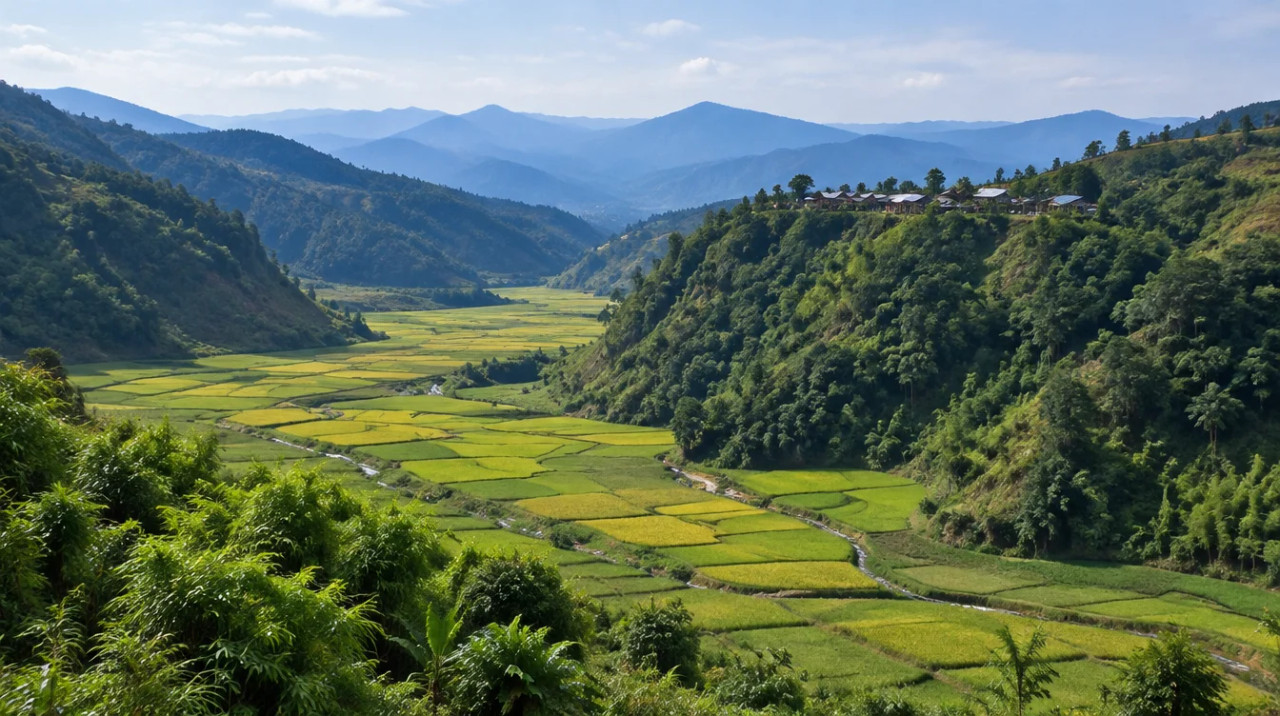
Mizoram is a hill state of about 21,081 sq km wedged between Bangladesh to the west and Myanmar to the east and south, with Assam, Tripura and Manipur to the north. It had about 10.97 lakh people at the 2011 Census. Long north–south ridges, steep valleys and bamboo forest cover most of the state; flat land is scarce, and the Champhai plain on the Myanmar border is the largest stretch of rice land. Aizawl, the capital, spreads along a ridge; Lunglei is the main town of the south, and Champhai, Kolasib, Serchhip, Saitual, Lawngtlai and Siaha are the other centres.
The state has 11 districts. Saitual (from Aizawl), Hnahthial (from Lunglei) and Khawzawl (from Champhai) were made full districts in 2019 (EastMojo, March 2019[10]). Mizos make up most of the population, alongside the Chakma, Mara, Lai and other communities, and the Lai, Mara and Chakma have Autonomous District Councils in the south. Village and church life is strong, and land is held mostly by individuals under certificates and pattas issued by the state, rather than by clans.
Interest from outside the state has grown since Aizawl joined the national rail network in September 2025, with Rajdhani and express trains to Delhi, Guwahati and Kolkata (PTI, 13 September 2025[6]). Within the state, buyers are Mizo families purchasing around Aizawl, Sairang, Kolasib, Lunglei and Champhai. For outside buyers, our pages on Manipur, Nagaland and Arunachal Pradesh describe neighbouring states where land is also reserved for local communities.
Start with the law. Section 98(2) of the Land Revenue Act bars a tribal from transferring land to a non-tribal, and registering officers are told not to register such deeds. Most outsiders therefore cannot buy land in Mizoram. A deal built on a local name, a long lease or an unregistered agreement can be declared void.
- 11 districts
- Capital: Aizawl
- Rail to Sairang since 2025
- Land for tribal residents
- Groundwater 3.95% used
- Borders Bangladesh and Myanmar
Market bands
Reported cost reference points — Mizoram
No official farmland price series is published for Mizoram, and outsiders generally cannot buy; these are the confirmed and proposed cost points.
| Item | Scope | Reported figure* | Source |
|---|---|---|---|
| Stamp duty (proposed) | Conveyance, other than a widow acting solely | 3% of market value in the 2024 amendment bill | Bill dated 1 Feb 2024[3] |
| Gift to family | Donee a family member | 1% of market value, capped at Rs 5,000 (bill) | Bill dated 1 Feb 2024 |
| Registration | Every valid transfer | Compulsory (Section 100) | 2013 Act |
| Unauthorised diversion | Use for another purpose | Eviction; penalty of at least Rs 1,000 per sq m | Section 19 |
| Diversion approval | Up to 5,000 sq m | Deputy Commissioner (August 2025 amendment) | NE Now, May 2026[8] |
| Farmland price series | State or district level | None published | Not published |
*No newspaper or official source publishes a farmland price series for Mizoram. Land changes hands between tribal residents under certificates and pattas, with the competent authority’s permission, and the market is local. The stamp duty figures above come from a 2024 amendment bill; ask the sub-registrar whether it was enacted and what rate applies today.
Transaction costs
Stamp duty & registration in Mizoram
3%
Proposed conveyance duty
Market value, in the 2024 Indian Stamp (Mizoram Amendment) Bill
5,000 sq m
DC can approve diversion
Under the August 2025 amendments to the 2013 Act
27
Services on e-Ram
Registration, pattas, leases, house sites and name transfers online
Ask the sub-registrar for the stamp duty now in force on a sale deed in Mizoram. A bill from the Land Revenue and Settlement Department dated 1 February 2024, the Indian Stamp (Mizoram Amendment) Bill, 2024, proposed duty on conveyance of 3% of market value, with a lower rate for a widow acting alone, 1% (capped at Rs 5,000) on gifts within the family and 1% (capped at Rs 1,000) on equitable mortgages, to raise revenue and align related instruments with conveyance (bill text[3]). Check with the sub-registrar whether these rates apply. Every valid transfer has to be registered under Section 100 of the 2013 Act, and the registering officer must refuse a deed that breaks Section 98. Since November 2024 the e-Ram portal has offered 27 Revenue Department services, including registration, periodic pattas, land leases, house sites and name transfers, starting with a pilot in Aizawl district and available through Common Service Centres (The Sentinel, November 2024[9]).
Connectivity
How Mizoram connects: road, rail and air
A new railway to Sairang, Lengpui airport, the Silchar–Aizawl road and a north–south highway spine.
🚗 By road
✈️ By air
🚆 By rail
🏞 Where demand is
Mizoram has little industry. Demand for land follows Aizawl and its ridges, the new rail corridor through Kolasib to Sairang, and the district towns of Lunglei and Champhai. Freight to Sairang in the line’s first year was mostly construction material, a sign of building activity around the capital. Outside the towns, land is farmed on certificates and pattas or used for jhum and plantations.
Growth catalysts
Upcoming infrastructure & developments
Status as of November 2026, with the date and source of each report.
01Rail line
Bairabi–Sairang, open since September 2025
04Catalysts
Agriculture & terrain
Soil, crops & water across Mizoram
Rice on the Champhai plain and jhum slopes, ginger, fruit and plantations on the hills.
Aizawl and the north
Aizawl, Saitual, Kolasib and Mamit hold most of the state’s people and the new railway. Around the capital, ridges are built up and farm plots on the slopes grow vegetables, ginger, banana and areca. Kolasib, on the road and rail line from Assam, has more gentle land with paddy and plantations.
- Vegetables, ginger, areca
- Rail and road corridor
- Most local demand
Champhai and the east
Champhai and Khawzawl on the Myanmar border hold the Champhai plain, the largest rice-growing flat in the state, and grow grapes, oranges and passion fruit on the hills around it. Zokhawthar is the border trade point.
- Wet rice on the plain
- Grapes and oranges
- Border trade
The south
Serchhip, Lunglei, Hnahthial, Lawngtlai and Siaha are steep and forested, with jhum, bamboo and plantations of oil palm, areca, rubber and broom grass. Lawngtlai and Siaha include the Lai and Mara autonomous council areas, and Lawngtlai borders Bangladesh and Myanmar.
- Jhum and plantations
- Bamboo forest
- Autonomous council areas
Groundwater
Groundwater is hardly used. The Central Ground Water Board put Mizoram’s stage of extraction at 3.95% in its 2024 assessment, with annual extractable resources of 0.19 billion cubic metres, extraction of 0.01 billion cubic metres and all 26 blocks rated safe (CGWB, 2024[5]). On steep hard-rock ridges, though, water comes mostly from springs, streams and rain harvesting, and summer shortages in towns are common.
Land use
Most of the state is forest and bamboo, and the steep terrain leaves little flat land for permanent fields. Jhum is still widespread, though the state has long pushed settled cultivation and plantations. Land held under a Periodic Patta can lapse if it is not developed, so a field that looks unused may be about to return to the government.
Crops
Rice is grown on jhum land and on the few flat stretches such as Champhai, with maize and vegetables on the slopes. Horticulture and plantations are the growth area: ginger, turmeric, chilli, banana, pineapple, passion fruit, oranges, grapes in Champhai, and areca, oil palm and broom grass in the south. Outside interest is more workable as buying or processing produce than as buying land.
At a glance
Mizoram’s regions side by side
| Region | Price series | Land and water | Note |
|---|---|---|---|
| North (Aizawl, Saitual, Kolasib, Mamit) | None published* | Ridges and valleys; springs | Capital; Bairabi–Sairang railway; Aizawl Bypass |
| East (Champhai, Khawzawl) | None published* | Champhai rice plain; hills | Grapes, oranges; Myanmar border trade at Zokhawthar |
| Centre (Serchhip, Lunglei, Hnahthial) | None published* | Steep hills; rain-fed | District towns; jhum and plantations |
| South (Lawngtlai, Siaha) | None published* | Forested hills; rivers | Lai and Mara autonomous council areas; border with Bangladesh and Myanmar |
*No newspaper or official source publishes a farmland price series for any part of Mizoram. Section 98(2) of the 2013 Act applies across the area to which the Act extends; in autonomous council areas, ask the council and the Deputy Commissioner which rules apply.

Farmland India view
Why investors look at Mizoram
Why the state is generally closed to outside land investment, and what local buyers watch.
Not open to outside buyers
For a non-tribal, Mizoram is generally closed to land investment. Section 98(2) bars transfers from tribals to non-tribals, such deeds cannot be registered and are void, and the Inner Line applies. Plan around partnerships, supply and processing rather than land.
The railway changed the map
The Bairabi–Sairang line put Aizawl on the national rail network in September 2025 and carried more than 15 lakh passenger journeys in its first year. For local buyers, land around Sairang, Kawnpui and the Aizawl Bypass is where the effect is likely to show, within the rules above.
Records are moving online
The e-Ram portal and the 2025 amendments make it easier to check certificates and pattas and to get diversions approved. Always confirm whether a seller holds a permanent Land Settlement Certificate or only a temporary Periodic Patta.
Plantations and horticulture
Ginger, turmeric, oil palm, areca, passion fruit and grapes are grown on small holdings. An outside business adds most value by buying and processing, with land staying with its owners.
Confirm the seller’s certificate or patta, tribal and domicile status, the competent authority’s permission and registrability before you pay anything.
STRAIGHT TALK
Risks & challenges in Mizoram
What can undo a land deal in Mizoram
Buying as a non-tribal
Section 98(2) of the 2013 Act bars a tribal from transferring land to a non-tribal, and Sections 98(4) and 98(5) make such transfers unregistrable and void. Companies and societies count as non-tribals too.
Benami and proxy deals
Putting land in a Mizo friend’s or spouse’s name leaves it legally theirs; a side agreement giving you control can be void.
Periodic Patta is not ownership
A Periodic Patta gives only a temporary right, with no transfer of ownership beyond its term, and a reclamation patta lapses if the land is not developed in five years. Do not pay an ownership price for a patta.
Diversion without sanction
Building or changing land use without approval can lead to eviction and a penalty of at least Rs 1,000 per square metre.
Landslides
Steep slopes, heavy monsoon rain and cut roads make landslides common around Aizawl and on highways. Look at the slope and drainage, not just the view.
Autonomous council areas
Parts of Lawngtlai and Siaha are under the Lai, Mara and Chakma Autonomous District Councils, which have their own role in land. Ask which authority keeps the record.
Changing law
A new Land Revenue Bill and a Survey and Settlement Operations Bill were being prepared in 2026, and stamp duty rates were proposed for change in 2024. Recheck the rules on the day of any transaction.
Permits
Indian visitors from outside the state need an Inner Line Permit. An NRI or OCI cannot buy farmland in India except by inheritance.
Who to contact
Local revenue & registration offices
Land administration in Mizoram runs through the Land Revenue and Settlement Department and the district administrations. In each district the Deputy Commissioner is the chief revenue authority and, since the August 2025 amendments, can approve diversion of land use up to 5,000 square metres; Assistant Commissioners have taken over the work of Settlement Officers. The Controller of Land Records issues Land Settlement Certificates, and deeds are registered at the sub-registrar office. In the south, the Lai, Mara and Chakma Autonomous District Councils have their own land functions. Many services, including name transfers and patta applications, are on the e-Ram portal (eram.mizoram.gov.in) and at Common Service Centres. Inner Line Permits are issued by the state online and at entry points.
COMMON QUESTIONS
Frequently asked questions
Everything buyers, NRIs and investors ask before their first reviewed farmland purchase in Mizoram.
Visit full wiki01 of 04
Can a non-Mizo buy land in Mizoram?
Generally no. Section 98(2) of the Mizoram (Land Revenue) Act, 2013 says no land shall be transferred by a tribal to a non-tribal, and a transfer that breaks the rule cannot be registered and is void. Confirm any proposal with the Deputy Commissioner.
02 of 04
What is the difference between an LSC and a Periodic Patta?
A Land Settlement Certificate gives a permanent, heritable and transferable right. A Periodic Patta gives a temporary right with no transfer of ownership beyond its term, and a reclamation patta lapses if the land is not developed within five years.
03 of 04
What is the stamp duty on land in Mizoram?
A 2024 amendment bill proposed 3% of market value on conveyance. Check with the sub-registrar whether it was enacted and what the current rate is.
04 of 04
Can NRIs buy farmland in Mizoram?
No. RBI rules bar NRIs and OCIs from acquiring agricultural land, farmhouses or plantation land anywhere in India except by inheritance, and the state’s own rules apply as well.
Transparency
Sources and references
Law
- [1]Constitution of India: Article 371G — constitutionofindia.net
- [2]Mizoram (Land Revenue) Act, 2013 (PRS copy) — prsindia.org
- [3]Indian Stamp (Mizoram Amendment) Bill, 2024 (PRS copy) — prsindia.org
- [4]RBI: Master Direction on acquisition and transfer of immovable property under FEMA — rbi.org.in
Government
- [5]CGWB: Dynamic Ground Water Resources of Mizoram, 2024 — cgwb.gov.in
News
- [6]The Week (PTI): PM launches Mizoram’s first railway line and other projects (13 Sep 2025) — theweek.in
- [7]Morung Express: Bairabi–Sairang line completes one year (Sep 2026) — morungexpress.com
- [8]NE Now: Mizoram Land Revenue Bill and 2025 amendments (27 May 2026) — nenow.in
- [9]The Sentinel: Mizoram launches e-Ram portal for land records (6 Nov 2024) — sentinelassam.com
- [10]EastMojo: full district status for three new districts (15 Mar 2019) — eastmojo.com
Further reading
Data-currency note: sources were read in November 2026. Rules, fees and infrastructure timelines change often; check the linked source and the relevant office before relying on any figure.
For developers
Ready to explore Mizoram farmland?
Browse reviewed projects and individual land parcels across Mizoram — or if you own land here, list it with platform review and reach serious buyers.