
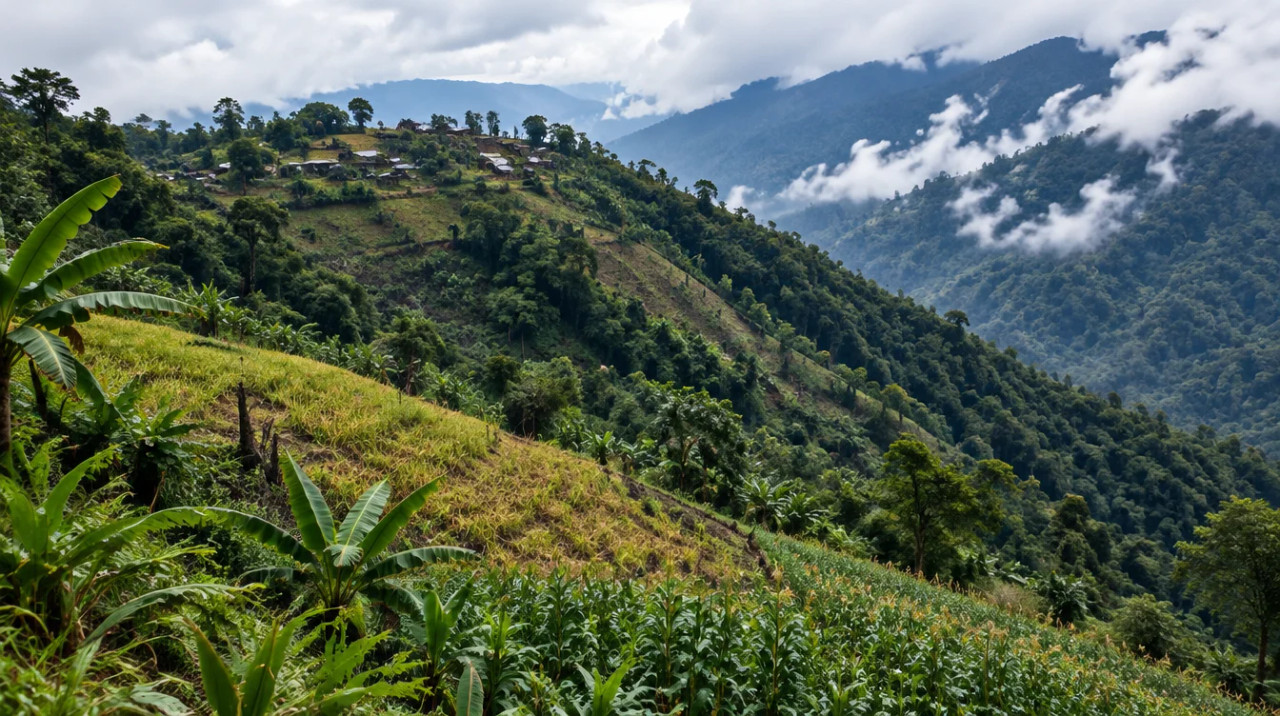
District guide
Buying Land in Shamator
Nagaland’s 16th district, created in 2022 from Tuensang and Kiphire land: Yimkhiung, Tikhir and Sumi hills on the NH-202 line, with village-held land closed.
Jan 2022
District notified (Home Dept notice)
34,223
Population, 2011 (Eastern Mirror)
37
Recognised villages (Eastern Mirror)
4.72%
Nagaland groundwater extraction (CGWB 2024)
District land record — Shamator
Rev. 2026 · Farmland India desk
State
Nagaland
Status
Hill district notified in January 2022 from Tuensang, with six villages moved from Kiphire (The Morung Express, 21 Jan 2022[6])
Key markets
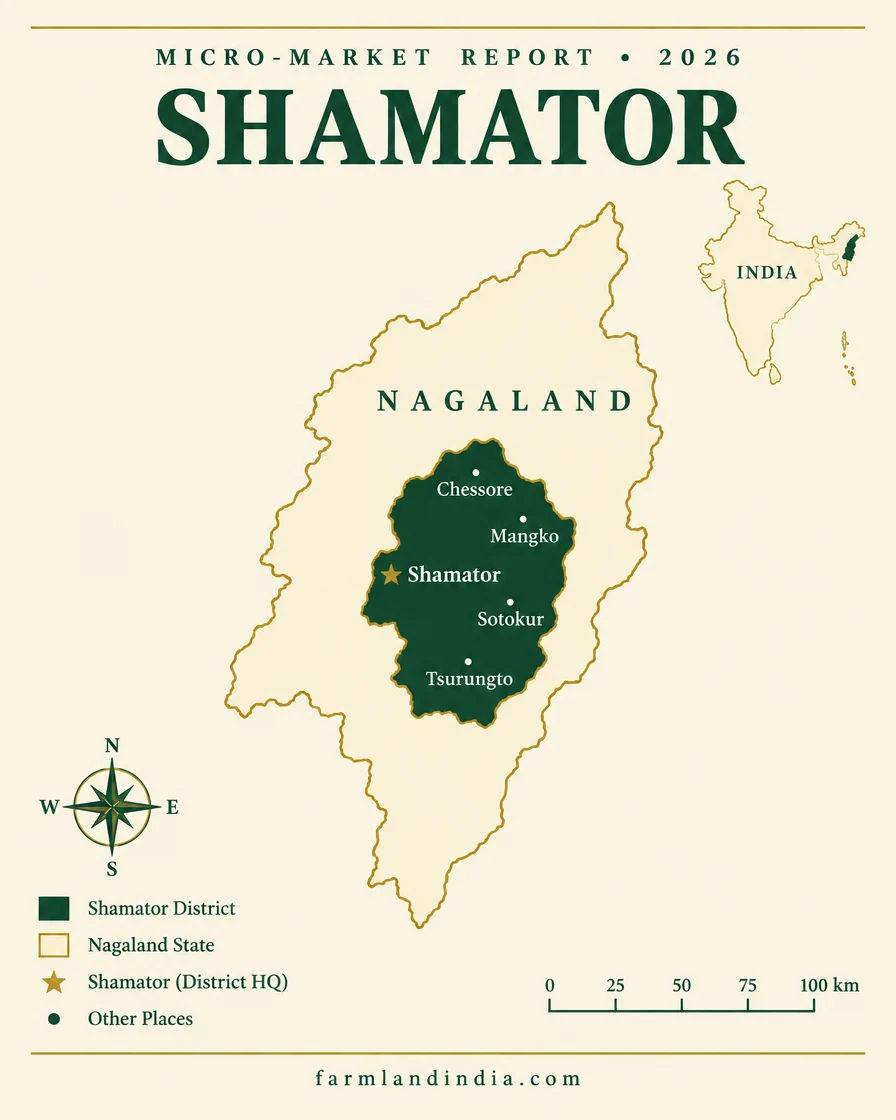
Shamator town · Chessore · Mangko · Sotokur · Tsurungto
Demand anchors
Village and farm land · district offices · the NH-202 corridor
Location
Eastern Nagaland between Tuensang and Kiphire districts on the NH-202 line (Swarajya[5])
Size and population
34,223 people in 2011 and 37 recognised villages per Eastern Mirror (Eastern Mirror[7]); no area is stated
Pricing unit
No official farmland price series is published for Shamator. Ask the sub-registrar for recent registered sale values in the village you are looking at. Quote land per acre and ask the DC office for any circle rate
Local units
Revenue records use the Revenue Chitha; village land is often described by clan or village area
Land records
Revenue Chitha, patta and mutation through the DC’s office; DLRS publishes the rules at dlrs.nagaland.gov.in.
Land law is state law. These rules are maintained on the Nagaland page and apply to every district within it.
Shamator — who can hold land
Nagaland protects land more completely than almost any other state. The Constitution keeps Parliament’s laws on the ownership and transfer of land out of the state unless its own Assembly decides otherwise, most land belongs to villages, clans and families under customary law, and a state law bars people who are not indigenous inhabitants from acquiring land in notified areas. This block sets out the rules as written, without legal conclusions. Get advice from a lawyer in Kohima or Dimapur and confirm with the Deputy Commissioner before any payment.
Article 371A: Under Article 371A(1)(a) of the Constitution, no Act of Parliament on the religious or social practices of the Nagas, Naga customary law and procedure, civil and criminal justice under customary law, or the “ownership and transfer of land and its resources” applies to Nagaland unless the Legislative Assembly of Nagaland by a resolution so decides. In practice, land in most of the state is held and passed on under the customary law of each tribe and village.
The 1978 restriction: Section 162(2), added to the Nagaland Land and Revenue Regulation by the 1978 amendment, says that a person other than an indigenous inhabitant of Nagaland may not acquire or possess land by transfer, exchange, lease or settlement in areas constituted into belts or blocks, whatever any other law, usage, contract or agreement says. Section 162(3) bars the registration of documents for such transactions (Directorate of Land Records and Survey compilation).
Banks and mortgages: A 2002 amendment lets owners mortgage land to nationalised banks, registered cooperative societies and approved lenders, but those lenders may not transfer the land to a non-indigenous person without the previous sanction of the State Government or an authority it appoints. Recovery of a loan does not open a back door to outside ownership.
Dimapur’s tribal belt: On 22 November 1979 the state constituted a tribal belt in the Dimapur sub-division, naming the Naga, Kuki, Kachari, Garo and Mikir (Karbi) communities for protection, and allotments of government land in Dimapur to non-indigenous persons came to need Cabinet approval. From 1992 the state banned allotment of government land to private individuals (state land orders, 1973–2016).
Inner Line Permit: Nagaland lies beyond the Inner Line under the Bengal Eastern Frontier Regulation, 1873, and Indian visitors from outside the state need an Inner Line Permit; Dimapur was brought under the permit regime in 2019. On 16 June 2026 the Gauhati High Court dismissed challenges to the Dimapur notifications, holding that the 1873 Regulation remains law, that the permit system regulates rather than prohibits, and that classifying residents by the date they settled is reasonable (Kiron Paira v Union of India, PIL 22/2025). An ILP gives no right to land.
Valuation and registration: The Nagaland Stamp (Prevention of Under-valuation of Instruments) Rules, 2015 require a market-value statement with each deed, the land area as per the Revenue Chitha, and a note of whether agricultural land is cadastral or not. Deeds must be presented within four months. For Dimapur the state fixed minimum circle rates in 2015, and no transaction may be registered below them.
Who is indigenous: Whether a person counts as an indigenous inhabitant is decided by the state’s own rules and certificates, not by long residence alone. The High Court’s June 2026 judgment noted the classification of residents by settlement date: before 1 December 1963, between 2 December 1963 and 21 November 1979, and later.
NRI and OCI buyers: Under the RBI Master Direction on immovable property, NRIs and OCIs may not acquire agricultural land, a farmhouse or plantation land in India except by inheritance. A Naga NRI who inherits land under custom is in a different position from an outsider; our NRI guide explains the national rule.
- Article 371A
- Customary land
- Section 162(2): no transfer to non-indigenous
- No registration of barred deeds
- ILP, including Dimapur
- Dimapur tribal belt, 1979
- NRIs: inheritance only
Shamator — district-specific notes
Shamator follows the state rules in full. The notes below sit on top of the state-level legal block above, which applies here without change.
⚠ Where land lies in a notified belt or block, a person who is not an indigenous inhabitant cannot acquire it. Section 162(2) of the 1978 Act bars acquisition or possession by transfer, exchange, lease or settlement, and section 162(3) says those documents are not to be registered (DLRS Act and Rules[1]). The 1979 Tribal Belt was set up in Dimapur Sub-Division. Land here is village, clan or family land under customary law.
⚠ Most land is not on an open market at all. It is held by villages, clans and families under customary law, and the 371A protection means central laws on land ownership and transfer do not apply unless the Assembly decides so. The ordinary route is a family or clan transfer, with village council consent and a written record, not a public sale. The district’s main communities are Yimkhiung, Tikhir and Sumi Nagas (Eastern Mirror[7]). Villages and clans hold the land, and village councils are the first stop for any land question.
⚠ Land can also be taken for projects. The Gauhati High Court (Kohima Bench) held in November 2026 that Nagaland can acquire land under its 1965 Act, but compensation must follow the 2013 central Act (Morung Express[3]). If a plot lies near a planned road or rail alignment, ask the acquisition office before paying an advance.
⚠ Visiting and working here needs an Inner Line Permit. The Gauhati High Court upheld the Bengal Eastern Frontier Regulation, 1873 on 16 June 2026 and treated the permit system as regulation, not prohibition (LiveLaw[2]).
⚠ Acquisition is already a live issue. The Centre has allowed Nagaland to use its 1965 acquisition Act, not the National Highways Act, for the NH-202 widening (Swarajya, 24 Aug 2026[5]), and Eastern Mirror says acquisition is a roadblock in Shamator because compensation proposals are seen as high.
NRI and OCI buyers should read can NRIs buy agricultural land in India first. The Nagaland state page sets out Article 371A and the customary-law basics.
- Indigenous inhabitants only
- Customary land
- Village council consent
- Inner Line Permit
- Acquisition
District overview
Shamator — A 2022 hill district on the NH-202 line: Yimkhiung, Tikhir and Sumi villages, and land held in village hands
Shamator was notified in January 2022 as Nagaland’s 16th district, taking the Shamator and Chessore sub-divisions (with Mangko EAC circle), most of Sotokur EAC circle and Tsurungto EAC circle from Tuensang, plus six villages moved from Kiphire. The headquarters is Shamator town (The Morung Express[6]). It was inaugurated on 4 March 2022 (Eastern Mirror[7]).
Buyers are Naga residents and eligible local communities. The 1978 Act bars a person who is not an indigenous inhabitant from acquiring land in belts and blocks (DLRS Act and Rules[1]), and customary ownership means villages and clans usually decide. Outsiders, including NRIs and family offices, should treat this page as a map of the rules, not an invitation to buy.
Eastern Mirror reports 34,223 people at the 2011 Census, 37 recognised villages and a district that still needs substantial infrastructure; some offices still sit under Kiphire and Tuensang (Eastern Mirror[7]). The district lies on the NH-202 highway, which is slated for widening (Swarajya[5]).
- Shamator town
- Chessore
- Mangko
- Sotokur
- Tsurungto
Transaction costs
Stamp duty & registration in Shamator
Stamp duty
Conveyance of land
Ask the sub-registrar for the rate in force.
Registration fee
Notified 15 July 2015
The DLRS compilation lists a fee notification dated 15 July 2015.
Valuation rules
Stamp (Prevention of Under-valuation) Rules, 2015
Market value stated in Form A; register within four months. Minimum circle rates were fixed for Dimapur mauza.
Because belt and block land cannot be registered to a non-indigenous buyer, a deed the registrar will not register is not a title, whatever the agreement says. Ask the sub-registrar for the stamp percentage and any circle rate before you agree a price, and keep the Form A statement with the deed.
Know the belt
What is moving prices in Shamator
Five named places and one highway corridor; no listing-site prices are used.
Shamator town
District headquarters
The headquarters of the new district, where offices are still being set up (Eastern Mirror[7]).
Check: village council consent, slope stability and the office that holds the plot’s records
Chessore and Mangko
Sub-division and EAC circle
The Chessore sub-division, including Mangko EAC circle, came from Tuensang (The Morung Express[6]).
Check: which circle holds the village records after the 2022 transfer
Sotokur
EAC circle
Most of Sotokur EAC circle is in Shamator, but Chingmelen, Helipong and Sipongsang villages stay out of it (The Morung Express[6]).
Check: whether the village is inside the district boundary
Tsurungto
EAC circle
Tsurungto EAC circle includes six villages moved from Kiphire in 2022 (The Morung Express[6]).
Check: which district’s records the village uses and the Kiphire-side boundary
Asking prices
No official farmland price series is published, so the price table is empty. Do not rely on asking prices; compare any figure with the minimum circle rate, registered deeds in the same village and the community’s own view of the plot.
Connectivity
How Shamator connects — road, rail and air
Shamator lies on the NH-202 line in eastern Nagaland; the nearest airport and railhead are at Dimapur.
By road
By air
By rail
Drive times are not given because no source was found. Hill roads are slow in the monsoon, so allow for landslide delays.
Growth catalysts
Upcoming infrastructure & developments
Project status as reported, with the source and date for each
00Open
02Catalysts
Agriculture & terrain
Soil, crops & water in Shamator
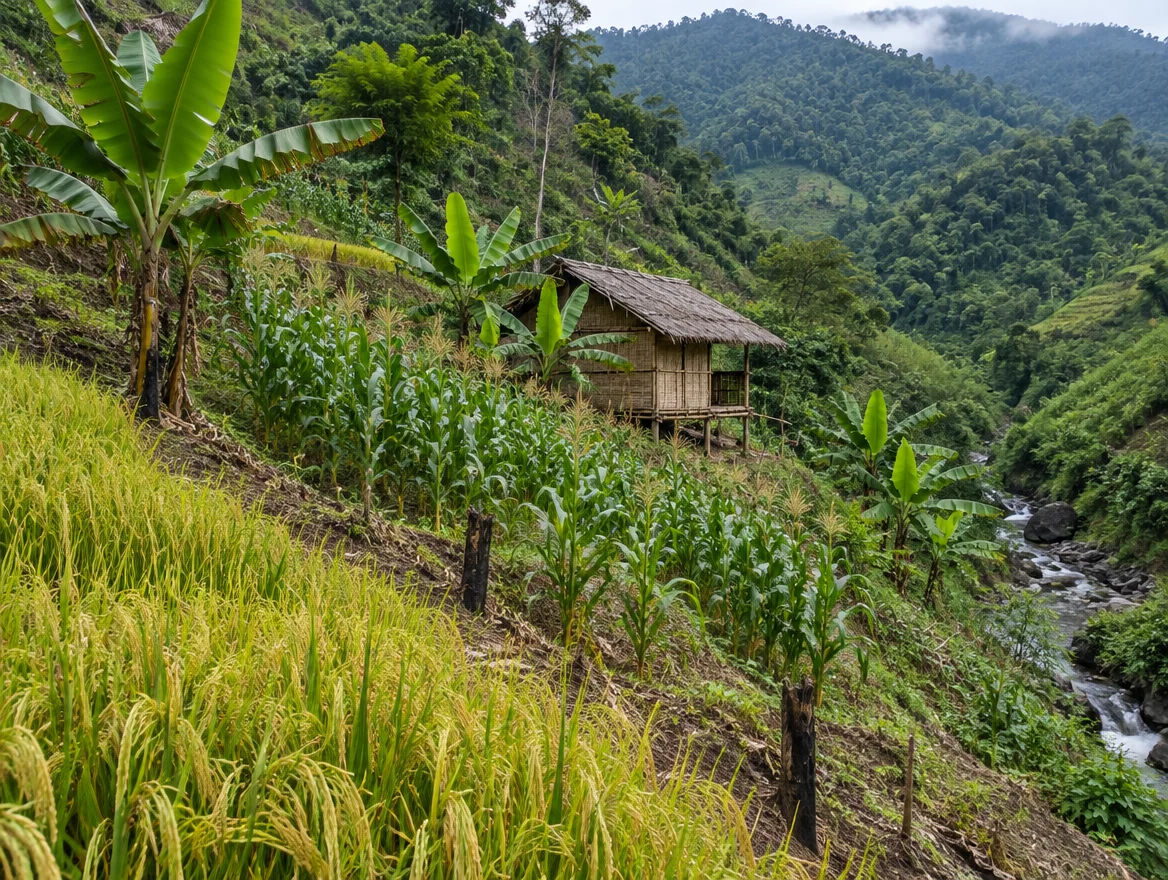
No district plan exists for Shamator; the Tuensang plan, which covered most of the area, shows jhum paddy and maize on steep hills.
Crops
The ICAR-CRIDA plan for Tuensang pre-dates Shamator. For the older district it lists jhum paddy on about 10,550 ha and maize on about 10,100 ha, with wet and terrace rice on about 3,520 ha (ICAR-CRIDA plan[8]).
- Jhum paddy and maize dominate
- Kholar (French bean), potato and ginger are secondary
- These are not Shamator figures; ask the local agriculture office for village-level data
Climate and water
The Tuensang plan lists drought as a regular hazard and hail as a risk for maize and rice, and does not list floods (ICAR-CRIDA plan[8]).
- Heavy rain has damaged NH-202 in the region, per the maintenance report ([The Morung Express](https://www.morungexpress.com/morth-approves-major-maintenance-for-nh-202-across-four-districts-in-nagaland))
- Nagaland stage of groundwater extraction: 4.72% ([state, CGWB 2024](https://cgwb.gov.in/cgwbpnm/public/uploads/documents/17435861881237953287file.pdf))
Soil
Hill soils in the region are typically acidic and erosion-prone on slopes, so take a local soil test before any planting.
Land use
Forest and fallow land is usually held by clans and communities and is not for sale.
At a glance
Shamator vs. nearby districts
| District | Land and water | What links it to Shamator |
|---|---|---|
| Tuensang | The parent district; see the [Tuensang page](/locations/nagaland/tuensang) | Parent district |
| Kiphire | Six villages moved from Kiphire into Shamator | Neighbouring district |
| Meluri | The 17th district, also on NH-202 | Further along the NH-202 line |
Compare neighbouring districts as direction, not exact numbers: plan boundaries and data years differ, and no plan covers Shamator as a district.
Farmland India view
Why investors look at Shamator
Five reasoned points for Shamator, each tied to a source on this page.
A very new, small market
A district of about 34,000 people in 2011 (Eastern Mirror[7]) has few transactions, and eligibility limits keep demand local.
Highway widening is the catalyst
The NH-202 widening is announced, not yet under way (Swarajya[5]), and acquisition is already contested, so timing is uncertain.
Offices still being set up
Some district offices still sit under Kiphire and Tuensang (Eastern Mirror[7]), which slows records and services.
Little published price data
No official farmland price series is published, so a buyer who is eligible should lean on registered deeds and village records.
Confirm the record of rights (jamabandi and chitha), mutation, zoning and acquisition status directly — these are not certified by Farmland India’s review.
STRAIGHT TALK
Risks & challenges in Shamator
District-specific risks. Read the Nagaland state page for the general risks on ceiling, conversion and records.
Acquisition and compensation
Compensation proposals are seen as high by the government, and acquisition is described as a roadblock (Eastern Mirror[7]). A plot beside NH-202 may be acquired.
Boundary and records after the split
Villages moved from Tuensang and Kiphire in 2022, and some offices are still outside the district. Confirm which office holds the plot’s papers.
Buying where the law bars the buyer
Belt and block land cannot go to a non-indigenous person, and such documents are not registered (DLRS Act and Rules[1]). A seller who offers it to an outsider is offering something the registrar will refuse.
Community and clan land
Land held by villages and clans needs consent through the village council. A signature from one family member is not enough, and unrecorded boundary disputes are common.
Acquisition for roads and rail
Land can be acquired under the 1965 Act with compensation under the 2013 Act (Morung Express[3]). Plots beside a planned alignment may be acquired.
Who to contact
Local revenue & planning offices
Deputy Commissioner, Shamator (shamator.nic.in) and the circle or sub-divisional offices for patta, chitha and mutation; the Sub-Registrar for registration; the Department of Land Resources and Survey (dlrs.nagaland.gov.in) for the rules. Ask each office for its written position on the plot.
COMMON QUESTIONS
Frequently asked questions
Everything buyers, NRIs and investors ask before their first reviewed farmland purchase in Shamator.
Visit full wiki01 of 04
Can an outsider buy land in Shamator?
Generally not. A person who is not an indigenous inhabitant cannot acquire land in notified belts and blocks, and such documents are not registered. Most land is village, clan or family land under customary law. Confirm any plot with the Deputy Commissioner.
02 of 04
When was Shamator created?
The Governor’s notice was reported on 21 January 2022. Shamator became the 16th district, mostly from Tuensang, with six villages moved from Kiphire, and was inaugurated on 4 March 2022.
03 of 04
Is there a published price per acre?
The price table is empty. Ask the DC office for any circle rate and compare registered deeds in the same village.
04 of 04
Is land acquisition a problem here?
Eastern Mirror reports that land acquisition is a major roadblock because the district’s compensation proposals are seen as high by the government. Check any plot near a project.
Transparency
Sources and references
Law and courts
- [1]DLRS Nagaland: Act and Rules compilation (1978 Act, 2015 Stamp Rules) — dlrs.nagaland.gov.in
- [2]LiveLaw: Gauhati High Court, Kiron Paira v Union of India, 16 Jun 2026 — livelaw.in
- [3]The Morung Express: Gauhati High Court on 1965 Act and compensation, Nov 2026 — morungexpress.com
Government
- [4]CGWB: Nagaland groundwater resource assessment 2024 — cgwb.gov.in
News
- [5]Swarajya: NH-202 land acquisition under state law, 24 Aug 2026 — swarajyamag.com
- [6]The Morung Express: Nagaland government notifies areas under Shamator district — morungexpress.com
- [7]Eastern Mirror: Shamator district still struggling with infrastructure three years after inception — easternmirrornagaland.com
- [8]ICAR-CRIDA: Nagaland district agriculture contingency plan, Tuensang (regional context) — icar-crida.res.in
- [9]morungexpress.com: The Morung Express, 7 Aug 2026 — morungexpress.com
Project status, the benchmark valuation and land rules change often; check the linked source and the relevant office before relying on any figure.
For developers
Ready to explore Shamator farmland?
Browse reviewed projects and individual land parcels across Shamator — or if you own land here, list it with platform review and reach serious buyers.