
State guide
Buying Land in West Bengal
No farmer-only bar, but a family ceiling, Collector’s conversion permission, bargadar rights, leasehold tea land and a land policy being rewritten in 2026.
23
Districts
88,752 sq km
Area
91.3 million
Population (Census 2011)
45.63%
Groundwater extraction (2024)
State land record — West Bengal
Rev. 2026 · Farmland India desk
Regions (informal)
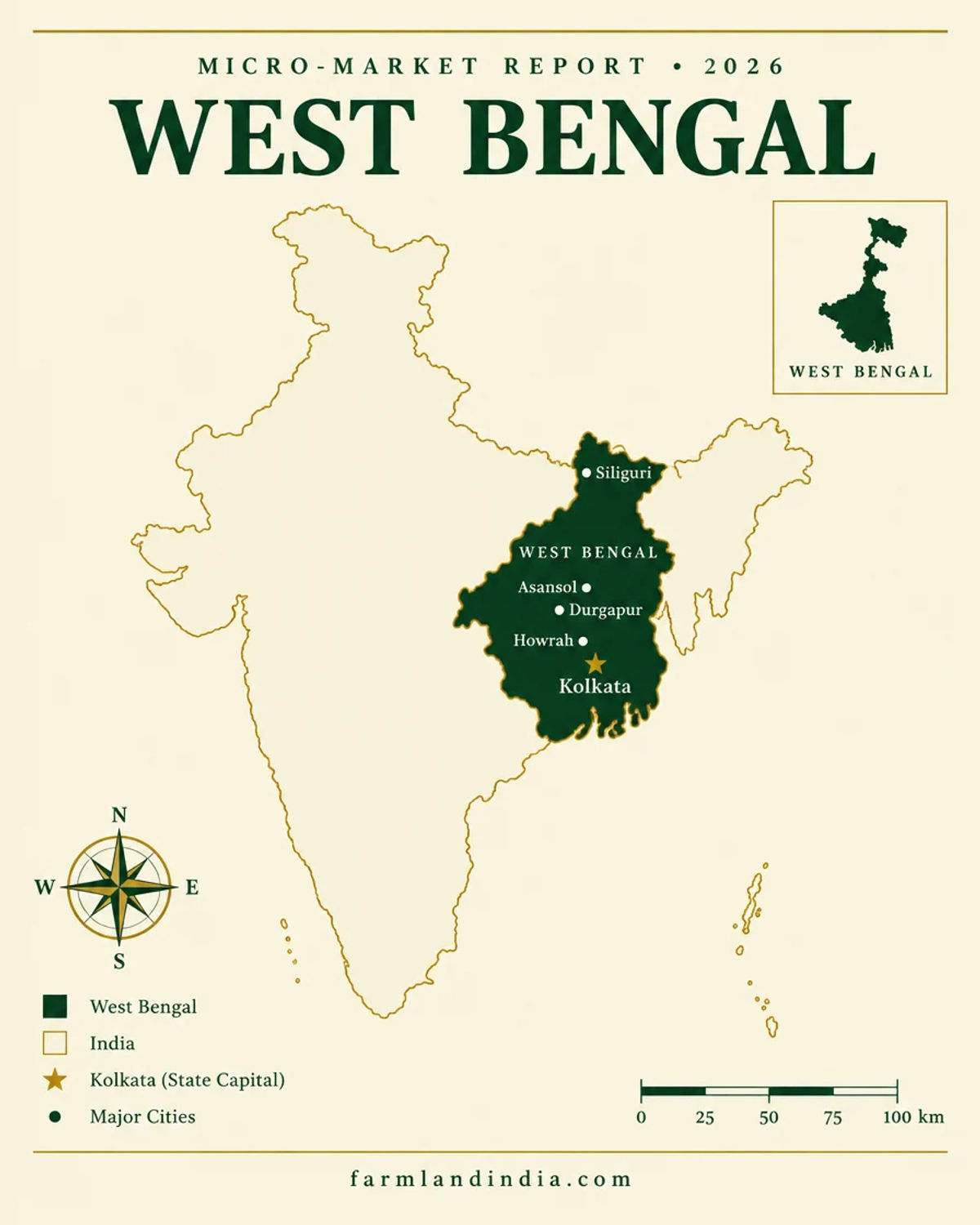
North Bengal (the Darjeeling and Kalimpong hills, the Terai and Dooars, Cooch Behar and the Dinajpurs), the Gangetic plain and Kolkata belt, the Sundarbans delta coast, and the western Rarh uplands of Purulia, Bankura and Jhargram
Total districts
23 (ThePrint, 21 June 2026); the 2026-27 budget proposes five more (ThePrint, 22 June 2026)
State area
88,752 sq km, of which 11,879 sq km (13.38%) is forest (Government of West Bengal)
Groundwater extraction
45.63% of the extractable resource, 2024; 239 of 345 assessment units safe and 60 saline (CGWB, December 2024)
Land records
Khatian (খতিয়ান), plot (dag) details and mutation through the Land and Land Reforms Department’s Banglarbhumi portal; deeds through the registration portal; see our Banglarbhumi guide
Governing acts
West Bengal Land Reforms Act, 1955 (India Code): ceiling in Chapter IIB (Section 14M), change of use in Sections 4C and 4D, Scheduled Tribe transfers in Section 14C, pre-emption in Section 8. Darjeeling hills: Gorkhaland Territorial Administration Act, 2011 (Home and Hill Affairs Department)
Stamp duty (conveyance)
5% in gram panchayat areas and 6% in corporation, municipal and notified areas, plus 1% where market value exceeds Rs 1 crore; registration fee 1% (Registration Directorate presentation); see our stamp duty guide
Market value (government rate)
Duty is charged on the market value assessed by the Directorate of Registration and Stamp Revenue. Check the value for your plot through the department’s portal before the deed is drafted; it is a floor for duty, not a price quote
West Bengal — land purchase legal rules
West Bengal has no rule, in the Act text we reviewed, that limits farmland purchases to farmers. What controls a purchase is the family ceiling in Chapter IIB of the 1955 Land Reforms Act, the Collector’s permission to change land use, pre-emption claims by co-sharers and neighbours, bargadar rights that stay with the plot, and a land policy the new state government says it will rewrite. The points below summarise the law as published. Confirm each against the current gazette text and a local advocate before you pay a token amount.
Who can buy agricultural land: We found no provision in the Land Reforms Act, 1955 that limits purchases of agricultural land to agriculturists, unlike Gujarat. A non-farmer can buy, but the sale must stay inside the ceiling, must survive any pre-emption claim under Section 8 (co-sharer raiyats (রায়ত), bargadars and adjoining raiyats may apply to take a transferred share by depositing the price), and must pass the registration check that the intended use fits the land’s recorded class and Sections 4B, 4C, 4E and 49.
Ceiling limits: Chapter IIB (Sections 14J to 14Z) caps what a raiyat may own, counted in standard hectares. For a family of two to five members the limit is 5 standard hectares of irrigated land (12.35 acres) or 7 of non-irrigated land (17.30 acres); larger families get more, up to 7 and 9.8; any other raiyat, including a company, is capped at 7 and 9.8 (Bengal Chamber of Commerce land handbook, undated). Section 14M is the operative provision. Barga land is outside the ceiling, and tea gardens, mills and factories may hold extra land the state considers necessary. A bill published in February 2023 would add townships to the Section 14Y exemptions (PRS Legislative Research).
Conversion to non-farm use: Section 4C requires the Collector’s permission before a raiyat changes the area, character or use of land, and Section 4D makes a breach an offence punishable by up to three years in prison, a fine, or both, on a complaint by the Collector or an authorised officer (India Code). On the Malda district administration page (undated), the Block office (BL&LRO) decides up to 10 decimals, the Sub-Divisional office (SDL&LRO) from 11 to 99 decimals and the District office (DL&LRO) from 1 acre. In rural areas that page lists Rs 20 per decimal (Rs 2,000 an acre) to convert agricultural land to homestead use and Rs 50 per decimal (Rs 5,000 an acre) for industrial or commercial use.
Urban agglomerations and the Kolkata belt: Section 4E makes a transfer of agricultural land or an orchard inside a designated urban agglomeration invalid without the Collector’s written order, and the registering authority may not register it without that order (India Code). Land inside the Kolkata Metropolitan Area is also subject to the planning rules of KMDA, a statutory authority under the Urban Development and Municipal Affairs Department. Ask for any Section 4E order and the land-use certificate with the title papers.
Mutation and the record of rights: A registered deed does not update the khatian by itself. The Malda page states that land registered at a District Sub-Registrar or Additional District Sub-Registrar office is mutated automatically, and mutation can also be applied for on Banglarbhumi or at the BL&LRO; processing fees are waived for agricultural land that stays in agriculture, on a self-declaration (notification of 11 June 2018). The 2023 bill would also remove time limits for correcting the published record under Section 51A (PRS). Our Banglarbhumi guide shows how to read the khatian and check mutation.
Bargadars (sharecroppers): Operation Barga recorded about 15.2 lakh bargadars (বর্গাদার). A barga right is inheritable, cannot be sold or transferred, and attaches to the plot rather than to ongoing farming, so a buyer takes the bargadar on as a virtual co-holder (Swarajya, 4 September 2026). Check the record of rights for a barga entry and get a written statement from the BL&LRO before you pay.
Scheduled Tribe land: Section 14C limits how a Scheduled Tribe raiyat may transfer land. A sale to someone outside the community needs the Revenue Officer’s prior written permission, given only if no Scheduled Tribe buyer will pay the fair market price and the sale serves a listed purpose (India Code). Trace the ownership history of the plot, and if any past owner was a Scheduled Tribe raiyat, ask for the Section 14C permission.
Vested and ceiling-surplus land: Ceiling-surplus land vests in the state and is distributed to landless, Scheduled Caste and Scheduled Tribe households (handbook). Such plots may carry transfer restrictions and are not ordinary market land. Ask for the allotment order and the khatian type, and look for a vested (khas) entry on Banglarbhumi.
Tea garden land: Tea estates in the Dooars, Terai and Darjeeling stand on leasehold land. The tea tourism policy lets planters use 15% of a garden, up to 150 acres, for non-tea projects (PTI via Devdiscourse, 31 October 2019), and a March 2025 notification said no freehold settlement will be granted for tea land under cultivation (The Statesman). A lessee has no freehold title to pass on, so treat any offer of a “tea garden plot” as a lease question, not a sale.
Darjeeling hills and the GTA: The Darjeeling, Kalimpong and Kurseong subdivisions, plus specified mouzas in Siliguri, sit under the Gorkhaland Territorial Administration, created by a 2011 Act (Home and Hill Affairs Department). The department page does not list land powers, so confirm with the BL&LRO or the GTA secretariat at Darjeeling which office keeps the record and which rules apply to a hill plot before you pay.
Policy in flux, 2026: The government that took office this year has announced direct purchase of land for industry (11 July 2026), land pooling (17 August 2026) and a land bank from unused public land, and says it will review the Urban Land (Ceiling and Regulation) Act, 1976 (The Hans India, Telangana Today, The Statesman). The Finance Minister has said land laws will be rationalised, without naming sections (Business Today, 21 August 2026). We found no notified change to the Chapter IIB ceiling; check again before signing.
Documents to ask for: Before paying, ask for the latest khatian copy and plot information from Banglarbhumi, the mouza map, registered title deeds going back as far as they exist (ideally 30 years), the mutation record, up-to-date land revenue receipts, a written statement from the BL&LRO on barga and vested land, an encumbrance search at the registration office, and any Section 4C or 4E orders.
NRI and OCI buyers: Under the RBI Master Direction on immovable property, NRIs and OCIs may not buy agricultural land, a farmhouse or plantation property. They can inherit it or receive it as a gift from a resident relative, and may sell it only to a resident Indian citizen. Land lawfully converted to non-agricultural use is treated differently, so check the conversion order against the exact plot. Our NRI guide covers the options.
- No farmer-only rule found
- Ceiling: Section 14M
- Conversion: Section 4C
- Bargadar rights
- ST land: Section 14C
- Tea land is leasehold
- NRI agri: barred (RBI)
- Records via Banglarbhumi
State overview
West Bengal — from the Himalayan foothills to the Sundarbans
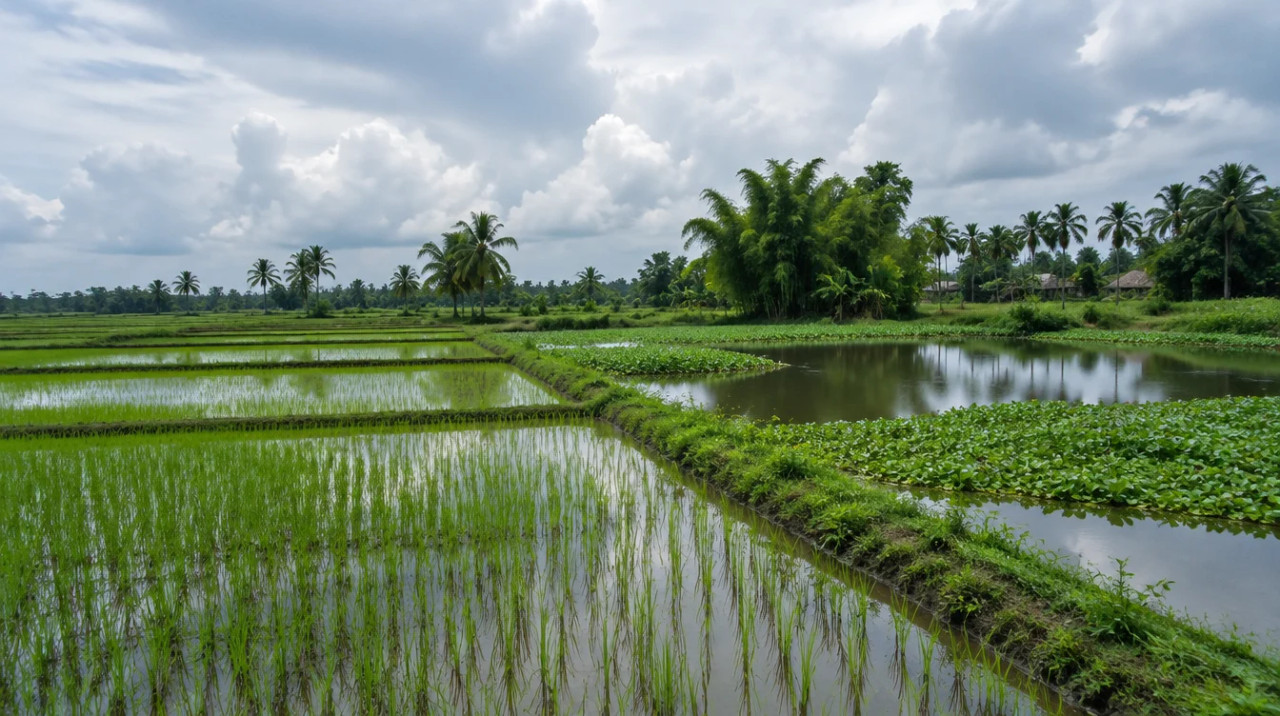
West Bengal runs from the Himalayan foothills to the mangrove coast. Within 88,752 sq km it holds the Darjeeling and Kalimpong hills, the tea belt of the Terai and Dooars, the Gangetic plain around Kolkata, the red-soil Rarh uplands of Purulia and Bankura, and the Sundarbans delta. Rainfall averages 1,830 mm a year statewide, but 2,486 mm in sub-Himalayan Bengal against 1,502 mm in the Gangetic region, and the principal crops the state lists are boro and monsoon rice, jute, maize, wheat, potato, mustard, pulses, sugarcane and tea (wb.gov.in). There are 23 districts today. Alipurduar (2014), Kalimpong, Jhargram and Paschim and Purba Bardhaman (2017) are the newest, with Jhargram and Paschim Bardhaman notified in April 2017 (RBI lead bank letter). The 2026-27 budget proposes Kolkata, Sundarbans, Arambagh, Jangipur and Basirhat as new districts, which would take the count to 28 (ThePrint, 22 June 2026).
Land here is small, regulated and contested. The average operational holding was 0.76 hectares in the 2015-16 Agriculture Census (Lok Sabha reply), about 15.2 lakh bargadars hold recorded rights on other people’s plots, and tea gardens sit on leasehold land. Agriculture produced 19.3% of state GSDP in 2022-23, against a states’ average of 15.8% (NITI Aayog). Typical buyers are Kolkata families looking for weekend farmhouse land within two or three hours of the city, investors following the new expressway alignments, and operators in tea, fisheries and horticulture. NRIs cannot buy agricultural land under FEMA, so they come in through converted land or inheritance.
For a buyer, 2026 is the year to watch. A new state government has announced direct land purchase for industry, land pooling and a land bank, and says land laws will be rationalised. None of that has yet changed the Land Reforms Act, the ceiling or the conversion route, so a purchase today still rests on the khatian, the mutation, the Section 4C and 4E papers and a clean barga and vested-land position. Announcements move asking prices before they move law. This page tags every project below with its status and a dated source, and it quotes no price band because we found no sourced price series for farmland in the state.
- Eastern India
- Kolkata
- Gangetic delta
- Darjeeling hills and Dooars
- Banglarbhumi
- Land policy review 2026
Market bands
Reported valuation reference points — West Bengal
There is no sourced price series for West Bengal farmland, so no price bands are shown. The table lists the official cost references we could source; market value is the government’s assessment for duty, not a market price.
| Item | Scope | Reported figure* | Source |
|---|---|---|---|
| Stamp duty | Conveyance, gram panchayat areas | 5% of market value | Registration Directorate |
| Stamp duty | Conveyance, corporation, municipal and notified areas | 6% of market value | Registration Directorate |
| Additional stamp duty | Where market value exceeds Rs 1 crore | Plus 1 percentage point | Registration Directorate |
| Registration fee | Deeds registered in the state | 1% of market value | Registration Directorate |
| Conversion fee | Rural agricultural land to homestead use | Rs 20 per decimal (Rs 2,000 an acre) | Malda district page |
| Mutation fee | Agricultural land that stays in agriculture | Waived on self-declaration | Malda district page |
| Market value | Government assessment used to charge duty | Set by the Registration Directorate | Registration portal |
*Reported figures are for orientation; the Directorate presentation is undated. Confirm the rate and any surcharge on the registration portal before the deed is drafted, and compare registered deeds in the same mouza (revenue village) for a realistic price. The market value is a floor for duty, not a quote for the land.
Transaction costs
Stamp duty & registration in West Bengal
5%
Stamp duty in gram panchayat areas
as stated in the Registration Directorate presentation
6%
Stamp duty in corporation, municipal and notified areas
plus 1% where market value exceeds Rs 1 crore
1%
Registration fee
same presentation, which is undated
The Directorate of Registration and Stamp Revenue’s presentation, hosted on a government site in September 2024 and carrying no date, gives the duty structure as 5% in rural (gram panchayat) areas, 6% in urban areas (corporations, municipalities and notified areas), an extra 1% where market value exceeds Rs 1 crore, and a 1% registration fee (presentation). Our stamp duty guide traces the Rs 1 crore threshold, which replaced Rs 40 lakh in 2018 and Rs 30 lakh in 2015, and notes that a temporary 2-point rebate brought in during 2021 was reported as discontinued from 1 July 2024; we saw no later notification restoring it. Duty is charged on market value rather than on the price written in the deed, so a deed registered below the assessed value can be questioned. Mutation fees are waived for agricultural land that stays in agriculture, and conversion fees are separate (Malda district page). Pay duty and fees through the registration portal, and ask the sub-registrar’s office for the market value of your plot before the deed is drafted.
Connectivity
How West Bengal connects: road, rail, air and ports
Expressways, airports, rail and the Kolkata Metro that link north and south Bengal.
🚗 By road
✈️ By air
🚆 By rail
🚢 Ports and waterways
Kolkata’s dock system and Haldia carry the state’s sea cargo, and the Prime Minister’s 14 March 2026 package for Bengal included shipping and port projects (All India Radio). The proposed Tajpur deep-sea port is covered under upcoming infrastructure. Land near a confirmed interchange, airport or metro station is a different market from land a village road away, but only an alignment notified for acquisition gives a buyer something real to price in.
Growth catalysts
Upcoming infrastructure & developments
Status as of November 2026, maintained by the Farmland India research desk. Government-announced timelines are not guaranteed.
03Expressways
At land acquisition, tendered or announced stage
09Catalysts
Agriculture & terrain
Soil, crops & water across West Bengal
Crop belts, water quality and cyclone exposure. Water figures are from the Central Ground Water Board assessment for 2024; rainfall is from the state government.
North Bengal: hills, Terai and Dooars
Rainfall is heaviest here, 2,486 mm a year in sub-Himalayan Bengal (wb.gov.in). The Darjeeling hills and the Dooars are tea country, on leasehold garden land that is not sold as farmland (The Statesman). The Terai and Cooch Behar plains grow paddy, jute and potato, and the hill rivers bring flood and bank-erosion risk to low plots.
- Tea on leased garden land, not a freehold market
- Paddy, jute and potato on the plains
- Check flood-plain and forest-edge status of every plot
Gangetic plain and the Kolkata belt
The Hooghly and Bhagirathi plain, with about 1,502 mm of rain a year (wb.gov.in), carries the state’s densest farming: monsoon and boro rice, jute, potato, vegetables and pulses. Several districts here are also the ones where the Central Ground Water Board found arsenic above the 0.01 mg/L limit: Howrah, Malda, Murshidabad, Nadia and the two 24 Parganas (CGWB, December 2024).
- Rice, jute, potato and vegetable rotations
- Fringe land converts fast inside the Kolkata Metropolitan Area
- Test borewell water for arsenic before building
Sundarbans and the coast
The delta is held by about 3,500 km of embankments. Cyclone Amphan in May 2020 breached several, and an expert quoted by Down To Earth said saline ingress even 20 km inland can leave farmland unproductive for a long time; most boro paddy had already been harvested when it struck (Down To Earth).
- Paddy and fish ponds behind embankments
- Salinity and cyclone exposure after every major storm
- Coastal Regulation Zone and mangrove limits near the tidal line
Groundwater
The 2024 assessment puts extraction at 45.63% of the annual extractable resource of 23.56 billion cubic metres, against 10.75 billion cubic metres drawn. Of 345 assessment units, 239 are safe, 36 semi-critical, 10 critical and 60 saline (CGWB, December 2024). Ask for the block’s category before paying for a tubewell-irrigated farm.
Arsenic, fluoride and salinity
The same report lists arsenic above 10 ppb in Howrah, Malda, Murshidabad, Nadia and North and South 24 Parganas (84 of 959 samples), fluoride above 1.5 mg/L in Birbhum, Dakshin Dinajpur and Paschim Bardhaman, and high salinity in Bankura, Howrah, Malda, Purulia and South 24 Parganas (CGWB). Test the water before planning irrigation or drinking supply.
Rainfall
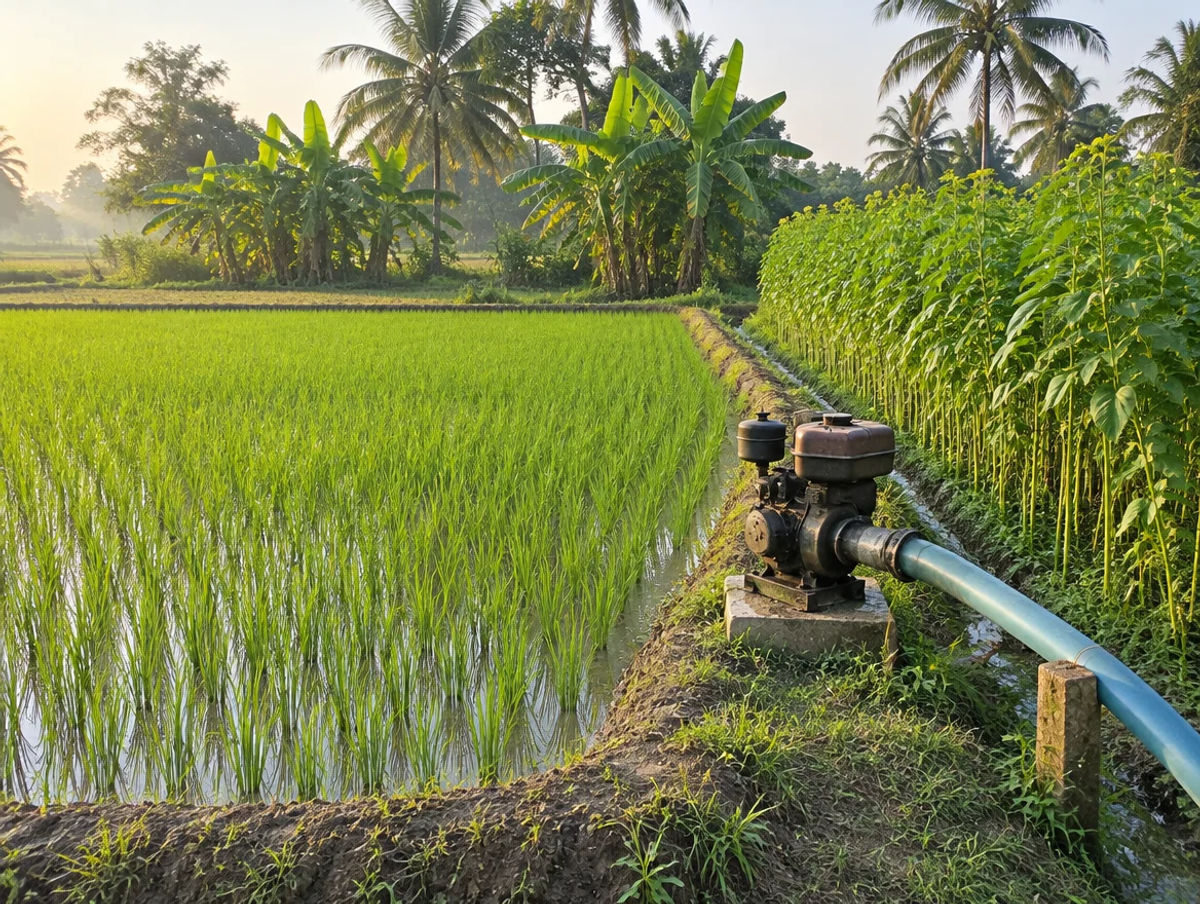
Normal rainfall is 1,830 mm a year statewide: 2,486 mm in sub-Himalayan Bengal and 1,502 mm in the Gangetic region (wb.gov.in). Monsoon rice dominates, and boro is irrigated through the dry months, so a working tubewell and pump power matter for a farm plot.
At a glance
West Bengal’s regions side by side
| Region | Price series | Water and irrigation | Note |
|---|---|---|---|
| Hills and Dooars: Darjeeling, Kalimpong, Jalpaiguri, Alipurduar | None sourced* | Rain-fed; hill rivers; 2,486 mm of rain | Leasehold tea land, GTA in the hills, Bagdogra terminal works |
| Cooch Behar and the Dinajpurs | None sourced* | Plains rivers and tubewells; fluoride in Dakshin Dinajpur | Corridor north of Moregram not yet tendered |
| Malda and Murshidabad | None sourced* | Tubewells; arsenic reported in both; saline samples in Malda | Eastern end of the Kharagpur–Moregram section |
| Kolkata belt: Hooghly, Howrah, Nadia and the 24 Parganas | None sourced* | Dense tubewell irrigation; arsenic in Howrah, Nadia and the 24 Parganas | KMDA planning, Section 4E, airport metro, Dankuni industry |
| Sundarbans coast: South 24 Parganas and Purba Medinipur | None sourced* | Embankment-protected; salinity after cyclones | CRZ limits; Tajpur port tender cancelled |
| Rarh uplands: Purulia, Bankura, Jhargram, Paschim Medinipur, Birbhum, Paschim Bardhaman | None sourced* | Salinity in Bankura and Purulia; fluoride in Birbhum and Paschim Bardhaman | Varanasi–Kolkata alignment, Raghunathpur steel plant, Scheduled Tribe land |
*No sourced price series for West Bengal farmland, so none is shown. Water-quality notes are from the CGWB 2024 report and rainfall from wb.gov.in; project notes summarise the infrastructure section above. For prices, compare registered deeds in the same mouza.
Farmland India view
Why investors look at West Bengal
Five points this desk weighs for West Bengal, each tied to a source on this page.
New highways are redrawing access
Three expressway corridors cross the state, from the Varanasi–Kolkata alignment through Purulia, Bankura, Hooghly and Howrah to the Kharagpur–Moregram section toward Siliguri. They sit at acquisition, tender or announced stage, so the opportunity is in notified alignments, not in headlines.
Kolkata’s edge now runs on the metro
The Yellow Line reached the airport in August 2025 and the Orange and Purple lines are being completed. Land inside the Kolkata Metropolitan Area still has to clear Section 4E and KMDA planning, so investable parcels there are usually converted plots rather than farmland.
The government is rewriting land policy
Direct purchase, land pooling and a land bank have been announced, and the ceiling-related laws are under review. Terms are unpublished. Watch the gazette: a scheme that lets owners keep a stake in pooled land could change how farmland near industrial sites is valued.
North Bengal has a logistics and tourism case
Bagdogra’s new terminal and the Siliguri gateway support the Terai and Dooars, but tea land is leasehold and the hills have a separate administration. Look for freehold agricultural parcels on the plains, not garden land.
Small holdings and sharecroppers shape every deal
With an average holding of 0.76 hectares and about 15.2 lakh recorded bargadars, clean title is the scarce asset. A plot with a clear khatian, a mutation, no barga entry and no vested-land flag is worth paying a little more for.
Confirm the khatian, the mutation and any Section 4C or 4E order on Banglarbhumi before you pay a token amount.
STRAIGHT TALK
Risks & challenges in West Bengal
Read these before shortlisting. They apply across West Bengal; local conditions vary by block.
Land policy is moving
Direct purchase, pooling and a land bank were announced between June and August 2026, with terms still unpublished (Telangana Today). Expect rules to change, and make any offer subject to documents, not to announcements.
Bargadar claims
A barga right stays with the plot and cannot be transferred, so a buyer inherits the bargadar (Swarajya). Get a written statement from the BL&LRO and walk the plot with the neighbours.
Records that do not match
RS and LR numbers, old and current plot numbers, and plots shared across several khatians are common (our Banglarbhumi guide). Match the deed, khatian, mouza map and field boundary, and confirm mutation after registration.
Ceiling and surplus land
Land above the Section 14M limit is liable to vest in the state and be redistributed (handbook). Ask the seller for the family’s holding statement and trace the plot back to its recorded owner.
Unconverted use
Building on farmland without Section 4C permission is an offence under Section 4D, and inside an urban agglomeration the sale itself needs a Section 4E order (India Code). A farmhouse plot is farmland until an order says otherwise.
Cyclones, floods and salt
Amphan breached embankments in the Sundarbans in 2020 and let saline water into farmland (Down To Earth). Ask villagers which plots flooded in the last cyclone, and check the embankment and CRZ position.
Arsenic in groundwater
The CGWB found arsenic above the limit in Howrah, Malda, Murshidabad, Nadia and the two 24 Parganas (CGWB). Test borewell water before building a farmhouse or planning a drinking supply.
Tea and Scheduled Tribe land
Tea land is leasehold, with no freehold settlement for land under cultivation (The Statesman), and Section 14C limits sales of Scheduled Tribe land (India Code). Walk away from a seller who cannot show the lease or the Section 14C permission.
Who to contact
Local revenue & registration offices
Land administration runs through the Land and Land Reforms Department, whose Banglarbhumi portal serves the record of rights, plot information, mutation and conversion. The Block Land and Land Reforms Officer (BL&LRO) keeps the khatian and plot maps, mutates records and decides small conversions; the Sub-Divisional and District Land and Land Reforms Officers handle larger conversions, and the Collector issues orders under Sections 4C and 4E. The Directorate of Registration and Stamp Revenue runs deed registration through its registration portal, with District Sub-Registrar and Additional District Sub-Registrar offices; register your mobile number there to receive mutation updates. Common Service Centres and the e-District portal also take applications, and district sites such as Malda publish fee schedules. In the hills, ask whether the plot lies in a GTA area (Home and Hill Affairs Department) before choosing the office.
COMMON QUESTIONS
Frequently asked questions
Everything buyers, NRIs and investors ask before their first reviewed farmland purchase in West Bengal.
Visit full wiki01 of 04
Can a non-farmer buy agricultural land in West Bengal?
We found no provision in the Land Reforms Act, 1955 that limits purchases to agriculturists. The limits are the family ceiling in Chapter IIB, the Collector’s permission under Section 4C before any non-farm use, and a Section 4E order inside urban agglomerations.
02 of 04
What is the land ceiling in West Bengal?
For a family of two to five members the limit is 5 standard hectares of irrigated or 7 of non-irrigated land, with higher caps for larger families and other raiyats. Barga land is outside the ceiling, and the state can exempt tea gardens, mills and factories.
03 of 04
How do I check a khatian and mutation in West Bengal?
Search the khatian or plot number by district, block and mouza on the Banglarbhumi portal, and get a certified copy from the Block Land and Land Reforms Office. Land registered at a sub-registrar office is mutated automatically, and you can also apply online or at the BL&LRO.
04 of 04
Can NRIs buy farmland in West Bengal?
No. Under the RBI’s FEMA rules NRIs and OCIs cannot buy agricultural land, a farmhouse or plantation property. They can inherit it or receive it as a gift from a resident relative, and may sell it only to a resident Indian citizen.
Transparency
Sources and references
Law and courts
- West Bengal Land Reforms Act, 1955 (India Code text)
- Bengal Chamber of Commerce: A handbook of land in West Bengal (undated)
- PRS Legislative Research: West Bengal Land Reforms (Amendment) Bill, 2023
- RBI Master Direction on acquisition and transfer of immovable property
Government
- Banglarbhumi, Land and Land Reforms Department
- West Bengal registration portal
- Directorate of Registration and Stamp Revenue: registration system presentation (undated)
- e-District West Bengal
- Malda district administration: mutation and conversion services
- Government of West Bengal: facts and figures
- Home and Hill Affairs Department: Gorkhaland Territorial Administration
- KMDA, Kolkata Metropolitan Development Authority
- CGWB: Dynamic Ground Water Resources and Ground Water Quality of West Bengal, 2024
- NITI Aayog: Macro and Fiscal Landscape of West Bengal, 2025
- Lok Sabha: Agriculture Census 2015-16 holdings (Unstarred Question 1123)
- Union Cabinet: Bagdogra airport civil enclave
- RBI lead bank letter on new districts, 21 September 2017
- All India Radio: Prime Minister’s Kolkata projects, 14 March 2026
News
- ThePrint: why West Bengal needs more districts, 21 June 2026
- ThePrint: Bengal budget announces 5 new districts, 22 June 2026
- Business Today: Kashi–Bengal expressway put on fast track, 11 May 2026
- Business Today: West Bengal to rationalise land laws, 21 August 2026
- The Statesman: land bank in the 2026-27 budget
- The Hans India: direct land purchase policy, 11 July 2026
- Telangana Today: new investment and land policies, 17 August 2026
- Free Press Journal: Purulia projects, 18 August 2026
- The Week: Purulia steel plant, 18 August 2026
- Outlook Business (PTI): Tajpur port, 6 May 2026
- The Metro Rail Guy: Kharagpur–Siliguri Economic Corridor, updated February 2025
- NBMCW: four greenfield expressways in West Bengal, 2 December 2022
- Swarajya: Operation Barga and land reform, 4 September 2026
- Swarajya: Bagdogra airport terminal, 16 February 2025
- Swarajya: Kolkata Metro outlook, 2026
- The Week (PTI): Kolkata Metro stretches flagged off, 22 August 2025
- Devdiscourse (PTI): tea garden land decision, 31 October 2019
- The Statesman: tea tourism policy amended, March 2025
- Down To Earth: Amphan and the Sundarbans, May 2020
Further reading
- Banglarbhumi, West Bengal land records (Farmland India wiki)
- Stamp duty in West Bengal (Farmland India wiki)
- Can NRIs buy agricultural land in India? (Farmland India wiki)
Data-currency note: sources were read in November 2026. Infrastructure timelines, state land policy and the new-district proposal change often; check the linked source and the relevant office before relying on any figure.
For developers
Ready to explore West Bengal farmland?
Browse reviewed projects and individual land parcels across West Bengal — or if you own land here, list it with platform review and reach serious buyers.