Agricultural Land Valuation: How Land Is Priced (2026)
The factors that move farmland prices in North India, how circle rates differ from market value, and a method to check an asking price.
Agricultural land has no listed price. It is priced by negotiation, and the asking figure often reflects hope more than evidence. This guide explains what actually moves the price of farmland (कृषि भूमि का मूल्य) in North India: location, access, water, land type, legal status and nearby projects. It also shows how to check an asking price without relying on a broker's story. We give no price per acre, because we have no verified, current figure we can stand behind.
Why there is no single price
Two fields in the same village can differ by a wide margin. One is on a metalled road with a clean title; the other is behind another farmer's plot with a disputed boundary. The market treats them as different assets. Prices also move with news: a new expressway announcement, a master plan, or a land-use change can raise asking prices faster than real transactions follow.
Because land is rarely traded on an exchange, there is no daily price to look up. Buyers must build a price from evidence. We do not publish rates per acre by district on this page. Where we have price-pattern research it is in separate analysis, and we do not repeat unverified figures here.
The factors that set price
| Factor | Why it matters | How to check |
|---|---|---|
| Location and distance from a town or highway | Access to markets and services | Drive it; check on a map |
| Road access and frontage | A legal right of way is worth paying for; no access is a major discount | Check the revenue map and a physical visit; see cadastral maps |
| Water and irrigation | Irrigated land is valued above unirrigated land in law and in practice | Canal, tubewell and borewell records; see water rights and borewells |
| Soil and crop history | Affects farming income | Girdawari and local farmers |
| Shape and size | Regular plots are easier to use and resell | Measure on site; see demarcation |
| Title and records | Disputed or clouded title cuts price sharply | See how to verify land title |
| Legal status and land use | Zones decide what can be built; see land use zones | Master plan; see how to read a master plan |
| Nearby projects | Highways, airports and industry raise expectations | Official alignment and notification only |
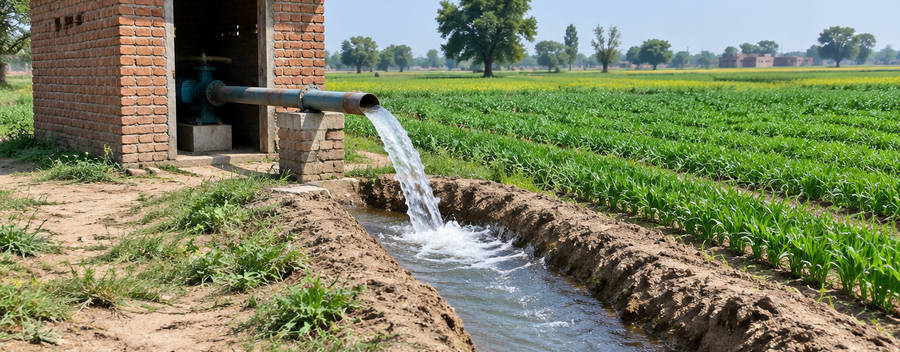
Irrigation is a useful example of how the law itself values land. The Haryana ceiling Act we read sets a different permissible area for two-crop irrigated, one-crop irrigated and other land, and treats 5 hectares under private tubewells as equal to 4 hectares under canal irrigation (section 4). The UP ceiling Act also separates irrigated land, defined by khasra records. Both show that irrigation class is a value driver. See Haryana ceiling and UP ceiling.
Circle rate versus market value
The circle rate (collector rate) is a minimum value set by the state for stamp duty purposes. Market value is what a willing buyer pays a willing seller. They can differ widely. Circle rates in some areas lag the market, and in others exceed it. Read our full explainer, circle rate vs market rate, and use the lookups for Uttar Pradesh and Haryana.
The circle rate is a floor for duty, not a valuation. If you register at a value below the circle rate, the stamp authority may question it; see stamp duty and registration charges by state. We could not confirm how every state treats agricultural land in its circle rate tables, so check your district's list.
A method to test an asking price
- Collect comparables. Find recent registered sales of similar land within a few kilometres. Ask the sub-registrar office what can be inspected; see encumbrance certificate guide for how records are searched. Treat WhatsApp and portal asking prices as asks, not sales.
- Adjust for differences. Make a list: road, water, size, title, land use, shape. Discount for problems.
- Cross-check with the circle rate. If the asking price is several times the circle rate, ask what justifies it.
- Ask local farmers. A farmer in the next field will often know what recent deals closed at.
- Reduce for time and cost. Registration, mutation, legal review and possible conversion all add cost. See land registration process.
- Be ready to walk away. A clean title and a fair price beat a fast deal.
Never value on a promise
If the price depends on a conversion, a road not yet built or an expressway not yet open, price in the risk. Confirm the notification or order itself, not a broker's statement.
Price traps in speculative zones
- Corridor hype. Prices near announced highways can run ahead of reality. Confirm the alignment from official sources.
- Layouts sold as farmland. Small plots sold with roads and gates may be unauthorised layouts. See land fraud in India.
- Cash components. Part payment in cash exposes you to legal and tax risk and to disputes over the real price. See benami and land.
- GPA sales. A power of attorney sale is not a clean transfer; see GPA land sales risk.
- Double sale. The same land sold twice; see double sale and forged records.
Price, tax and the true cost
The final cost of land includes stamp duty, registration, legal fees and sometimes tax. Tax on a purchase or sale of agricultural land depends on the land type and your status. See capital gains on agricultural land, tax benefits of agricultural land and TDS on property purchase. Tax rules change; check the current year. The Income-tax Act, 2025 replaced the 1961 Act for tax years starting 1 April 2026, so section numbers on older pages may differ. We did not print any rate or threshold here.
If you plan to change land use later, the permission and its cost can change the real price; see change of land use in India. And if you want a loan against the land, valuation by the lender may be lower than your price; see land loans in India.
What we could not confirm
We did not open an official valuation manual or a state guideline on agricultural land valuation, and we do not state any price per acre, per bigha or per kanal. We also could not confirm how every state sets circle rates for agricultural land. The Haryana and UP Acts were opened for their irrigation classes only. Local units vary; before comparing prices, convert to one unit using the definition in the record; see land measurement units in India.