Possession Certificate and Allotment Letter for Land (2026)
What these two papers prove, what they do not, and why neither replaces a registered sale deed.
Land buyers are often shown a possession certificate (कब्जा प्रमाणपत्र) or an allotment letter (आवंटन पत्र) as proof of ownership. Both have a place, but neither is a title deed. This guide explains what each document is, who issues it, what it can prove and how to treat it in a purchase.
What each document is
A possession certificate records that a named person is in possession of described land on a stated date. It is usually issued by a revenue officer such as the tehsildar or patwari, or by a builder, society or development authority when handing over a plot. An allotment letter is issued by an authority, society or developer to say that a plot or unit has been allotted to a person, usually subject to payment and conditions. Names, forms and issuing offices vary by state; we could not confirm a single official form for either document across the states.
| Point | Possession certificate | Allotment letter |
|---|---|---|
| Issued by | Revenue officer, authority or developer | Authority, society or developer |
| Says | Who is in possession on a date | Plot or unit has been allotted, with conditions |
| Transfers ownership? | No | No |
| Next document | Sale deed or lease deed, registered | Sale deed or lease deed after conditions are met |
Why neither is proof of ownership
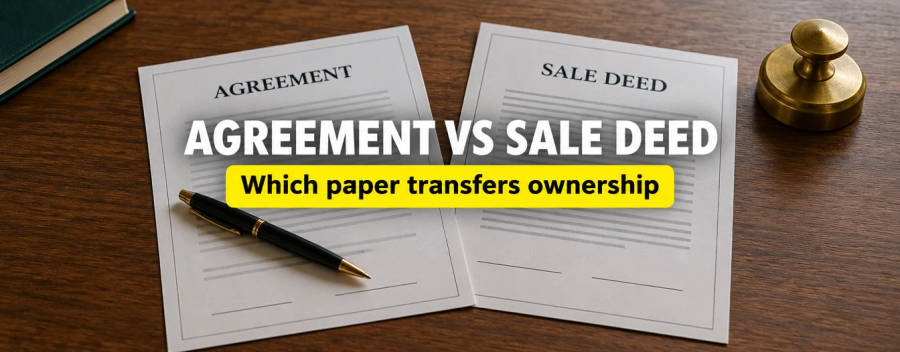
Possession and ownership are different things. A person can be in possession as owner, tenant, licensee or trespasser. The Registration Act, 1908, as published by the UP department, lists non-testamentary instruments that create, assign or extinguish rights in immovable property among documents to be registered (section 17(1)(b)), and section 49 limits the effect of unregistered documents. A possession certificate or allotment letter does not itself create the title that a registered deed does; a letter of allotment is, in effect, the start of a process that ends in a deed. Read our pages on agreement to sell vs sale deed and how to verify land title.
Where you meet them in practice
- Plots allotted by a development authority, housing board or industrial authority, where an allotment letter is followed by a lease or conveyance deed. Check the terms of the authority; we could not confirm them for each state.
- Co-operative society or private colony plots, where the letter is issued by the society or developer.
- Government land or land allotted under a scheme, where transfer may be restricted or need permission.
- Resale of a plot where the seller holds only an allotment letter and not yet a registered deed.
- Land loans, where a bank may ask for a possession certificate along with the title papers; see land loans in India.
Checks if the seller offers one of these papers
- Ask who issued the paper. Contact that office and ask whether it is genuine and still in force.
- Check that the name, plot number, area and location in the paper match the land you are being shown.
- Check for unpaid dues, transfer fees, or conditions such as time to build. An allotment can be cancelled for breach.
- Ask whether a registered deed has been executed in the seller's favour. If not, the seller cannot give you better than a right to ask for it.
- Check the revenue record or authority record for the land. See checking land records online.
- Check whether the authority permits transfer to a third party, and what permission is needed.
- Search for mortgages and cases; see the EC guide and checking land for litigation.
Pay the authority, not the seller, for transfer fees and dues
Ask for a no-dues certificate or a receipt from the issuing authority before you pay the seller, and keep the receipts with the deal papers.
Possession on the ground
Possession matters in a purchase, but it must be checked in the field and in the records. Visit the land with the revenue map, ask neighbours who farms it, and compare with the cultivation record, such as the girdawari in states where it is kept. See land demarcation (nishandehi) for how boundaries are fixed. If someone else is in actual possession, do not pay until the position is clear; read land fraud in India.
A possession certificate issued at the time of sale is useful as a record that the buyer was handed the land on a date. Ask for one from the seller, signed by witnesses, along with the registered deed. It supports your position, but the deed remains the proof of ownership.
What this means for farmland buyers
Most farmland sits in the revenue record, not in an authority's allotment records, so the main proof is the registered sale deed together with the mutation entry. Possession certificates in farmland are commonly issued by the tehsil or patwari for a particular purpose such as a loan or a dispute, and we could not confirm a standard form. Allotment letters appear more in developer farmland projects, farmhouse plots and colonies. If you are buying such a plot, ask for the project approvals, the layout, and the title chain for the whole parent land. See farmhouse rules in India and RERA and farmland. For the buyer's overall list, use the due diligence checklist.
Red flags
- Possession certificate issued by someone who is not a revenue officer or the project owner.
- An allotment letter from a developer that has no registered title to the parent land.
- Allotment in a name that is not the seller's, with no recorded transfer.
- Plot area or number that differs between the letter, the layout map and the site.
- A seller who offers the paper and refuses to show the registered deed or the revenue record.
- Pressure to pay in cash or to sign a power of attorney in place of a deed. See GPA vs SPA for land.