
District guide
Buying Land in East Siang
The old gateway of the Adi country: Pasighat, an airport, a station on the way, the Siang river and its dam debate; outsiders generally cannot buy land.
3,603 sq km
Area (district site)
155 m
Pasighat height (district site)
51,580
Adi population (district site, 2011)
11,200 MW
Siang project proposed
District land record — East Siang
Rev. 2026 · Farmland India desk
State
Arunachal Pradesh. Outsiders (people who are not natives of the area) generally cannot buy land here; see the notes below
Sub-divisions
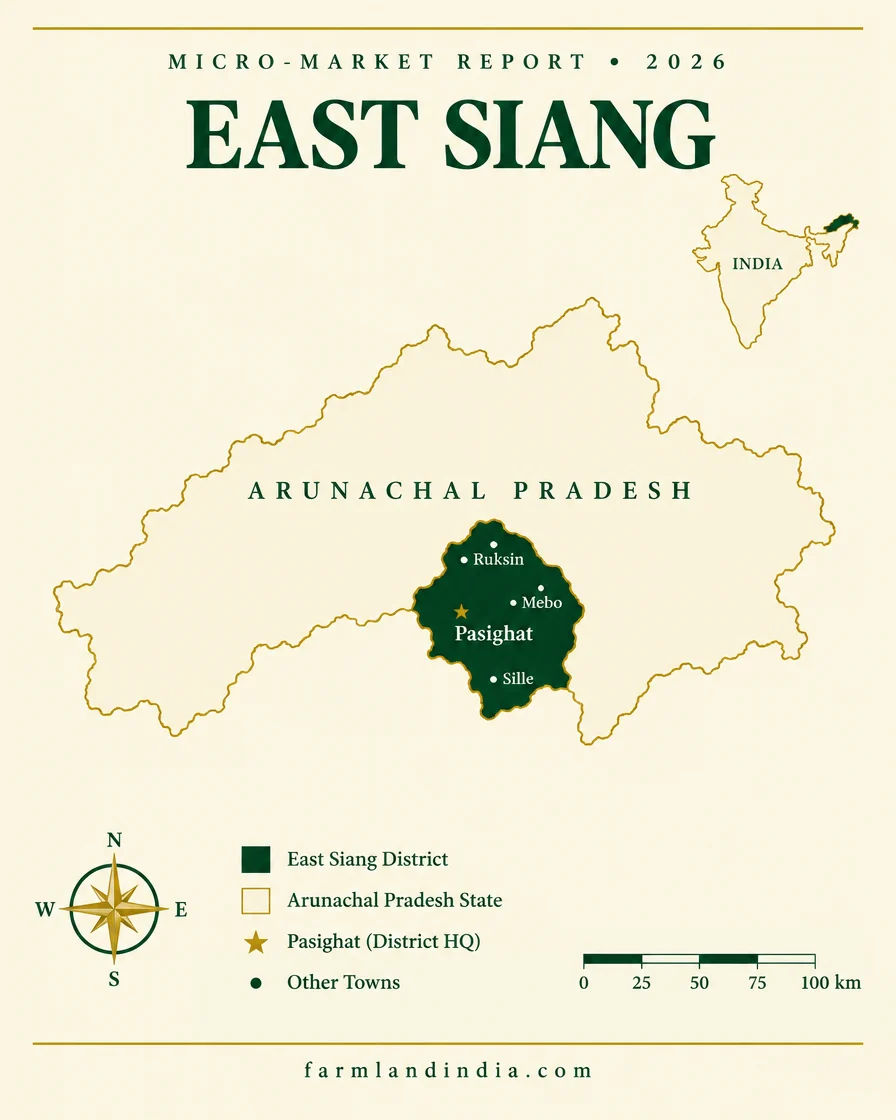
Five assembly constituencies are listed (Panging, Nari-Koyu, Pasighat West, Pasighat East and Mebo); the district site names no circles (East Siang district site[4])
Key markets
Pasighat · Ruksin · Mebo · Sille
Demand anchors
Pasighat airport and the planned Pasighat–Tezu rail line · Pasighat’s Smart Cities Mission status (2017) · the College of Horticulture and Forestry (Central Agricultural University)
Access
Pasighat airport (operational) and road links to Assam; Pasighat railway station is being built
Size and population
3,603 sq km; the district site gives 99,214 people at the 2011 Census in its text but 81,882 in its table (East Siang district site[4])
Pricing unit
Quote any land per acre or per sq m and ask for local units to be converted in writing.
Local units
Records and village talk use local measures; convert to acres or sq m in the agreement
Land records
LISA (Land Information System of Arunachal) for allotments and Land Holding Certificates, launched February 2025 (NIC Informatics[6])
Land law is state law. These rules are maintained on the Arunachal Pradesh page and apply to every district within it.
East Siang — who can hold land
Arunachal Pradesh is one of the few parts of India where the basic question is not how to buy land but whether an outsider can hold any at all. The answer, for most buyers reading this page, is no. The whole state sits beyond the Inner Line drawn under a colonial-era regulation that is still in force, and land is held by indigenous tribal families and clans under custom and state-issued documents. This block sets out the rules as written, without legal conclusions. Take advice from a lawyer in Itanagar and confirm the position with the Deputy Commissioner before you commit money to anything.
Inner Line Permit: Under Section 2 of the Bengal Eastern Frontier Regulation, 1873, the state can notify an Inner Line and bar citizens from crossing it without a pass; Section 3 makes crossing without one punishable with up to a year in prison, a fine, or both. All of Arunachal lies beyond the line. In practice, Indian citizens who are not from the state need an Inner Line Permit (ILP) to enter, and foreign nationals need a Protected Area Permit. An ILP is a travel document: it gives no right to buy, lease or settle on land.
Section 7, the land rule: The same Regulation says it is not lawful for any person who is not a native of the districts it covers to acquire “any interest in land or the product of land” beyond the Inner Line without the sanction of the State Government or an officer it appoints. That covers sale, lease, mortgage and any other interest, not just outright purchase. A deed or agreement that rests on a sanction that was never given is the kind of document a buyer cannot rely on.
Ownership under the 2000 Act: The Arunachal Pradesh (Land Settlement and Records) Act, 2000 defines a land owner as someone who acquires land by inheritance, by custom, by gift under local custom, by purchase “if such purchase is not contrary to local customs”, or under Section 88. It defines a resident as an indigenous person ordinarily living in a village or area. Customary and clan land is the norm; individual titles are newer.
Section 88 and the 2018 amendment: Section 88 made people holding government land for agriculture when the Act began its owners, excluding river beds, land acquired by the government and land used for public or community purposes. A 2018 amendment added Section 88(1A), letting holders of a valid land possession document issued by the competent authority, outside notified forest, be conferred ownership. The Act grants no rights to minerals below the surface (Section 88(7)).
Transfers stay within the community: The proviso to Section 88 speaks of transferring allotted land to a member of an indigenous Arunachal Pradesh Scheduled Tribe, on payment of fees, and Section 89 makes transfers to successors subject to the satisfaction of the district authorities. Read together with Section 7 of the 1873 Regulation, the scheme keeps land within the state’s indigenous communities. For a non-APST buyer there is generally no purchase route; the realistic options are a government allotment or a lease approved by the authorities.
Leases and land use: Section 90 caps leases at 33 years and limits them to the permitted land use, and Section 91 lets the Deputy Commissioner lease out land left uncultivated for two consecutive years. Section 17 requires permission before agricultural land is diverted to another use. Any lease you are offered should name the approving authority and match the land use on record.
Report every acquisition: Section 44(2) of the 2000 Act requires anyone who acquires a right in land, by purchase, gift, mortgage, lease or otherwise, to report it to the revenue officer within three months. An entry in the finally published record of rights is presumed correct until the contrary is proved (Section 39(3)).
NRI and OCI buyers: Under the RBI Master Direction on immovable property, NRIs and OCIs may not acquire agricultural land, a farmhouse or plantation land in India except by inheritance. In Arunachal the state rules above apply on top of that. Our NRI guide covers the options elsewhere in India.
- Inner Line: BEFR 1873
- Section 7: no outside interest in land
- ILP to enter
- Land Settlement and Records Act, 2000
- Leases capped at 33 years
- Report within 3 months
- NRIs: inheritance only
East Siang — district-specific notes
The Arunachal Pradesh state page applies to East Siang in full: the Inner Line, Section 7 of the 1873 Regulation, the 2000 Land Settlement and Records Act and the NRI bar. These points are specific to the district. Nothing here is a legal conclusion; confirm the position with the Deputy Commissioner’s office before you commit money.
⚠ Section 7 of the Bengal Eastern Frontier Regulation, 1873[1] says no person who is not a native of the area may acquire any interest in land beyond the Inner Line without the sanction of the State Government or an appointed officer, and the whole state lies beyond the line. Under the Land Settlement and Records Act, 2000[2] land is owned by inheritance, custom, purchase “not contrary to local customs”, gift or allotment, and allotted land may be transferred to a member of an indigenous Arunachal Pradesh Scheduled Tribe on payment of fees. In East Siang the buyers and sellers are therefore, in practice, local families and clans.
⚠ The district site counts the 2011 population by tribe: Adi 51,580, Galo 6,864, Mishing 3,394 and Mishmi 163 (only in Aohali village), with 19,881 others (East Siang district site[4]). Land in the villages is held by clans and families under custom; the large “others” group does not change who may acquire land under the 1873 Regulation or the 2000 Act.
⚠ Pasighat was founded in 1911 and calls itself Arunachal’s oldest town, so plots in and around it may have a long paper trail of allotments, leases and transfers. Ask for the whole chain, including the allotment order and any Land Holding Certificate, and ask whether the holder could lawfully transfer.
⚠ The Siang river runs through the district and an 11,200 MW project is proposed upstream in the Siang basin, where villagers have blocked drilling (ThePrint, 31 October 2026). Ask the Deputy Commissioner about the project’s status before you rely on any claim about the Siang valley.
Read the full Arunachal Pradesh land buying guide for the Inner Line, the 2000 Act, records and the NRI rule.
- Beyond the Inner Line
- Adi and Galo community land
- Siang river plain
- Old allotments in Pasighat
- Dam proposal upstream
District overview
East Siang — East Siang — Pasighat and the Siang river plain, home of the Adi
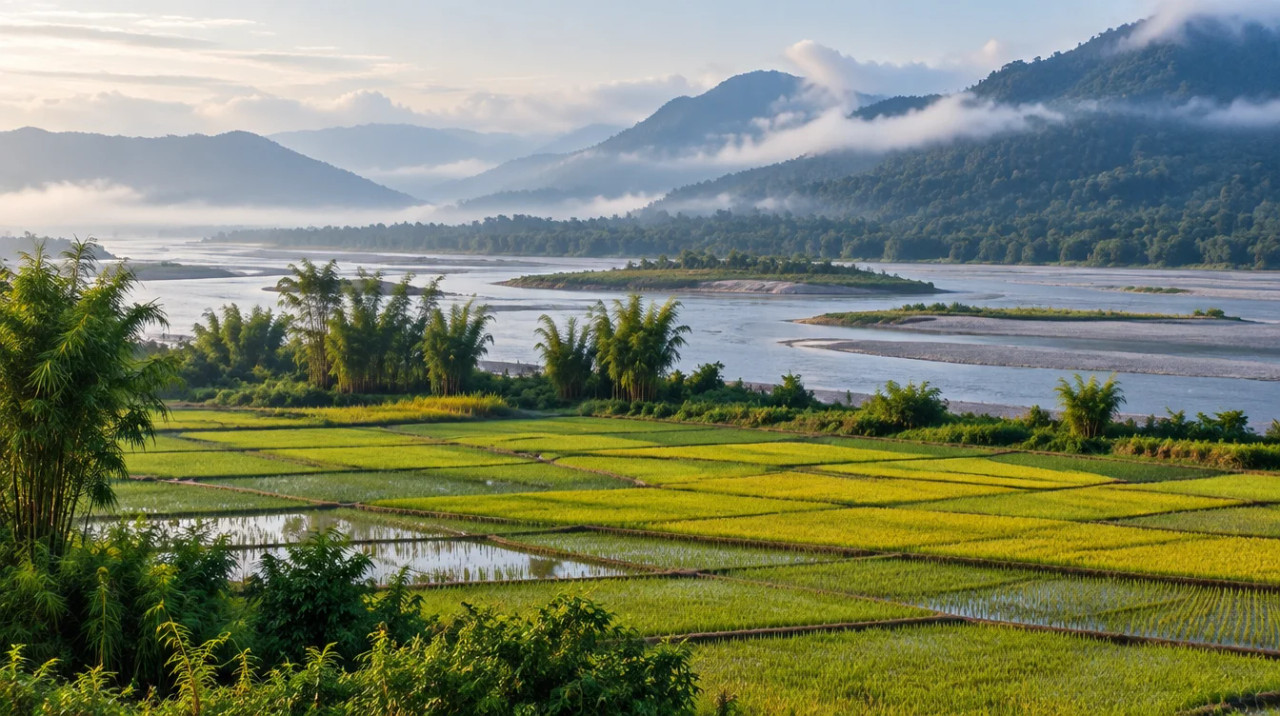
East Siang is the old gateway of the Adi country, where the Siang river leaves the hills and spreads onto the Assam plain. Pasighat, the headquarters, sits at 155 m on the eastern foothills of the Himalayas and was founded in 1911; it was included in the Smart Cities Mission in June 2017. The district site gives the area as 3,603 sq km, and a 2011 population of 99,214 in its text and 81,882 in its table, so we treat the figure as approximate (East Siang district site[4]).
Pasighat has a string of firsts for Arunachal: an airfield in 1946, the state’s first agricultural institute in 1950, its first college (Jawaharlal Nehru College) in 1964, its first All India Radio station in 1966 and, since 2001, the College of Horticulture and Forestry of the Central Agricultural University. It lost the bid to be state capital in 1974, when Itanagar was chosen. The district was split in 1999 to create Upper Siang (East Siang district site[4]).
Who buys here? Mainly local Adi, Galo and Mishing families. Outsiders generally cannot acquire land beyond the Inner Line without State Government sanction, and the RBI bars NRIs and OCIs from agricultural land and farmhouses except by inheritance (RBI Master Direction[3]). For an outside reader, East Siang’s story is about infrastructure and agricultural education, and this page treats it that way.
- Pasighat
- Ruksin
- Mebo
- Sille
- Siang river
- Smart City
Transaction costs
Stamp duty & registration in East Siang
Check
Stamp duty on a sale deed
Ask the district registration office.
Check
Registration fee
Check on NGDRS or at the office.
Feb 2025
LISA and NGDRS
Land records and registration systems launched 3 February 2025
What is confirmed is the system: the Land Information System of Arunachal (LISA) and the National Generic Document Registration System (NGDRS) were launched on 3 February 2025, and LISA covers land allotments, land revenue payments and Land Holding Certificates (NIC Informatics, February 2025[6]). A person who acquires a right in land by purchase, gift, mortgage or lease must report it to the revenue officer within three months under Section 44(2) of the Act, and diversion of land to non-agricultural use needs the competent authority’s permission under Section 17(1).
Know the belt
What is moving prices in East Siang
Pockets named from the district site and news reports; no listing-site prices are used.
Pasighat
District headquarters and Smart City
Pasighat has the Deputy Commissioner’s office, the airport, colleges and hospitals, and is the town where land is most likely to have a documented history. No official price series is published.
Check: the full allotment and transfer chain, and whether the holder could lawfully transfer
Ruksin
Southern gateway
A Ruksin-to-Itanagar flight route was announced in September 2023 under UDAN-5 (NE News[10]). Ruksin lies towards the Assam border, so Assam-side demand may touch it.
Check: whether the airfield area has acquisition or height limits
Mebo
Assembly constituency town
Mebo is one of the five assembly constituencies the district site lists. It is a farming and trading centre.
Check: clan boundaries and the village council’s view
Sille and the Siang banks
River edge
River-edge land near the Siang is attractive for its soil and view but exposed to floods and bank erosion; Check locally.
Check: flood history after a monsoon and the river’s past course
Asking prices
No official farmland price series is published for East Siang. Ask the sub-registrar for recent registered sale values in the village you are looking at Treat any figure you are offered as unsourced until you see the registered deed and the Land Holding Certificate. Because outsiders generally cannot buy, a “market price” here is mostly a matter between local families.
Connectivity
How East Siang connects — road, rail and air
Air and rail are the headline links.
🚗 By road
✈️ By air
🚆 By rail
Pasighat is the best connected town in the Siang basin, with an airport, a station on the way and roads to Assam. Visitors who are not natives need an Inner Line Permit; check current procedure with the state authorities.
Growth catalysts
Upcoming infrastructure & developments
Each item shows its status and source; nothing here is a promise of price growth.
00Open
03Catalysts
Agriculture & terrain
Soil, crops & water in East Siang
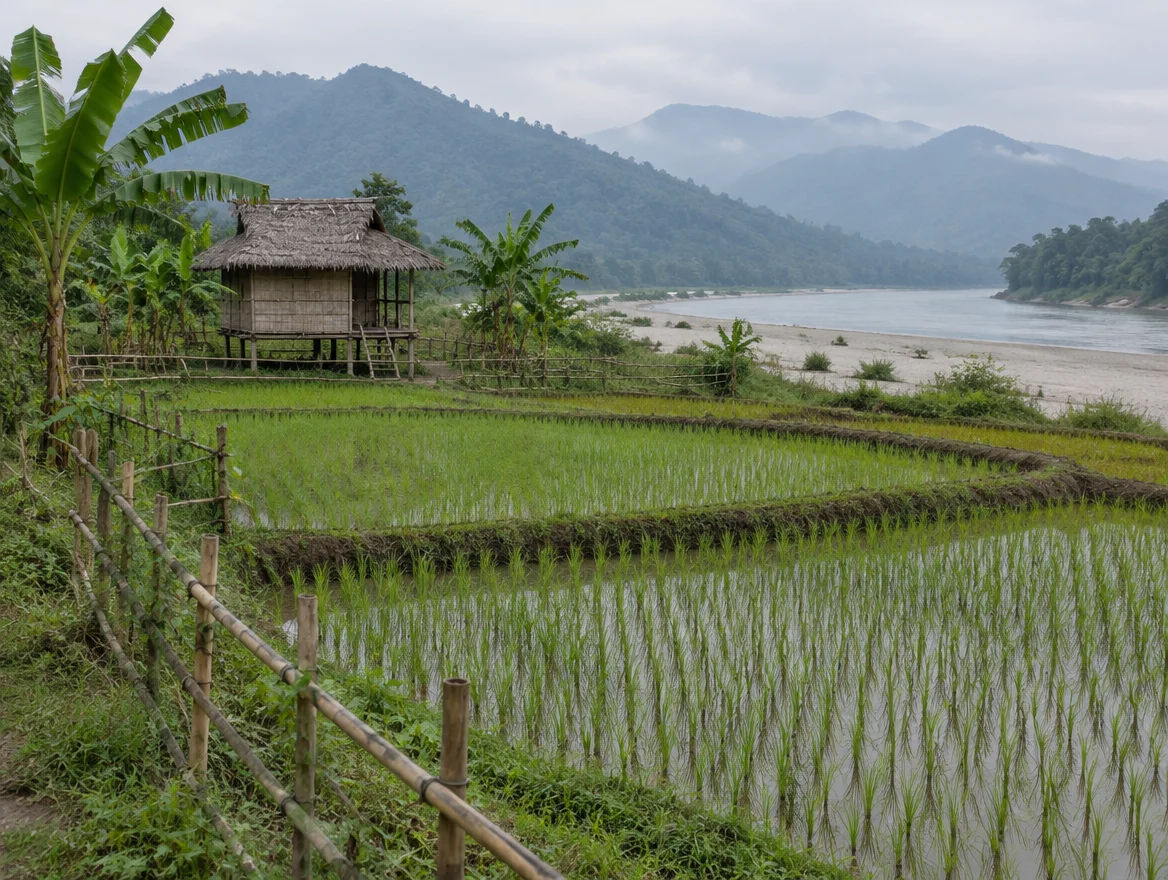
Siang river plain and foothills with paddy, horticulture and a state-level agricultural education base; no crop-area profile was found.
What
The district site records the first agricultural institute in Arunachal at Pasighat in 1950 and the College of Horticulture and Forestry of the Central Agricultural University there since 2001 (East Siang district site[4]).
- Agricultural institute (1950)
- College of Horticulture and Forestry (2001)
- Crop-area data not found
Water
No district groundwater figure was read. The 2024 state-wide assessment finds extraction at 0.39% with all 42 units safe (CGWB, 2024[5]). The Siang is a large river; check flood and erosion history locally.
Land use
No land-use table was found.
At a glance
East Siang vs. nearby districts
| District | Land and water | What links it to East Siang |
|---|---|---|
| Upper Siang | North; the Siang river upstream | Where the 11,200 MW project’s drilling is on hold |
| Lower Siang and Lepa Rada | West and south-west; newer districts in the same region | Smaller and less connected; see their own pages |
| Dibang Valley and Lohit | East and north-east | Idu and Mishmi country; Tezu has the next airport |
The state rules on who may hold land are the same in every neighbour; what differs is access, with Pasighat the best connected town in the Siang basin.
Farmland India view
Why investors look at East Siang
Five reasoned points for East Siang, each tied to a source on this page.
1. A documented town, a local market
Pasighat is the likeliest place in the Siang basin to find documented plots, but the same law applies: outsiders generally cannot buy. Any offer to an outsider should be tested with the Deputy Commissioner.
2. Airport and railway are the assets
Pasighat’s airport is operating, and a station and a line to Tezu are planned. They help local business; they do not open the land to outsiders.
3. Education is the quiet driver
The College of Horticulture and Forestry, the state’s first agricultural institute and the first college keep a stream of students and staff in Pasighat. That drives rentals, not purchases by outsiders.
4. The Siang is both asset and risk
The river shapes the plain; the 11,200 MW proposal upstream is contested.
5. Leases, not purchases
The 2000 Act allows government leases of up to 33 years within the permissible land use (Section 90). Whether any lease is available is for the Deputy Commissioner to say.
Confirm the record of rights (B-1 and khasra), mutation, zoning and acquisition status directly — these are not certified by Farmland India’s review.
STRAIGHT TALK
Risks & challenges in East Siang
District-specific risks. Read the Arunachal Pradesh state page for the general risks on ceiling, conversion and records.
Land an outsider cannot lawfully hold
Section 7 of the 1873 Regulation and the 2000 Act can make an outsider’s purchase unregistrable or challengeable.
Floods and bank erosion
Visit after a monsoon and ask local owners.
Dam uncertainty
The upstream project has local opposition, and its extent will not be known until the report is final (ThePrint, 31 October 2026).
Conflicting official figures
The district site gives two different 2011 populations.
Old allotments and leases
Documents in an old town may carry conditions. Ask whether a lease, a government allotment or a community grant lies behind the plot.
Who to contact
Local revenue & planning offices
The first stop is the Deputy Commissioner’s office at Pasighat (district site: eastsiang.nic.in). Ask which circle holds the village record and whether the plot is on LISA. Check before travelling.
COMMON QUESTIONS
Frequently asked questions
Everything buyers, NRIs and investors ask before their first reviewed farmland purchase in East Siang.
Visit full wiki01 of 04
Can an outsider buy land in East Siang?
Generally not. Section 7 of the 1873 Regulation bars a person who is not a native of the area from acquiring any interest in land beyond the Inner Line without State Government sanction, and all of Arunachal lies beyond it. Confirm with the Deputy Commissioner.
02 of 04
Is there a price guide for Pasighat land?
No official price series is published. Ask the registration office about documents and rates, and treat unsourced asking prices with caution.
03 of 04
How do I reach Pasighat?
Pasighat has an operating airport and roads to Assam; a station is being built and a Pasighat–Tezu rail line has a finalised project report. Non-natives need an Inner Line Permit; check current schedules and procedure.
04 of 04
What is the Siang dam project?
NHPC is preparing a pre-feasibility report for an 11,200 MW project on the Siang upstream. Drilling at three sites was on hold in October 2026 after villagers objected.
Transparency
Sources and references
Law and courts
- [1]Bengal Eastern Frontier Regulation, 1873 — latestlaws.com
- [2]Arunachal Pradesh (Land Settlement and Records) Act, 2000, India Code — indiacode.nic.in
- [3]RBI Master Direction on immovable property — rbi.org.in
Government
- [4]East Siang district site: district at a glance — eastsiang.nic.in
- [5]CGWB: Dynamic Ground Water Resources of Arunachal Pradesh, 2024 — cgwb.gov.in
- [6]NIC Informatics: LISA and NGDRS launch, February 2025 — informatics.nic.in
News
- [7]ThePrint: Siang dam survey hits a wall, 31 October 2026 — theprint.in
- [8]News Arena: CM Khandu on rail connectivity, 13 October 2025 — newsarenaindia.com
- [9]Borderlens: upgraded Tezu airport inaugurated, September 2023 — borderlens.com
- [10]NE News: three new air routes, 24 September 2023 — nenews.in
- [11]ThePrint (PTI): Highway connecting all districts of Arunachal, 26 Feb 2025 — theprint.in
Data-currency note: Sources reviewed in November 2026. Project status, the benchmark valuation and land rules change often; check the linked source and the relevant office before relying on any figure.
For developers
Ready to explore East Siang farmland?
Browse reviewed projects and individual land parcels across East Siang — or if you own land here, list it with platform review and reach serious buyers.