
District guide
Buying Land in Papum Pare
Papum Pare surrounds the capital region. Outsiders generally cannot buy land; settle which district a plot is in, then read the rules and airport news.
28
Districts in Arunachal after 2024 (PTI)
About 3,462 sq km
District area (district site)
1 Oct 2008
Capital Complex split (SDMA)
1.5 million a year
Donyi Polo terminal capacity (Sept 2025)
District land record — Papum Pare
Rev. 2026 · Farmland India desk
State
Arunachal Pradesh
Headquarters
Yupia
Key places
Yupia · Doimukh · Sagalee · Balijan · Hollongi
Who can buy
Outsiders generally cannot; a non-native needs State Government sanction under the 1873 Regulation.[1]
Land law is state law. These rules are maintained on the Arunachal Pradesh page and apply to every district within it.
Papum Pare — who can hold land
Arunachal Pradesh is one of the few parts of India where the basic question is not how to buy land but whether an outsider can hold any at all. The answer, for most buyers reading this page, is no. The whole state sits beyond the Inner Line drawn under a colonial-era regulation that is still in force, and land is held by indigenous tribal families and clans under custom and state-issued documents. This block sets out the rules as written, without legal conclusions. Take advice from a lawyer in Itanagar and confirm the position with the Deputy Commissioner before you commit money to anything.
Inner Line Permit: Under Section 2 of the Bengal Eastern Frontier Regulation, 1873, the state can notify an Inner Line and bar citizens from crossing it without a pass; Section 3 makes crossing without one punishable with up to a year in prison, a fine, or both. All of Arunachal lies beyond the line. In practice, Indian citizens who are not from the state need an Inner Line Permit (ILP) to enter, and foreign nationals need a Protected Area Permit. An ILP is a travel document: it gives no right to buy, lease or settle on land.
Section 7, the land rule: The same Regulation says it is not lawful for any person who is not a native of the districts it covers to acquire “any interest in land or the product of land” beyond the Inner Line without the sanction of the State Government or an officer it appoints. That covers sale, lease, mortgage and any other interest, not just outright purchase. A deed or agreement that rests on a sanction that was never given is the kind of document a buyer cannot rely on.
Ownership under the 2000 Act: The Arunachal Pradesh (Land Settlement and Records) Act, 2000 defines a land owner as someone who acquires land by inheritance, by custom, by gift under local custom, by purchase “if such purchase is not contrary to local customs”, or under Section 88. It defines a resident as an indigenous person ordinarily living in a village or area. Customary and clan land is the norm; individual titles are newer.
Section 88 and the 2018 amendment: Section 88 made people holding government land for agriculture when the Act began its owners, excluding river beds, land acquired by the government and land used for public or community purposes. A 2018 amendment added Section 88(1A), letting holders of a valid land possession document issued by the competent authority, outside notified forest, be conferred ownership. The Act grants no rights to minerals below the surface (Section 88(7)).
Transfers stay within the community: The proviso to Section 88 speaks of transferring allotted land to a member of an indigenous Arunachal Pradesh Scheduled Tribe, on payment of fees, and Section 89 makes transfers to successors subject to the satisfaction of the district authorities. Read together with Section 7 of the 1873 Regulation, the scheme keeps land within the state’s indigenous communities. For a non-APST buyer there is generally no purchase route; the realistic options are a government allotment or a lease approved by the authorities.
Leases and land use: Section 90 caps leases at 33 years and limits them to the permitted land use, and Section 91 lets the Deputy Commissioner lease out land left uncultivated for two consecutive years. Section 17 requires permission before agricultural land is diverted to another use. Any lease you are offered should name the approving authority and match the land use on record.
Report every acquisition: Section 44(2) of the 2000 Act requires anyone who acquires a right in land, by purchase, gift, mortgage, lease or otherwise, to report it to the revenue officer within three months. An entry in the finally published record of rights is presumed correct until the contrary is proved (Section 39(3)).
NRI and OCI buyers: Under the RBI Master Direction on immovable property, NRIs and OCIs may not acquire agricultural land, a farmhouse or plantation land in India except by inheritance. In Arunachal the state rules above apply on top of that. Our NRI guide covers the options elsewhere in India.
- Inner Line: BEFR 1873
- Section 7: no outside interest in land
- ILP to enter
- Land Settlement and Records Act, 2000
- Leases capped at 33 years
- Report within 3 months
- NRIs: inheritance only
Papum Pare — district-specific notes
The Arunachal Pradesh state page applies to Papum Pare in full. The district surrounds the state capital region, sits inside the Inner Line area, and land is held by indigenous families, clans and villages under custom and state-issued documents.
⚠ Outsiders generally cannot buy land in Papum Pare. Under Section 7 of the 1873 Regulation, a person who is not a native needs the State Government’s sanction to acquire any interest in land beyond the Inner Line, and the whole state lies beyond it.[1] That includes Indians from other states and NRIs.
Land is held by indigenous owners through inheritance, custom and state possession or holding documents. The 2000 Act counts a purchase as a valid route to ownership only if it is “not contrary to local customs”.[2] An Inner Line Permit is a travel document; it gives no right to buy or lease land.
The routes open to non-natives are a government allotment or a lease approved by the authorities, not purchase. Being next to the capital does not change this: the state-level rules apply in Papum Pare and in the Capital Complex alike. Ask the Deputy Commissioner at Yupia before paying anything.
Read the Arunachal Pradesh state page for the full legal block and the NRI land guide for the FEMA position. Confirm every point with the Deputy Commissioner’s office before paying anything.
- Inner Line area
- Outsiders generally cannot buy
- Sanction under Section 7, 1873 Regulation
- Indigenous (APST) ownership
- NRIs: inheritance only
District overview
Papum Pare — the district around the capital, with its headquarters at Yupia
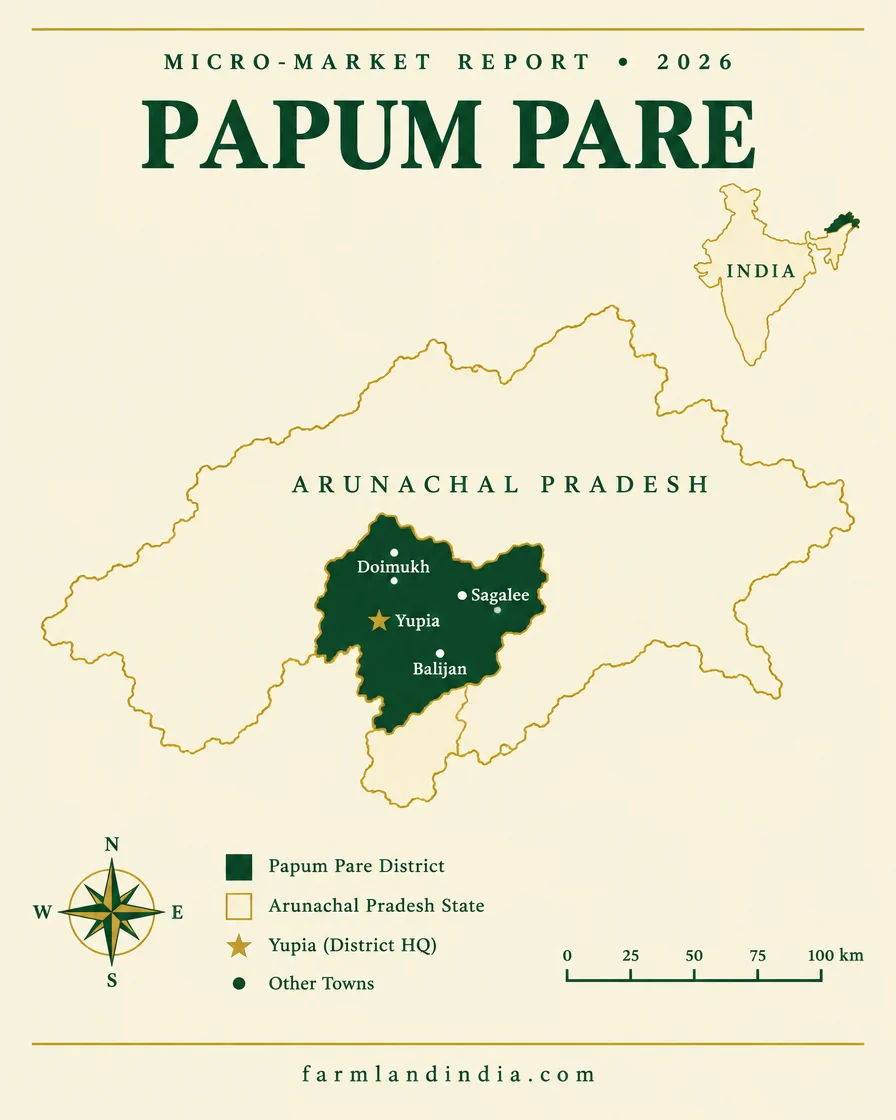
Papum Pare is the district that surrounds the state capital region in southern Arunachal Pradesh. The district website says it was created in 1992 by splitting Lower Subansiri, with Itanagar as a temporary headquarters until Yupia became the permanent one in 2000.PP[5] It takes its name from the Papum and Pare rivers.PP The state now has 28 districts.[8]
The district profile gives an area of about 3,462 sq km and a 2011 Census population of 176,573, but that population figure includes the Capital Complex.PP[5] The Capital Complex (Itanagar, Naharlagun and Banderdewa) was bifurcated from Papum Pare for administrative convenience on 1 October 2008 and has its own Deputy Commissioner, although the Papum Pare Deputy Commissioner kept some functions.SD[7]IT[6] For a buyer the practical point is simple: before you read any figure or listing, find out which of the two districts the plot lies in, because the offices differ.
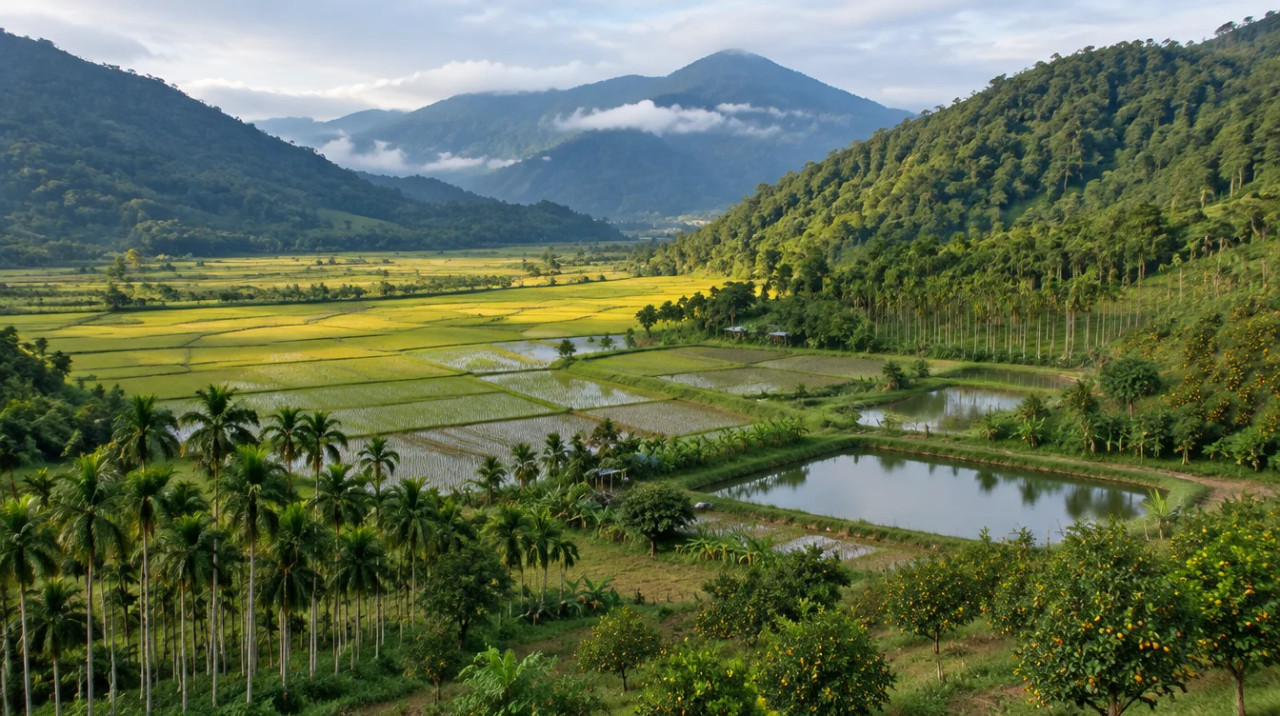
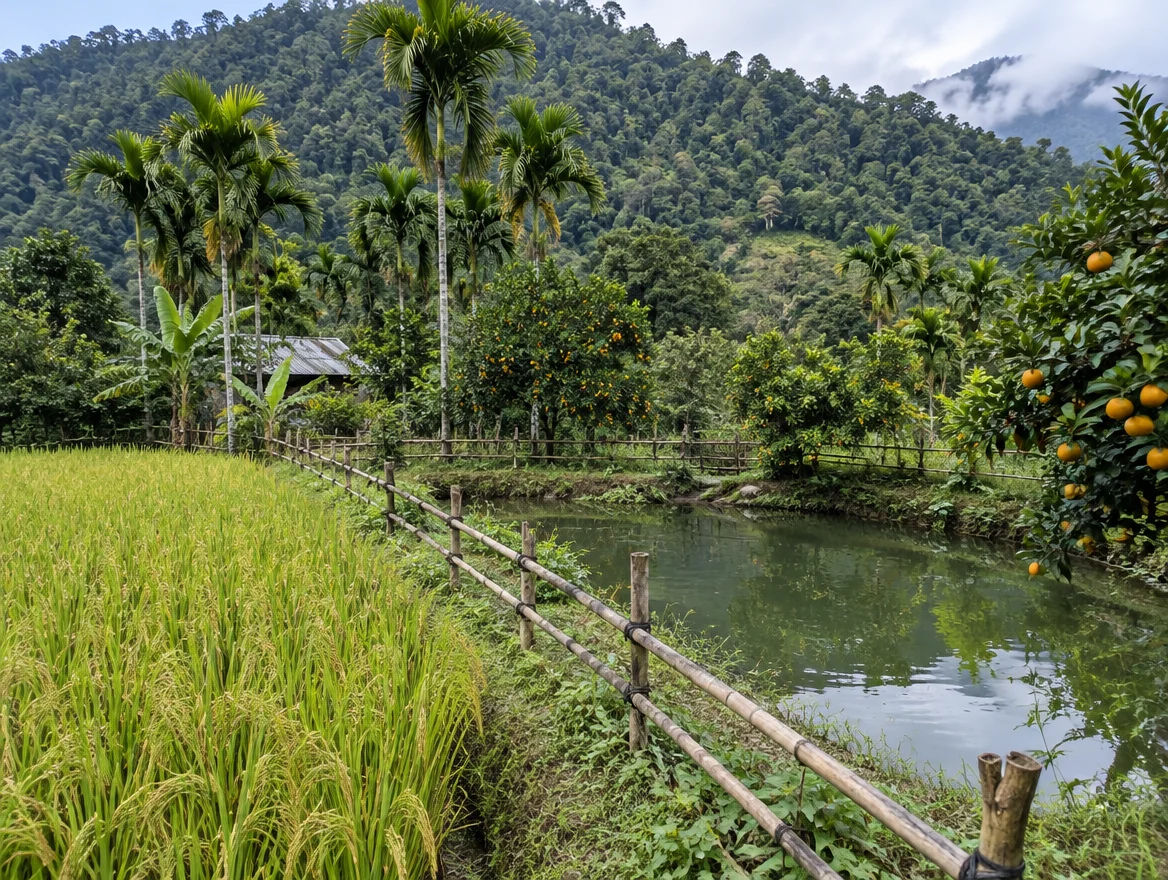
The district website describes a mixed economy of subsistence farming: jhum (shifting) cultivation on slopes, wet rice in low-lying areas, and horticulture including orange, pineapple, banana, guava, jackfruit, papaya, lemon, litchi, plum, peach, large cardamom and pear.PP[5] Rain is heavy, especially around Doimukh.PP
The district’s weight comes from its position: the capital’s airport at Hollongi, the Naharlagun rail station and the main roads from Assam all serve the capital region and touch Papum Pare.PP[5][10] That brings interest. The page is most useful to indigenous buyers and families, researchers, and those weighing lease or allotment routes.
Read the state page for the rules that apply across Arunachal Pradesh, and check the live page for reviewed land here.
- Yupia
- Doimukh
- Sagalee
- Balijan
- Hollongi
Transaction costs
Stamp duty & registration in Papum Pare
Conveyance stamp duty
Ask the sub-registrar before relying on any figure.
3 months
Reporting an acquisition
Anyone who acquires a right in land must report it to the revenue officer within three months (Section 44(2), 2000 Act).[2]
Sanction
Transfers to non-natives
Under Section 7 of the 1873 Regulation, a non-native needs the State Government’s sanction to acquire any interest in land.[1]
Registration moved online in February 2025, when the state launched the Land Information System of Arunachal (LISA) and the National Generic Document Registration System (NGDRS).[3] The only schedule amendment concerns mortgage deeds. Any fee a agent or seller quotes should be checked against the receipt the sub-registrar issues. Because a sale to a non-native needs sanction first, the stamp-duty question usually arises only for transfers between indigenous owners or for government-approved leases in Papum Pare.
Know the belt
What is moving prices in Papum Pare
Reported developments only; no listing-site prices are used.
Yupia
District headquarters
Yupia has been the permanent headquarters since 2000 and is about 18 to 22 km from Itanagar (the district site gives both figures).PP[5] The district court and the Deputy Commissioner’s office are the reasons buyers visit.
Check: Confirm at the Deputy Commissioner’s office whether the plot is in Papum Pare or in the Capital Complex.
Doimukh
Heavy-rain area near the capital
The district website names Doimukh as an area of especially heavy rain.PP[5] No official farmland price series is published for Papum Pare. Ask the sub-registrar for recent registered sale values in the village you are looking at
Check: Ask the circle officer for the holding document and whether any drainage or road notice affects the plot.
Hollongi and the airport belt
Donyi Polo Airport area
The Donyi Polo Airport at Hollongi began operating in 2022, and a new terminal opened on 4 September 2025.[10] Land near new airports attracts speculation.
Check: Ask which district and circle the plot lies in, and whether any acquisition for the airport or its approach roads covers it.
Sagalee and Balijan
Other places in the district
Sagalee and Balijan are other places in the district.
Check: Treat any agent claim about them as Have walked the plot.
Asking prices
Because most transfers are between indigenous owners under custom, many sales are never advertised.
Connectivity
How Papum Pare connects — road, rail and air
Road, air and rail access to Papum Pare
🚗 By road
✈️ By air
🚆 By rail
Heavy rain and slopes make approach roads a risk in the monsoon. Visit in July to September as well as in the dry months, and check that the plot has a legal right of way.
Growth catalysts
Upcoming infrastructure & developments
Sanctioned and reported work
01Open
02Catalysts
Agriculture & terrain
Soil, crops & water in Papum Pare
District crop and rainfall figures where sourced
Crops
The district website lists the main farm activities; it gives no area or yield figures.
- Wet rice in low-lying areas
- Jhum (shifting) cultivation on slopes
- Orange, pineapple, banana, guava, jackfruit, papaya, lemon, litchi, plum, peach, large cardamom and pear
Land use and water
For groundwater, the Central Ground Water Board’s 2024 assessment puts Arunachal Pradesh as a whole at 0.39 percent stage of extraction, with all 42 assessment units Safe.[4] That is a state figure, not a district one.
Soils and rainfall
Rainfall is described only as heavy, especially around Doimukh.PP[5]
What to ask before buying farmland
Who holds the land under custom, what document proves it, which district and circle it lies in, and whether the access road is public or only a village track.
At a glance
Papum Pare vs. nearby districts
| District | Land and water | What links it to Papum Pare |
|---|---|---|
| Itanagar Capital Complex | Split from Papum Pare on 1 October 2008; covers Itanagar, Naharlagun and Banderdewa | Separate Deputy Commissioner; same state land rules; covered on its own page |
| Lower Subansiri | Parent district until 1992; lies to the east | Same Inner Line rules; covered on its own page |
| Kra Daadi | Neighbouring district to the north | Same state land rules; covered on its own page |
Do not compare prices across districts; compare registered deeds village by village, and only where a transfer is lawful.
Farmland India view
Why investors look at Papum Pare
Five reasoned points for Papum Pare.
Start with who may buy
The capital’s pull does not change the Inner Line rule. A non-native needs State Government sanction, and a willing seller is not enough.
Settle the district first
Itanagar, Naharlagun and Banderdewa belong to the Capital Complex. A plot described as “near Itanagar” may be in either district, with different offices.
Treat the airport belt with care
Hollongi has a new terminal and daily flights, which raises interest. Insist on documents before paying.
Expect no public price data
No official price series is published. Registered deeds between indigenous owners, and the circle officer’s records, are the only reliable guide.
Watch informal deals
Customary and clan land near the capital changes hands informally. Ask for registration and the community’s consent, not just a handshake and a power of attorney.
Confirm the land-holding certificate or possession document, the owner’s status and any government sanction directly with the Deputy Commissioner’s office and the circle officer; these are not certified by Farmland India’s review.
STRAIGHT TALK
Risks & challenges in Papum Pare
District-specific risks. Read the Arunachal Pradesh state page for the general risks on custom, records and transfers.
Outsider purchase is generally not possible
A person who is not a native needs the State Government’s sanction to acquire any interest in land beyond the Inner Line, and the whole state lies beyond it. Treat an offer that skips this step as a warning sign.
Custom and clan land
Much land is held by clans and villages under custom. An individual seller may not be free to sell without community consent, and a paper title can be disputed by relatives or the village.
Possession documents are not all equal
A land possession certificate or land holding certificate is not the same as a registered sale deed. Ask which authority issued it, under which section, and whether the plot lies inside notified forest.
Landslides and monsoon damage
Steep slopes, heavy rain and road cuts make slope stability a real risk. Walk the plot in the wet season and check the approach road before committing.
Government and project land
Roads, hydropower and defence works take land. Ask the circle officer whether any acquisition, survey or notice covers the plot.
Which district, which office
The boundary between Papum Pare and the Capital Complex is administrative, not visible on the ground. A wrong assumption sends you to the wrong office.
Speculation near the capital
Interest around the airport and capital can inflate asking prices. No official price series is published.
Who to contact
Local revenue & planning offices
Start at the Deputy Commissioner’s office at Yupia for land holding certificates, sanction and leases; plots in Itanagar, Naharlagun or Banderdewa fall under the Deputy Commissioner (Capital Complex). Land documents run through the state’s LISA and NGDRS systems.[3]
COMMON QUESTIONS
Frequently asked questions
Everything buyers, NRIs and investors ask before their first reviewed farmland purchase in Papum Pare.
Visit full wiki01 of 04
Can an outsider buy land in Papum Pare?
Generally not. A person who is not a native needs the State Government’s sanction under Section 7 of the 1873 Regulation, and the whole state lies beyond the Inner Line. Confirm with the Deputy Commissioner’s office before paying anything.
02 of 04
Is Itanagar in Papum Pare?
For administration, Itanagar, Naharlagun and Banderdewa form the Itanagar Capital Complex, which was split from Papum Pare on 1 October 2008 and has its own Deputy Commissioner. Confirm which district a plot lies in before contacting any office.
03 of 04
Where is the Papum Pare headquarters?
Yupia, about 18 to 22 km from Itanagar. Itanagar was the temporary headquarters from 1992 to 2000, according to the district website.
04 of 04
Can NRIs buy farmland here?
No. Under the RBI Master Direction, NRIs and OCIs cannot acquire agricultural land, a farmhouse or plantation land in India except by inheritance, and the state rules apply on top.
Transparency
Sources and references
Law and courts
- [1][1]Bengal Eastern Frontier Regulation, 1873 (bare act text)— latestlaws.com — latestlaws.com
- [2][2]Arunachal Pradesh (Land Settlement and Records) Act, 2000, as amended (India Code)— indiacode.nic.in — indiacode.nic.in
Government
- [3][3]NIC Informatics: LISA and NGDRS launched in Arunachal Pradesh, 3 Feb 2025— informatics.nic.in — informatics.nic.in
- [4][4]CGWB: Dynamic Ground Water Resources of Arunachal Pradesh, 2024— cgwb.gov.in — cgwb.gov.in
- [5][5]Papum Pare district website: About the district— papumpare.nic.in — papumpare.nic.in
- [6][6]Itanagar Capital Complex district website: About the district— itanagar.nic.in — itanagar.nic.in
- [7][7]Arunachal SDMA: Itanagar Capital Complex— sdma-arunachal.in — sdma-arunachal.in
News
- [8][8]ThePrint (PTI): Arunachal assembly passes bill to create two new districts, 8 Feb 2024— theprint.in — theprint.in
- [9][9]ThePrint (PTI): highway connecting all districts to be completed soon, Rijiju, 26 Feb 2025— theprint.in — theprint.in
- [10][10]Assam Tribune: Donyi Polo Airport gets new terminal, 4 Sep 2025— assamtribune.com — assamtribune.com
- [11][11]The Week (PTI): Arunachal minister on air connectivity, 4 Sep 2025— theweek.in — theweek.in
- [12][12]Construction World: Centre approves 17 Arunachal road projects, 2026— constructionworld.in — constructionworld.in
Data-currency note: Sources reviewed in November 2026. Fees, rules and project status change; confirm current figures with the office concerned before acting.
For developers
Ready to explore Papum Pare farmland?
Browse reviewed projects and individual land parcels across Papum Pare — or if you own land here, list it with platform review and reach serious buyers.