
Area guide
Buying Land in Najafgarh
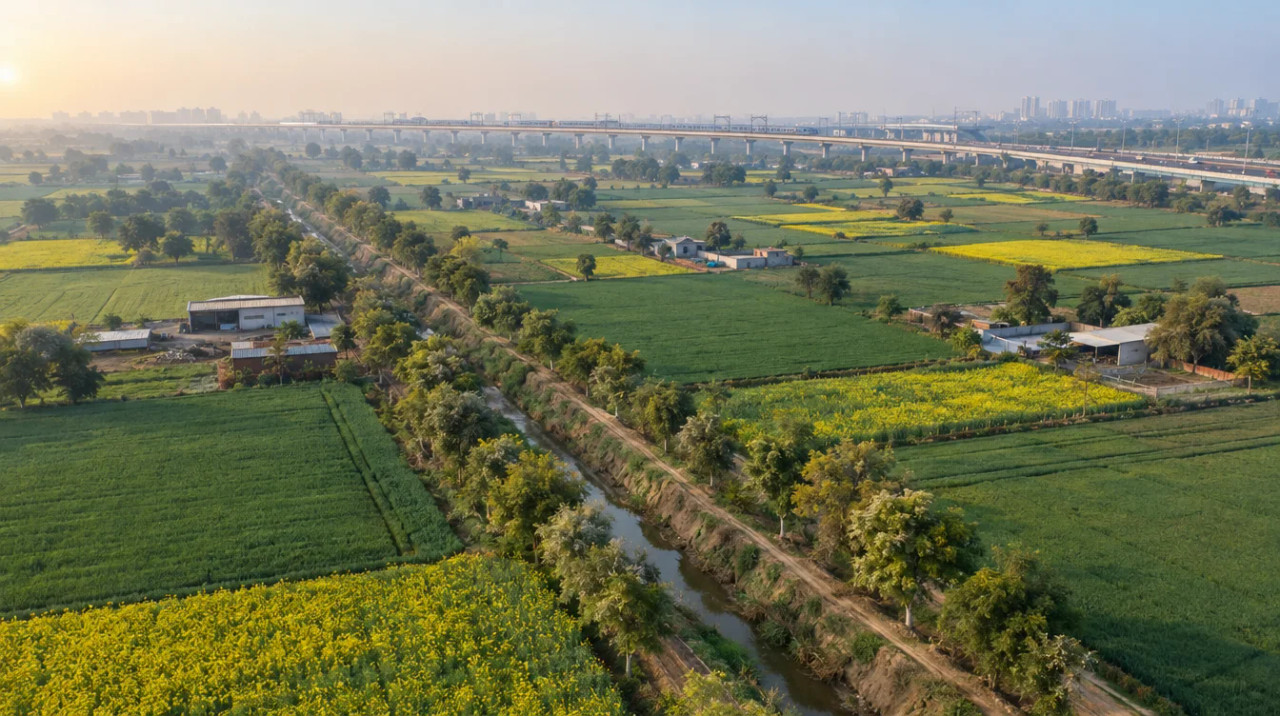
Farm land in South West Delhi's largest village belt: DDA pooling lists, the Najafgarh drain and jheel, and what to check first.
21 villages
Najafgarh sub-division
L (DDA list)
Pooling zone
4 Oct 2019
Grey Line opened
₹53 lakh/acre, reported
Agri circle rate
*Indicative range across districts and land types. Stamp duty, registration and conversion charges are additional. Local measurement units vary — every listing states the unit it is priced in. Not a valuation or an offer.
Micro-market record — Najafgarh
Rev. 2026 · Farmland India desk
District
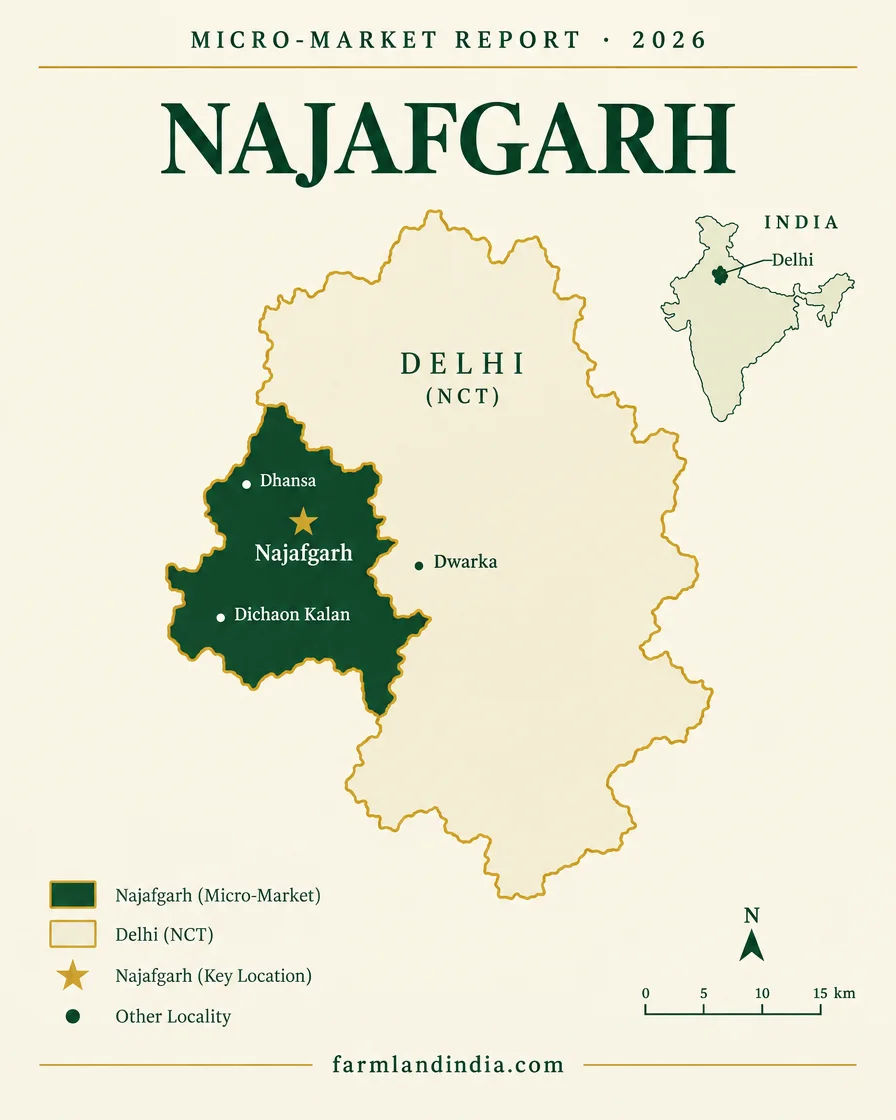
South West Delhi, Najafgarh sub-division with 21 villages (Revenue Department list, December 2025)
Sub-division office
B-64A Tehsil Road, Turamandi, Najafgarh (Revenue Department)
Land pooling
DDA's list places Najafgarh (part in Zone K-I), Ujwa, Jhuljhuli, Roshanpura and Malikpur Zer in Zone L (DDA list)
Drain
Najafgarh drain, about 57 km, formerly the Sahibi river (The Week/PTI, June 2025)
Metro
Grey Line opened 4 Oct 2019 (Business Today)
Roads
UER-II links Najafgarh; new links to Bahadurgarh and Sonipat (Business Today; PMO)
Land law is state law. These rules are maintained on the Delhi page and apply to every district within it.
Najafgarh — land purchase legal rules
⚠ Three layers of control apply to Delhi farm land at once: the Land Reforms Act, the Master Plan and DDA zoning. Check the land record, the Master Plan zone and the floodplain and Ridge position before you pay anything.
Who can buy agricultural land? The Delhi Land Reforms Act, 1954 (DLR Act) puts its main limits on the seller and on use rather than on the buyer, and we found no bar by domicile in the sources we could open. Section 33 restricts transfers by a landholder that would fragment the holding. The Revenue Department's notice inviting amendment suggestions (undated; comments were due 24 June 2016) called Section 33 outdated and proposed deleting it, but those were proposals. We have not read the current Act text, so ask the sub-registrar or the Revenue Department what applies to the seller's holding before any token payment.
Use of agricultural land (Section 81): Under the DLR Act a landholder who puts agricultural land to non-agricultural use is liable to ejectment, as the same Revenue Department notice describes. A house, event venue or "farmhouse" on land still recorded as agricultural therefore carries legal risk, whatever a broker calls the plot. The notice proposed replacing Sections 81 and 82 with a conversion permission, and we found no evidence that this was enacted.
Fragmentation and title: Many Delhi holdings are small, co-owned, or still in a deceased owner's name. Ask for the current revenue record, the mutation status and proof that the seller can transfer the whole holding.
Master Plan zoning decides what can be built: The Master Plan for Delhi 2047 (MPD-2047) replaces MPD-2021. DDA approved it on 12 August 2026 (Tribune, August 2026), and ThePrint reported it as notified by the Ministry of Housing and Urban Affairs on 20 August 2026. Farmhouse rules are the unsettled part. ThePrint quoted the Housing Minister as saying no farm houses will be allowed in low-density areas, while Outlook Money, August 2026 reported that the draft one-acre norm is absent from the final gazette. Treat the rules as restrictive and still under debate. We could not open the gazette copy, so ask DDA for the zone and permitted use of the plot in writing.
Land pooling: MPD-2047 marks nearly 200 sq km for land pooling and expects about 12 lakh homes from it, according to Outlook Money, August 2026. A village inside a pooling zone may be taken into a DDA-led scheme instead of staying farm land. Ask DDA whether the plot falls in one.
Yamuna floodplain, Ridge and heritage areas: The plan bars concrete structures in the core of the Yamuna O-zone (Business Today, August 2026) and aims to preserve about 180 sq km of floodplain and Ridge (ThePrint, August 2026). About 9,700 ha was declared O-zone under MPD-2021, and the High Court ruled on 26 May 2026 against regularising O-zone colonies (Business Standard, June 2026). The NGT has been monitoring encroachment on the floodplain (NGT order, February 2025). We have not sourced the legal limits around the Ridge, Asola Bhatti or the Mehrauli monuments, so ask DDA, the Forest Department and ASI for written positions on any plot near them. Stay out of the floodplain altogether.
Unauthorised colonies: Delhi opened the SWAGAM portal on 24 April 2026 to register land in 1,511 unauthorised colonies under PM-UDAY, on an as-is-where-is basis, as Outlook Money reported in April 2026. The O-zone and Sainik Farms are excluded from that policy under the High Court order (Business Standard, June 2026). A plot sold as "regularised" needs the regularisation certificate in hand.
NRI & OCI buyers: Under the 2018 FEMA regulations on immovable property (RBI, Regulation 3(a)), NRIs and OCIs cannot buy agricultural land, plantation land or a farm house anywhere in India, Delhi included. They may buy residential or commercial land, subject to zoning.
- Buyer eligibility: confirm
- DLR Act Sec 33: transfer limits
- Sec 81: use ejectment
- MPD-2047 zoning
- Floodplain, Ridge: avoid
- Land pooling zones
- NRI agri: barred (FEMA)
Sub-area overview
Najafgarh — a large village belt split between pooling land and the drain
Buying agricultural land in Najafgarh means buying in a sub-division the Revenue Department's list shows with 21 villages, including Najafgarh, Dhansa, Mitraon, Ujwa, Dichaon Kalan and Qazipur; neighbouring Matiala has 38, including Jhuljhuli, Goela Khurd and Chhawla (Revenue Department, December 2025). The legal picture changes village by village, so a village name matters more than the town name.
The land pooling lists are the first thing to read. DDA's list places Najafgarh (part in Zone K-I), Ujwa, Jhuljhuli, Roshanpura, Malikpur Zer, Qazipur and Dichaon Kalan in Zone L; by our matching of spellings 12 of the sub-division's 21 villages are on it, while Dhansa and Mitraon are not (DDA list; updated list). Both lists are undated. DDA's table of 31 May 2026 shows Zone L sectors from nil to 94.70% pooled (DDA table), and DDA said in August 2026 that 105 villages and 7,885 ha had been pooled across Delhi (NewKerala/IANS, August 2026). The table names no villages, so ask DDA for the sector and khasra status.
Then read the water. PTI described the Najafgarh drain in June 2025 as the former Sahibi river, about 57 km long and the biggest polluter of the Yamuna (The Week/PTI). Down To Earth found more than 283 ha of farmland, roads and empty plots submerged at Raota in August 2020 (Down To Earth, September 2020). Najafgarh Jheel still has no formal wetland notification, according to SANDRP in February 2026 (SANDRP). Read the Delhi agricultural land rules and Delhi state page for rules common to Delhi, and our Jhajjar page for the Haryana side of the drain's catchment.
- South West Delhi
- Pooling Zone L
- Dhansa, Mitraon not listed
- Drain flood risk
- NRIs barred (agri)
Connectivity
How Najafgarh connects
Najafgarh is on the metro and the UER-II ring, with the Haryana border to its west; the constraint is land use, not access.
By road and metro (approximate)
Read this before relying on distances
No distance is given because we did not read route-checked figures. The Grey Line is a short branch of about 4.3 km, later extended by 1.5 km, so check frequency and the station you would actually use (Business Today, October 2019).
Growth catalysts
Upcoming infrastructure & developments
Status labels reflect sources read in October 2026. Government-announced timelines are not guaranteed; items marked confirm have single or conflicting sources.
03Operational
02In progress, pending or policy
Agriculture & terrain
Soil, crops & water in Najafgarh
Crop figures below are Delhi-wide; the water story is specific to the drain.
Soil & crops
We found no village-level crop survey for Najafgarh. The Planning Department's Economic Survey 2018-19 shows Delhi's net sown area falling from 34,034 ha in 2000-01 to an estimated 22,300 ha in 2018-19, with wheat on 19,671 ha in 2017-18 (Economic Survey of Delhi 2018-19). Check the recorded crop entry for each parcel.
- Wheat
- Falling sown area
- Khatauni check
- Drain flood risk
Water
The Najafgarh drain is the main water feature and the main hazard. Down To Earth reported in September 2020 that residents said wastewater at Raota now stays through the year (Down To Earth), and The Bastion reported in 2020 that Raota lies in a roughly 5.5 km stretch left without embankments, with a rice acre earning about ₹50,000 to ₹70,000 a year before the losses (The Bastion, 2020). Ask for monsoon history on any plot near the drain. CGWB put Delhi's stage of groundwater extraction at 100.77% in 2024 (CGWB, 2024).
Mandi price reference
We have not used a mandi price series; no market-level price was sourced for Najafgarh.
Farmland India view
Why buyers look at Najafgarh
Reasons buyers look at this micro-market, stated with the evidence we have. Not a price forecast.
Where the villages are
Najafgarh and Matiala together hold 59 of South West Delhi's 76 revenue villages (Revenue Department list).
Rail and road already built
The Grey Line opened on 4 October 2019 and the Dwarka Expressway Delhi section and the Alipur–Dichaon Kalan stretch of UER-II were inaugurated on 17 August 2025 (Business Today; ETV Bharat).
Pooling lists you can read
DDA publishes the Zone L village list and sector percentages, so a buyer can check whether the village is in policy before paying (DDA table).
Water rules still being settled
The NGT gave the environment ministry until March 2026 for the jheel boundary (SANDRP, February 2026). We found no later order, so judge a plot by its site history.
Listing data is not legal advice. Confirm title, land use and eligibility with the sub-registrar.
STRAIGHT TALK
Risks & challenges specific to Najafgarh
Specific to this micro-market, beyond the South West Delhi and Delhi-wide points.
Drain, waterlogging and the jheel
Down To Earth found over 283 ha submerged at Raota in August 2020 (Down To Earth, September 2020), and the jheel's wetland boundary is still before the NGT (SANDRP, February 2026). Never buy land that floods; ask neighbours, check monsoon photos and avoid any plot in a notified floodplain or wetland.
Pooling lists and sectors
DDA's list shows Najafgarh part in Zone K-I and Dhansa and Mitraon absent, so check the village and the sector for each khasra (DDA list). Ask DDA for the sector map and the zoning of the khasra.
Land Reforms Act limits what a deed can do
Section 33 of the Delhi Land Reforms Act, 1954 stops a bhumidhar from transferring land if the transferor would be left with less than eight standard acres, and Section 42 makes the transferee liable to ejectment (India Code text). Section 81, on non-agricultural use, was outside the part of the Act we opened; that copy stops near Section 75 and carries amendments only to 1966. On 11 August 2026 the Delhi High Court held in LPA 34/2024 that the Act keeps applying to a village's land until a Section 507(a) DMC Act notification urbanises it, and upheld an order vesting plotted land in the Gaon Sabha (Delhi High Court, August 2026). A Revenue Department notice invited comments on deleting Sections 33 and 81 (comments due 24 June 2016); we found no sign it was enacted. Ask the SDM office whether the Najafgarh khasra is still under the Act.
Master Plan 2047 zoning decides what you can build
The Housing Ministry unveiled MPD-2047 on 20 August 2026 (ThePrint, August 2026). DDA's FAQs set a low-density residential norm of a 10,000 sq m minimum plot, 15% ground coverage, 10 m height and an 18 m right of way, and have no separate farmhouse category (DDA FAQs on MPD-2047). The Minister was quoted as saying no farm houses will be allowed in low-density areas, while an expert told Outlook Money that the draft's one-acre norm does not appear in the final gazette (Outlook Money, August 2026). We have not opened the gazette copy or the zonal plan, so get written zoning confirmation from DDA before planning any structure in Najafgarh.
Circle rate and stamp duty
Realty Today reported in December 2025 that Delhi has a single agricultural circle rate of ₹53 lakh per acre, last changed in 2008, and that a draft revision could lift it to about ₹5 crore in some places; the draft was not finalised (Realty Today, December 2025). It names Najafgarh and Dhichau Kalan among the villages in the draft. Stamp duty is 6% for men and 4% for women, plus a 1% registration fee and ₹100, charged on the higher of the deal value or the circle rate (Delhi Revenue Department). Check the rate that applies to the khasra with the sub-registrar.
NRIs and OCIs cannot buy
The RBI's FEMA regulations allow an NRI or OCI to buy land or buildings in India other than agricultural land, a farm house or plantation land (FEMA Regulations 2018, Reg 3(a)). Agricultural and farmhouse plots are therefore closed to them, whatever a seller says.
Policy is still moving
DDA's table shows many Zone L sectors below 20% pooled on 31 May 2026 (DDA). Price on what is lawful today.
COMMON QUESTIONS
Frequently asked questions
Everything buyers, NRIs and investors ask before their first reviewed farmland purchase in Najafgarh.
Visit full wiki01 of 04
Is Najafgarh covered by land pooling?
DDA's list places Najafgarh (part in Zone K-I), Ujwa, Jhuljhuli, Roshanpura, Malikpur Zer and Qazipur in Zone L; Dhansa and Mitraon are not on it. The lists are undated, so ask DDA for the sector and khasra status.
02 of 04
Does the Najafgarh drain flood nearby land?
In places. Down To Earth found more than 283 ha submerged at Raota in August 2020, and residents said the water now stays through the year. Avoid plots with a flood or waterlogging history.
03 of 04
Can an NRI buy farm land in Najafgarh?
No. The RBI's FEMA regulations exclude agricultural land, farm houses and plantation land from what an NRI or OCI may acquire.
04 of 04
What does land cost in Najafgarh?
We found no sourced price series for Najafgarh. Realty Today reported in December 2025 a single agricultural circle rate of ₹53 lakh per acre since 2008, with a draft revision that names Najafgarh; neither is a transaction price.
Ready to look at what is available?
Browse reviewed listingsTransparency
Sources and references
Law and courts
- Delhi Land Reforms Act, 1954 (Sections 33 and 42), India Code text, opened October 2026
- Notice inviting suggestions on amending the Delhi Land Reforms Act, Revenue Department (comments due 24 June 2016)
- Delhi High Court, LPA 34/2024, judgment of 11 August 2026
- FEMA Regulations 2018 on acquisition of immovable assets by NRIs and OCIs, Reg 3(a), Reserve Bank of India
Government
- List of districts, sub-divisions and revenue villages, Delhi Revenue Department, December 2025
- Sub-divisional offices, Delhi Revenue Department, opened October 2026
- Important information regarding registration, Delhi Revenue Department (stamp duty and fees)
- FAQs on MPD-2047, Delhi Development Authority
- List of villages and zones under land pooling, Delhi Development Authority (undated)
- Updated list of villages and zones under land pooling, Delhi Development Authority (undated)
- Sector-wise land pooling status, Delhi Development Authority, data as of 31 May 2026
- Economic Survey of Delhi 2018-19, chapter 10 Agriculture, Planning Department
- Dynamic Ground Water Resources of Delhi 2024, Central Ground Water Board
- Highway projects in Delhi on 17 August, Prime Minister's Office, August 2025
News
- Delhi now has 13 districts, The Week/PTI, December 2025
- MPD-2047 unveiled, ThePrint/PTI, 20 August 2026
- Delhi Master Plan 2047 notified, Outlook Money, 21 August 2026
- DDA on land pooling progress, NewKerala/IANS, August 2026
- Delhi plans revision of agricultural circle rates, Realty Today, December 2025
- PM inaugurates Delhi section of UER-II and Dwarka Expressway, ETV Bharat, 17 August 2025
- UER-II and Dwarka Expressway, Business Today, 16 August 2025
- Grey Line connecting Dwarka and Najafgarh inaugurated, Business Today, 4 October 2019
- Najafgarh-Dhansa metro stretch inaugurated, Daily Pioneer, 2021
- Najafgarh riverfront project, The Week/PTI, 24 June 2025
- Raising a stink: Raota village sinks under wastewater, Down To Earth, 21 September 2020
- In southwest Delhi, fields have been underwater for two decades, The Bastion, 2020 (date not shown on the page)
- Delhi's waterbodies going extinct, SANDRP, 7 February 2026
Further reading
- Najafgarh Jheel wetland tag stuck for 11 years, ThePrint, 6 October 2025
- Village lists for the Najafgarh and Matiala sub-divisions (Table II)
- Sector-wise pooling data to 31 May 2026
- Farmhouse norms and land pooling under MPD-2047
- DDA FAQs: pooling terms and low-density norms
- Draft circle-rate revision and villages named
- Delhi groundwater assessment 2024
- Delhi now has 13 districts: the notification, December 2025
General information, not legal advice. Report inaccuracies to wiki@farmlandindia.com.
For developers
Ready to explore Najafgarh farmland?
Browse reviewed projects and individual land parcels across Najafgarh — or if you own land here, list it with platform review and reach serious buyers.