
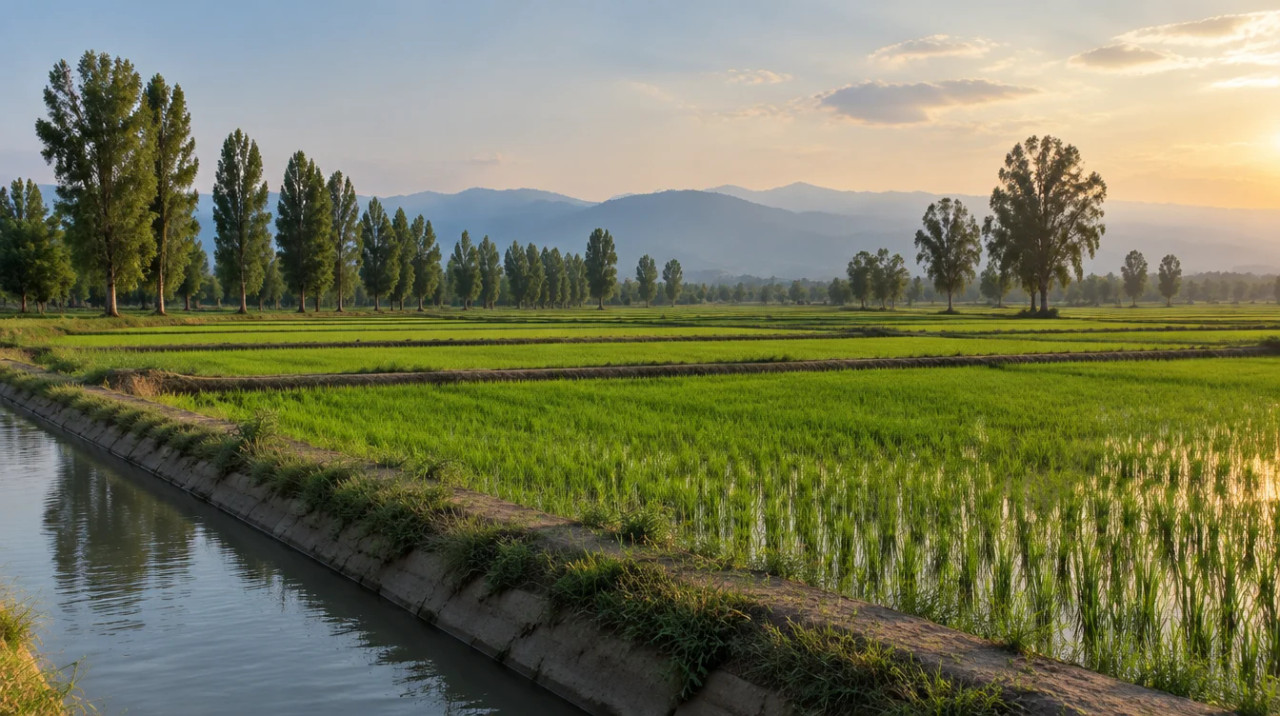
Area guide
Buying Land in Nagrota
The northern gateway of Jammu on NH-44, where the ring road ends at Jagti and agricultural land can be bought only by agriculturists.
Nearly 56 km
Jammu Ring Road length (CW, Jan 2026)
Rs 2,674 crore
Ring road cost (CW, Jan 2026)
About 95%
Raya Morh–Jagti stretch done (Jan 2026)
7% / 3%
Stamp duty, men / women (reported)
*Indicative range across districts and land types. Stamp duty, registration and conversion charges are additional. Local measurement units vary — every listing states the unit it is priced in. Not a valuation or an offer.
Micro-market record — Nagrota
Rev. 2026 · Farmland India desk
District
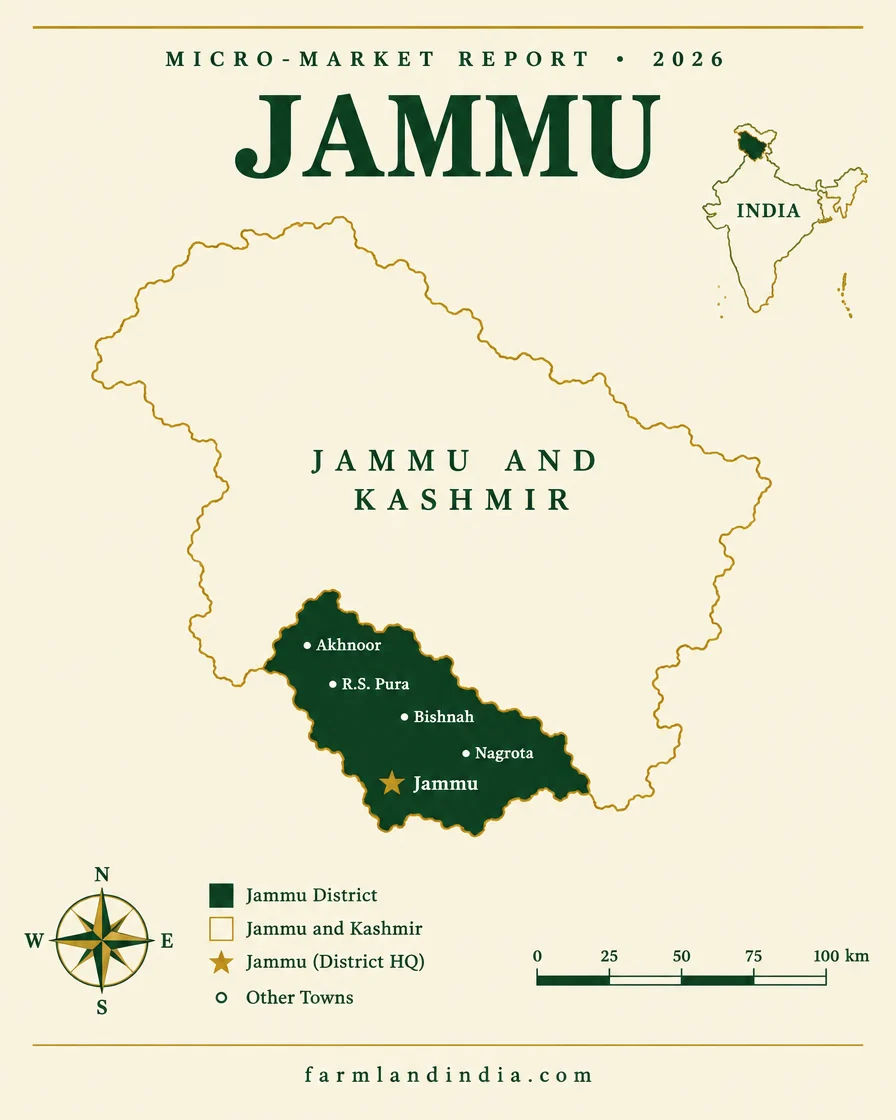
Jammu (Nagrota tehsil, on NH-44 north of the city)
Corridor
Jammu Ring Road joins NH-44 near Jagti in Nagrota, about 14 km before Jammu; nearly 56 km, Rs 2,674 crore (Construction World, Jan 2026)[8]
Status
About 95% of the Raya Morh–Jagti stretch built, about 5 km pending near Jagti; commissioning targeted June 2026[8]
Land law
Agricultural land only to agriculturists; any Indian may buy non-agricultural land[1]
Stamp duty
7% men, 3% women, plus 1.2% registration charges (Kashmir Life, reported)[7]
Records
Land Records Information System, J&K[5]
Land rates
No published price series found; use the guideline rate and registered deeds
Land law is state law. These rules are maintained on the Jammu and Kashmir page and apply to every district within it.
Nagrota — land purchase legal rules
Jammu and Kashmir’s land law was rewritten in October 2020. Non-agricultural land is now open to any Indian citizen, but agricultural land can pass only to agriculturists of the Union Territory, with exemptions the government grants case by case, and converting farmland needs permission. Migrant land, state land and strategic areas carry their own rules. This block applies to every district page in the Union Territory.
What changed in October 2020: On 26 October 2020 the Ministry of Home Affairs issued the Jammu and Kashmir Reorganisation (Adaptation of Central Laws) Third Order and the Adaptation of State Laws Fifth Order. Together they repealed 12 land laws, among them the Big Landed Estates Abolition Act, 1950, the Alienation of Land Act, 1938, the Tenancy Act, the Consolidation of Holdings Act, the Prohibition on Conversion of Land and Alienation of Orchards Act, 1975 and the Right of Prior Purchase Act, and amended others (ThePrint, 29 October 2020). Before 2019 only permanent residents of the state could own land there; that rule is gone.
Non-agricultural land: The words “permanent resident of the State” were removed from Section 17 of the Jammu and Kashmir Development Act, so any Indian citizen can now buy non-agricultural land, for a house, a shop, a hotel or an industrial unit, in the Union Territory. The Real Estate (Regulation and Development) Act now applies here as it does elsewhere (ThePrint, 29 October 2020).
Agricultural land: agriculturists only: The amended Jammu and Kashmir Land Revenue Act, 1996 bars the sale, gift, exchange or possessory mortgage of agricultural land to a non-agriculturist. An agriculturist is a person who cultivates land personally in the Union Territory, or a category the government notifies; in December 2022 the government ordered that the legal heirs of an agriculturist (mother, father, wife and children) be treated as agriculturists too for the purposes of Section 133-H, the section that bars transfers to non-agriculturists (Kashmir Observer, 1 December 2022). In plain terms, a buyer from outside Jammu and Kashmir who does not farm here cannot buy farmland in his own name.
Exemptions: The government, or an officer it authorises, may permit a transfer of agricultural land to a non-agriculturist. It may allow transfers to public trusts and charities for education or health, and may notify transfers for industrial, commercial, housing or agricultural development. Leases are not barred. Land transferred under such a permission is meant to be put to the permitted use within five years (Drishti, 29 October 2020).
Converting farmland: Agricultural land cannot be used for any other purpose without permission. The Agricultural Land (Conversion for Non-Agricultural Purposes) Regulations, notified in January 2022, route applications to a district committee headed by the District Development Commissioner (the Deputy Commissioner). The fee is 5% of the market value notified under the Stamp Act, the decision is due within 30 days of a complete application, and the approved use must begin within one to two years. If the committee does not decide in time, the District Collector grants the permission (Kashmir Life, 15 January 2022). The old limit of 400 square metres, for houses only, no longer applies.
Strategic areas: The Union Territory government can declare an area a strategic area for the direct operational and training needs of the armed forces, on a request from an officer not below the rank of Corps Commander (Drishti, 29 October 2020). Land inside such an area is not open to ordinary purchase or development.
Kashmiri migrant land: Land of Kashmiri migrants is protected under the Jammu and Kashmir Migrant Immovable Property (Preservation, Protection and Restraint on Distress Sales) Act, 1997. Under the Inspector General of Registration’s instructions of May 2025, a sale deed of migrant land can be executed only by the owner in person, with the permission of the Divisional Commissioner, Kashmir; registration through a power of attorney is not allowed (IGR Jammu and Kashmir, 2025). Ask whether the seller or the land is on the migrant list before anything else.
State land and the Roshni Act: In October 2020 the High Court declared the Jammu and Kashmir State Land (Vesting of Ownership to the Occupants) Act, 2001, known as the Roshni Act, unconstitutional and void from the start, ordered a CBI inquiry and directed that state land vested under it be retrieved (LiveLaw, 11 October 2020). Title that traces back to a Roshni grant, or to state land (khalsa sarkar), kahcharai (village grazing land) or nazul land, is not safe to buy.
Stamp duty and registration: Stamp duty on a sale deed is reported at 7% for men and 3% for women, with registration charges of 1.2%, according to the government’s fee schedule (Kashmir Life, 17 April 2026). Deeds are registered at the sub-registrar office through NGDRS, and duty is charged on the higher of the deed price and the notified market value. Confirm the current rate with the sub-registrar before you register.
Records and units: Records of rights, jamabandi, girdawari and mutation entries are on the Land Records Information System run under the Aapki Zameen Aapki Nigrani (your land, your oversight) programme. Land is measured in kanal and marla: 20 marla make a kanal and 8 kanal make an acre, so a 4-kanal plot is half an acre. Ask for the khasra number, check the jamabandi and the latest girdawari, and confirm the last mutation was attested.
NRI and OCI buyers: Under the RBI Master Direction on immovable property, NRIs and OCIs may not acquire agricultural land, a farmhouse or plantation property in India except by inheritance. In Jammu and Kashmir the agriculturist rule applies on top of that. Our NRI guide covers the options.
What this page does not do: It does not give a legal view on any particular plot or seller. The orders have been amended several times since 2020; have a local advocate read the jamabandi, the mutation history and any permission before you pay.
- Non-agricultural land: any Indian
- Farmland: agriculturists only
- Section 133-H
- Conversion: district committee
- Strategic areas
- Migrant land: Divisional Commissioner
- Roshni Act void
- NRIs: inheritance only
Sub-area overview
Nagrota — the northern gateway of Jammu, where a ring road meets a farmland rule
Nagrota is a tehsil on the northern edge of Jammu district, on NH-44, the road towards Udhampur, Katra and Srinagar. Our Jammu district page calls it, with Jagti, the northern gateway: land here is priced on road access and ring-road expectations rather than on crop yield. Jagti is also known for a township for Kashmiri migrants, which matters because migrant-owned land follows its own sale rules.
The ring road is the main story. Construction World reported on 21 January 2026 that the Jammu Ring Road, nearly 56 km with six- and four-lane stretches, runs from Raya Morh in Samba district to NH-44 near Jagti in Nagrota, about 14 km before Jammu; its cost had risen from Rs 2,024 crore to Rs 2,674 crore, about 95% of the Raya Morh–Jagti stretch was done with about 5 km pending near Jagti, four tunnels totalling about 3.1 km were being finished, and commissioning was targeted for June 2026 with the last tunnel by August or September 2026[8]. Ask NHAI or check a recent report.
The law that decides most purchases is the 2020 change to J&K land rules. Orders in October 2020 repealed 12 land laws and removed the “permanent resident” condition, so any Indian can buy non-agricultural land, and the amended Land Revenue Act bars sale, gift, exchange or mortgage of agricultural land to a non-agriculturist, with exemptions such as transfers for notified industrial, commercial, housing or agricultural development (ThePrint[1]; Drishti[2]). Agricultural land can be converted for non-agricultural use under the January 2022 Regulations: a district committee headed by the Deputy Commissioner decides, the fee is 5% of market value, and a complete application is deemed granted if not decided in 30 days (Kashmir Life[3]).
Three more checks. First, migrants: a sale deed for migrant-owned land requires the owner in person and the Divisional Commissioner Kashmir’s permission, and cannot be registered through a power of attorney (IGR J&K letter, 22 May 2025[6]). Second, state land: the High Court held the Roshni Act unconstitutional in October 2020 and ordered its actions void, so land once vested under it is at risk (LiveLaw[9]); ask for the title chain. Third, money: Kashmir Life reported 7% stamp duty for men, 3% for women and 1.2% registration charges. Confirm with the sub-registrar[7]. Read the Jammu and Kashmir land buying guide and the J&K land records guide first.
For most buyers, the practical route is non-agricultural land that has already been converted, or a plot bought through a seller who is an agriculturist and a buyer who is one too. A buyer who is not an agriculturist should not accept a promise that “conversion will follow” without a written order. Ask for the jamabandi and girdawari from the records portal[5], the khasra number, and the tehsil’s confirmation of land class.
A realistic checklist for a Nagrota plot: confirm in writing from the Tehsildar the land class, the khasra number and whether any part is in an acquisition notice; get the jamabandi and the latest girdawari (crop record); ask whether the seller is an agriculturist and whether the buyer must be one; check whether the plot is migrant-owned or ever touched by Roshni vesting; and ask for the conversion order if the use will not be farming. Because land close to a national highway is often cut into small pieces, also confirm legal road access from the highway or a village road. Skipping any of these is how buyers end up with a deed that cannot be registered or that is later challenged.
- NH-44 gateway
- Ring road end
- Agriculturist rule
- Migrant land check
- Reported stamp duty
Connectivity
How Nagrota connects
Nagrota is on NH-44 north of Jammu. Distances are not route-checked.
By road
By air
Growth catalysts
Upcoming infrastructure & developments
One road, mostly built, with its last stretch and tunnels unfinished as of January 2026.
00Open
Operational or in use
02Catalysts
Built, building or reported
Agriculture & terrain
Soil, crops & water in Nagrota
Foothill farmland where the rule on who can own it matters most.
Soil & crops
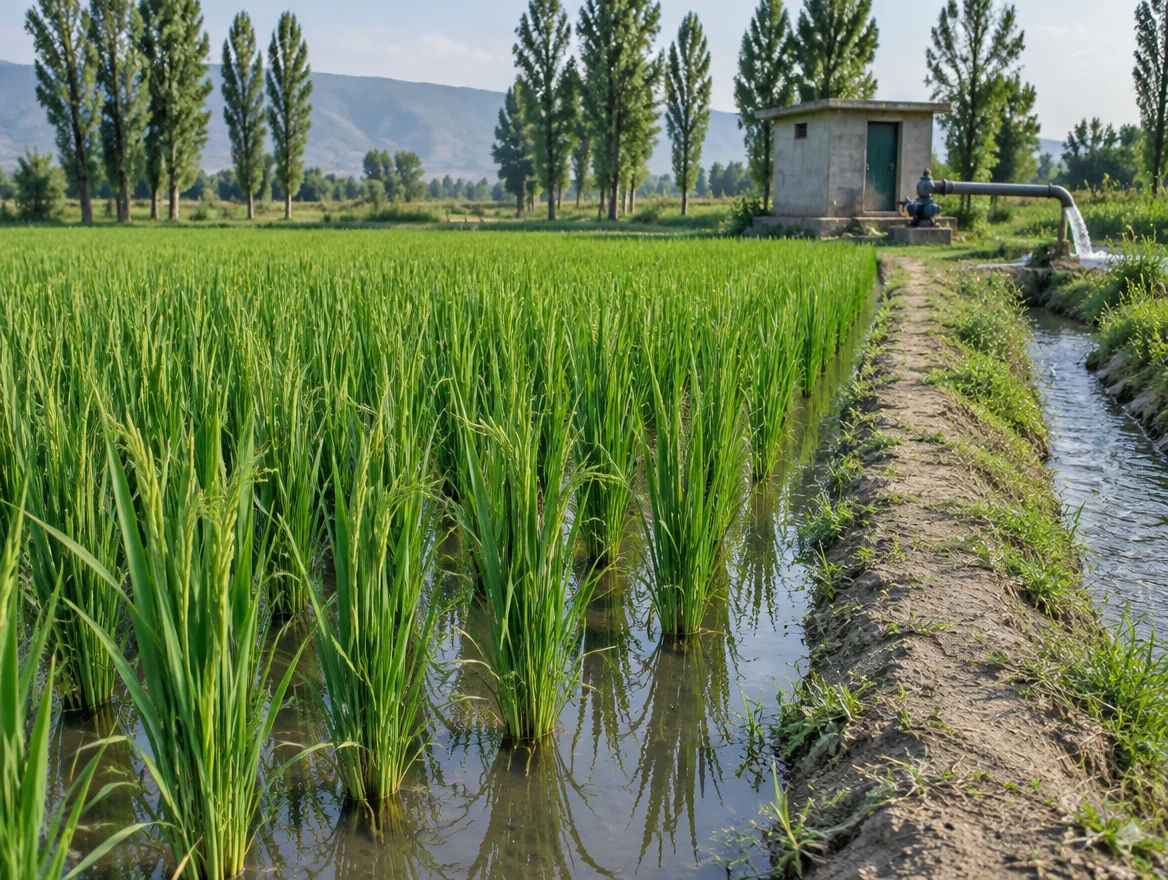
Jammu district is part of the basmati belt that stretches across Jammu, Samba and Kathua, about 63,000 ha in total, with R.S. Pura and Bishnah the best-known tehsils (Kashmir Reader, PTI, 15 Jun 2026[10]). The article does not name Nagrota, so ask the tehsil what the village grows, typically wheat, maize, paddy or vegetables.
- Basmati and paddy
- Wheat
- Maize
- Vegetables
Water
Ask the district groundwater office for the block category and water quality before you plan a borewell. Ask for a borewell record from neighbours and test the water before you pay. Seasonal streams are not a substitute for a tested borewell.
Land class and use
Because only agriculturists can buy agricultural land, the recorded land class in the jamabandi decides who may purchase. Ask the tehsil for the class and any conversion order.
Farmland India view
Why buyers look at Nagrota
Why buyers look at Nagrota, and what to weigh.
A ring road with a clear end point
The Jagti connection is a known point on NH-44, so buyers can judge access. Ask the project authority for the current timeline and cost.
Priced on road access
Land here is priced on road access and ring-road hope rather than crop income. Compare registered deeds, not a dealer’s claim.
Convert first, or buy converted land
A non-agriculturist cannot buy agricultural land; buy land that is already recorded as non-agricultural, with the order in hand.
Migrant and state land histories
Jagti’s migrant township and the Roshni history make a title chain check essential.
Buy at the price of use, not hope
If the ring road is open and traffic is relieved, access will matter; if it is not, land should still make sense as farmland or as converted plots.
Check the neighbours’ rights
Plots near NH-44 often share access with several owners. A written right of way avoids later disputes.
Listing data is not legal advice. Confirm land class, migrant status, state-land history and any NHAI acquisition notice with the Nagrota Tehsildar before paying an advance.
STRAIGHT TALK
Risks & challenges specific to Nagrota
Check these before paying an advance on Nagrota land.
Agriculturist rule
Agricultural land cannot be sold to a non-agriculturist except under limited exemptions[1]. A deed that breaks this rule can be challenged.
Migrant-owned land
Sale needs the owner in person and the Divisional Commissioner Kashmir’s permission; no power of attorney registration[6].
Roshni and state land
Land once vested under the Roshni Act is at risk after the High Court ruling[9]. Ask for the title chain.
Ring road acquisition and opening
The road was about 95% done in January 2026 with the Jagti stretch pending[8]. Confirm the alignment, interchange and any acquisition notice.
Conversion and its fee
Conversion needs a district committee decision and a fee of 5% of market value[3].
Stamp duty not notified
Ask the sub-registrar for recent registered sale values in the village you are looking at.[7]. Confirm with the sub-registrar.
Slope and drainage
Land near the Shivalik foothills can have slopes and seasonal streams. Check drainage and ask neighbours about the last monsoon before building or planting.
NRIs and OCIs
FEMA bars NRIs and OCIs from buying agricultural land, farmhouses or plantations except by inheritance; see the NRI guide.
COMMON QUESTIONS
Frequently asked questions
Everything buyers, NRIs and investors ask before their first reviewed farmland purchase in Nagrota.
Visit full wiki01 of 04
Where does the Jammu Ring Road meet Nagrota?
Construction World reported on 21 January 2026 that the nearly 56 km road runs from Raya Morh in Samba district to NH-44 near Jagti in Nagrota, about 14 km before Jammu on the Katra–Srinagar side, with about 95% of the stretch done and about 5 km pending near Jagti.
02 of 04
Can an outsider buy farmland near Nagrota?
Only agriculturists can buy agricultural land in Jammu and Kashmir under the amended Land Revenue Act, with limited exemptions. Any Indian can buy non-agricultural land. Check the recorded land class before you pay.
03 of 04
Is migrant-owned land different?
Yes. An IGR J&K letter of 22 May 2025 says a migrant’s land can be sold only by the owner in person with the Divisional Commissioner Kashmir’s permission, and not through a power of attorney. Check the seller’s status.
04 of 04
What are the stamp duty rates?
Kashmir Life reported on 17 April 2026 stamp duty of 7% for men and 3% for women, plus 1.2% registration charges, from a government fee schedule. Confirm with the sub-registrar.
Transparency
Sources for this page
- [1]ThePrint: 12 laws repealed, 14 amended; what changes under the new land orders, 29 October 2020 — theprint.in
- [2]Drishti IAS: Amendment related to land in Jammu and Kashmir, 29 October 2020 — drishtiias.com
- [3]Kashmir Life: J&K announces rules for land conversion, 15 January 2022 — kashmirlife.net
- [4]Jammu district administration: demography (Census 2011) — jammu.nic.in
- [5]Land Records Information System, J&K — landrecords.jk.gov.in
- [6]Inspector General of Registration J&K: letter on registration of migrant property, 22 May 2025 — igr.jk.gov.in
- [7]Kashmir Life: registration at 3% for women, 7% for men, 17 April 2026 — kashmirlife.net
- [8]Construction World: Jammu Ring Road nears launch, 21 January 2026 — constructionworld.in
- [9]LiveLaw: J&K High Court holds Roshni Act unconstitutional, 11 October 2020 — livelaw.in
- [10]Kashmir Reader: basmati paddy sowing begins in Jammu border belt, 15 June 2026 — kashmirreader.com
General information, not legal advice. Report inaccuracies to wiki@farmlandindia.com.
For developers
Ready to explore Nagrota farmland?
Browse reviewed projects and individual land parcels across Nagrota — or if you own land here, list it with platform review and reach serious buyers.