
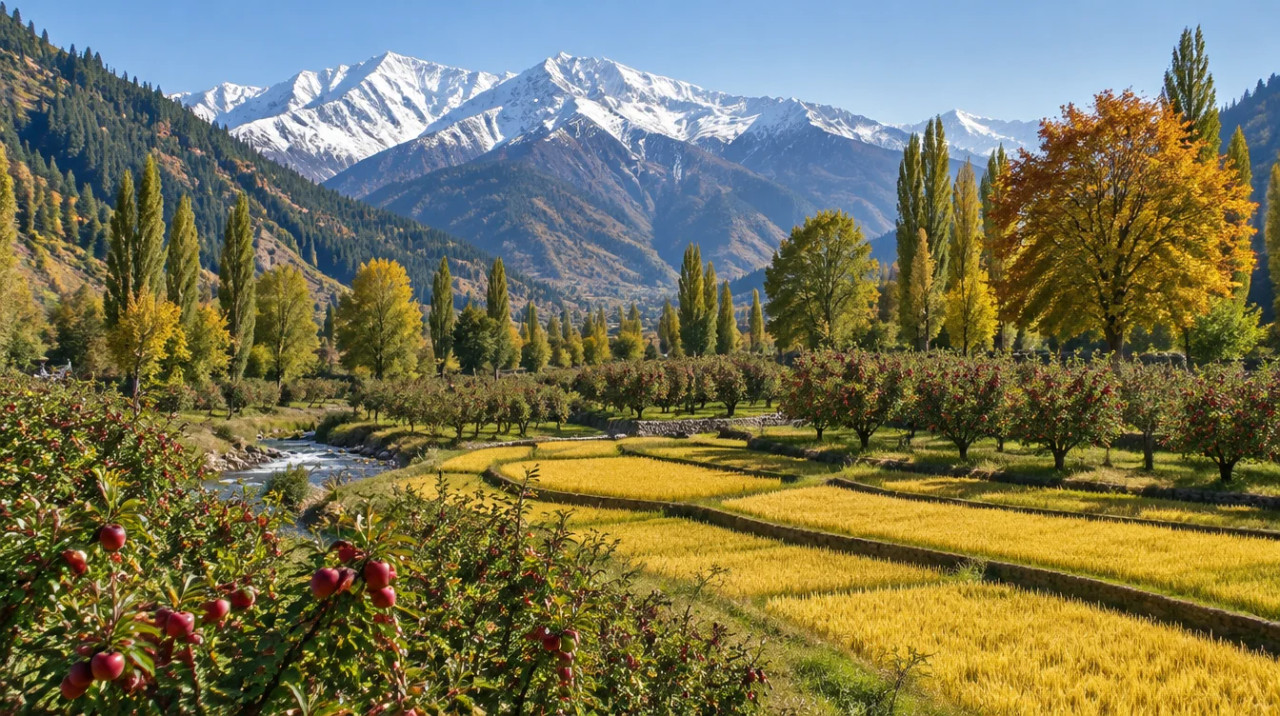
State guide
Buying Land in Jammu and Kashmir
Non-agricultural land is open to all Indians; farmland only to J&K agriculturists. Conversion, migrant land, stamp duty and records explained.
20
Districts
2: Kashmir and Jammu
Divisions
149 of 149
Groundwater units safe (2025)
Over 21 lakh tonnes
Apple output (2024-25)
*Indicative range across districts and land types. Stamp duty, registration and conversion charges are additional. Local measurement units vary — every listing states the unit it is priced in. Not a valuation or an offer.
State land record — Jammu and Kashmir
Rev. 2026 · Farmland India desk
Status
Union Territory with a legislature since 31 October 2019, when the former state was split into two Union Territories: Jammu and Kashmir, and Ladakh. Ladakh has its own land rules and its own page.
Divisions and districts
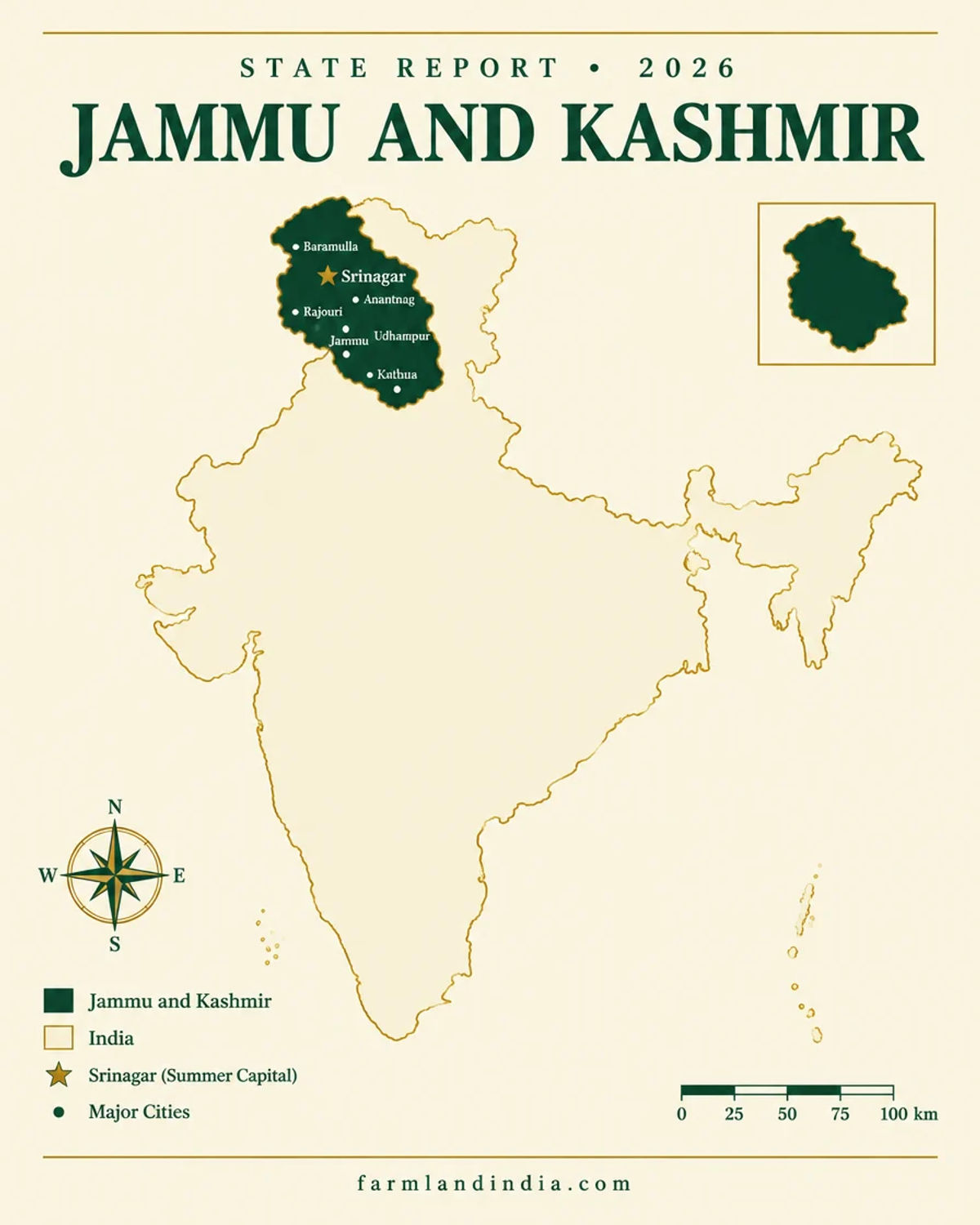
Two divisions, Kashmir and Jammu, with 20 districts: ten in the Kashmir valley and ten in the Jammu region. Srinagar is the summer capital and Jammu the winter capital.
Who can buy farmland
Agricultural land can be transferred only to an agriculturist, defined as a person who cultivates land personally in the Union Territory, or a category the government notifies (Kashmir Observer, December 2022[3]). Non-agricultural land is open to any Indian citizen since October 2020.
Land records
Jamabandi (the record of rights), girdawari (the crop inspection register), khasra numbers and mutation on the Land Records Information System; see our J&K land records guide
Stamp duty and registration
Reported at 7% for men and 3% for women, plus 1.2% registration charges, with deeds registered through NGDRS; confirm at the sub-registrar
Groundwater
All 149 assessment units rated safe in the 2025 national assessment
Local units
Kanal and marla: 20 marla make 1 kanal, and 8 kanal make 1 acre
NRI and OCI buyers
Cannot acquire agricultural land, a farmhouse or plantation land except by inheritance, under RBI rules
Jammu and Kashmir — land purchase legal rules
Jammu and Kashmir’s land law was rewritten in October 2020. Non-agricultural land is now open to any Indian citizen, but agricultural land can pass only to agriculturists of the Union Territory, with exemptions the government grants case by case, and converting farmland needs permission. Migrant land, state land and strategic areas carry their own rules. This block applies to every district page in the Union Territory.
What changed in October 2020: On 26 October 2020 the Ministry of Home Affairs issued the Jammu and Kashmir Reorganisation (Adaptation of Central Laws) Third Order and the Adaptation of State Laws Fifth Order. Together they repealed 12 land laws, among them the Big Landed Estates Abolition Act, 1950, the Alienation of Land Act, 1938, the Tenancy Act, the Consolidation of Holdings Act, the Prohibition on Conversion of Land and Alienation of Orchards Act, 1975 and the Right of Prior Purchase Act, and amended others (ThePrint, 29 October 2020). Before 2019 only permanent residents of the state could own land there; that rule is gone.
Non-agricultural land: The words “permanent resident of the State” were removed from Section 17 of the Jammu and Kashmir Development Act, so any Indian citizen can now buy non-agricultural land, for a house, a shop, a hotel or an industrial unit, in the Union Territory. The Real Estate (Regulation and Development) Act now applies here as it does elsewhere (ThePrint, 29 October 2020).
Agricultural land: agriculturists only: The amended Jammu and Kashmir Land Revenue Act, 1996 bars the sale, gift, exchange or possessory mortgage of agricultural land to a non-agriculturist. An agriculturist is a person who cultivates land personally in the Union Territory, or a category the government notifies; in December 2022 the government ordered that the legal heirs of an agriculturist (mother, father, wife and children) be treated as agriculturists too for the purposes of Section 133-H, the section that bars transfers to non-agriculturists (Kashmir Observer, 1 December 2022). In plain terms, a buyer from outside Jammu and Kashmir who does not farm here cannot buy farmland in his own name.
Exemptions: The government, or an officer it authorises, may permit a transfer of agricultural land to a non-agriculturist. It may allow transfers to public trusts and charities for education or health, and may notify transfers for industrial, commercial, housing or agricultural development. Leases are not barred. Land transferred under such a permission is meant to be put to the permitted use within five years (Drishti, 29 October 2020).
Converting farmland: Agricultural land cannot be used for any other purpose without permission. The Agricultural Land (Conversion for Non-Agricultural Purposes) Regulations, notified in January 2022, route applications to a district committee headed by the District Development Commissioner (the Deputy Commissioner). The fee is 5% of the market value notified under the Stamp Act, the decision is due within 30 days of a complete application, and the approved use must begin within one to two years. If the committee does not decide in time, the District Collector grants the permission (Kashmir Life, 15 January 2022). The old limit of 400 square metres, for houses only, no longer applies.
Strategic areas: The Union Territory government can declare an area a strategic area for the direct operational and training needs of the armed forces, on a request from an officer not below the rank of Corps Commander (Drishti, 29 October 2020). Land inside such an area is not open to ordinary purchase or development.
Kashmiri migrant land: Land of Kashmiri migrants is protected under the Jammu and Kashmir Migrant Immovable Property (Preservation, Protection and Restraint on Distress Sales) Act, 1997. Under the Inspector General of Registration’s instructions of May 2025, a sale deed of migrant land can be executed only by the owner in person, with the permission of the Divisional Commissioner, Kashmir; registration through a power of attorney is not allowed (IGR Jammu and Kashmir, 2025). Ask whether the seller or the land is on the migrant list before anything else.
State land and the Roshni Act: In October 2020 the High Court declared the Jammu and Kashmir State Land (Vesting of Ownership to the Occupants) Act, 2001, known as the Roshni Act, unconstitutional and void from the start, ordered a CBI inquiry and directed that state land vested under it be retrieved (LiveLaw, 11 October 2020). Title that traces back to a Roshni grant, or to state land (khalsa sarkar), kahcharai (village grazing land) or nazul land, is not safe to buy.
Stamp duty and registration: Stamp duty on a sale deed is reported at 7% for men and 3% for women, with registration charges of 1.2%, according to the government’s fee schedule (Kashmir Life, 17 April 2026). Deeds are registered at the sub-registrar office through NGDRS, and duty is charged on the higher of the deed price and the notified market value. Confirm the current rate with the sub-registrar before you register.
Records and units: Records of rights, jamabandi, girdawari and mutation entries are on the Land Records Information System run under the Aapki Zameen Aapki Nigrani (your land, your oversight) programme. Land is measured in kanal and marla: 20 marla make a kanal and 8 kanal make an acre, so a 4-kanal plot is half an acre. Ask for the khasra number, check the jamabandi and the latest girdawari, and confirm the last mutation was attested.
NRI and OCI buyers: Under the RBI Master Direction on immovable property, NRIs and OCIs may not acquire agricultural land, a farmhouse or plantation property in India except by inheritance. In Jammu and Kashmir the agriculturist rule applies on top of that. Our NRI guide covers the options.
What this page does not do: It does not give a legal view on any particular plot or seller. The orders have been amended several times since 2020; have a local advocate read the jamabandi, the mutation history and any permission before you pay.
- Non-agricultural land: any Indian
- Farmland: agriculturists only
- Section 133-H
- Conversion: district committee
- Strategic areas
- Migrant land: Divisional Commissioner
- Roshni Act void
- NRIs: inheritance only
Union Territory overview
Jammu and Kashmir — from the Kashmir valley to the Jammu plains
Jammu and Kashmir has been a Union Territory with its own legislature since 31 October 2019, when the old state was divided and Ladakh became a separate Union Territory. It has two divisions with 20 districts between them. The Kashmir division is the valley of the Jhelum, ringed by the Pir Panjal and the Great Himalaya, with Srinagar, Anantnag, Baramulla, Pulwama, Shopian, Kulgam, Budgam, Ganderbal, Bandipora and Kupwara. The Jammu division runs from the Punjab plains at Kathua and Samba through the Shivalik foothills of Jammu, Udhampur and Reasi to the hill districts of Rajouri and Poonch and the Chenab valley districts of Doda, Kishtwar and Ramban. Srinagar is the summer capital and Jammu the winter capital. The Union Territory borders Punjab and Himachal Pradesh to the south and Ladakh to the east.
Farming carries the economy: the Economic Survey 2025-26 says nearly 70% of the population depends on agriculture directly or indirectly (Kashmir Life[15]). The valley is apple country, with output above 21 lakh tonnes in 2024-25, almost all of it from Kashmir (Kashmir Life, October 2025[14]), along with saffron on the karewa (raised plateau) land of Pampore, walnuts, almonds and the paddy of the valley floor. The Jammu plains grow wheat and paddy, including the basmati of R.S. Pura, and the hill districts grow maize. Buyers fall into a few groups: local families and agriculturists consolidating orchards and paddy land; Jammu and Srinagar households buying plots on the edges of the two cities; investors in hotels, homestays and commercial sites at Gulmarg, Pahalgam, Sonamarg, Patnitop and Katra; and industrial buyers in the estates of Kathua, Samba and Jammu. Buyers comparing the north can read our Punjab and Himachal Pradesh pages.
Start with who may buy. Since October 2020 any Indian citizen can buy non-agricultural land here, but agricultural land can pass only to an agriculturist of the Union Territory unless the government permits otherwise, and turning farmland into a house plot or a hotel site needs a conversion order. A safe purchase begins with the jamabandi and girdawari, the land class, the mutation history and the seller’s status, and only then moves to price.
- 20 districts
- 2 divisions
- Capitals: Srinagar and Jammu
- Union Territory since 2019
- Apples: 21 lakh tonnes
- Land Revenue Act, 1996
Market bands
Reported cost reference points — Jammu and Kashmir
No official farmland price series is published for Jammu and Kashmir. These are the official cost reference points a buyer will meet; actual prices come from registered deeds in the village.
| Item | Scope | Reported figure* | Source |
|---|---|---|---|
| Stamp duty, men | Sale deed in a man’s name | 7% (reported) | Kashmir Life, 17 April 2026[6] |
| Stamp duty, women | Sale deed in a woman’s name | 3% (reported) | Kashmir Life, 17 April 2026 |
| Registration charges | Sale deed | 1.2% (reported) | Kashmir Life, 17 April 2026 |
| Conversion fee | Agricultural land converted to non-agricultural use | 5% of the notified market value | Kashmir Life, 15 January 2022[7] |
| Farmland price series | Union Territory or district level | None published | Not published |
*No newspaper or official source publishes a farmland price series for Jammu and Kashmir’s districts, so this page does not quote one. Duty is charged on the higher of the deed price and the market value the government notifies for the area. Ask the sub-registrar for the notified value of the exact khasra, compare registered deeds in the same village, and remember that prices quoted per kanal need converting: 8 kanal make an acre. A farmland price far below the village level usually means the seller cannot lawfully sell to you, or the land is state land, migrant land or under a conversion condition.
Transaction costs
Stamp duty & registration in Jammu and Kashmir
7%
Stamp duty, men
Reported rate on a sale deed in a man’s name
3%
Stamp duty, women
Reported rate on a sale deed in a woman’s name
1.2%
Registration charges
Reported, on top of stamp duty
A report on the government’s schedule of fees in April 2026 put stamp duty on land registration at 7% for men and 3% for women, with registration charges of 1.2% on top (Kashmir Life, 17 April 2026[6]). Treat these as reported figures and confirm them at the sub-registrar office or in the NGDRS fee calculator on the day you register. The gap between the two rates is large: on a deed of Rs 50 lakh, 7% is Rs 3.5 lakh and 3% is Rs 1.5 lakh. Many families therefore register land in a woman’s name, but make sure the buyer named on the deed is the one who meets the agriculturist test if the land is agricultural. Duty is charged on the higher of the price in the deed and the market value notified for the area. Converting agricultural land to another use carries a separate fee of 5% of that notified market value, paid when the district committee grants permission (Kashmir Life, 15 January 2022[7]). Deeds are registered through NGDRS at the sub-registrar office; the Inspector General of Registration publishes circulars and forms at igr.jk.gov.in. Sales of Kashmiri migrant land need the Divisional Commissioner’s permission and the owner present in person.
Connectivity
How Jammu and Kashmir connects: road, rail and air
NH-44 and the Mughal Road, two airports and the new railway into the valley
🚗 By road
✈️ By air
🚆 By rail
🏭 Industrial belts
Most industry sits on the Jammu plains, in the estates around Bari Brahmana, Samba and Kathua, where the Delhi–Katra expressway and the Punjab border give the best road access. In the valley, the industrial areas at Lassipora in Pulwama and around Srinagar serve food processing, cold storage and handicrafts, and the apple trade drives demand for controlled-atmosphere stores: capacity was about 2.92 lakh tonnes against an estimated need of 6 lakh tonnes in 2025 (Kashmir Life, October 2025[14]). For farmland buyers the useful signal is land near a mandi, a cold store or a new road, which is still farmed and outside any acquisition notice.
Growth catalysts
Upcoming infrastructure & developments
Status as of November 2026, with the date and source of the latest public update for each project
04Highway corridors
Three under construction, one sanctioned
08Catalysts
Agriculture & terrain
Soil, crops & water across Jammu and Kashmir
Orchards and paddy in the valley, wheat and basmati on the plains, maize in the hills
The Kashmir valley
Srinagar, Budgam, Ganderbal, Pulwama, Shopian, Kulgam, Anantnag, Baramulla, Bandipora and Kupwara sit on the alluvial floor of the Jhelum and the raised karewa terraces above it. Paddy fills the low, irrigated land; apple orchards cover the slopes and much of the old paddy land in Shopian, Pulwama, Kulgam and Baramulla; saffron grows on the Pampore karewas; walnuts and almonds on the drier uplands. Irrigation comes from streams fed by snowmelt and from small canals (kuhls). Holdings are small and frequently cut by partition.
- Paddy, apple, saffron, walnut
- Snowmelt streams and kuhls
- One harvest a year in most of the valley
The Jammu plains and Kandi belt
Jammu, Samba and Kathua run from the irrigated plains along the Punjab border up into the dry Kandi foothills. The canal-fed plains grow wheat in winter and paddy in summer, including the basmati of R.S. Pura; the Kandi belt depends on rain and grows maize, wheat and fodder. This is the most open and easily reached farmland in the Union Territory, and the belt where the Delhi–Katra expressway and the industrial estates sit.
- Wheat and paddy, basmati
- Canal plains, rain-fed Kandi
- Close to Punjab and the expressway
The hill districts
Udhampur, Reasi, Rajouri, Poonch, Doda, Kishtwar and Ramban are hill country on either side of the Pir Panjal and along the Chenab. Maize is the main crop, with pulses, rajmash (kidney beans), vegetables and some fruit, mostly on terraced, rain-fed fields. Kishtwar also grows saffron. Land is broken, roads are slow and much of the area is forest or close to the Line of Control in Rajouri and Poonch.
- Maize, pulses, rajmash
- Terraced, rain-fed
- Forest and border areas
Groundwater
Groundwater is not a constraint here on paper. In the 2025 national assessment all 149 assessment units in Jammu and Kashmir were rated safe and none over-exploited, according to a reply in the Rajya Sabha (Kashmir Life, 3 August 2026[8]). Farming in the valley relies on snowmelt rather than wells, so the real risk is a dry winter or a weak snowfall, not a falling water table. In the Kandi belt, ask about borewell yields and the nearest canal before buying.
Land use
Most farms are small family holdings measured in kanals, and buying a block of several acres usually means dealing with many co-sharers recorded on the same khasra. In the valley, paddy land has been converted to orchards on a large scale because apples pay more, and orchard land near towns is under pressure from housing. A conversion order is needed before farmland is built on, and the 1975 law against converting orchards was among those repealed in 2020.
Crops
Apple output crossed 21 lakh tonnes in 2024-25, with 20.79 lakh tonnes from Kashmir and about 30,000 tonnes from Jammu, and exports of 13.35 lakh tonnes in 2023-24 (Kashmir Life, October 2025[14]). Kashmir saffron, Mushkbudji rice and the basmati of Jammu carry GI tags. With controlled-atmosphere storage at about half the estimated need, land near the highways and mandis that suits cold stores and packing houses is in demand.
At a glance
Jammu and Kashmir’s regions side by side
| Region | Price series | Water and irrigation | Note |
|---|---|---|---|
| Kashmir valley (Srinagar, Budgam, Ganderbal, Pulwama, Shopian, Kulgam, Anantnag, Baramulla, Bandipora, Kupwara) | None published* | Snowmelt streams, kuhls; all units safe | Apple and paddy; Srinagar Ring Road; USBRL stations; migrant land rules apply widely |
| Jammu plains (Jammu, Samba, Kathua) | None published* | Canals on the plains; rain-fed Kandi belt | Delhi–Katra expressway; industrial estates; most open farmland |
| Jammu hills (Udhampur, Reasi, Rajouri, Poonch) | None published* | Rain-fed terraces | USBRL through Udhampur and Reasi; Akhnoor–Poonch road; border areas |
| Chenab valley (Doda, Kishtwar, Ramban) | None published* | Rain-fed slopes, streams | NH-44 through Ramban; hydropower projects; forest and steep land |
*No newspaper or official source publishes a farmland price series for these regions. The same land law applies across all 20 districts; what differs is the land itself, the roads and the share of state, forest and migrant land. Buyers weighing Jammu and Kashmir against a neighbour can compare the agriculturist rule here with the rules on our Himachal Pradesh page.
Farmland India view
Why investors look at Jammu and Kashmir
A railway into the valley, an expressway on the plains and clear, strict rules
The valley is joined to the rail network
Since June 2025 trains run from Katra to Srinagar and on to Baramulla. For the first time, apples and other produce can leave the valley without depending on one mountain highway, and visitors can arrive without it. The stations are where the change will show first, in demand for stores, shops and hotel sites.
The Jammu plains are about to get an expressway
The Delhi–Amritsar–Katra expressway is near completion in Kathua, Samba and Jammu, with a March 2027 target. Land near its interchanges, the industrial estates and Jammu city is the most liquid in the Union Territory, and non-agricultural plots there are open to any Indian buyer.
Orchards and cold chains pay
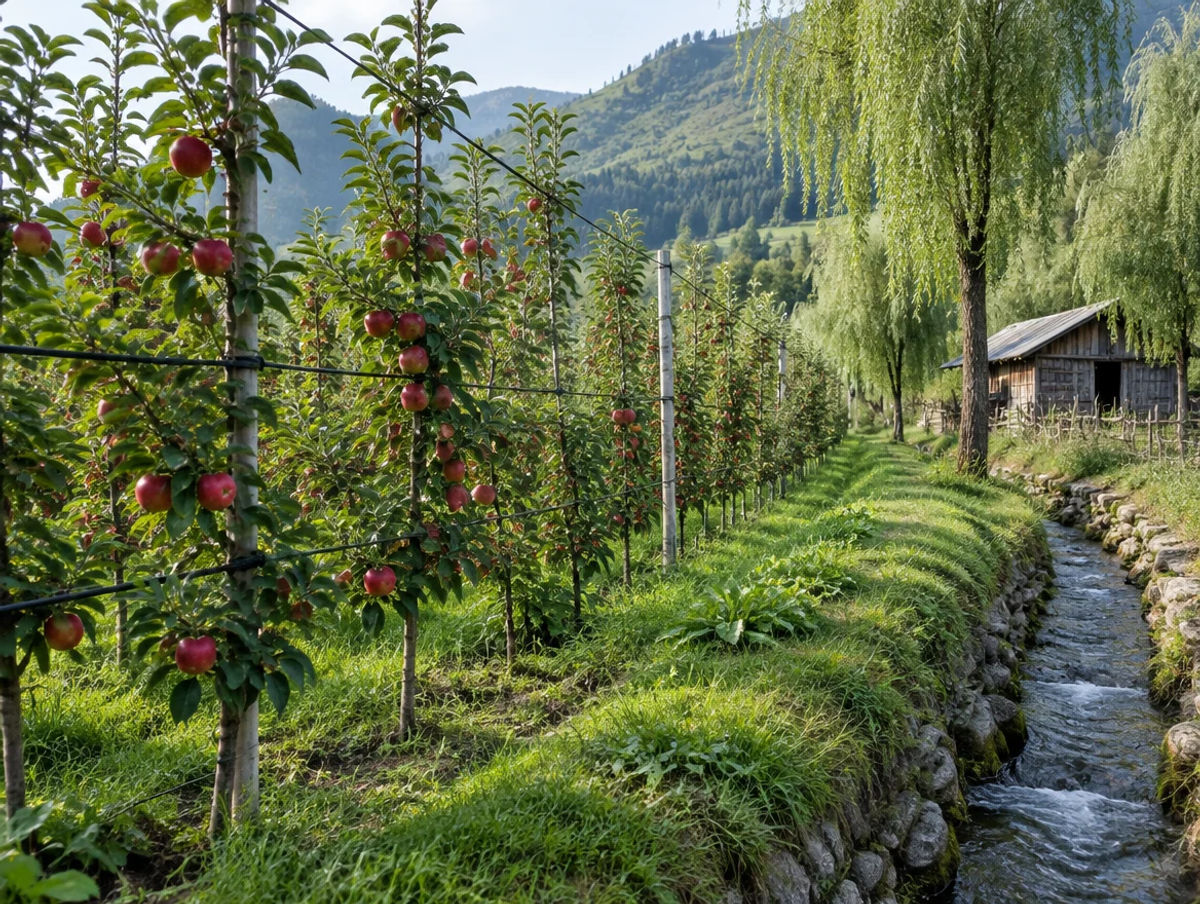
Apple output is above 21 lakh tonnes a year and storage covers about half the need. Orchard land with water and road access, and sites suited to cold stores and packing houses near mandis, are the strongest farm-linked plays, but orchard land itself can be bought only by an agriculturist.
Tourism needs land, with permission
Year-round access to Sonamarg, the new railway and planned roads to Pahalgam and through the Pir Panjal widen the tourism map. Hotel and homestay sites are non-agricultural uses, so a buyer needs land already recorded as non-agricultural or a conversion order, and local building and environmental rules.
The rules are clear, and strict
Since 2020 the law is simple to state: non-agricultural land is open to all Indians; agricultural land is for agriculturists, unless the government permits otherwise. That clarity is an advantage, but it also means there is no safe workaround. Do not pay a premium for farmland on the promise that conversion or permission will follow.
Confirm the jamabandi, the girdawari, the land class, the mutation history, the buyer’s agriculturist status and any conversion order before you pay a token amount.
STRAIGHT TALK
Risks & challenges in Jammu and Kashmir
What can undo a land purchase in Jammu and Kashmir
Buying farmland as a non-agriculturist
A sale, gift or exchange of agricultural land to a person who is not an agriculturist of the Union Territory is barred unless the government has given permission. Deeds in breach should not be registered, and arrangements built around a local nominee, a long agreement to sell or a power of attorney can be undone. Walk away from any deal that depends on one.
Conversion that never comes
Building on farmland needs a conversion order from the district committee, at a fee of 5% of the notified market value, and the approved use must start within one to two years. Do not buy agricultural land at a building-plot price on a promise that the seller will “get it converted”.
State, kahcharai and Roshni land
Land recorded as state land (khalsa sarkar), kahcharai (grazing land), nazul or forest cannot be bought from a private seller, however long it has been occupied. Ownership granted under the Roshni Act was declared void in 2020 (LiveLaw, October 2020[4]). Read the land class in the jamabandi and trace the title back several decades.
Migrant land
Land belonging to Kashmiri migrants can be sold only by the owner in person, with the Divisional Commissioner’s permission, and not through a power of attorney (IGR Jammu and Kashmir[5]). A cheap orchard sold by a relative or an agent for an absent owner is a warning sign.
Co-sharers and old entries
Holdings are small and often shared by many heirs on one khasra, and some records still carry entries from before the 2020 repeals, such as tenancy or prior-purchase claims. Get every co-sharer to sign, and have the patwari show the plot on the map and confirm the latest attested mutation, as our land records guide explains.
Strategic and border areas
Areas notified as strategic for the armed forces, land near the Line of Control in Rajouri, Poonch, Kupwara and Baramulla, and land near cantonments carry restrictions and practical access limits. Ask the tehsil before you look at price.
Floods and slopes
The Jhelum flooded much of Srinagar and the valley in 2014, and hill districts face landslides and flash floods. Check whether a plot lies in a flood plain, a wetland or a slide zone, and ask the neighbours what happened in the last big flood.
Rates you must confirm
Stamp duty and registration figures on this page are reported, not taken from the notification, and the government has changed fees several times. Confirm the duty, the registration charge and the notified market value at the sub-registrar on the day you register.
Who to contact
Local revenue & registration offices
Land administration in Jammu and Kashmir runs through the Revenue Department, two Divisional Commissioners (Kashmir in Srinagar, Jammu in Jammu) and 20 Deputy Commissioners, who also act as District Collectors. For any plot, start with the patwari of the halqa (the village record keeper), who keeps the jamabandi, the girdawari and the field map; the Girdawar supervises a group of patwaris. The Tehsildar attests mutations and handles demarcation at the tehsil, and the Assistant Commissioner (Revenue) and the Deputy Commissioner deal with appeals, permissions and conversion of agricultural land through the district committee. The Divisional Commissioner, Kashmir grants permission for the sale of Kashmiri migrant land. Deeds are registered at the sub-registrar office through NGDRS, under the Inspector General of Registration (igr.jk.gov.in). Records can be seen on the Land Records Information System (landrecords.jk.gov.in), and each district’s website lists its tehsils and officers.
COMMON QUESTIONS
Frequently asked questions
Everything buyers, NRIs and investors ask before their first reviewed farmland purchase in Jammu and Kashmir.
Visit full wiki01 of 04
Can someone from outside Jammu and Kashmir buy land there?
Yes, non-agricultural land, since the October 2020 land orders removed the permanent-resident condition. Agricultural land can be sold only to an agriculturist of the Union Territory unless the government permits the transfer.
02 of 04
Can I buy farmland and convert it to a house or hotel site?
Only an agriculturist can buy farmland without special permission, and any change of use needs a conversion order from the district committee headed by the Deputy Commissioner. The fee is 5% of the notified market value, and the new use must start within one to two years.
03 of 04
What is the stamp duty on land in Jammu and Kashmir?
It is reported at 7% for men and 3% for women, plus 1.2% registration charges, charged on the higher of the deed value and the notified market value. Confirm the current rate at the sub-registrar before you register.
04 of 04
How do I check land records in Jammu and Kashmir?
The Land Records Information System at landrecords.jk.gov.in shows the record of rights, jamabandi, girdawari and mutations. Match the khasra on the ground with the patwari and check that the latest mutation has been attested.
Transparency
Sources and references
Law and courts
- [1]ThePrint: 12 laws repealed, 14 amended — what changes under the new land orders in J&K (29 Oct 2020) — theprint.in
- [2]Drishti: amendment related to land in Jammu and Kashmir (29 Oct 2020) — drishtiias.com
- [3]Kashmir Observer: legal heirs of an agriculturist can inherit agricultural land (1 Dec 2022) — kashmirobserver.net
- [4]LiveLaw: High Court holds the Roshni Act unconstitutional (11 Oct 2020) — livelaw.in
Government
- [5]Inspector General of Registration, J&K: registration of Kashmiri migrant land (2025) — igr.jk.gov.in
News
- [6]Kashmir Life: registration at 3% for women, 7% for men (17 Apr 2026) — kashmirlife.net
- [7]Kashmir Life: J&K announces rules for land conversion (15 Jan 2022) — kashmirlife.net
- [8]Kashmir Life: all 149 groundwater units in J&K safe (3 Aug 2026) — kashmirlife.net
- [9]ThePrint: Katra to Srinagar in three hours, Vande Bharat flagged off (6 Jun 2025) — theprint.in
- [10]Tribune: Delhi–Katra expressway to be completed by March 2027 (26 Feb 2026) — tribuneindia.com
- [11]Kashmir Life: Chief Secretary reviews Rs 40,000 crore highway and tunnel projects (2 Sep 2026) — kashmirlife.net
- [12]Kashmir Life: Srinagar Ring Road phase I at 71.5% (27 Jun 2025) — kashmirlife.net
- [13]Kashmir Life: Sonamarg breaks winter isolation with Z-Morh tunnel (13 Jan 2025) — kashmirlife.net
- [14]Kashmir Life: apple production crosses 21 lakh tonnes (30 Oct 2025) — kashmirlife.net
- [15]Kashmir Life: agriculture supports 70% of population, Economic Survey 2025-26 — kashmirlife.net
Further reading
Data-currency note: sources were read in November 2026. Fees, notified market values, permissions and infrastructure timelines change often; check the linked source and the relevant office before relying on any figure.
For developers
Ready to explore Jammu and Kashmir farmland?
Browse reviewed projects and individual land parcels across Jammu and Kashmir — or if you own land here, list it with platform review and reach serious buyers.