
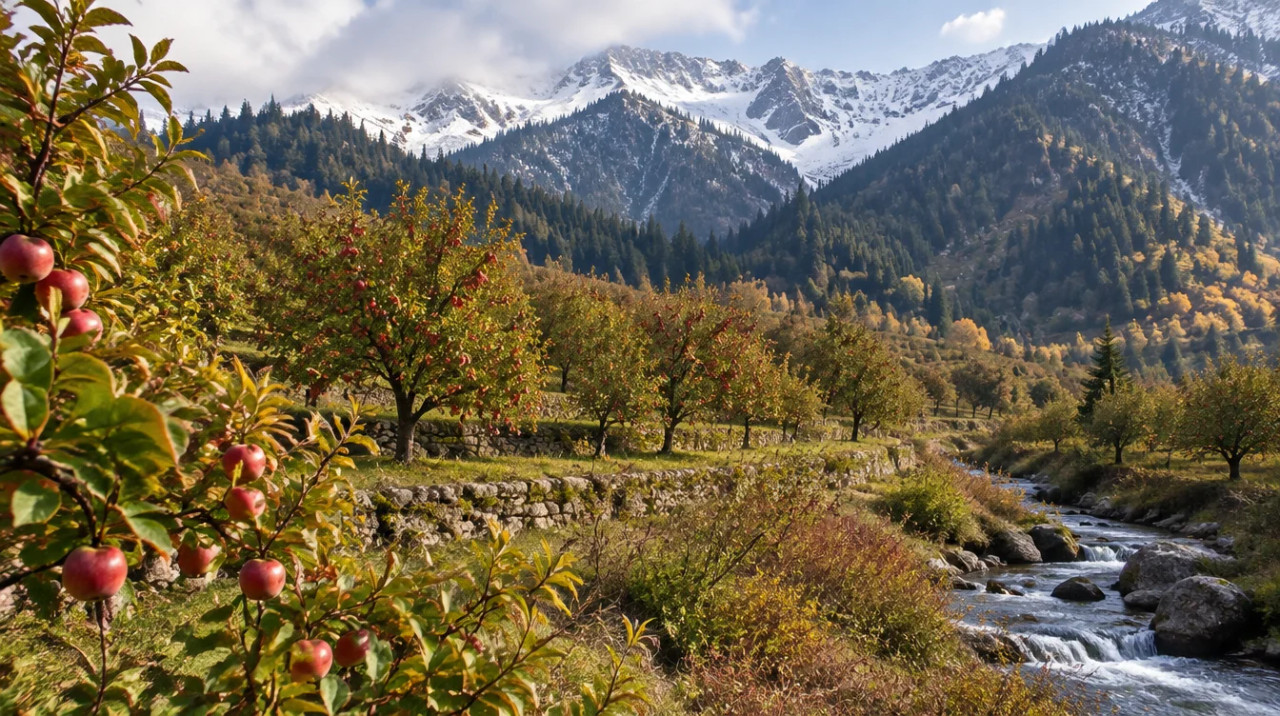
District guide
Buying Land in Shopian
India’s apple heartland on the Pir Panjal: what to check on the agriculturist rule, the Mughal Road, the master-plan freeze and title before you buy in Shopian.
19,770 ha
Apple area (ICAR-CRIDA plan, 2008-09)
3,720 ha
Walnut area (ICAR-CRIDA plan, 2008-09)
40.55 km, seasonal
Mughal Road, Shopian to Peer Ki Gali (NH-701A)
2.57 lakh MT
South Kashmir CA storage (Kashmir Life, Feb 2026)
*Indicative range across districts and land types. Stamp duty, registration and conversion charges are additional. Local measurement units vary — every listing states the unit it is priced in. Not a valuation or an offer.
District land record — Shopian
Rev. 2026 · Farmland India desk
State
Jammu and Kashmir (Union Territory)
Setting
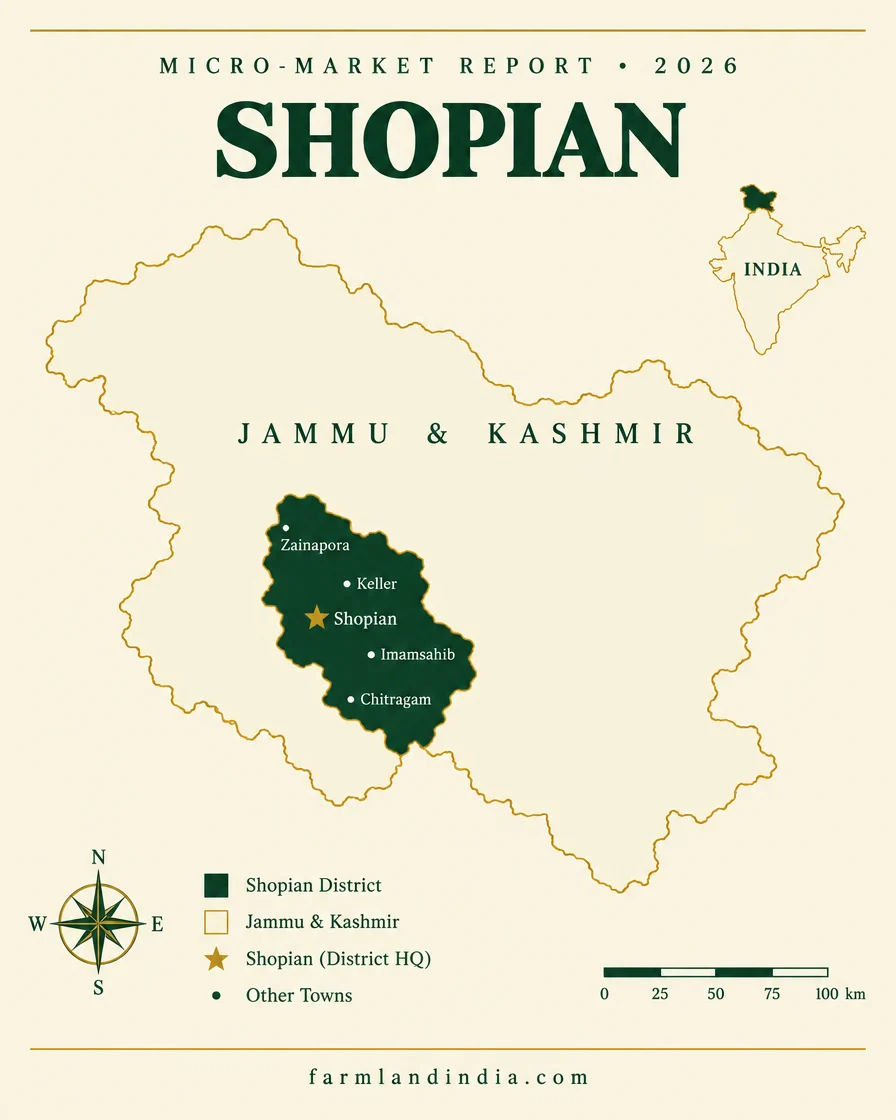
Shopian lies on the southern edge of the Kashmir Valley, where the valley floor meets the Pir Panjal. It borders Pulwama and Kulgam in the Valley and, across the range, the Jammu-side districts of Poonch and Rajouri. It was made a district in 2007.
Key markets
Shopian · Zainapora · Keller · Imamsahib · Chitragam · Aglar
Demand anchors
Apple and walnut orchards · the Aglar CA-storage cluster · the Mughal Road · the town’s master plan
Rail
No railway line in the district. The nearest stations are on the Banihal–Baramulla line in Pulwama and Anantnag districts.
Roads
NH-444 links Shopian with Pulwama, Kulgam and Srinagar. NH-701A, the Mughal Road, climbs from Shopian to Peer Ki Gali and on to Poonch and Rajouri (Kashmir Life[7]).
Water
The 2012 plan lists canals as the main irrigation source and about 11,900 hectares as rainfed, so orchard water depends on streams, canals and rain.
Pricing unit
No official price series is published; ask the sub-registrar for recent registered sale values in the village. Quote any land per acre and compare it with the registered deeds in the same village.
Local units
Revenue records use kanal and marla. Eight kanals make one acre and twenty marla make one kanal; convert before comparing quotes.
Land records portal
The J&K Land Records Information System (landrecords.jk.gov.in[4]) shows jamabandi, girdawari and mutation entries.
Land law is state law. These rules are maintained on the Jammu and Kashmir page and apply to every district within it.
Shopian — land purchase legal rules
Jammu and Kashmir’s land law was rewritten in October 2020. Non-agricultural land is now open to any Indian citizen, but agricultural land can pass only to agriculturists of the Union Territory, with exemptions the government grants case by case, and converting farmland needs permission. Migrant land, state land and strategic areas carry their own rules. This block applies to every district page in the Union Territory.
What changed in October 2020: On 26 October 2020 the Ministry of Home Affairs issued the Jammu and Kashmir Reorganisation (Adaptation of Central Laws) Third Order and the Adaptation of State Laws Fifth Order. Together they repealed 12 land laws, among them the Big Landed Estates Abolition Act, 1950, the Alienation of Land Act, 1938, the Tenancy Act, the Consolidation of Holdings Act, the Prohibition on Conversion of Land and Alienation of Orchards Act, 1975 and the Right of Prior Purchase Act, and amended others (ThePrint, 29 October 2020). Before 2019 only permanent residents of the state could own land there; that rule is gone.
Non-agricultural land: The words “permanent resident of the State” were removed from Section 17 of the Jammu and Kashmir Development Act, so any Indian citizen can now buy non-agricultural land, for a house, a shop, a hotel or an industrial unit, in the Union Territory. The Real Estate (Regulation and Development) Act now applies here as it does elsewhere (ThePrint, 29 October 2020).
Agricultural land: agriculturists only: The amended Jammu and Kashmir Land Revenue Act, 1996 bars the sale, gift, exchange or possessory mortgage of agricultural land to a non-agriculturist. An agriculturist is a person who cultivates land personally in the Union Territory, or a category the government notifies; in December 2022 the government ordered that the legal heirs of an agriculturist (mother, father, wife and children) be treated as agriculturists too for the purposes of Section 133-H, the section that bars transfers to non-agriculturists (Kashmir Observer, 1 December 2022). In plain terms, a buyer from outside Jammu and Kashmir who does not farm here cannot buy farmland in his own name.
Exemptions: The government, or an officer it authorises, may permit a transfer of agricultural land to a non-agriculturist. It may allow transfers to public trusts and charities for education or health, and may notify transfers for industrial, commercial, housing or agricultural development. Leases are not barred. Land transferred under such a permission is meant to be put to the permitted use within five years (Drishti, 29 October 2020).
Converting farmland: Agricultural land cannot be used for any other purpose without permission. The Agricultural Land (Conversion for Non-Agricultural Purposes) Regulations, notified in January 2022, route applications to a district committee headed by the District Development Commissioner (the Deputy Commissioner). The fee is 5% of the market value notified under the Stamp Act, the decision is due within 30 days of a complete application, and the approved use must begin within one to two years. If the committee does not decide in time, the District Collector grants the permission (Kashmir Life, 15 January 2022). The old limit of 400 square metres, for houses only, no longer applies.
Strategic areas: The Union Territory government can declare an area a strategic area for the direct operational and training needs of the armed forces, on a request from an officer not below the rank of Corps Commander (Drishti, 29 October 2020). Land inside such an area is not open to ordinary purchase or development.
Kashmiri migrant land: Land of Kashmiri migrants is protected under the Jammu and Kashmir Migrant Immovable Property (Preservation, Protection and Restraint on Distress Sales) Act, 1997. Under the Inspector General of Registration’s instructions of May 2025, a sale deed of migrant land can be executed only by the owner in person, with the permission of the Divisional Commissioner, Kashmir; registration through a power of attorney is not allowed (IGR Jammu and Kashmir, 2025). Ask whether the seller or the land is on the migrant list before anything else.
State land and the Roshni Act: In October 2020 the High Court declared the Jammu and Kashmir State Land (Vesting of Ownership to the Occupants) Act, 2001, known as the Roshni Act, unconstitutional and void from the start, ordered a CBI inquiry and directed that state land vested under it be retrieved (LiveLaw, 11 October 2020). Title that traces back to a Roshni grant, or to state land (khalsa sarkar), kahcharai (village grazing land) or nazul land, is not safe to buy.
Stamp duty and registration: Stamp duty on a sale deed is reported at 7% for men and 3% for women, with registration charges of 1.2%, according to the government’s fee schedule (Kashmir Life, 17 April 2026). Deeds are registered at the sub-registrar office through NGDRS, and duty is charged on the higher of the deed price and the notified market value. Confirm the current rate with the sub-registrar before you register.
Records and units: Records of rights, jamabandi, girdawari and mutation entries are on the Land Records Information System run under the Aapki Zameen Aapki Nigrani (your land, your oversight) programme. Land is measured in kanal and marla: 20 marla make a kanal and 8 kanal make an acre, so a 4-kanal plot is half an acre. Ask for the khasra number, check the jamabandi and the latest girdawari, and confirm the last mutation was attested.
NRI and OCI buyers: Under the RBI Master Direction on immovable property, NRIs and OCIs may not acquire agricultural land, a farmhouse or plantation property in India except by inheritance. In Jammu and Kashmir the agriculturist rule applies on top of that. Our NRI guide covers the options.
What this page does not do: It does not give a legal view on any particular plot or seller. The orders have been amended several times since 2020; have a local advocate read the jamabandi, the mutation history and any permission before you pay.
- Non-agricultural land: any Indian
- Farmland: agriculturists only
- Section 133-H
- Conversion: district committee
- Strategic areas
- Migrant land: Divisional Commissioner
- Roshni Act void
- NRIs: inheritance only
Shopian — district-specific notes
The Jammu and Kashmir state page applies to Shopian in full. In this district the first checks are the buyer’s status as an agriculturist, who really holds the orchard, and whether a plot near the town is affected by the master-plan freeze.
⚠ Shopian’s land is overwhelmingly apple, walnut and rice-and-maize farmland, and all of it counts as agricultural land. After the 2020 amendments the Land Revenue Act bars the sale of agricultural land to a non-agriculturist, with limited exemptions (ThePrint[1]). A buyer from outside the UT who is not an agriculturist should plan on non-agricultural land, or on a lease, rather than a sale deed for an orchard.
⚠ A change of use is possible but slow. The 2022 conversion regulations route an application through a district committee headed by the Deputy Commissioner, with a fee of 5% of market value and a decision due within 30 days of a complete file (Kashmir Life[2]). Make conversion a condition of the agreement; do not pay on the promise of it.
⚠ Many Kashmiri Pandit families hold land in the Valley, including in the Shopian belt. A migrant owner can sell only in person, with the permission of the Divisional Commissioner Kashmir, and the registry does not accept a power of attorney for such a sale (IGR J&K letter, 22 May 2025[3]). A deed that skips this step is a title problem, whatever the price.
⚠ Orchards are usually held in shares across generations. Check the jamabandi for every co-sharer, the latest girdawari for what is actually grown, and the mutation history; a partition that exists only in family memory is a common source of later disputes.
⚠ State land entered as private holdings is a separate risk. The High Court’s 2020 ruling that the Roshni Act was unconstitutional, and the recovery drive that followed, means a plot whose title traces back to a Roshni vesting needs a lawyer’s opinion before any payment.
⚠ Shopian town has a particular problem: the 2023 draft master plan was criticised as outdated, and residents have been largely unable to renovate or build because zoning is unsettled (Greater Kashmir[9]). A plot in the town’s planning area may not be buildable until the new plan is notified. Ask the Municipal Council what zone the plot falls in.
⚠ Confirm each fact on the day of purchase at the tehsil and the sub-registrar. Farmland India’s review reads the records but does not replace a title search.
The state page covers the ceiling, conversion route, NRI position and the full land-law background.
- Agriculturists only for farmland
- Orchard land is agricultural
- Migrant land needs permission
- Master-plan freeze
- State land and Roshni
District overview
Shopian — the Pir Panjal apple belt and the gateway to the Mughal Road
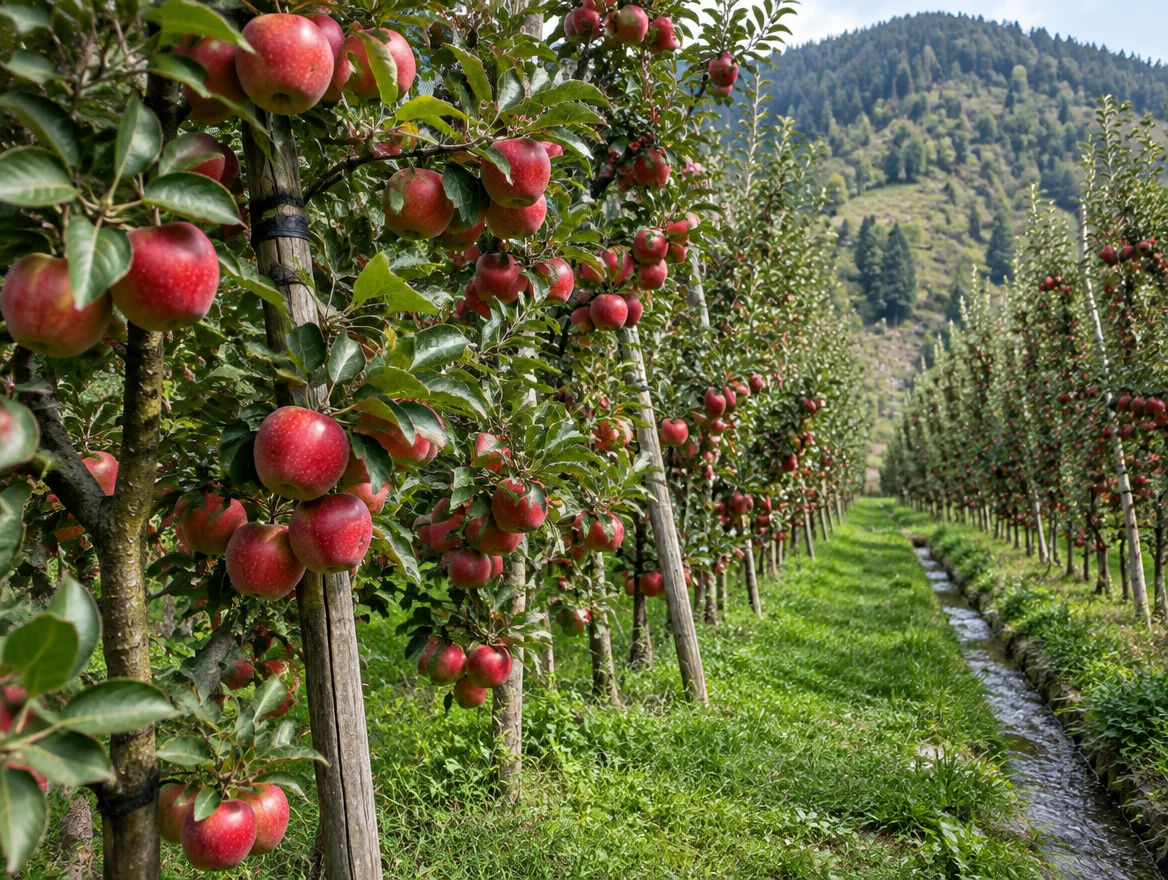
Shopian is a small district on the southern edge of the Kashmir Valley, where the orchards of the plain climb into the Pir Panjal. It is widely regarded as one of the Valley’s best apple districts, and a legislator described its fruit in the Assembly in February 2026 as some of the highest-quality in the Valley (Greater Kashmir[10]). The district sits on the Mughal Road, the old route over Pir Ki Gali to Poonch and Rajouri.
The ICAR-CRIDA contingency plan puts the district’s net sown area at about 19,500 hectares, cropped at 128% intensity, with a normal rainfall of 658 mm over 60 days (ICAR-CRIDA plan[5]). It lists apple at about 19,800 hectares, walnut at 3,700, oilseeds at 3,600 and maize at 1,500, with paddy at just 560 hectares. The plan’s apple area is larger than its net sown area, so the figures do not reconcile; use them to see that this is an orchard district, not for arithmetic.
Cold storage is the district’s strength. A February 2026 Kashmir Life report put south Kashmir at 55 controlled-atmosphere stores with 2.57 lakh tonnes of capacity against an estimated need of 2.85 lakh, and said most such stores are in Lassipora (Pulwama) and Aglar (Kashmir Life[11]). In the same month the Agriculture Minister said Shopian and Pulwama are saturated for CA storage and will not be first for the new top-up subsidy. An orchard owner here is close to storage; a CA-store developer is not likely to be subsidised.
Who buys in Shopian? Mostly local growers and families consolidating or splitting orchard land, and traders and storage owners who already work the fruit business. Outside buyers meet the agriculturist rule at the first step, so the realistic outside route is non-agricultural land, a lease, or a storage or processing plot that qualifies for conversion.
The town’s planning freeze matters more than any single price. Until the new master plan is notified, a plot in Shopian town cannot be assumed to be buildable, and the same uncertainty weighs on surrounding villages. Verify zoning with the Municipal Council in writing before paying a deposit.
The Mughal Road gives the district its second identity. It is a seasonal road and not a year-round corridor, but a tunnel at Pir Ki Gali is among the projects sanctioned in 2025-26, and a buyer should read its status below before pricing any land on the road.
- Apple heartland
- Walnut and cherry
- Aglar cold storage
- Mughal Road
- Agriculturist rule
Transaction costs
Stamp duty & registration in Shopian
7%
Stamp duty for men
Reported in the government fee schedule of April 2026
3%
Stamp duty for women
Reported in the same schedule, for land registered in a woman’s name
1.2%
Registration charges
Reported in the same schedule, on top of stamp duty
These rates are as reported by Kashmir Life from the government fee schedule in April 2026 (Kashmir Life[6]). Confirm them at the sub-registrar before you budget, and check the government’s market value for the village, since duty is charged on the higher of the deed price and that value. Registration runs through the Inspector General of Registration, J&K.
Know the belt
What is moving prices in Shopian
Four pockets buyers ask about. They are descriptions of how land is used, not price signals.
Shopian town and its planning area
Master-plan freeze
Land in and around Shopian town is the most affected by the planning freeze. Plots that would normally sell as housing or commercial land cannot be assumed buildable. This is a pocket to buy only with written zoning, or after the new plan is notified.
Check: Written zone confirmation from the Municipal Council, classification in the jamabandi, and road width.
Aglar and the cold-storage cluster
CA stores and the packing economy
Aglar is where much of south Kashmir’s controlled-atmosphere storage stands. Land near the cluster serves trucking, packing and storage, and the district’s own administration reads it as already saturated for new CA stores. Treat it as an orchard-support area, not a free-for-all development belt.
Check: Existing CA-store neighbours, truck access, and whether any storage use is approved for the plot.
Zainapora, Keller and Chitragam orchards
Apple and walnut benches
Orchards on the benches and lower slopes carry the district’s commercial value. Variety, tree age, road access in the harvest season and water matter more than frontage. A high-density block is a different asset from an old seedling orchard.
Check: Tree age and variety, truck access in autumn, water source, and co-sharers in the jamabandi.
Imamsahib and the Mughal Road approach
Roadside land towards Peer Ki Gali
The upper road towards Peer Ki Gali is scenic and has seasonal tourism, but it is shut for months and passes through forest and state land. Private holdings are small. Treat any roadside resort plan as a long, permission-heavy process.
Check: Forest or state-land boundary on the revenue map, winter closure days, and road gradient and width.
Asking prices
Asking prices circulated by agents and listings in Shopian are not an official series. Treat them as a starting point only, compare them with registered deeds for the same village, and ask the sub-registrar for the government rate.
Connectivity
How Shopian connects — road, rail and air
Shopian is reached by NH-444 from the Valley and by the seasonal Mughal Road from Poonch and Rajouri. Drive times vary with the season and traffic, so none are quoted.
🚗 By road
✈️ By air
🚆 By rail
For a buyer, this means Shopian’s road access depends on NH-444 on the Valley side and is seasonal on the Jammu side. Check the actual road to the plot in the season you expect to use it.
Growth catalysts
Upcoming infrastructure & developments
Shopian’s projects are a seasonal road, a tunnel under it, a town master plan and an existing cold-storage cluster, at different stages.
02Open
04Catalysts
Agriculture & terrain
Soil, crops & water in Shopian
Apple first, then walnut, oilseeds and maize, on a district where paddy is a minor crop.
Land use
The 2012 ICAR-CRIDA plan for the district gives these indicative figures (ICAR-CRIDA plan[5]):
- Net sown area: about 19,500 ha
- Cropping intensity: 128%
- Net irrigated: about 13,300 ha
- Normal rain: 658 mm, 60 days
- Soil: clay to clay loam, ~90%
Crops
In the plan’s 2008-09 figures apple dominates at about 19,800 hectares, walnut covers about 3,700 hectares, cherry about 800 and pear about 400. Among field crops oilseeds take about 3,600 hectares and maize about 1,500, while paddy is only about 560. The plan’s own totals do not add up, because apple alone exceeds the net sown area, so use the shares rather than the hectares.
Water
The plan lists canals as the largest irrigation source, with bore-wells and micro-irrigation as smaller ones, and about 11,900 hectares are rainfed. Orchards need water at fruit set and in dry autumns; ask what source the plot uses and how it did in the last dry spell.
Trends
Growers across the Valley are replanting old seedling orchards to high-density apple, and Shopian is a leader in the trend. That raises the value of newly planted blocks but also the cost of buying them. Post-harvest storage is nearby at Aglar, which supports orchard values, though the government now treats the district as saturated for new CA stores.
At a glance
Shopian vs. nearby districts
| District | Land and water | What links it to Shopian |
|---|---|---|
| Pulwama | Saffron, almond and apple district to the north, with the Lassipora CA cluster | Closest to Srinagar and the NH-44 belt |
| Kulgam | Quieter apple and paddy district to the east and south | Reached from Shopian by NH-444 |
| Anantnag | Highway, rail and tourism district beyond Kulgam | Larger land market with Pahalgam tourism |
| Poonch and Rajouri | Jammu-side districts across the Pir Panjal | Linked only by the seasonal Mughal Road |
Shopian is the apple specialist among the south Kashmir districts. Compare it with Kulgam and Pulwama on access to cold storage, the state of the town’s planning, and what the land can legally be used for, rather than on headline price.
Farmland India view
Why investors look at Shopian
Five reasoned points for Shopian, each tied to a source on this page.
An orchard market with storage on the doorstep
Aglar’s CA stores put Shopian growers closer to cold storage than Kulgam or Anantnag growers. For an orchard buyer, distance to Aglar is worth checking on the map.
Agriculturist rule narrows the buyer pool
The sale of agricultural land is open only to agriculturists. That keeps outside demand low and prices tied to orchard incomes. A non-agriculturist should focus on non-agricultural land or a lease.
The town is frozen until the plan arrives
With no workable master plan, town-edge plots are priced on hope. Until the new plan is notified and zoning is clear, treat any plot near Shopian town as an option on the plan.
Newly planted blocks cost more but cut risk
High-density plantations bear earlier than seedling orchards. A buyer should compare the price per acre with the age of the trees and the share of productive area, not just the plot size.
Think in orchard income, not road frontage
The Mughal Road is seasonal and the tunnels are only sanctioned. Value here comes from trees, water, storage access and clean title.
Confirm the RoR (Jamabandi), mutation, zoning and acquisition status directly — these are not certified by Farmland India’s review.
STRAIGHT TALK
Risks & challenges in Shopian
District-specific risks. Read the Jammu and Kashmir state page for the general risks on ceiling, conversion and records.
Agriculturist rule
A buyer who is not an agriculturist cannot buy farmland by sale deed; see the state page and take advice before paying a deposit.
Master-plan freeze
Plots in Shopian town may not be buildable until the new plan is notified. Get zoning in writing before paying.
Conversion is slow and conditional
The district committee decides, with a 5% fee and a 30-day clock that starts only when the file is complete. Do not assume approval.
Migrant-owned land
A sale needs the owner in person and the Divisional Commissioner’s permission. Ask for the permission before any payment.
State land and Roshni titles
A title that traces to a Roshni vesting can be void. Get a lawyer’s opinion on the chain of title.
Seasonal road and winter closure
The Mughal Road is shut by snow for months, and the upper hill land has no winter access. Check the road to the plot in January.
Co-sharers and unrecorded partition
A family arrangement that is not mutated is not a title. Check every co-sharer in the jamabandi and get each signature.
Who to contact
Local revenue & planning offices
The Deputy Commissioner, Shopian runs the district collectorate and the committee that decides conversions. Tehsildars record mutation and issue jamabandi extracts; the sub-registrar registers deeds, and the Municipal Council Shopian handles town planning questions. Use the land records portal (landrecords.jk.gov.in[4]) for the records themselves.
COMMON QUESTIONS
Frequently asked questions
Everything buyers, NRIs and investors ask before their first reviewed farmland purchase in Shopian.
Visit full wiki01 of 04
Can an outsider buy an apple orchard in Shopian?
Not by sale deed unless the buyer is an agriculturist of Jammu and Kashmir; the law allows limited exemptions. Orchards are agricultural land. Non-agricultural land is open to any Indian citizen.
02 of 04
Why is it hard to build in Shopian town?
The 2023 draft master plan was criticised as outdated and construction has been largely frozen. A new plan is being prepared by SPA, and the draft will be opened for objections. Check zoning before buying near the town.
03 of 04
Is the Mughal Road open all year?
No. NH-701A from Shopian to Peer Ki Gali is shut by snow in winter and reopened for vehicles on 27 February 2026. Plan on seasonal access, and do not assume a Poonch or Rajouri link in winter.
04 of 04
How do I read a Shopian land record?
Use the J&K Land Records Information System for jamabandi, girdawari and mutation, and match the plot number with the tehsil. Areas are in kanal and marla; eight kanals make an acre.
Transparency
Sources and references
Law and courts
- [1]ThePrint: 12 laws repealed, 14 amended under new land orders, 29 Oct 2020 — theprint.in
- [2]Kashmir Life: J&K announces rules for land conversion, 15 Jan 2022 — kashmirlife.net
Government
- [3]IGR J&K: letter on migrant immovable property, 22 May 2025 — igr.jk.gov.in
- [4]J&K Land Records Information System — landrecords.jk.gov.in
- [5]ICAR-CRIDA: district agriculture contingency plan, Shopian, 2012 — icar-crida.res.in
News
- [6]Kashmir Life: stamp duty and registration fee schedule, 17 Apr 2026 — kashmirlife.net
- [7]Kashmir Life: Mughal Road to reopen for traffic, 26 Feb 2026 — kashmirlife.net
- [8]Kashmir Life: CS reviews Rs 40,000 crore highway and tunnel projects, 2 Sep 2026 — kashmirlife.net
- [9]Greater Kashmir: Shopian to get new master plan after years of development freeze, 18 Nov 2025 — m.greaterkashmir.com
- [10]Greater Kashmir: MLA Shopian, Agriculture Minister spar over CA storage subsidy policy, 10 Feb 2026 — m.greaterkashmir.com
- [11]Kashmir Life: South Kashmir apple output and CA storage, 17 Feb 2026 — kashmirlife.net
Data-currency note: sources are as of November 2026. Project status, the benchmark valuation and land rules change often; check the linked source and the relevant office before relying on any figure.
For developers
Ready to explore Shopian farmland?
Browse reviewed projects and individual land parcels across Shopian — or if you own land here, list it with platform review and reach serious buyers.