
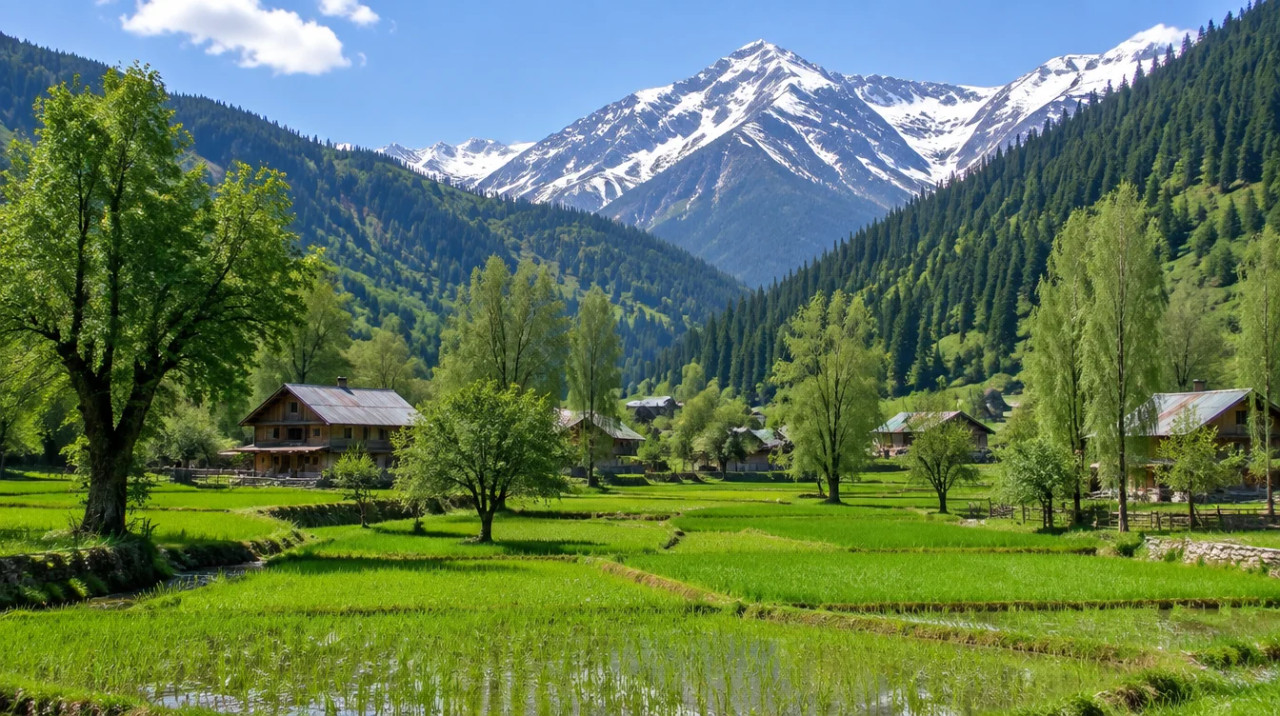
District guide
Buying Land in Kupwara
The northern frontier district of the Valley, where border limits, forest and farmland rules decide which land can be bought.
2,379 sq km
District area (district site)
240+ km
Line of Control length (district site)
50 acres
Handwara biotech park (Greater Kashmir)
586 kanal 42 marlas
Industrial estate land transferred (Kashmir Life)
District land record — Kupwara
Rev. 2026 · Farmland India desk
State
Jammu and Kashmir (Union Territory)
Formation and division
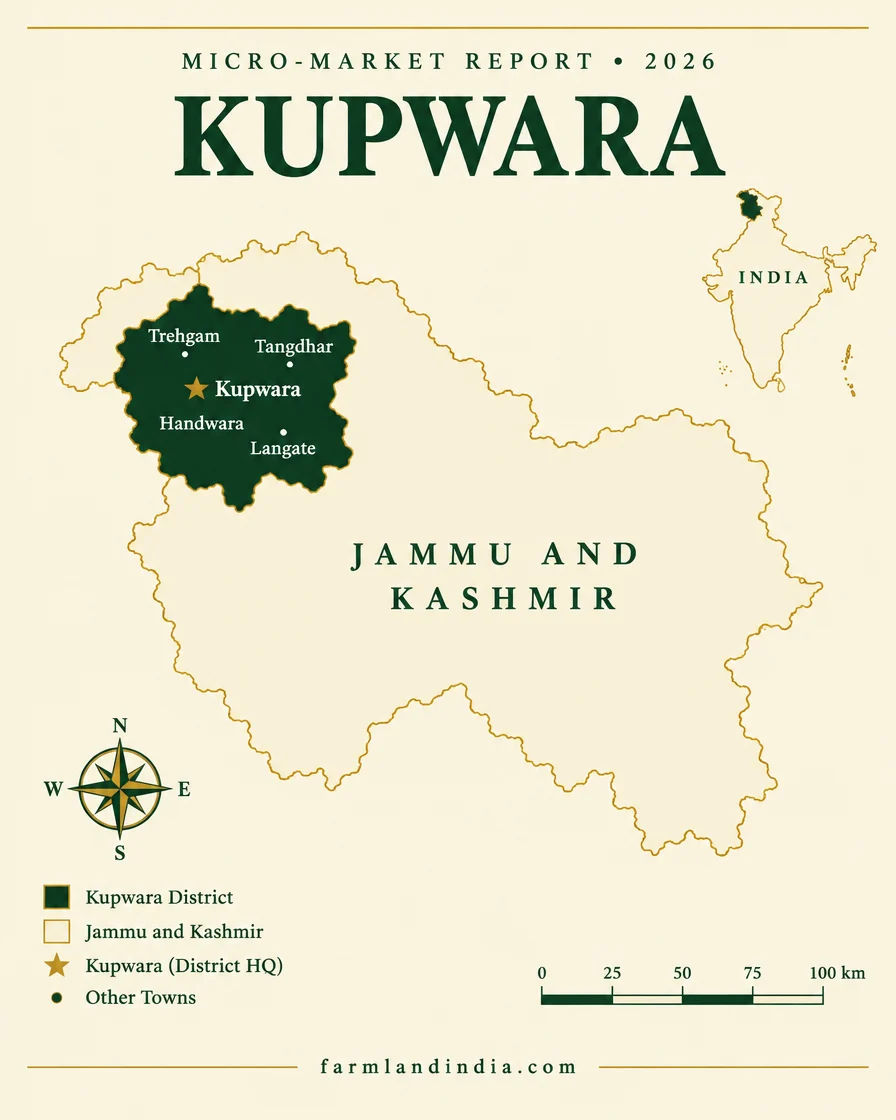
District headquartered at Kupwara, in the Kashmir division, a northern frontier district with more than 240 km of the Line of Control (Kupwara district site[4])
Size and population
2,379 sq km, 363 villages and 8,75,564 people, as shown on the district site
Key markets
Kupwara town · Handwara · Langate · Trehgam · Sogam · Lolab Valley · Karnah · Tangdhar · Keran
Demand anchors
Orchards and local trade · Handwara biotech park · industrial estates · border and valley tourism
Rail
Kupwara has no station of its own; the nearest railhead is on the Srinagar–Baramulla line, and the Katra–Srinagar Vande Bharat reaches Srinagar in about three hours (ThePrint[6])
Pricing unit
No newspaper price series for Kupwara land was found, so no band is shown. Quote and compare land per acre or per sq yd, and check the guideline rate with the sub-registrar
Local units
Records and sellers use kanal and marla: 1 kanal is 20 marla, about 5,445 sq ft (605 sq yd), and 8 kanal make one acre. Convert every offer to acres or sq yd before comparing
Land records portal
Land Records Information System (Aapki Zameen Aapki Nigrani) at landrecords.jk.gov.in[5]; see the J&K land records guide
Land law is state law. These rules are maintained on the Jammu and Kashmir page and apply to every district within it.
Kupwara — land purchase legal rules
Jammu and Kashmir’s land law was rewritten in October 2020. Non-agricultural land is now open to any Indian citizen, but agricultural land can pass only to agriculturists of the Union Territory, with exemptions the government grants case by case, and converting farmland needs permission. Migrant land, state land and strategic areas carry their own rules. This block applies to every district page in the Union Territory.
What changed in October 2020: On 26 October 2020 the Ministry of Home Affairs issued the Jammu and Kashmir Reorganisation (Adaptation of Central Laws) Third Order and the Adaptation of State Laws Fifth Order. Together they repealed 12 land laws, among them the Big Landed Estates Abolition Act, 1950, the Alienation of Land Act, 1938, the Tenancy Act, the Consolidation of Holdings Act, the Prohibition on Conversion of Land and Alienation of Orchards Act, 1975 and the Right of Prior Purchase Act, and amended others (ThePrint, 29 October 2020). Before 2019 only permanent residents of the state could own land there; that rule is gone.
Non-agricultural land: The words “permanent resident of the State” were removed from Section 17 of the Jammu and Kashmir Development Act, so any Indian citizen can now buy non-agricultural land, for a house, a shop, a hotel or an industrial unit, in the Union Territory. The Real Estate (Regulation and Development) Act now applies here as it does elsewhere (ThePrint, 29 October 2020).
Agricultural land: agriculturists only: The amended Jammu and Kashmir Land Revenue Act, 1996 bars the sale, gift, exchange or possessory mortgage of agricultural land to a non-agriculturist. An agriculturist is a person who cultivates land personally in the Union Territory, or a category the government notifies; in December 2022 the government ordered that the legal heirs of an agriculturist (mother, father, wife and children) be treated as agriculturists too for the purposes of Section 133-H, the section that bars transfers to non-agriculturists (Kashmir Observer, 1 December 2022). In plain terms, a buyer from outside Jammu and Kashmir who does not farm here cannot buy farmland in his own name.
Exemptions: The government, or an officer it authorises, may permit a transfer of agricultural land to a non-agriculturist. It may allow transfers to public trusts and charities for education or health, and may notify transfers for industrial, commercial, housing or agricultural development. Leases are not barred. Land transferred under such a permission is meant to be put to the permitted use within five years (Drishti, 29 October 2020).
Converting farmland: Agricultural land cannot be used for any other purpose without permission. The Agricultural Land (Conversion for Non-Agricultural Purposes) Regulations, notified in January 2022, route applications to a district committee headed by the District Development Commissioner (the Deputy Commissioner). The fee is 5% of the market value notified under the Stamp Act, the decision is due within 30 days of a complete application, and the approved use must begin within one to two years. If the committee does not decide in time, the District Collector grants the permission (Kashmir Life, 15 January 2022). The old limit of 400 square metres, for houses only, no longer applies.
Strategic areas: The Union Territory government can declare an area a strategic area for the direct operational and training needs of the armed forces, on a request from an officer not below the rank of Corps Commander (Drishti, 29 October 2020). Land inside such an area is not open to ordinary purchase or development.
Kashmiri migrant land: Land of Kashmiri migrants is protected under the Jammu and Kashmir Migrant Immovable Property (Preservation, Protection and Restraint on Distress Sales) Act, 1997. Under the Inspector General of Registration’s instructions of May 2025, a sale deed of migrant land can be executed only by the owner in person, with the permission of the Divisional Commissioner, Kashmir; registration through a power of attorney is not allowed (IGR Jammu and Kashmir, 2025). Ask whether the seller or the land is on the migrant list before anything else.
State land and the Roshni Act: In October 2020 the High Court declared the Jammu and Kashmir State Land (Vesting of Ownership to the Occupants) Act, 2001, known as the Roshni Act, unconstitutional and void from the start, ordered a CBI inquiry and directed that state land vested under it be retrieved (LiveLaw, 11 October 2020). Title that traces back to a Roshni grant, or to state land (khalsa sarkar), kahcharai (village grazing land) or nazul land, is not safe to buy.
Stamp duty and registration: Stamp duty on a sale deed is reported at 7% for men and 3% for women, with registration charges of 1.2%, according to the government’s fee schedule (Kashmir Life, 17 April 2026). Deeds are registered at the sub-registrar office through NGDRS, and duty is charged on the higher of the deed price and the notified market value. Confirm the current rate with the sub-registrar before you register.
Records and units: Records of rights, jamabandi, girdawari and mutation entries are on the Land Records Information System run under the Aapki Zameen Aapki Nigrani (your land, your oversight) programme. Land is measured in kanal and marla: 20 marla make a kanal and 8 kanal make an acre, so a 4-kanal plot is half an acre. Ask for the khasra number, check the jamabandi and the latest girdawari, and confirm the last mutation was attested.
NRI and OCI buyers: Under the RBI Master Direction on immovable property, NRIs and OCIs may not acquire agricultural land, a farmhouse or plantation property in India except by inheritance. In Jammu and Kashmir the agriculturist rule applies on top of that. Our NRI guide covers the options.
What this page does not do: It does not give a legal view on any particular plot or seller. The orders have been amended several times since 2020; have a local advocate read the jamabandi, the mutation history and any permission before you pay.
- Non-agricultural land: any Indian
- Farmland: agriculturists only
- Section 133-H
- Conversion: district committee
- Strategic areas
- Migrant land: Divisional Commissioner
- Roshni Act void
- NRIs: inheritance only
Kupwara — district-specific notes
The Jammu and Kashmir state page sets out who may buy land, the agriculturist rule, conversion and the NRI position. Kupwara adds a frontier layer: much of the district lies along the Line of Control, so security and strategic-area limits come before price.
⚠ The district site calls Kupwara a northern frontier district with more than 240 km of the Line of Control (Kupwara district site[4]). The 2020 amendments to the land laws let the Centre declare strategic areas for the armed forces, with a corps-commander-rank officer able to certify the need (Drishti IAS[1]). A plot in Karnah, Tangdhar, Keran or Machil should therefore come with the Deputy Commissioner’s written position on whether it lies in such an area, and with an understanding that use and access may be restricted.
⚠ The Valley’s hillsides above the Lolab and Bangus meadows include forest, pasture and eco-sensitive land. A seller offering a “plot” on a meadow edge may be offering forest or state land that cannot be sold, so ask for the land category in the revenue record and the forest department’s position.
⚠ Where land is still recorded as agricultural, a non-agriculturist cannot simply buy it. The conversion route runs through a district committee headed by the Deputy Commissioner, with a fee of 5% of market value and a decision due within 30 days of a complete application (Kashmir Life[2]). The High Court declared the Roshni Act void in October 2020 (LiveLaw[3]), and land owned by Kashmiri migrants can be sold only with the Divisional Commissioner’s permission and not through a power of attorney.
NRI and OCI buyers should read can NRIs buy agricultural land in India before shortlisting any farmland here.
- Border and strategic-area limits
- Forest and meadow land
- Farmland: agriculturists only
- Industrial estate land
- Migrant land rules
District overview
Kupwara — the northern frontier district of the Valley, where border limits, orchards and a new industrial and biotech push shape the market
Kupwara is the north-western frontier of the Kashmir Valley. The district site gives its area as 2,379 sq km, with 363 villages and 8,75,564 people, and describes it as lying between the Pir Panjal and Shams Bari ranges, with meadows and pastures that draw tourists and adventure seekers (Kupwara district site[4]). Kupwara town is the headquarters, Handwara and Langate are the larger market towns, and the Lolab and Karnah valleys run toward the border.
Who buys? Mostly local families, orchard owners and traders from Handwara and Kupwara, with a smaller interest from people with a family link to the district. Outside buyers can buy non-agricultural land after the 2020 land orders but not farmland, and the border and forest rules narrow the field further. This is a local-need market rather than a speculative one.
Two public programmes are worth watching. A Greater Kashmir report of 20 February 2026 describes a biotech park at Handwara on 50 acres with more than Rs 100 crore of public investment, still being made industry-ready on road access, power and security (Greater Kashmir[7]). And the Department of Industries told the Assembly that 586 kanal 42 marlas had been transferred for industrial estates, including 59 kanal 13 marlas for a new estate at Kunan in Trehgam (Kashmir Life[8]).
Tourism is the third driver. The Centre told the Rajya Sabha on 30 July 2026 that tourism infrastructure projects worth more than Rs 58 crore were proposed for Kupwara destinations such as Lolab, Bangus, Keran, Machil and Teetwal (Kashmir Life[9]). They are planned, not built, and they sit on the frontier, so they widen visitor interest without making border land easier to buy.
Kupwara suits a patient buyer with a local reason to be here. The strongest cases are a small plot with a recorded non-agricultural use near a market town or industrial estate; the weakest are meadow-edge or border-belt plots sold on a tourism story.
- Frontier district
- Lolab and Bangus
- Handwara biotech park
- Industrial estates
- Apple and walnut
- Border belt
Transaction costs
Stamp duty & registration in Kupwara
7%
Stamp duty for men (reported)
Kashmir Life, 17 April 2026, citing the government fee schedule
3%
Stamp duty for women (reported)
same report; confirm the woman-buyer rate for your deed
1.2%
Registration charges (reported)
added on top of stamp duty, per the same report
Kashmir Life reported on 17 April 2026 that the government fee schedule puts stamp duty at 7% for men and 3% for women, with registration charges of 1.2% (Kashmir Life[10]). Treat these as reported rates and ask the sub-registrar for a written assessment before you pay an advance. A sale deed is registered at the sub-registrar’s office and should carry the khasra (survey) number, the area in kanal and marla and the seller’s mutation entry. In border tehsils, also ask the sub-registrar and the Deputy Commissioner whether any security or strategic-area limit is recorded against the khasra. Do not accept a deal that rests only on stamp paper or an agreement to sell.
Know the belt
What is moving prices in Kupwara
Land-use notes for each belt; no listing-site rates are quoted.
Kupwara town, Handwara and Langate
Market-town belt
These towns hold the district’s trade, schools and offices, and Handwara is the site of the proposed biotech park. Land near them is the most liquid in the district and the most likely to have a clean record.
Check: the plan status, the road width and whether any land was acquired for the park or estates
Trehgam, Kunan and the industrial estates
Industrial belt
Estates at Chotipora, Redbugh, Brainwari, Handwara and Gorihakar already exist, and a new one at Kunan in Trehgam is being added. Industrial land is allotted by the industries department and may not be freely resold.
Check: the allotment terms and any lease or resale condition
Lolab and Bangus valleys
Valley tourism belt
These are the district’s best-known valleys and the focus of the proposed tourism works. The surrounding hills include forest and pasture, so small plots offered as holiday sites need a forest and revenue check.
Check: forest or state-land status, building rules and road and water access
Keran, Machil, Tangdhar and Karnah
Frontier belt
These tehsils lie along or near the Line of Control. Land here is mainly useful to families who already hold it, and strategic-area, security and access limits can apply.
Check: the Deputy Commissioner’s written position on strategic-area status and any access limit
Asking prices
No official price series is published for Kupwara land. Compare any quote with the guideline rate for the village and with recent registered deeds in the same locality. Treat a rate quoted by a seller without a registered deed as unproven, and be especially cautious with any price quoted for border or meadow land.
Connectivity
How Kupwara connects — road, rail and air
A road district with no rail, where the tunnels are plans rather than projects under way.
🚗 By road
🚆 By rail
✈️ By air
Road access sets value in Kupwara more than almost anywhere else in the Valley, and the road can close in snow. A plot reached by a seasonal track may be hard to use for months, so walk the route and confirm it is a recorded public path.
Growth catalysts
Upcoming infrastructure & developments
Biotech, industrial estates and tourism works are the live items; the tunnels are far off.
00Open
04Catalysts
Agriculture & terrain
Soil, crops & water in Kupwara
Orchard and rice country on the valley floors, pasture above.
Crops and land use
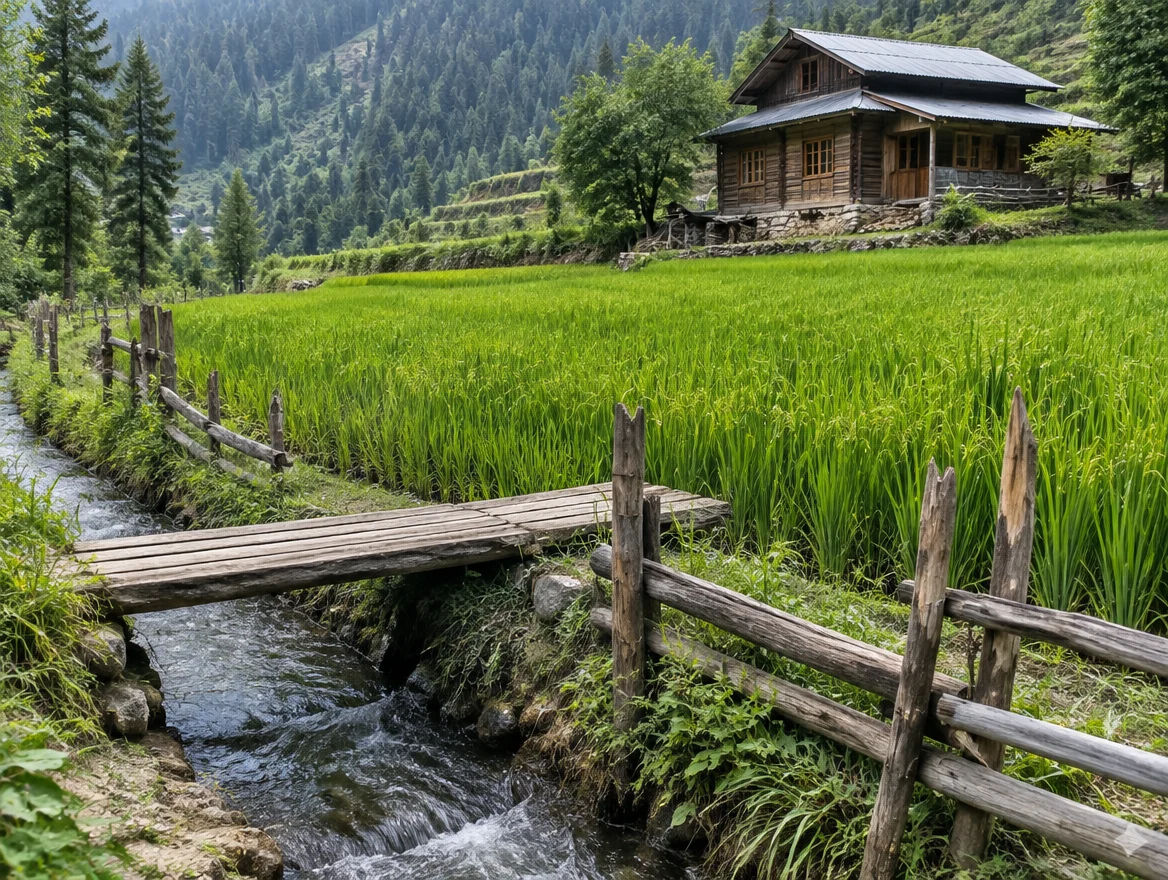
Kupwara is mainly a rice, orchard and livestock district. A Greater Kashmir report put its paddy area at 17,308 hectares in 2025 against 17,000 in 2020, one of the few Valley districts where the area did not fall (Greater Kashmir[12]). The lower hills carry apple, walnut and other orchard fruit, and the high meadows are grazed in summer.
- Paddy on the valley floors
- Apple, walnut and other orchards
- Vegetables and fodder
- Summer pasture above the tree line
Snow and access
Heavy winter snow closes high roads and passes. Land at altitude may be unusable for part of the year, so check road access and winter use before buying.
Conversion pressure
As farmland around Handwara and Kupwara is subdivided, the revenue staff look closely at changes of use. A plot recorded as agricultural cannot be bought by a non-agriculturist, so ask for the current jamabandi entry.
At a glance
Kupwara vs. nearby districts
| District | Land and water | What links it to Kupwara |
|---|---|---|
| Baramulla (south) | Larger market and Sopore mandi; the Gulmarg belt | Master-plan and orchard rules, higher prices |
| Bandipora (south-east) | Wular and Gurez side; its own housing colony at Watapora | Lake and forest limits |
| Srinagar and Budgam (south-east, beyond Baramulla) | The capital’s market and the airport belt, some hours away by road | Prices rise sharply toward the Srinagar line |
All of these run under the same land law, but they differ in how much land is open to an outside buyer. Kupwara has the heaviest border and forest limits of the north Kashmir districts; Baramulla has the strongest market, and Srinagar the highest prices.
Farmland India view
Why investors look at Kupwara
Five reasoned points for Kupwara, each tied to a source on this page.
Buy near the market towns
Land near Kupwara town, Handwara or Langate is the easiest to document and resell. The border and meadow belts are for families with a local reason to be there.
Read the strategic-area position first
Because the Centre can declare strategic areas, a plot near the Line of Control needs the Deputy Commissioner’s written position before any price discussion.
Treat the public programmes as signals
The biotech park and industrial estates show where public money is going, but the park is still being made ready and the tourism works are proposals. Pay for today’s access and use.
Look for recorded non-agricultural use
Because farmland is closed to non-agriculturists, the realistic opening for an outside buyer is land with a recorded non-agricultural use or a conversion order.
Hold for the long term
Supply is limited by border, forest and farmland rules and demand is local, so the case rests on a clean title and a long hold, not a quick resale.
Confirm the jamabandi (record of rights), khasra number, mutation, zoning and acquisition status directly — these are not certified by Farmland India’s review.
STRAIGHT TALK
Risks & challenges in Kupwara
District-specific risks. Read the Jammu and Kashmir state page for the general risks on ceiling, conversion and records.
Border and strategic-area limits
Land near the Line of Control may carry security or strategic-area limits on use, sale or access. Ask the Deputy Commissioner for the position in writing.
Forest, meadow and state land
Meadow and hillside plots can be forest, pasture or state land. Ask for the land category and the forest department’s position.
Agricultural land sold as plots
Much of what looks cheap near the towns is still agricultural land. A non-agriculturist cannot buy it, and an unauthorised conversion can be challenged.
Industrial-estate allotment terms
Plots in industrial estates are allotted by the industries department and may carry lease or resale conditions. Read the allotment letter before paying.
State land and Roshni vesting
The Roshni Act was held unconstitutional in October 2020, and transfers under it were declared void. Ask whether the seller’s title ever depended on state land or Roshni vesting.
Migrant land and fragmented holdings
Land owned by Kashmiri migrants can be sold only with the Divisional Commissioner’s permission, and not through a power of attorney. Check that every co-owner signs, and pay by traceable transfer.
Who to contact
Local revenue & planning offices
The Deputy Commissioner’s office at Kupwara is the district authority for land revenue and conversion; the tehsildar offices handle mutation and records, and the sub-registrar offices register sales. Check the jamabandi on landrecords.jk.gov.in[5], and ask the Deputy Commissioner for the strategic-area position on any border-belt plot.
COMMON QUESTIONS
Frequently asked questions
Everything buyers, NRIs and investors ask before their first reviewed farmland purchase in Kupwara.
Visit full wiki01 of 04
Can an outsider buy land in Kupwara?
Yes for non-agricultural land such as a residential plot, after the 2020 land orders. No for agricultural land: only an agriculturist can buy it. Border-belt land also needs a strategic-area check.
02 of 04
Is land near the Line of Control restricted?
It can be. The 2020 amendments let the Centre declare strategic areas for the armed forces. Ask the Deputy Commissioner whether the parcel falls in one.
03 of 04
Is the Handwara biotech park built?
Greater Kashmir reported on 20 February 2026 that the 50-acre park was being made industry-ready on road access, power and security. Treat it as under development.
04 of 04
What is the stamp duty in Kupwara?
A news report on the 2026 fee schedule gives 7% for men, 3% for women and 1.2% registration charges. Confirm at the sub-registrar before you budget.
Transparency
Sources and references
Law and courts
- [1]Drishti IAS: Amendment related to land in Jammu and Kashmir, 29 October 2020 — drishtiias.com
- [2]Kashmir Life: J&K announces rules for land conversion, 15 January 2022 — kashmirlife.net
- [3]LiveLaw: J&K High Court holds Roshni Act unconstitutional, 11 October 2020 — livelaw.in
Government
- [4]Kupwara district: profile — kupwara.nic.in
- [5]Land Records Information System, J&K — landrecords.jk.gov.in
News
- [6]ThePrint: Katra to Srinagar in 3 hours, Vande Bharat flagged off, 6 June 2025 — theprint.in
- [7]Greater Kashmir: Handwara bets on biotech, Rs 100 crore park, 20 February 2026 — greaterkashmir.com
- [8]Kashmir Life: Kupwara earmarked for industrial push, 9 February 2026 — kashmirlife.net
- [9]Kashmir Life: Rs 58 crore tourism push planned for Kupwara’s border destinations, 30 July 2026 — kashmirlife.net
- [10]Kashmir Life: registration at 3 per cent for women, 7 per cent for men, 17 April 2026 — kashmirlife.net
- [11]Kashmir Life: CS reviews Rs 40,000 crore highway and tunnel projects, 2 September 2026 — kashmirlife.net
- [12]Greater Kashmir: Kashmir’s rice bowl vanishing, 28 July 2025 — greaterkashmir.com
Data-currency note: sources are as of November 2026. Project status, the benchmark valuation and land rules change often; check the linked source and the relevant office before relying on any figure.
For developers
Ready to explore Kupwara farmland?
Browse reviewed projects and individual land parcels across Kupwara — or if you own land here, list it with platform review and reach serious buyers.