
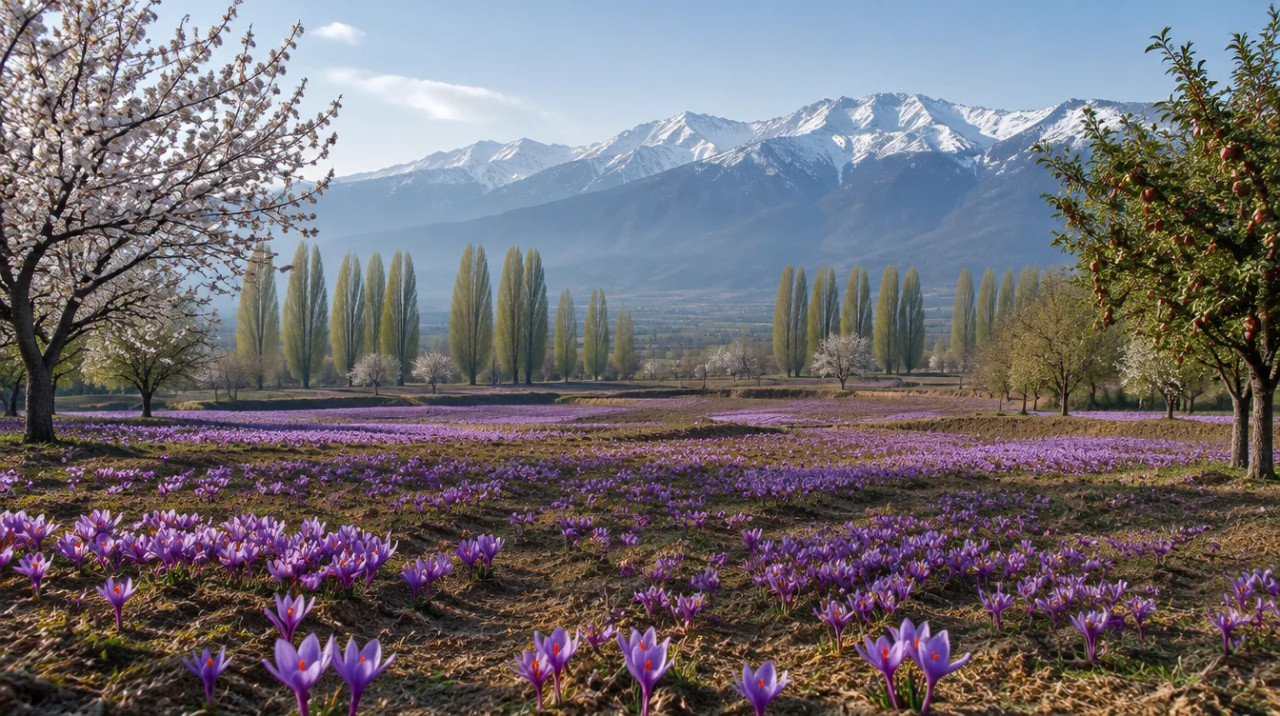
District guide
Buying Land in Pulwama
Saffron karewas, almond and apple orchards, and the Srinagar edge: what to check on the agriculturist rule, saffron land and title before you buy in Pulwama.
32,381 ha
Net sown area (ICAR-CRIDA, 2012)
176%
Cropping intensity (ICAR-CRIDA)
3,715 ha
Saffron area, official (J&K Assembly, Feb 2026)
2,056 of 3,200 ha
Pampore saffron rejuvenation (same reply)
District land record — Pulwama
Rev. 2026 · Farmland India desk
State
Jammu and Kashmir (Union Territory)
Setting
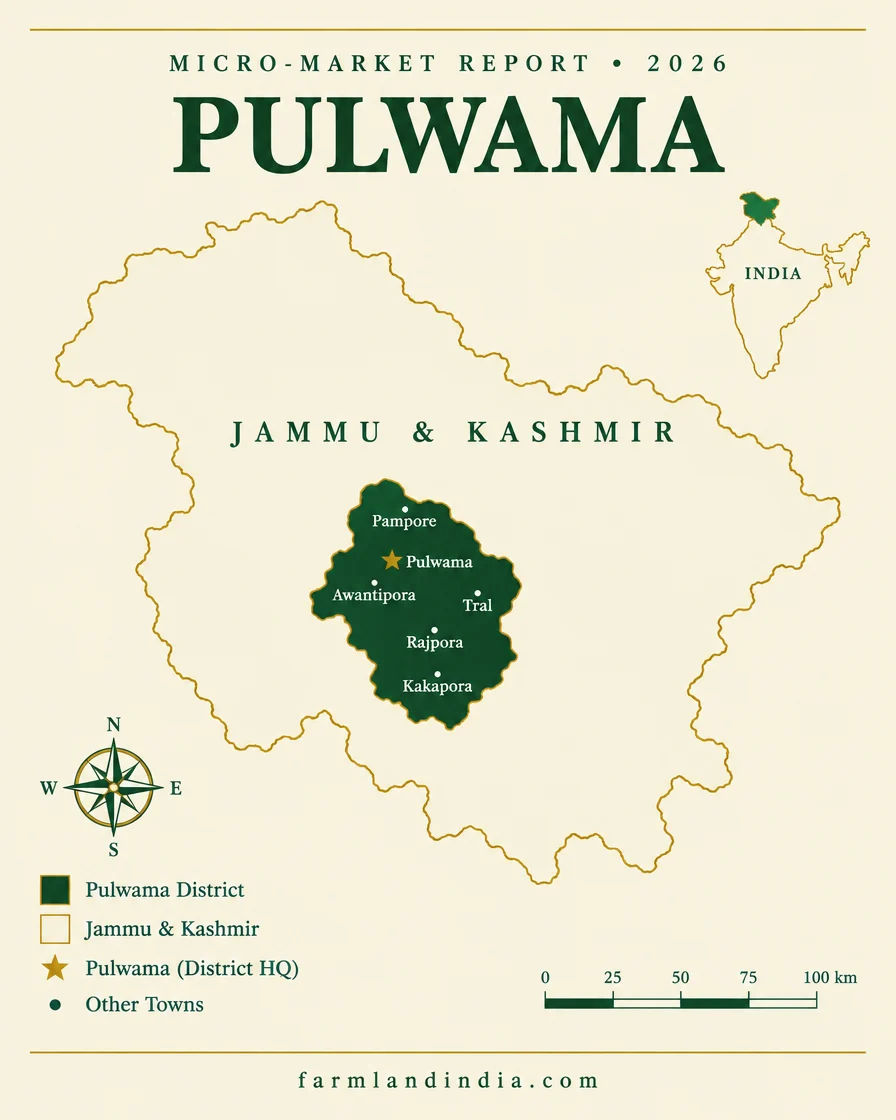
Pulwama lies on the southern side of Srinagar, in the Jhelum valley and on the karewa plateaus that rise above it. It borders Srinagar and Budgam to the north and Anantnag and Shopian to the south. Shopian was carved out of the area in 2007.
Key markets
Pulwama · Pampore · Awantipora · Tral · Rajpora · Kakapora
Demand anchors
Pampore saffron karewas · almond and apple orchards · the Srinagar–Jammu highway belt · AIIMS Awantipora, still under construction · Lassipora cold-storage cluster
Rail
The Banihal–Baramulla line runs through the district, with stations including Pampore and Awantipora, so the Srinagar commute is short.
Roads
NH-44 passes through Pampore and Awantipora. NH-444 links Pulwama to Srinagar, Shopian and Kulgam; its restoration, a bypass and a widening proposal are covered below (Daily Excelsior[10]).
Water
Canals and small canals are the main mapped irrigation source in the 2012 plan, and saffron fields depend on rain or sprinklers and bore-wells. Dry spells, not shortage of groundwater, are the recurring risk.
Pricing unit
No official price series is published; ask the sub-registrar for recent registered sale values in the village. Quote any land per acre and compare it with the registered deeds in the same village.
Local units
Revenue records use kanal and marla. Eight kanals make one acre and twenty marla make one kanal; convert before comparing quotes.
Land records portal
The J&K Land Records Information System (landrecords.jk.gov.in[4]) shows jamabandi, girdawari and mutation entries.
Land law is state law. These rules are maintained on the Jammu and Kashmir page and apply to every district within it.
Pulwama — land purchase legal rules
Jammu and Kashmir’s land law was rewritten in October 2020. Non-agricultural land is now open to any Indian citizen, but agricultural land can pass only to agriculturists of the Union Territory, with exemptions the government grants case by case, and converting farmland needs permission. Migrant land, state land and strategic areas carry their own rules. This block applies to every district page in the Union Territory.
What changed in October 2020: On 26 October 2020 the Ministry of Home Affairs issued the Jammu and Kashmir Reorganisation (Adaptation of Central Laws) Third Order and the Adaptation of State Laws Fifth Order. Together they repealed 12 land laws, among them the Big Landed Estates Abolition Act, 1950, the Alienation of Land Act, 1938, the Tenancy Act, the Consolidation of Holdings Act, the Prohibition on Conversion of Land and Alienation of Orchards Act, 1975 and the Right of Prior Purchase Act, and amended others (ThePrint, 29 October 2020). Before 2019 only permanent residents of the state could own land there; that rule is gone.
Non-agricultural land: The words “permanent resident of the State” were removed from Section 17 of the Jammu and Kashmir Development Act, so any Indian citizen can now buy non-agricultural land, for a house, a shop, a hotel or an industrial unit, in the Union Territory. The Real Estate (Regulation and Development) Act now applies here as it does elsewhere (ThePrint, 29 October 2020).
Agricultural land: agriculturists only: The amended Jammu and Kashmir Land Revenue Act, 1996 bars the sale, gift, exchange or possessory mortgage of agricultural land to a non-agriculturist. An agriculturist is a person who cultivates land personally in the Union Territory, or a category the government notifies; in December 2022 the government ordered that the legal heirs of an agriculturist (mother, father, wife and children) be treated as agriculturists too for the purposes of Section 133-H, the section that bars transfers to non-agriculturists (Kashmir Observer, 1 December 2022). In plain terms, a buyer from outside Jammu and Kashmir who does not farm here cannot buy farmland in his own name.
Exemptions: The government, or an officer it authorises, may permit a transfer of agricultural land to a non-agriculturist. It may allow transfers to public trusts and charities for education or health, and may notify transfers for industrial, commercial, housing or agricultural development. Leases are not barred. Land transferred under such a permission is meant to be put to the permitted use within five years (Drishti, 29 October 2020).
Converting farmland: Agricultural land cannot be used for any other purpose without permission. The Agricultural Land (Conversion for Non-Agricultural Purposes) Regulations, notified in January 2022, route applications to a district committee headed by the District Development Commissioner (the Deputy Commissioner). The fee is 5% of the market value notified under the Stamp Act, the decision is due within 30 days of a complete application, and the approved use must begin within one to two years. If the committee does not decide in time, the District Collector grants the permission (Kashmir Life, 15 January 2022). The old limit of 400 square metres, for houses only, no longer applies.
Strategic areas: The Union Territory government can declare an area a strategic area for the direct operational and training needs of the armed forces, on a request from an officer not below the rank of Corps Commander (Drishti, 29 October 2020). Land inside such an area is not open to ordinary purchase or development.
Kashmiri migrant land: Land of Kashmiri migrants is protected under the Jammu and Kashmir Migrant Immovable Property (Preservation, Protection and Restraint on Distress Sales) Act, 1997. Under the Inspector General of Registration’s instructions of May 2025, a sale deed of migrant land can be executed only by the owner in person, with the permission of the Divisional Commissioner, Kashmir; registration through a power of attorney is not allowed (IGR Jammu and Kashmir, 2025). Ask whether the seller or the land is on the migrant list before anything else.
State land and the Roshni Act: In October 2020 the High Court declared the Jammu and Kashmir State Land (Vesting of Ownership to the Occupants) Act, 2001, known as the Roshni Act, unconstitutional and void from the start, ordered a CBI inquiry and directed that state land vested under it be retrieved (LiveLaw, 11 October 2020). Title that traces back to a Roshni grant, or to state land (khalsa sarkar), kahcharai (village grazing land) or nazul land, is not safe to buy.
Stamp duty and registration: Stamp duty on a sale deed is reported at 7% for men and 3% for women, with registration charges of 1.2%, according to the government’s fee schedule (Kashmir Life, 17 April 2026). Deeds are registered at the sub-registrar office through NGDRS, and duty is charged on the higher of the deed price and the notified market value. Confirm the current rate with the sub-registrar before you register.
Records and units: Records of rights, jamabandi, girdawari and mutation entries are on the Land Records Information System run under the Aapki Zameen Aapki Nigrani (your land, your oversight) programme. Land is measured in kanal and marla: 20 marla make a kanal and 8 kanal make an acre, so a 4-kanal plot is half an acre. Ask for the khasra number, check the jamabandi and the latest girdawari, and confirm the last mutation was attested.
NRI and OCI buyers: Under the RBI Master Direction on immovable property, NRIs and OCIs may not acquire agricultural land, a farmhouse or plantation property in India except by inheritance. In Jammu and Kashmir the agriculturist rule applies on top of that. Our NRI guide covers the options.
What this page does not do: It does not give a legal view on any particular plot or seller. The orders have been amended several times since 2020; have a local advocate read the jamabandi, the mutation history and any permission before you pay.
- Non-agricultural land: any Indian
- Farmland: agriculturists only
- Section 133-H
- Conversion: district committee
- Strategic areas
- Migrant land: Divisional Commissioner
- Roshni Act void
- NRIs: inheritance only
Pulwama — district-specific notes
The Jammu and Kashmir state page applies to Pulwama in full. In this district the first checks are the buyer’s status as an agriculturist, what the plot really grows, and whether it falls in a draft master-plan zone or a road alignment close to Srinagar.
⚠ Pulwama’s land is overwhelmingly saffron, orchard and paddy, and all of it counts as agricultural land. After the 2020 amendments the Land Revenue Act bars the sale of agricultural land to a non-agriculturist, with limited exemptions (ThePrint[1]). A buyer from outside the UT who is not an agriculturist should plan on non-agricultural land, or on a lease, rather than a sale deed for a saffron field or orchard.
⚠ A change of use is possible but slow. The 2022 conversion regulations route an application through a district committee headed by the Deputy Commissioner, with a fee of 5% of market value and a decision due within 30 days of a complete file (Kashmir Life[2]). Saffron land close to Srinagar draws conversion requests; make approval a condition of the agreement and do not pay on the promise of it.
⚠ Many Kashmiri Pandit families hold land in the Valley, including in the Pampore and Awantipora belt. A migrant owner can sell only in person, with the permission of the Divisional Commissioner Kashmir, and the registry does not accept a power of attorney for such a sale (IGR J&K letter, 22 May 2025[3]). A deed that skips this step is a title problem, whatever the price.
⚠ Saffron holdings are small and heavily shared. Check the jamabandi for every co-sharer, the latest girdawari for what is actually grown, and the mutation history. A field that has been left fallow for several years may still be recorded as saffron, and the reverse also happens.
⚠ State land entered as private holdings is a separate risk. The High Court’s 2020 ruling that the Roshni Act was unconstitutional, and the recovery drive that followed, means a plot whose title traces back to a Roshni vesting needs a lawyer’s opinion before any payment.
⚠ Check the plot against the government’s own plans. Master plans for Awantipora and Pulwama are in preparation, a mass housing colony is proposed at Padgampora, and NH-444 projects are at different stages. Land inside a green zone, a road alignment or a housing scheme can lose its development value.
⚠ Confirm each fact on the day of purchase at the tehsil and the sub-registrar. Farmland India’s review reads the records but does not replace a title search.
The state page covers the ceiling, conversion route, NRI position and the full land-law background.
- Agriculturists only for farmland
- Saffron land is agricultural
- Migrant land needs permission
- Master plan and road acquisition
- State land and Roshni
District overview
Pulwama — the Pampore saffron karewas and the southern edge of Srinagar
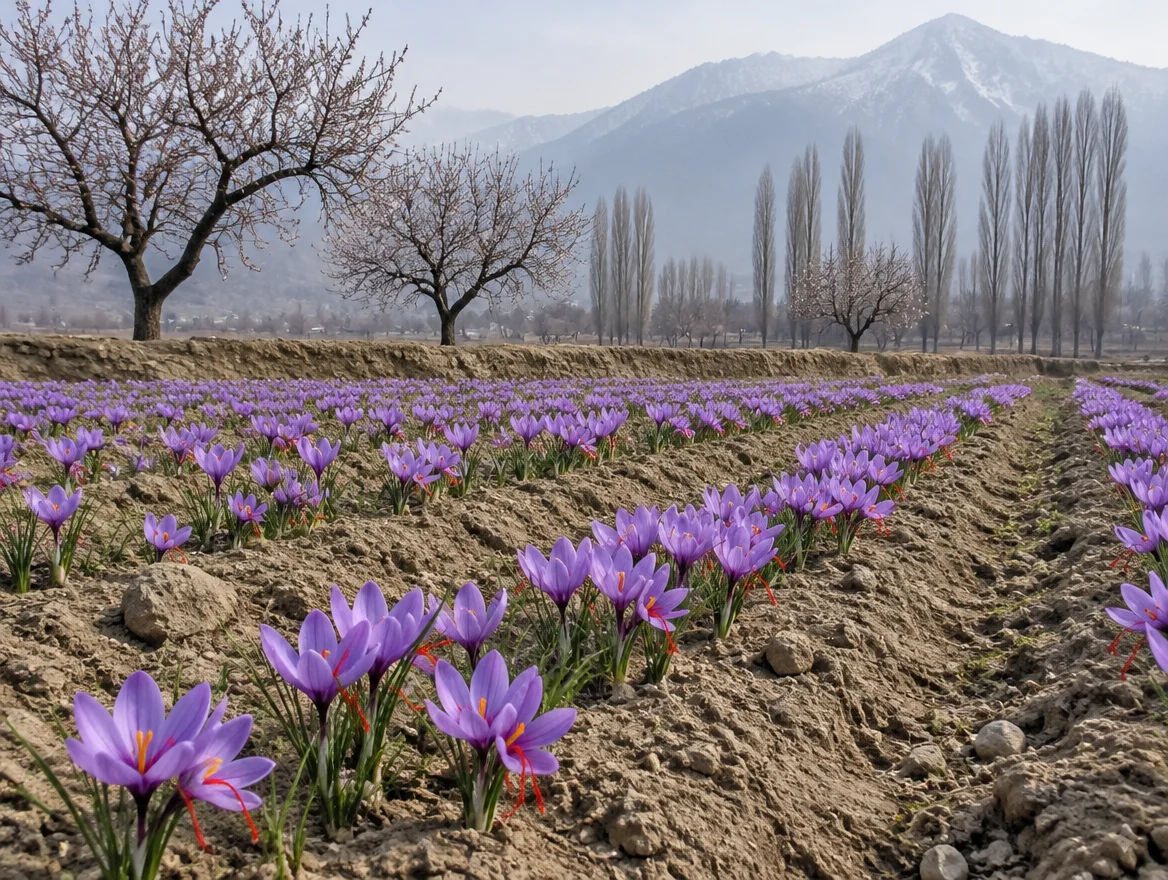
Pulwama is the district where Srinagar’s southern suburbs turn into farmland. NH-44 and the Banihal–Baramulla railway pass through Pampore and Awantipora, so much of the district is within a short drive of the city and the airport. Beyond the highway belt the land changes: the Tral valley on the east side is forested and orchard-heavy, and the karewas of Pampore are the home of Kashmir saffron, which carries a Geographical Indication.
The ICAR-CRIDA contingency plan puts the district’s net sown area at about 32,400 hectares, cropped at 176% intensity, with a normal rainfall of 658 mm over 79 days (ICAR-CRIDA plan[5]). Paddy covers roughly 16,700 hectares, maize 5,400, apple about 7,600 and almond about 7,200 hectares, with walnut at 3,300. These are 2008-09 figures in a 2012 plan, so treat them as the shape of the district rather than today’s totals.
Saffron is what the district is known for, and it is also where a buyer needs the most care. The government told the Assembly in February 2026 that cultivated saffron area has been stable at 3,715 hectares since 2010-11, down from 5,707 hectares earlier, and that production was 19.58 tonnes in 2024-25. Growers disagree: the Saffron Growers Association says the 2025 crop was hardly 15% of normal (Greater Kashmir[7]). Output has been hit by dry spells, poor corm quality and weak irrigation, and 85 of 124 community bore-wells handed over were reported, with only 8 working.
Who buys in Pulwama? Local growers, families dividing orchard and saffron land, and Srinagar-based buyers who want land in reach of the city. Outside buyers meet the agriculturist rule at the first step, so the realistic outside route is non-agricultural land near the highway and the towns, or a lease. A plot near Srinagar is priced by its use class and zoning far more than by its soil.
Two public projects shape expectations. AIIMS Awantipora remains under construction, according to a July 2026 reply in Parliament (Kashmir Life[8]), and master plans for Awantipora and Pulwama towns are in preparation. Both raise demand for housing and services near Awantipora; neither has changed what the law allows on agricultural land.
Pulwama also hosts the Lassipora controlled-atmosphere cluster, where most of south Kashmir’s CA stores stand, and the Pampore industrial estate. That makes it the district where an orchard owner has the shortest route to cold storage, which supports the value of well-connected orchard land.
- Pampore saffron
- Almond and apple
- Srinagar edge
- AIIMS Awantipora
- Agriculturist rule
Transaction costs
Stamp duty & registration in Pulwama
7%
Stamp duty for men
Reported in the government fee schedule of April 2026
3%
Stamp duty for women
Reported in the same schedule, for land registered in a woman’s name
1.2%
Registration charges
Reported in the same schedule, on top of stamp duty
These rates are as reported by Kashmir Life from the government fee schedule in April 2026 (Kashmir Life[6]). Confirm them at the sub-registrar before you budget, and check the government’s market value for the village, since duty is charged on the higher of the deed price and that value. Registration runs through the Inspector General of Registration, J&K.
Know the belt
What is moving prices in Pulwama
Four pockets buyers ask about. They are descriptions of how land is used, not price signals.
Pampore saffron karewas
Saffron fields on the plateau above the Jhelum
The karewas around Pampore are the traditional saffron fields, and a plot here is farmland with a name attached. Pressure comes from the highway and from conversion requests, but the land is agricultural and the buyer pool is limited to agriculturists. Value depends on water and corm quality more than on location.
Check: Last three harvests, sprinkler or bore-well status, co-sharers in the jamabandi, and whether the plot is inside the notified saffron area.
Awantipora and the NH-44 belt
Highway, rail and the AIIMS site
Land along NH-44 between Pampore and Awantipora is the most liquid in the district, because it serves roadside commerce, storage and housing. The AIIMS site and the town’s master plan sit at the centre of it. Draft zoning will decide what a plot can become, so ask for it before paying a premium.
Check: Draft master-plan zone, distance from the highway edge, and whether the plot is classed agricultural or non-agricultural.
Pulwama town and the NH-444 road
Bypass, widening and the town plan
Pulwama town has a bypass on NH-444 reported under execution, a widening proposal and a town master plan close to completion. A plot on the old road may lose through-traffic when the bypass opens, while one on the new alignment gains. This is a pocket to read the alignment map before buying.
Check: Alignment of the bypass, setback from the road edge, and the master-plan zone.
Tral and the eastern valley
Orchards, forest edge and tourism
The Tral side of the district is hillier, with orchards, walnut and forest. Much of the upper land is forest or state land, and private holdings are small. It suits a buyer looking for a quiet orchard rather than a development play.
Check: Forest or state-land boundary on the revenue map, tree age and variety, and winter road access.
Asking prices
Asking prices circulated by agents and listings in Pulwama are not an official series. Treat them as a starting point only, compare them with registered deeds for the same village, and ask the sub-registrar for the government rate.
Connectivity
How Pulwama connects — road, rail and air
Pulwama is the best-connected of the south Kashmir districts, with NH-44 and the railway on its western side. Drive times vary with the season and traffic, so none are quoted.
🚗 By road
✈️ By air
🚆 By rail
For a buyer, this means the western half of the district, along NH-44, has the access of a Srinagar suburb, while the eastern valley and the NH-444 side depend on a road that is still being repaired and upgraded. Check the actual road to the plot in the season you expect to use it.
Growth catalysts
Upcoming infrastructure & developments
Pulwama’s big public projects are a hospital, two town master plans and road work on NH-444, all at different stages.
00Open
04Catalysts
Agriculture & terrain
Soil, crops & water in Pulwama
Saffron on the karewas, paddy on the valley floor, and almond and apple orchards across the district.
Land use
The 2012 ICAR-CRIDA plan for the district gives these indicative figures (ICAR-CRIDA plan[5]):
- Net sown area: about 32,400 ha
- Cropping intensity: 176%
- Net irrigated: about 21,300 ha
- Normal rain: 658 mm, 79 days
- Soil: clay about 70%, sandy loam 30%
Crops
In the plan’s 2008-09 figures paddy is the largest field crop at about 16,700 hectares, followed by maize (5,400 ha) and fodder (3,500 ha). In horticulture apple covers roughly 7,600 hectares and almond about 7,200 hectares, which makes Pulwama the district where almond is a real commercial crop; walnut adds about 3,300 hectares. The plan’s crop table does not list saffron, which the Assembly figures put at 3,715 hectares in the district’s Pampore belt.
Water
The plan lists canals as the main irrigation source, with a share of micro-irrigation, and a large rainfed area of about 20,500 hectares. Saffron in particular is rain-sensitive: dry spells at flowering have cut harvests, and the community bore-well programme has had limited success, with 8 of 85 handed-over wells reported working in February 2026.
Trends
Growers around Pampore have been moving land from saffron to apple, almond or housing for years, and the area figures are disputed between the government and growers. A buyer should ask what the plot grew in the last three seasons, who owns the corms, and whether the field is inside the rejuvenation programme. Pulwama is also the district with the shortest route to cold storage, which helps orchard values.
At a glance
Pulwama vs. nearby districts
| District | Land and water | What links it to Pulwama |
|---|---|---|
| Shopian | Apple district to the south-west, with the Aglar cold-storage cluster | Carved out of the Pulwama area in 2007; same Pir Panjal slopes |
| Anantnag | Highway, rail and tourism district to the south-east | Same Jhelum valley and the same rail line |
| Kulgam | Orchard and paddy district to the south | Reached from Pulwama by NH-444 |
| Srinagar and Budgam | The city and airport district to the north | The reason the NH-44 belt is priced differently from the rest of Pulwama |
Pulwama is the Srinagar-facing market of south Kashmir. Compare it with Anantnag and Kulgam on distance to the city and the highway, and on what the land can legally be used for, rather than on headline price.
Farmland India view
Why investors look at Pulwama
Five reasoned points for Pulwama, each tied to a source on this page.
Saffron is a heritage asset, not a sure yield
The government and growers disagree on how much saffron Pampore still produces, and both name irrigation and corm quality as the weak points. Buy a saffron field for the land and the water, not for a stated yield.
The Srinagar edge carries the premium
Land along NH-44 near Awantipora and Pampore is priced for its closeness to the city. That premium rests on zoning and access, so a plot’s master-plan zone matters more than its soil.
Agriculturist rule narrows the buyer pool
The sale of agricultural land is open only to agriculturists. A non-agriculturist should focus on non-agricultural land near the highway and the towns, or on a lease.
Cold storage is a real local advantage
The Lassipora CA cluster gives orchard owners a short route to storage that Kulgam and Anantnag lack. For an orchard buyer, distance to Lassipora is worth checking on the map.
Wait for the plans before paying a premium
The Awantipora and Pulwama master plans and the NH-444 bypass will redraw what each plot can do. Until the plans are notified, price town-edge land as if the zone could go either way.
Confirm the RoR (Jamabandi), mutation, zoning and acquisition status directly — these are not certified by Farmland India’s review.
STRAIGHT TALK
Risks & challenges in Pulwama
District-specific risks. Read the Jammu and Kashmir state page for the general risks on ceiling, conversion and records.
Agriculturist rule
A buyer who is not an agriculturist cannot buy farmland by sale deed; see the state page and take advice before paying a deposit.
Saffron yield and water risk
Dry spells, weak irrigation and poor corms have cut harvests. Look at the plot’s last three seasons before paying for a saffron field.
Conversion is slow and conditional
The district committee decides, with a 5% fee and a 30-day clock that starts only when the file is complete. Do not assume approval, especially for saffron land.
Migrant-owned land
A sale needs the owner in person and the Divisional Commissioner’s permission. Ask for the permission before any payment.
State land and Roshni titles
A title that traces to a Roshni vesting can be void. Get a lawyer’s opinion on the chain of title.
Master plan and road alignments
Land inside a green or public zone, a bypass or widening alignment, or the housing scheme at Padgampora may be acquired or restricted. Ask the department what is earmarked.
Co-sharers and unrecorded partition
A family arrangement that is not mutated is not a title. Check every co-sharer in the jamabandi and get each signature.
Who to contact
Local revenue & planning offices
The Deputy Commissioner, Pulwama runs the district collectorate and the committee that decides conversions. Tehsildars record mutation and issue jamabandi extracts; the sub-registrar registers deeds. Start with the district website (pulwama.nic.in) and the land records portal (landrecords.jk.gov.in[4]).
COMMON QUESTIONS
Frequently asked questions
Everything buyers, NRIs and investors ask before their first reviewed farmland purchase in Pulwama.
Visit full wiki01 of 04
Can an outsider buy saffron or orchard land in Pulwama?
Not by sale deed unless the buyer is an agriculturist of Jammu and Kashmir; the law allows limited exemptions. Saffron fields and orchards are agricultural land. Non-agricultural land is open to any Indian citizen.
02 of 04
Is Pampore saffron land a safe investment?
Treat it as farmland, not a yield play. The government says output is stable; growers say the 2025 crop was about 15% of normal. Both agree irrigation and corm quality are the problems. Check the plot’s water and its last three harvests.
03 of 04
Is the Pulwama ring road or bypass happening?
The government told the Assembly in September 2026 that no ring road around Pulwama is under consideration. A bypass on NH-444 is reported as sanctioned and in execution, and NH-444 widening is only a proposal.
04 of 04
How do I read a Pulwama land record?
Use the J&K Land Records Information System for jamabandi, girdawari and mutation, and match the plot number with the tehsil. Areas are in kanal and marla; eight kanals make an acre.
Transparency
Sources and references
Law and courts
- [1]ThePrint: 12 laws repealed, 14 amended under new land orders, 29 Oct 2020 — theprint.in
- [2]Kashmir Life: J&K announces rules for land conversion, 15 Jan 2022 — kashmirlife.net
Government
- [3]IGR J&K: letter on migrant immovable property, 22 May 2025 — igr.jk.gov.in
- [4]J&K Land Records Information System — landrecords.jk.gov.in
- [5]ICAR-CRIDA: district agriculture contingency plan, Pulwama, 2012 — icar-crida.res.in
News
- [6]Kashmir Life: stamp duty and registration fee schedule, 17 Apr 2026 — kashmirlife.net
- [7]Greater Kashmir: govt rejects saffron collapse claim, 13 Feb 2026 — m.greaterkashmir.com
- [8]Kashmir Life: AIIMS Awantipora still under construction, 31 Jul 2026 — kashmirlife.net
- [9]Kashmir Life: master plans for Awantipora and Pulwama; Padgampora housing, 21 Feb 2026 — kashmirlife.net
- [10]Daily Excelsior: no ring road for Pulwama; NH-444 projects, 29 Sep 2026 — dailyexcelsior.com
- [11]Greater Kashmir: stakeholders seek early resolution of land possession delay at IE Pampore, 4 Jan 2026 — m.greaterkashmir.com
Data-currency note: sources are as of November 2026. Project status, the benchmark valuation and land rules change often; check the linked source and the relevant office before relying on any figure.
For developers
Ready to explore Pulwama farmland?
Browse reviewed projects and individual land parcels across Pulwama — or if you own land here, list it with platform review and reach serious buyers.