
District guide
Buying Land in Ganderbal
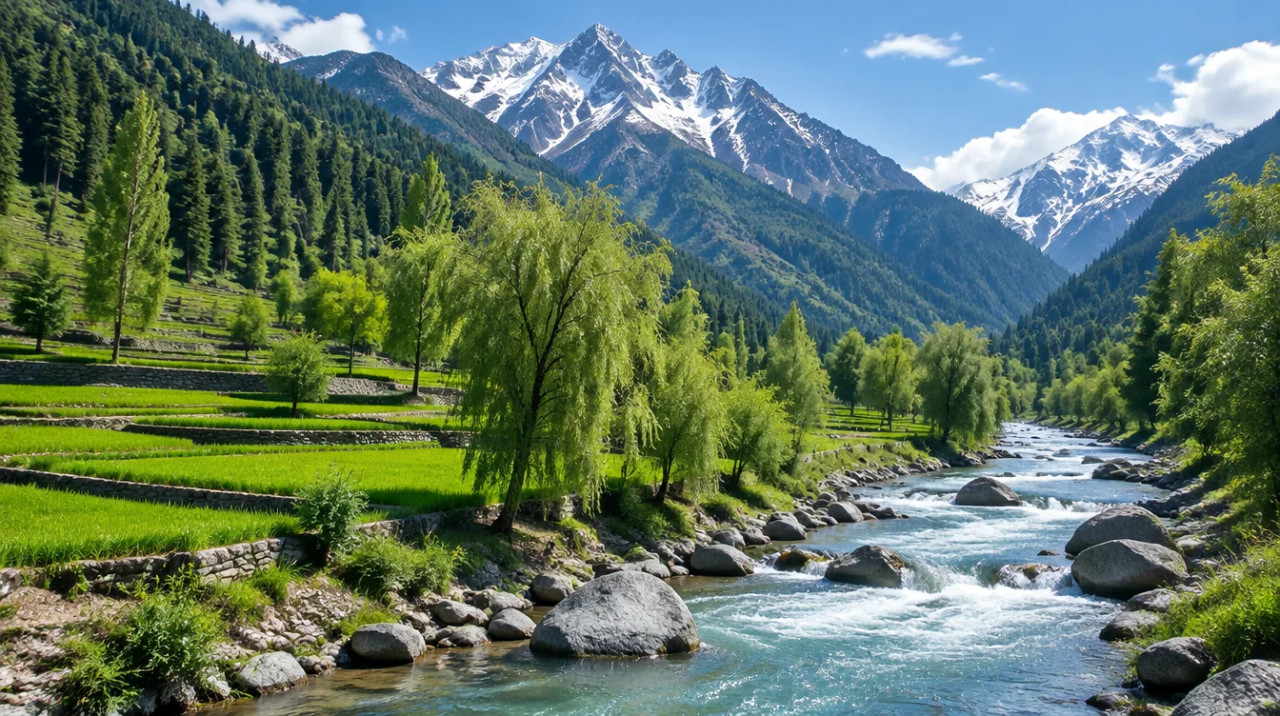
The Sindh valley district north-east of Srinagar, where Sonamarg state land, Ring Road notices and farmland rules decide which land is safe to buy.
6.5 km
Z-Morh tunnel length (Kashmir Life)
7,674+ kanals
Sonamarg state land being demarcated (Greater Kashmir)
13.153 km
Zojila tunnel length (Deccan Chronicle)
4
Blocks (district site)
District land record — Ganderbal
Rev. 2026 · Farmland India desk
State
Jammu and Kashmir (Union Territory)
Formation and division
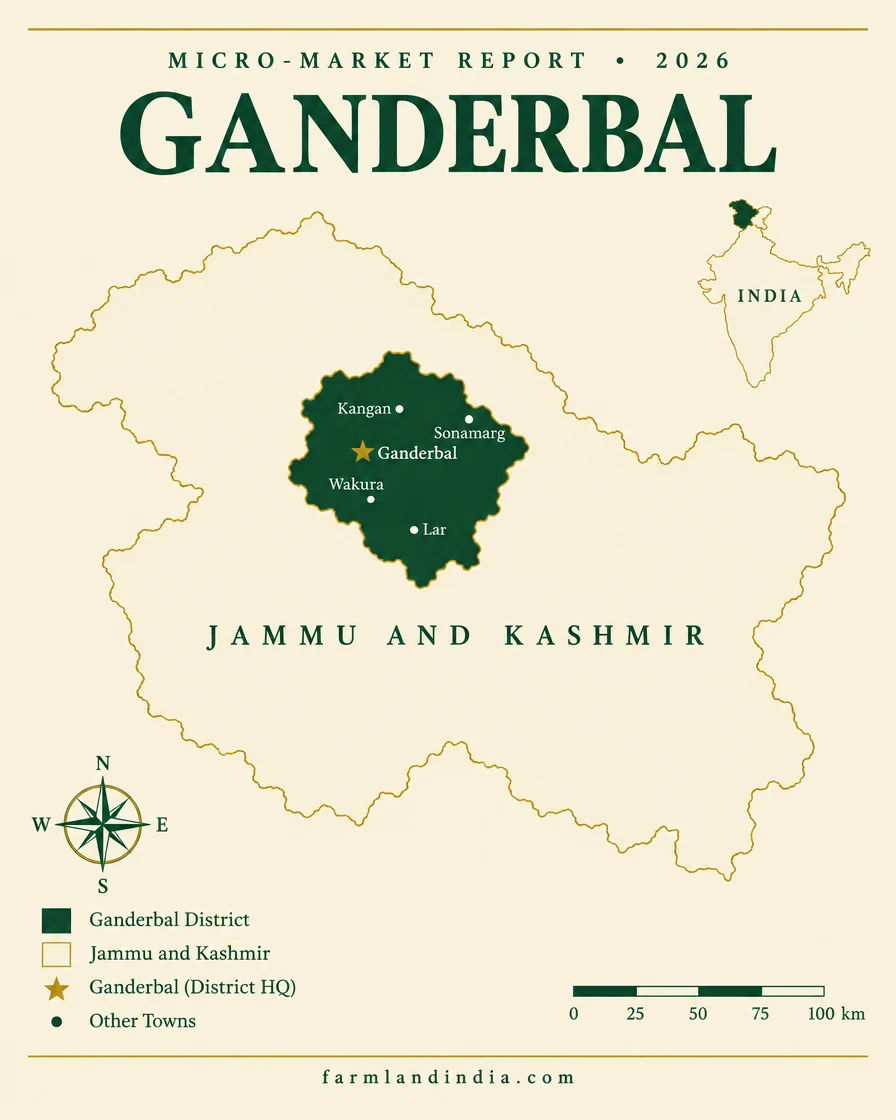
District headquartered at Ganderbal, in the Kashmir division, north-east of Srinagar on the Sindh river (Nallah Sindh); four blocks: Ganderbal, Kangan, Lar and Wakura (Ganderbal district site[3])
Key markets
Ganderbal town · Kangan · Lar · Wakura · Bakoora · Gund · Sonamarg · Manasbal
Demand anchors
Srinagar spillover · Ring Road Phase II · Z-Morh and Zojila tunnels · Sonamarg and Gangabal tourism · Upper Sindh hydropower
Borders
Srinagar to the south, Bandipora to the north, Kargil (Ladakh) to the north-east, Anantnag to the south-east and Baramulla to the south-west, per the district site
Rail
No station of its own; the nearest railhead is Srinagar, with the Katra–Srinagar Vande Bharat taking about three hours from Katra
Pricing unit
No newspaper price series for Ganderbal land was found, so no band is shown. Quote and compare land per acre or per sq yd, and check the guideline rate with the sub-registrar
Local units
Records and sellers use kanal and marla: 1 kanal is 20 marla, about 5,445 sq ft (605 sq yd), and 8 kanal make one acre. Convert every offer to acres or sq yd before comparing
Land records portal
Land Records Information System (Aapki Zameen Aapki Nigrani) at landrecords.jk.gov.in[4]; see the J&K land records guide
Land law is state law. These rules are maintained on the Jammu and Kashmir page and apply to every district within it.
Ganderbal — land purchase legal rules
Jammu and Kashmir’s land law was rewritten in October 2020. Non-agricultural land is now open to any Indian citizen, but agricultural land can pass only to agriculturists of the Union Territory, with exemptions the government grants case by case, and converting farmland needs permission. Migrant land, state land and strategic areas carry their own rules. This block applies to every district page in the Union Territory.
What changed in October 2020: On 26 October 2020 the Ministry of Home Affairs issued the Jammu and Kashmir Reorganisation (Adaptation of Central Laws) Third Order and the Adaptation of State Laws Fifth Order. Together they repealed 12 land laws, among them the Big Landed Estates Abolition Act, 1950, the Alienation of Land Act, 1938, the Tenancy Act, the Consolidation of Holdings Act, the Prohibition on Conversion of Land and Alienation of Orchards Act, 1975 and the Right of Prior Purchase Act, and amended others (ThePrint, 29 October 2020). Before 2019 only permanent residents of the state could own land there; that rule is gone.
Non-agricultural land: The words “permanent resident of the State” were removed from Section 17 of the Jammu and Kashmir Development Act, so any Indian citizen can now buy non-agricultural land, for a house, a shop, a hotel or an industrial unit, in the Union Territory. The Real Estate (Regulation and Development) Act now applies here as it does elsewhere (ThePrint, 29 October 2020).
Agricultural land: agriculturists only: The amended Jammu and Kashmir Land Revenue Act, 1996 bars the sale, gift, exchange or possessory mortgage of agricultural land to a non-agriculturist. An agriculturist is a person who cultivates land personally in the Union Territory, or a category the government notifies; in December 2022 the government ordered that the legal heirs of an agriculturist (mother, father, wife and children) be treated as agriculturists too for the purposes of Section 133-H, the section that bars transfers to non-agriculturists (Kashmir Observer, 1 December 2022). In plain terms, a buyer from outside Jammu and Kashmir who does not farm here cannot buy farmland in his own name.
Exemptions: The government, or an officer it authorises, may permit a transfer of agricultural land to a non-agriculturist. It may allow transfers to public trusts and charities for education or health, and may notify transfers for industrial, commercial, housing or agricultural development. Leases are not barred. Land transferred under such a permission is meant to be put to the permitted use within five years (Drishti, 29 October 2020).
Converting farmland: Agricultural land cannot be used for any other purpose without permission. The Agricultural Land (Conversion for Non-Agricultural Purposes) Regulations, notified in January 2022, route applications to a district committee headed by the District Development Commissioner (the Deputy Commissioner). The fee is 5% of the market value notified under the Stamp Act, the decision is due within 30 days of a complete application, and the approved use must begin within one to two years. If the committee does not decide in time, the District Collector grants the permission (Kashmir Life, 15 January 2022). The old limit of 400 square metres, for houses only, no longer applies.
Strategic areas: The Union Territory government can declare an area a strategic area for the direct operational and training needs of the armed forces, on a request from an officer not below the rank of Corps Commander (Drishti, 29 October 2020). Land inside such an area is not open to ordinary purchase or development.
Kashmiri migrant land: Land of Kashmiri migrants is protected under the Jammu and Kashmir Migrant Immovable Property (Preservation, Protection and Restraint on Distress Sales) Act, 1997. Under the Inspector General of Registration’s instructions of May 2025, a sale deed of migrant land can be executed only by the owner in person, with the permission of the Divisional Commissioner, Kashmir; registration through a power of attorney is not allowed (IGR Jammu and Kashmir, 2025). Ask whether the seller or the land is on the migrant list before anything else.
State land and the Roshni Act: In October 2020 the High Court declared the Jammu and Kashmir State Land (Vesting of Ownership to the Occupants) Act, 2001, known as the Roshni Act, unconstitutional and void from the start, ordered a CBI inquiry and directed that state land vested under it be retrieved (LiveLaw, 11 October 2020). Title that traces back to a Roshni grant, or to state land (khalsa sarkar), kahcharai (village grazing land) or nazul land, is not safe to buy.
Stamp duty and registration: Stamp duty on a sale deed is reported at 7% for men and 3% for women, with registration charges of 1.2%, according to the government’s fee schedule (Kashmir Life, 17 April 2026). Deeds are registered at the sub-registrar office through NGDRS, and duty is charged on the higher of the deed price and the notified market value. Confirm the current rate with the sub-registrar before you register.
Records and units: Records of rights, jamabandi, girdawari and mutation entries are on the Land Records Information System run under the Aapki Zameen Aapki Nigrani (your land, your oversight) programme. Land is measured in kanal and marla: 20 marla make a kanal and 8 kanal make an acre, so a 4-kanal plot is half an acre. Ask for the khasra number, check the jamabandi and the latest girdawari, and confirm the last mutation was attested.
NRI and OCI buyers: Under the RBI Master Direction on immovable property, NRIs and OCIs may not acquire agricultural land, a farmhouse or plantation property in India except by inheritance. In Jammu and Kashmir the agriculturist rule applies on top of that. Our NRI guide covers the options.
What this page does not do: It does not give a legal view on any particular plot or seller. The orders have been amended several times since 2020; have a local advocate read the jamabandi, the mutation history and any permission before you pay.
- Non-agricultural land: any Indian
- Farmland: agriculturists only
- Section 133-H
- Conversion: district committee
- Strategic areas
- Migrant land: Divisional Commissioner
- Roshni Act void
- NRIs: inheritance only
Ganderbal — district-specific notes
The Jammu and Kashmir state page sets out who may buy land, the agriculturist rule, conversion and the NRI position. Ganderbal adds three district-specific checks: how much land around Sonamarg is state land, whether a plot lies on the Ring Road alignment, and whether it is forest or eco-sensitive land.
⚠ Greater Kashmir reported on 12 September 2025 that the revenue department had begun marking out more than 7,674 kanals of state land in Sonamarg for handover to the Sonamarg Development Authority, under a Government Order of 25 July 2007 meant for eco-friendly development. The report says the delay of about 18 years let encroachment and unauthorised construction grow (Greater Kashmir[5]). A further Tehsildar order in November 2025 called for a fresh demarcation as part of a probe into Roshni and encroachment cases referred to the CBI (Kashmir Life[6]). A “plot” in Sonamarg may therefore be state land or on land transferred to the authority, and no seller can pass title to it.
⚠ On the Ring Road, the Assistant Collector (Tehsildar) at Ganderbal issued a notice dated 10 June 2026 requiring immediate clearance of land and structures on the Phase IIA alignment, including by owners who had already received compensation, with seven days to remove them or face removal at their cost (Kashmir Life[7]). The work upgrades the Manigam–Ganderbal–Pandach section of the old NH-1D to four lanes under Bharatmala. A plot beside that road should come with the acquisition and award papers, not just the sale deed.
⚠ Where land is still recorded as agricultural, a non-agriculturist cannot simply buy it. The conversion route runs through a district committee headed by the Deputy Commissioner, with a fee of 5% of market value and a decision due within 30 days of a complete application (Kashmir Life[1]). The High Court declared the Roshni Act void in October 2020 (LiveLaw[2]), so any title that depended on it needs scrutiny, and land owned by Kashmiri migrants can be sold only with the Divisional Commissioner’s permission and not through a power of attorney.
NRI and OCI buyers should read can NRIs buy agricultural land in India before shortlisting any farmland here.
- Sonamarg state land
- Roshni and CBI probe
- Ring Road Phase IIA clearance
- Farmland: agriculturists only
- Migrant land rules
District overview
Ganderbal — the Sindh valley district north-east of Srinagar, where Sonamarg state land and the Ring Road decide what can be bought
Ganderbal lies north-east of Srinagar along the Sindh river, a Jhelum tributary used for irrigation, hydropower and, through the Rangil plant, Srinagar’s drinking water. The district site lists four blocks (Ganderbal, Kangan, Lar and Wakura) and three hydroelectric projects on the river (Lower Sindh, Upper Sindh I at Kangan and Upper Sindh II at Sumbal) (Ganderbal district site[3]). It is also home to Sonamarg, the Gangabal and Vishansar lakes, Manasbal Lake and the Kheer Bhawani temple, so tourism, hydropower and the capital’s overflow all shape the land market.
Who buys? Mostly local families building near the Srinagar edge, hospitality and tourism operators, and people with a family link to the district. Outside buyers can buy non-agricultural land after the 2020 land orders but not farmland, and in Sonamarg the first question is whether a plot is private land at all.
The district’s position has changed with the Z-Morh tunnel, a 6.5 km tunnel between Gagangir and Sonamarg that the Prime Minister opened on 13 January 2025 and that Kashmir Life described as making Sonamarg accessible throughout the year (Kashmir Life[8]). A second, larger project, the Zojila tunnel, is meant to extend all-weather access towards Ladakh, which raises the long-term value of the corridor but not of every plot on it.
Ganderbal is also part of the capital’s growth plan. The Srinagar Development Authority board approved a flatted housing colony at Bakoora in December 2025, and the Ring Road’s Phase II and IIA run through the district toward Pandach (Greater Kashmir[9]). Land near Ganderbal town and Wakura is therefore the most contested, and also the most carefully watched by the revenue staff.
Ganderbal is a place for careful, document-first buying. A small plot with a recorded non-agricultural use, a clear road and a tehsil statement on the Ring Road is a sound case; a plot in Sonamarg or on the river fringe sold on a tourism story is not.
- Sindh valley
- Sonamarg
- Z-Morh tunnel
- Ring Road Phase II
- State land
- Manasbal
Transaction costs
Stamp duty & registration in Ganderbal
7%
Stamp duty for men (reported)
Kashmir Life, 17 April 2026, citing the government fee schedule
3%
Stamp duty for women (reported)
same report; confirm the woman-buyer rate for your deed
1.2%
Registration charges (reported)
added on top of stamp duty, per the same report
Kashmir Life reported on 17 April 2026 that the government fee schedule puts stamp duty at 7% for men and 3% for women, with registration charges of 1.2% (Kashmir Life[10]). Treat these as reported rates and ask the sub-registrar for a written assessment before you pay an advance. A sale deed is registered at the sub-registrar’s office and should carry the khasra (survey) number, the area in kanal and marla and the seller’s mutation entry. Because Sonamarg and the Ring Road alignment involve state land and acquisition, ask the sub-registrar and tehsil to record in writing that the khasra is private land and not under any notice. Do not accept a deal that rests only on stamp paper or an agreement to sell.
Know the belt
What is moving prices in Ganderbal
Land-use notes for each belt; no listing-site rates are quoted.
Ganderbal town, Wakura and Bakoora
Srinagar-edge belt
This is the belt nearest Srinagar, where the Ring Road’s Phase II runs and where the Srinagar Development Authority has approved a flatted housing colony at Bakoora. It has the most buyer interest and the most acquisition and demarcation activity.
Check: the Ring Road alignment and award status, any Development Authority notice, and the road width at the plot
Kangan, Lar and the Sindh plain
Paddy, orchard and hydropower belt
The river plain carries paddy, orchards and vegetable plots, and the hydropower projects have drawn roads and staff housing. Land here is mostly agricultural in the record and therefore limited to agriculturists.
Check: the jamabandi entry, river-bank and flood-channel limits, and any land taken for hydropower or roads
Sonamarg and Gund
Tourism and state-land belt
Sonamarg’s state land is being demarcated for the Sonamarg Development Authority, and construction in the zone is closely watched. The Z-Morh tunnel has improved winter access, but it has not made unrecorded land saleable.
Check: whether the khasra is private land, the demarcation report, and the authority’s building permission
Manasbal and the Tullamulla side
Lake and temple belt
The lake and the Kheer Bhawani temple are the draw. Wetland and lakeshore land is usually protected, and land near a heritage site may carry building limits.
Check: any wetland or lake buffer, the land category in the record, and whether the village is within a development authority’s area
Asking prices
No official price series is published for Ganderbal land. Compare any quote with the guideline rate for the village and with recent registered deeds in the same locality. Treat a rate quoted by a seller without a registered deed as unproven, and be especially cautious with any price quoted for Sonamarg land.
Connectivity
How Ganderbal connects — road, rail and air
The Srinagar–Leh road runs through the district; the Ring Road and the tunnels are changing it.
🚗 By road
🚆 By rail
✈️ By air
Access sets value in Ganderbal more than almost anywhere in the Valley. A plot beside the Srinagar–Leh road can be both well placed and in the way of a road widening, so check the right-of-way before measuring the plot against it.
Growth catalysts
Upcoming infrastructure & developments
Two tunnels, a road upgrade and a housing colony, at different stages.
01Open
04Catalysts
Agriculture & terrain
Soil, crops & water in Ganderbal
A river-plain farming base, with hill pasture and tourism above it.
Crops and land use
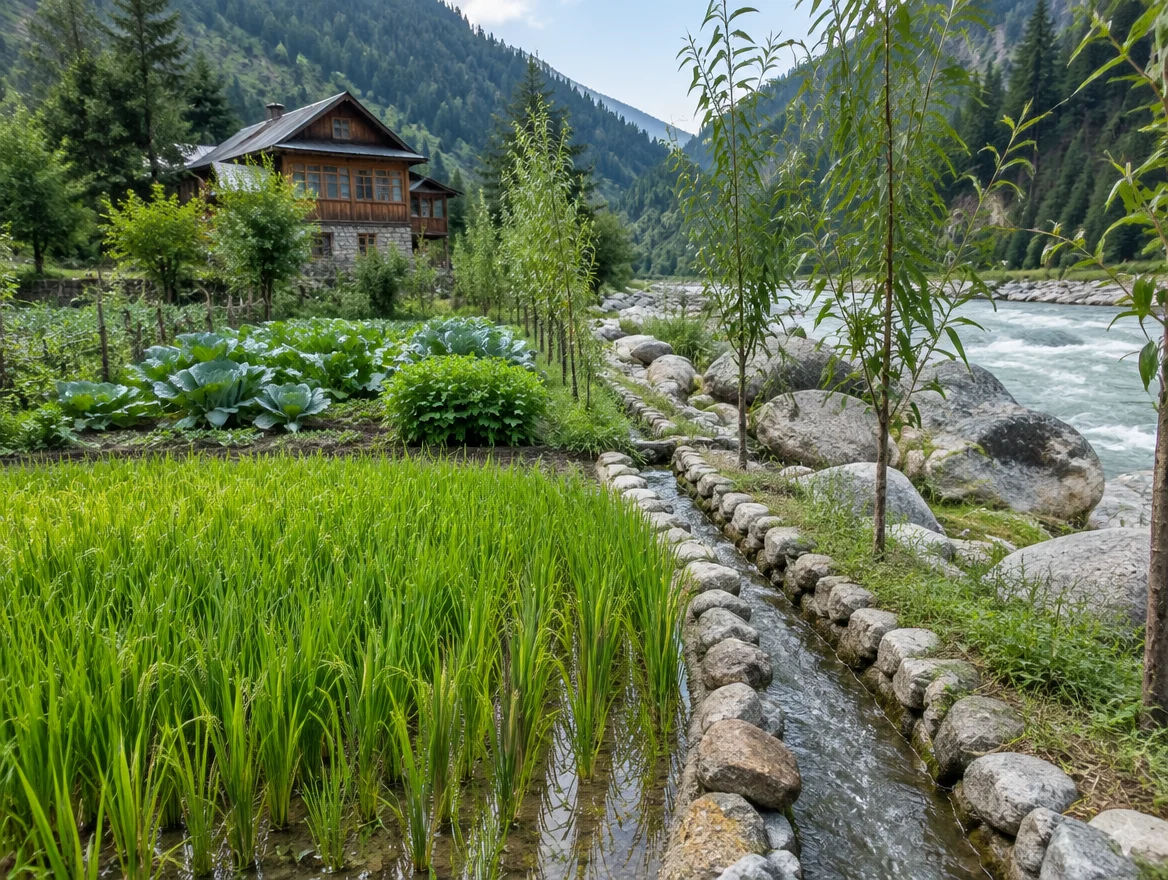
The Sindh plain around Ganderbal, Kangan and Lar supports paddy, vegetables and orchards, and the river feeds irrigation channels, hydropower and the Rangil water plant for Srinagar (Ganderbal district site[3]). Higher up, grazing and tourism take over, with the meadows and lakes of Sonamarg, Gangabal and Vishansar. The district is small, so farmland is limited and valued.
- Paddy on the plain
- Vegetables and fodder
- Orchards and willow along the river
- Mountain pasture above Sonamarg
River and flood limits
The Sindh and its channels can flood or shift in heavy years. Land on the river fringe may lie in a flood channel or protected strip, so check the record and ask the irrigation department about bank limits.
Conversion pressure
Because the Srinagar edge is being pulled into housing and road plans, the revenue staff look closely at changes of use. A plot recorded as agricultural cannot be bought by a non-agriculturist, so ask for the current jamabandi entry.
At a glance
Ganderbal vs. nearby districts
| District | Land and water | What links it to Ganderbal |
|---|---|---|
| Srinagar (south) | The capital and main market; Ring Road Phase II links it to Ganderbal | Prices fall quickly with distance from the Srinagar line |
| Bandipora (north) | Wular and Hajin side; its own housing colony at Watapora | Cheaper land, different lake and forest rules |
| Anantnag and Baramulla | Larger fruit and farming districts | Orchard rules and farmland limits dominate |
All of these run under the same land law, but they differ in what the land is. Ganderbal’s edge is shaped by Srinagar and Sonamarg’s by state land and tourism; Bandipora and Baramulla are more about orchards and lakes.
Farmland India view
Why investors look at Ganderbal
Five reasoned points for Ganderbal, each tied to a source on this page.
Buy private land with a clear record
Because farmland is closed to non-agriculturists, the realistic opening for an outside buyer is land with a recorded non-agricultural use. A plot with a clear khasra entry, road access and a tehsil statement on acquisition is the safest case.
Treat Sonamarg as a title exercise first
More than 7,674 kanals of state land are being demarcated for the Sonamarg Development Authority, and a CBI-linked probe covers Roshni cases there. Buy only with the demarcation report and the revenue record in hand.
Read Ring Road notices before the road map
Phase IIA is moving and notices are being served. Land near the alignment can gain access, but it can also be acquired, and compensation disputes can last years.
Treat tunnel dates as targets
The Z-Morh tunnel is open, but Zojila is estimated for February 2028. Plan for the road you can use, not the one on the calendar.
Hold for the long term
Land supply is capped by river, forest and state-land limits, and the demand drivers (Srinagar, tourism, hydropower) are real. That favours a patient buyer who pays for a clean title.
Confirm the jamabandi (record of rights), khasra number, mutation, zoning and acquisition status directly — these are not certified by Farmland India’s review.
STRAIGHT TALK
Risks & challenges in Ganderbal
District-specific risks. Read the Jammu and Kashmir state page for the general risks on ceiling, conversion and records.
State land and Roshni
Over 7,674 kanals in Sonamarg are being demarcated as state land, and Roshni cases are under a CBI probe. Ask whether the seller’s title ever depended on state land or Roshni vesting.
Ring Road clearance
Tehsil notices on Phase IIA ask for structures to be cleared within days, even after compensation. Ask for the award or no-acquisition statement for the khasra.
Agricultural land sold as plots
Much of what looks cheap near the towns is still agricultural land. A non-agriculturist cannot buy it, and an unauthorised conversion can be challenged.
Forest, wetland and lake limits
Land around Sonamarg, Manasbal and the river fringe can be forest, eco-sensitive or protected. Ask for the category in writing.
Flood and river-channel risk
The Sindh and its tributaries can shift in heavy years. Check the flood history and the irrigation department’s bank limits.
Migrant land and fragmented holdings
Land owned by Kashmiri migrants can be sold only with the Divisional Commissioner’s permission, and not through a power of attorney. Check that every co-owner signs, and pay by traceable transfer.
Who to contact
Local revenue & planning offices
The Deputy Commissioner’s office at Ganderbal is the district authority for land revenue and conversion; the tehsildar offices (including Gund and Kangan) handle mutation and records, and the sub-registrar registers sales. Check the jamabandi on landrecords.jk.gov.in[4], and ask the Sonamarg Development Authority or the Srinagar Development Authority whether the plot lies in its area.
COMMON QUESTIONS
Frequently asked questions
Everything buyers, NRIs and investors ask before their first reviewed farmland purchase in Ganderbal.
Visit full wiki01 of 04
Can an outsider buy land in Ganderbal?
Yes for non-agricultural land such as a residential plot, after the 2020 land orders. No for agricultural land: only an agriculturist can buy it. Check the current jamabandi entry before any payment.
02 of 04
Is Sonamarg land safe to buy?
Not without a title check. More than 7,674 kanals of state land are being demarcated for the Sonamarg Development Authority, and Roshni cases are under a CBI probe. Ask for the demarcation report and revenue record.
03 of 04
Is Ganderbal land affected by the Ring Road?
It can be. A Tehsildar notice of 10 June 2026 required clearance of structures on the Phase IIA alignment. Ask the tehsil for the acquisition and award status of the exact khasra.
04 of 04
What is the stamp duty in Ganderbal?
A news report on the 2026 fee schedule gives 7% for men, 3% for women and 1.2% registration charges. Confirm at the sub-registrar before you budget.
Transparency
Sources and references
Law and courts
- [1]Kashmir Life: J&K announces rules for land conversion, 15 January 2022 — kashmirlife.net
- [2]LiveLaw: J&K High Court holds Roshni Act unconstitutional, 11 October 2020 — livelaw.in
Government
- [3]Ganderbal district: profile and notices — ganderbal.nic.in
- [4]Land Records Information System, J&K — landrecords.jk.gov.in
News
- [5]Greater Kashmir: Revenue department starts demarcating state land in Sonamarg, 12 September 2025 — m.greaterkashmir.com
- [6]Kashmir Life: Fresh demarcation of state land transferred to the Sonamarg authority, 18 November 2025 — kashmirlife.net
- [7]Kashmir Life: Ganderbal notice for removal of encroachments along Ring Road route, 12 June 2026 — kashmirlife.net
- [8]Kashmir Life: Sonamarg breaks winter isolation with Z-Morh tunnel opening, 13 January 2025 — kashmirlife.net
- [9]Greater Kashmir: Govt envisions Greater Srinagar for sustainable urban growth, 12 February 2026 — greaterkashmir.com
- [10]Kashmir Life: registration at 3 per cent for women, 7 per cent for men, 17 April 2026 — kashmirlife.net
- [11]Deccan Chronicle: Zojila tunnel breakthrough marks milestone, June 2026 — deccanchronicle.com
Data-currency note: sources are as of November 2026. Project status, the benchmark valuation and land rules change often; check the linked source and the relevant office before relying on any figure.
For developers
Ready to explore Ganderbal farmland?
Browse reviewed projects and individual land parcels across Ganderbal — or if you own land here, list it with platform review and reach serious buyers.