
Area guide
Buying Land in Pantha Chowk
A Srinagar bypass junction where a flood basin, a planning bar and the agriculturist rule decide what land can be bought.
46 km
Srinagar Ring Road phase I (reported)
About 78.8 km
Whole ring road length (reported)
About 57%
Master Plan 2035 area unsuitable for development
7% / 3%
Stamp duty, men / women (reported)
Micro-market record — Pantha Chowk
Rev. 2026 · Farmland India desk
District
Srinagar (bypass junction on the Srinagar–Nowgam stretch)
Planning
Master Plan 2035 preface records a bar on development along the NH bypass, Pantha Chowk to Nowgam, a flood absorption basin[4]
Plan area
About 57% of the 766 sq km plan area is unsuitable for development[4]
Ring road
Phase I of 46 km targeted for end December 2026; whole ring road about 78.8 km, Rs 4,786 crore (reported)[7]
Land law
Agricultural land only to agriculturists; any Indian may buy non-agricultural land[1]
Stamp duty
7% men, 3% women, plus 1.2% registration charges (Kashmir Life, reported)[6]
Records
Land Records Information System, J&K[5]
Land rates
No published price series found for this pocket; use the guideline rate and registered deeds
Land law is state law. These rules are maintained on the Jammu and Kashmir page and apply to every district within it.
Pantha Chowk — land purchase legal rules
Jammu and Kashmir’s land law was rewritten in October 2020. Non-agricultural land is now open to any Indian citizen, but agricultural land can pass only to agriculturists of the Union Territory, with exemptions the government grants case by case, and converting farmland needs permission. Migrant land, state land and strategic areas carry their own rules. This block applies to every district page in the Union Territory.
What changed in October 2020: On 26 October 2020 the Ministry of Home Affairs issued the Jammu and Kashmir Reorganisation (Adaptation of Central Laws) Third Order and the Adaptation of State Laws Fifth Order. Together they repealed 12 land laws, among them the Big Landed Estates Abolition Act, 1950, the Alienation of Land Act, 1938, the Tenancy Act, the Consolidation of Holdings Act, the Prohibition on Conversion of Land and Alienation of Orchards Act, 1975 and the Right of Prior Purchase Act, and amended others (ThePrint, 29 October 2020). Before 2019 only permanent residents of the state could own land there; that rule is gone.
Non-agricultural land: The words “permanent resident of the State” were removed from Section 17 of the Jammu and Kashmir Development Act, so any Indian citizen can now buy non-agricultural land, for a house, a shop, a hotel or an industrial unit, in the Union Territory. The Real Estate (Regulation and Development) Act now applies here as it does elsewhere (ThePrint, 29 October 2020).
Agricultural land: agriculturists only: The amended Jammu and Kashmir Land Revenue Act, 1996 bars the sale, gift, exchange or possessory mortgage of agricultural land to a non-agriculturist. An agriculturist is a person who cultivates land personally in the Union Territory, or a category the government notifies; in December 2022 the government ordered that the legal heirs of an agriculturist (mother, father, wife and children) be treated as agriculturists too for the purposes of Section 133-H, the section that bars transfers to non-agriculturists (Kashmir Observer, 1 December 2022). In plain terms, a buyer from outside Jammu and Kashmir who does not farm here cannot buy farmland in his own name.
Exemptions: The government, or an officer it authorises, may permit a transfer of agricultural land to a non-agriculturist. It may allow transfers to public trusts and charities for education or health, and may notify transfers for industrial, commercial, housing or agricultural development. Leases are not barred. Land transferred under such a permission is meant to be put to the permitted use within five years (Drishti, 29 October 2020).
Converting farmland: Agricultural land cannot be used for any other purpose without permission. The Agricultural Land (Conversion for Non-Agricultural Purposes) Regulations, notified in January 2022, route applications to a district committee headed by the District Development Commissioner (the Deputy Commissioner). The fee is 5% of the market value notified under the Stamp Act, the decision is due within 30 days of a complete application, and the approved use must begin within one to two years. If the committee does not decide in time, the District Collector grants the permission (Kashmir Life, 15 January 2022). The old limit of 400 square metres, for houses only, no longer applies.
Strategic areas: The Union Territory government can declare an area a strategic area for the direct operational and training needs of the armed forces, on a request from an officer not below the rank of Corps Commander (Drishti, 29 October 2020). Land inside such an area is not open to ordinary purchase or development.
Kashmiri migrant land: Land of Kashmiri migrants is protected under the Jammu and Kashmir Migrant Immovable Property (Preservation, Protection and Restraint on Distress Sales) Act, 1997. Under the Inspector General of Registration’s instructions of May 2025, a sale deed of migrant land can be executed only by the owner in person, with the permission of the Divisional Commissioner, Kashmir; registration through a power of attorney is not allowed (IGR Jammu and Kashmir, 2025). Ask whether the seller or the land is on the migrant list before anything else.
State land and the Roshni Act: In October 2020 the High Court declared the Jammu and Kashmir State Land (Vesting of Ownership to the Occupants) Act, 2001, known as the Roshni Act, unconstitutional and void from the start, ordered a CBI inquiry and directed that state land vested under it be retrieved (LiveLaw, 11 October 2020). Title that traces back to a Roshni grant, or to state land (khalsa sarkar), kahcharai (village grazing land) or nazul land, is not safe to buy.
Stamp duty and registration: Stamp duty on a sale deed is reported at 7% for men and 3% for women, with registration charges of 1.2%, according to the government’s fee schedule (Kashmir Life, 17 April 2026). Deeds are registered at the sub-registrar office through NGDRS, and duty is charged on the higher of the deed price and the notified market value. Confirm the current rate with the sub-registrar before you register.
Records and units: Records of rights, jamabandi, girdawari and mutation entries are on the Land Records Information System run under the Aapki Zameen Aapki Nigrani (your land, your oversight) programme. Land is measured in kanal and marla: 20 marla make a kanal and 8 kanal make an acre, so a 4-kanal plot is half an acre. Ask for the khasra number, check the jamabandi and the latest girdawari, and confirm the last mutation was attested.
NRI and OCI buyers: Under the RBI Master Direction on immovable property, NRIs and OCIs may not acquire agricultural land, a farmhouse or plantation property in India except by inheritance. In Jammu and Kashmir the agriculturist rule applies on top of that. Our NRI guide covers the options.
What this page does not do: It does not give a legal view on any particular plot or seller. The orders have been amended several times since 2020; have a local advocate read the jamabandi, the mutation history and any permission before you pay.
- Non-agricultural land: any Indian
- Farmland: agriculturists only
- Section 133-H
- Conversion: district committee
- Strategic areas
- Migrant land: Divisional Commissioner
- Roshni Act void
- NRIs: inheritance only
Sub-area overview
Pantha Chowk — a bypass junction where the plan, the flood basin and the law all bind
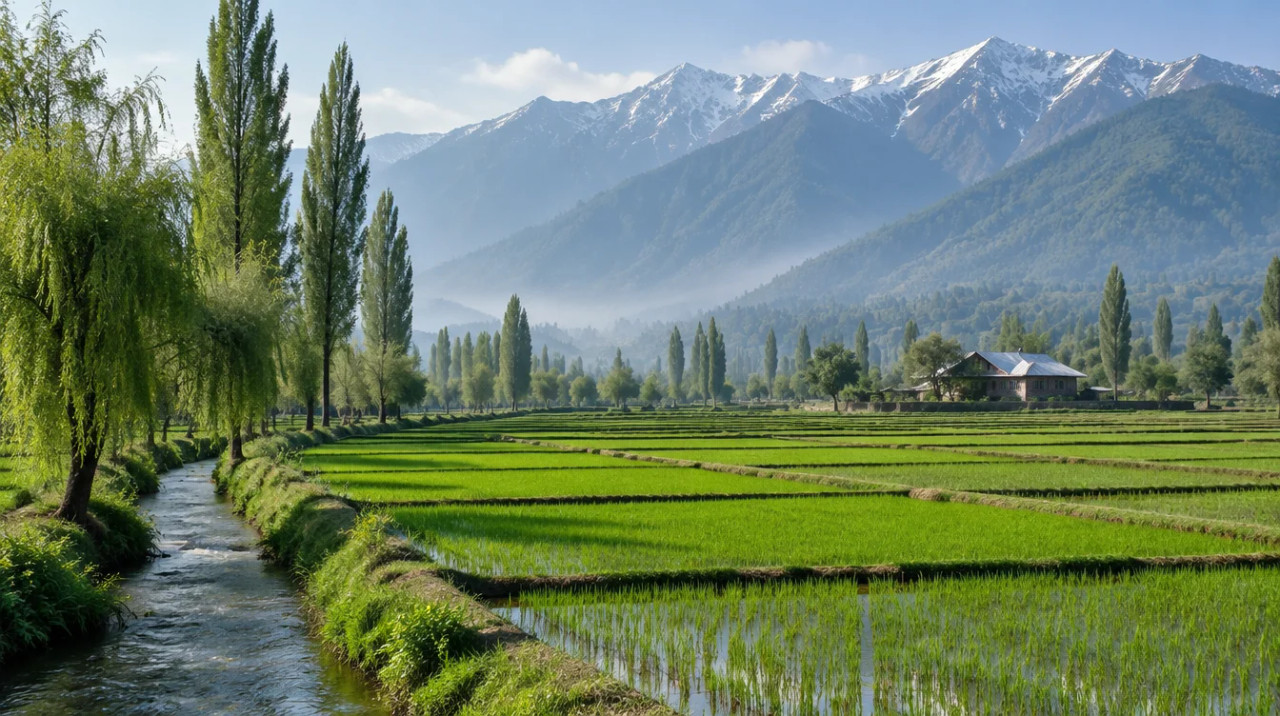
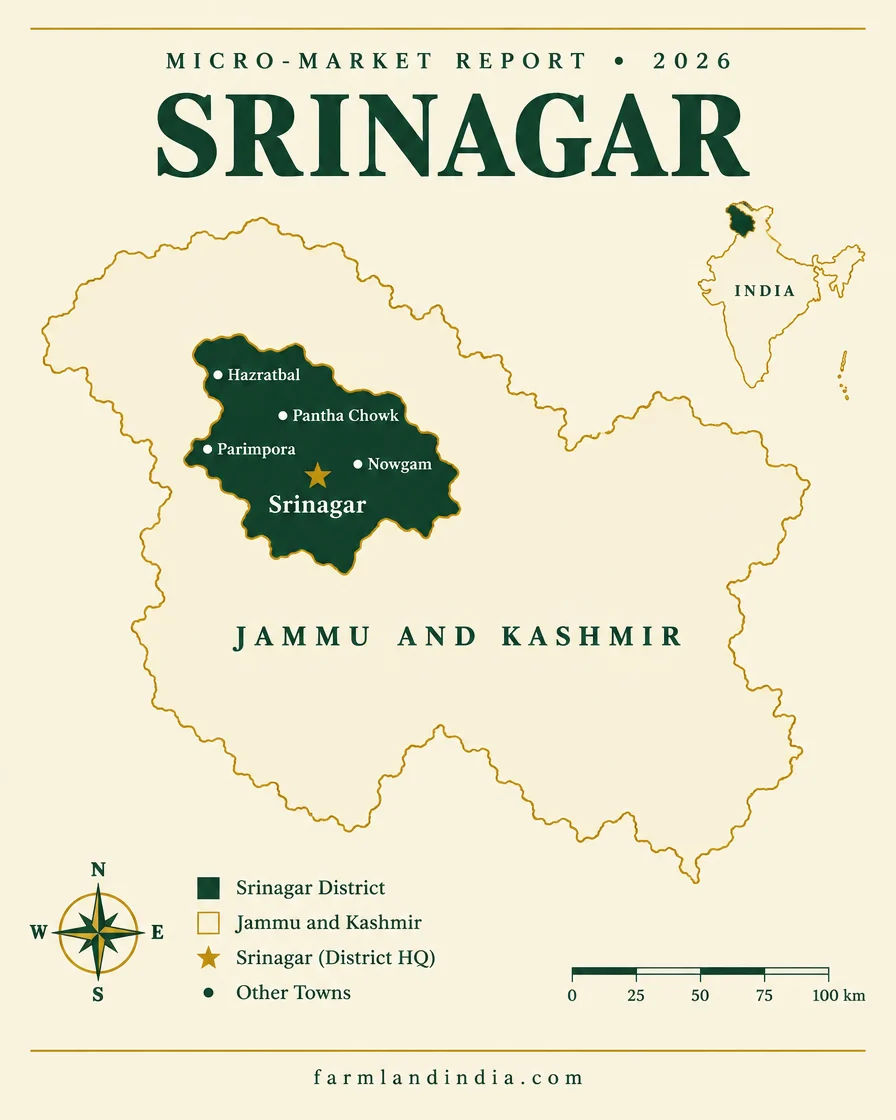
Pantha Chowk is a junction on the Srinagar bypass, on the south-eastern side of the city, where the National Highway bypass heads towards Nowgam. It is best known as a transport point, and the surrounding land is largely low-lying paddy and orchard. For a buyer, the first thing to know is not a price but a planning statement: the preface to the Srinagar Master Plan 2035 records that the State Administrative Council barred development along the National Highway bypass from Pantha Chowk to Nowgam, an area it describes as a flood absorption basin (Master Plan 2035[4]).
That statement matters because the same plan says about 57% of the 766 sq km plan area is unsuitable for development, which tells you how much of the Srinagar valley floor is treated as flood-prone or protected (Master Plan 2035[4]). The plan is published by the Srinagar Development Authority[10]. A buyer must obtain the current zoning position in writing from the Authority before paying anything.
The second influence is the ring road. A review reported by Kashmir Life on 2 September 2026 put phase I of the Srinagar Ring Road at 46 km with a target of the end of December 2026, in a whole ring road of about 78.8 km costing Rs 4,786 crore (Kashmir Life[12]). Construction World also reported on the phase I work on 30 September 2026[7]. Do not assume that a ring road interchange will reach this junction.
The third influence is land law. The October 2020 orders repealed 12 land laws and removed the permanent resident condition, so any Indian can buy non-agricultural land, while the amended Land Revenue Act bars sale of agricultural land to a non-agriculturist, with exemptions such as notified industrial, commercial, housing or agricultural development (ThePrint[1]; Drishti[2]). The January 2022 Conversion Regulations let a district committee approve non-agricultural use for a fee of 5% of market value, with deemed approval if there is no decision in 30 days (Kashmir Life[3]). Read the Jammu and Kashmir land buying guide and the J&K land records guide.
Put together, Pantha Chowk is a place to be cautious, not a place to chase. Paddy land around Srinagar has been shrinking, a trend a Greater Kashmir report of 28 July 2025 describes under the heading of a vanishing rice bowl[8], and the planning bar on the bypass means that even land bought lawfully may not be buildable. A buyer who wants to farm, or who wants a long hold with no building plan, faces a different risk from one who wants a house. Decide which you are before you look at a plot, and ask for the jamabandi, the girdawari and the khasra map from the records portal[5].
A practical due diligence order starts at the Authority and the tehsil. First, ask the Srinagar Development Authority for the zoning of the khasra under the Master Plan 2035 and for any order on the bypass bar. Second, get the latest jamabandi and check the name, the khasra number, the area and the recorded land class. Third, compare the khasra map with the plot on the ground, because boundary disputes on valley paddy land often come from old partitions never entered in the record. Fourth, check the mutation history and search for any loan charge or court stay. Only then discuss price.
Next, deal with water and access. Visit after heavy rain and ask neighbours about standing water and the date of the last flood. Check whether a drain, a channel or an embankment crosses the plot and who maintains it. A paper right of way across a neighbour’s paddy field is not a usable track in the wet season. Remember that insurers and lenders may treat flood-basin land differently, so ask a bank what it would lend against the khasra before you commit.
Finally, think about holding cost and exit. A plot where building may be barred has a narrow buyer pool, and the agriculturist rule narrows it further. If you plan to farm, arrange a trusted local cultivator and keep the girdawari current. If you plan to build, do not pay until zoning and conversion are in writing. Keep the registered deed, the mutation entry and every receipt together, and ask a local advocate to read the title chain before you sign.
- Master Plan 2035
- Flood basin
- Bypass
- Agriculturist rule
- Ring road watch
Connectivity
How Pantha Chowk connects
Pantha Chowk is on the Srinagar bypass. Distances are not route-checked.
By road
By air
Growth catalysts
Upcoming infrastructure & developments
A planning bar and a ring road, with one documented and one not tied to this junction.
00Open
Operational or in use
02Catalysts
Built, building or reported
Agriculture & terrain
Soil, crops & water in Pantha Chowk
Paddy and orchard on a low-lying plain; flood exposure is the main question.
Soil & crops
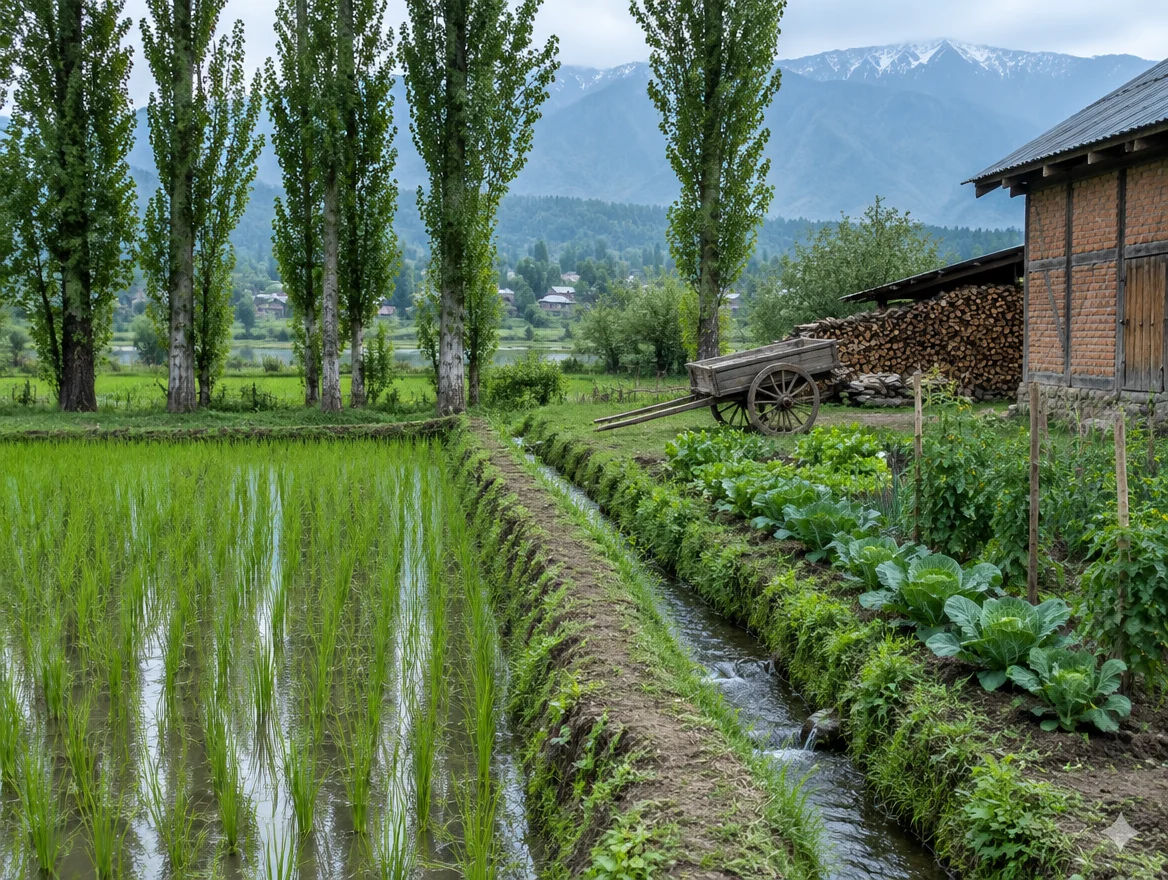
The land around the bypass is mostly low-lying paddy with some orchard and vegetable plots. A Greater Kashmir report on paddy land loss in the valley describes the pressure on rice fields[8]. Ask the tehsil what the khasra grows and how long it has been cultivated.
- Paddy
- Orchard
- Vegetables
Flood and water
The Master Plan 2035 calls the stretch a flood absorption basin[4]. Ask neighbours and the tehsil about past flooding of the khasra, and check drainage and the water table before any purchase.
Land class and use
Because only agriculturists can buy agricultural land, the recorded land class decides who may purchase. Ask the tehsil for the class, any conversion order, and whether the khasra is mapped in the bar area.
Farmland India view
Why buyers look at Pantha Chowk
Why people look at Pantha Chowk, and why they should be careful.
A junction with city access
The bypass gives quick access to the city and onward roads, which is the reason people look here.
A planning bar that may limit building
The Master Plan 2035 records a bar on development along this bypass stretch[4]. Get written zoning confirmation first.
Flood basin risk
The plan describes the stretch as a flood absorption basin. Flood exposure affects cultivation, insurance and resale.
Agriculturist-only market
Farmland moves mostly between agriculturists, so resale to an outside buyer is limited unless the land is converted.
Listing data is not legal advice. Confirm zoning, flood status and land class with the Srinagar Development Authority and the Tehsildar before paying an advance.
STRAIGHT TALK
Risks & challenges specific to Pantha Chowk
Check these before paying an advance on Pantha Chowk land.
Development bar
The Master Plan 2035 preface records a bar on development along the bypass from Pantha Chowk to Nowgam[4]. Ask whether it still applies to the khasra.
Flood basin
The stretch is described as a flood absorption basin[4]. Ask about past flooding and drainage.
Agriculturist rule
Agricultural land cannot be sold to a non-agriculturist except under limited exemptions[1].
Conversion and its fee
Conversion needs a district committee decision and a fee of 5% of market value[3], and conversion in a restricted zone may not be allowed.
Wetland and lake buffers
Buffer-zone questions around Srinagar water bodies are before the High Court[11]. Ask whether any water body or buffer touches the plot.
Ring road assumptions
Do not pay for an interchange that has not been notified[12].
NRIs and OCIs
FEMA bars NRIs and OCIs from buying agricultural land, farmhouses or plantations except by inheritance; see the NRI guide.
COMMON QUESTIONS
Frequently asked questions
Everything buyers, NRIs and investors ask before their first reviewed farmland purchase in Pantha Chowk.
Visit full wiki01 of 04
Can I build near Pantha Chowk?
Be careful. The preface of the Srinagar Master Plan 2035 says the State Administrative Council barred development along the National Highway bypass from Pantha Chowk to Nowgam, which it describes as a flood absorption basin. Ask the Srinagar Development Authority in writing how the rule applies to the khasra.
02 of 04
Can an outsider buy farmland here?
Only agriculturists can buy agricultural land in Jammu and Kashmir under the amended Land Revenue Act, with limited exemptions. Any Indian can buy non-agricultural land.
03 of 04
What is the ring road doing for the area?
A review reported in Kashmir Life on 2 September 2026 put phase I of the Srinagar Ring Road at 46 km, targeted for the end of December 2026, within a whole ring road of about 78.8 km costing Rs 4,786 crore. Check how the alignment relates to the bypass before assuming any gain.
04 of 04
What are the stamp duty rates?
Kashmir Life reported 7% for men and 3% for women plus 1.2% registration charges. Confirm with the sub-registrar.
Transparency
Sources for this page
- [1]ThePrint: 12 laws repealed, 14 amended; what changes under the new land orders, 29 October 2020 — theprint.in
- [2]Drishti IAS: Amendment related to land in Jammu and Kashmir, 29 October 2020 — drishtiias.com
- [3]Kashmir Life: J&K announces rules for land conversion, 15 January 2022 — kashmirlife.net
- [4]Master Plan 2035 document — huddobps.jk.gov.in
- [5]Land Records Information System, J&K — landrecords.jk.gov.in
- [6]Kashmir Life: registration at 3 per cent for women, 7 per cent for men, 17 April 2026 — kashmirlife.net
- [7]Construction World: Srinagar Ring Road Phase I, 30 September 2026 — constructionworld.in
- [8]Greater Kashmir: Kashmir’s rice bowl vanishing, 28 July 2025 — greaterkashmir.com
- [9]Kashmir Life: Rs 1,667-crore plan for Srinagar airport, 31 August 2026 — kashmirlife.net
- [10]Srinagar Development Authority: Master Plan 2035 — sdasrinagar.jk.gov.in
- [11]The Tribune: Examine buffer zones around Dal Lake, High Court — tribuneindia.com
- [12]Kashmir Life: Srinagar Ring Road phase I at 71.5%, review of J&K highway projects, 27 Jun 2025 — kashmirlife.net
General information, not legal advice. Report inaccuracies to wiki@farmlandindia.com.
For developers
Ready to explore Pantha Chowk farmland?
Browse reviewed projects and individual land parcels across Pantha Chowk — or if you own land here, list it with platform review and reach serious buyers.