

District guide
Buying Land in Idukki
Keralam’s spice and cardamom hill district: forest loam, cardamom-patta construction limits under review, one critical groundwater block and steep land.
48%
Forest loam share of area (ICAR-CRIDA plan)
33,000 ha
Cardamom area (ICAR-CRIDA plan)
39,300 ha
Rubber area (ICAR-CRIDA plan)
229,650 ha
Net sown area (ICAR-CRIDA plan)
District land record — Idukki
Rev. 2026 · Farmland India desk
State
Keralam (Kerala)
Sub-divisions
Taluks include Thodupuzha, Idukki, Udumbanchola, Devikulam and Peerumade; the district headquarters is at Painavu
Key markets
Thodupuzha · Munnar · Kattappana · Nedumkandam · Peerumade · Adimali
Demand anchors
cardamom, pepper, coffee and rubber plantations, Munnar and hill tourism, and hydropower reservoirs
Rail
Idukki has no railway station; the nearest stations are in Ernakulam and Kottayam districts
Size and population
About 4,363 sq km (436,328 ha in ICAR-CRIDA’s plan, 2011[4]); the second largest district in the plan’s area figures
Pricing unit
No official price series is published; ask the sub-registrar for recent registered sale values in the village. ask for any land per cent and per acre, and compare with the fair value
Local units
Records use hectare, are and cent. One cent is one hundredth of an acre, about 435.6 sq ft. Ask for the extent from the Thandaper (the land-holder account) and the survey sketch before comparing offers.
Land records portal
Ente Bhoomi, the integrated land system linking revenue, registration and survey records (NIC Kerala[6]); for NRIs see our guide to NRI land purchase.
Land law is state law. These rules are maintained on the Keralam page and apply to every district within it.
Idukki — land purchase legal rules
Keralam has no rule that only farmers or residents may buy farmland, so the first question here is not who you are but what the land is and how much of it you will hold. Three laws decide that: the ceiling under the Kerala Land Reforms Act, 1963, the near-total protection of paddy land and wetland under the 2008 Act, and the rule that land used for food crops needs permission before it is put to any other use. The figures below come from the statutes and court judgments; they are a starting point for a lawyer’s opinion, not a substitute for one. This block applies to every district page in the state.
Who can buy: The Kerala laws do not limit the purchase of agricultural land to agriculturists or to people from the state. An Indian citizen from anywhere can buy, subject to the ceiling, the paddy and wetland rules and registration. Land assigned by the government (pattayam land) can carry its own conditions on sale, so read the assignment order before you treat it as freely saleable.
The ceiling: Chapter III of the Kerala Land Reforms Act, 1963 caps what a person or family may own. Under Section 82(1), as reproduced by the Supreme Court (JUDIS 14366), an adult unmarried person may hold 5 standard acres (not less than 6 and not more than 7.5 acres in extent); a family of two to five members 10 standard acres (not less than 12 and not more than 15 acres); and a larger family one more standard acre for each member above five, up to 20 acres. The standard acre weights land by quality, so the ordinary acreage you can hold depends on the class of the land.
Plantation exemption: Section 81(1)(e) exempts plantations of crops such as tea, coffee, rubber, cardamom, cocoa and cinnamon from the ceiling, which is why large estates still exist in the hills. Cashew estates lost the exemption from 1 January 1970, and Section 84 makes some voluntary transfers by holders of excess land void. Buying a slice of an estate is heavily litigated territory: ask whether the land is claimed as exempt plantation and whether any Taluk Land Board case is pending.
Paddy land and wetland: The Kerala Conservation of Paddy Land and Wetland Act, 2008 forbids converting or reclaiming paddy land except as the Act allows (Section 3) and bans reclamation of wetland outright (Section 11). A Local Level Monitoring Committee prepares a notified data bank of paddy land and wetland (Section 5(4)). An owner may fill up to 10 cents in a panchayat, or 5 cents in a municipality or corporation, only to build his own house and only with permission (Section 9). Illegal reclamation carries six months to two years in prison and a fine of Rs 50,000 to Rs 1 lakh (Section 23).
Unnotified land and the conversion fee: The 2018 amendment created a route for "unnotified land", land shown as paddy in the Basic Tax Register but left out of the data bank: an application to the Revenue Divisional Officer (RDO) in Form 6 and a fee. The Supreme Court recorded the fee in 2025: nothing up to 25 cents held on 30 December 2017, and 10% of fair value above that, payable on the whole extent, with a higher slab for large holdings; land split into small plots after that date does not get the exemption (State of Kerala v. Moushmi Ann Jacob, 20 February 2025). In August 2026 the Revenue Department began examining changes, including basing the fee on the fair value of paddy land rather than of nearby house plots (Kerala Kaumudi, 14 August 2026); ask the sub-registrar whether any change has been notified.
Change of use: Under the Kerala Land Utilisation Order, 1967, land used for food crops cannot be put to other use without the written permission of the District Collector or the RDO, and the Supreme Court has held that changing the Basic Tax Register entry alone does not change the nature of the land. A seller who says the BTR “has been changed” but cannot show an order has not converted anything.
Stamp duty and fee: Since 1 April 2023 a sale deed pays stamp duty of Rs 8 for every Rs 100 of the fair value of the land or the price, whichever is higher, in panchayats and towns alike (Kerala Finance Act, 2023). The registration fee is 2% of the value, and 1% for gifts, partitions, releases and settlements within the family.
NRI and OCI buyers: Under the RBI Master Direction on immovable property, NRIs and OCIs may not acquire agricultural land, a farmhouse or plantation property in India except by inheritance. Our NRI guide covers the options.
- No farmer-only rule found
- Ceiling: 12–15 acres for a family
- Plantations exempt
- Paddy and Wetland Act, 2008
- Wetland: no reclamation
- Stamp duty 8%
- NRIs: inheritance only
Idukki — district-specific notes
The Keralam state page covers the ceiling, the paddy and wetland law and the NRI rule in full, and all of it applies to Idukki. The district-specific points are the cardamom-patta construction limits, the plantation exemption and history, the forest-edge land and the steep terrain. These five points matter most here.
⚠ Cardamom-patta land: the 2026-27 Budget announced a review of the construction ban on cardamom-patta land (Onmanorama, 19 Jun 2026[10]). There is no notified change, so check the patta conditions before building.
⚠ Paddy and wetland in Idukki: under the Kerala Conservation of Paddy Land and Wetland Act, 2008, notified paddy land cannot be converted or reclaimed (Section 3) and wetland cannot be reclaimed at all (Section 11); the data bank is prepared by the Local Level Monitoring Committee (Act page[2]). Ask for the data-bank entry for the survey number and the Basic Tax Register class (Nilam is paddy, Purayidam is garden or dry land) before you pay an advance.
⚠ Ceiling and estates: the Kerala Land Reforms Act, 1963 limits a family of two to five to 10 standard acres, which works out to 12 to 15 acres of ordinary land (Act, Chapter III[1]). Plantations are exempt, so an estate in Idukki may be sold whole but is heavily litigated; ask for the Taluk Land Board position before paying for any part of it.
⚠ Unnotified paddy land and the conversion fee: land recorded as paddy but missing from the data bank can be converted through the Revenue Divisional Officer with a fee. The Supreme Court held in February 2025 that no fee is due up to 25 cents held on 30 December 2017, and the fee applies to the total extent above that (State of Kerala v Moushmi Ann Jacob[3]). Plots split after that date do not get the exemption, so ask for the pre-2018 extent of any plot you buy in Idukki.
⚠ Land use after purchase: food-crop land needs Collector or RDO permission under the Kerala Land Utilisation Order, 1967 before it is used for anything else, and changing the Basic Tax Register entry alone does not change the nature of the land (Supreme Court, 2015). A house plot in Idukki can be refused a building permit if the parcel was paddy on the date of the data bank.
None of this is legal advice. Read the data-bank entry, the Basic Tax Register class and any acquisition notice for the actual survey number before paying an advance.
- Cardamom and spice estates
- Patta and construction limits
- Forest-edge land
- Groundwater
- Steep slopes
District overview
Idukki — a hill district of cardamom, pepper, rubber and coffee on forest loam, with reservoirs, steep slopes and the Munnar tourism belt
Idukki is a high-range district in eastern Keralam. ICAR-CRIDA’s plan puts the area at about 436,328 ha, with forest loam about 48% (ICAR-CRIDA plan[4]). Rainfall in the plan is split roughly as 988 mm south-west monsoon and 507 mm north-east monsoon, with an actual annual total of about 1,783 mm in 2008-09.
Spices dominate: pepper at about 58,200 ha, cardamom 33,000 ha, rubber 39,300 ha, coconut 17,700 ha, coffee 12,600 ha and cocoa 10,200 ha, with jackfruit 11,171 ha, tapioca 7,706 ha, mango 5,054 ha and rice only 2,115 ha (ICAR-CRIDA plan[4]). Net sown area is about 229,650 ha.
Net irrigated area is only about 18,060 ha, from tanks (6,462 ha), canals (4,117 ha), open wells (1,849 ha) and other sources. The plan listed one critical groundwater block, two semi-critical and five safe ones.
Buyers are spice-plantation investors, resort and homestay buyers around Munnar and Thekkady, Gulf-linked local families, and small farmers. The main constraints are patta and assignment conditions, steep slopes and forest boundaries.
There is no district-specific infrastructure report we could confirm for this page, so the infrastructure section is limited to statewide items. Idukki has no railway line, so access is by hill roads.
Compare Idukki with its neighbours Ernakulam, Kottayam, Pathanamthitta and Tamil Nadu’s Theni in the table below, and browse reviewed land across the district through the link at the foot of this section.
- Thodupuzha
- Munnar
- Kattappana
- Nedumkandam
- Peerumade
- Adimali
Transaction costs
Stamp duty & registration in Idukki
Confirmed
Stamp duty on a sale deed
8% of the higher of fair value or price, from 1 April 2023 ([Kerala Finance Act, 2023](https://prsindia.org/files/bills_acts/acts_states/kerala/2023/ActNo.17of2023Kerala.pdf))
Confirmed
Registration fee
2% of value with no cap; 1% for family gift, partition, release and settlement deeds ([Registration Department fee table](https://registration.kerala.gov.in/wp-content/uploads/2021/05/Table-of-Fees-under-Section-78.pdf))
Check
Fair value (nyayavila)
A statewide revision was announced in the 2026-27 Budget and no notification has been published; ask the sub-registrar for the rate in force ([Onmanorama, 19 Jun 2026](https://www.onmanorama.com/news/kerala/2026/06/19/land-reforms-2-0-land-bank-and-pattayam-drive-kerala-budget-live.html))
Duty and fee are charged on the higher of the fair value and the price in the deed, so the fair value set for your village is the practical floor. The 2026-27 Budget announced a technology-based revision of fair value, a special adalat window for stamp-duty undervaluation appeals to 31 October 2026, and a one-time settlement for 1,46,355 old undervaluation cases; unpaid deficit duty is to carry 1% a month after 60 days and a charge on the land (Onmanorama, 19 Jun 2026[10]). No concession for women buyers was found. After registration, mutation and tax run through Ente Bhoomi, the portal that links the revenue, registration and survey systems (NIC Kerala[6]). Ask the sub-registrar in Idukki for the fair value of your village and survey number, and check whether any pending deficit duty is attached to the land.
Know the belt
What is moving prices in Idukki
Plantation, patta and groundwater reports; no listing-site prices are used.
Thodupuzha and Muttom
Lowland gateway
The western foothill belt is rubber, coconut, tapioca and jackfruit land closest to Ernakulam and Kottayam; rubber covers about 39,300 ha district-wide (ICAR-CRIDA plan[4]).
Check: BTR class, road access, and estate history.
Munnar and Devikulam
Tea, tourism and estate belt
High-range estate and resort land. Munnar has its own micro-market page on this site.
Check: patta or assignment class, estate ceiling history, and court cases.
Kattappana, Nedumkandam and Udumbanchola
Cardamom hills
Cardamom (33,000 ha) and pepper (58,200 ha) are the main crops (ICAR-CRIDA plan[4]).
Check: cardamom-patta conditions, slope, and water source.
Peerumade and Thekkady side
Forest-edge and tourism
Coffee, pepper and rubber on slopes near forest and tourism areas.
Check: forest boundary, wildlife, and building rules.
Asking prices
No official price series is published for Idukki farmland. Use the fair value and registered deeds, and treat any per-cent quote as a seller’s figure until the deed supports it.
Connectivity
How Idukki connects — road, rail and air
Idukki is reached by hill roads from Ernakulam, Kottayam and Tamil Nadu; there is no railway line or airport in the district.
🚗 By road
✈️ By air
🚆 By rail
Hill roads are slow and weather-dependent. Ask for recorded access and the monsoon condition of the last stretch.
Growth catalysts
Upcoming infrastructure & developments
Statuses and sources are listed for each item.
00Open
04Catalysts
Agriculture & terrain
Soil, crops & water in Idukki
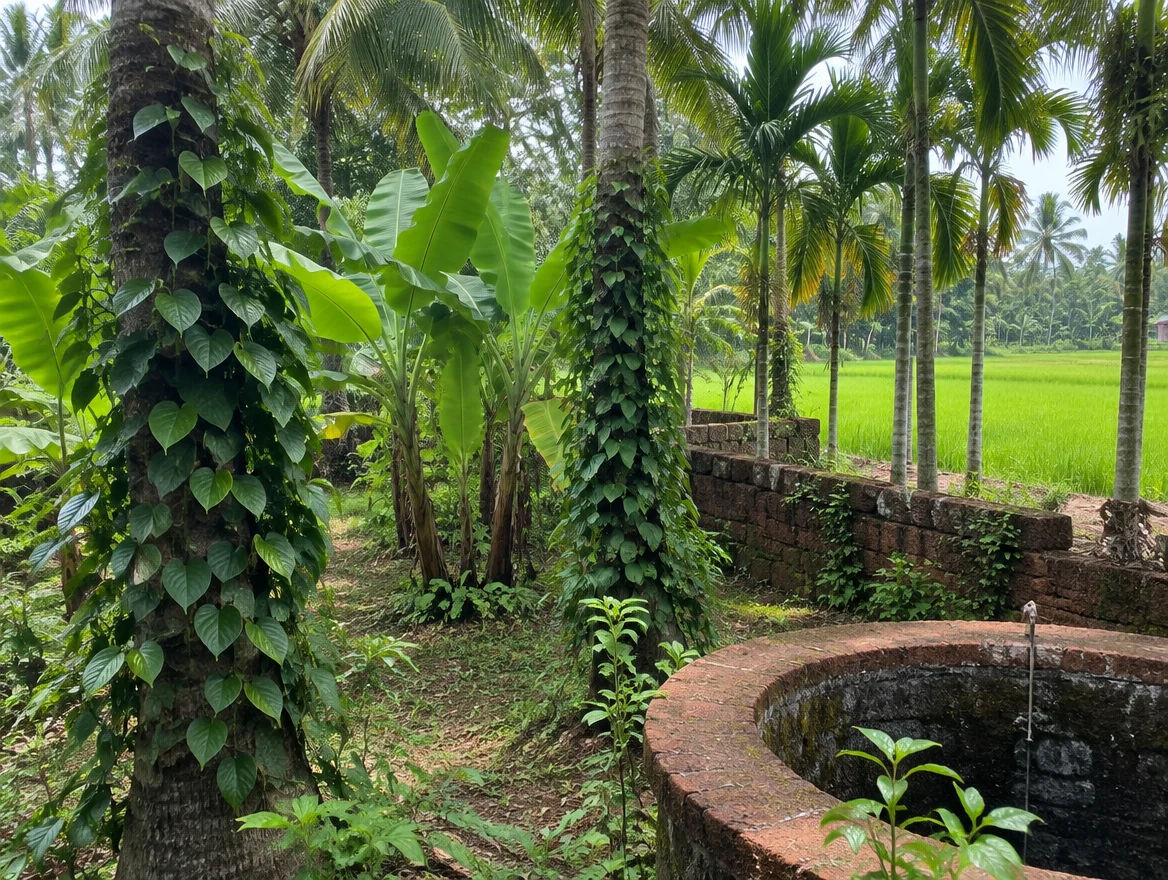
The state’s spice and plantation heartland, with pepper, cardamom, rubber and coffee on forest loam and little paddy.
Crops
ICAR-CRIDA’s plan lists pepper on about 58,200 ha, rubber 39,300 ha, cardamom 33,000 ha, coconut 17,700 ha, coffee 12,600 ha, jackfruit 11,171 ha, cocoa 10,200 ha, tapioca 7,706 ha, mango 5,054 ha, plantain 3,390 ha and rice 2,115 ha (ICAR-CRIDA plan[4]).
- Pepper and cardamom
- Rubber
- Coffee and cocoa
- Jackfruit, tapioca and fruit
Soils
Forest loam covers about 48% of the district; the plan also lists laterite, brown hydromorphic and alluvial soils without areas. Net sown area is about 229,650 ha, with about 60,180 ha sown more than once.
Water, rainfall and groundwater
Actual rainfall in 2008-09 was about 1,783 mm. Net irrigated area is about 18,060 ha. Of eight blocks, one was critical, two semi-critical and five safe, with good water quality (ICAR-CRIDA plan[4]). The state average stage of extraction is 53.78% (CGWB 2024[7]).
At a glance
Idukki vs. nearby districts
| District | Land and water | What links it to Idukki |
|---|---|---|
| Ernakulam (west) | Kochi metro district | Linked by hill roads via Muvattupuzha and Kothamangalam side |
| Kottayam (north-west and west) | Rubber district | Linked by hill roads; airport plan site is nearby |
| Pathanamthitta (south-west) | Rubber and forest district | Hill link; forest limits |
| Theni (Tamil Nadu, east) | Spice and border district | Across the ghats; Tamil Nadu land rules apply there |
Idukki is the spice-and-forest district: little paddy, steep land, patta conditions that matter as much as price, and tourism pockets around Munnar and Thekkady.
Farmland India view
Why investors look at Idukki
Five reasoned points for Idukki, each tied to a source on this page.
Spice land is the core asset
Pepper, cardamom and rubber cover a large share of the district (ICAR-CRIDA plan[4]). There is no price series.
Patta rules can change
The Budget announced a review of the cardamom-patta construction ban (Onmanorama, 19 Jun 2026[10]), but nothing was notified as far as we found.
Tourism pockets
Resort and homestay demand around Munnar and Thekkady sits on estate and assigned land; check class and history.
Limited irrigation
Net irrigated area is only about 18,060 ha (ICAR-CRIDA plan[4]), so water access decides yield.
Remote and slow access
Hill roads and no rail raise transport costs for produce and building.
Confirm the record of rights (Thandaper and survey records), mutation, zoning and acquisition status directly — these are not certified by Farmland India’s review.
STRAIGHT TALK
Risks & challenges in Idukki
District-specific risks. Read the Keralam state page for the general risks on ceiling, conversion and records.
Patta and construction limits
The Budget announced a review of the cardamom-patta construction ban (Onmanorama, 19 Jun 2026[10]). Until a rule is notified, assume the ban applies.
Steep slopes and landslides
Hill land may be landslide-prone; ask for the plot’s hazard status.
Forest boundary
Forest loam covers about 48% of the district (ICAR-CRIDA plan[4]). Confirm the plot is not forest or reserved land.
One critical groundwater block
The plan listed one critical and two semi-critical blocks (ICAR-CRIDA plan[4]). Data are old, so check current categories.
Coconut mite and yellowing
The plan lists coconut mite and yellowing, plus disease management for coffee, pepper, arecanut and banana.
Estate and ceiling history
Selling part of a plantation estate is heavily litigated (Land Reforms Act[1]).
Highway works not finished
NH 66 flyover orders and service-road land were still pending in November 2026 (Onmanorama, 9 Nov 2026[8]).
Who to contact
Local revenue & planning offices
The Idukki Collectorate is the district authority for land records, mutation appeals and acquisition. Village offices handle the Thandaper and basic tax; taluk offices (Thodupuzha, Idukki, Udumbanchola, Devikulam, Peerumade) hold survey and revenue records; the Revenue Divisional Office handles paddy conversion applications; sub-registrar offices register deeds. Search by survey number in Ente Bhoomi, and confirm the patta conditions with the village office.
COMMON QUESTIONS
Frequently asked questions
Everything buyers, NRIs and investors ask before their first reviewed farmland purchase in Idukki.
Visit full wiki01 of 04
Can I build on cardamom-patta land in Idukki?
A construction ban applies on cardamom-hill patta land, and the 2026-27 Budget announced a review of it. Confirm the patta conditions and the current rules with the Collector before paying.
02 of 04
Is Munnar land open to buy?
Munnar has its own micro-market page on this site. Much hill land there has assignment, patta or estate conditions, so check the land’s class, history and any court cases before an advance.
03 of 04
Is there a price per cent I can rely on?
No official price series is published for Idukki farmland. Use the fair value for your village from the sub-registrar and compare it with recent registered deeds.
04 of 04
Can an NRI buy land in Idukki?
An NRI or OCI cannot buy agricultural land, a plantation or a farmhouse except by inheritance (RBI Master Direction). Residential and commercial plots are different, so confirm the land class in the records first.
Transparency
Sources and references
Law and courts
- [1]Kerala Land Reforms Act, 1963 (India Code) — indiacode.nic.in
- [2]Kerala Conservation of Paddy Land and Wetland Act, 2008 — india.gov.in
- [3]Supreme Court: State of Kerala v Moushmi Ann Jacob, 20 Feb 2025 — api.sci.gov.in
Government
- [4]ICAR-CRIDA: District Agriculture Contingency Plan, Idukki — icar-crida.res.in
- [5]Registration Department: Table of Fees under Section 78 — registration.kerala.gov.in
- [6]NIC Kerala: Integrated Land Information Management System — informaticsweb.nic.in
- [7]CGWB: Dynamic Ground Water Resources of Kerala 2024 — cgwb.gov.in
News
- [8]Onmanorama: NH 66 completion may take years, 9 Nov 2026 — onmanorama.com
- [9]The Week/PTI: Kerala digital resurvey, 30 Aug 2025 — theweek.in
- [10]onmanorama.com: Onmanorama, 19 Jun 2026 — onmanorama.com
- [11]english.deshabhimani.com: Deshabhimani, 18 Feb 2026 — english.deshabhimani.com
- [12]keralakaumudi.com: Kerala Kaumudi, 14 Aug 2026 — keralakaumudi.com
Data-currency note: sources are as of November 2026. Project status, the benchmark valuation and land rules change often; check the linked source and the relevant office before relying on any figure.
For developers
Ready to explore Idukki farmland?
Browse reviewed projects and individual land parcels across Idukki — or if you own land here, list it with platform review and reach serious buyers.