
District guide
Buying Land in Thiruvananthapuram
The capital district: Vizhinjam port, the pending Outer Ring Road, Technopark and a coconut-and-laterite countryside, with paddy rules that bind each plot.
57 lakh TEU a year
Vizhinjam port capacity when complete (Onmanorama, Jan 2026)
Rs 8,398.46 crore
Vizhinjam to Navaikulam Outer Ring Road cost (Onmanorama, Jun 2026)
71,700 ha
Coconut area, ICAR-CRIDA plan (2008-09)
1,680 mm
Normal annual rainfall (ICAR-CRIDA plan)
*Indicative range across districts and land types. Stamp duty, registration and conversion charges are additional. Local measurement units vary — every listing states the unit it is priced in. Not a valuation or an offer.
District land record — Thiruvananthapuram
Rev. 2026 · Farmland India desk
State
Keralam (Kerala)
Sub-divisions
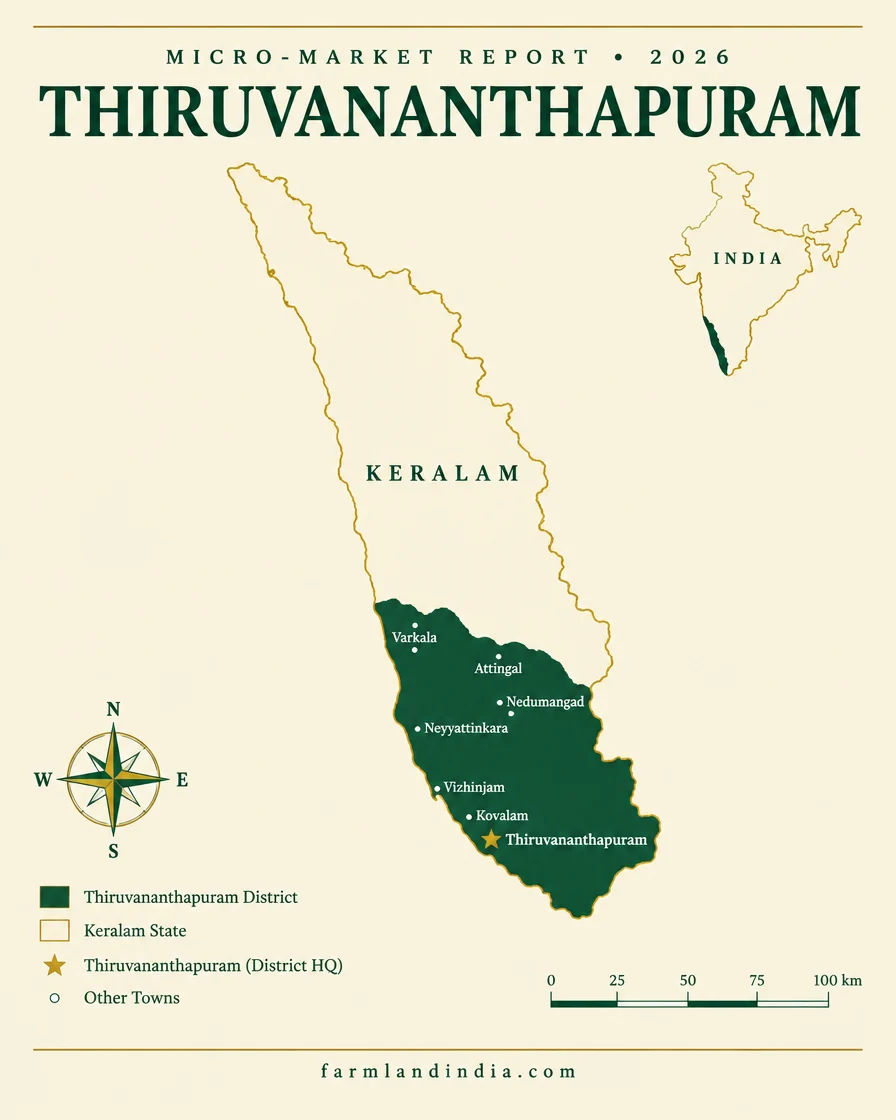
Taluks include Thiruvananthapuram, Chirayinkeezhu, Nedumangad, Neyyattinkara, Kattakada and Varkala; the city is the district and state capital
Key markets
Thiruvananthapuram city · Kazhakootam · Vizhinjam · Neyyattinkara · Nedumangad · Attingal · Varkala
Demand anchors
Vizhinjam port (Onmanorama, 24 Jan 2026[6]), the state capital, Technopark, Kovalam and Varkala tourism, and Gulf-linked homestead demand
Rail
Thiruvananthapuram Central is the southern terminus of the main line from Kollam; Neyyattinkara and Varkala also have stations
Size and population
About 2,187 sq km (2.19 lakh ha in ICAR-CRIDA’s plan, 2011[3]); the district is densely settled, with coastal, midland and hill belts
Pricing unit
No official price series is published; ask the sub-registrar for recent registered sale values in the village. ask for any land per cent and per acre, and compare with the fair value
Local units
Records use hectare, are and cent. One cent is one hundredth of an acre, about 435.6 sq ft. Ask for the extent from the Thandaper (the land-holder account) and the survey sketch before comparing offers.
Land records portal
Ente Bhoomi, the integrated land system linking revenue, registration and survey records (NIC Kerala[4]); for NRIs see our guide to NRI land purchase.
Land law is state law. These rules are maintained on the Keralam page and apply to every district within it.
Thiruvananthapuram — land purchase legal rules
Keralam has no rule that only farmers or residents may buy farmland, so the first question here is not who you are but what the land is and how much of it you will hold. Three laws decide that: the ceiling under the Kerala Land Reforms Act, 1963, the near-total protection of paddy land and wetland under the 2008 Act, and the rule that land used for food crops needs permission before it is put to any other use. The figures below come from the statutes and court judgments; they are a starting point for a lawyer’s opinion, not a substitute for one. This block applies to every district page in the state.
Who can buy: The Kerala laws do not limit the purchase of agricultural land to agriculturists or to people from the state. An Indian citizen from anywhere can buy, subject to the ceiling, the paddy and wetland rules and registration. Land assigned by the government (pattayam land) can carry its own conditions on sale, so read the assignment order before you treat it as freely saleable.
The ceiling: Chapter III of the Kerala Land Reforms Act, 1963 caps what a person or family may own. Under Section 82(1), as reproduced by the Supreme Court (JUDIS 14366), an adult unmarried person may hold 5 standard acres (not less than 6 and not more than 7.5 acres in extent); a family of two to five members 10 standard acres (not less than 12 and not more than 15 acres); and a larger family one more standard acre for each member above five, up to 20 acres. The standard acre weights land by quality, so the ordinary acreage you can hold depends on the class of the land.
Plantation exemption: Section 81(1)(e) exempts plantations of crops such as tea, coffee, rubber, cardamom, cocoa and cinnamon from the ceiling, which is why large estates still exist in the hills. Cashew estates lost the exemption from 1 January 1970, and Section 84 makes some voluntary transfers by holders of excess land void. Buying a slice of an estate is heavily litigated territory: ask whether the land is claimed as exempt plantation and whether any Taluk Land Board case is pending.
Paddy land and wetland: The Kerala Conservation of Paddy Land and Wetland Act, 2008 forbids converting or reclaiming paddy land except as the Act allows (Section 3) and bans reclamation of wetland outright (Section 11). A Local Level Monitoring Committee prepares a notified data bank of paddy land and wetland (Section 5(4)). An owner may fill up to 10 cents in a panchayat, or 5 cents in a municipality or corporation, only to build his own house and only with permission (Section 9). Illegal reclamation carries six months to two years in prison and a fine of Rs 50,000 to Rs 1 lakh (Section 23).
Unnotified land and the conversion fee: The 2018 amendment created a route for "unnotified land", land shown as paddy in the Basic Tax Register but left out of the data bank: an application to the Revenue Divisional Officer (RDO) in Form 6 and a fee. The Supreme Court recorded the fee in 2025: nothing up to 25 cents held on 30 December 2017, and 10% of fair value above that, payable on the whole extent, with a higher slab for large holdings; land split into small plots after that date does not get the exemption (State of Kerala v. Moushmi Ann Jacob, 20 February 2025). In August 2026 the Revenue Department began examining changes, including basing the fee on the fair value of paddy land rather than of nearby house plots (Kerala Kaumudi, 14 August 2026); ask the sub-registrar whether any change has been notified.
Change of use: Under the Kerala Land Utilisation Order, 1967, land used for food crops cannot be put to other use without the written permission of the District Collector or the RDO, and the Supreme Court has held that changing the Basic Tax Register entry alone does not change the nature of the land. A seller who says the BTR “has been changed” but cannot show an order has not converted anything.
Stamp duty and fee: Since 1 April 2023 a sale deed pays stamp duty of Rs 8 for every Rs 100 of the fair value of the land or the price, whichever is higher, in panchayats and towns alike (Kerala Finance Act, 2023). The registration fee is 2% of the value, and 1% for gifts, partitions, releases and settlements within the family.
NRI and OCI buyers: Under the RBI Master Direction on immovable property, NRIs and OCIs may not acquire agricultural land, a farmhouse or plantation property in India except by inheritance. Our NRI guide covers the options.
- No farmer-only rule found
- Ceiling: 12–15 acres for a family
- Plantations exempt
- Paddy and Wetland Act, 2008
- Wetland: no reclamation
- Stamp duty 8%
- NRIs: inheritance only
Thiruvananthapuram — district-specific notes
The Keralam state page covers the ceiling, the paddy and wetland law and the NRI rule in full, and all of it applies to Thiruvananthapuram. In the capital district the live issues are land that is notified or likely to be notified for the Outer Ring Road and the port growth corridor, and the coastal strip. These five points are specific to Thiruvananthapuram.
⚠ Outer Ring Road land: the Vizhinjam to Navaikulam ring road is a national highway project costed at Rs 8,398.46 crore. As of June 2026 acquisition and compensation were not complete, approvals from the Finance Minister and the Union Cabinet were pending, and landowners who surrendered land about four years ago were still waiting for compensation (Onmanorama, 26 Jun 2026[7]). A plot on or near the alignment needs a written statement of its notification status from the Collectorate before you pay.
⚠ Growth corridor and port logistics land: the Chief Minister has said the government will expedite acquisition for logistics and warehousing at Vizhinjam, with the port company allowed to acquire up to 200 acres within 10 km at a cost of Rs 1,000 crore (Kerala Kaumudi, 2026[8]). The growth corridor acquisition itself had not begun as at January 2026 (Onmanorama, 24 Jan 2026[6]), so land within the 10 km zone can be notified without warning.
⚠ Paddy and wetland in Thiruvananthapuram: under the Kerala Conservation of Paddy Land and Wetland Act, 2008, notified paddy land cannot be converted or reclaimed (Section 3) and wetland cannot be reclaimed at all (Section 11); the data bank is prepared by the Local Level Monitoring Committee (Act page[1]). Ask for the data-bank entry for the survey number and the Basic Tax Register class (Nilam is paddy, Purayidam is garden or dry land) before you pay an advance.
⚠ Unnotified paddy land and the conversion fee: land recorded as paddy but missing from the data bank can be converted through the Revenue Divisional Officer with a fee. The Supreme Court held in February 2025 that no fee is due up to 25 cents held on 30 December 2017, and the fee applies to the total extent above that (State of Kerala v Moushmi Ann Jacob[2]). Plots split after that date do not get the exemption, so ask for the pre-2018 extent of any plot you buy in Thiruvananthapuram.
⚠ Coastal land and pattayam: the Budget announced a pattayam (title) drive for coastal residents (Onmanorama, 19 Jun 2026[10]). Land on the coast at Vizhinjam, Kovalam and Varkala may fall under the coastal regulation zone, and an old assignment may carry conditions on sale, so read the assignment order and the zone map before paying.
None of this is legal advice. For plots near Vizhinjam or the Outer Ring Road, get the Collectorate’s written statement of acquisition status for the survey number.
- Outer Ring Road alignment
- Vizhinjam growth corridor
- Paddy and wetland bar
- Coastal zone
- Pattayam land
District overview
Thiruvananthapuram — the state capital district, where a deep-water port and a ring road are reshaping a coconut and laterite countryside
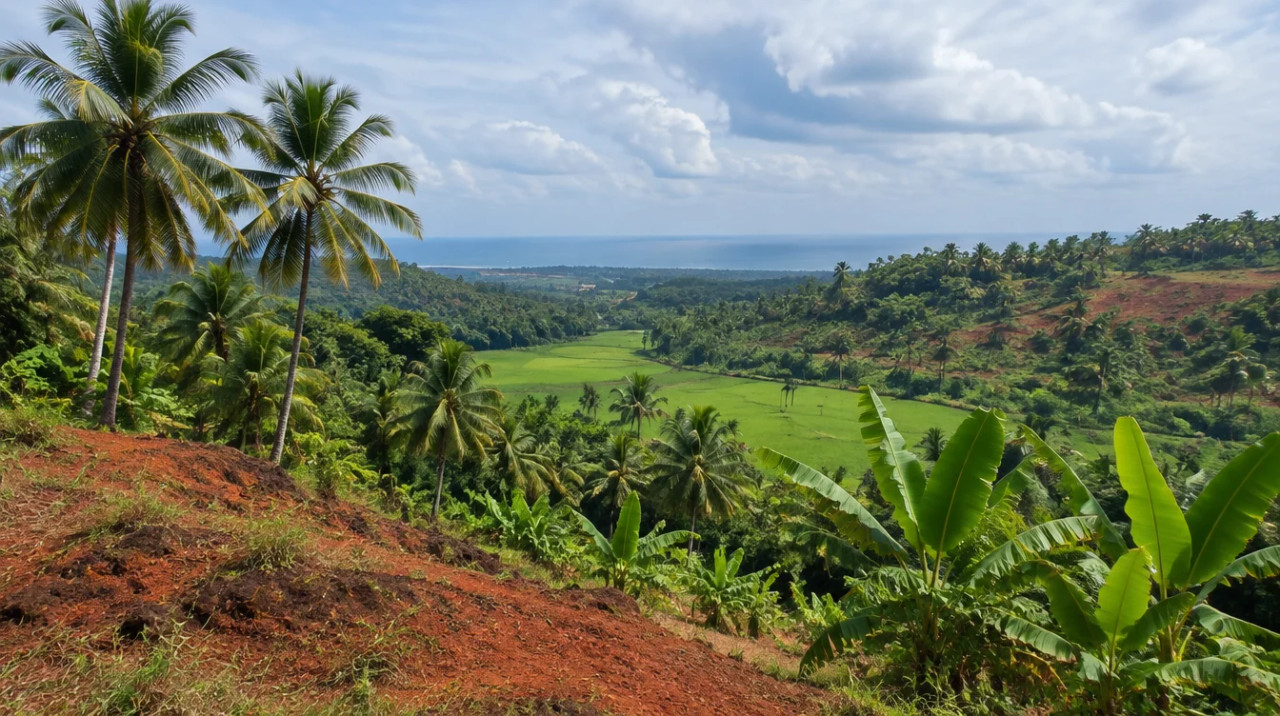
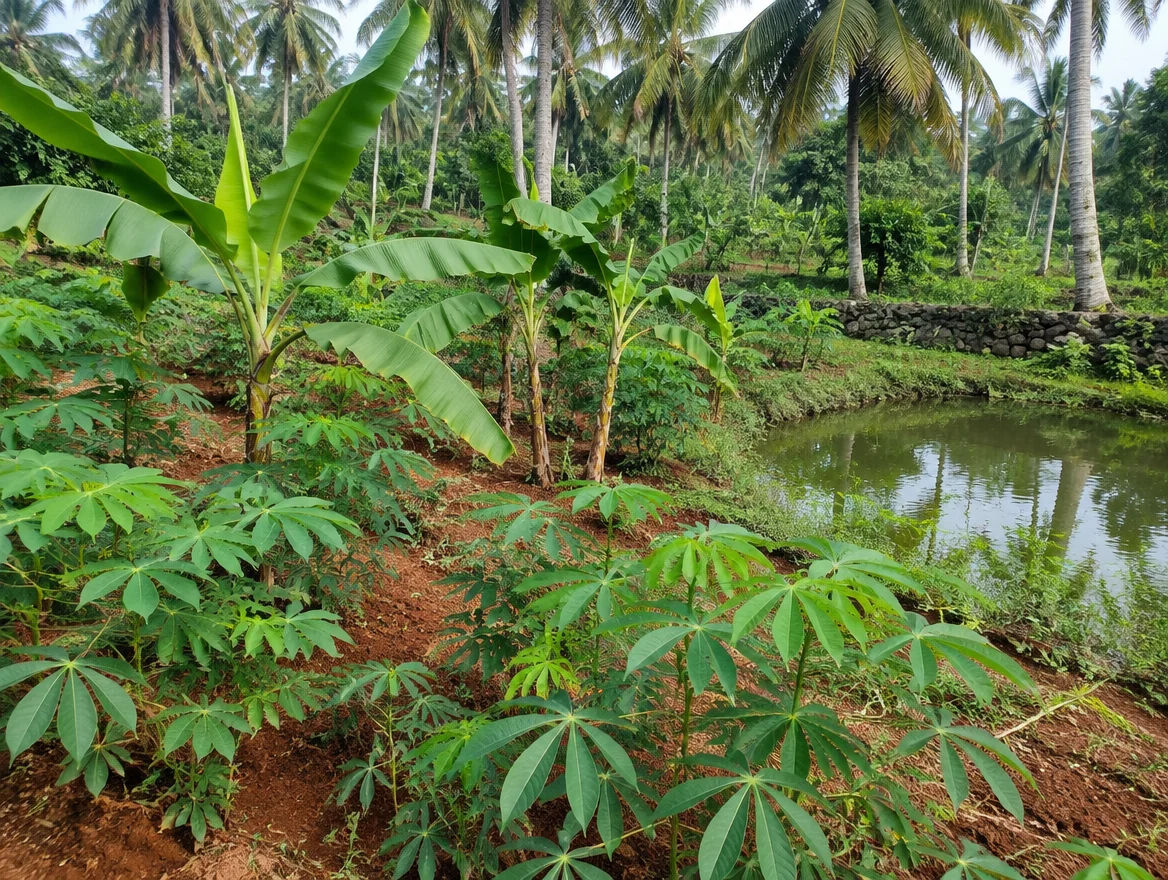
Thiruvananthapuram is the southernmost district of Keralam and its capital. About 2.19 lakh ha in ICAR-CRIDA’s contingency plan, it runs from the Arabian Sea in the west to the Agasthyamalai foothills in the east (ICAR-CRIDA plan[3]). Gravelly sandy clay loam covers about 71% of the land, so most of the district is laterite-based midland under coconut, rubber, tapioca and banana.
The land market is driven by three things. The first is the capital itself: government offices, the university and Technopark at Kazhakootam give steady house-plot demand across the city and its fringe. The second is Vizhinjam, where the container port’s first phase began operating on 2 May 2025 and the final phase is due in 2028 (Onmanorama, 24 Jan 2026[6]). The third is tourism and Gulf-linked homestead demand along the Kovalam and Varkala coast.
The east of the district, around Nedumangad, Vithura and Palode, rises into the Agasthyamalai hills with rubber, spice and forest-edge land. The south, around Neyyattinkara and Kattakada, is a mix of coconut garden land, paddy valleys and tapioca. The north, around Attingal and Chirayinkeezhu, is the coastal and midland belt towards Kollam.
Many buyers come to Thiruvananthapuram for land around Vizhinjam and the ring road. That is where the biggest uncertainty lies: acquisition for the Outer Ring Road is pending, and the port’s growth corridor has not been notified in full. The sensible approach is to buy for current use and with documents that show the plot is clear of both.
Thiruvananthapuram has no Scheduled Area. Its constraints are paddy and wetland protection, the coastal regulation zone, acquisition notifications, and old assigned land.
Compare Thiruvananthapuram with its neighbours Kollam and the Tamil Nadu districts of Kanniyakumari and Tirunelveli in the table below, and browse reviewed land across the district through the link at the foot of this section.
- Vizhinjam
- Kazhakootam
- Neyyattinkara
- Nedumangad
- Varkala
- Kovalam
Transaction costs
Stamp duty & registration in Thiruvananthapuram
Confirmed
Stamp duty on a sale deed
8% of the higher of fair value or price, from 1 April 2023 ([Kerala Finance Act, 2023](https://prsindia.org/files/bills_acts/acts_states/kerala/2023/ActNo.17of2023Kerala.pdf))
Confirmed
Registration fee
2% of value with no cap; 1% for family gift, partition, release and settlement deeds ([Registration Department fee table](https://registration.kerala.gov.in/wp-content/uploads/2021/05/Table-of-Fees-under-Section-78.pdf))
Check
Fair value (nyayavila)
A statewide revision was announced in the 2026-27 Budget and no notification has been published; ask the sub-registrar for the rate in force ([Onmanorama, 19 Jun 2026](https://www.onmanorama.com/news/kerala/2026/06/19/land-reforms-2-0-land-bank-and-pattayam-drive-kerala-budget-live.html))
Duty and fee are charged on the higher of the fair value and the price in the deed, so the fair value set for your village is the practical floor. The 2026-27 Budget announced a technology-based revision of fair value, a special adalat window for stamp-duty undervaluation appeals to 31 October 2026, and a one-time settlement for 1,46,355 old undervaluation cases; unpaid deficit duty is to carry 1% a month after 60 days and a charge on the land (Onmanorama, 19 Jun 2026[10]). No concession for women buyers was found. After registration, mutation and tax run through Ente Bhoomi, the portal that links the revenue, registration and survey systems (NIC Kerala[4]). Ask the sub-registrar in Thiruvananthapuram for the fair value of your village and survey number, and check whether any pending deficit duty is attached to the land. Near Vizhinjam, expect fair values and deeds to be scrutinised more closely because of the port and the proposed corridors.
Know the belt
What is moving prices in Thiruvananthapuram
Port, ring-road and Budget reports; no listing-site prices are used.
Vizhinjam and the south coast
Port and logistics
Vizhinjam is the focus of port-linked demand. The port company may acquire up to 200 acres within 10 km for logistics, including 50 acres for a warehousing complex and 20 acres for a bunkering facility, and more than 100 private firms were reported to need about 10 acres each (Kerala Kaumudi, 2026[8]).
Check: whether the plot lies within the port’s 10 km logistics zone and any notification under the growth corridor.
Kazhakootam, Technopark and the city
Capital and IT belt
Technopark and the capital’s institutions support house-plot demand in Kazhakootam, Pallippuram and the northern city. The Outer Ring Road, if built, will touch this belt, and land on the alignment is uncertain (Onmanorama, 26 Jun 2026[7]).
Check: alignment status, the master-plan zone, and the data-bank class of any paddy inside the city fringe.
Neyyattinkara, Kattakada and Nedumangad
Midland garden and hill-edge land
The southern and eastern midlands have coconut, rubber, tapioca and banana land on laterite. ICAR-CRIDA lists coconut on about 71,700 ha, rubber 30,000 ha and tapioca 20,300 ha (ICAR-CRIDA plan[3]). Land is more affordable to hold than the coast.
Check: access, the wildlife conflict risk near forest, and the estate history of larger plots.
Varkala, Kovalam and the tourist coast
Coastal tourism land
Varkala and Kovalam have long-established tourism, with small resort and homestay land on the cliff and beach strips. Coastal regulation applies, and an old assignment may limit sale.
Check: coastal zone map, assignment order, and whether the building permit history is clean.
Asking prices
No official price series is published for Thiruvananthapuram farmland. Use the fair value and registered deeds, and treat any per-cent quote as a seller’s figure until the deed supports it.
Connectivity
How Thiruvananthapuram connects — road, rail and air
Thiruvananthapuram is the southern end of NH 66, the main rail line and the state’s capital airport; port-linked links are still being built.
🚗 By road
✈️ By air
🚆 By rail and sea
The port and ring road are the connectivity story, but both are partly in the future. Check what exists today before relying on promised links.
Growth catalysts
Upcoming infrastructure & developments
Statuses and sources are listed for each item.
00Open
04Catalysts
Agriculture & terrain
Soil, crops & water in Thiruvananthapuram
A coconut, rubber and tapioca district on gravelly laterite, drier than the rest of the coast.
Crops
ICAR-CRIDA’s plan (2008-09 data) lists coconut on about 71,700 ha, rubber 30,000 ha, tapioca 20,300 ha, banana and plantain 8,300 ha, pepper 5,700 ha, jackfruit 5,400 ha, mango 3,600 ha and rice 2,900 ha (ICAR-CRIDA plan[3]). The cropping intensity is about 121%.
- Coconut
- Rubber
- Tapioca
- Banana and jackfruit
Soils
Gravelly sandy clay loam covers about 71% of the district, with smaller areas of gravelly clay loam, sandy clay loam, loam and beach sand. Net sown area is about 135,000 ha.
Water, rainfall and floods
Normal annual rainfall is about 1,680 mm, with about 807 mm in the south-west monsoon and 559 mm in the north-east monsoon. Net irrigated area is only about 8,200 ha, mostly canals (56%) and open wells (35%), so about 127,000 ha is rainfed. The plan lists drought, flood, cyclone, sea-water intrusion and wild-animal damage near forest (ICAR-CRIDA plan[3]). A recent block-wise groundwater table was not found; the state average stage of extraction is 53.78% (CGWB 2024[5]).
At a glance
Thiruvananthapuram vs. nearby districts
| District | Land and water | What links it to Thiruvananthapuram |
|---|---|---|
| Kollam (north) | Coastal and laterite district | The next district up the coast; the two share NH 66 and the main rail line |
| Kanniyakumari (south-east, Tamil Nadu) | Tamil Nadu district across the border | Across the state border; different land law, records and stamp duty, so compare using the Tamil Nadu state page |
| Tirunelveli (east, Tamil Nadu) | Dry-zone Tamil Nadu district | Crosses the Agasthyamalai ridge; different land law and records |
| Pathanamthitta (north-east, beyond Kollam) | Hill and rubber district | Not adjacent; reached via Kollam or the MC Road |
Thiruvananthapuram has the capital’s demand and the port’s upside, but also the pending ring road and a coastal strip that is tightly regulated. Kollam is the nearest comparable district in Keralam.
Farmland India view
Why investors look at Thiruvananthapuram
Five reasoned points for Thiruvananthapuram, each tied to a source on this page.
Port upside is real, but timed to 2028
The final phase is due in 2028 with a capacity of 57 lakh TEU a year (Onmanorama, 24 Jan 2026[6]). Land around the port will be priced on that expectation before it arrives.
Check the corridor before the price
Land within the 10 km logistics zone and along the Outer Ring Road can be acquired by notification, and compensation delays of about four years have been reported (Onmanorama, 26 Jun 2026[7]). A cheap plot on the alignment may not be cheap.
The capital gives a floor
Government offices, Technopark and the university give the city fringe a steady house-plot demand, less tied to the port.
Midlands for long holders
Neyyattinkara, Kattakada and Nedumangad offer coconut, rubber and tapioca land, with ICAR-CRIDA’s data showing low irrigation and a rainfed base (ICAR-CRIDA plan[3]). They suit holders with a use in mind.
Policy may help or hinder
Land Reforms 2.0 and the conversion-fee proposal could change paddy-plot values (Kerala Kaumudi, 14 Aug 2026[12]). Both are proposals at the time of writing.
Confirm the record of rights (Thandaper and survey records), mutation, zoning and acquisition status directly — these are not certified by Farmland India’s review.
STRAIGHT TALK
Risks & challenges in Thiruvananthapuram
District-specific risks. Read the Keralam state page for the general risks on ceiling, conversion and records.
Notified land for the ring road
Compensation for the ring road was still pending in June 2026 after about four years for early landowners (Onmanorama, 26 Jun 2026[7]). A buyer of notified land may get little.
Growth-corridor acquisition not begun
Acquisition for the growth corridor had not started as at January 2026 (Onmanorama, 24 Jan 2026[6]). Land inside the likely zone can be notified without warning.
Paddy and wetland bar
Conversion of notified paddy land is barred, and illegal reclamation carries six months to two years in prison and a fine of Rs 50,000 to Rs 1 lakh under Section 23 (Act page[1]).
Coastal regulation zone
Land at Vizhinjam, Kovalam and Varkala may fall under coastal regulation.
Dry-season water
Only about 8,200 ha is irrigated and most land is rainfed (ICAR-CRIDA plan[3]), so wells and borewells matter for any farming plan.
Wildlife on the hill edge
ICAR-CRIDA lists wild-animal damage near forest (ICAR-CRIDA plan[3]). Plots near the Agasthyamalai foothills can face crop loss.
Highway works not finished
NH 66 flyover orders and service-road land were still pending in November 2026 (Onmanorama, 9 Nov 2026[9]).
Who to contact
Local revenue & planning offices
The Thiruvananthapuram Collectorate is the district authority for land records, mutation appeals and acquisition, including notifications for the Outer Ring Road and Vizhinjam corridor. Village offices handle the Thandaper and basic tax; taluk offices (Thiruvananthapuram, Chirayinkeezhu, Nedumangad, Neyyattinkara, Kattakada, Varkala) hold survey and revenue records; the Revenue Divisional Office handles paddy conversion applications; sub-registrar offices register deeds. Search by survey number in Ente Bhoomi, and confirm the data-bank entry with the village office.
KEEP EXPLORING
Explore more areas
Micro-markets in Thiruvananthapuram
Other districts in Keralam
COMMON QUESTIONS
Frequently asked questions
Everything buyers, NRIs and investors ask before their first reviewed farmland purchase in Thiruvananthapuram.
Visit full wiki01 of 04
Will Vizhinjam port raise land prices around Thiruvananthapuram?
It may, but there is no official price series published, so we cannot quote a figure. The final phase is due in 2028 and needs no land acquisition for the port itself, while acquisition for the growth corridor and Outer Ring Road is still pending. Do not pay for an expected rise.
02 of 04
Is the Outer Ring Road land safe to buy?
Land on the proposed alignment is a risk. As of June 2026 acquisition and compensation were not complete and landowners had waited about four years; the High Court was told approvals would take up to 45 days. Ask the Collectorate whether a plot is notified before you pay.
03 of 04
Can I buy farmland in Thiruvananthapuram for a farmhouse?
Yes if it is not notified paddy or wetland and not otherwise restricted. The 2008 Act bars conversion of notified paddy land, and food-crop land needs permission before another use. Check the data bank and Basic Tax Register class first.
04 of 04
Can an NRI buy land in Thiruvananthapuram?
An NRI or OCI cannot buy agricultural land, a plantation or a farmhouse except by inheritance (RBI Master Direction). Residential and commercial plots are different, so confirm the land class in the records first.
Transparency
Sources and references
Law and courts
- [1]Kerala Conservation of Paddy Land and Wetland Act, 2008 — india.gov.in
- [2]Supreme Court: State of Kerala v Moushmi Ann Jacob, 20 Feb 2025 — api.sci.gov.in
Government
- [3]ICAR-CRIDA: District Agriculture Contingency Plan, Thiruvananthapuram — icar-crida.res.in
- [4]NIC Kerala: Integrated Land Information Management System — informaticsweb.nic.in
- [5]CGWB: Dynamic Ground Water Resources of Kerala 2024 — cgwb.gov.in
News
- [6]Onmanorama: Vizhinjam port expansion, 24 Jan 2026 — onmanorama.com
- [7]Onmanorama: Outer Ring Road acquisition, 26 Jun 2026 — onmanorama.com
- [8]Kerala Kaumudi: Vizhinjam port logistics land, 2026 — keralakaumudi.com
- [9]Onmanorama: NH 66 completion may take years, 9 Nov 2026 — onmanorama.com
- [10]onmanorama.com: Onmanorama, 19 Jun 2026 — onmanorama.com
- [11]english.deshabhimani.com: Deshabhimani, 18 Feb 2026 — english.deshabhimani.com
- [12]keralakaumudi.com: Kerala Kaumudi, 14 Aug 2026 — keralakaumudi.com
Data-currency note: sources are as of November 2026. Project status, the benchmark valuation and land rules change often; check the linked source and the relevant office before relying on any figure.
For developers
Ready to explore Thiruvananthapuram farmland?
Browse reviewed projects and individual land parcels across Thiruvananthapuram — or if you own land here, list it with platform review and reach serious buyers.