
Area guide
Buying Land in Mhow
Agricultural land in Mhow, Indore, estimated at ₹20 lakh–1 crore per acre*: ring road and scheme status, tribal-land and diversion checks.
₹20 lakh–1 cr/acre*
Estimated price*
140–161 km
Ring road options
5
Tehsils in Indore district
About 10.5%
Duty plus fee (reported)
*Indicative range across districts and land types. Stamp duty, registration and conversion charges are additional. Local measurement units vary — every listing states the unit it is priced in. Not a valuation or an offer.
Micro-market record — Mhow
Rev. 2026 · Farmland India desk
District
Indore (Mhow tehsil)
Corridor
Proposed Indore ring road (options of 140–161 km, May 2023 report)
Rail
Station and line status not checked
Terrain
Hill edge and plateau farmland (confirm on site)
Distance from Indore
Not confirmed; check a live route
Groundwater
Indore plan: over-exploited at 104% (about 2012 data; confirm)
Estimated land price*
₹20 lakh–1 crore per acre*
Land law is state law. These rules are maintained on the Madhya Pradesh page and apply to every district within it.
Mhow — land purchase legal rules
⚠ Madhya Pradesh does not run on a single rule for farmland. Tribal land, land above the holding ceiling, diverted land and ordinary farmland each follow a different track, and the Collector’s office sits at the centre of the first. Work out which track a parcel is on before looking at the price.
Which office decides what: A member of a tribe that the Code treats as aboriginal needs written permission from a revenue officer of at least Collector rank to sell land outside a notified area, and in a notified area the bar on sale to a non-tribal is absolute (section 165(6); Supreme Court, April 2025). The Supreme Court accepted in April 2025 that an Additional Collector can grant that permission under a valid work-allocation order (Lawyer E-News, April 2025). Sale deeds are registered through the Registration Department, which launched the Sampada 2.0 online registration system in October 2024 (The Statesman, October 2024).
Section 165 and tribal land: The April 2025 judgment concerned 6.29 hectares in Ratlam district outside the notified tehsils; the sale went through because the Additional Collector had given written permission, the price was above market value and a 10-year bar on changing the land’s use was attached under section 165(6-ee) (Supreme Court, April 2025). The High Court had earlier upheld the same sale and noted the Patwari’s report, the sellers’ need to fund a marriage and settle loans, and the land they kept (High Court, October 2023). Permission is a gate, not a formality: a sale with no permission is exposed. Under section 170B a transfer made by fraud can be reverted to the tribal owner or heirs, and the Supreme Court in March 2019 held that a civil court could not revisit a Collector’s 1985 section 170B order that had survived a writ petition (Supreme Court, March 2019).
Wills and indirect transfers: In February 2025 the High Court held that “transfer” in section 165(6) is not confined to sale and covers a Will of tribal land in favour of a non-tribal, so Collector permission was needed there too (High Court, February 2025). A buyer cannot assume that an inheritance document or a power of attorney avoids the permission step. There is a narrow carve-out: in October 2024 the High Court, relying on an older Division Bench ruling, held that sections 165(6) and 170 do not apply to Nazul land in an urban area, and sent the question of whether a given parcel was Nazul or Abadi back to the Additional Commissioner (High Court, October 2024).
Diversion and the Code: Turning farmland to another use is a diversion. A June 2022 High Court order refers to land “diverted under section 172” to non-agricultural purposes, and the Supreme Court has described section 59 as allowing reassessment of land revenue on a change of use, with a premium that the Sub-Divisional Officer may impose (High Court, June 2022; Supreme Court, August 2008). We could not read the current text of sections 172 and 190, so this page does not describe their procedure or fees, and a seller’s diversion order should be read in full, not taken on trust.
Ceiling on holdings: The Madhya Pradesh Ceiling on Agricultural Holdings Act, 1960 caps how much one holder or family may hold and provides for acquiring surplus land. In the 2021 case the Supreme Court quoted section 7(b) as allowing a family of five or fewer 54 acres, and set aside surplus declarations where a pending suit had not been disclosed (Supreme Court, January 2021). A legal-database copy of the Act lists three tiers for a family of five or fewer: 18 acres of two-crop irrigated land, 27 acres of one-crop irrigated land and 54 acres of dry land, and says land cannot be transferred before the final ceiling order without the Collector’s written permission, unless the holder is within the ceiling (legal database text of the 1960 Act). Treat those figures as the Act’s text as published there, and have a lawyer check the current schedule before buying a large holding.
Who may buy: None of the court orders or Act texts we opened bars a buyer simply for not being a farmer; the limits that turned up were the tribal-land permission in section 165(6) and the ceiling on holdings. We found no state notice listing other buyer conditions, so confirm with the Registration Department and the Collector’s office that none applies to the district you are looking at.
Registration and stamping: The Indian Stamp (Madhya Pradesh Second Amendment) Act, 2025 was published on 17 December 2025 and changes how short-stamped documents are handled, including a penalty of 1% of the deficient portion per month (TeamLease RegTech, December 2025). Duty rates are covered in the stamp duty section below.
Land records: Madhya Pradesh land records (khasra and the B-1 extract) are issued through the state’s MP Bhulekh portal. We could not open that portal for this page and found no independent description of its current fields or fees, so ask the seller for a fresh extract and compare the survey number, area and recorded owner with the sale deed.
NRI and OCI buyers: The Reserve Bank’s Master Direction under FEMA 1999 excludes agricultural land, plantation land and a farm house from what NRIs and OCIs may buy, in Madhya Pradesh as elsewhere (RBI Master Direction FED 12/2015-16, updated to September 2022). They can buy other immovable assets such as residential or commercial sites, and inheritance is treated separately in the Direction. Benami-law exposure was not checked against the Act text for this page, so take legal advice before using a nominee.
- Land Revenue Code 1959
- Section 165(6) tribal land
- Ceiling Act 1960
- Wills need permission
- NRI agri: barred (FEMA)
- Sampada 2.0
Sub-area overview
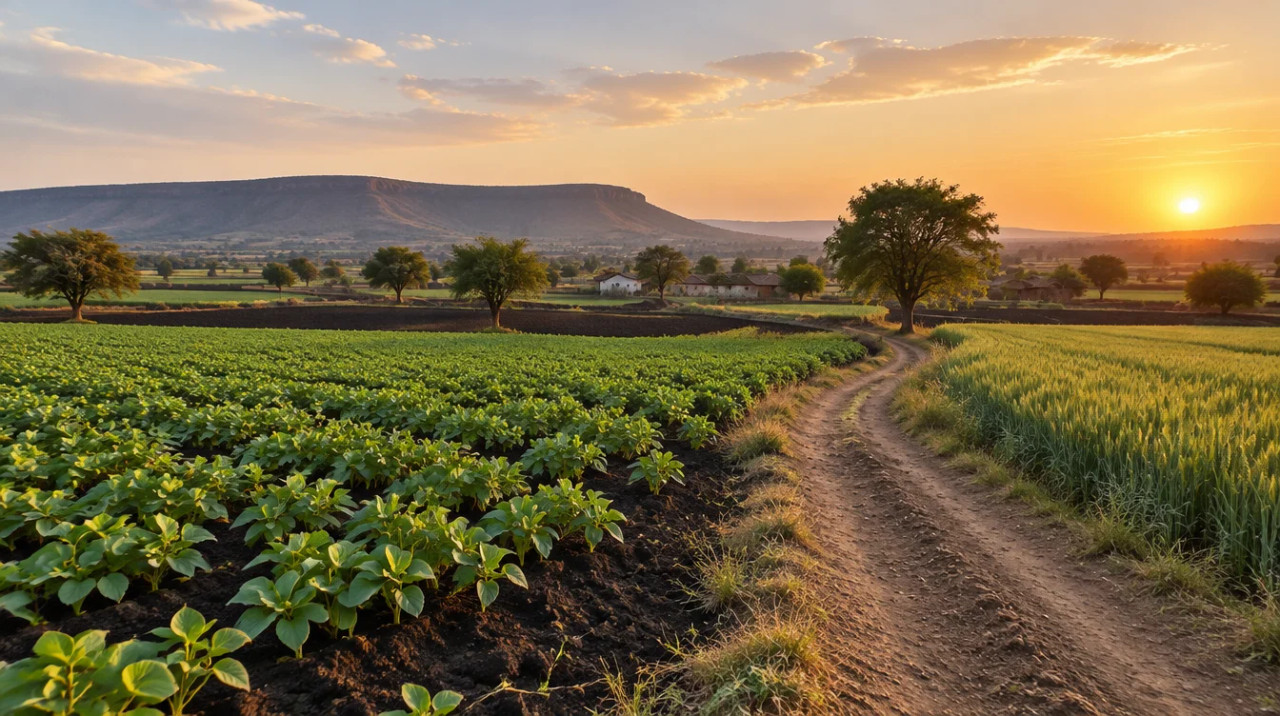
Mhow — the hill-edge farm belt in Indore district, priced below the Ujjain road side
Mhow is one of the five tehsils of Indore district and the hill-edge, farmland side of the Indore market. Land is bought here for farmhouses, small farms and holding, usually per acre, and our estimate is ₹20 lakh–1 crore per acre*, indicative only. It sits well below the Indore–Ujjain road belt in our district estimates (up to ₹3 crore per acre*), but the band is wide: hill-edge and outer parcels sit at the bottom and parcels near the city and roads at the top. We found no registered-deed series.
Growth around Mhow is tied to Indore's edge projects, and none of them is finished. An Indore ring road with options of 140, 145 and 161 km was proposed in May 2023 and we found no later report. The Indore Development Authority's Ahilyapath scheme is contested by farmers in other edge villages (Free Press Journal, August 2026, reported), and the Indore Metro missed its sixth deadline in June 2026. Price on today's roads.
Read the Indore district page and the state-wise land laws guide first. Ask the Collector's office whether the recorded holder is a tribal member, ask the Indore Development Authority whether the survey number sits inside a scheme or alignment, and ask the Forest Department and any cantonment authority for written status on land near hills or defence land.
- Hill-edge farms
- Indore edge
- Ring road proposal
- Scheme check
- NRI barred

Connectivity
How Mhow connects
Mhow is in Indore district. Distances and rail links were not route-checked.
By road and rail
Read this before relying on proposed roads
The ring road is a 2023 proposal with no later report found, and the Ahilyapath scheme shows how edge land can be drawn into a plan after purchase. A parcel near a proposed alignment may be priced on a road that is never built, or may be restricted by one that is. Ask for the scheme and alignment status of the survey number in writing.
Growth catalysts
Upcoming infrastructure & developments
Status labels maintained by the Farmland India research desk. Government-announced timelines — not guaranteed.
00Operational
None confirmed
04Pipeline items
Confirm status
Agriculture & terrain
Soil, crops & water in Mhow
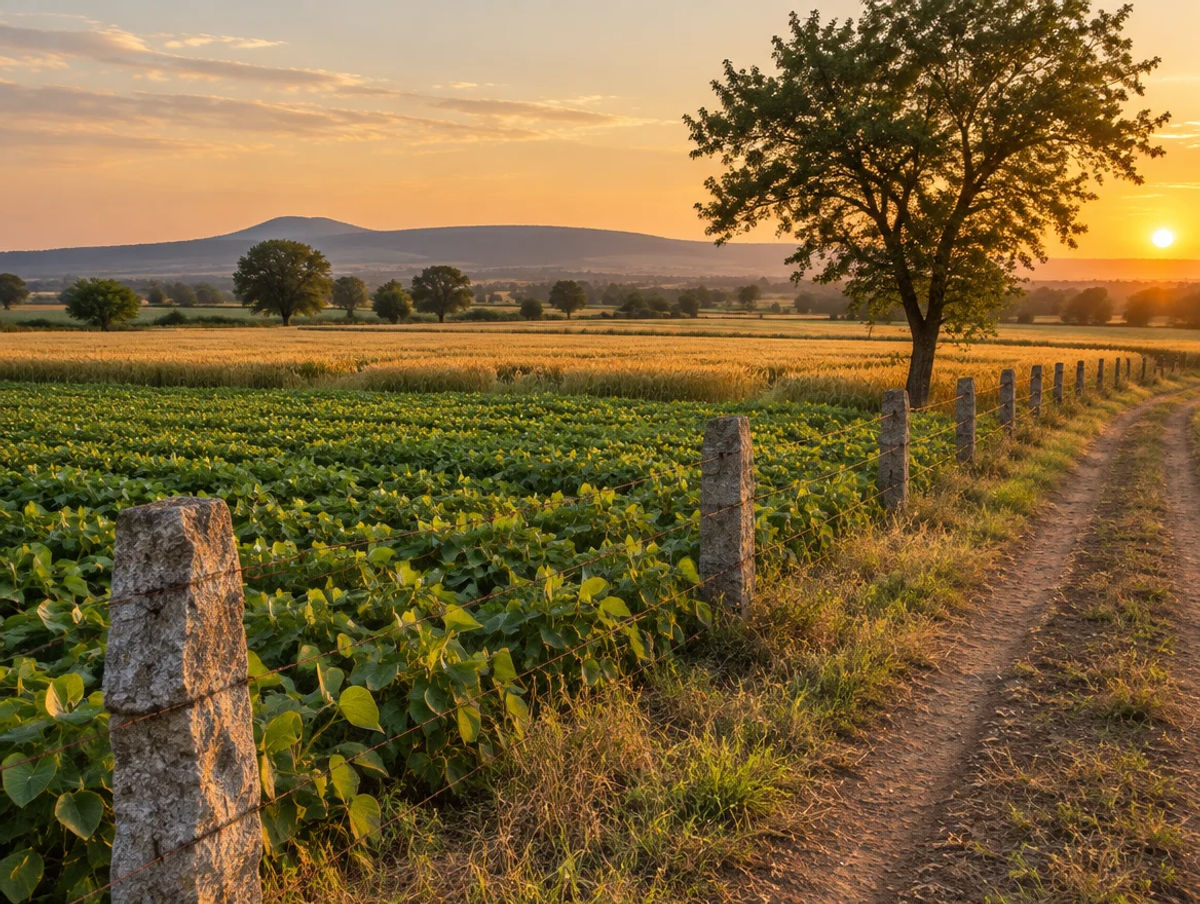
Mhow is plateau farmland with hill edges: soybean in kharif and wheat or chickpea in rabi, mostly on borewell water.
Soil & crops
The ICAR-CRIDA plan for Indore district (file dated 2012, so old data) gives deep soils on 60.9% of the area and shallow soils on 33.4%, with soybean on 219.8 thousand hectares in kharif and wheat and chickpea in rabi. We found no Mhow-specific data. Hill-edge parcels are likely to carry shallower soil (confirm on site). Data: Soil Health Card site.
- Soybean
- Wheat
- Chickpea
Water
The same plan records that 66.6% of irrigation in the district comes from bore wells and classed groundwater development as over-exploited at 104%, which is old data. CGWB's 2024 report lists Indore among districts with sporadic nitrate above limits, and we did not find a Mhow block figure. Ask for a borewell record and a water test. Groundwater categories: CGWB.
Mandi price reference
We quote no mandi price for Mhow because no dated figure was read. Price a parcel on location and permitted use, not on crop income. Live prices: Agmarknet.
Farmland India view
Why buyers look at Mhow
Reasons buyers look at this micro-market, stated with the evidence we have. Not a price forecast.
Lower entry than the road belt
Our estimate of ₹20 lakh–1 crore per acre* sits below the Indore–Ujjain road belt, so budgets stretch further; compare registered sales in the same village.
The Indore city market next door
Mhow is part of Indore district, so city-edge demand may reach it, but we found no Mhow-specific demand data.
Hill-edge and farm land
Parcels away from the city are priced on soil, irrigation and access rather than on road hopes.
Paperwork decides value
Tribal-land, diversion, scheme and alignment status are parcel-specific; a buyer with them in writing is better placed.
Listing data is not legal advice. Confirm title, tribal-land, diversion and scheme status with the Collector, the Indore Development Authority and the Sub-Registrar.
STRAIGHT TALK
Risks & challenges specific to Mhow
Specific to this micro-market, beyond the Indore and Madhya Pradesh-wide points.
Alignment and scheme exposure
Ring road and town planning scheme status can change what you can use or sell. Ask the Indore Development Authority and NHAI about the survey number.
Tribal-held land
Sale of land held by a tribal member needs written permission from a revenue officer of Collector rank or above under section 165(6) of the Land Revenue Code. Ask whether the holder is a tribal member.
Diversion for a house or farmhouse
Non-agricultural use needs diversion under the Land Revenue Code, and the route changed in 2018. Ask the Collector's office for the route and fees now in force.
Hill edge, forest and defence land
We found no district notification on forest or eco-sensitive land. Ask the Forest Department and any cantonment authority for written status near hills and defence land.
Holding ceiling
The Ceiling on Agricultural Holdings Act, 1960 limits what one family may hold; the Supreme Court quoted 54 acres for a family of five or fewer. Confirm the current schedule.
Stamp duty and registration
Duty and fee were reported at 7.5% and 3% in March 2026, about 10.5% together; confirm with the Sub-Registrar and check the guideline rate for the village.
NRIs and OCIs cannot buy this land
FEMA bars NRIs and OCIs from agricultural land, plantation land and farmhouses. Confirm status with a lawyer before paying a token amount.
COMMON QUESTIONS
Frequently asked questions
Everything buyers, NRIs and investors ask before their first reviewed farmland purchase in Mhow.
Visit full wiki01 of 04
What does agricultural land in Mhow cost?
Our estimate for farm and agricultural land in Mhow is ₹20 lakh–1 crore per acre*, indicative only. Prices vary by plot and road access; check the guideline rate with the Sub-Registrar and registered deeds from the same village.
02 of 04
Is the Indore ring road built?
No. A ring road with options of 140 to 161 km was proposed in May 2023 and we found no later report. Confirm the alignment with NHAI before paying for land priced on it.
03 of 04
Do I need diversion to build a farmhouse near Mhow?
Yes. Non-agricultural use needs diversion of the land under the MP Land Revenue Code, and the route changed in 2018. Ask the Collector's office for the current route and fees.
04 of 04
Can an NRI buy land in Mhow?
An NRI or OCI cannot buy agricultural land, plantation land or a farmhouse under FEMA. Residential and commercial land in approved areas is a separate question for a lawyer.
Ready to look at what is available?
Browse reviewed listingsTransparency
Sources for this page
- Tehsils and district area — Indore district page citing the MSME-DI profile (2011 data)
- Price band — Farmland India estimate*, derived from the Indore district estimates; no registered deed used; guideline rate to be obtained from the Sub-Registrar
- Ring road, Ahilyapath, Indore–Pithampur corridor and Metro — carried from the Indore district page; ETV Bharat, Free Press Journal, Swarajya (reported, not re-read)
- Tribal land, diversion, ceiling and stamp duty — Supreme Court orders and press reports as cited on the Indore district page
- Soil, crops and groundwater — ICAR-CRIDA Indore plan (2012) and CGWB 2024, as cited on the district page
- Mhow distances, rail, cantonment limits and Census data — not checked
- Full district and state sourcing: see the Indore page and the Madhya Pradesh page. Sources read October 2026.
General information, not legal advice. Report inaccuracies to wiki@farmlandindia.com.
For developers
Ready to explore Mhow farmland?
Browse reviewed projects and individual land parcels across Mhow — or if you own land here, list it with platform review and reach serious buyers.