
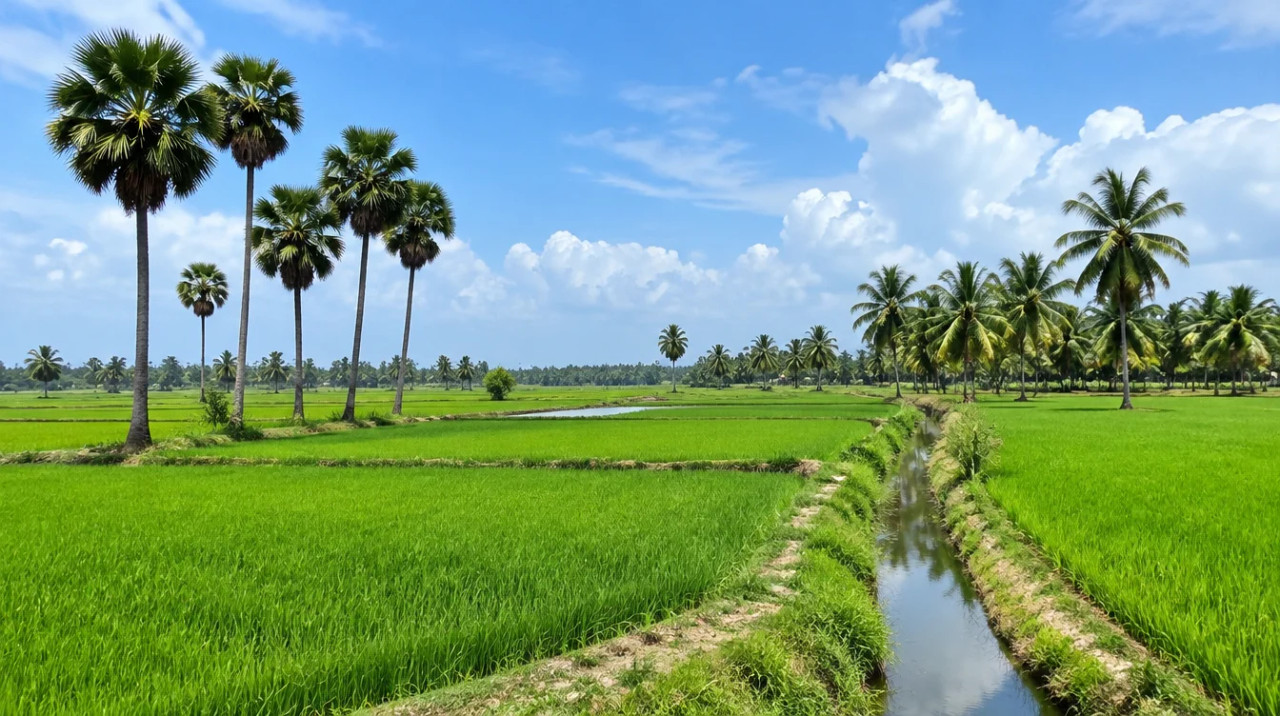
Area guide
Buying Land in Poonamallee
The western edge of Chennai: the Phase II metro line that opened on 11 October 2026, the proposed Sriperumbudur corridor, and what buyers should check.
118.9 km, Rs 63,246 crore
Metro Phase II
Poonamallee Bypass–Porur, 14.64 km
First stretch
11 October 2026 (flagged off)
Line opened
2% (stamp duty reported 7%)
Registration fee
*Indicative range across districts and land types. Stamp duty, registration and conversion charges are additional. Local measurement units vary — every listing states the unit it is priced in. Not a valuation or an offer.
Micro-market record — Poonamallee
Rev. 2026 · Farmland India desk
District
Tiruvallur; Poonamallee taluk
Metro
Poonamallee–Vadapalani service flagged off 11 October 2026
First stretch
Poonamallee Bypass to Porur Junction, 14.64 km, 11 stations (August 2026 report)
Proposed
Poonamallee–Sunguvarchathiram via Sriperumbudur corridor; no approval or date reported
Ring road
Tiruvallur–Sriperumbudur section, 24 km, lies to the west
Phase II total
118.9 km at Rs 63,246 crore
District rainfall
About 1,153 mm a year (TNAU plan)
Land price
Use the guideline value and recent registered deeds
Land law is state law. These rules are maintained on the Tamil Nadu page and apply to every district within it.
Poonamallee — land purchase legal rules
Tamil Nadu lets any Indian buy farmland, and its records and registration are among the most computerised in the country. The risks lie in the history of the land: whether it was assigned by the government or granted as Panchami land, whether it is a water body or other government land recorded as poromboke, and whether the family’s holding stays within the ceiling. Land use change is a separate approval. The points below come from the statutes, gazette notifications and court orders; they describe the rules, not how they apply to a given plot. This block applies to every district page in the state.
Who can buy: The statutes reviewed contain no provision in Tamil Nadu law that limits the purchase of agricultural land to farmers or residents of the state. An Indian citizen who is not a farmer can buy and register farmland, subject to the ceiling, the conditions on assigned and Panchami land, and land use rules.
The ceiling: Under Section 5(1) of the Tamil Nadu Land Reforms (Fixation of Ceiling on Land) Act, 1961, a family of up to five members may hold 15 standard acres, plus 5 standard acres for each additional member. A standard acre converts wet and dry land into a common unit by class and assessment, so the ordinary acreage varies with the land. Section 7 bars holding above the ceiling, Section 22 lets the authorised officer void transfers made to defeat it, and land declared surplus vests in the government and cannot be validly sold by a private owner.
The 2024 change: L.A. Bill No. 28 of 2024, published on 29 June 2024, replaced "minor sons and unmarried daughters" with "minor children" in the definition of family, so that unmarried adult daughters hold land in their own right up to the ceiling, as unmarried adult sons already did.
Companies: Section 37-A lets an industrial or commercial undertaking apply to the government for permission to acquire or keep land above the ceiling, on conditions such as using it within a fixed time. Whether a company may buy farmland below the ceiling without permission depends on its objects and the use; take advice before signing.
Panchami and assigned land: Panchami land was assigned to the then Depressed Classes under Government Orders of 1892. The Madras High Court (P. Dhandapani, W.P. No. 3628 of 2013, 26 July 2018) described its conditions: no sale for ten years, and after that sale only to members of those classes; transfers in breach are illegal and the land can be resumed. Other assigned land carries the conditions in its assignment order. A clean recent chain of deeds does not cure a void transfer further back.
Change of land use: Outside planning areas, farmland is changed to other use under the Tamil Nadu Change of Land Use (Agriculture to Non-agriculture Purposes in Non-planning Areas) Rules, 2017: an application to the local authority in Form I with a scrutiny fee of Rs 1,000 a plot, concurrence of the Director of Town and Country Planning, and for wet land the Collector’s concurrence after checking that it is not a water body or poromboke. G.O. (Ms.) No. 149 of 31 July 2026 let the Director decide on dry land himself. Inside planning areas the master plan zoning governs.
Stamp duty and fee: A sale deed is reported to attract 7% in all, made up of 5% stamp duty and 2% transfer duty, on the guideline value or the price, whichever is higher (King Stubb & Kasiva), and a 2% registration fee, cut from 4% in the 2023-24 Budget. The 7% is as reported; the TNREGINET calculator gives the exact amount.
NRI and OCI buyers: Under the RBI Master Direction on immovable property, NRIs and OCIs may not acquire agricultural land, a farmhouse or plantation property in India except by inheritance. Our NRI guide covers the options.
- No farmer-only rule found
- Ceiling: 15 standard acres
- 2024: daughters hold in own right
- Panchami land protected
- Change of land use rules, 2017
- Registration fee 2%
- NRIs: inheritance only
Sub-area overview
Poonamallee — the metro town on Chennai’s western edge
Poonamallee is a town and taluk on the western edge of Chennai, in Tiruvallur district. It has become a land market because the first stretch of Chennai Metro Phase II reaches it. The 2026-27 State Budget coverage describes the first stretch as 14.64 km with 11 stations, from Poonamallee Bypass to Porur Junction, joining the existing line at Vadapalani, as part of a 118.9 km phase costing Rs 63,246 crore (DT Next, 5 August 2026[8]). Prime Minister Narendra Modi and Chief Minister C. Joseph Vijay flagged off the Poonamallee–Vadapalani service on 11 October 2026 (DT Next, 11 October 2026[9]).
This is mostly urban and suburban land, so a buyer should be clear about what this page does and does not cover. Plots near the metro and the highway behave like Chennai land, and the district’s farmland lies further out. The more speculative part of the story is the proposed corridor west to Sunguvarchathiram via Sriperumbudur, which the Budget coverage lists among other Phase II corridors but does not approve or date. For a land buyer the value of a metro line is real in the first kilometre or two of a station and thins out fast, and the line can raise prices for plots that were already expensive.
Start with the Tiruvallur page for the district and the Tamil Nadu page for state rules. The south-west neighbour, Kancheepuram, holds Sriperumbudur.
- Metro line
- Western edge
- Sriperumbudur corridor
- Layout approvals
- NRI barred
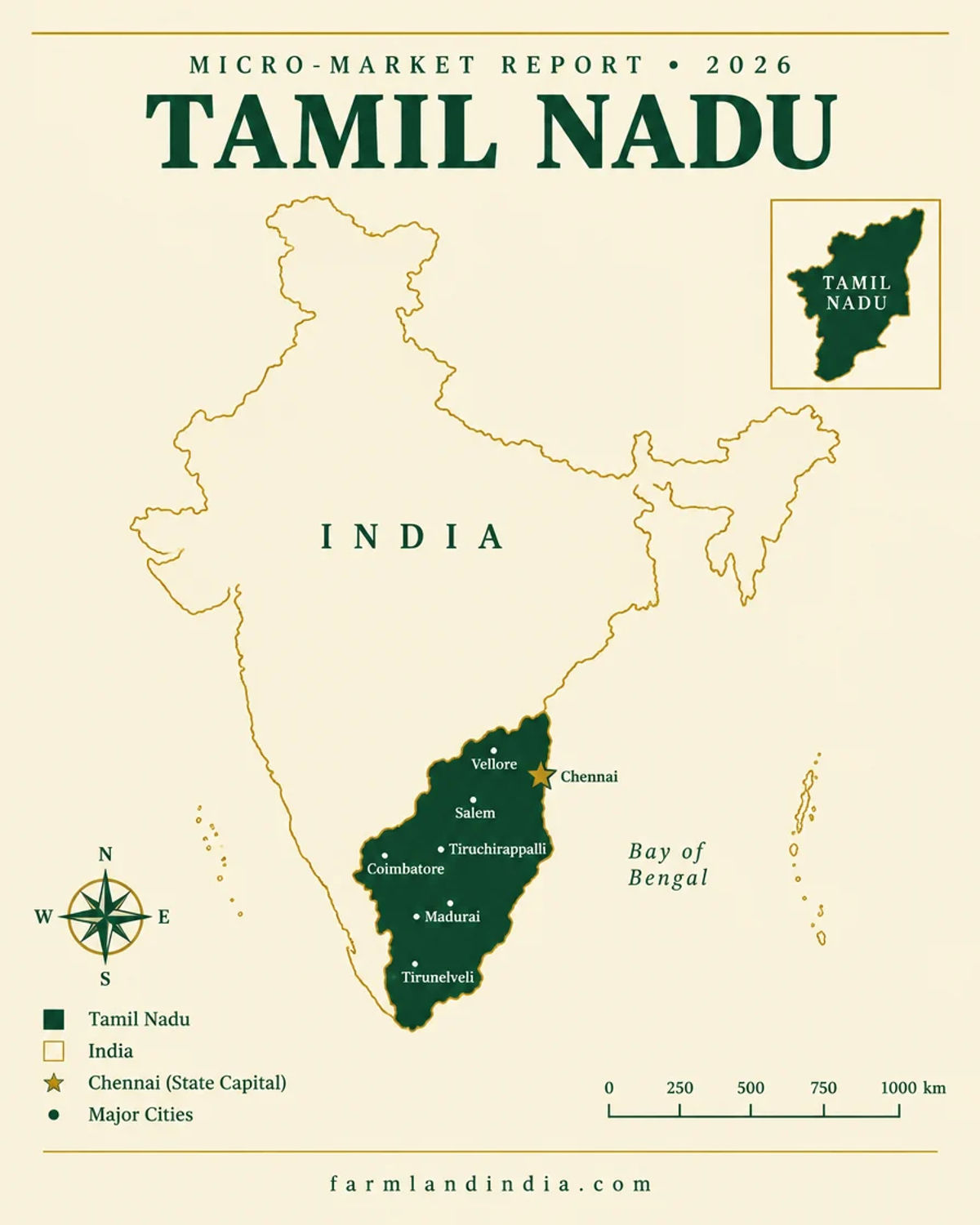
Connectivity
How Poonamallee connects
Poonamallee has a metro line to Vadapalani and the highways west of Chennai. Distances are not route-checked.
By metro and road
Read this before relying on distances
A metro line gives a firm timetable but only near stations. Road distances here swing with the peak hour, and a plot described as “near metro” can be a long walk or auto ride from the station. Measure from the nearest station exit.
Growth catalysts
Upcoming infrastructure & developments
Statuses are from dated reports. Government timelines are not guaranteed; proposed corridors have no approval or date.
01Metro
Opened
02Next
Proposed
Agriculture & terrain
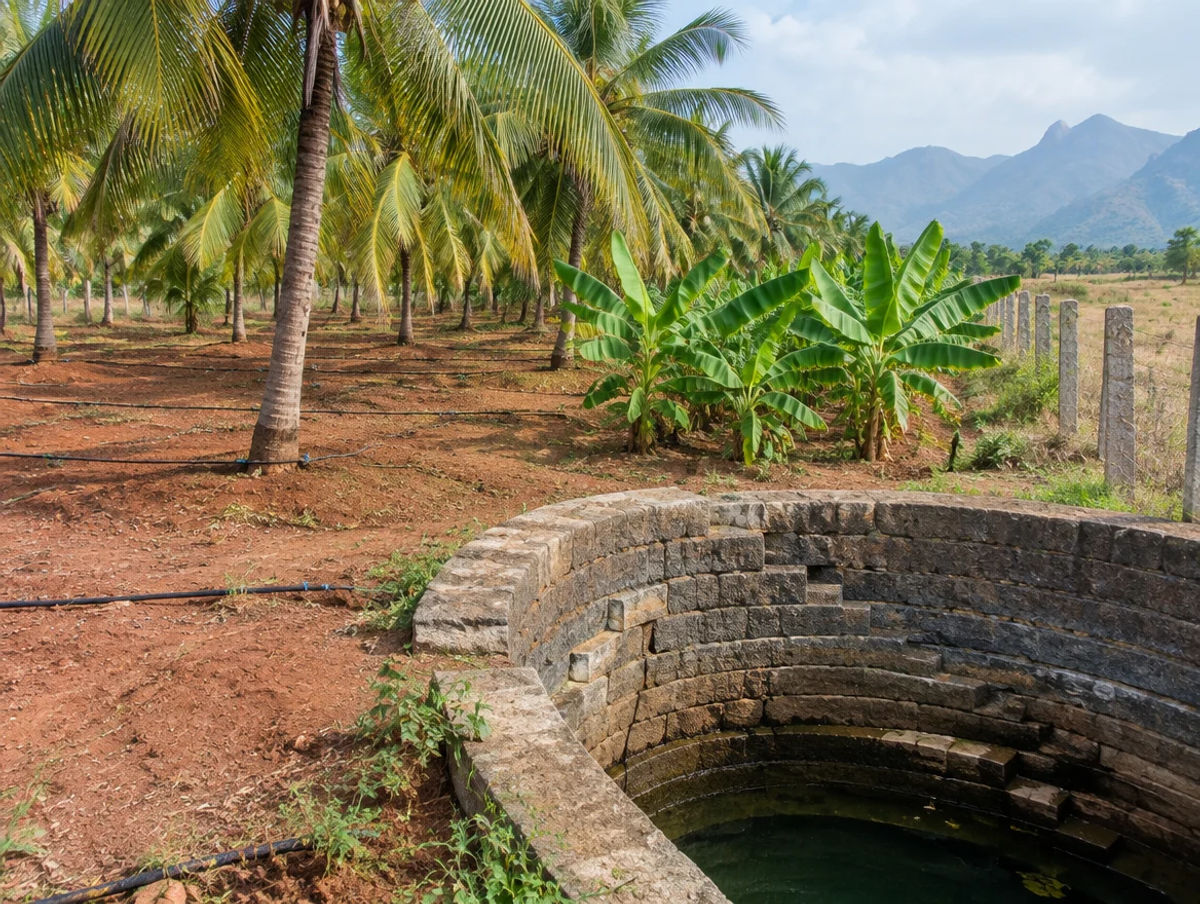
Soil, crops & water in Poonamallee
A district plan from 2006–10 data, so values are indicative. Poonamallee itself has little open farmland left.
Land and crops
The state’s district agriculture plan lists paddy at about 96,800 ha, groundnut about 28,000 ha and coconut about 11,100 ha across Tiruvallur district, with a cropping intensity of about 132% (TNAU district plan[5]). It is undated and uses 2006–10 data. In the taluk itself, farmland is mostly tank-fed paddy on the outskirts, much of it under pressure from layouts.
- Rice
- Groundnut
- Coconut
- Vegetables
Water and groundwater
The plan counts 1,895 tanks and 1,615 borewells in the district and rates 6 of its 14 blocks over-exploited, 2 critical, 5 semi-critical and 1 safe. Tamil Nadu’s stage of extraction was 74.26% in 2024 (CGWB[4]). Check the firka status of the survey number.
Reading the field before the file
Ask the sub-registrar for recent registered sale values in the village you are looking at. For land, the guideline value on TNREGINET and the last few registered deeds in the village are the working references.
Farmland India view
Why buyers look at Poonamallee
Reasons buyers look at this micro-market, with the evidence we have. Not a price forecast.
A metro line that is open
The Poonamallee–Vadapalani service is operating, which is stronger evidence than a plan. It gives plots within walking or short auto range of a station a clear commuting case.
Phase II extensions are proposals
The Sriperumbudur and Avadi corridors are listed as proposed. Treat any price premium for them as a bet on approval.
A ring road section to the west
The Tiruvallur–Sriperumbudur section is part of the ring road and gives the west of Chennai a second axis, but no interchange location was reported.
Urban plots are priced like urban plots
Land near the line is not cheap farmland. The case is commuter housing and long-term holding, not farm yield.
Listing data is not legal advice. Confirm the patta, the approval and the encumbrance with the revenue office and a lawyer before paying.
STRAIGHT TALK
Risks & challenges specific to Poonamallee
Specific to this micro-market, beyond the Tiruvallur district and Tamil Nadu-wide points.
Unapproved layouts near the metro
Metro stories draw layouts of mixed quality. Ask for the approval number and match it to the survey numbers on the deed, and check that the plot is not on a tank bed or channel.
Panchami, assigned and poromboke land
Some of the land that looks like ordinary farmland in this part of Tamil Nadu was assigned by the government or granted as Panchami land to members of the then Depressed Classes. Assigned land carries conditions in its assignment order, and the Madras High Court has held that Panchami land cannot be sold to buyers outside those classes and can be resumed. Poromboke land, which includes tank beds, channels and other government land, cannot be sold at all. Ask the village administrative officer and the taluk office for the classification of the survey number, and trace the deeds back past the last transfer, because a void sale earlier in the chain is not cured by a clean recent one.
The land ceiling and surplus land
Under Section 5(1) of the Tamil Nadu Land Reforms (Fixation of Ceiling on Land) Act, 1961[1], a family of up to five may hold 15 standard acres, plus 5 for each extra member, and transfers made to defeat the Act can be voided. A standard acre is a unit that converts wet and dry land by class, so the ordinary acreage varies. Land declared surplus vests in the government. For a small purchase the ceiling is rarely the problem, but a seller with large ancestral holdings in several villages is worth a question.
Agricultural land needs a change of use
Outside planning areas, farmland is converted under the Tamil Nadu Change of Land Use Rules, 2017[2]: an application in Form I with a scrutiny fee of Rs 1,000 a plot, concurrence of the Director of Town and Country Planning, and for wet land the Collector, after checking it is not a water body. Inside a planning area the master plan governs. A plot sold from a layout that has no approval from the Directorate of Town and Country Planning or the Chennai Metropolitan Development Authority, as applicable, may not get a building permit or an electricity connection later.
Stamp duty, fees and guideline value
A sale deed is reported to attract 7% in all, 5% stamp duty and 2% transfer duty, plus a 2% registration fee, on the higher of guideline value and price (King Stubb & Kasiva[6]). Treat 7% as reported. Revised guideline values came into force on 1 July 2024 in every district except Viluppuram (DT Next, 2 July 2024[7]). Read the guideline value for the exact survey number on TNREGINET before negotiating, and budget for the duty on that figure if it is higher than the price.
Groundwater is stressed in much of the state
The Central Ground Water Board put Tamil Nadu’s stage of groundwater extraction at 74.26% in 2024, with 392 of 1,202 firkas over-exploited and 56 critical (CGWB, 2024[4]). That is a state figure, not a reading for Poonamallee. Ask which firka the survey number falls in, test a borewell before you pay for irrigation land, and near the coast check for salinity.
Proposed lines are not approved
The Sriperumbudur and Avadi corridors have no reported approval or date. A agent who prices a plot on them should show the sanction.
Flood-prone low land
Low-lying plots near lakes and rivers in this district can flood in heavy north-east monsoon rain; ask neighbours and the village administrative officer about past flooding.
NRIs and OCIs cannot buy this land
Under the RBI Master Direction on immovable property[3], NRIs and OCIs may not acquire agricultural land, a farmhouse or plantation in India except by inheritance. Residents of India who are Indian citizens can buy, subject to the points above. Our NRI land guide sets out what NRIs can and cannot do.
COMMON QUESTIONS
Frequently asked questions
Everything buyers, NRIs and investors ask before their first reviewed farmland purchase in Poonamallee.
Visit full wiki01 of 04
Is the Poonamallee metro open?
Yes. Prime Minister Narendra Modi and Chief Minister C. Joseph Vijay flagged off the Poonamallee–Vadapalani service on 11 October 2026, the first stretch of Chennai Metro Phase II.
02 of 04
Will the metro reach Sriperumbudur?
A Poonamallee–Sunguvarchathiram corridor via Sriperumbudur is among the proposed Phase II corridors, according to the 2026-27 Budget coverage. It is a proposal; no approval or date was reported.
03 of 04
Is Poonamallee farmland or urban land?
Mostly urban or suburban. Plots near the metro and the highway are priced like Chennai land, and farmland is further out in the district; check each survey number’s classification.
04 of 04
Can an NRI buy land in Poonamallee?
NRIs and OCIs cannot buy agricultural land, a farmhouse or plantation in India except by inheritance (RBI Master Direction). Other categories of land need legal advice on the exact plot.
Transparency
Sources for this page
Law and courts
- [1]Tamil Nadu Land Reforms (Fixation of Ceiling on Land) Act, 1961 (India Code) — indiacode.nic.in
- [2]Government of Tamil Nadu: Change of Land Use Rules, 2017 — kygcms.tn.gov.in
- [3]Reserve Bank of India: Master Direction on acquisition and transfer of immovable property — rbi.org.in
Government
- [4]CGWB: Dynamic Ground Water Resources of Tamil Nadu, 2024 — cgwb.gov.in
- [5]TNAU Agritech: District agriculture contingency plan, Thiruvallur (undated, 2006–10 data) — agritech.tnau.ac.in
News and reports
- [6]King Stubb & Kasiva: Tamil Nadu stamp duty and registration charges, 2023 — ksandk.com
- [7]DT Next: new guideline values come into effect, 2 July 2024 — dtnext.in
- [8]DT Next: Tamil Nadu Budget 2026, Metro Phase II, 5 August 2026 — dtnext.in
- [9]DT Next: PM Modi, CM Vijay flag off Poonamallee–Vadapalani metro service, 11 October 2026 — dtnext.in
- [10]Deccan Chronicle: Land acquisition begins for second phase of CPRR, 30 August 2026 — deccanchronicle.com
General information, not legal advice. Reviewed November 2026; project statuses are dated in the text.
For developers
Ready to explore Poonamallee farmland?
Browse reviewed projects and individual land parcels across Poonamallee — or if you own land here, list it with platform review and reach serious buyers.