
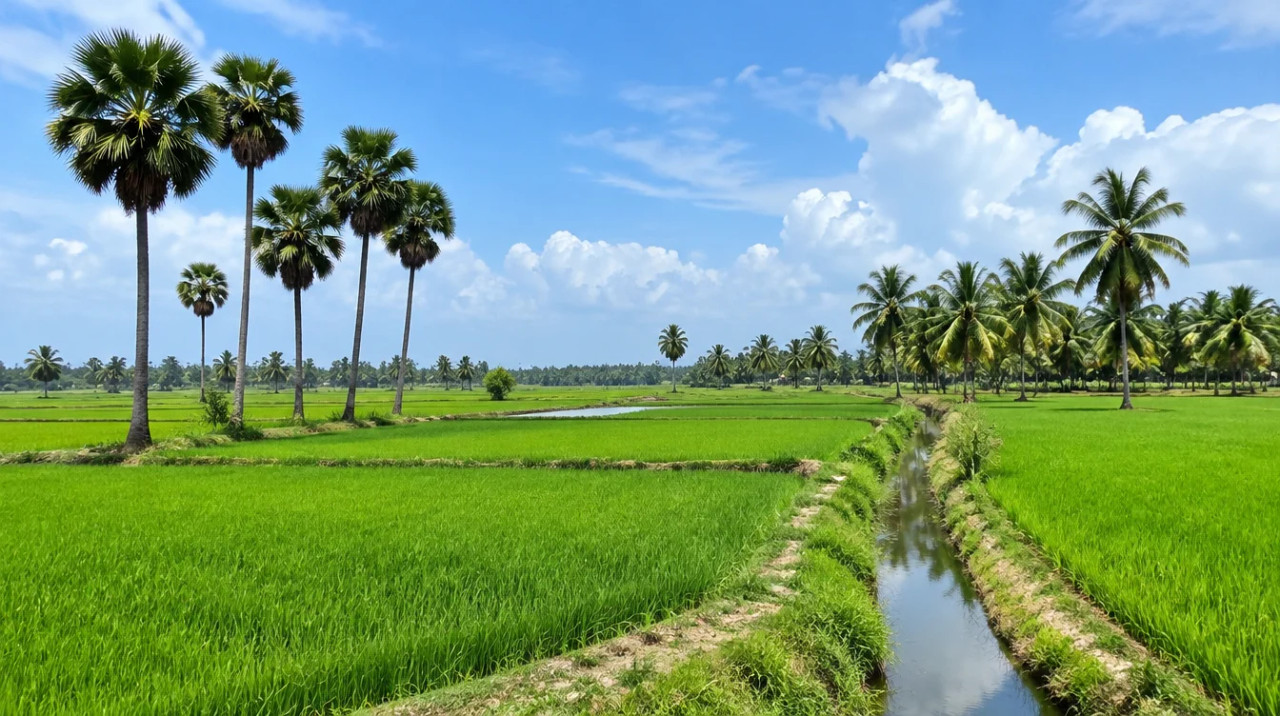
State guide
Buying Land in Tamil Nadu
The 15 standard acre ceiling, Panchami and assigned land, change of land use, 7% duty and 2% fee, Patta-Chitta records and the scrapped Parandur airport.
38
Districts
7% + 2% (reported)
Duty + fee
74.26% (CGWB 2024)
Groundwater use
15 standard acres
Family ceiling
State land record — Tamil Nadu
Rev. 2026 · Farmland India desk
Regions
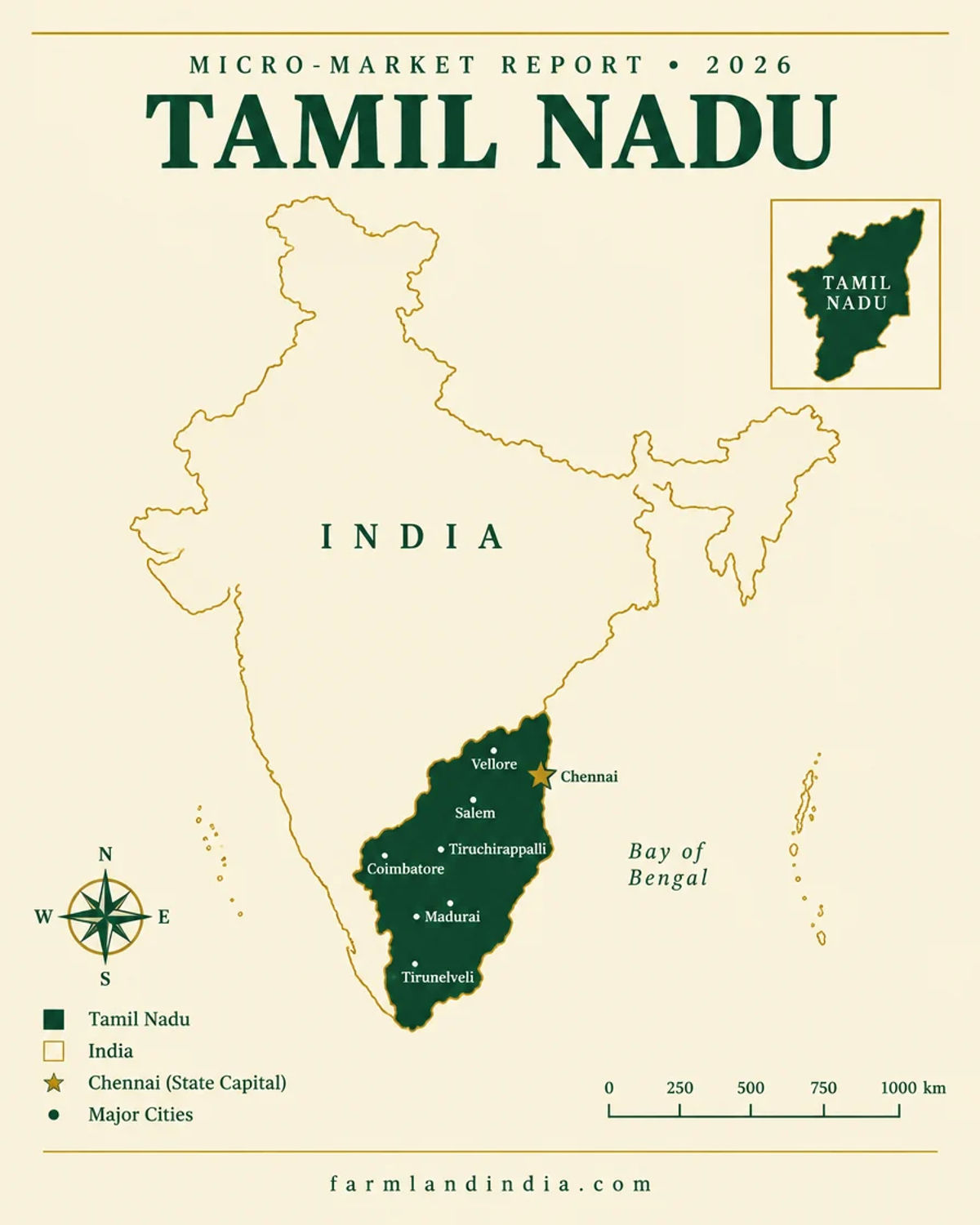
The Chennai metropolitan belt, the Kongu west around Coimbatore, Tiruppur, Erode and Salem, the Cauvery delta, the dry central and northern plains, and the far south from Madurai to Kanniyakumari
Total districts
38, the newest (Chengalpattu, Kallakurichi, Ranipet, Tenkasi, Tirupathur and Mayiladuthurai) created in 2019–2020
Who can buy
Any Indian buyer; the statutes reviewed contain no agriculturist-only rule in Tamil Nadu law
Ceiling
15 standard acres for a family of up to five, plus 5 for each extra member, under the Land Reforms (Fixation of Ceiling on Land) Act, 1961
Stamp duty and fee
Reported 7% stamp duty on a sale deed and a 2% registration fee, on the higher of guideline value and price; women get 1 point off the fee on land up to Rs 10 lakh
Land records
Patta, Chitta, A-register and FMB sketch through the revenue e-services portal; registration, encumbrance certificates and guideline values on TNREGINET
Sensitive land
Panchami land, assigned land, poromboke (government land, including water bodies) and natham village sites
Groundwater
Stage of extraction 74.26% in 2024; of 1,202 firkas, 392 over-exploited and 56 critical (CGWB[6])
Tamil Nadu — land purchase legal rules
Tamil Nadu lets any Indian buy farmland, and its records and registration are among the most computerised in the country. The risks lie in the history of the land: whether it was assigned by the government or granted as Panchami land, whether it is a water body or other government land recorded as poromboke, and whether the family’s holding stays within the ceiling. Land use change is a separate approval. The points below come from the statutes, gazette notifications and court orders; they describe the rules, not how they apply to a given plot. This block applies to every district page in the state.
Who can buy: The statutes reviewed contain no provision in Tamil Nadu law that limits the purchase of agricultural land to farmers or residents of the state. An Indian citizen who is not a farmer can buy and register farmland, subject to the ceiling, the conditions on assigned and Panchami land, and land use rules.
The ceiling: Under Section 5(1) of the Tamil Nadu Land Reforms (Fixation of Ceiling on Land) Act, 1961, a family of up to five members may hold 15 standard acres, plus 5 standard acres for each additional member. A standard acre converts wet and dry land into a common unit by class and assessment, so the ordinary acreage varies with the land. Section 7 bars holding above the ceiling, Section 22 lets the authorised officer void transfers made to defeat it, and land declared surplus vests in the government and cannot be validly sold by a private owner.
The 2024 change: L.A. Bill No. 28 of 2024, published on 29 June 2024, replaced "minor sons and unmarried daughters" with "minor children" in the definition of family, so that unmarried adult daughters hold land in their own right up to the ceiling, as unmarried adult sons already did.
Companies: Section 37-A lets an industrial or commercial undertaking apply to the government for permission to acquire or keep land above the ceiling, on conditions such as using it within a fixed time. Whether a company may buy farmland below the ceiling without permission depends on its objects and the use; take advice before signing.
Panchami and assigned land: Panchami land was assigned to the then Depressed Classes under Government Orders of 1892. The Madras High Court (P. Dhandapani, W.P. No. 3628 of 2013, 26 July 2018) described its conditions: no sale for ten years, and after that sale only to members of those classes; transfers in breach are illegal and the land can be resumed. Other assigned land carries the conditions in its assignment order. A clean recent chain of deeds does not cure a void transfer further back.
Change of land use: Outside planning areas, farmland is changed to other use under the Tamil Nadu Change of Land Use (Agriculture to Non-agriculture Purposes in Non-planning Areas) Rules, 2017: an application to the local authority in Form I with a scrutiny fee of Rs 1,000 a plot, concurrence of the Director of Town and Country Planning, and for wet land the Collector’s concurrence after checking that it is not a water body or poromboke. G.O. (Ms.) No. 149 of 31 July 2026 let the Director decide on dry land himself. Inside planning areas the master plan zoning governs.
Stamp duty and fee: A sale deed is reported to attract 7% in all, made up of 5% stamp duty and 2% transfer duty, on the guideline value or the price, whichever is higher (King Stubb & Kasiva), and a 2% registration fee, cut from 4% in the 2023-24 Budget. The 7% is as reported; the TNREGINET calculator gives the exact amount.
NRI and OCI buyers: Under the RBI Master Direction on immovable property, NRIs and OCIs may not acquire agricultural land, a farmhouse or plantation property in India except by inheritance. Our NRI guide covers the options.
- No farmer-only rule found
- Ceiling: 15 standard acres
- 2024: daughters hold in own right
- Panchami land protected
- Change of land use rules, 2017
- Registration fee 2%
- NRIs: inheritance only
State overview
Tamil Nadu — from the delta to the Kongu belt
Tamil Nadu covers about 1.3 lakh sq km at the south-eastern tip of India, with a coastline of about 1,000 km on the Bay of Bengal and the Indian Ocean, and borders Keralam, Karnataka, Andhra Pradesh and Puducherry. It had about 7.2 crore people at the 2011 Census and is one of the most urbanised and industrialised states in India. Its 38 districts fall into a few broad regions. The Chennai metropolitan belt of Chennai, Chengalpattu, Kancheepuram and Tiruvallur holds the capital, the car and electronics plants of Sriperumbudur and Oragadam and most of the state’s land demand. The Kongu west, from Coimbatore and Tiruppur to Erode, Salem, Namakkal and Karur, is a belt of textile and engineering towns and well-irrigated farms. The Cauvery delta of Thanjavur, Tiruvarur, Nagapattinam and Mayiladuthurai is the rice bowl. The central and northern plains around Tiruchirappalli, Vellore, Tiruvannamalai and Villupuram are drier, and the south from Madurai to Tirunelveli, Thoothukudi and Kanniyakumari mixes dry farming, salt pans, ports and wind farms.
Unlike most of India, Tamil Nadu gets much of its rain from the north-east monsoon in October to December, and its farms depend on tanks, wells and the Kaveri. Buyers come in several kinds: Chennai families and NRIs looking at farm plots and weekend land along the GST Road, the East Coast Road, the Bengaluru highway and the Chengalpattu belt; industrial and logistics buyers around Sriperumbudur, Oragadam, Hosur and the Coimbatore corridors; investors watching the Bengaluru–Chennai Expressway; and farmers adding to holdings in the Kongu belt. Buyers comparing the south can read our Keralam and Karnataka pages.
The paperwork is good, but history matters. Before price, read the Patta, Chitta and A-register, pull a 30-year encumbrance certificate from TNREGINET, and ask the revenue office whether the survey number was ever assigned, Panchami, poromboke or a water body.
- 38 districts
- Capital: Chennai
- North-east monsoon state
- Patta and Chitta online
- Six airports
- Groundwater 74.26% used
Market bands
Reported cost reference points — Tamil Nadu
No official farmland price series is published for Tamil Nadu. These are the cost figures a buyer will meet.
| Item | Scope | Reported figure* | Source |
|---|---|---|---|
| Stamp duty | Sale deed | 7% (5% duty and 2% transfer duty), reported | King Stubb & Kasiva, 2023[8] |
| Registration fee | Sale, gift, exchange | 2%, cut from 4% in the 2023-24 Budget | PRS budget analysis[5] |
| Women buyers | Land up to Rs 10 lakh in a woman’s name | Registration fee 1 point lower, from 1 April 2025 | DT Next, 31 March 2025[9] |
| Guideline value | Every survey number | Revised values in force from 1 July 2024 | DT Next, 2 July 2024[10] |
| Fixed fees | Copies, visits and other services | Revised from 10 July 2023 | G.O.Ms.No.69, 7 July 2023[7] |
| Farmland price series | State or district level | None published | Not published |
*No newspaper or official source publishes a farmland price series for Tamil Nadu. Prices near Chennai, Coimbatore and Hosur are quoted per square foot or per cent and behave like urban land, while dry farmland in the south and centre trades per acre at a fraction of that. Use the guideline value for the survey number on TNREGINET and recent deeds in the village, shown in the encumbrance certificate, as your guide.
Transaction costs
Stamp duty & registration in Tamil Nadu
7%
Stamp duty (reported)
5% duty plus 2% transfer duty on the higher of guideline value and price
2%
Registration fee
Cut from 4% in the 2023-24 Budget
1 point
Women’s concession
Lower registration fee on land up to Rs 10 lakh
Tamil Nadu charges stamp duty under the Indian Stamp Act as amended for the state and a registration fee under the Registration Act, both on the guideline value or the price, whichever is higher. A law firm note on the 2023 changes describes the duty on a sale as 5% stamp duty plus 2% transfer duty, 7% in all (King Stubb & Kasiva[8]); treat 7% as the reported figure. The registration fee, which had been raised to 4% in 2017, was cut back to 2% in the 2023-24 Budget, which also tied the change to guideline values (PRS budget analysis[5]). From 1 April 2025, land worth up to Rs 10 lakh registered in a woman’s name, including agricultural land, pays a registration fee one percentage point lower (DT Next, 31 March 2025[9]). Fixed fees for copies, a sub-registrar’s visit and similar services were revised from 10 July 2023 by G.O.Ms.No.69. Guideline values have moved several times since 2017, and revised values came into force in every district except Villupuram on 1 July 2024 (DT Next, 2 July 2024[10]). Search the guideline value for the exact survey number on TNREGINET and use its calculator on the day; family settlements, partitions and releases are charged differently, with capped duty.
Connectivity
How Tamil Nadu connects: road, rail and air
The Chennai hub, the Bengaluru expressway, six airports and the southern main lines.
🚗 By road
✈️ By air
🚆 By rail
🏭 Where activity is
The Chennai–Sriperumbudur–Oragadam belt is the heart of the state’s car, electronics and warehousing industry, with the GST Road, the Chengalpattu corridor and the north-west towards Tiruvallur growing around it. Hosur on the Karnataka border is a second industrial pole tied to Bengaluru. The Kongu belt of Coimbatore, Tiruppur, Erode and Salem holds textiles, pumps and engineering, and Thoothukudi a port and salt and power plants. These belts set the price of farmland around them.
Growth catalysts
Upcoming infrastructure & developments
Status as of November 2026, with the date and source of the latest public update for each item.
38Districts
Six created in 2019–2020
05Catalysts
Agriculture & terrain
Soil, crops & water across Tamil Nadu
Paddy in the delta, coconut and turmeric in the west, millets and cotton on the dry plains.
The delta and the river valleys
The Cauvery delta of Thanjavur, Tiruvarur, Nagapattinam and Mayiladuthurai, and the valleys of the Vaigai and Thamirabarani in the south, are flat alluvial paddy country fed by canals, with banana, sugarcane and coconut. Holdings are small and much land is in families’ hands for generations. Water depends on the Mettur dam releases and the river-sharing with Karnataka.
- Paddy, banana, sugarcane
- Canal irrigation
- Flood and cyclone exposure on the coast
The Kongu west
Coimbatore, Tiruppur, Erode, Salem, Namakkal, Karur and Dharmapuri form an upland of red soil, wells and canals, with coconut, banana, turmeric, sugarcane, maize, poultry and dairy. Farmland here is valuable because it is close to industrial towns and is well run, and the Nilgiris and the hills above Coimbatore add tea and vegetable country with strict hill-area rules.
- Coconut, turmeric, banana
- Wells and canals
- Industrial towns close by
The dry plains
Much of the north and the south, from Vellore, Tiruvannamalai and Villupuram to Ramanathapuram, Sivaganga, Virudhunagar and Thoothukudi, is rain-fed red and black soil with tanks, millets, pulses, groundnut and cotton, and palmyra on the sandy coast. Land is cheaper and holdings larger, and water is the constant constraint.
- Millets, pulses, groundnut, cotton
- Tank irrigation
- Larger, cheaper holdings
Groundwater
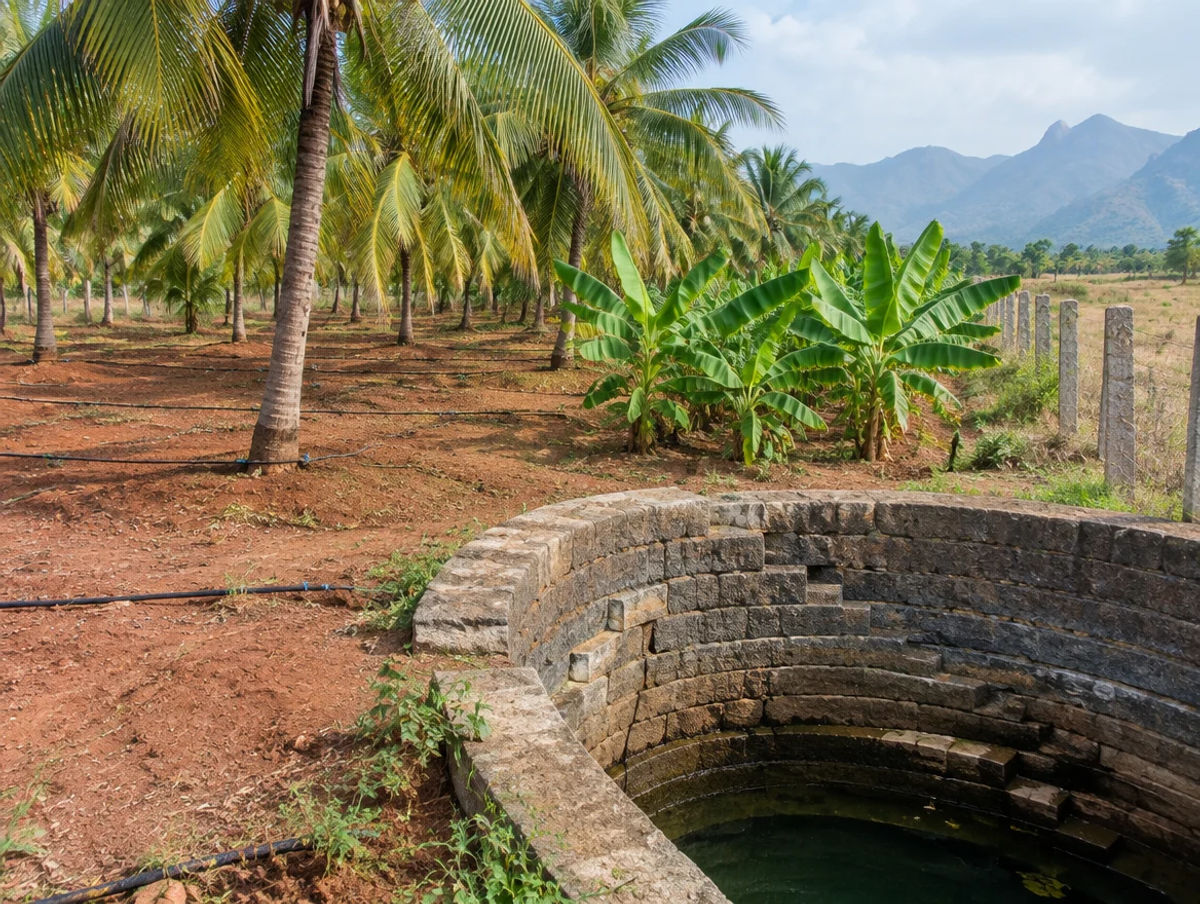
Tamil Nadu leans hard on its groundwater. The Central Ground Water Board put the state’s stage of extraction at 74.26% in its 2024 assessment; of 1,202 firkas, 481 were safe, 239 semi-critical, 56 critical, 392 over-exploited and 34 saline (CGWB, 2024[6]). Over-exploited firkas are spread across the Kongu belt, the north and the south, and coastal wells face salinity. Look up the firka of any plot you consider, and test the well before the north-east monsoon, not after it.
Land use
Revenue records classify land as wet (nanjai) or dry (punjai), with government land recorded as poromboke, including tanks, channels, grazing land and burial grounds, and village house sites as natham. Water body poromboke cannot be lawfully sold or built on, and courts have ordered encroachments on tanks and channels removed. Read the classification in the A-register before you buy. Land shown as natham is a village house site and usually has no Patta of the agricultural kind; ask for the natham Patta or the town survey record instead. Where an FMB sketch and the ground do not match, a survey by the taluk surveyor settles the boundary before registration, not after.
Crops
Paddy is the main crop in the delta and the river valleys, grown in up to three seasons where water allows. Sugarcane, banana, coconut and turmeric are the big cash crops of the west, with cotton, groundnut, millets and pulses on the dry plains, tea and vegetables in the Nilgiris, and mango, jasmine and other flowers around Krishnagiri, Dindigul and Madurai. Coconut and mango orchards are the usual choice for buyers who want a low-maintenance farm.
At a glance
Tamil Nadu’s regions side by side
| Region | Price series | Land and water | Note |
|---|---|---|---|
| Chennai belt (Chennai, Chengalpattu, Kancheepuram, Tiruvallur) | None published* | Coastal plain, tanks, saline pockets | Highest prices; industry and warehousing; Parandur dropped |
| North (Vellore, Ranipet, Tirupathur, Tiruvannamalai, Villupuram, Kallakurichi, Cuddalore, Krishnagiri, Dharmapuri) | None published* | Dry red soil, Palar basin, wells | Hosur industry; expressway interchanges; cheaper farmland |
| Kongu west (Coimbatore, Tiruppur, Erode, Salem, Namakkal, Karur, The Nilgiris) | None published* | Wells, Bhavani and Amaravathi canals, hills | Industrial towns; well-run farms; hill-area rules in the Nilgiris |
| Delta and centre (Thanjavur, Tiruvarur, Nagapattinam, Mayiladuthurai, Tiruchirappalli, Pudukkottai, Perambalur, Ariyalur) | None published* | Cauvery canals, alluvium | Rice bowl; small family holdings; flood and cyclone risk |
| South (Madurai, Dindigul, Theni, Sivaganga, Ramanathapuram, Virudhunagar, Thoothukudi, Tirunelveli, Tenkasi, Kanniyakumari) | None published* | Vaigai and Thamirabarani valleys, dry plains, coast | Port at Thoothukudi; wind farms; dry farming |
*No newspaper or official source publishes a farmland price series for Tamil Nadu’s regions. The groups follow geography, not an official division. The same state laws apply everywhere; water, distance from the industrial belts and the share of assigned and government land change from one district to the next.
Farmland India view
Why investors look at Tamil Nadu
Industrial belts that set the price, good records, and water that decides farm value.
Industry sets the price
The Chennai–Sriperumbudur–Oragadam belt, Hosur and the Coimbatore–Tiruppur corridor are where land demand is strongest and most liquid. Farmland close to these belts trades on its development value; farther out, it trades as farmland.
Good records lower the cost of checking
Patta, Chitta, A-register, FMB sketches, encumbrance certificates and guideline values are online, and the Patta now changes automatically for simple sales. That makes it easier to trace a plot’s history from a distance than in most states, though a visit to the village and the taluk office is still needed.
The airport story has changed
With Parandur dropped in August 2026, land bought around it on the airport story has lost its main driver, and the next site is unknown. Do not pay a premium for land near a rumoured airport site until one is notified.
Water is the real asset
With three-quarters of the state’s recharge already being pumped out and hundreds of firkas over-exploited, a plot with canal water, a reliable well or tank rights is worth far more than one without. Pay for proven water.
Costs are predictable
About 7% duty and 2% fee on the higher of guideline value and price, with a concession for women on smaller plots, make costs easy to work out on TNREGINET. Do not under-declare the price; undervaluation is pursued.
Daughters and family holdings
Since the 2024 change to the ceiling law, an unmarried adult daughter counts as a separate holder, just as an unmarried adult son already did. Families planning several purchases should work out the ceiling for each holder before registering, and decide early whose name each plot will go in, especially where the women’s fee concession applies.
Confirm the Patta, Chitta and A-register, a 30-year encumbrance certificate, the guideline value and the land’s history (assigned, Panchami, poromboke) before you pay an advance.
STRAIGHT TALK
Risks & challenges in Tamil Nadu
What can undo a land deal in Tamil Nadu
Panchami land
Land originally assigned as Panchami can be resumed by the government if it was transferred in breach of its conditions, however many sales have happened since. Ask the Tahsildar to check the settlement records for the survey number.
Assigned land
Land assigned to landless families carries conditions on sale in its assignment order. A sale in breach can be cancelled.
Poromboke and water bodies
Tanks, channels, grazing land and other poromboke belong to the government. Plots carved out of dried tanks or channels are a common trap near growing towns, and courts have ordered such encroachments removed.
Unapproved layouts
Farmland sold as house plots without DTCP or CMDA approval and change of land use can be refused building permission and services. Check approval numbers before buying a plot in a layout.
Ceiling surplus
Land declared surplus under the 1961 Act vests in the government. Trace the title far enough back to see any ceiling proceedings.
Floods and cyclones
Low-lying land around Chennai, the delta and the coast floods in heavy north-east monsoon years and is exposed to cyclones. Check flood history and drainage.
Hill and forest rules
In the Nilgiris and other hill areas, building and land use are restricted, and land near reserved forests and elephant corridors faces further limits. Confirm what can be built before you buy.
NRIs and power of attorney
NRIs cannot buy farmland in India except by inheritance. Deals through a relative’s name or a power of attorney leave the land legally in someone else’s hands.
Who to contact
Local revenue & registration offices
Land administration in Tamil Nadu runs through the Revenue and Disaster Management Department, the Commissionerate of Land Administration, 38 District Collectors, Revenue Divisional Officers and taluk offices. For any plot, start with the Village Administrative Officer (VAO), who keeps the village accounts, the Adangal and the A-register and can show the plot on the village map. The Tahsildar at the taluk office issues and transfers the Patta and decides disputes, and the Revenue Divisional Officer hears appeals. Surveys and FMB sketches come from the Survey and Land Records department. Ceiling matters go to the Commissionerate of Land Reforms, and change of land use to the local body with the Directorate of Town and Country Planning. Deeds are registered at the sub-registrar office, booked and paid for through TNREGINET. Each district Collectorate’s website lists its taluks, firkas and revenue villages, and the TNREGINET portal shows which sub-registrar office covers a village. For a plot in a planning area, the local planning authority, CMDA in the Chennai region or the DTCP elsewhere, confirms the zoning.
KEEP EXPLORING
Districts & guides in Tamil Nadu
Districts
- Ariyalur
- Chengalpattu
- Chennai
- Coimbatore
- Cuddalore
- Dharmapuri
- Dindigul
- Erode
- Kallakurichi
- Kancheepuram
- Kanniyakumari
- Karur
- Krishnagiri
- Madurai
- Mayiladuthurai
- Nagapattinam
- Namakkal
- Perambalur
- Pudukkottai
- Ramanathapuram
- Ranipet
- Salem
- Sivaganga
- Tenkasi
- Thanjavur
- The Nilgiris
- Theni
- Thoothukudi
- Tiruchirappalli
- Tirunelveli
- Tirupathur
- Tiruppur
- Tiruvallur
- Tiruvannamalai
- Tiruvarur
- Vellore
- Viluppuram
- Virudhunagar
COMMON QUESTIONS
Frequently asked questions
Everything buyers, NRIs and investors ask before their first reviewed farmland purchase in Tamil Nadu.
Visit full wiki01 of 04
Can a non-farmer buy agricultural land in Tamil Nadu?
Yes. The statutes reviewed contain no rule in Tamil Nadu law that limits farmland purchases to farmers or residents. The ceiling under the 1961 Act, the conditions on assigned and Panchami land, and land use rules still apply.
02 of 04
What are stamp duty and registration charges in Tamil Nadu?
A sale deed is reported to attract 7% stamp duty, made up of 5% duty and 2% transfer duty, and a 2% registration fee, on the higher of guideline value and price. Check the exact amount with the TNREGINET calculator.
03 of 04
Is there a concession for women buyers?
Yes. From 1 April 2025, land worth up to Rs 10 lakh registered in a woman’s name, including agricultural land, pays a registration fee one percentage point lower.
04 of 04
What is Panchami land?
Land assigned to the then Depressed Classes under 1892 Government Orders. The Madras High Court has held that transfers in breach of its conditions are illegal and the land can be resumed, so check a survey number’s history with the Tahsildar before buying.
Transparency
Sources and references
Law
- [1]India Code: Tamil Nadu Land Reforms (Fixation of Ceiling on Land) Act, 1961 — indiacode.nic.in
- [2]Tamil Nadu Government Gazette: L.A. Bill No. 28 of 2024 (29 Jun 2024) — stationeryprinting.tn.gov.in
- [3]Government of Tamil Nadu: Change of Land Use Rules, 2017 — kygcms.tn.gov.in
- [4]Tamil Nadu Government Gazette: G.O. (Ms.) No. 149, Housing and Urban Development (31 Jul 2026) — stationeryprinting.tn.gov.in
Government
- [5]PRS Legislative Research: Tamil Nadu Budget analysis 2023-24 — prsindia.org
- [6]CGWB: Dynamic Ground Water Resources of Tamil Nadu, 2024 — cgwb.gov.in
- [7]Tamil Nadu Government Gazette: G.O.Ms.No.69, revised registration fees (7 Jul 2023) — stationeryprinting.tn.gov.in
News and analysis
- [8]King Stubb & Kasiva: changes in Tamil Nadu stamp duty and registration charges (2023) — ksandk.com
- [9]DT Next: 1% registration fee concession for women (31 Mar 2025) — dtnext.in
- [10]DT Next: new guideline values come into effect (2 Jul 2024) — dtnext.in
- [11]DT Next: automated patta transfer system updated (4 Jul 2026) — dtnext.in
- [12]The Week: Tamil Nadu scraps Parandur airport (24 Aug 2026) — theweek.in
- [13]Deccan Herald: Bengaluru–Chennai expressway (23 Aug 2025) — deccanherald.com
Further reading
Data-currency note: sources were read in November 2026. Rules, fees and infrastructure timelines change often; check the linked source and the relevant office before relying on any figure.
For developers
Ready to explore Tamil Nadu farmland?
Browse reviewed projects and individual land parcels across Tamil Nadu — or if you own land here, list it with platform review and reach serious buyers.