
State guide
Buying Land in Karnataka
Who can buy after the 2020 reform, the ceiling, PTCL granted land, conversion, 7.6% duty and fee, Bhoomi records and Bengaluru’s new roads.
31
Districts
About 7.6% (reported)
Duty, cess and fee
68.44% (2024)
Groundwater use
20 units
Ceiling
State land record — Karnataka
Rev. 2026 · Farmland India desk
Regions
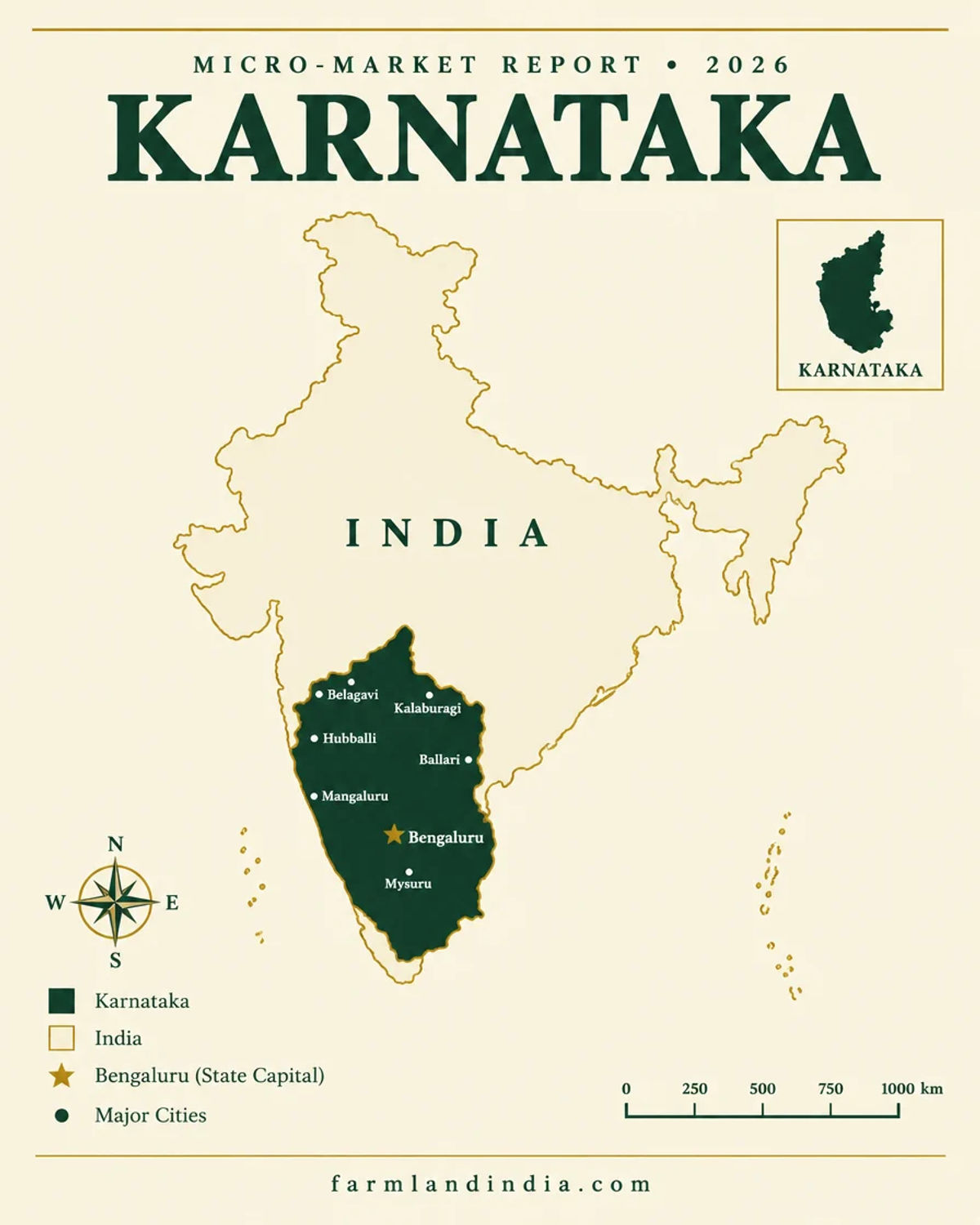
Four revenue divisions: Bengaluru, Mysuru, Belagavi and Kalaburagi. Locally the state is read as Old Mysore in the south, the coast (Karavali), the Malnad hills, Kittur Karnataka in the north-west and Kalyana Karnataka in the north-east
Total districts
31, including Vijayanagara (carved from Ballari in 2021); Ramanagara was renamed Bengaluru South in May 2025 (Deccan Herald[6])
Who can buy
Since 2020, any Indian individual, company or trust; the farmer-only and income tests in Sections 79A and 79B were deleted
Ceiling
20 units for an individual or a family of up to five under Section 63 of the Karnataka Land Reforms Act, 1961; one unit is an acre of the best irrigated land
Granted land
SC/ST granted land cannot be sold without prior government permission under the PTCL Act, and there is now no time limit on reopening a sale
Stamp duty and fee
Reported 5% stamp duty plus about 0.6% cess and surcharge, and 2% registration fee since 31 August 2025 (Deccan Herald[3])
Land records
Bhoomi for the RTC (Pahani) and mutation, Kaveri 2.0 for deed registration, Bhu Suraksha for scanned old records
Groundwater
Stage of extraction 68.44% in 2024, with heavy overuse in Kolar, Bengaluru Urban, Chikkaballapura, Bengaluru Rural and Chitradurga (Deccan Herald[8])
Karnataka — land purchase legal rules
Karnataka opened its farmland market in 2020. Before that, a buyer had to be a farmer, earn less than a set income from other sources, and could not be a company or trust; those tests are gone. What still decides a deal is the land itself: the ceiling, whether it was granted to a Scheduled Caste or Scheduled Tribe family, its class, and whether it has been converted for the use you have in mind. The points below come from the amending ordinance, the bills and court judgments; they describe the rules, not how they apply to a given plot. This block applies to every district page in the state.
Who can buy: The Karnataka Land Reforms (Amendment) Ordinance, 2020 (No. 13 of 2020, 13 July 2020) deleted Sections 79A, 79B and 79C of the Karnataka Land Reforms Act, 1961, with effect from 1 March 1974. Those sections barred anyone with non-farm income of Rs 25 lakh a year or more, and most companies, trusts and societies, from acquiring farmland. Pending cases under them stood abated. The ordinance was replaced by the Karnataka Land Reforms (Second Amendment) Act, 2020. Today an Indian individual, company or trust can buy agricultural land, within the ceiling.
What Section 80 still restricts: Section 80 now restricts transfers only where the land is A-class irrigated land that will not be used for agriculture, or where the buyer would cross the ceiling. Ask whether the plot is irrigated A-class land if you do not plan to farm it.
The ceiling: Section 63 measures the ceiling in units, one unit being an acre of A-class land or an equivalent area of poorer land under Schedule I. The 2020 changes doubled the limit from 10 to 20 units for an individual or a family of up to five, with more for larger families up to 40 units. Because drier land counts for less, the ordinary acreage you can hold is larger in dry districts than in canal-irrigated ones. Add up all farmland your family unit already holds in the state before you buy.
SC/ST granted land: Under Section 4 of the Karnataka Scheduled Castes and Scheduled Tribes (Prohibition of Transfer of Certain Lands) Act, 1978 (the PTCL Act), land granted by the government to SC/ST families cannot be transferred without the government’s prior permission, and the Assistant Commissioner can declare a sale void and restore the land. The 2023 amendment (LA Bill No. 15 of 2023) removed any time limit for invoking the Act. Courts still look at the facts, as the Supreme Court did in Seethamma v. State of Karnataka, 7 May 2026, but a buyer should treat any grant, Darkhast or PTCL entry on the RTC as high risk.
Conversion: Agricultural land needs conversion under Section 95 of the Karnataka Land Revenue Act, 1964 before any non-farm use. The Karnataka Land Revenue (Amendment) Rules, 2025 (notification RD-LGP/6/2025, 17 September 2025) say that inside an approved master plan zone whose use matches, no Deputy Commissioner permission is needed and the planning authority issues a digitally signed conversion certificate; outside, the DC is to decide within 15 days, with deemed approval after 30. Small industries up to two acres and renewable energy projects need no separate conversion, and violations can draw fines of up to Rs 1 lakh plus Rs 2,500 a day, recorded on the RTC (Cyril Amarchand Mangaldas, November 2025).
Stamp duty and fee: Duty and fee are charged on the higher of the deed price and the guidance value. The registration fee was raised from 1% to 2% from 31 August 2025, taking the reported total on a sale deed, with 5% stamp duty and about 0.6% in cess and surcharge, from 6.6% to 7.6% (Deccan Herald, 30 August 2025). Check the figure Kaveri 2.0 calculates before you pay.
NRI and OCI buyers: Under the RBI Master Direction on immovable property, NRIs and OCIs may not acquire agricultural land, a farmhouse or plantation property in India except by inheritance. The 2020 changes in Karnataka do not alter that. Our NRI guide covers the options.
- Farmer test removed in 2020
- Companies and trusts can buy
- Ceiling: 20 units
- PTCL: granted land protected
- Conversion under Section 95
- Registration fee 2%
- NRIs: inheritance only
State overview
Karnataka — from the coast to the Deccan
Karnataka is the largest state in the south, about 1.92 lakh sq km running from the Western Ghats and a 300 km coastline on the Arabian Sea across the Deccan plateau to the borders of Maharashtra, Telangana, Andhra Pradesh, Tamil Nadu, Kerala and Goa. It had about 6.1 crore people at the 2011 Census. Its 31 districts fall into four revenue divisions, but buyers think in regions: Bengaluru and the Old Mysore country of the south, with ragi, silk, mango and coconut on red soil; the rainy coast of Dakshina Kannada, Udupi and Uttara Kannada; the Malnad hills of Kodagu, Chikkamagaluru, Hassan and Shivamogga, the heart of India’s coffee; the black-soil north-west of Belagavi, Dharwad and Vijayapura; and Kalyana Karnataka in the north-east, from Kalaburagi and Bidar to Raichur, Koppal, Ballari and Vijayanagara, with tur, jowar and canal paddy along the Tungabhadra and the Krishna.
Bengaluru dominates the land market. The city and its surrounding districts, Bengaluru Rural, Bengaluru South (renamed from Ramanagara in May 2025), Tumakuru, Kolar and Chikkaballapura, draw almost every kind of buyer: technology professionals looking for weekend farms and managed farmland, investors banking land along the new expressways, warehousing and industrial buyers on the highways out of the city, and families from across India. Mysuru, Hubballi-Dharwad, Belagavi and Mangaluru are smaller hubs. Coffee and areca estates in the Malnad attract a different, slower market. Buyers comparing the south can read our Keralam and Tamil Nadu pages.
The 2020 reform made it easy to buy; it did not make every plot safe. Check the RTC for a grant or PTCL entry, add up the ceiling, confirm the land class, and look for the conversion order if anyone has promised a farmhouse or a layout, before price or roads.
- 31 districts
- Capital: Bengaluru
- Four revenue divisions
- Ramanagara now Bengaluru South
- India’s coffee state
- Groundwater 68.44% used
Market bands
Reported cost reference points — Karnataka
No official farmland price series is published for Karnataka. These are the cost and rule figures a buyer will meet.
| Item | Scope | Reported figure* | Source |
|---|---|---|---|
| Stamp duty | Sale deed | 5%, plus about 0.6% cess and surcharge (reported) | Deccan Herald, 30 August 2025[3] |
| Registration fee | Sale deed | 2% from 31 August 2025 (was 1%) | King Stubb & Kasiva, 2025[4] |
| Guidance value | All land | Last revised 1 October 2023; new revision proposed for April 2026 | Deccan Herald, 2026[5] |
| Conversion penalty | Use without conversion | Up to Rs 1 lakh plus Rs 2,500 a day | Land Revenue Rules, 2025 |
| Ceiling | Individual or family of up to five | 20 units | Section 63, as amended in 2020 |
| Farmland price series | State or district level | None published | Not published |
*No newspaper or official source publishes a farmland price series for Karnataka. Land near Bengaluru is priced like urban land, while dry farmland in the north can sell for a small fraction of that; within a district, frontage on a highway or a converted plot sells at many times the rate of the farm behind it. Use the guidance value for the survey number in Kaveri and recent registered deeds in the village as your guide.
Transaction costs
Stamp duty & registration in Karnataka
5% + 0.6%
Stamp duty and cess
Reported rate on a sale deed, on the higher of price and guidance value
2%
Registration fee
Raised from 1% on 31 August 2025
30 days
Deemed conversion
Outside master plan areas, if the DC does not decide
Stamp duty on a sale of land is levied under the Karnataka Stamp Act, 1957 and the registration fee under the Registration Act, 1908, both on the higher of the price in the deed and the guidance value (the government’s minimum value for the survey number). Newspapers reported on 30 August 2025 that stamp duty on a conveyance stands at 5%, with about 0.6% more in cess and surcharge, and that the registration fee would rise from 1% to 2% from 31 August 2025, lifting the total from 6.6% to 7.6% of the value (Deccan Herald, 30 August 2025[3]). A law firm note on the notification describes the fee rising from Rs 10 to Rs 20 per Rs 1,000 (King Stubb & Kasiva[4]). Applicants who had paid at the old rate were asked to pay the difference. The guidance value was last revised statewide on 1 October 2023; the Central Valuation Committee met on 12 January 2026 to begin another revision, with an average increase of 15 to 20% reported as proposed from 1 April 2026 (Deccan Herald[5]). Check the value in Kaveri on the day. Ask the sub-registrar whether any concession applies to women buyers. Deeds are registered through Kaveri 2.0, where the parties enter details, pay online and book a slot at the sub-registrar office.
Connectivity
How Karnataka connects: road, rail and air
The Bengaluru road and rail hub, new expressways, nine airports and the Konkan line on the coast.
🚗 By road
✈️ By air
🚆 By rail
🏭 Where activity is
The Bengaluru belt, from Tumakuru and Nelamangala in the west to Hoskote and Kolar in the east and Devanahalli and Doddaballapura in the north, holds most of the state’s industry, warehousing and land investment, with Bidadi, Harohalli and Kanakapura Road rising in the south. Other clusters are the Hubballi-Dharwad and Belagavi engineering belt, the steel and mining country around Ballari and Vijayanagara, the port and petrochemical zone at Mangaluru, and the cement belt around Kalaburagi.
Growth catalysts
Upcoming infrastructure & developments
Status as of November 2026, with the date and source of the latest public update for each item.
7.6%Total on a sale deed
Reported stamp duty, cess and fee since August 2025
05Catalysts
Agriculture & terrain
Soil, crops & water across Karnataka
Ragi and silk on the southern plateau, coffee in the Malnad, tur and sugarcane in the north.
The southern maidan
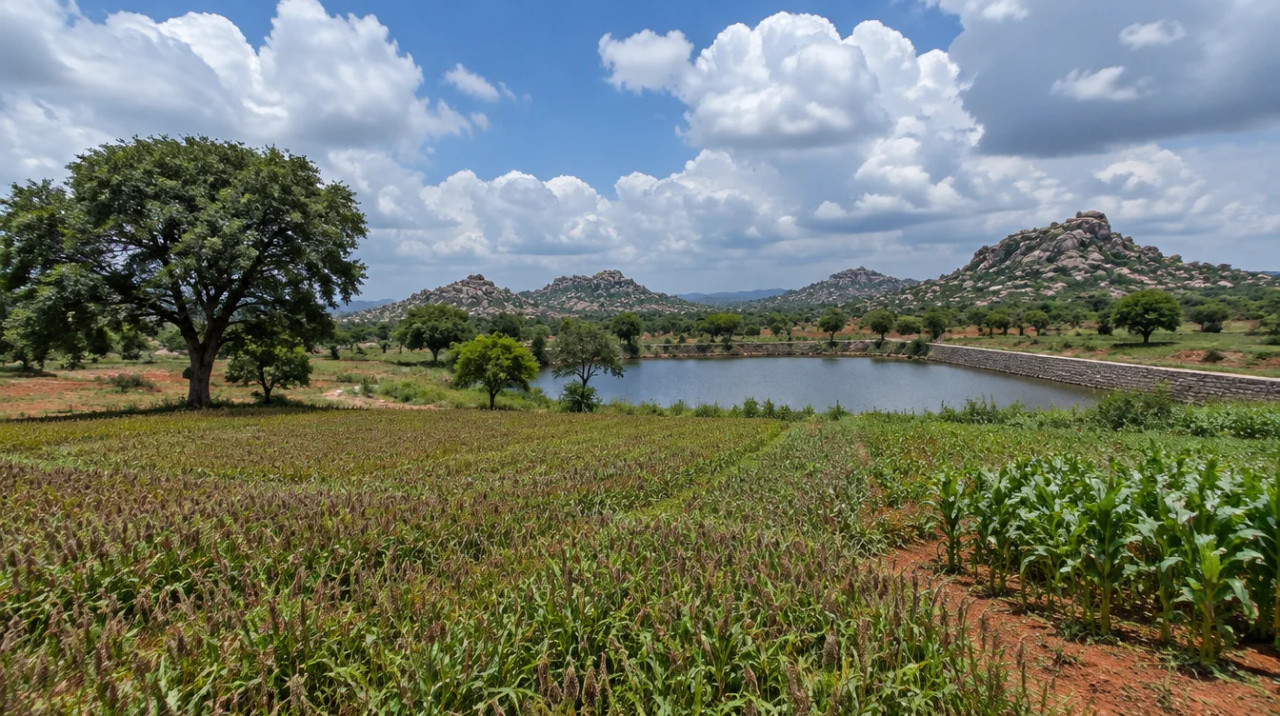
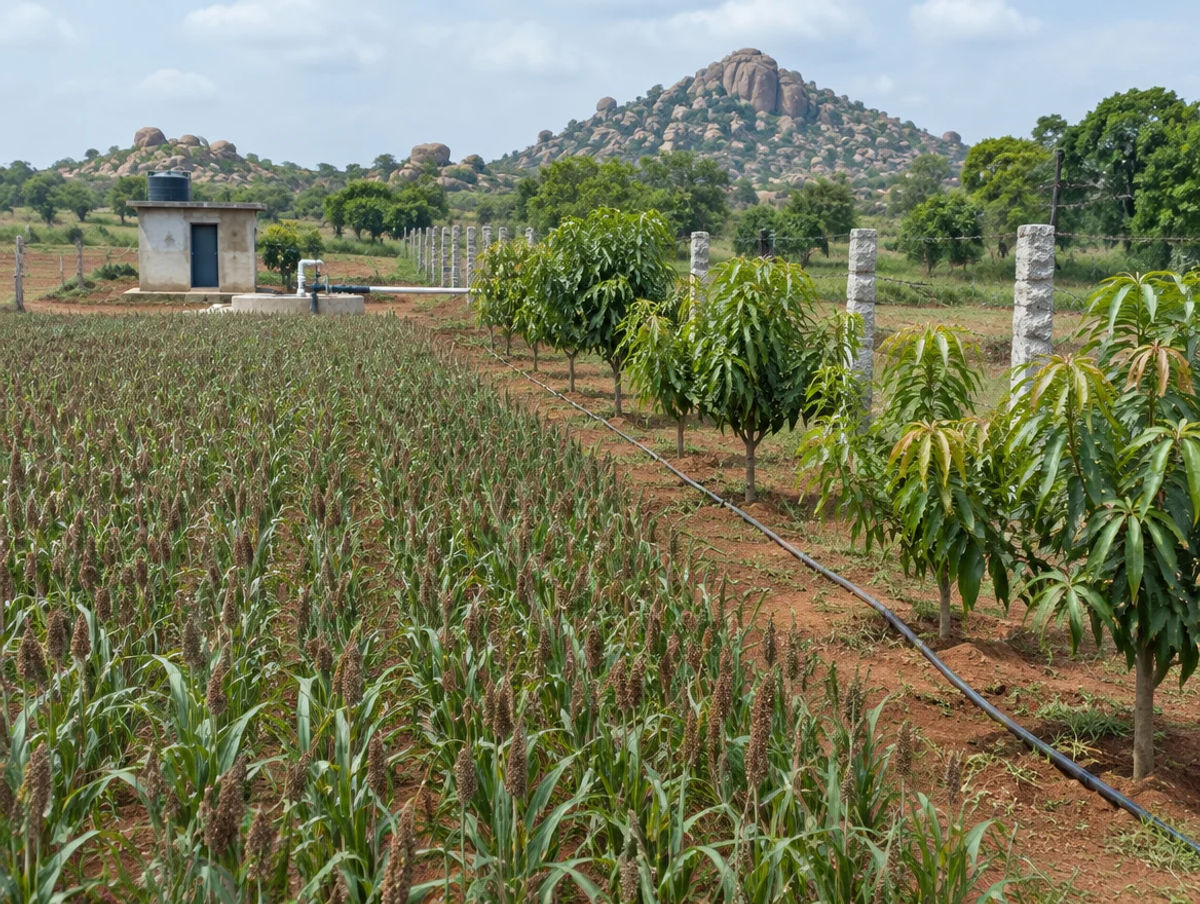
The Old Mysore plateau around Bengaluru, Mysuru, Mandya, Tumakuru, Kolar, Chikkaballapura and Chamarajanagar: red soil, granite hills and tanks, with ragi, maize, mulberry for silk, mango, coconut and vegetables, and canal paddy and sugarcane in Mandya under the Kaveri. This is where most farm plots for city buyers are sold, and where groundwater is under the most strain.
- Ragi, silk, mango, coconut
- Tank and borewell irrigation
- Closest to Bengaluru
The coast and the Malnad
Dakshina Kannada, Udupi and Uttara Kannada on the coast, and Kodagu, Chikkamagaluru, Hassan and Shivamogga in the Ghats, get heavy rain. Areca, coconut, pepper, cashew and paddy on the coast give way to coffee, cardamom, pepper and areca estates in the hills. Estates change hands slowly, and forest, sensitive zones and landslides shape what can be done with them.
- Coffee, areca, pepper
- Heavy rainfall
- Estates and forest
The northern plains
Belagavi, Dharwad, Vijayapura, Bagalkote, Kalaburagi, Bidar, Raichur and their neighbours are black-soil country of jowar, tur, cotton, sunflower, chilli and sugarcane, with grapes and pomegranate in Vijayapura and canal paddy in the Tungabhadra and Upper Krishna commands. Holdings are larger and land cheaper, and much of it is rain-fed.
- Tur, jowar, cotton, sugarcane
- Canal commands of the Krishna and Tungabhadra
- Larger, cheaper holdings
Groundwater
Karnataka is a hard-rock state where borewells dry out quickly. The 2024 assessment put the stage of extraction at 68.44%, and the report flagged heavy extraction in Kolar, Bengaluru Urban, Chikkaballapura, Bengaluru Rural and Chitradurga (Deccan Herald, December 2025[8]), exactly the belt where many farm plots are sold to city buyers. Do not buy a dry-land plot near Bengaluru on the strength of one working borewell; ask for its yield in summer and look at neighbouring wells.
Land use
Agricultural land is classed by soil and irrigation, and its class decides the ceiling units and whether Section 80 applies. RTCs carry the class, the crop, the source of title and any remarks; kharab land within a survey number (rocks, tanks, roads) may not belong to the holder at all. Land inside a city’s master plan area may be converted more easily, while green-belt zoning can stop it.
Crops
Karnataka grows most of India’s coffee and silk and a large share of its areca. Ragi and maize dominate the southern plateau, tur, jowar and cotton the north, sugarcane the canal belts of Mandya, Belagavi and Bagalkote, and paddy the coast and the canal commands. Horticulture, mango in Kolar and Chikkaballapura, grapes and pomegranate in the north, vegetables and flowers around Bengaluru, earns the best returns on small plots that have water.
At a glance
Karnataka’s regions side by side
| Region | Price series | Land and water | Note |
|---|---|---|---|
| Bengaluru region (Bengaluru Urban, Bengaluru Rural, Bengaluru South, Tumakuru, Kolar, Chikkaballapura) | None published* | Red soil, tanks, borewells under strain | Highest prices and demand; expressway and airport plans |
| Old Mysore south (Mysuru, Mandya, Chamarajanagar, Hassan) | None published* | Kaveri canals, red and mixed soils | Weekend and farm plots on the Mysuru road; sugarcane and paddy |
| Coast (Dakshina Kannada, Udupi, Uttara Kannada) | None published* | Heavy rain, laterite, rivers | Areca and coconut gardens; Mangaluru port |
| Malnad (Kodagu, Chikkamagaluru, Shivamogga) | None published* | Ghats, forest, high rainfall | Coffee and pepper estates; homestays; landslide and forest limits |
| Kittur Karnataka (Belagavi, Dharwad, Haveri, Gadag, Vijayapura, Bagalkote) | None published* | Black soil; Krishna and Ghataprabha canals | Hubballi-Dharwad and Belagavi hubs; sugarcane and grapes |
| Kalyana Karnataka (Kalaburagi, Bidar, Yadgir, Raichur, Koppal, Ballari, Vijayanagara) | None published* | Dry black soil; Tungabhadra and Upper Krishna commands | Cheapest farmland; Article 371J region; steel and cement |
*No newspaper or official source publishes a farmland price series for Karnataka’s regions. The groups follow the regions buyers use, not revenue divisions. The same state laws apply everywhere; what changes is water, the share of granted land, and distance from Bengaluru.
Farmland India view
Why investors look at Karnataka
An open market since 2020, a city that sets the price, and water that sets the value of a farm.
Bengaluru sets the price
Almost all of the state’s land investment demand is tied to Bengaluru. Plots within reach of the city, its expressways and its industrial belts have risen fastest and stay the most liquid. Further out, farmland is priced as farmland, and a story about the city spreading to it may take decades to come true.
The 2020 reform widened the buyer pool
With the farmer and income tests gone, companies, trusts and salaried buyers can purchase directly. That has pulled in managed-farmland projects and institutional buyers, and it means a buyer no longer needs the workarounds that once made titles messy. The ceiling and the PTCL Act still apply.
Conversion is quicker, not automatic
The 2025 rules promise master-plan conversion without the DC and deemed approval after 30 days outside it. A plot that matches the zoning and has clean records can be converted faster than before, but a plot in a green belt or with a grant history cannot be rescued by deadlines.
Water decides farm value
In the dry belts around Bengaluru, Kolar and Chitradurga, a plot with an assured water source is worth far more than one without. Canal command land in Mandya or the Krishna and Tungabhadra belts, and the wetter Malnad, carry less water risk.
Budget for 7.6% and a higher guidance value
Duty and fee now come to about 7.6% of the higher of price and guidance value, and a new guidance value revision was in the pipeline in 2026. Register sooner rather than later once you are sure of the title.
Confirm the RTC, the mutation history, any grant or PTCL entry, the land class, the ceiling and the conversion order before you pay an advance.
STRAIGHT TALK
Risks & challenges in Karnataka
What can undo a land deal in Karnataka
Granted and PTCL land
A sale of land granted to an SC/ST family without government permission can be declared void and the land restored, and since 2023 there is no time limit. Look at the source of title on the RTC and the mutation register for any grant or Darkhast entry.
Unconverted layouts
Farmland cut into plots and sold as a layout without conversion and planning approval is common around Bengaluru and other cities. Such plots can be refused building permission and services, and violations now carry heavy fines recorded on the RTC.
Ceiling and Section 80
A buyer whose family already holds farmland must stay within 20 units, and A-class irrigated land bought for non-farm use can fall foul of Section 80. Add up holdings and check the land class first.
Kharab and government land
Rocks, tanks, roads and grazing land inside a survey number may belong to the government. Government land encroached on and later “sold” has no valid title, and the state is mapping its land to evict encroachers.
Dead owners and missing succession
Lakhs of parcels are still recorded in the names of dead owners. A sale by one heir without the others, or without a succession record, invites a challenge.
Groundwater failure
Borewells in the Bengaluru, Kolar and Chitradurga belts fail often. Do not pay for water you have not tested in summer.
Forest, elephant corridors and the Malnad
Estates and plots near reserved forest, eco-sensitive zones and elephant corridors in Kodagu, Chikkamagaluru, Hassan and the Ghats face limits on clearing and building, and the hills carry landslide risk.
Airport and corridor speculation
Land around rumoured airport sites and unannounced ring roads is often sold at a premium on stories. Pay for what is notified and built.
Who to contact
Local revenue & registration offices
Land administration in Karnataka runs through the Revenue Department, four Regional Commissioners and 31 Deputy Commissioners. For any plot, start with the Village Accountant and the Revenue Inspector of the hobli, who keep the village accounts and inspect the land, and the taluk office, where the Tahsildar handles mutation, disputes and the RTC through Bhoomi. The Assistant Commissioner hears revenue appeals and PTCL cases, and the Deputy Commissioner decides conversion outside master plan areas under Section 95. Surveys, sketches and phodi (subdivision) are done by the Survey, Settlement and Land Records department. Deeds are registered at the sub-registrar office through Kaveri 2.0, and guidance values can be searched there.
KEEP EXPLORING
Districts & guides in Karnataka
COMMON QUESTIONS
Frequently asked questions
Everything buyers, NRIs and investors ask before their first reviewed farmland purchase in Karnataka.
Visit full wiki01 of 04
Can a non-farmer buy agricultural land in Karnataka?
Yes. The 2020 amendment deleted Sections 79A, 79B and 79C of the Karnataka Land Reforms Act, which had barred people with high non-farm income and most companies and trusts. The ceiling, the PTCL Act and the NRI rules still apply.
02 of 04
What are stamp duty and registration charges in Karnataka?
Newspapers report 5% stamp duty plus about 0.6% cess and surcharge, and a 2% registration fee since 31 August 2025, about 7.6% in all, on the higher of the deed price and the guidance value. Confirm the amount in Kaveri 2.0 before you pay.
03 of 04
What is PTCL land and why does it matter?
It is land granted by the government to Scheduled Caste or Scheduled Tribe families. It cannot be sold without the government’s prior permission, and a sale made without it can be declared void and the land restored, with no time limit since 2023.
04 of 04
Do I need conversion to build a farmhouse or layout?
Yes, non-farm use needs conversion under Section 95 of the Karnataka Land Revenue Act. Since 2025, land in a matching master plan zone can be converted by the planning authority, and elsewhere the Deputy Commissioner is to decide within 15 days.
Transparency
Sources and references
Law
- [1]Karnataka Land Reforms (Amendment) Ordinance, 2020 (PRS copy) — prsindia.org
- [2]Karnataka PTCL (Amendment) Bill, 2023 (LA Bill No. 15 of 2023) — prsindia.org
News and analysis
- [3]Deccan Herald: registration fee hiked to 2% (30 Aug 2025) — deccanherald.com
- [4]King Stubb & Kasiva: Karnataka doubles registration fee (2025) — ksandk.com
- [5]Deccan Herald: deals across Karnataka may get costlier from April (2026) — deccanherald.com
- [6]Deccan Herald: Ramanagara becomes Bengaluru South (May 2025) — deccanherald.com
- [7]South First: Bhoo Guarantee and the land records clean-up (18 Feb 2026) — thesouthfirst.com
- [8]Deccan Herald: groundwater overuse in five districts (2 Dec 2025) — deccanherald.com
- [9]Deccan Herald: Karnataka leg of Bengaluru–Chennai expressway (23 Aug 2025) — deccanherald.com
- [10]Free Press Journal: second airport to come up in South Bengaluru (8 Jul 2026) — freepressjournal.in
- [11]Cyril Amarchand Mangaldas: Karnataka Land Revenue (Amendment) Rules, 2025 (Nov 2025) — corporate.cyrilamarchandblogs.com
Further reading
Data-currency note: sources were read in November 2026. Rules, fees and infrastructure timelines change often; check the linked source and the relevant office before relying on any figure.
For developers
Ready to explore Karnataka farmland?
Browse reviewed projects and individual land parcels across Karnataka — or if you own land here, list it with platform review and reach serious buyers.