
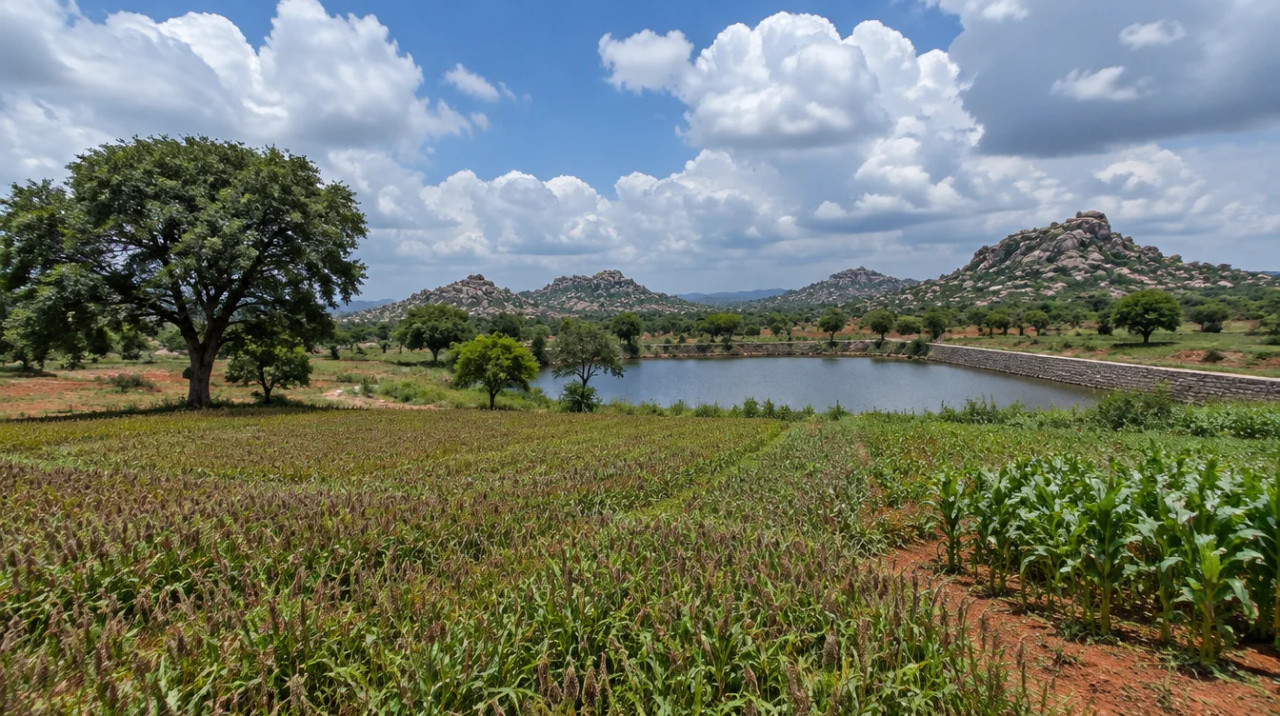
District guide
Buying Land in Kodagu
Kodagu is a Western Ghats coffee district where slope, tenure and forest edges decide whether a plot is worth buying. Check records before any deposit.
Madikeri
Headquarters
5.5 lakh
Population, Census 2011 (approx.)
68.44%
Statewide groundwater extraction, 2024 (CGWB)
Oct 2023
Guidance value last revised statewide
*Indicative range across districts and land types. Stamp duty, registration and conversion charges are additional. Local measurement units vary — every listing states the unit it is priced in. Not a valuation or an offer.
District land record — Kodagu
Rev. 2026 · Farmland India desk
State
Karnataka
Headquarters
Madikeri
Key places
Madikeri · Virajpet · Somwarpet · Kushalnagar · Ponnampet
Land records
RTC (record of rights, tenancy and crops) and mutation on Bhoomi; deeds on Kaveri 2.0
Who can buy
Any Indian citizen can buy agricultural land; the farmer-only bar was removed in 2020, and land granted to SC/ST families needs prior Government permission to sell.L1[1]
Land law is state law. These rules are maintained on the Karnataka page and apply to every district within it.
Kodagu — land purchase legal rules
Karnataka opened its farmland market in 2020. Before that, a buyer had to be a farmer, earn less than a set income from other sources, and could not be a company or trust; those tests are gone. What still decides a deal is the land itself: the ceiling, whether it was granted to a Scheduled Caste or Scheduled Tribe family, its class, and whether it has been converted for the use you have in mind. The points below come from the amending ordinance, the bills and court judgments; they describe the rules, not how they apply to a given plot. This block applies to every district page in the state.
Who can buy: The Karnataka Land Reforms (Amendment) Ordinance, 2020 (No. 13 of 2020, 13 July 2020) deleted Sections 79A, 79B and 79C of the Karnataka Land Reforms Act, 1961, with effect from 1 March 1974. Those sections barred anyone with non-farm income of Rs 25 lakh a year or more, and most companies, trusts and societies, from acquiring farmland. Pending cases under them stood abated. The ordinance was replaced by the Karnataka Land Reforms (Second Amendment) Act, 2020. Today an Indian individual, company or trust can buy agricultural land, within the ceiling.
What Section 80 still restricts: Section 80 now restricts transfers only where the land is A-class irrigated land that will not be used for agriculture, or where the buyer would cross the ceiling. Ask whether the plot is irrigated A-class land if you do not plan to farm it.
The ceiling: Section 63 measures the ceiling in units, one unit being an acre of A-class land or an equivalent area of poorer land under Schedule I. The 2020 changes doubled the limit from 10 to 20 units for an individual or a family of up to five, with more for larger families up to 40 units. Because drier land counts for less, the ordinary acreage you can hold is larger in dry districts than in canal-irrigated ones. Add up all farmland your family unit already holds in the state before you buy.
SC/ST granted land: Under Section 4 of the Karnataka Scheduled Castes and Scheduled Tribes (Prohibition of Transfer of Certain Lands) Act, 1978 (the PTCL Act), land granted by the government to SC/ST families cannot be transferred without the government’s prior permission, and the Assistant Commissioner can declare a sale void and restore the land. The 2023 amendment (LA Bill No. 15 of 2023) removed any time limit for invoking the Act. Courts still look at the facts, as the Supreme Court did in Seethamma v. State of Karnataka, 7 May 2026, but a buyer should treat any grant, Darkhast or PTCL entry on the RTC as high risk.
Conversion: Agricultural land needs conversion under Section 95 of the Karnataka Land Revenue Act, 1964 before any non-farm use. The Karnataka Land Revenue (Amendment) Rules, 2025 (notification RD-LGP/6/2025, 17 September 2025) say that inside an approved master plan zone whose use matches, no Deputy Commissioner permission is needed and the planning authority issues a digitally signed conversion certificate; outside, the DC is to decide within 15 days, with deemed approval after 30. Small industries up to two acres and renewable energy projects need no separate conversion, and violations can draw fines of up to Rs 1 lakh plus Rs 2,500 a day, recorded on the RTC (Cyril Amarchand Mangaldas, November 2025).
Stamp duty and fee: Duty and fee are charged on the higher of the deed price and the guidance value. The registration fee was raised from 1% to 2% from 31 August 2025, taking the reported total on a sale deed, with 5% stamp duty and about 0.6% in cess and surcharge, from 6.6% to 7.6% (Deccan Herald, 30 August 2025). Check the figure Kaveri 2.0 calculates before you pay.
NRI and OCI buyers: Under the RBI Master Direction on immovable property, NRIs and OCIs may not acquire agricultural land, a farmhouse or plantation property in India except by inheritance. The 2020 changes in Karnataka do not alter that. Our NRI guide covers the options.
- Farmer test removed in 2020
- Companies and trusts can buy
- Ceiling: 20 units
- PTCL: granted land protected
- Conversion under Section 95
- Registration fee 2%
- NRIs: inheritance only
Kodagu — district-specific notes
Karnataka dropped its farmer-only rules in 2020, so an Indian citizen can buy agricultural land in Kodagu if the seller has a clean title. The state legal block above sets out the law; this is the local checklist.
Who owns it. Land that the Government granted to a Scheduled Caste or Scheduled Tribe family cannot be sold without prior Government permission under Section 4 of the Karnataka SC/ST (Prohibition of Transfer of Certain Lands) Act, 1978 (PTCL Act). A 2023 amendment removed any time limit for the Assistant Commissioner to act, so an old sale can still be reopened.L2[2] Look for a grant entry on the RTC and ask the seller for the grant order.
Ceiling. After the 2020 amendment the ceiling under Section 63 is 20 units for an individual or a family of up to five, and up to 40 units for larger families; the old income and company bars (Sections 79A to 79C) were deleted from 1 March 1974.L1[1]
Conversion. Non-farm use needs conversion under Section 95 of the Karnataka Land Revenue Act, 1964. Under the 2025 rules as summarised by a law firm, land inside a master plan zone for a matching use is converted by the planning authority; outside it the Deputy Commissioner has 15 days, with deemed approval after 30.N3[4] Check the RTC for a conversion entry before you accept any plot.
NRIs. NRIs and OCIs cannot buy agricultural land, plantation or farmhouse land except by inheritance.L3[3] See the NRI land guide.
Read the Karnataka state page for the full legal block. Confirm every point with the Tahsildar and the sub-registrar before paying anything.
- Farmer-only bar removed 2020
- Ceiling 20 to 40 units
- SC/ST granted land (PTCL Act)
- Conversion under Section 95
- NRIs: inheritance only
District overview
Kodagu — a Western Ghats coffee district where slope and tenure decide the deal
Kodagu (Coorg) is a small, hilly district in the Western Ghats of south-west Karnataka, with its headquarters at Madikeri. At the 2011 Census it had about 5.5 lakh people, one of the smallest populations among Karnataka’s districts. Its taluks include Madikeri, Virajpet, Somwarpet, Kushalnagar and Ponnampet. The river Kaveri rises here, and the land is a mix of coffee estates, paddy valleys, forest and reserved areas.
Most land here is coffee and spice estate land, with pepper, cardamom and orange alongside. That shapes the market: estates are bought and sold as working plantations, and small farm plots are often cut from larger holdings. Kodagu also has its own historical land tenures, including the local term jamma (a tenure on which many Kodava family holdings rest), so the tenure entry on the RTC is worth having explained by the Tahsildar before any deposit.
The district’s recent history matters to land buyers. Heavy monsoon rain in August 2018 caused floods and landslides in the Madikeri area, and slope stability is now a first question for any hill plot. Wildlife and forest areas, including parts bordering Nagarhole and the Brahmagiri and Pushpagiri ranges, also sit close to private land.
There is no newspaper-reported or official price for land in Kodagu, so the price table is empty by design. A per-acre figure for a coffee estate depends on the planted area, the yield record, the water source and the road, so ask for the estate’s accounts as well as the deed.
Read the state page for the rules that apply across Karnataka, and check the live land for sale page for reviewed land in Kodagu.
- Madikeri
- Virajpet
- Somwarpet
- Kushalnagar
- Ponnampet
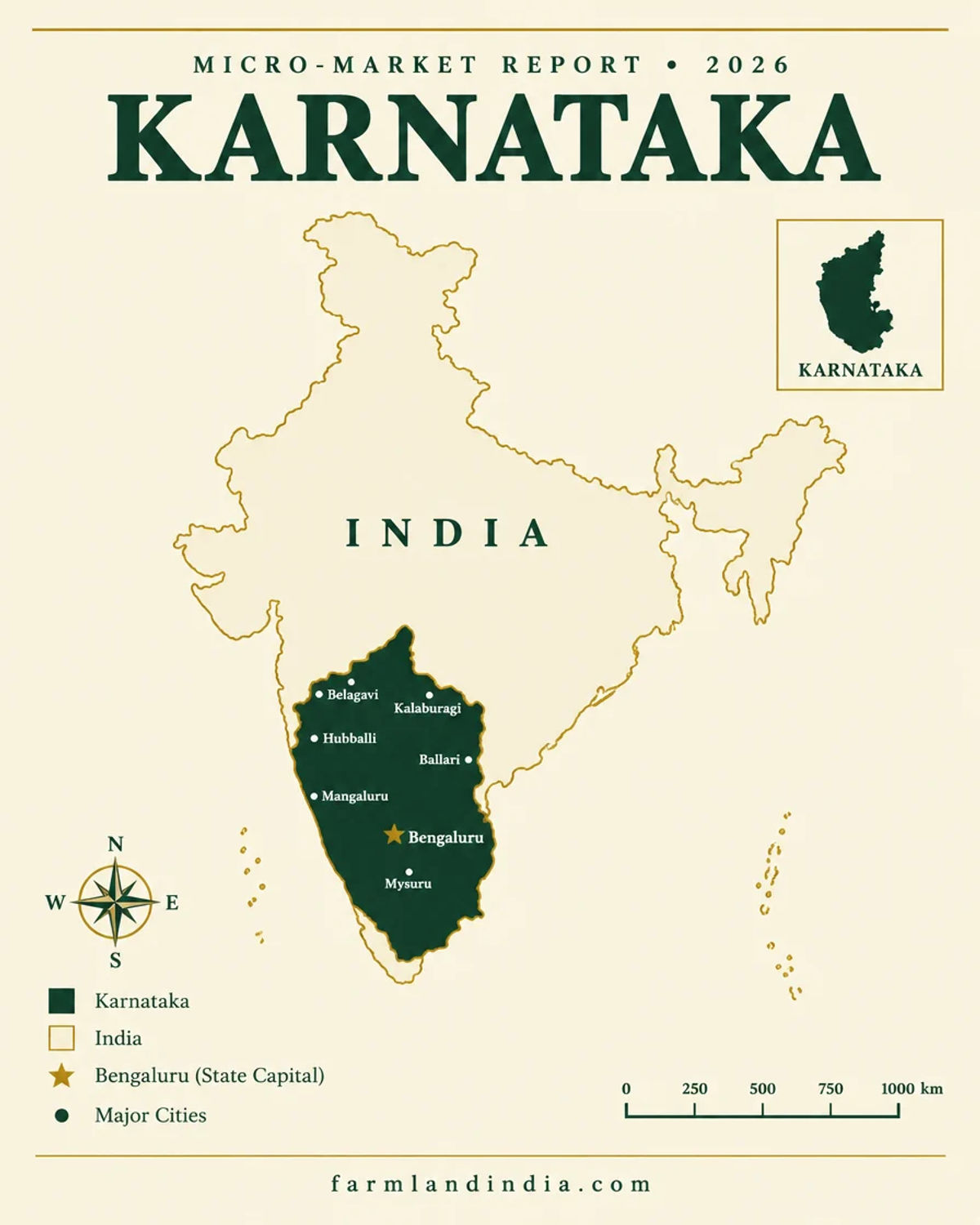
Transaction costs
Stamp duty & registration in Kodagu
About 5%
Stamp duty on sale (reported)
Reported at 5%, plus about 0.6% cess and surcharge. This figure is from press and law-firm reports; check the official schedule with the sub-registrar.N1[5]
2%
Registration fee (reported)
Raised from 1% to 2% from 31 August 2025, per press and law-firm reports.N1[5]
Oct 2023
Last statewide guidance value
A review averaging 15 to 20% was proposed from 1 April 2026; ask the sub-registrar whether it was notified.N2[6]
Deeds are registered on Kaveri 2.0 at the sub-registrar’s office, and the Bhoomi portal carries the RTC and mutation. Ask the sub-registrar for the guidance value of the survey number before you agree a price. Kodagu has sub-registrar offices at its taluk towns; use the one that covers the village.
Know the belt
What is moving prices in Kodagu
Estate land and homestay plots; no official price for either.
Coffee and spice estates
Somwarpet, Madikeri, Virajpet
Estates are valued on planted area, shade trees, yield and water. Estates may be exempt from ordinary ceiling limits in some cases, and the old estate-ceiling rules were not touched by the 2020 changes.
Check: Ask for the RTC, estate accounts, the coffee-board registration and any ceiling or conversion order.
Homestay and second-home plots
Madikeri, Kushalnagar, Virajpet edges
Small plots near towns and roads are sold for homes and homestays. These need conversion from agricultural use, and the district’s slope and drainage risks make a site visit in the rain a basic step.
Check: Ask for the conversion order, the building approval and a drainage and slope check.
Paddy valley and river-bank land
Kaveri tributary valleys
Low valley land is productive but floods; land near the Kaveri and its tributaries may include river-margin or government land.
Check: Ask the Tahsildar whether any part of the survey number is river-margin, forest or government land.
Asking prices
No official land prices are published for Kodagu, and listing-site asking prices are not registered deals. Treat any per-acre figure from an agent as a claim to test against registered deeds in the same village.
Connectivity
How Kodagu connects — road, rail and air
Hill roads link the district to Mysuru and the coast; no drive times are given.
🚗 By road
✈️ By air
🚆 By rail
Road widening and any rail survey bring acquisition notices. Ask the Tahsildar whether any notice covers the survey number, and ignore brochure distances that are not backed by a map.
Growth catalysts
Upcoming infrastructure & developments
No district-specific project with a dated source was confirmed.
00Open
02Catalysts
Agriculture & terrain
Soil, crops & water in Kodagu
Coffee, pepper, cardamom and paddy in a high-rainfall belt.
Crops
Kodagu’s agriculture is plantation-led.
- Coffee (robusta and arabica) under shade trees
- Pepper, cardamom and orange
- Paddy in the valley floors
Water and rain
Kodagu receives heavy monsoon rain and the Kaveri rises in the district, so groundwater is rarely the constraint; slope and drainage are. The statewide groundwater extraction stage was 68.44% in 2024, and Kodagu was not among the districts named for heavy extraction.N5[7]
- Ask where the estate’s water comes from in the dry season
- Check stream and spring rights with neighbours
- Visit the plot in the monsoon, not only in the dry months
Landslide-prone slopes
Steep plots, cut-and-fill road edges and drainage lines are the usual failure points. A geotechnical opinion is cheap against the cost of a failed slope.
Estate records
Ask for several years of crop sales, labour records and the coffee registration. Estate land is often sold on stated yield.
At a glance
Kodagu vs. nearby districts
| District | Land and water | What links it to Kodagu |
|---|---|---|
| Hassan | Coffee and plateau district to the north-east | Shares the Western Ghats plantation belt at Sakleshpur |
| Mysuru | Larger market to the east | The main city and airport for Kodagu buyers |
| Dakshina Kannada | Coastal district to the west | Linked by ghat roads; different coastal land market |
| Chikkamagaluru (Chikmagalur) | Coffee district to the north | Another large coffee-estate market |
These districts do not share price levels, so compare registered deeds village by village, not district averages.
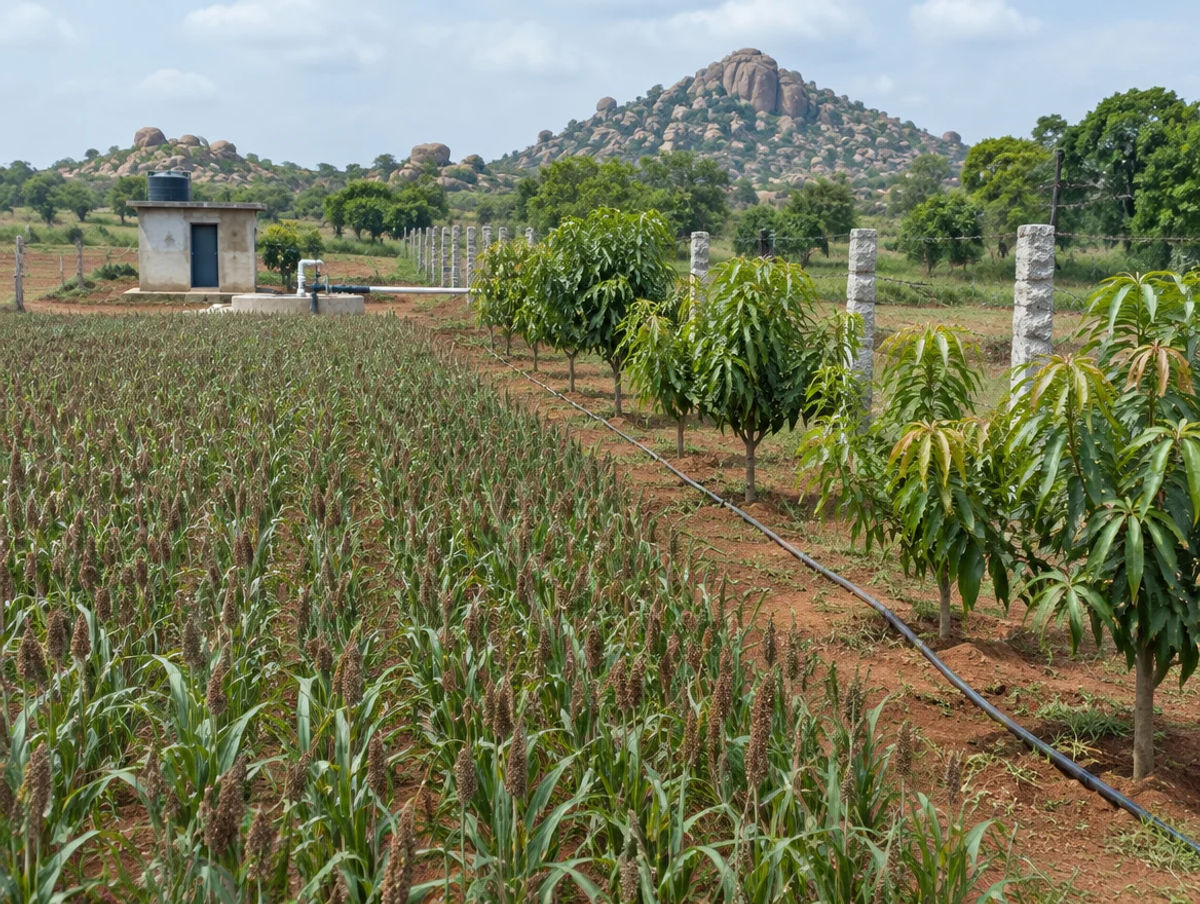
Farmland India view
Why investors look at Kodagu
Four things to settle before a deposit.
Understand the tenure
Ask the Tahsildar to explain the tenure entry on the RTC, including any jamma holding, and whether it limits sale, partition or conversion.
Walk the slope in the rain
The 2018 floods and landslides make slope, drainage and the approach road the first checks for any hill plot.
Value an estate on records
For a working estate, ask for yield and sales records, not an agent’s per-acre claim.
Check forest and wildlife boundaries
Ask the forest range office whether the plot adjoins a reserved forest or wildlife area, and about any elephant corridor.
NRIs and companies
NRIs and OCIs cannot buy agricultural land, plantation or farmhouse land except by inheritance; Indian companies and trusts are no longer barred since 2020.
Confirm the RTC, mutation, conversion status and any acquisition notice directly with the Tahsildar and sub-registrar; these are not certified by Farmland India’s review.
STRAIGHT TALK
Risks & challenges in Kodagu
Slope, tenure and paper-title risks to clear before paying a deposit.
Landslides and flooding
Heavy rain in August 2018 caused floods and landslides in the Madikeri area. Slope, drainage and the approach road are real risks on hill plots.
Forest, wildlife and tenure complications
Estate boundaries can touch reserved forest, and historical tenures can limit what a holder may sell. A clean-looking RTC does not answer both questions.
Granted (Darkhast) land
Land granted by the Government to SC/ST families cannot be sold without permission. A registered deed does not protect a buyer if the grant conditions were breached, so ask for the grant order and trace every owner since.
Plots sold from unconverted farm land
Selling plots out of agricultural land without conversion and layout approval is a common pitfall near towns. Check the conversion entry on the RTC and the approving authority before you pay a booking amount.
Old records and deceased owners
Many RTCs still show deceased owners; the state has been clearing them through its E-Pouthi mutation drive. Insist on a mutation in the seller’s name before the sale.
Who to contact
Local revenue & planning offices
Start at the Deputy Commissioner’s office in Madikeri for district-level questions, the Tahsildar of the taluk for the RTC, tenure, mutation and conversion, the forest range office for estate edges, and the sub-registrar for the encumbrance certificate and guidance value on Kaveri.
COMMON QUESTIONS
Frequently asked questions
Everything buyers, NRIs and investors ask before their first reviewed farmland purchase in Kodagu.
Visit full wiki01 of 04
Can an outsider buy a coffee estate in Kodagu?
Karnataka removed its farmer-only and income bars in 2020, so any Indian citizen can buy if the seller has a clean title. Check the tenure entry, ceiling position and any conversion order with the Tahsildar first.
02 of 04
Why does slope matter so much in Kodagu?
Heavy rain in August 2018 caused floods and landslides around Madikeri. Steep plots and cut-and-fill road edges need a slope and drainage check before purchase.
03 of 04
Is there a railway in Kodagu?
A Mysuru–Kushalnagar line has been proposed for years but there is no current approval.
04 of 04
Can NRIs buy coffee land in Kodagu?
No, except by inheritance. NRIs and OCIs cannot acquire agricultural land, plantation or farmhouse land under the RBI Master Direction.
Transparency
Sources and references
Law and courts
- [1][1]PRS: Karnataka Land Reforms (Amendment) Ordinance, 2020 (No. 13 of 2020)— prsindia.org — prsindia.org
- [2][2]PRS: Karnataka Land Reforms (Amendment) Bill, 2023 (Bill 15 of 2023, PTCL Act)— prsindia.org — prsindia.org
- [3][3]RBI: Master Direction on acquisition and transfer of immovable property in India— rbi.org.in — rbi.org.in
News
- [4][4]Cyril Amarchand Mangaldas: Karnataka Land Revenue Rules amendment 2025, Nov 2025— corporate.cyrilamarchandblogs.com — corporate.cyrilamarchandblogs.com
- [5][5]Deccan Herald: registration fee hiked to 2%, 30 Aug 2025— deccanherald.com — deccanherald.com
- [6][6]Deccan Herald: guidance value revision proposed from April 2026, Jan 2026— deccanherald.com — deccanherald.com
- [7][7]Deccan Herald: groundwater overuse in five districts in Karnataka, 2 Dec 2025— deccanherald.com — deccanherald.com
Rates, notifications and project status change; confirm the current position with the office concerned before relying on any figure above.
For developers
Ready to explore Kodagu farmland?
Browse reviewed projects and individual land parcels across Kodagu — or if you own land here, list it with platform review and reach serious buyers.