
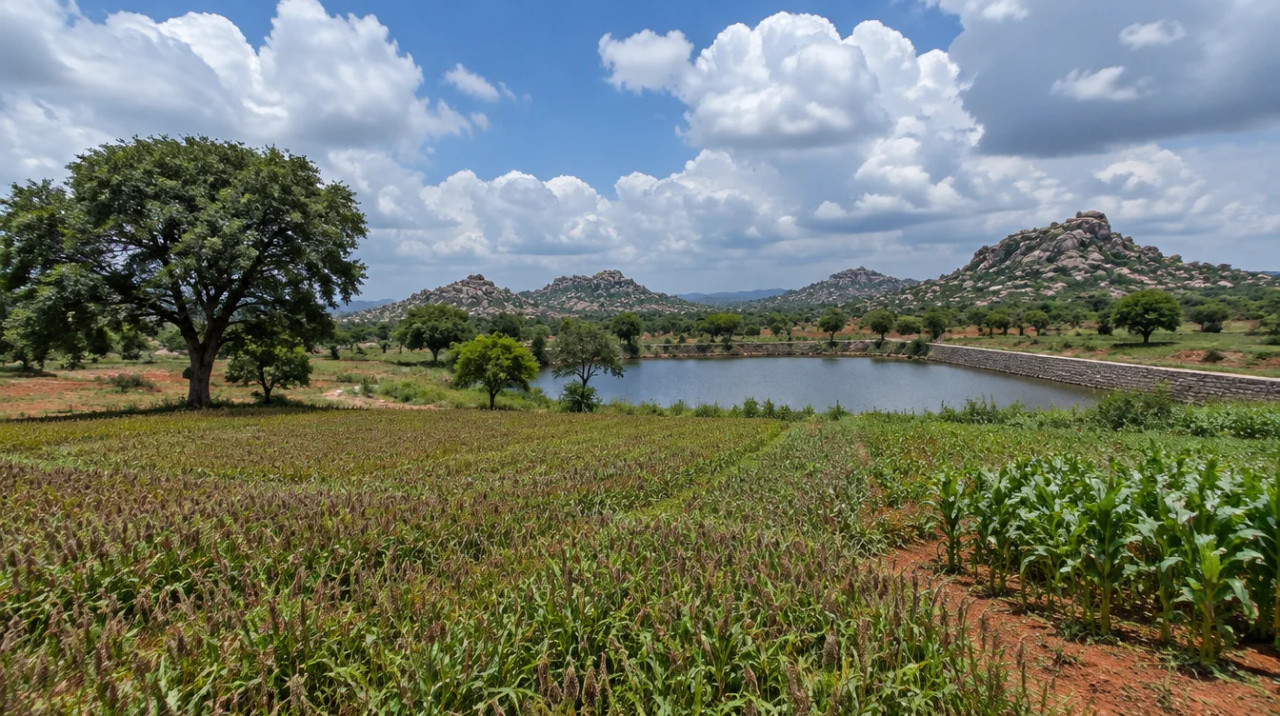
District guide
Buying Land in Dakshina Kannada
The Mangaluru coast and its Western Ghats hinterland: port and industry on one side, arecanut and rubber gardens on the other, with CRZ and forest limits in between.
Joint working group formed Nov 2025 (feasibility only)
Shiradi Ghat tunnel
About 20,668 sq km, 1,449 villages in Karnataka
Western Ghats ESA draft
2% from 31 Aug 2025
Registration fee (reported)
68.44%
Karnataka groundwater stage (CGWB 2024)
District land record — Dakshina Kannada
Rev. 2026 · Farmland India desk
State
Karnataka
Formation and division
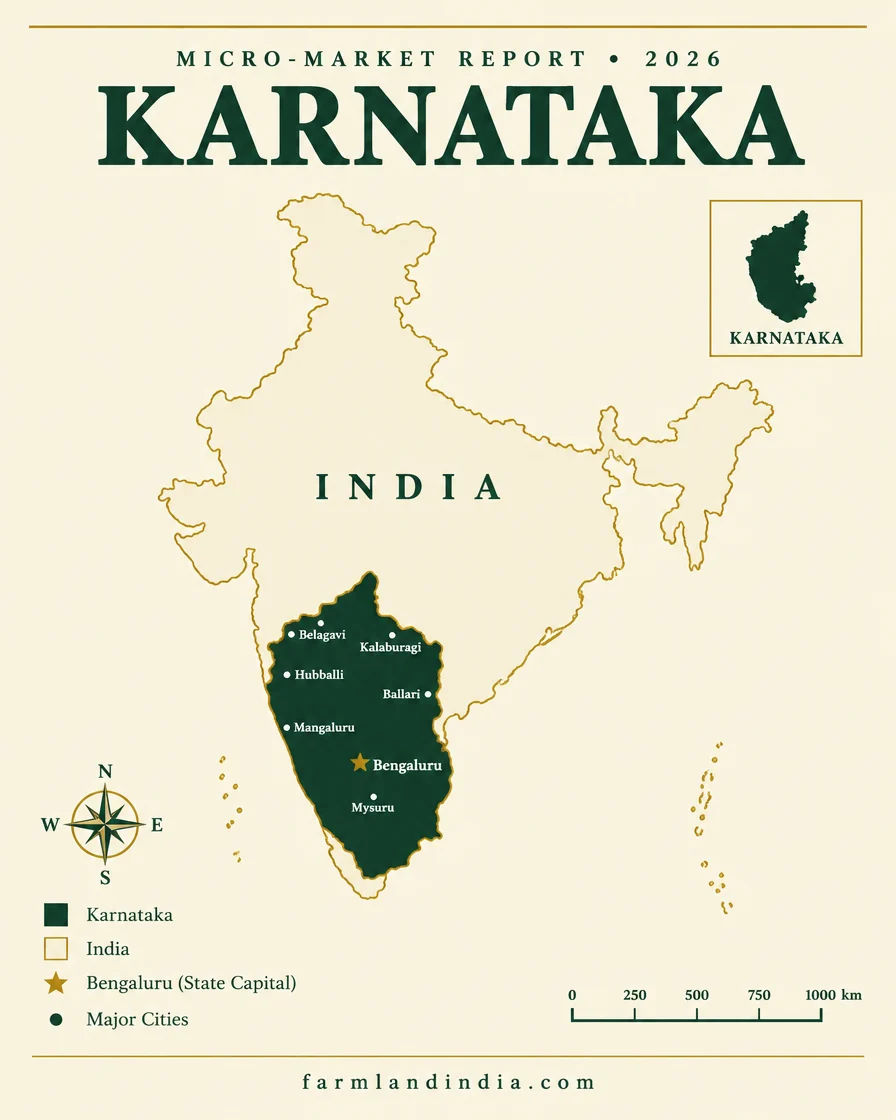
Headquartered at Mangaluru (Mangalore), in the Mysuru division on the Arabian Sea coast.
Key markets
Mangaluru · Bantwal · Moodbidri · Puttur · Belthangady · Sullia · Ullal
Demand anchors
New Mangalore Port and industry · Mangaluru airport · NH-66 and NH-75 · arecanut, coconut and rubber farming · pilgrim and beach tourism
Rail
On the Konkan and Southern Railway lines; the Shiradi Ghat integrated rail and road tunnel is at a feasibility stage (Swarajya[8])
Size and population
For area and population, use the Census 2011 district handbook
Pricing unit
No official price series is published; ask the sub-registrar for recent registered sale values in the village. quote any land per acre and check the area on the RTC (Record of Rights, Tenancy and Crops) at Bhoomi[4]
Local units
Karnataka records give area in acres and guntha (1 guntha = 1/40 acre, about 1,089 sq ft). Ask for the area in acres and guntha as it appears on the RTC, and for registration details on Kaveri[5]
Land and water
Very high rainfall on the coast and Ghats; check the district groundwater category with the Central Ground Water Board. Karnataka overall was at 68.44% stage of extraction in 2024
Land law is state law. These rules are maintained on the Karnataka page and apply to every district within it.
Dakshina Kannada — land purchase legal rules
Karnataka opened its farmland market in 2020. Before that, a buyer had to be a farmer, earn less than a set income from other sources, and could not be a company or trust; those tests are gone. What still decides a deal is the land itself: the ceiling, whether it was granted to a Scheduled Caste or Scheduled Tribe family, its class, and whether it has been converted for the use you have in mind. The points below come from the amending ordinance, the bills and court judgments; they describe the rules, not how they apply to a given plot. This block applies to every district page in the state.
Who can buy: The Karnataka Land Reforms (Amendment) Ordinance, 2020 (No. 13 of 2020, 13 July 2020) deleted Sections 79A, 79B and 79C of the Karnataka Land Reforms Act, 1961, with effect from 1 March 1974. Those sections barred anyone with non-farm income of Rs 25 lakh a year or more, and most companies, trusts and societies, from acquiring farmland. Pending cases under them stood abated. The ordinance was replaced by the Karnataka Land Reforms (Second Amendment) Act, 2020. Today an Indian individual, company or trust can buy agricultural land, within the ceiling.
What Section 80 still restricts: Section 80 now restricts transfers only where the land is A-class irrigated land that will not be used for agriculture, or where the buyer would cross the ceiling. Ask whether the plot is irrigated A-class land if you do not plan to farm it.
The ceiling: Section 63 measures the ceiling in units, one unit being an acre of A-class land or an equivalent area of poorer land under Schedule I. The 2020 changes doubled the limit from 10 to 20 units for an individual or a family of up to five, with more for larger families up to 40 units. Because drier land counts for less, the ordinary acreage you can hold is larger in dry districts than in canal-irrigated ones. Add up all farmland your family unit already holds in the state before you buy.
SC/ST granted land: Under Section 4 of the Karnataka Scheduled Castes and Scheduled Tribes (Prohibition of Transfer of Certain Lands) Act, 1978 (the PTCL Act), land granted by the government to SC/ST families cannot be transferred without the government’s prior permission, and the Assistant Commissioner can declare a sale void and restore the land. The 2023 amendment (LA Bill No. 15 of 2023) removed any time limit for invoking the Act. Courts still look at the facts, as the Supreme Court did in Seethamma v. State of Karnataka, 7 May 2026, but a buyer should treat any grant, Darkhast or PTCL entry on the RTC as high risk.
Conversion: Agricultural land needs conversion under Section 95 of the Karnataka Land Revenue Act, 1964 before any non-farm use. The Karnataka Land Revenue (Amendment) Rules, 2025 (notification RD-LGP/6/2025, 17 September 2025) say that inside an approved master plan zone whose use matches, no Deputy Commissioner permission is needed and the planning authority issues a digitally signed conversion certificate; outside, the DC is to decide within 15 days, with deemed approval after 30. Small industries up to two acres and renewable energy projects need no separate conversion, and violations can draw fines of up to Rs 1 lakh plus Rs 2,500 a day, recorded on the RTC (Cyril Amarchand Mangaldas, November 2025).
Stamp duty and fee: Duty and fee are charged on the higher of the deed price and the guidance value. The registration fee was raised from 1% to 2% from 31 August 2025, taking the reported total on a sale deed, with 5% stamp duty and about 0.6% in cess and surcharge, from 6.6% to 7.6% (Deccan Herald, 30 August 2025). Check the figure Kaveri 2.0 calculates before you pay.
NRI and OCI buyers: Under the RBI Master Direction on immovable property, NRIs and OCIs may not acquire agricultural land, a farmhouse or plantation property in India except by inheritance. The 2020 changes in Karnataka do not alter that. Our NRI guide covers the options.
- Farmer test removed in 2020
- Companies and trusts can buy
- Ceiling: 20 units
- PTCL: granted land protected
- Conversion under Section 95
- Registration fee 2%
- NRIs: inheritance only
Dakshina Kannada — district-specific notes
The Karnataka state page applies to Dakshina Kannada in full. Dakshina Kannada’s extra layers are the Coastal Regulation Zone on the shore and the Western Ghats forest rules in the east.
⚠ Along the shoreline, tidal rivers and backwaters, construction is limited by CRZ rules. The classification comes from the coastal zone management plan, not from the sale deed, so ask the district coastal zone authority or the Karnataka State Coastal Zone Management Authority for the plot’s zone.
⚠ In the east, the Western Ghats eco-sensitive draft issued on 27 July 2026 covers about 20,668 sq km and 1,449 villages in 10 Karnataka districts; the state legislature rejected it in its present form on 22 September 2026. The report names Udupi, Shivamogga, Chikkamagaluru and Hassan; ask the Tahsildar whether Dakshina Kannada villages are in it (The Week, 22 Sep 2026[9]).
⚠ The ceiling on agricultural land was raised by the 2020 amendment from 10 to 20 units for an individual or a family of up to five, with up to 40 units for larger families; the farmer-only, income and company bars were removed from 1 March 1974 (PRS, Ordinance 13 of 2020[10]). Ask for the RTC extent and any earlier declaration of surplus land.
⚠ Karnataka is cleaning up its records. A February 2026 report says 100 of 240 taluks had completed Bhu Suraksha digitisation, with roughly 69 crore pages scanned, and that parcels of deceased owners are being cleared under E-Pouthi (South First, 18 Feb 2026[11]). Do not assume your village is done; ask for the current RTC and the mutation order.
⚠ The 2025 change to the Land Revenue Rules decides how conversion works. Inside a master-plan zone, a matching use needs no District Commissioner permission and the planning authority issues a signed certificate; outside, the Deputy Commissioner decides within 15 days and approval is deemed after 30. Penalties reach Rs 1 lakh plus Rs 2,500 a day and are noted on the RTC (Cyril Amarchand Mangaldas, Nov 2025[3]).
⚠ Land granted to Scheduled Caste or Scheduled Tribe families under the 1978 Act cannot be sold without prior government permission, and the 2023 amendment removed any time limit on the Assistant Commissioner’s power to void a sale (PRS, Bill 15 of 2023[2]). Ask for the grant history of any plot in an older village.
NRI and OCI buyers cannot acquire agricultural land, a plantation or a farmhouse except by inheritance (RBI Master Direction[1]). See can NRIs buy agricultural land in India.
- Coastal Regulation Zone
- Western Ghats ESA draft
- Forest and kharab land
- Plantation and garden records
- Granted (PTCL) land
District overview
Dakshina Kannada — a port-and-plantation coast with CRZ and Ghat limits
Dakshina Kannada is Karnataka’s south coastal district, with the port city of Mangaluru, the New Mangalore Port and industries on the coast, and the Western Ghats to the east. The coast has paddy, coconut and cashew; the hills carry arecanut, rubber, cocoa and pepper gardens.
The market is shaped by Mangaluru’s urban growth, by buyers from the Gulf and the Mumbai and Bengaluru diaspora looking for houses or gardens near home, and by investors in garden and hill land. For NRIs, the RBI rule still applies: agricultural land and plantations are barred except by inheritance.
The infrastructure story is access. The Bengaluru–Mangaluru road over the Shiradi Ghat is the district’s bottleneck, and in November 2025 the Centre formed a joint working group of the road and rail ministries and NHAI to study an integrated rail and road tunnel; the group has only been asked to assess feasibility (Swarajya, 8 Nov 2025[8]).
There is no official price series published, so no price bands are shown. Prices differ greatly between the coastal strip, the Mangaluru edge and the hill taluks; compare the guidance value with registered deeds for the same village.
Houses on garden plots are the typical purchase around Mangaluru, Bantwal and Puttur. A garden plot is recorded by its trees and may be classed as agricultural or garden land, so a house on it usually needs a conversion order and local-body approval first. Ask the seller whether any earlier building was permitted, and whether the plot has a road that stays open in the monsoon.
Pilgrimage and beach tourism at Dharmasthala, Kukke Subramanya and the Mangaluru coast bring guesthouse and homestay demand. A visitor-facing use is a non-farm use, so the same conversion, CRZ and forest checks apply, and the tourism and local-body licences are separate steps.
Read this page with the Karnataka state page for the ceiling, SC/ST land, conversion and NRI rules, and browse . Udupi, Kodagu and Hassan are the nearest comparisons.
- Mangaluru
- Bantwal
- Moodbidri
- Puttur
- Belthangady
- Sullia
Transaction costs
Stamp duty & registration in Dakshina Kannada
5%
Stamp duty on sale, plus about 0.6% cess and surcharge
as reported by Deccan Herald, Aug 2025; check the official schedule with the sub-registrar
2%
Registration fee, from 31 Aug 2025
raised from 1%; reported by Deccan Herald and a law-firm note
About 7.6%
Total cost of transfer
reported; confirm the final figure with the sub-registrar before you pay
Stamp duty is charged on the higher of the sale price and the guidance value. The last statewide guidance-value revision took effect on 1 October 2023; the Central Valuation Committee met on 12 January 2026 to begin another revision, discussing an average rise of 15–20% from 1 April 2026,; ask the sub-registrar whether a new schedule has been notified (Deccan Herald[7]). The rise in the registration fee from 1% to 2% from 31 August 2025 is from press and law-firm reports (Deccan Herald, 30 Aug 2025[6]). Near Mangaluru, guidance values for garden land and for residential plots differ sharply; read the Kaveri entry for the exact survey number and land class.
Know the belt
What is moving prices in Dakshina Kannada
Buying belts and what to check.
Mangaluru and the city edge
District HQ · port and airport
Land at the city edge goes to residential layouts and small plots, with conversion and local-body approval the main steps.
Check: CRZ status, conversion order, and whether the plot is in a master-plan zone.
Bantwal and Moodbidri
East of the city · garden land
Garden, paddy and rubber land close to Mangaluru, popular with buyers wanting a house site on a garden plot.
Check: the RTC class (garden or paddy) and any conversion needed to build.
Puttur, Sullia and Belthangady
East · Western Ghats foothills
Arecanut, rubber and forest-edge plots. Forest and eco-sensitive rules matter most here.
Check: forest boundary, kharab entries and the ESA draft’s village list.
Asking prices
There is no newspaper or official asking-price series for farm land in Dakshina Kannada. Listing prices for similar plots vary widely, so treat any claim as unsourced and compare the guidance value with registered deeds in the same village.
Connectivity
How Dakshina Kannada connects — road, rail and air
A coastal hub with port, airport and railways, but a difficult Ghat road inland.
🚗 By road
✈️ By air
🚆 By rail
The tunnel would be a major change for inland access, but it is only at a feasibility stage.
Growth catalysts
Upcoming infrastructure & developments
One regional catalyst, still at study stage.
00Open
01Catalysts
Agriculture & terrain
Soil, crops & water in Dakshina Kannada
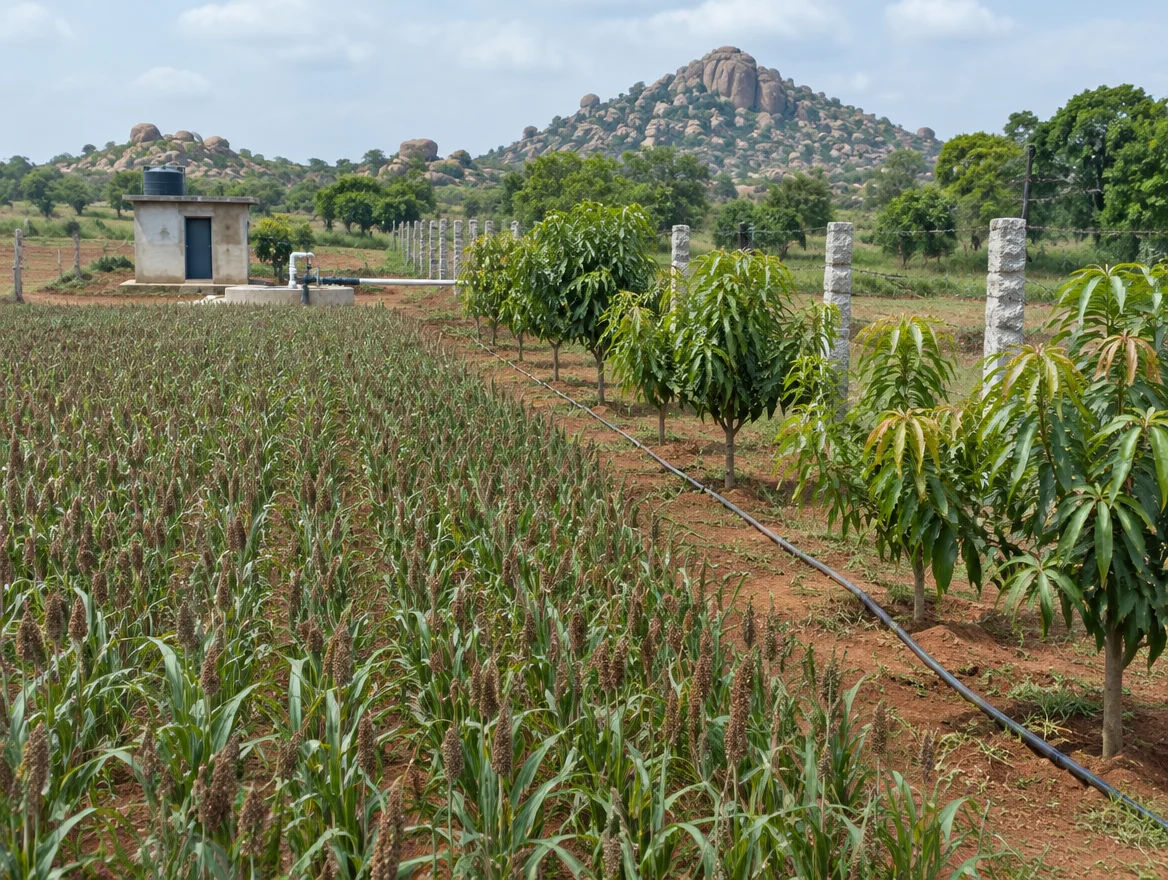
Arecanut, coconut, rubber and cashew gardens, with paddy on the low land.
Crops
Arecanut, coconut, rubber, cashew, cocoa, pepper and paddy are typical.
- Arecanut
- Coconut
- Rubber
- Cashew
- Paddy
Water
Rainfall is very high on the coast and Ghats. Karnataka’s overall stage of extraction was 68.44% in 2024.
- Heavy monsoon rain
- Wells and borewells in dry months
- Flood and landslip risk in places
Garden land
Garden land is valued on its trees and water; ask for the garden’s production records.
Monsoon access
Check road access in the rains before you pay.
At a glance
Dakshina Kannada vs. nearby districts
| District | Land and water | What links it to Dakshina Kannada |
|---|---|---|
| Udupi (north) | Coastal district with similar CRZ rules | Shared coastal and port economy |
| Kodagu (east) | Coffee and forest with strict rules | Ghat-edge rules are similar |
| Hassan (east) | Coffee and the Ghat road | The Shiradi Ghat route links them |
| Kasaragod (Keralam, south) | Border district across the state line | Different state rules |
Compare CRZ and forest status first, then guidance values.
Farmland India view
Why investors look at Dakshina Kannada
Five reasoned points for Dakshina Kannada, each tied to a source on this page.
The coast is regulated land
CRZ limits can decide whether a plot is usable; confirm first.
Garden land is income land
Arecanut and rubber gardens are valued on yield.
Access projects are early
The Shiradi tunnel is only at the feasibility stage.
NRIs face the RBI rule
Plantations and farmland are barred except by inheritance.
Compare Udupi
The neighbouring coastal district has similar rules and a different price level.
Confirm the Bhoomi RTC, survey and hissa number, mutation, conversion and acquisition status directly — these are not certified by Farmland India’s review.
STRAIGHT TALK
Risks & challenges in Dakshina Kannada
District-specific risks. Read the Karnataka state page for the general risks on ceiling, conversion and records.
CRZ and shoreline limits
Construction near the shore, creeks and backwaters may be limited; check CRZ.
Forest and ESA rules in the east
Foothill land may be forest or kharab; the ESA draft may apply.
Monsoon access and flood
Heavy rain can cut access and flood low land.
SC/ST granted land
Land granted under the 1978 Act may be unsaleable without government permission. Ask the seller for the grant order and mutation history.
Records and guidance value
Mismatches between the RTC, the survey sketch and the registered deed are a common source of disputes. Check the Bhoomi entry for the exact survey and hissa number and the Kaveri guidance value before you pay.
Access and boundaries
Many farm plots have no recorded access road. Check the village map and the survey sketch for a public path, walk the boundary, and confirm the hissa (sub-division) number before you pay a token amount.
Chain of title
Ask the seller for the earlier sale deeds, partition deeds and mutation orders going back at least 30 years, and have a local advocate read them. A clean RTC alone does not show who else may claim the plot.
Who to contact
Local revenue & planning offices
The Dakshina Kannada Deputy Commissioner’s office and the tahsildar offices handle revenue and land records; sale deeds are registered through Kaveri at sub-registrar offices. For CRZ, ask the district coastal zone authority; for forest status, the Deputy Conservator of Forests. A practical order of checks before paying: pull the current RTC on Bhoomi and read the owner, extent, crop and any loan or court entries; ask for the mutation order; search the encumbrance certificate on Kaveri for the years you need; compare the survey and hissa number with the village map and the field boundary; and, if the plot is meant for a non-farm use, ask for the conversion order or the planning-authority certificate. Keep a copy of each, and walk the plot with the seller and a neighbour.
COMMON QUESTIONS
Frequently asked questions
Everything buyers, NRIs and investors ask before their first reviewed farmland purchase in Dakshina Kannada.
Visit full wiki01 of 04
Is the Shiradi Ghat tunnel approved?
Not yet. In November 2025 the Centre formed a joint working group of road, rail and NHAI officials to assess the feasibility of an integrated rail and road tunnel on the Shiradi Ghat stretch; no approval, cost or timeline was reported.
02 of 04
What is the CRZ and why does it matter on the coast?
The Coastal Regulation Zone limits construction near the shoreline, tidal rivers and backwaters. Ask for the plot’s CRZ classification from the district coastal zone authority before you buy near the sea or a creek.
03 of 04
What are stamp duty and registration charges?
Reports put stamp duty at 5% plus about 0.6% cess and the registration fee at 2% from 31 August 2025. Confirm with the sub-registrar.
04 of 04
Can an NRI buy farm land in Dakshina Kannada?
No. NRIs and OCIs cannot acquire agricultural land, a plantation or a farmhouse except by inheritance.
Transparency
Sources and references
Law and courts
- [1]RBI Master Direction on acquisition of immovable property — rbi.org.in
- [2]PRS: Karnataka PTCL Amendment Bill 2023 — prsindia.org
- [3]Cyril Amarchand Mangaldas: Land Revenue Rules amendment 2025 — corporate.cyrilamarchandblogs.com
Government
- [4]Bhoomi, Karnataka land records — landrecords.karnataka.gov.in
- [5]Kaveri online, registration — kaverionline.karnataka.gov.in
News
- [6]Deccan Herald: registration fee hiked to 2% — deccanherald.com
- [7]Deccan Herald: guidance value revision — deccanherald.com
- [8]Swarajya: Shiradi Ghat integrated rail and road tunnel — swarajyamag.com
- [9]The Week: Karnataka rejects Western Ghats ESA draft — theweek.in
- [10]prsindia.org: PRS, Ordinance 13 of 2020 — prsindia.org
- [11]thesouthfirst.com: South First, 18 Feb 2026 — thesouthfirst.com
Data-currency note: sources are as of November 2026. Project status, the guidance value and land rules change often; check the linked source and the relevant office before relying on any figure.
For developers
Ready to explore Dakshina Kannada farmland?
Browse reviewed projects and individual land parcels across Dakshina Kannada — or if you own land here, list it with platform review and reach serious buyers.