
District guide
Buying Land in Tirunelveli
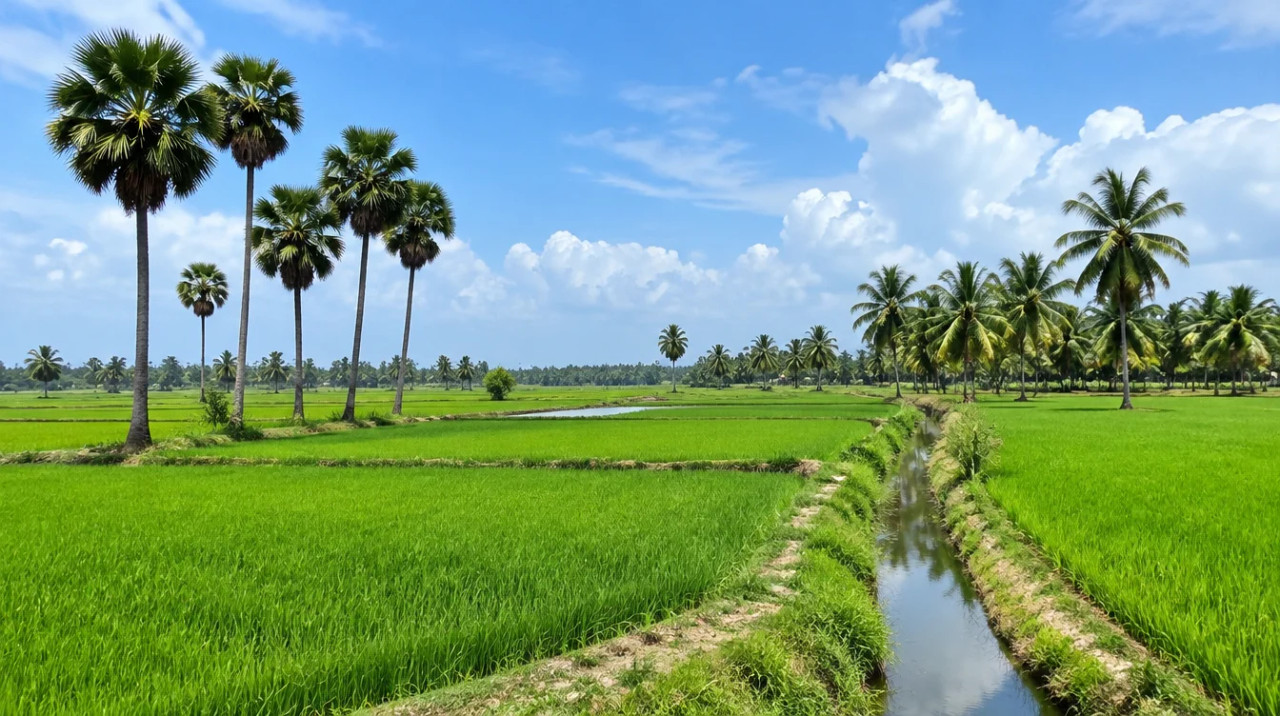
Tirunelveli is a Thamirabarani-watered district of paddy, banana and citrus land, with dry black-soil country to the east. Read the canal, tank and land-use points first.
736.9 mm
Normal annual rainfall (TNAU plan)
40.7%
Irrigated area watered by tanks (TNAU plan)
17.2%
Irrigated area watered by Thamirabarani canals
74.26%
Statewide groundwater extraction (CGWB 2024)
District land record — Tirunelveli
Rev. 2026 · Farmland India desk
State
Tamil Nadu
Headquarters
Tirunelveli
Key places
Tirunelveli · Palayamkottai · Ambasamudram · Nanguneri · Cheranmahadevi · Radhapuram
Who can buy
Any Indian citizen; no farmer-only or residency rule found. Assigned and Panchami land carry conditions.ICL[1]
Land law is state law. These rules are maintained on the Tamil Nadu page and apply to every district within it.
Tirunelveli — land purchase legal rules
Tamil Nadu lets any Indian buy farmland, and its records and registration are among the most computerised in the country. The risks lie in the history of the land: whether it was assigned by the government or granted as Panchami land, whether it is a water body or other government land recorded as poromboke, and whether the family’s holding stays within the ceiling. Land use change is a separate approval. The points below come from the statutes, gazette notifications and court orders; they describe the rules, not how they apply to a given plot. This block applies to every district page in the state.
Who can buy: The statutes reviewed contain no provision in Tamil Nadu law that limits the purchase of agricultural land to farmers or residents of the state. An Indian citizen who is not a farmer can buy and register farmland, subject to the ceiling, the conditions on assigned and Panchami land, and land use rules.
The ceiling: Under Section 5(1) of the Tamil Nadu Land Reforms (Fixation of Ceiling on Land) Act, 1961, a family of up to five members may hold 15 standard acres, plus 5 standard acres for each additional member. A standard acre converts wet and dry land into a common unit by class and assessment, so the ordinary acreage varies with the land. Section 7 bars holding above the ceiling, Section 22 lets the authorised officer void transfers made to defeat it, and land declared surplus vests in the government and cannot be validly sold by a private owner.
The 2024 change: L.A. Bill No. 28 of 2024, published on 29 June 2024, replaced "minor sons and unmarried daughters" with "minor children" in the definition of family, so that unmarried adult daughters hold land in their own right up to the ceiling, as unmarried adult sons already did.
Companies: Section 37-A lets an industrial or commercial undertaking apply to the government for permission to acquire or keep land above the ceiling, on conditions such as using it within a fixed time. Whether a company may buy farmland below the ceiling without permission depends on its objects and the use; take advice before signing.
Panchami and assigned land: Panchami land was assigned to the then Depressed Classes under Government Orders of 1892. The Madras High Court (P. Dhandapani, W.P. No. 3628 of 2013, 26 July 2018) described its conditions: no sale for ten years, and after that sale only to members of those classes; transfers in breach are illegal and the land can be resumed. Other assigned land carries the conditions in its assignment order. A clean recent chain of deeds does not cure a void transfer further back.
Change of land use: Outside planning areas, farmland is changed to other use under the Tamil Nadu Change of Land Use (Agriculture to Non-agriculture Purposes in Non-planning Areas) Rules, 2017: an application to the local authority in Form I with a scrutiny fee of Rs 1,000 a plot, concurrence of the Director of Town and Country Planning, and for wet land the Collector’s concurrence after checking that it is not a water body or poromboke. G.O. (Ms.) No. 149 of 31 July 2026 let the Director decide on dry land himself. Inside planning areas the master plan zoning governs.
Stamp duty and fee: A sale deed is reported to attract 7% in all, made up of 5% stamp duty and 2% transfer duty, on the guideline value or the price, whichever is higher (King Stubb & Kasiva), and a 2% registration fee, cut from 4% in the 2023-24 Budget. The 7% is as reported; the TNREGINET calculator gives the exact amount.
NRI and OCI buyers: Under the RBI Master Direction on immovable property, NRIs and OCIs may not acquire agricultural land, a farmhouse or plantation property in India except by inheritance. Our NRI guide covers the options.
- No farmer-only rule found
- Ceiling: 15 standard acres
- 2024: daughters hold in own right
- Panchami land protected
- Change of land use rules, 2017
- Registration fee 2%
- NRIs: inheritance only
Tirunelveli — district-specific notes
The state rules in the box above apply in Tirunelveli without change. The district points below are about how they show up here: river-bank and canal land, dry black-soil country to the east, and a district whose boundaries changed in 2019 when Tenkasi was split off.
The Thamirabarani and its canals and tanks create a lot of government water land recorded as poromboke. Ask the revenue office to confirm from the village map that the boundary does not include any.
Because Tenkasi was split from Tirunelveli in 2019, older documents may carry the old district name. A sub-registrar office and taluk office will tell you the correct jurisdiction for a village; check it before paying.
Land near the coast and near large energy installations can carry restrictions or acquisition history. Ask the revenue office whether any survey number is covered.
Small holdings are usually inherited by several heirs. Ask for the legal-heir records and make every co-owner a party to the sale deed; a patta in one name does not show who else has a share.
The family ceiling is 15 standard acres for a family of up to five, with five more standard acres for each additional member, and standard acres are worked out from wet and dry land by a fixed formula. A buyer of a few acres is far below it, but a seller who holds a lot of land in the family name may not be.ICL[1]
The state is amending how patta is transferred after registration. A revised order of 25 June 2026 allows joint family signatories and valid power-of-attorney holders, so ask the sub-registrar which process applies to your sale.PATTA[12]
Read the Tamil Nadu state page for the full legal block and the NRI land guide for the FEMA position. Confirm every point with the taluk office and the sub-registrar before paying anything.
- Any Indian can buy
- Ceiling: 15 standard acres
- Check Panchami and assigned land
- Poromboke is government land
- NRIs: inheritance only
District overview
Tirunelveli — a river-watered district of paddy, banana and citrus
Tirunelveli district lies in the far south of Tamil Nadu, between the Western Ghats in the west and the Gulf of Mannar in the south-east. The TNAU plan gives a geographical area of about 6,706 sq km and a net sown area of 175,100 hectares, but it describes an older, larger district that includes the Tenkasi area, split off in 2019.TN[7] The towns to know in today’s district are Tirunelveli, Palayamkottai, Ambasamudram, Nanguneri, Cheranmahadevi and Radhapuram.
Normal rainfall is 736.9 mm a year, of which 429.8 mm falls in the north-east monsoon and only 92.6 mm in the south-west monsoon. Soils are about 38% deep to very deep black and 24% deep to very deep red.TN[7] Paddy is the main crop at about 91,800 hectares, followed by black gram, citrus, maize, banana, sugarcane, cashew and mango.
Water is mixed. Tanks (2,172 of them) supply about 40.7% of irrigated land, Thamirabarani canals about 17.2%, and more than 82,000 open wells and nearly 25,000 pumpsets supply the rest.TN[7] The plan counted four blocks over-exploited, five semi-critical and ten safe.
Buyers are local families and returning migrants, investors looking for banana and paddy land on the river, and people with roots in the south who want land near home. There is no published price series for Tirunelveli or its towns.
The district is not on the state’s 2026-27 list of new SIPCOT sites, though the neighbouring Thoothukudi district has the largest listed total.IP30[11] there is no reported large land acquisition in the district for this page.[11]
Land records follow the state pattern. A buyer checks the patta (the owner’s title extract), the chitta (the village holding register entry), the Field Measurement Book sketch and the adangal (crop and occupancy register) on the state e-services portal, with an encumbrance certificate from TNREGINET.
Tirunelveli rewards patient buyers. The market is steadier than the metro belt and the prices of plots near the Thamirabarani follow the river’s reliability, not the news. A buyer who visits in both a wet and a dry season, checks the canal turn and walks the boundary with the village administrative officer will understand a plot better than any listing could explain.
Read the state page for the rules that apply across Tamil Nadu, and check the live land for sale page for reviewed land here.
- Tirunelveli
- Palayamkottai
- Ambasamudram
- Nanguneri
- Cheranmahadevi
Transaction costs
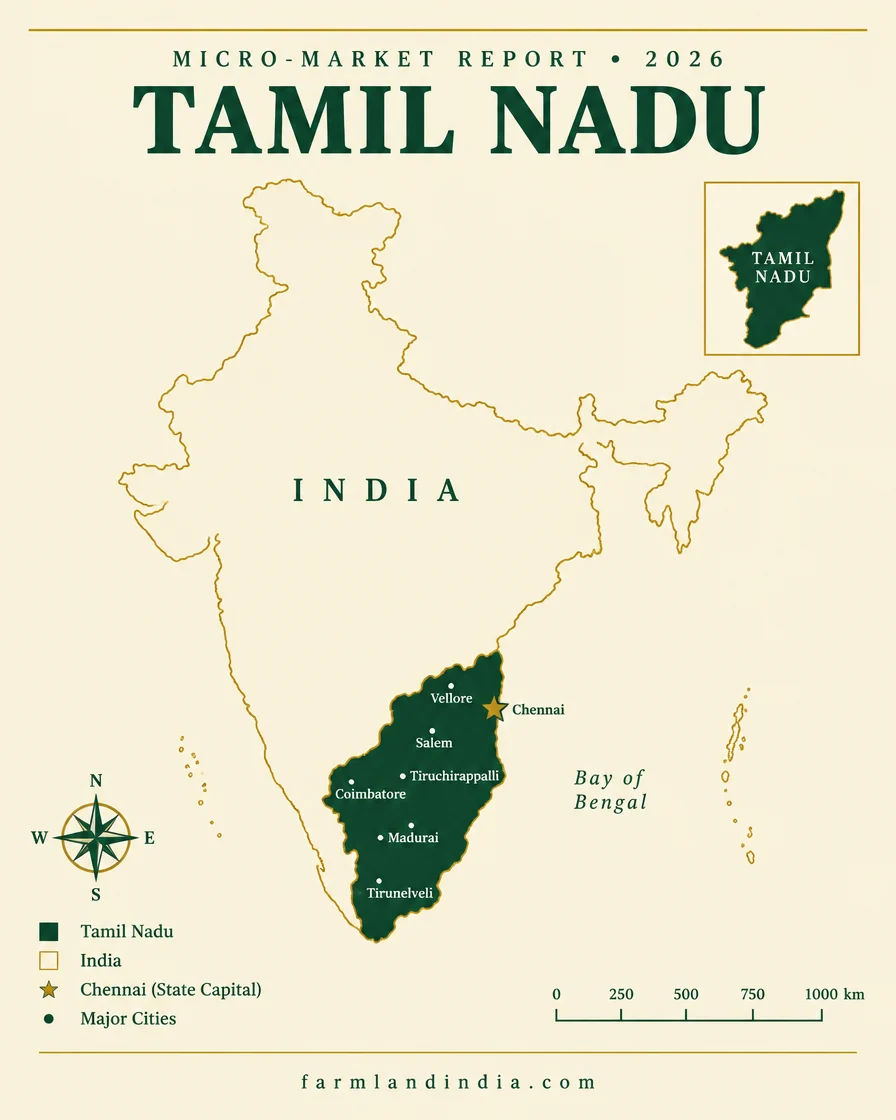
Stamp duty & registration in Tirunelveli
2%
Registration fee
Cut from 4% to 2% in the 2023-24 Budget and in force from 1 April 2023.PRS[5]
7% (reported)
Stamp duty on sale
Reported as 5% stamp duty plus 2% transfer duty, about 9% with the registration fee. Confirm the figure with the sub-registrar.KSK[8][8]
1 point lower
Women buyers
From 1 April 2025 the registration fee is 1 percentage point lower for houses, plots and agricultural land registered in a woman’s name, when the value is up to Rs 10 lakh.DTW[9]
Revised guideline values came into force on 1 July 2024 in every district except Viluppuram.GV[10] Check the guideline value of the survey number on TNREGINET before you agree a price in Tirunelveli, and compare it with what neighbouring plots actually registered for. Registration, the encumbrance certificate (villangam) and the guideline-value look-up all run on that portal.
Know the belt
What is moving prices in Tirunelveli
Reported developments only; no listing-site prices are used.
Thamirabarani canal land
The core paddy and banana belt
Canals and tanks water the largest share of irrigated land in the TNAU plan, so canal position is the first test of a plot.TN[7] there is no newspaper-reported price.[7]
Check: Ask neighbouring farmers when water reaches the plot and whether it reaches the tail end in a dry year.
Banana and citrus land
Horticulture plots
Citrus covers about 17,000 hectares and banana about 8,100 in the plan. Horticulture land is priced on the plot and the crop together.TN[7]
Check: Ask the age and number of trees or plants and write the count into the sale deed.
Town-edge plots
Tirunelveli, Palayamkottai, Nanguneri
Land near the larger towns is sold for housing. There is no official or newspaper price. Check any layout approval before paying.
Check: Compare the guideline value with recent registered values in the same village.
Asking prices
There is no newspaper-reported or official land prices for Tirunelveli. Treat any per-acre figure you are quoted as an opening position until you see registered deeds for the same village.
Connectivity
How Tirunelveli connects — road, rail and air
Road, rail and air access to Tirunelveli
Road
Air
Rail
Check the live route before you travel. Confirm them before you rely on them for a land decision.
Growth catalysts
Upcoming infrastructure & developments
Reported and operational items; check the notification for the actual village
01Open
02Catalysts
Agriculture & terrain
Soil, crops & water in Tirunelveli
District crop and rainfall figures where sourced (TNAU plan, 2006-10 averages)
Rainfall and soil
Normal rainfall is 736.9 mm a year, with 92.6 mm in the south-west monsoon and 429.8 mm in the north-east monsoon.TN[7]
- Deep to very deep black soils about 38% of area
- Deep to very deep red soils about 24%
- Moderately deep and shallow soils about 25%
Main crops
Paddy leads, followed by black gram, citrus, maize, banana, sugarcane, cashew and mango.TN[7]
- Paddy about 91,800 hectares
- Black gram about 17,700 hectares
- Citrus about 17,000 hectares
- Banana about 8,100 hectares
- Cashew about 5,000 hectares
Irrigation
Net irrigated area is 118,400 hectares against 56,700 rainfed, with tanks the largest source.TN[7]
- Tanks (2,172) about 47,800 hectares (40.7%)
- Thamirabarani canals about 20,200 hectares (17.2%)
- Open wells (82,718) and pumpsets (24,817)
- Bore wells under 1%
Groundwater
The plan counted 19 to 21 blocks: four over-exploited, five semi-critical and ten safe, none critical. That is old data. Statewide, the 2024 CGWB assessment puts Tamil Nadu’s extraction at 74.26%, so check the current category for the block before you drill or pay for a well.CGWB[6]
Reading the figures
The TNAU plan carries no date and uses 2006 to 2010 averages, and some of its tables do not add up. The plan appears to include blocks now in Tenkasi, and its block count does not reconcile. Use it for the pattern of crops and water, not for current acreage.
Cropping intensity
Cropping intensity is about 119%, higher than in most dry-interior districts, thanks to river and tank water.
At a glance
Tirunelveli vs. nearby districts
| District | Land and water | What links it to Tirunelveli |
|---|---|---|
| Tenkasi | Hill-foot canal and tank land to the north-west | Split off in 2019; covered on its own page |
| Thoothukudi | Dry coastal and industrial district to the east | Largest SIPCOT land bank in the 2026 note |
| Virudhunagar | Dry cotton and tank farming to the north | Lower rainfall than Tirunelveli |
| Kanniyakumari | Wet southern tip to the south-west | More rain, tiny holdings |
No official farmland price series is published for Tirunelveli. Ask the sub-registrar for recent registered sale values in the village you are looking at. Compare registered deeds village by village, and only for land with the same water source.
Farmland India view
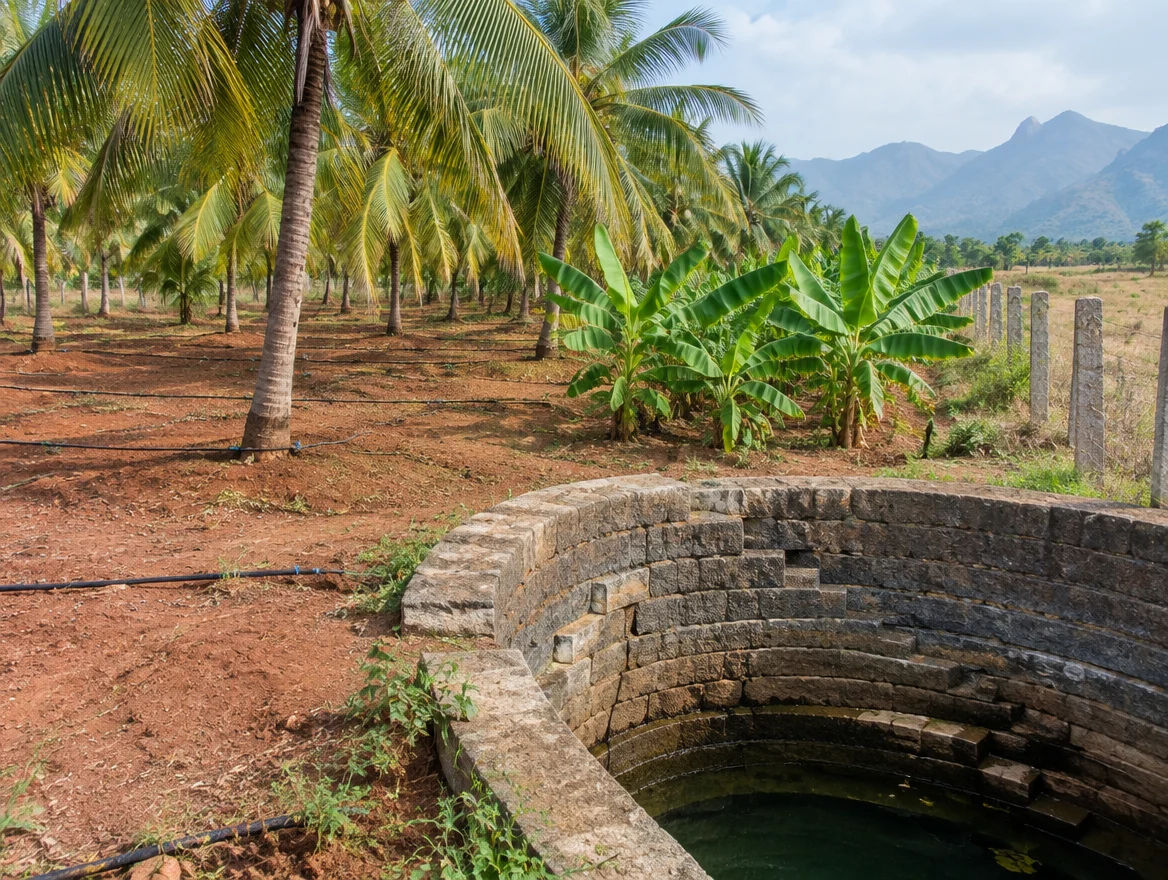
Why investors look at Tirunelveli
Five reasoned points for Tirunelveli, each tied to a source on this page.
Canal and tank rights are the value
Water supply sets the value of a plot. Ask how often water reaches it and in which seasons.TN[7]
Use the right district name
Older documents may carry the pre-2019 district name; confirm which sub-registrar office covers the village.
Banana and citrus need a crop check
Horticulture land is worth the crop. Check the age and health of what is planted.
Budget for the survey and legal work
A taluk survey, a legal-heir search and an encumbrance certificate cost little compared with the land. They are the cheapest protection against boundary and family-share disputes.
Compare deeds, not asking prices
Ask the sub-registrar for recent registered values in the same village and compare them with the guideline value on TNREGINET before you negotiate.
Confirm the patta, chitta, FMB sketch and encumbrance certificate with the taluk office and the sub-registrar; Farmland India’s review does not certify title.
STRAIGHT TALK
Risks & challenges in Tirunelveli
District-specific risks. Read the Tamil Nadu state page for the general risks on assigned land, poromboke and records.
Assigned and Panchami land
Land the government assigned to individuals, or Panchami land set aside for the Depressed Classes, can carry conditions on transfer. Ask for the assignment order and the history of the survey number.
Poromboke and water bodies
Tanks, channels, stream beds and other government land are recorded as poromboke, and a patta on such land can be cancelled. Compare the A-register with the village map.
Patta, chitta and FMB must agree
Compare the patta, chitta, Field Measurement Book (FMB) sketch and adangal. Differences in extent or owner name are common and delay mutation after the sale.
Farm use to non-farm use
Outside planning areas a change of land use follows the 2017 rules, with DTCP concurrence and the Collector for wet land.CLU[3] Do not pay for land on the promise of a later conversion.
River flood and canal breach
Land on the river flats can flood, and canal breaches affect nearby plots.
Boundary changes and old paperwork
The 2019 split of Tenkasi means old documents may name the wrong district or office.
Tail-end water shortage
In a dry year, tail-end plots can miss a crop when canal water is late.
Who to contact
Local revenue & planning offices
The District Collectorate is in Tirunelveli, with revenue divisional offices and taluk offices for Tirunelveli, Palayamkottai, Ambasamudram, Nanguneri, Radhapuram, Cheranmahadevi and the other taluks. Patta, chitta and FMB work goes through the taluk office, and sale deeds are registered at the sub-registrar office with jurisdiction over the village. Use eservices.tn.gov.in for patta and chitta and tnreginet.gov.in for registration and the encumbrance certificate.
KEEP EXPLORING
Explore more areas
Other districts in Tamil Nadu
- Ariyalur
- Chengalpattu
- Chennai
- Coimbatore
- Cuddalore
- Dharmapuri
- Dindigul
- Erode
- Kallakurichi
- Kancheepuram
- Kanniyakumari
- Karur
- Krishnagiri
- Madurai
- Mayiladuthurai
- Nagapattinam
- Namakkal
- Perambalur
- Pudukkottai
- Ramanathapuram
- Ranipet
- Salem
- Sivaganga
- Tenkasi
- Thanjavur
- The Nilgiris
- Theni
- Thoothukudi
- Tiruchirappalli
- Tirupathur
- Tiruppur
- Tiruvallur
- Tiruvannamalai
- Tiruvarur
- Vellore
- Viluppuram
- Virudhunagar
COMMON QUESTIONS
Frequently asked questions
Everything buyers, NRIs and investors ask before their first reviewed farmland purchase in Tirunelveli.
Visit full wiki01 of 04
Can an outsider buy farmland in Tirunelveli?
Yes. There is no Tamil Nadu rule that limits farmland purchase to farmers or residents. The checks that matter are the patta, whether the land is assigned or Panchami land, the family ceiling and any change of land use.
02 of 04
How is Tirunelveli farmland irrigated?
Tanks water about 41% of irrigated area in the TNAU plan and Thamirabarani canals about 17%, with wells and pumpsets supplying the rest. The plan describes an older, larger district that included the Tenkasi area.
03 of 04
Is groundwater a problem?
Four blocks were over-exploited, five semi-critical and ten safe in the plan, none critical. That is old data; check the current category for the block.
04 of 04
Are there Tirunelveli land prices on this page?
No. The table stays empty. Use the guideline value on TNREGINET and registered deeds for the same village.
Transparency
Sources and references
Law and courts
- [1][1]India Code: Tamil Nadu Land Reforms (Fixation of Ceiling on Land) Act, 1961— indiacode.nic.in — indiacode.nic.in
- [2][2]RBI: Master Direction on acquisition and transfer of immovable property in India— rbi.org.in — rbi.org.in
- [3][3]Tamil Nadu Government: Change of Land Use (agricultural to non-agricultural) in non-planning areas Rules, 2017 (G.O. 79)— kygcms.tn.gov.in — kygcms.tn.gov.in
- [4][4]Tamil Nadu Gazette: G.O.(Ms) No.149 H&UD, 31 Jul 2026, amending Rule 4— stationeryprinting.tn.gov.in — stationeryprinting.tn.gov.in
Government
- [5][5]PRS Legislative Research: Tamil Nadu Budget Analysis 2023-24— prsindia.org — prsindia.org
- [6][6]CGWB: Dynamic Ground Water Resources of Tamil Nadu, 2024— cgwb.gov.in — cgwb.gov.in
- [7][7]TNAU Agritech: District Agriculture Contingency Plan, Tirunelveli (undivided, includes Tenkasi blocks) (undated; 2006-10 data)— agritech.tnau.ac.in — agritech.tnau.ac.in
News
- [8][8]King Stubb & Kasiva: Changes in Tamil Nadu’s 2023 stamp duty and registration charges— ksandk.com — ksandk.com
- [9][9]DT Next: 1% registration fee concession for women, 31 Mar 2025— dtnext.in — dtnext.in
- [10][10]DT Next: New guideline values come into effect, 2 Jul 2024— dtnext.in — dtnext.in
- [11][11]DT Next: Tamil Nadu identifies 14,840 acres for 30 new industrial parks, 25 Aug 2026— dtnext.in — dtnext.in
- [12][12]DT Next: Automated patta transfer system updated, 4 Jul 2026— dtnext.in — dtnext.in
Fees, rules and infrastructure timelines change often; check the linked source and the relevant office before relying on any figure.
For developers
Ready to explore Tirunelveli farmland?
Browse reviewed projects and individual land parcels across Tirunelveli — or if you own land here, list it with platform review and reach serious buyers.