
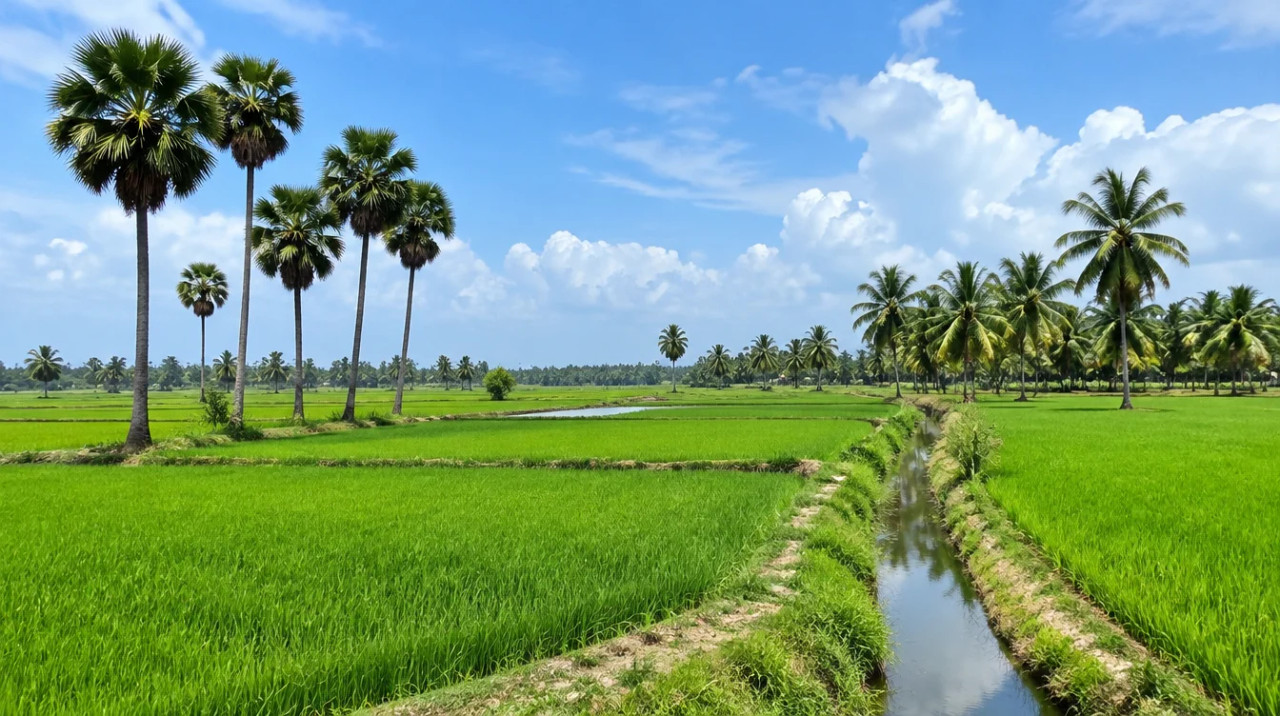
District guide
Buying Land in Salem
Salem is a hill-ringed district that farms mostly on open wells, and most of its blocks were over-exploited in the state plan. Check water, ceiling and records before you buy.
983 mm
Normal annual rainfall (TNAU plan)
14 of 20
Blocks over-exploited in TNAU plan
88.8%
Irrigated area watered by open wells
74.26%
Statewide groundwater extraction (CGWB 2024)
District land record — Salem
Rev. 2026 · Farmland India desk
State
Tamil Nadu
Headquarters
Salem
Key places
Salem · Attur · Mettur · Omalur · Edappadi · Sankagiri
Who can buy
Any Indian citizen; no farmer-only or residency rule found. Assigned and Panchami land carry conditions.ICL[1]
Land law is state law. These rules are maintained on the Tamil Nadu page and apply to every district within it.
Salem — land purchase legal rules
Tamil Nadu lets any Indian buy farmland, and its records and registration are among the most computerised in the country. The risks lie in the history of the land: whether it was assigned by the government or granted as Panchami land, whether it is a water body or other government land recorded as poromboke, and whether the family’s holding stays within the ceiling. Land use change is a separate approval. The points below come from the statutes, gazette notifications and court orders; they describe the rules, not how they apply to a given plot. This block applies to every district page in the state.
Who can buy: The statutes reviewed contain no provision in Tamil Nadu law that limits the purchase of agricultural land to farmers or residents of the state. An Indian citizen who is not a farmer can buy and register farmland, subject to the ceiling, the conditions on assigned and Panchami land, and land use rules.
The ceiling: Under Section 5(1) of the Tamil Nadu Land Reforms (Fixation of Ceiling on Land) Act, 1961, a family of up to five members may hold 15 standard acres, plus 5 standard acres for each additional member. A standard acre converts wet and dry land into a common unit by class and assessment, so the ordinary acreage varies with the land. Section 7 bars holding above the ceiling, Section 22 lets the authorised officer void transfers made to defeat it, and land declared surplus vests in the government and cannot be validly sold by a private owner.
The 2024 change: L.A. Bill No. 28 of 2024, published on 29 June 2024, replaced "minor sons and unmarried daughters" with "minor children" in the definition of family, so that unmarried adult daughters hold land in their own right up to the ceiling, as unmarried adult sons already did.
Companies: Section 37-A lets an industrial or commercial undertaking apply to the government for permission to acquire or keep land above the ceiling, on conditions such as using it within a fixed time. Whether a company may buy farmland below the ceiling without permission depends on its objects and the use; take advice before signing.
Panchami and assigned land: Panchami land was assigned to the then Depressed Classes under Government Orders of 1892. The Madras High Court (P. Dhandapani, W.P. No. 3628 of 2013, 26 July 2018) described its conditions: no sale for ten years, and after that sale only to members of those classes; transfers in breach are illegal and the land can be resumed. Other assigned land carries the conditions in its assignment order. A clean recent chain of deeds does not cure a void transfer further back.
Change of land use: Outside planning areas, farmland is changed to other use under the Tamil Nadu Change of Land Use (Agriculture to Non-agriculture Purposes in Non-planning Areas) Rules, 2017: an application to the local authority in Form I with a scrutiny fee of Rs 1,000 a plot, concurrence of the Director of Town and Country Planning, and for wet land the Collector’s concurrence after checking that it is not a water body or poromboke. G.O. (Ms.) No. 149 of 31 July 2026 let the Director decide on dry land himself. Inside planning areas the master plan zoning governs.
Stamp duty and fee: A sale deed is reported to attract 7% in all, made up of 5% stamp duty and 2% transfer duty, on the guideline value or the price, whichever is higher (King Stubb & Kasiva), and a 2% registration fee, cut from 4% in the 2023-24 Budget. The 7% is as reported; the TNREGINET calculator gives the exact amount.
NRI and OCI buyers: Under the RBI Master Direction on immovable property, NRIs and OCIs may not acquire agricultural land, a farmhouse or plantation property in India except by inheritance. Our NRI guide covers the options.
- No farmer-only rule found
- Ceiling: 15 standard acres
- 2024: daughters hold in own right
- Panchami land protected
- Change of land use rules, 2017
- Registration fee 2%
- NRIs: inheritance only
Salem — district-specific notes
The state rules in the box above apply in Salem without change. The district points below are about how they appear here: dry red-soil holdings on open wells, hill-foot land next to reserved forest, and a long record of land sold in small plots near the city.
Land near the Shevaroy and other hills can border reserved forest. Ask the forest range office whether the survey numbers or the approach path touch notified forest, and compare with the village map.
Salem city and its edge towns have many small plots cut from farm land. A plot sold without an approved layout is a farm sale and cannot normally be built on; check the approval number and the 2017 land-use rules before paying.CLU[3]
Small holdings are usually inherited by several heirs. Ask for the legal-heir records and make every co-owner a party to the sale deed; a patta in one name does not show who else has a share.
The family ceiling is 15 standard acres for a family of up to five, with five more standard acres for each additional member, and standard acres are worked out from wet and dry land by a fixed formula. A buyer of a few acres is far below it, but a seller who holds a lot of land in the family name may not be.ICL[1]
The state is amending how patta is transferred after registration. A revised order of 25 June 2026 allows joint family signatories and valid power-of-attorney holders, so ask the sub-registrar which process applies to your sale.PATTA[12]
If a seller says a plot has “conversion done”, ask for the approved order or the layout approval, not a patta that merely lists the land as dry. A patta shows classification, not permission to build.
Read the Tamil Nadu state page for the full legal block and the NRI land guide for the FEMA position. Confirm every point with the taluk office and the sub-registrar before paying anything.
- Any Indian can buy
- Ceiling: 15 standard acres
- Check Panchami and assigned land
- Poromboke is government land
- NRIs: inheritance only
District overview
Salem — a hill-ringed district on open-well farming
Salem district sits in the north-west of Tamil Nadu’s interior, ringed by hills and centred on the industrial and trading city of Salem. The TNAU district plan gives a geographical area of about 5,205 sq km and a net sown area of 205,100 hectares, with cropping intensity of about 110%.TN[7]
Normal rainfall is 983 mm a year, but 493 mm of it falls in the south-west monsoon and 301 mm in the north-east monsoon, so the pattern is more uneven than in the delta. Soils are mostly shallow to moderately deep red, with pockets of black soil. Sorghum covers 63,300 hectares in the plan, maize 41,700, paddy 32,600 and groundnut 24,400, with mango on 8,900 hectares and turmeric on 5,200.TN[7]
Water is what shapes the market. Open wells account for 88.8% of irrigated area in the plan and bore wells for 9.4%, with tanks only 1.4%. That makes farmers dependent on the water table, and the same plan counted 14 of 20 blocks over-exploited.TN[7] A buyer is therefore buying a well as much as a field.
The people who buy here are mostly local farming families, buyers from Salem city and the Bengaluru and Coimbatore corridors looking for mango or tapioca land, and small investors buying near the hill towns. The towns to know are Attur, Mettur, Omalur, Edappadi and Sankagiri; there is no published price series for any of them.
Land records follow the state pattern. A buyer checks the patta (the owner’s title extract), the chitta (the village holding register entry), the Field Measurement Book sketch and the adangal (crop and occupancy register), plus an encumbrance certificate from TNREGINET. Where land is sold by well, ask for the well’s record and any power connection papers as well.
Salem’s economy is more mixed than a farm map suggests. The city is a trading and manufacturing centre, Mettur on the Cauvery supplies water and power to the region, and the hill town of Yercaud draws weekend buyers. Each of these pulls land prices in its own direction, which is why a district-wide figure tells a buyer little. Compare a plot with others within a few kilometres that have the same water and the same road access.
Read the state page for the rules that apply across Tamil Nadu, and check the live land for sale page for reviewed land here.
- Salem
- Attur
- Mettur
- Omalur
- Edappadi
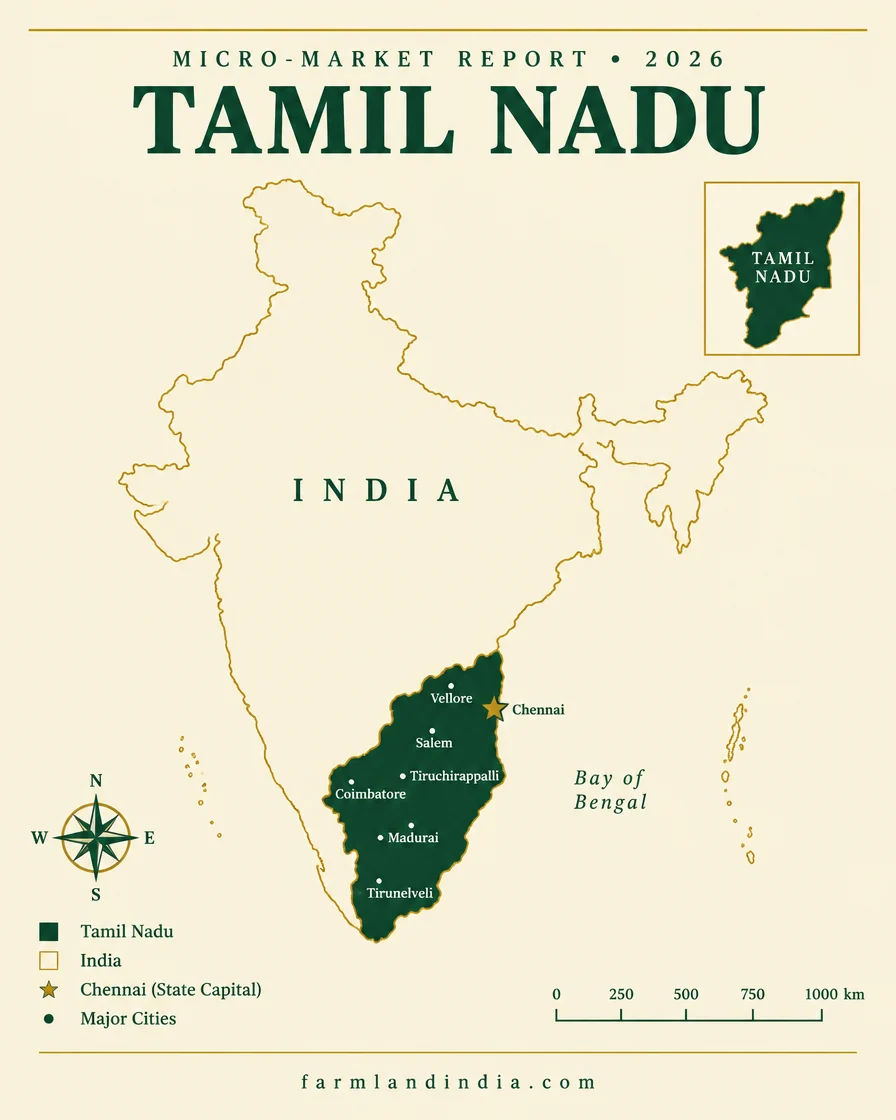
Transaction costs
Stamp duty & registration in Salem
2%
Registration fee
Cut from 4% to 2% in the 2023-24 Budget and in force from 1 April 2023.PRS[5]
7% (reported)
Stamp duty on sale
Reported as 5% stamp duty plus 2% transfer duty, about 9% with the registration fee. Confirm the figure with the sub-registrar.KSK[8][8]
1 point lower
Women buyers
From 1 April 2025 the registration fee is 1 percentage point lower for houses, plots and agricultural land registered in a woman’s name, when the value is up to Rs 10 lakh.DTW[9]
Revised guideline values came into force on 1 July 2024 in every district except Viluppuram.GV[10] Check the guideline value of the survey number on TNREGINET before you agree a price in Salem, and compare it with what neighbouring plots actually registered for. Registration, the encumbrance certificate (villangam) and the guideline-value look-up all run on that portal.
Know the belt
What is moving prices in Salem
Reported developments only; no listing-site prices are used.
Well-fed farm land
The core Salem purchase
Open wells account for 88.8% of irrigated area in the TNAU plan, so the well and its recharge are the asset.TN[7] there is no newspaper-reported price for well-fed land in the district.[7]
Check: Ask for the well’s depth, the last time it ran dry, and neighbouring borewell depths.
Mango and tapioca land
Hill-foot belts
Mango covers about 8,900 hectares and tapioca about 11,500 in the plan, much of it on red soil near the hills.TN[7] Tree-crop land is priced on the plot and the trees together.
Check: Count the trees and write the count into the sale deed.
City-edge plots
Salem, Omalur, Attur
Plots on the edge of Salem city and the large towns are often sold as house plots cut from farm land. There is no official or newspaper price for them.
Check: Ask for the layout approval number and verify it with the planning authority.
Mettur and Cauvery-side land
The north-western edge
Land near the Cauvery at Mettur has a different water position from the red-soil interior, and the TNAU plan’s district-wide well figures will not describe it. There is no newspaper-reported price for the area.
Check: Ask the taluk office whether any part of the plot lies in a flood or backwater zone.
Asking prices
There is no newspaper-reported or official land prices for Salem. Treat any per-acre figure you are quoted as an opening position until you see registered deeds for the same village.
Connectivity
How Salem connects — road, rail and air
Road, rail and air access to Salem
Road
Air
Rail
Check the live route before you travel. Confirm them before you rely on them for a land decision.
Growth catalysts
Upcoming infrastructure & developments
Reported and operational items; check the notification for the actual village
01Open
02Catalysts
Agriculture & terrain
Soil, crops & water in Salem
District crop and rainfall figures where sourced (TNAU plan, 2006-10 averages)
Rainfall and soil
Normal rainfall is 983 mm a year, with 493 mm in the south-west monsoon and 301 mm in the north-east monsoon.TN[7]
- Shallow red soils about 19% of area
- Moderately shallow red soils about 18%
- Very deep black soils about 12%
Main crops
Sorghum, maize, paddy and groundnut lead; sugarcane, cotton, tapioca, mango and turmeric follow.TN[7]
- Sorghum about 63,300 hectares
- Maize about 41,700 hectares
- Paddy about 32,600 hectares
- Groundnut about 24,400 hectares
- Mango about 8,900 and turmeric about 5,200 hectares
Irrigation
Net irrigated area is 98,800 hectares against 106,300 hectares rainfed, and almost all of it depends on wells.TN[7]
- Open wells (107,723) about 88.8% of irrigated area
- Bore wells (9,872) about 9.4%
- Tanks (546) about 1.4%
- Four canals, about 4,100 hectares
Groundwater
The plan counted 20 blocks: 14 over-exploited, two critical, three semi-critical and one safe. That is old data. Statewide, the 2024 CGWB assessment puts Tamil Nadu’s extraction at 74.26%, so check the current category for the block before you drill or pay for a well.CGWB[6]
Reading the figures
The TNAU plan carries no date and uses 2006 to 2010 averages, and some of its tables do not add up. Use it for the pattern of crops and water, not for current acreage.
Cropping intensity
Cropping intensity is about 110%, and nearly half the net sown area is rainfed. Check what a plot grows in a dry year, not in a good one.
At a glance
Salem vs. nearby districts
| District | Land and water | What links it to Salem |
|---|---|---|
| Namakkal | Poultry, tapioca and well farming to the south | Neighbour to the south; listed in the 2026 SIPCOT land bank note |
| Dharmapuri | Drier hill and plateau farming to the north | Northern neighbour with a similar dry pattern |
| Erode | Cauvery, turmeric and canal paddy to the west | Water is canal-fed; Salem relies on wells |
| Tiruvannamalai | Wells and groundnut to the north-east | Different crop mix; covered on its own page |
No official farmland price series is published for Salem. Ask the sub-registrar for recent registered sale values in the village you are looking at. Compare registered deeds village by village, and only for land with the same water source.
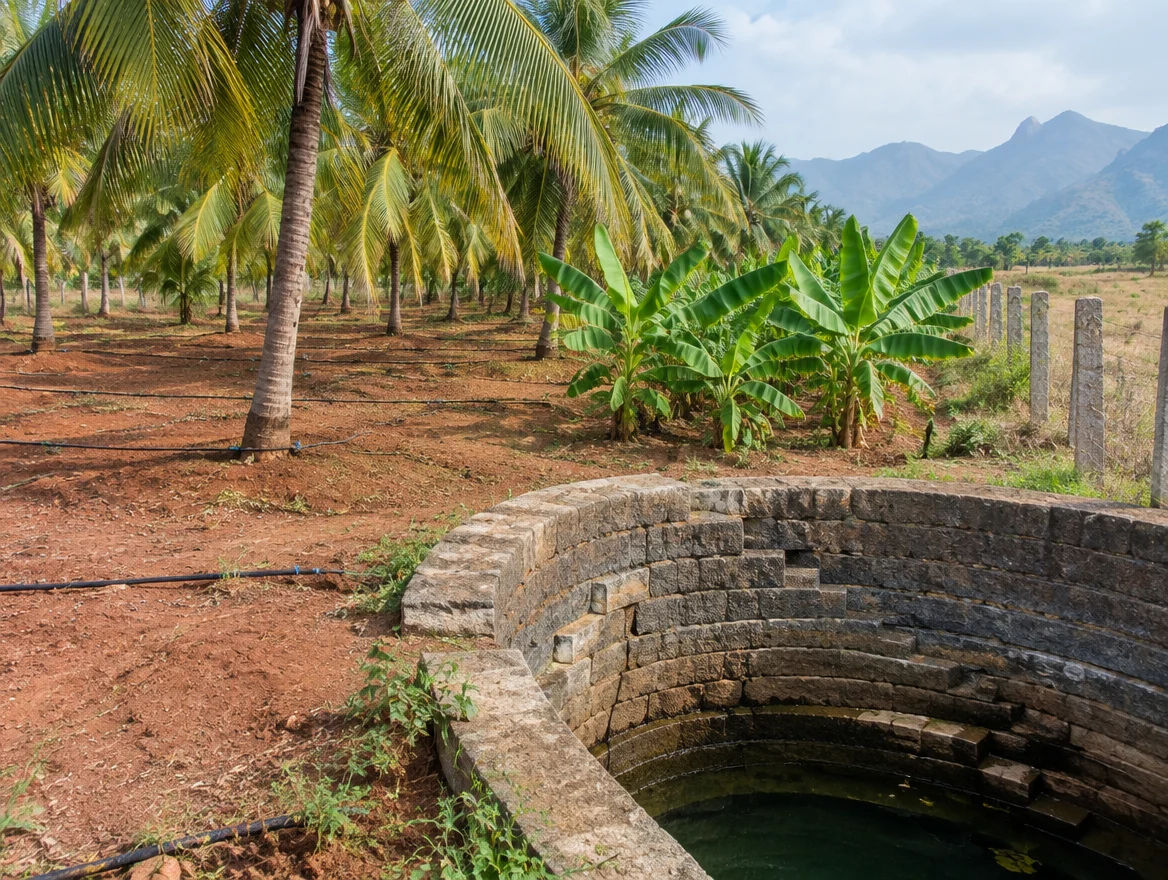
Farmland India view
Why investors look at Salem
Five reasoned points for Salem, each tied to a source on this page.
Buy the water, then the land
With 14 of 20 blocks over-exploited in the plan, a borewell can be a short-lived asset. A plot with an old, shallow open well that still holds water is worth more than one on a deep borewell.TN[7]
Hill-foot land needs a forest check
Land near the hills can border reserved forest or have an access path that crosses it. Ask the forest office before paying.
City-edge plots need an approval number
An unapproved layout is a farm sale with a building problem. Check the approval before paying a token amount.
Budget for the survey and legal work
A taluk survey, a legal-heir search and an encumbrance certificate cost little compared with the land. They are the cheapest protection against boundary and family-share disputes.
Compare deeds, not asking prices
Ask the sub-registrar for recent registered values in the same village and compare them with the guideline value on TNREGINET before you negotiate.
Confirm the patta, chitta, FMB sketch and encumbrance certificate with the taluk office and the sub-registrar; Farmland India’s review does not certify title.
STRAIGHT TALK
Risks & challenges in Salem
District-specific risks. Read the Tamil Nadu state page for the general risks on assigned land, poromboke and records.
Assigned and Panchami land
Land the government assigned to individuals, or Panchami land set aside for the Depressed Classes, can carry conditions on transfer. Ask for the assignment order and the history of the survey number.
Poromboke and water bodies
Tanks, channels, stream beds and other government land are recorded as poromboke, and a patta on such land can be cancelled. Compare the A-register with the village map.
Patta, chitta and FMB must agree
Compare the patta, chitta, Field Measurement Book (FMB) sketch and adangal. Differences in extent or owner name are common and delay mutation after the sale.
Farm use to non-farm use
Outside planning areas a change of land use follows the 2017 rules, with DTCP concurrence and the Collector for wet land.CLU[3] Do not pay for land on the promise of a later conversion.
Over-exploited groundwater
Most blocks were over-exploited in the TNAU plan, and a falling water table can end a crop or force a deeper, costlier borewell.
Reserved forest and hill land
Some plots near the hills touch reserved forest or have a government path across them.
Highway and expressway projects
A proposed Chennai to Salem expressway raised acquisition and court issues from 2018. Ask the Collectorate whether any survey number is under notice.
Who to contact
Local revenue & planning offices
The District Collectorate and revenue divisional offices are in Salem, with taluk offices for Salem, Omalur, Attur, Mettur, Edappadi, Sankagiri and the other taluks. Patta, chitta and FMB work goes through the taluk office, and sale deeds are registered at the sub-registrar office with jurisdiction over the village. Use eservices.tn.gov.in for patta and chitta and tnreginet.gov.in for registration and the encumbrance certificate.
KEEP EXPLORING
Explore more areas
Other districts in Tamil Nadu
- Ariyalur
- Chengalpattu
- Chennai
- Coimbatore
- Cuddalore
- Dharmapuri
- Dindigul
- Erode
- Kallakurichi
- Kancheepuram
- Kanniyakumari
- Karur
- Krishnagiri
- Madurai
- Mayiladuthurai
- Nagapattinam
- Namakkal
- Perambalur
- Pudukkottai
- Ramanathapuram
- Ranipet
- Sivaganga
- Tenkasi
- Thanjavur
- The Nilgiris
- Theni
- Thoothukudi
- Tiruchirappalli
- Tirunelveli
- Tirupathur
- Tiruppur
- Tiruvallur
- Tiruvannamalai
- Tiruvarur
- Vellore
- Viluppuram
- Virudhunagar
COMMON QUESTIONS
Frequently asked questions
Everything buyers, NRIs and investors ask before their first reviewed farmland purchase in Salem.
Visit full wiki01 of 04
Can an outsider buy farmland in Salem?
Yes. There is no Tamil Nadu rule that limits farmland purchase to farmers or residents. The checks that matter are the patta, whether the land is assigned or Panchami land, the family ceiling and any change of land use.
02 of 04
Is groundwater a problem in Salem?
In the TNAU district plan, 14 of 20 blocks were over-exploited, two critical, three semi-critical and one safe. The data is old, so check the current category for the block and the depth of nearby wells before paying for land that relies on a borewell.
03 of 04
What do farmers grow around Salem?
Sorghum, maize, paddy and groundnut lead the crop table in the plan, with sugarcane, cotton, tapioca, mango and turmeric as smaller crops. Mango and tapioca land near the hills is a typical Salem purchase.
04 of 04
Are there Salem land prices on this page?
No. The table stays empty. Use the guideline value on TNREGINET and registered deeds for the same village.
Transparency
Sources and references
Law and courts
- [1][1]India Code: Tamil Nadu Land Reforms (Fixation of Ceiling on Land) Act, 1961— indiacode.nic.in — indiacode.nic.in
- [2][2]RBI: Master Direction on acquisition and transfer of immovable property in India— rbi.org.in — rbi.org.in
- [3][3]Tamil Nadu Government: Change of Land Use (agricultural to non-agricultural) in non-planning areas Rules, 2017 (G.O. 79)— kygcms.tn.gov.in — kygcms.tn.gov.in
- [4][4]Tamil Nadu Gazette: G.O.(Ms) No.149 H&UD, 31 Jul 2026, amending Rule 4— stationeryprinting.tn.gov.in — stationeryprinting.tn.gov.in
Government
- [5][5]PRS Legislative Research: Tamil Nadu Budget Analysis 2023-24— prsindia.org — prsindia.org
- [6][6]CGWB: Dynamic Ground Water Resources of Tamil Nadu, 2024— cgwb.gov.in — cgwb.gov.in
- [7][7]TNAU Agritech: District Agriculture Contingency Plan, Salem (undated; 2006-10 data)— agritech.tnau.ac.in — agritech.tnau.ac.in
News
- [8][8]King Stubb & Kasiva: Changes in Tamil Nadu’s 2023 stamp duty and registration charges— ksandk.com — ksandk.com
- [9][9]DT Next: 1% registration fee concession for women, 31 Mar 2025— dtnext.in — dtnext.in
- [10][10]DT Next: New guideline values come into effect, 2 Jul 2024— dtnext.in — dtnext.in
- [11][11]DT Next: Tamil Nadu identifies 14,840 acres for 30 new industrial parks, 25 Aug 2026— dtnext.in — dtnext.in
- [12][12]DT Next: Automated patta transfer system updated, 4 Jul 2026— dtnext.in — dtnext.in
Fees, rules and infrastructure timelines change often; check the linked source and the relevant office before relying on any figure.
For developers
Ready to explore Salem farmland?
Browse reviewed projects and individual land parcels across Salem — or if you own land here, list it with platform review and reach serious buyers.