
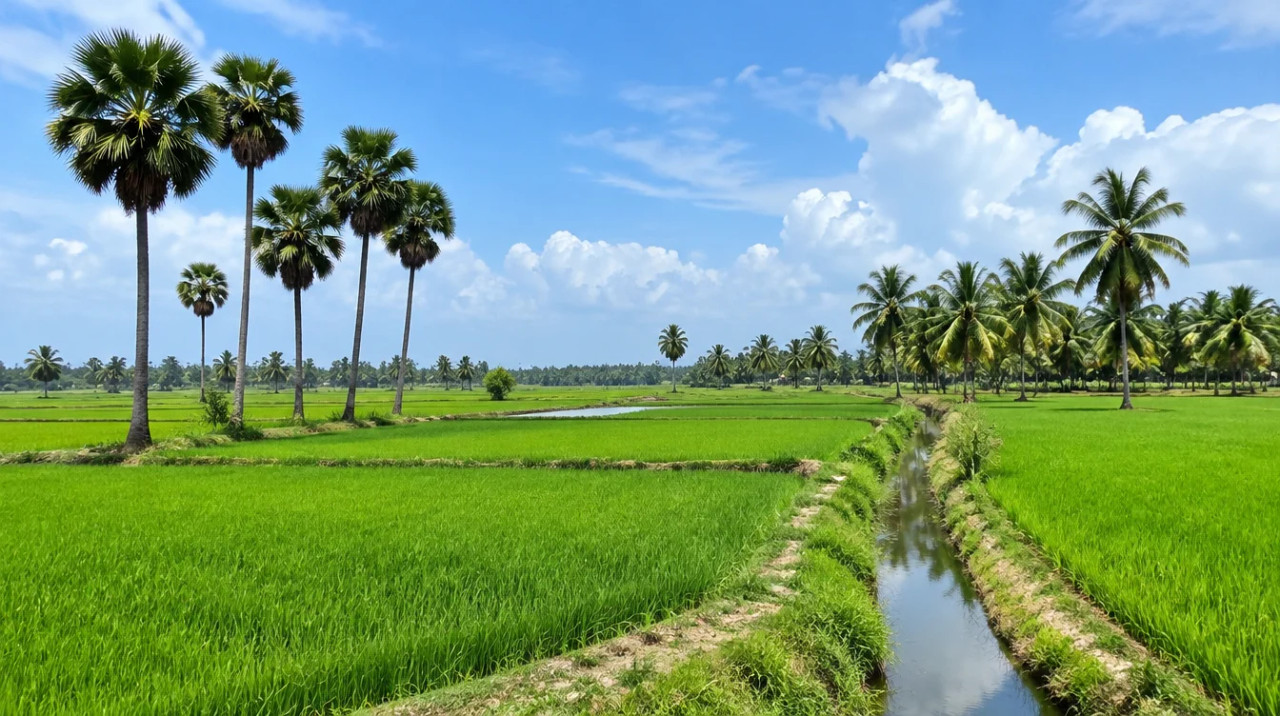
District guide
Buying Land in Chennai
An all-urban district with almost no farmland: CMDA rules, Metro Phase 2, the Peripheral Ring Road, flood risk and the farm plots on the city’s edge.
About 46.5 lakh
Population (Census 2011)
118.9 km, Rs 63,246 crore
Metro Phase II (DT Next, Aug 2026)
132.87 km, Rs 17,958 crore
Peripheral Ring Road (DT Next, Aug 2026)
Scrapped, 24 Aug 2026
Parandur airport (The Week)
*Indicative range across districts and land types. Stamp duty, registration and conversion charges are additional. Local measurement units vary — every listing states the unit it is priced in. Not a valuation or an offer.
District land record — Chennai
Rev. 2026 · Farmland India desk
State
Tamil Nadu
Sub-divisions
Chennai is wholly urban and is run by the Greater Chennai Corporation in 15 zones and 200 wards. CMDA plans the wider Chennai Metropolitan Area, which also takes in parts of Tiruvallur, Kancheepuram and Chengalpattu
Key markets
OMR and Sholinganallur · Velachery and Pallikaranai · Porur · Ambattur · Madhavaram and Manali · Perumbakkam
Demand anchors
IT and services corridor on Old Mahabalipuram Road · Chennai Port and Kamarajar Port at Ennore · Metro Phase 2 · Peripheral Ring Road
Size and population
About 426 sq km and roughly 46.5 lakh people at the 2011 Census, the most populous district in the state (Census of India figures, not on the district portal)
Land records
Patta, Chitta, A-register and the FMB sketch on the Tamil Nadu revenue e-services portal; registration, encumbrance certificates and guideline values on TNREGINET
Pricing unit
No official farmland price series is published for Chennai. Ask the sub-registrar for recent registered sale values in the village you are looking at.
Local units
Records give area in hectares and ares; sale talk uses the cent (1/100 acre) and, in Chennai and larger towns, the ground (2,400 sq ft)
Groundwater
State-wide, 392 of 1,202 firkas were over-exploited in the 2024 CGWB assessment; look up the plot’s firka before you buy (CGWB, 2024[3])
Land law is state law. These rules are maintained on the Tamil Nadu page and apply to every district within it.
Chennai — land purchase legal rules
Tamil Nadu lets any Indian buy farmland, and its records and registration are among the most computerised in the country. The risks lie in the history of the land: whether it was assigned by the government or granted as Panchami land, whether it is a water body or other government land recorded as poromboke, and whether the family’s holding stays within the ceiling. Land use change is a separate approval. The points below come from the statutes, gazette notifications and court orders; they describe the rules, not how they apply to a given plot. This block applies to every district page in the state.
Who can buy: The statutes reviewed contain no provision in Tamil Nadu law that limits the purchase of agricultural land to farmers or residents of the state. An Indian citizen who is not a farmer can buy and register farmland, subject to the ceiling, the conditions on assigned and Panchami land, and land use rules.
The ceiling: Under Section 5(1) of the Tamil Nadu Land Reforms (Fixation of Ceiling on Land) Act, 1961, a family of up to five members may hold 15 standard acres, plus 5 standard acres for each additional member. A standard acre converts wet and dry land into a common unit by class and assessment, so the ordinary acreage varies with the land. Section 7 bars holding above the ceiling, Section 22 lets the authorised officer void transfers made to defeat it, and land declared surplus vests in the government and cannot be validly sold by a private owner.
The 2024 change: L.A. Bill No. 28 of 2024, published on 29 June 2024, replaced "minor sons and unmarried daughters" with "minor children" in the definition of family, so that unmarried adult daughters hold land in their own right up to the ceiling, as unmarried adult sons already did.
Companies: Section 37-A lets an industrial or commercial undertaking apply to the government for permission to acquire or keep land above the ceiling, on conditions such as using it within a fixed time. Whether a company may buy farmland below the ceiling without permission depends on its objects and the use; take advice before signing.
Panchami and assigned land: Panchami land was assigned to the then Depressed Classes under Government Orders of 1892. The Madras High Court (P. Dhandapani, W.P. No. 3628 of 2013, 26 July 2018) described its conditions: no sale for ten years, and after that sale only to members of those classes; transfers in breach are illegal and the land can be resumed. Other assigned land carries the conditions in its assignment order. A clean recent chain of deeds does not cure a void transfer further back.
Change of land use: Outside planning areas, farmland is changed to other use under the Tamil Nadu Change of Land Use (Agriculture to Non-agriculture Purposes in Non-planning Areas) Rules, 2017: an application to the local authority in Form I with a scrutiny fee of Rs 1,000 a plot, concurrence of the Director of Town and Country Planning, and for wet land the Collector’s concurrence after checking that it is not a water body or poromboke. G.O. (Ms.) No. 149 of 31 July 2026 let the Director decide on dry land himself. Inside planning areas the master plan zoning governs.
Stamp duty and fee: A sale deed is reported to attract 7% in all, made up of 5% stamp duty and 2% transfer duty, on the guideline value or the price, whichever is higher (King Stubb & Kasiva), and a 2% registration fee, cut from 4% in the 2023-24 Budget. The 7% is as reported; the TNREGINET calculator gives the exact amount.
NRI and OCI buyers: Under the RBI Master Direction on immovable property, NRIs and OCIs may not acquire agricultural land, a farmhouse or plantation property in India except by inheritance. Our NRI guide covers the options.
- No farmer-only rule found
- Ceiling: 15 standard acres
- 2024: daughters hold in own right
- Panchami land protected
- Change of land use rules, 2017
- Registration fee 2%
- NRIs: inheritance only
Chennai — district-specific notes
The Tamil Nadu state page applies to Chennai in full: no farmer-only rule, the 1961 ceiling Act, Panchami and assigned land, and the registration route. Because almost all land in Chennai is urban, these five points matter more here than the ceiling.
⚠ Land inside the Chennai Metropolitan Area is zoned by CMDA’s master plan. The 2017 land use rules (Change of Land Use Rules, 2017[1]) govern farmland in non-planning areas; inside a planning area, the permitted use is whatever the master plan says for the plot, so ask for the zoning certificate before you pay an advance.
⚠ A plot sold as part of a layout should carry a CMDA or DTCP approval number, with roads, open space reservation and the plot boundaries marked on the approved plan. An unapproved layout can be refused building permission, water and power connections, and home loans.
⚠ Chennai’s rivers, canals, tanks and the Pallikaranai marsh are government water bodies, recorded as poromboke. Land that is or was part of a water body cannot be lawfully sold or built on, and courts have ordered encroachments cleared. The marsh is a protected wetland, so check how close a plot lies to its boundary.
⚠ Most urban plots here are recorded in town survey records, but the Patta and A-register still matter. After a registered sale without subdivision the Patta is now transferred automatically (DT Next, 4 July 2026[12]); check that the buyer’s name actually appears.
⚠ Land along the Marina, the East Coast Road and the Ennore creek can fall in the Coastal Regulation Zone, where building near the high tide line is restricted. Ask for the CRZ status of any coastal plot in writing.
NRI and OCI buyers should read can NRIs buy agricultural land in India. Under the RBI Master Direction on immovable property[2], NRIs and OCIs cannot acquire agricultural land, a farmhouse or a plantation in India except by inheritance.
- Urban land
- CMDA and DTCP layouts
- Water bodies and marsh
- Coastal Regulation Zone
- Farm plots outside the district
District overview
Chennai — an all-urban capital district whose farmland lies in the districts next door
Chennai (formerly Madras) is the capital of Tamil Nadu, on the Coromandel Coast of the Bay of Bengal, and its commercial, educational and industrial centre (Chennai district portal[4]). The district covers about 426 sq km and had roughly 46.5 lakh people at the 2011 Census, which made it the most populous in the state. It has no real farming economy. What people call land near Chennai is mostly in the three districts around it, and it is those districts, not Chennai itself, that hold farm plots, orchards and agricultural land.
That shapes who buys. Inside the district the buyers are households looking for residential plots and small commercial sites, builders assembling parcels for apartments, and the IT and services workforce along Old Mahabalipuram Road. On the edge of the metropolitan area, buyers are Chennai families and NRIs looking for weekend land, orchards and farm plots, and industrial and warehouse users around the ring road and Sriperumbudur. NRIs and OCIs may buy residential and commercial land but not agricultural land, a farmhouse or a plantation; read our NRI guide before you commit. For the rules that apply to farmland across the state, see the Tamil Nadu page.
Three public projects are reshaping land demand. Chennai Metro Phase II, 118.9 km at an estimated Rs 63,246 crore, is being built across the west, south and north of the city (DT Next, 5 August 2026[7]). The Chennai Peripheral Ring Road, a 132.87 km Ennore–Mamallapuram bypass, is under construction in five packages (DT Next, 21 August 2026[8]). And CMDA is preparing a Third Master Plan for an expanded metropolitan area, now expected in 2027 (DT Next, 28 October 2026[11]). One project has gone the other way: the Parandur airport was scrapped in August 2026 (The Week[10]).
The paperwork in Chennai is easy to reach and hard to get right. Before price, get the Patta and the encumbrance certificate for the survey number, the CMDA or DTCP approval for the layout, the zoning of the plot and the flood history of the street. A plot that looks cheap beside a lake or a canal is usually cheap for a reason.
- OMR corridor
- Porur–Poonamallee Metro
- Manali–Ennore
- Pallikaranai marsh
- Peripheral Ring Road
- CMDA Third Master Plan
Transaction costs
Stamp duty & registration in Chennai
7%
Stamp duty on a sale (reported)
5% duty plus 2% transfer duty on the higher of guideline value and price; the government order was not read
2%
Registration fee
Cut from 4% in the 2023-24 Budget
1 point
Women’s concession
Lower registration fee on land up to Rs 10 lakh registered in a woman’s name, from 1 April 2025
Chennai land is registered at sub-registrar offices across the city and booked on TNREGINET. Plots here are quoted per ground (2,400 sq ft) or per sq ft, but the duty and fee are calculated on the guideline value and the price of the whole parcel. Tamil Nadu is reported to charge 7% on a sale deed, made up of 5% stamp duty and 2% transfer duty, plus a 2% registration fee, all on the higher of the guideline value and the price (King Stubb & Kasiva[5]). Treat it as the reported figure and use the TNREGINET calculator for the exact amount on the day. Land worth up to Rs 10 lakh registered in a woman’s name pays a registration fee one point lower. Revised guideline values came into force on 1 July 2024 in every district except Viluppuram (DT Next, 2 July 2024[6]). Duty is charged on the guideline value of the exact survey number, so look it up on TNREGINET rather than relying on a neighbour’s figure, and do not under-declare the price, because undervaluation is pursued after registration.
Know the belt
What is moving prices in Chennai
Corridors and pockets inside and beside the city
OMR and the south
IT corridor
Old Mahabalipuram Road (Rajiv Gandhi Salai) runs south from the city through Perungudi, Thoraipakkam and Sholinganallur towards Navalur, Siruseri and Mamallapuram. The first part lies in Chennai district and the rest in Chengalpattu. It is the IT and services job belt, so demand is for apartments, offices and plots rather than farmland.
Check: which side of the district boundary the plot is on, because guideline values and approvals differ, and whether it lies in the Coastal Regulation Zone or near the Pallikaranai marsh
Porur to Poonamallee
Metro Phase II corridor
The 14.64 km Poonamallee Bypass–Porur stretch of Phase II, with 11 stations and a link to Vadapalani, is the first to open (DT Next, 5 August 2026[7]). Land near stations on this west corridor is priced on the Metro.
Check: whether the line has actually opened, how far the plot is from a station, and the flood history of the street
North: Ambattur, Madhavaram and Manali
Industrial and port-side land
Ambattur has an industrial estate, and the Manali and Ennore side holds the Kamarajar Port, refineries and warehouses. The Ring Road starts at Ennore. Demand here is industrial and logistics, and residential plots follow the workforce.
Check: industrial zoning, pollution and noise, and drainage in the monsoon
Velachery, Pallikaranai and the south-west
Marsh-edge residential land
A large residential belt has grown around the Pallikaranai marsh, with the marsh itself a protected wetland. It is close to the IT corridor, and it is also among the areas that flooded in 2015 and 2023.
Check: distance from the marsh boundary, flood marks on the street and the status of the stormwater drains
Asking prices
No official farmland price series is published for Chennai. Ask the sub-registrar for recent registered sale values in the village you are looking at. Prices inside the city are quoted per ground (2,400 sq ft) or per sq ft and change street by street, while farm plots on the edge trade per acre or per cent. Ask for the guideline value and recent registered deeds in the same street, and treat a agent’s figure as an opening claim.
Connectivity
How Chennai connects — road, rail and air
Metro, suburban rail, ports and ring roads
🚗 By road
✈️ By air
🚆 By rail
Travel times in Chennai swing with the hour, the monsoon and road works, so check a route at the time you will actually use it before relying on any distance.
Growth catalysts
Upcoming infrastructure & developments
Statuses and sources are dated; the project pages carry the detail
00Open
04Catalysts
Agriculture & terrain
Soil, crops & water in Chennai
Farming sits outside the district; the city’s land and water story is about lakes, canals and the monsoon
Farming in and around Chennai
Chennai district has almost no cultivated land. The farming around the city is in the neighbouring districts, where paddy, groundnut, vegetables and flowers are grown on tank-fed and well-fed plots, and where the north-east monsoon from October to December brings most of the rain. Inside the district the land question is urban, and the water question is lakes, canals and drainage.
- Little cultivated land in the district
- North-east monsoon rain
- Paddy and groundnut in outer districts
- Tank and well irrigation outside
Lakes and canals
The city draws on reservoirs and lakes on its edge, and its rivers and the Buckingham Canal carry floodwater to the sea. Tanks and lakes within and beside the city are government water bodies, and building on them is both unlawful and a flood risk.
Groundwater
Tamil Nadu’s 2024 CGWB assessment put the state’s stage of extraction at 74.26%, with coastal wells exposed to salinity (CGWB, 2024[3]). In the coastal city, well water quality varies street by street, so test it before relying on a borewell.
At a glance
Chennai vs. nearby districts
| District | Land and water | What links it to Chennai |
|---|---|---|
| Chengalpattu (south) | Plot and farm market from Tambaram to Mamallapuram; tanks, the Palar and the coast | OMR continues here, and most Chennai farm-plot demand lands in this district |
| Tiruvallur (north and west) | Industrial parks, Ponneri, Gummidipoondi and Poonamallee; tanks and the coastal belt | Ring Road package and the Ennore port belt |
| Kancheepuram (west) | Sriperumbudur and Oragadam factories, the Palar basin, tanks | Scrapped Parandur site and the highway towards Bengaluru |
No price series is sourced for any of these districts, and each applies its own guideline values. A plot on the OMR, in Poonamallee or near Sriperumbudur is priced by its distance from jobs and the Metro or the highway, not by the crop it once grew.
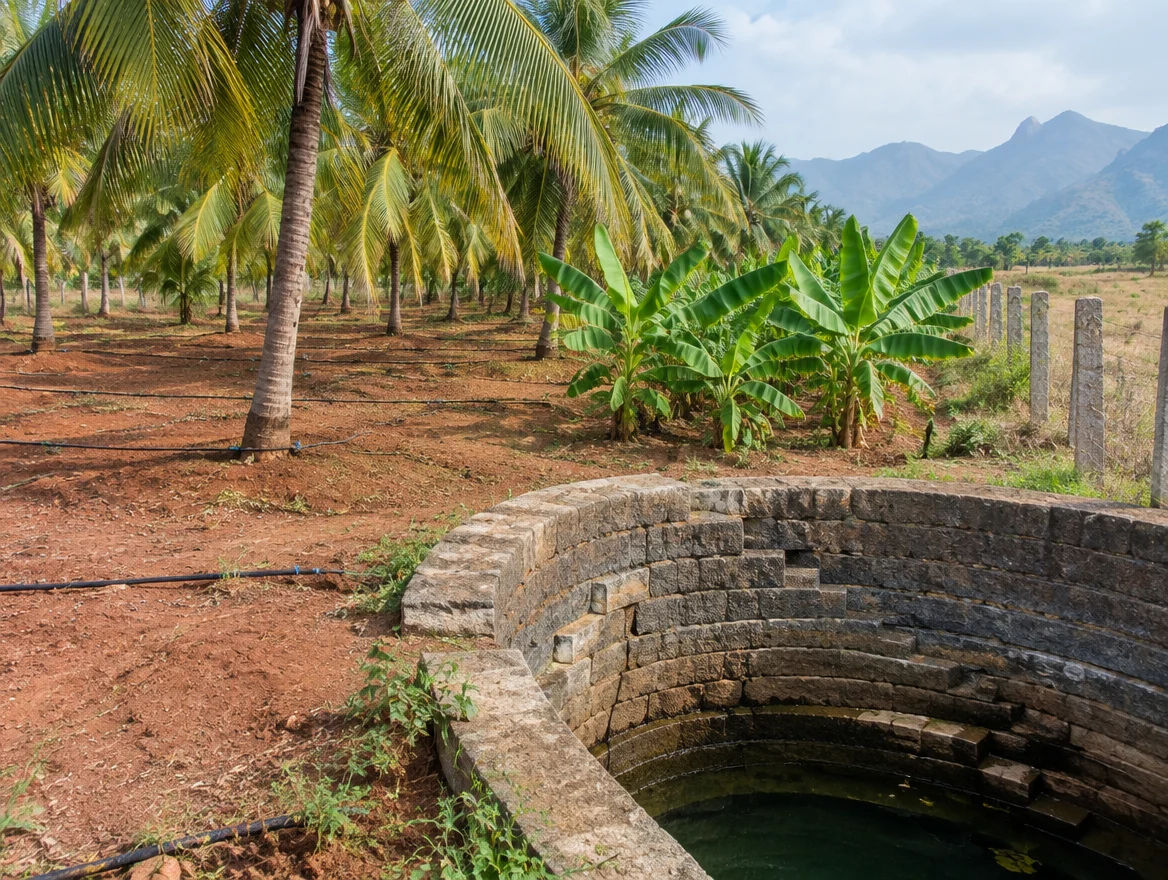
Farmland India view
Why investors look at Chennai
Five reasoned points for Chennai, each tied to a source on this page.
Urban land, not farmland
Inside Chennai you are buying plots and parcels, and the return comes from location, approvals and the next use. If you want farmland, the better value and the larger plots are in the outer districts.
Public works drive the price
Metro Phase II, the Ring Road and the Master Plan each change what a plot is worth. Their dates have slipped before, so pay for what is open or approved, not for a date on a hoarding.
Flood and water quality matter more than frontage
A plot on a flood path or beside a water body is a liability. Check flood history, drainage and the distance from the nearest water body before price.
Check approvals before you check the price
A CMDA or DTCP approval, a clear Patta and a 30-year encumbrance certificate decide whether the plot can be built on and resold. Ask for the approval number and verify it.
Do not buy on a rumour
Parandur shows how an announced project can be withdrawn. Land bought on the story of an airport, a road or a Metro line should be bought only after the project is notified and funded.
Confirm the Patta, Chitta and A-register, mutation, zoning and acquisition status directly — these are not certified by Farmland India’s review.
STRAIGHT TALK
Risks & challenges in Chennai
District-specific risks. Read the Tamil Nadu state page for the general risks on ceiling, conversion and records.
Floods and cyclones
Low-lying parts of the city and the marsh edge have flooded in heavy north-east monsoon years, including 2015 and December 2023. Check flood marks and drainage, and visit after rain.
Water bodies and poromboke
Plots carved from lakes, canals, tank beds or river margins are a recurrent trap, and courts have ordered such encroachments removed. Ask the Tahsildar whether the survey number was ever a water body.
Unapproved layouts
A layout without CMDA or DTCP approval may be refused building permission and services. Check the approval number and the approved plan.
Coastal and wetland rules
Land near the shore, creeks and the Pallikaranai marsh can fall in the Coastal Regulation Zone or near protected wetland. Ask for written confirmation of the status before paying.
Disputed urban title
Old urban plots often have several heirs, partition deeds and power of attorney sales in the chain. Trace the title back at least 30 years, and have a lawyer read every link.
NRIs and powers of attorney
NRIs cannot buy agricultural land in India except by inheritance, and a purchase through a relative’s name or a power of attorney leaves the land legally in someone else’s hands.
Who to contact
Local revenue & planning offices
Inside the city, the Greater Chennai Corporation handles building and trade approvals, and CMDA handles planning permission, layouts and zoning across the Chennai Metropolitan Area. Revenue records sit with the Tahsildar at the taluk office under the District Collector, who issue and transfer the Patta, and the Revenue Divisional Officer hears appeals. Surveys and sketches come from the Survey and Land Records department. Deeds are registered at the sub-registrar office for the area, booked and paid for through TNREGINET.
KEEP EXPLORING
Explore more areas
Other districts in Tamil Nadu
- Ariyalur
- Chengalpattu
- Coimbatore
- Cuddalore
- Dharmapuri
- Dindigul
- Erode
- Kallakurichi
- Kancheepuram
- Kanniyakumari
- Karur
- Krishnagiri
- Madurai
- Mayiladuthurai
- Nagapattinam
- Namakkal
- Perambalur
- Pudukkottai
- Ramanathapuram
- Ranipet
- Salem
- Sivaganga
- Tenkasi
- Thanjavur
- The Nilgiris
- Theni
- Thoothukudi
- Tiruchirappalli
- Tirunelveli
- Tirupathur
- Tiruppur
- Tiruvallur
- Tiruvannamalai
- Tiruvarur
- Vellore
- Viluppuram
- Virudhunagar
COMMON QUESTIONS
Frequently asked questions
Everything buyers, NRIs and investors ask before their first reviewed farmland purchase in Chennai.
Visit full wiki01 of 04
Can I buy farmland inside Chennai district?
Almost none exists. Chennai is built up and zoned for urban use, so buyers who want farm plots near the city look at Chengalpattu, Tiruvallur and Kancheepuram. Inside Chennai you will be buying urban land, which needs approved layouts and clear title.
02 of 04
Is the Parandur airport going ahead?
No. Chief Minister C. Joseph Vijay told the Assembly on 24 August 2026 that the project was dropped, and alternative sites are to be found. Do not pay a premium for land on the old airport story.
03 of 04
What approval should a plot in Chennai have?
A layout approved by CMDA, or by DTCP where it applies, with an approval number you can check, plus a clear Patta, a 30-year encumbrance certificate from TNREGINET and the current guideline value for the survey number.
04 of 04
Does Chennai flood?
Parts of it do. The city saw major floods in 2015 and again in December 2023 with Cyclone Michaung. Ask the seller for flood history, check the plot’s distance from rivers, canals, lakes and the Pallikaranai marsh, and visit after rain.
Transparency
Sources and references
Law and courts
- [1]Tamil Nadu Change of Land Use Rules, 2017 (Government of Tamil Nadu) — kygcms.tn.gov.in
- [2]RBI Master Direction on acquisition and transfer of immovable property — rbi.org.in
Government
- [3]CGWB: Dynamic Ground Water Resources of Tamil Nadu, 2024 — cgwb.gov.in
- [4]Chennai district portal: about the district — chennai.nic.in
News and analysis
- [5]King Stubb & Kasiva: Tamil Nadu stamp duty and registration charges (2023) — ksandk.com
- [6]DT Next: new guideline values come into effect (2 Jul 2024) — dtnext.in
- [7]DT Next: Chennai Metro Phase II first stretch to open shortly (5 Aug 2026) — dtnext.in
- [8]DT Next: Ennore–Mamallapuram road project (21 Aug 2026) — dtnext.in
- [9]Construction World: land acquisition for second phase of CPRR (2 Sep 2026) — constructionworld.in
- [10]The Week: Tamil Nadu scraps Parandur airport (24 Aug 2026) — theweek.in
- [11]DT Next: Chennai Third Master Plan likely in 2027 (28 Oct 2026) — dtnext.in
- [12]DT Next: automated patta transfer system updated (4 Jul 2026) — dtnext.in
Project status, the benchmark valuation and land rules change often; check the linked source and the relevant office before relying on any figure.
For developers
Ready to explore Chennai farmland?
Browse reviewed projects and individual land parcels across Chennai — or if you own land here, list it with platform review and reach serious buyers.