
District guide
Buying Land in Gomati
Udaipur’s district in the Gomati valleys: an old capital, the Matabari temple and a permission rule that applies to tribal-held land.
2012
District formed (district portal)
3
Sub-divisions (district portal)
Udaipur
District headquarters
9.48%
State groundwater extraction (2024)
District land record — Gomati
Rev. 2026 · Farmland India desk
State
Tripura
District headquarters
Udaipur (district portal[7])
Formation
2012, as a reduced version of the former South Tripura district (district portal[7])
Sub-divisions
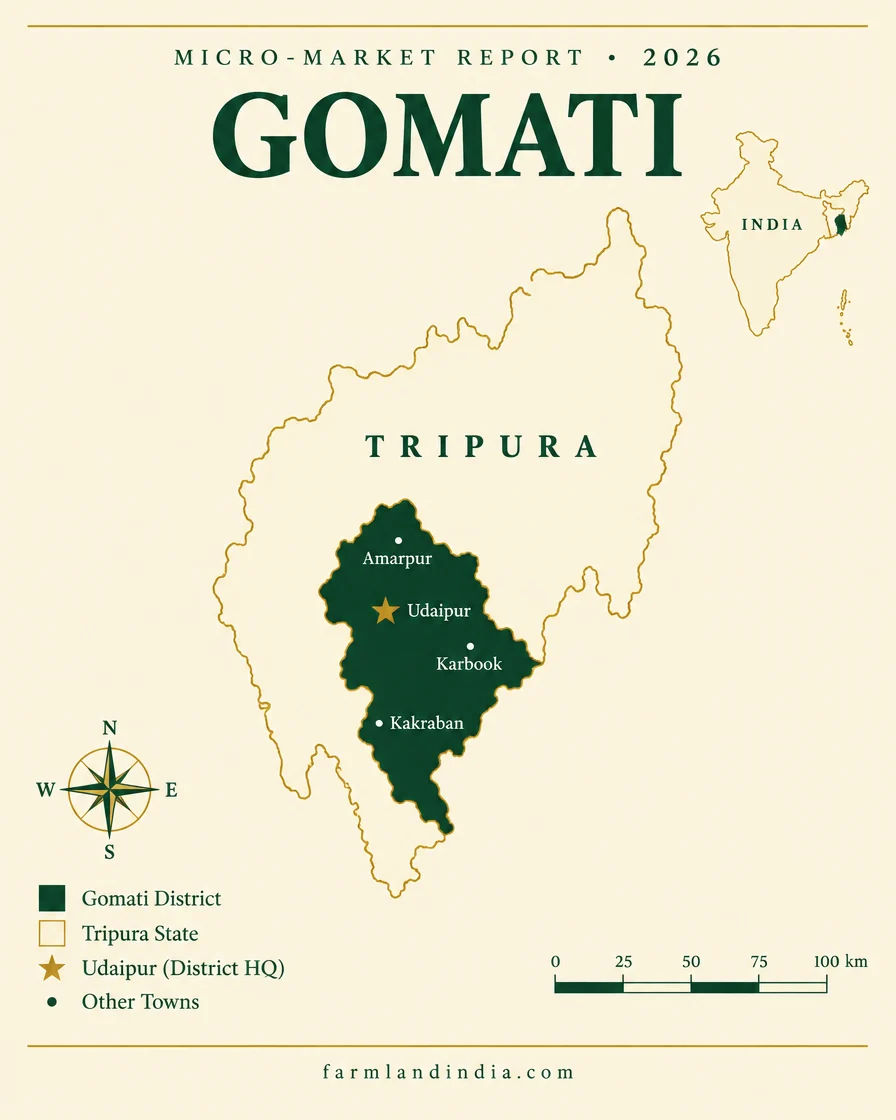
Udaipur, Amarpur and Karbook
Area and population
Land law
Tribal-held land needs the Collector’s written permission to pass to a non-tribal (High Court, 2026[2])
Pricing unit
No official farmland price series is published for Gomati. Ask the sub-registrar for recent registered sale values in the village you are looking at.
Records
Jami portal; Land Records Section at the sub-divisional office
Land law is state law. These rules are maintained on the Tripura page and apply to every district within it.
Gomati — land purchase legal rules
Tripura is a small state almost surrounded by Bangladesh, with a large tribal population and a Sixth Schedule tribal council that covers about two-thirds of its area. Land law here is the Tripura Land Revenue and Land Reforms Act, 1960, and its most important rule for a buyer is the protection of land owned by members of the Scheduled Tribes. What follows describes the rules as the Act, the courts and the government state them; it is not legal advice, and any purchase needs a local lawyer and the Sub-Divisional Magistrate’s office. This block applies to every district page in the state.
Who can buy: The statutes reviewed contain no state-wide rule that stops an Indian citizen from another state buying land held by a non-tribal owner in Tripura. The restriction runs through the seller: land owned by a member of the Scheduled Tribes is protected, and two-thirds of the state lies in the tribal council area, where much of the land is held by tribal families. In practice, an outsider can usually consider only land owned by non-tribals, and even that needs careful checks.
Section 187: Under Section 187 of the Tripura Land Revenue and Land Reforms Act, 1960, no transfer of land by a member of the Scheduled Tribes is valid unless it is to another member of the Scheduled Tribes, or is made with the previous written permission of the Collector. Mortgages to co-operative societies, banks and certain institutions are allowed, but the lender cannot pass the land to a non-tribal. The Tripura High Court quoted the section in August 2026 (Tufani Ram Bin v State of Tripura, WP(C) 533/2026, 21 August 2026).
Restoration: The Act also provides for restoring tribal land transferred in breach of Section 187, under Section 187B, and such cases are heard by revenue officers. A registered deed does not protect a buyer if the seller was a tribal owner and the Collector’s permission was never obtained. The same 2026 judgment is a reminder that revenue entries alone do not prove title; ask for the chain of deeds.
TTAADC area: The Tripura Tribal Areas Autonomous District Council is a Sixth Schedule council covering about two-thirds of the state. In November 2026 the state formed an eight-member committee, convened by the Secretary of the Tribal Welfare Department and including the council’s Chief Executive Member and the Director of Land Records and Settlement, to examine land issues in the council area and report within about a month (ThePrint (PTI), November 2026). Rules for land in the council area may change; ask the SDM and the council before buying there.
Ceiling: Chapter XIII of the Act (Sections 162 to 178) sets ceilings on land holdings and limits future acquisitions. The Act measures land in standard acres: one acre of lunga or nal (low, wet valley land) counts as one standard acre, and three acres of tilla (upland) count as one. Check the current ceiling figures in the amended text before buying a large block.
Stamp duty: Tripura sets its own rates under the Indian Stamp Act, 1899. The Indian Stamp (Tripura Fifth Amendment) Act, 2020 substituted the entry for conveyance, and a sixth amendment followed in 2023. Ask the sub-registrar for the current percentage before you budget.
Records: The record of rights (khatian) and plot maps are maintained under the Digital India Land Records Modernisation Programme and published on the state’s Jami portal (jami.tripura.gov.in), with land records sections at the SDM offices (Khowai district).
NRI and OCI buyers: Under the RBI Master Direction on immovable property, NRIs and OCIs may not acquire agricultural land, a farmhouse or plantation property in India except by inheritance. Our NRI guide covers the options.
- Section 187: tribal land
- Collector’s written permission
- TTAADC: two-thirds of the state
- Restoration under Section 187B
- Ceiling: Chapter XIII
- Standard acre: lunga and tilla
- Records on Jami
- NRIs: inheritance only
Gomati — district-specific notes
The Tripura state page covers the 1960 Act, section 187 and the autonomous district council. For Gomati, three points matter most.
⚠ Gomati has three sub-divisions, and each holds its own land-records section, so start with the sub-divisional office that covers the plot rather than the district headquarters. Ask for the khatian, the mutation history and a surveyor’s map, and check the plot on the Jami portal.
⚠ Section 187 depends on who holds the land. If the seller is a Scheduled Tribe member, the Collector’s previous written permission is needed before a non-tribal can buy. If not, the rule does not apply in the same way, but confirm the community and title with the sub-divisional office instead of relying on an agent. Part of the district may also lie under the autonomous district council. Ask the council office.
⚠ Land close to a pilgrimage site can carry extra questions about use, such as temple trust or government land beside the main roads. Treat any claim of a pilgrimage premium as an unproven asking price.
⚠ Section 187 of the Tripura Land Revenue and Land Reforms Act, 1960, as quoted by the Tripura High Court in August 2026, says no transfer of land by a Scheduled Tribe member is valid unless it is to another Scheduled Tribe member, or to a non-tribal with the previous written permission of the Collector (Tripura High Court, Tufani Ram Bin v State, 21 Aug 2026[2]). A transfer without that permission can be challenged, and section 187B provides for restoration. Do not pay more than a refundable token until the Collector’s order is in hand for Gomati.
Land in Tripura is governed by the Tripura Land Revenue and Land Reforms Act, 1960[1], whose ceiling chapter runs from section 162 to 178. About two-thirds of the state’s area is under the Tripura Tribal Areas Autonomous District Council, a Sixth Schedule body, and the state formed a committee on its land issues on 7 Nov 2026 (ThePrint, 7 Nov 2026[9]Ask the council office before buying inside it. Land records are on the Jami portal, with a Land Records Section at each sub-divisional office (Khowai district portal[5]). NRIs and OCIs cannot acquire agricultural land, a farmhouse or plantation land except by inheritance; see our NRI guide and the Tripura land buying guide.
- Permission needed for tribal land
- Council land is separate
- Pilgrimage-town land
- Thin public data
District overview
Gomati — Udaipur and the Gomati valleys
Gomati was created in 2012 from the former South Tripura district, with Udaipur as its headquarters and three sub-divisions: Udaipur, Amarpur and Karbook. The district portal says it lies in the Gomati valleys and that the Debtamura hill range runs across the Udaipur and Amarpur sub-divisions (district portal[7]).
Udaipur was the capital of Tripura until 1760, and the Tripura Sundari temple at Matabari, about 3 km from the town, is one of India’s 51 Mahapithas.
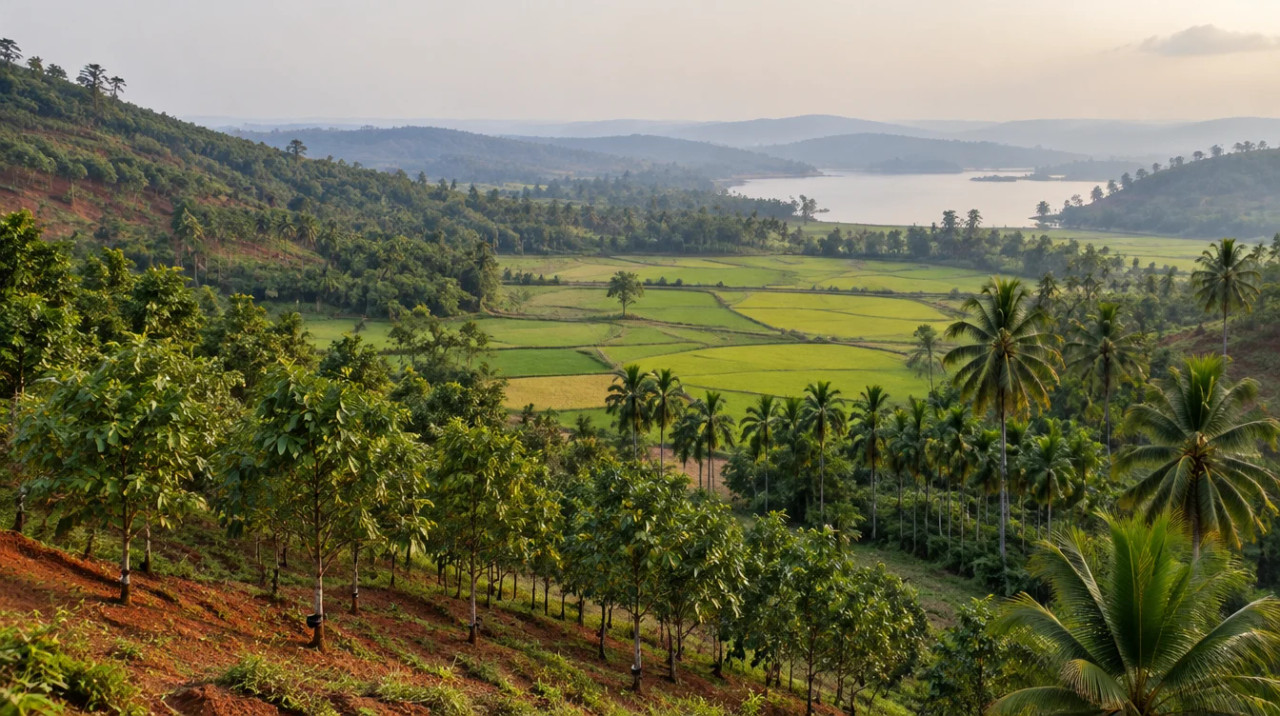
The district is a river-valley and low-range landscape. Plots in the valleys are typically paddy and plantation, and those on the Debtamura slopes face the same slope and access questions as any hill land.
Because Gomati was cut out of South Tripura in 2012, papers older than that may name South Tripura. Check which district and sub-division a plot belongs to today.
- Udaipur
- Amarpur
- Karbook
- Kakraban
Transaction costs
Stamp duty & registration in Gomati
Registration fee
Ask the sub-registrar for a written computation.
Stamp duty
The Indian Stamp (Tripura Fifth Amendment) Act, 2020 substituted the conveyance entry (gazetted 13 Nov 2020), and a Sixth Amendment followed in May 2023.
Permission
Collector’s written approval
Needed when land held by a Scheduled Tribe member is sold to a non-tribal, under section 187 of the 1960 Act
Tripura’s stamp law is the Indian Stamp Act as amended for the state; the Fifth Amendment Act of 2020 replaced the entry for conveyances and a Sixth Amendment followed in 2023 (Indian Stamp (Tripura Fifth Amendment) Act, 2020[6]). Ask the sub-registrar for a written computation on the exact land before you agree a price, and keep the receipt.
Know the belt
What is moving prices in Gomati
Four places worth knowing, by what drives them and what to check.
Udaipur
District headquarters
The old capital and the administrative centre; plots near town are for homes and shops.
Check: title chain and road width
Amarpur
Sub-division
Named south of Khowai by the Khowai portal; farm and plantation land.
Check: who holds the land and the land class
Karbook
Newly created sub-division
A newer administrative unit; records may have moved offices, so confirm where the plot’s file now sits.
Check: which office holds the record
Kakraban
Smaller place
South of Udaipur on our map, with farm plots; no project or price source found.
Check: boundary markers and council area or not
Asking prices
Treat an agent’s figure as an opening ask until it is matched with a registered deed.
Connectivity
How Gomati connects — road, rail and air
Check the live route
🚗 By road
✈️ By air
🚆 By rail
Check the live route
Growth catalysts
Upcoming infrastructure & developments
No project in this district could be confirmed in detail.
00Open
01Catalysts
Agriculture & terrain
Soil, crops & water in Gomati
Land and water
Tripura’s normal rainfall is 2,213.8 mm a year and groundwater extraction was 9.48% in 2024 (India Today NE[4]
- State rainfall: 2,213.8 mm
- State groundwater extraction: 9.48% (2024)
- Gomati river valleys; Debtamura range
Typical crops
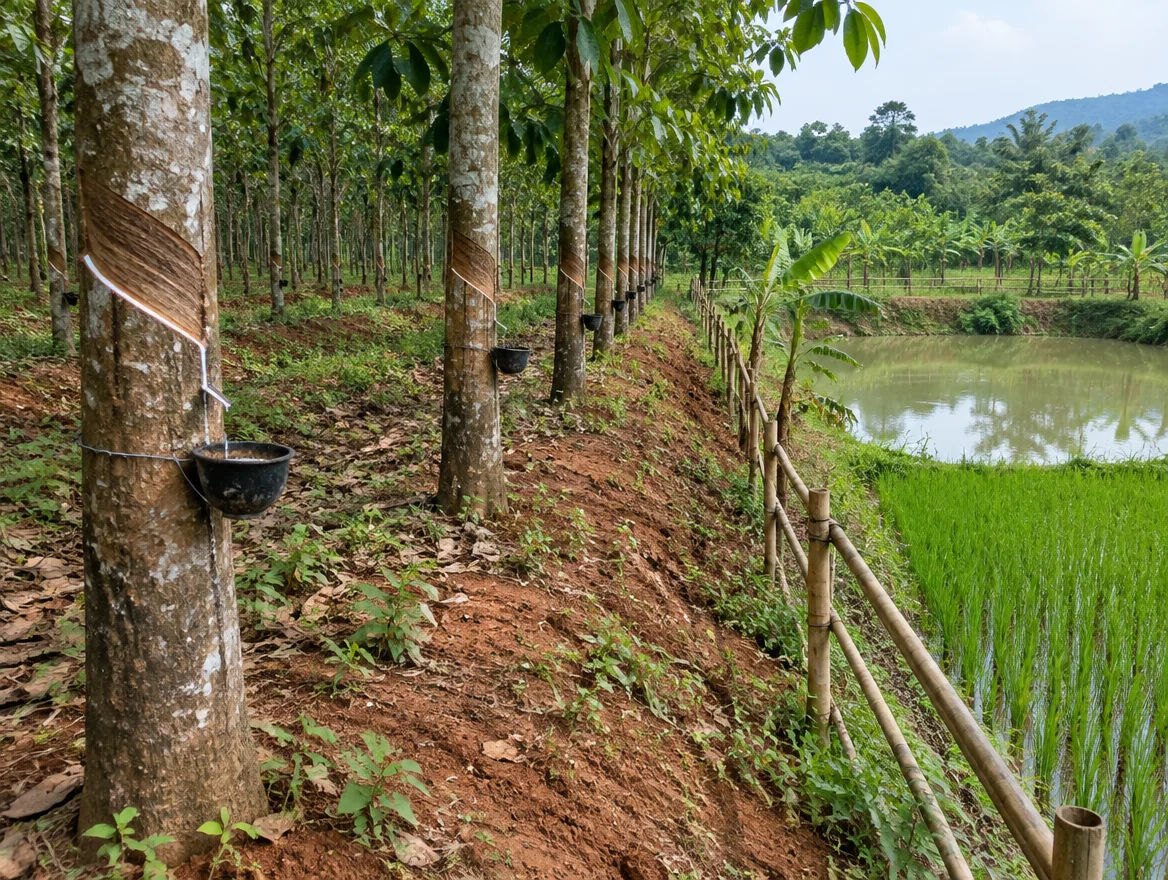
Rice, rubber and pineapple are Tripura’s main crops by state figures.
Flood and slope
Valley plots can flood and range-side plots can be steep. Visit in the rains and ask neighbours about water levels.
At a glance
Gomati vs. nearby districts
| District | Land and water | What links it to Gomati |
|---|---|---|
| South Tripura | Belonia | Gomati was cut from the older South Tripura district in 2012 |
| Sepahijala | Bishalgarh | Another district cut from the older West and South Tripura areas |
| Dhalai | Ambassa | Part of Amarpur sub-division went to Dhalai in 1995 |
The neighbours are listed from the district portals.
Farmland India view
Why investors look at Gomati
Five reasoned points for Gomati, each tied to a source on this page.
A pilgrimage-town market
A newer sub-division
Karbook is recent; plots there may have records that moved offices.
Papers are the value
A clear record and a mapped boundary matter more than a view.
Permission sets the timeline
Where the seller is tribal, the Collector’s order is the first gate for a non-tribal buyer.
Confirm the land record, mutation, zoning and acquisition status directly — these are not certified by Farmland India’s review.
STRAIGHT TALK
Risks & challenges in Gomati
District-specific risks. Read the Tripura state page for the general risks on ceiling, conversion and records.
Flood-prone valley plots
Check flood history before paying for land near the river valleys.
Records in two districts
Documents before 2012 may name South Tripura; confirm the plot’s district and sub-division.
Temple-side land
Plots beside the main roads near Matabari may be government or trust land; confirm on the record.
Permission refused or missing
A sale of tribal land without the Collector’s written permission can be challenged. Keep payments refundable until the order is issued.
Records and council land
Check the plot on the Jami portal and with the sub-divisional land records section, and ask whether any part lies inside the autonomous district council area.
Who to contact
Local revenue & planning offices
Gomati is administered from Udaipur by the District Magistrate and Collector, with sub-divisional offices at Udaipur, Amarpur and Karbook holding land records (district portal[7]). Deeds are registered at the sub-registrar’s office; ask for the written fee and duty computation. For land inside the council area, ask the council office as well.
COMMON QUESTIONS
Frequently asked questions
Everything buyers, NRIs and investors ask before their first reviewed farmland purchase in Gomati.
Visit full wiki01 of 04
Can an outsider buy land in Gomati?
It depends on who holds the land. Under section 187 of the Tripura Land Revenue and Land Reforms Act, 1960, land held by a Scheduled Tribe member can pass to a non-tribal only with the previous written permission of the Collector. A large part of the state also lies under the autonomous district council. Confirm the route with the sub-divisional office and a local lawyer before paying.
02 of 04
What is Gomati known for?
Udaipur, the district headquarters, was Tripura’s capital until 1760, and the Mata Tripura Sundari temple at Matabari, about 3 km away, is one of India’s 51 Mahapithas. The district lies in the Gomati valleys.
03 of 04
Which sub-divisions does Gomati have?
Udaipur, Amarpur and Karbook, the last newly created, according to the district portal. Check the sub-division of a plot before using any listing, because land records sit at the sub-divisional office.
04 of 04
Is there a price guide for land here?
No official farmland price series is published for Gomati. Ask the sub-registrar for recent registered sale values in the village you are looking at. Ask for recent registered deeds in the same locality and compare them with the asking price.
Transparency
Sources and references
Law and courts
- [1]Tripura Land Revenue and Land Reforms Act, 1960 — indiacode.nic.in
- [2]Tripura High Court: Tufani Ram Bin v State, 2026 — livelaw.in
Government
- [3]Tripura at a Glance 2024-25 — tripura.gov.in
- [4]Tripura groundwater 2024 (India Today NE) — indiatodayne.in
- [5]Jami land records note (Khowai district portal) — khowai.nic.in
- [6]Indian Stamp (Tripura Fifth Amendment) Act, 2020 — tripura.gov.in
- [7]Gomati district portal — gomati.nic.in
News
- [8]WebIndia: Tripura CM at the NEC plenary, 5 Jun 2026 — news.webindia123.com
- [9]theprint.in: ThePrint, 7 Nov 2026 — theprint.in
Data-currency note: sources were read in November 2026. Project status, the benchmark valuation and land rules change often; check the linked source and the relevant office before relying on any figure.
For developers
Ready to explore Gomati farmland?
Browse reviewed projects and individual land parcels across Gomati — or if you own land here, list it with platform review and reach serious buyers.