
District guide
Buying Land in Sepahijala
The rubber-and-paddy district west and south of Agartala, with Bishalgarh as headquarters, a Bangladesh border and a fresh border land check in November 2026.
1,043.04 sq km
Area (district portal)
5,42,731
Population (district portal)
3 · 7
Sub-divisions · blocks (portal)
18.53 sq km
Sepahijala sanctuary (tourism dept.)
District land record — Sepahijala
Rev. 2026 · Farmland India desk
State
Tripura
District office
DM Office, Sepahijala; the portal places the collectorate beside NH-8 near Bishramganj (district portal[7])
Sub-divisions
Three, with Sonamura and Bishalgarh named on the tourism.[8])
Local bodies
Two municipal councils and one nagar panchayat; seven blocks (district portal)
Area and population
1,043.04 sq km; 5,42,731 people per the portal, against 4,83,687 at Census 2011 (Tripura at a Glance[3])
Land law
Tribal-held land needs the Collector’s written permission to pass to a non-tribal (High Court, 2026[2])
Border
Sonamura sub-division is on the Bangladesh border; land checks began near Ashabari outpost in November 2026
Records
Jami portal; Land Records Section at the sub-divisional offices
Land law is state law. These rules are maintained on the Tripura page and apply to every district within it.
Sepahijala — land purchase legal rules
Tripura is a small state almost surrounded by Bangladesh, with a large tribal population and a Sixth Schedule tribal council that covers about two-thirds of its area. Land law here is the Tripura Land Revenue and Land Reforms Act, 1960, and its most important rule for a buyer is the protection of land owned by members of the Scheduled Tribes. What follows describes the rules as the Act, the courts and the government state them; it is not legal advice, and any purchase needs a local lawyer and the Sub-Divisional Magistrate’s office. This block applies to every district page in the state.
Who can buy: The statutes reviewed contain no state-wide rule that stops an Indian citizen from another state buying land held by a non-tribal owner in Tripura. The restriction runs through the seller: land owned by a member of the Scheduled Tribes is protected, and two-thirds of the state lies in the tribal council area, where much of the land is held by tribal families. In practice, an outsider can usually consider only land owned by non-tribals, and even that needs careful checks.
Section 187: Under Section 187 of the Tripura Land Revenue and Land Reforms Act, 1960, no transfer of land by a member of the Scheduled Tribes is valid unless it is to another member of the Scheduled Tribes, or is made with the previous written permission of the Collector. Mortgages to co-operative societies, banks and certain institutions are allowed, but the lender cannot pass the land to a non-tribal. The Tripura High Court quoted the section in August 2026 (Tufani Ram Bin v State of Tripura, WP(C) 533/2026, 21 August 2026).
Restoration: The Act also provides for restoring tribal land transferred in breach of Section 187, under Section 187B, and such cases are heard by revenue officers. A registered deed does not protect a buyer if the seller was a tribal owner and the Collector’s permission was never obtained. The same 2026 judgment is a reminder that revenue entries alone do not prove title; ask for the chain of deeds.
TTAADC area: The Tripura Tribal Areas Autonomous District Council is a Sixth Schedule council covering about two-thirds of the state. In November 2026 the state formed an eight-member committee, convened by the Secretary of the Tribal Welfare Department and including the council’s Chief Executive Member and the Director of Land Records and Settlement, to examine land issues in the council area and report within about a month (ThePrint (PTI), November 2026). Rules for land in the council area may change; ask the SDM and the council before buying there.
Ceiling: Chapter XIII of the Act (Sections 162 to 178) sets ceilings on land holdings and limits future acquisitions. The Act measures land in standard acres: one acre of lunga or nal (low, wet valley land) counts as one standard acre, and three acres of tilla (upland) count as one. Check the current ceiling figures in the amended text before buying a large block.
Stamp duty: Tripura sets its own rates under the Indian Stamp Act, 1899. The Indian Stamp (Tripura Fifth Amendment) Act, 2020 substituted the entry for conveyance, and a sixth amendment followed in 2023. Ask the sub-registrar for the current percentage before you budget.
Records: The record of rights (khatian) and plot maps are maintained under the Digital India Land Records Modernisation Programme and published on the state’s Jami portal (jami.tripura.gov.in), with land records sections at the SDM offices (Khowai district).
NRI and OCI buyers: Under the RBI Master Direction on immovable property, NRIs and OCIs may not acquire agricultural land, a farmhouse or plantation property in India except by inheritance. Our NRI guide covers the options.
- Section 187: tribal land
- Collector’s written permission
- TTAADC: two-thirds of the state
- Restoration under Section 187B
- Ceiling: Chapter XIII
- Standard acre: lunga and tilla
- Records on Jami
- NRIs: inheritance only
Sepahijala — district-specific notes
The Tripura state page covers the 1960 Act, section 187 and the autonomous district council. For Sepahijala, which borders Bangladesh to the west and north, three points matter most.
⚠ Sepahijala lies between Agartala and the Bangladesh border, so two things shape every purchase: the state rules on who may hold land, and a border where land papers are now being checked. Ask the Bishalgarh or Sonamura sub-divisional office for the khatian (record of rights), the mutation history and a certified map before paying anything beyond a refundable token, and check the plot on the Jami portal.
⚠ Section 187 depends on who holds the land. If the seller is a Scheduled Tribe member, the Collector’s previous written permission is needed before a non-tribal can buy. If not, that gate does not apply in the same way, but confirm the community and title with the sub-divisional office instead of relying on an agent.
⚠ On 3 November 2026 a clash at Ashabari border outpost in the Sonamura sub-division was followed by demarcation and a check of ownership papers near the outpost by a joint team of BSF, police and revenue staff. The report says some occupants lacked valid papers or may be on government land, and that the district’s two-month drive to clear government land of encroachers had reached 42 locations in Sonamura sub-division and one in Bishalgarh sub-division. It adds that the Union Home Minister had directed monitoring of land purchases and transfers along the border (NE Now, 6 Nov 2026[9]). Near the border, insist on a registered deed, a mapped boundary and a mutation entry in the seller’s name.
⚠ Section 187 of the Tripura Land Revenue and Land Reforms Act, 1960, as quoted by the Tripura High Court in August 2026, says no transfer of land by a Scheduled Tribe member is valid unless it is to another Scheduled Tribe member, or to a non-tribal with the previous written permission of the Collector (Tripura High Court, Tufani Ram Bin v State, 21 Aug 2026[2]). A transfer without that permission can be challenged, and section 187B provides for restoration. Do not pay more than a refundable token until the Collector’s order is in hand for Sepahijala.
Land in Tripura is governed by the Tripura Land Revenue and Land Reforms Act, 1960[1], whose ceiling chapter runs from section 162 to 178. About two-thirds of the state’s area is under the Tripura Tribal Areas Autonomous District Council, a Sixth Schedule body, and the state formed a committee on its land issues on 7 Nov 2026 (ThePrint, 7 Nov 2026[11]Ask the council office before buying inside it. Land records are on the Jami portal, with a Land Records Section at each sub-divisional office (Khowai district portal[5]). NRIs and OCIs cannot acquire agricultural land, a farmhouse or plantation land except by inheritance; see our NRI guide and the Tripura land buying guide.
- Permission needed for tribal land
- Border-side land checks
- Land near Agartala
- Records at SDM offices
District overview
Sepahijala — Bishalgarh, Sonamura and the western border
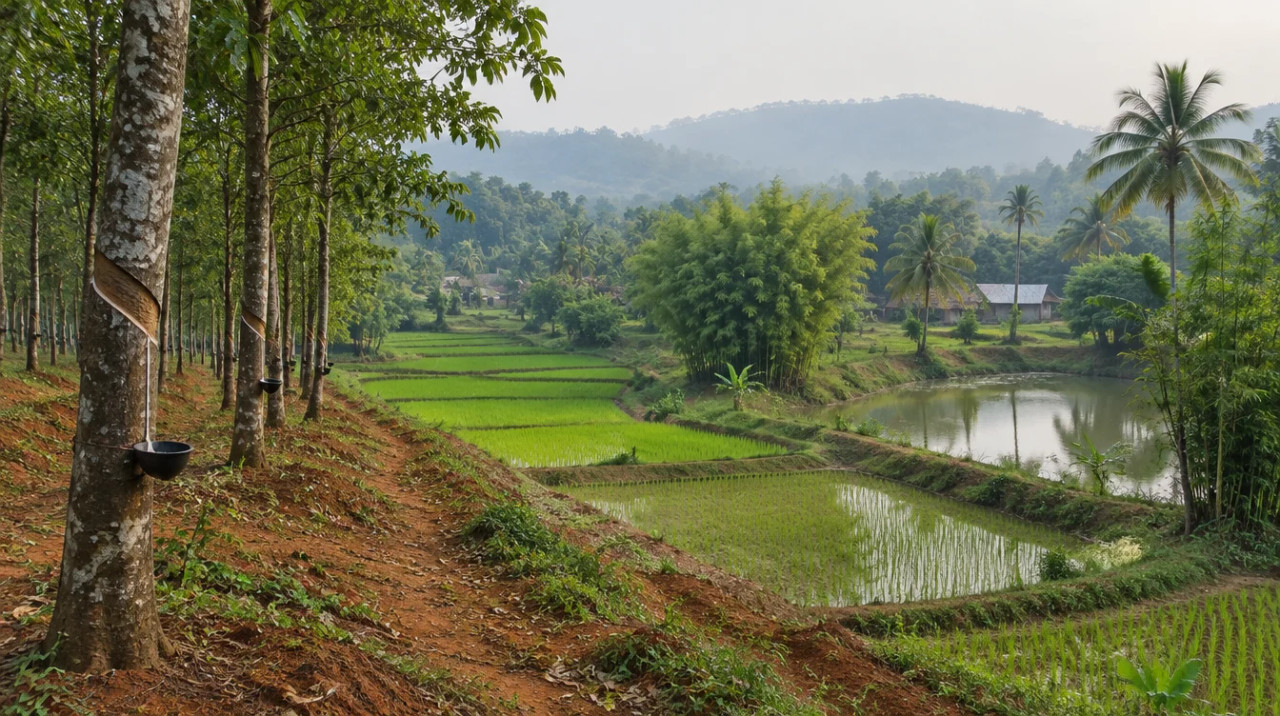
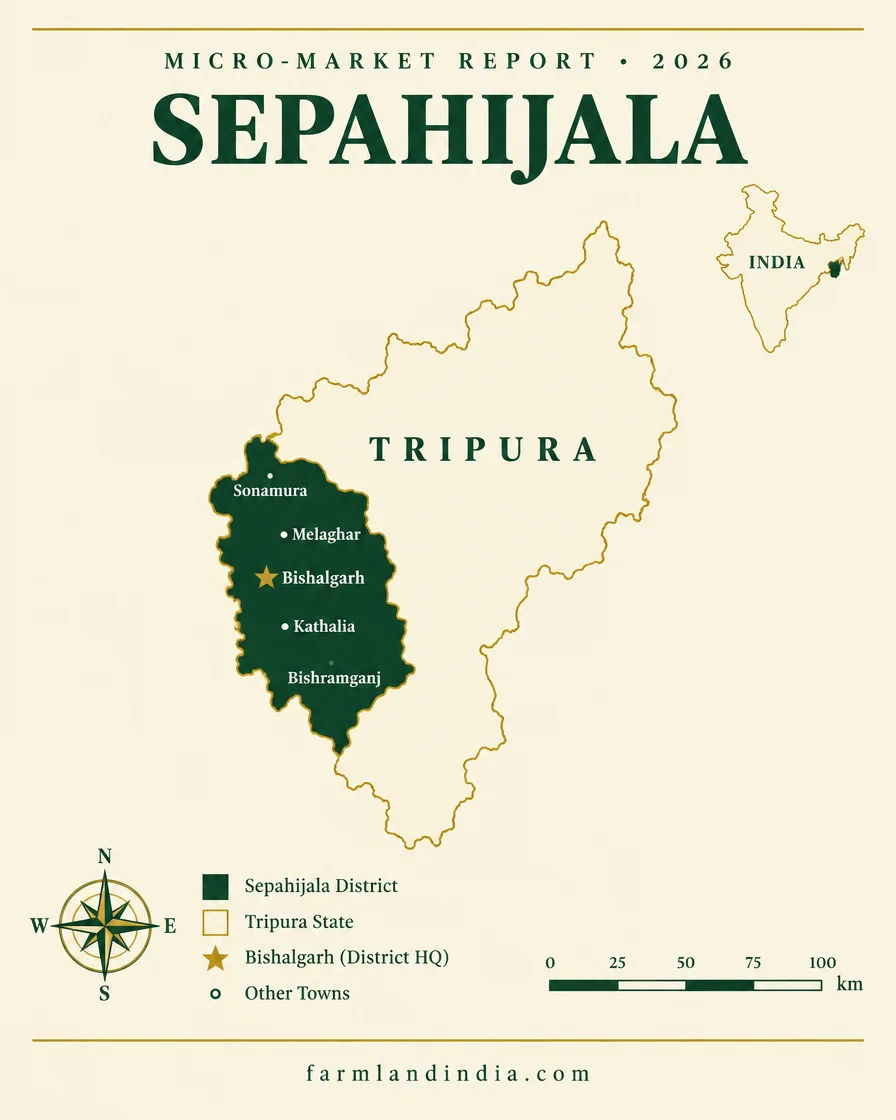
Sepahijala is a long narrow district on Tripura’s western side. The district portal gives 1,043.04 sq km, three sub-divisions, seven blocks, two municipal councils and one nagar panchayat, and says agriculture is the main livelihood with many families relying on rubber plantations (district portal[7]). It lists the Sepahijala Wildlife Sanctuary and zoo, Neermahal, a Buddha stupa and Kashbeswari Kalibari among its sights. The tourism department puts the sanctuary at 18.53 sq km and 28 km from Agartala, with rubber and coffee plantations that visitors can see (tourism department[8]).
The portal does not name the headquarters, though it places the Collectorate beside NH-8 near Bishramganj. The portal figure of 5,42,731 people does not state its year, and Census 2011 gives 4,83,687 for the district (Tripura at a Glance[3]).
- Bishalgarh
- Sonamura
- Melaghar
- Kathalia
- Bishramganj
Transaction costs
Stamp duty & registration in Sepahijala
Registration fee
Ask the sub-registrar for a written computation.
Stamp duty
The Indian Stamp (Tripura Fifth Amendment) Act, 2020 substituted the conveyance entry (gazetted 13 Nov 2020), and a Sixth Amendment followed in May 2023.
Permission
Collector’s written approval
Needed when land held by a Scheduled Tribe member is sold to a non-tribal, under section 187 of the 1960 Act
Tripura’s stamp law is the Indian Stamp Act as amended for the state; the Fifth Amendment Act of 2020 replaced the entry for conveyances and a Sixth Amendment followed in 2023 (Indian Stamp (Tripura Fifth Amendment) Act, 2020[6]). Ask the sub-registrar for a written computation on the exact land before you agree a price, and keep the receipt.
Know the belt
What is moving prices in Sepahijala
Five places worth knowing, by what drives them and what to check.
Bishalgarh
Sub-division town
A market town with a bus stand and railway station named by the tourism department; plots near town are for homes and shops, and the sub-divisional office holds the records.
Check: title chain and which office holds the record
Sonamura
Border sub-division
A separate sub-division with its own magistrate, on the Bangladesh border. Land checks near Ashabari outpost began here in November 2026.
Check: distance to the border and a mapped boundary
Melaghar
Neermahal side
Named on our map near the Neermahal tourist site; plots here may draw leisure interest.
Check: land class and access
Kathalia
Southern side
A smaller place south of Bishalgarh on our map, with farm and plantation land.
Check: who holds the land
Bishramganj
Collectorate area
The portal places the District Magistrate’s office beside NH-8 here, so records and permissions are close at hand.
Check: which office holds the record
Asking prices
No official farmland price series is published for Sepahijala. Ask the sub-registrar for recent registered sale values in the village you are looking at. Treat an agent’s figure as an opening ask until it is matched with a registered deed.
Connectivity
How Sepahijala connects — road, rail and air
🚗 By road
✈️ By air
🚆 By rail
Check the live route
Growth catalysts
Upcoming infrastructure & developments
One highway upgrade at the DPR stage; border land checks are a live factor.
00Open
02Catalysts
Agriculture & terrain
Soil, crops & water in Sepahijala
Land and water
Tripura’s normal rainfall is 2,213.8 mm a year and groundwater extraction was 9.48% in 2024 (India Today NE[4]
- State rainfall: 2,213.8 mm
- State groundwater extraction: 9.48% (2024)
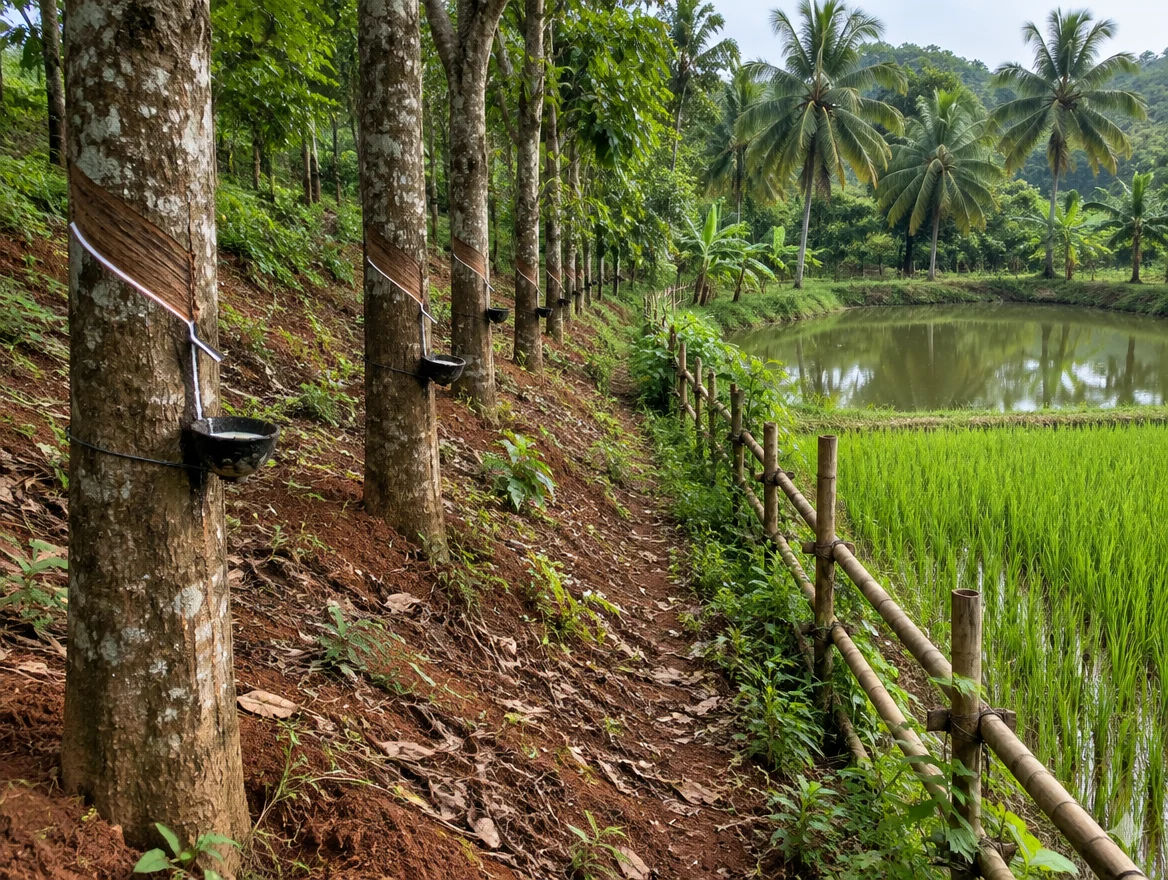
- Rubber plantations are a main livelihood (district portal)
Typical crops
The portal names rubber and general agriculture; Tripura’s main crops by state figures are rice, rubber and pineapple.
Low land and flood
Paddy land near streams and ponds can flood in the monsoon; red-soil slopes under rubber drain better. Visit in the rains.
At a glance
Sepahijala vs. nearby districts
| District | Land and water | What links it to Sepahijala |
|---|---|---|
| West Tripura | East; Agartala | The capital district, covered in our West Tripura page |
| Gomati | South-east; Udaipur | Separate district created from the former South Tripura, headquartered at Udaipur |
| Khowai | North-east | Smaller border district with two sub-divisions |
The neighbours are listed from our locator map, not from a boundary notification.
Farmland India view
Why investors look at Sepahijala
Five reasoned points for Sepahijala, each tied to a source on this page.
Close to Agartala, but no price series
The district sits on the NH-8 corridor and the sanctuary is 28 km from the capital, yet no price source exists, so returns are a guess.
Border papers matter
Land near Bangladesh with a mapped boundary and a full chain of title is easier to resell and less likely to be held up.
Check the community of the seller
Where the seller is tribal, the Collector’s order is the first gate for a non-tribal buyer.
Watch the NH-8 alignment
The four-lane alignment was due in August 2026; plots beside the road may be taken in part.
Confirm the land record, mutation, zoning and acquisition status directly — these are not certified by Farmland India’s review.
STRAIGHT TALK
Risks & challenges in Sepahijala
District-specific risks. Read the Tripura state page for the general risks on ceiling, conversion and records.
Border-side checks
Land near the border is being demarcated and papers checked; occupants without valid papers may be treated as being on government land.
Government-land clearance
A district drive has cleared encroachers from government land; confirm the plot is private.
Road acquisition
Plots along NH-8 may be affected when the four-lane alignment is final.
Flood and slope
Low paddy land can flood and rubber slopes can erode.
Permission refused or missing
A sale of tribal land without the Collector’s written permission can be challenged. Keep payments refundable until the order is issued.
Records and council land
Check the plot on the Jami portal and with the sub-divisional land records section, and ask whether any part lies inside the autonomous district council area.
Who to contact
Local revenue & planning offices
Sepahijala is administered by the District Magistrate and Collector, whose office the portal places beside NH-8 near Bishramganj, with sub-divisional offices at Bishalgarh and Sonamura holding the Land Records Section (district portal[7]). Deeds are registered at the sub-registrar’s office; ask for the written fee and duty computation. For land inside the council area, ask the council office as well.
COMMON QUESTIONS
Frequently asked questions
Everything buyers, NRIs and investors ask before their first reviewed farmland purchase in Sepahijala.
Visit full wiki01 of 04
Can an outsider buy land in Sepahijala?
It depends on who holds the land. Under section 187 of the Tripura Land Revenue and Land Reforms Act, 1960, land held by a Scheduled Tribe member can pass to a non-tribal only with the previous written permission of the Collector. A large part of the state also lies under the autonomous district council. Confirm the route with the sub-divisional office and a local lawyer before paying.
02 of 04
Is Sepahijala spelled Sipahijala?
The official spelling is Sepahijala; older records and some news reports write Sipahijala. Our web address keeps the older spelling. Check both when searching land records or deeds.
03 of 04
What land checks are being made near the border?
After a clash at Ashabari border outpost on 3 November 2026, the Sonamura sub-division began demarcating land and checking ownership documents near the outpost. The Union Home Minister was also reported to have directed monitoring of land purchases and transfers along the border. A plot near the border needs a clean deed and a mapped boundary.
04 of 04
Can an outsider buy land in Sepahijala?
Yes in principle, but who the seller is decides the process. If the seller is a Scheduled Tribe member, the Collector’s previous written permission is needed before a non-tribal can buy. Ask the sub-divisional office and a local lawyer before paying.
Transparency
Sources and references
Law and courts
- [1]Tripura Land Revenue and Land Reforms Act, 1960 — indiacode.nic.in
- [2]Tripura High Court: Tufani Ram Bin v State, 2026 — livelaw.in
Government
- [3]Tripura at a Glance 2024-25 — tripura.gov.in
- [4]Tripura groundwater 2024 (India Today NE) — indiatodayne.in
- [5]Jami land records note (Khowai district portal) — khowai.nic.in
- [6]Indian Stamp (Tripura Fifth Amendment) Act, 2020 — tripura.gov.in
- [7]Sepahijala district portal — sepahijala.nic.in
- [8]Tripura Tourism: Sepahijala — tripuratourism.gov.in
News
- [9]NE Now: land verification near Ashabari, 6 Nov 2026 — nenow.in
- [10]ANI: Tripura CM reviews national highway projects, 2 Jul 2026 — aninews.in
- [11]theprint.in: ThePrint, 7 Nov 2026 — theprint.in
Data-currency note: sources were read in November 2026. Project status, the benchmark valuation and land rules change often; check the linked source and the relevant office before relying on any figure.
For developers
Ready to explore Sepahijala farmland?
Browse reviewed projects and individual land parcels across Sepahijala — or if you own land here, list it with platform review and reach serious buyers.