
Area guide
Buying Land in Ormanjhi
A plateau block on the Ranchi–Ramgarh road where a greenfield expressway meets Scheduled Area land rules that every buyer must clear first.
59.94 km
Expressway length (MoRTH, 2023)
Rs 2,224 crore
Expressway cost (MoRTH, 2023)
4% + 3%
Stamp duty plus registration fee
31.42%
State groundwater extraction (CGWB, 2024)
*Indicative range across districts and land types. Stamp duty, registration and conversion charges are additional. Local measurement units vary — every listing states the unit it is priced in. Not a valuation or an offer.
Micro-market record — Ormanjhi
Rev. 2026 · Farmland India desk
District
Ranchi (Ormanjhi block, north-east of the city)
Corridor
Ormanjhi–Jainamore four-lane expressway, 59.94 km, Rs 2,224 crore (cleared June 2023)[8]
Highway
Ranchi–Ramgarh–Hazaribagh four-lane road, 73.8 km, built in 2015[9]
Legal
Scheduled Area; CNT Act 1908 s.46 limits transfers by tribal and protected raiyats[1]
Stamp duty
4% stamp duty plus 3% registration fee, per the state schedule[7]
Groundwater
Hard-rock plateau; state extraction 31.42% (CGWB, 2024); test each plot[6]
Land rates
No published price series found; use the circle rate and registered deeds
Land law is state law. These rules are maintained on the Jharkhand page and apply to every district within it.
Ormanjhi — land purchase legal rules
Jharkhand’s land law turns on the seller, not the buyer. Two tenancy laws, the Chota Nagpur Tenancy Act, 1908 and the Santhal Parganas Tenancy Act, 1949, decide whether a raiyati plot can be sold at all and to whom. Get this wrong and a registered sale can be annulled, with no refund, decades later.
Who can buy: There is no farmer-only rule in Jharkhand. The restriction runs the other way: the tenancy laws decide which land may be sold, and to whom, according to the community of the person who owns it. Land held by a raiyat (occupancy tenant) who is not Scheduled Tribe, Scheduled Caste or Backward Class can be sold to anyone under the CNT Act. Land held by a tribal, Dalit or backward-class raiyat cannot be bought by an outsider, whatever price is offered.
CNT Act, Section 46: Any sale, gift or lease of more than five years by a raiyat is void except as the section allows. A Scheduled Tribe raiyat may sell, exchange, gift or bequeath land only to another Scheduled Tribe member who lives within the same police-station area, and only with the Deputy Commissioner’s prior sanction. A Scheduled Caste or Backward Class raiyat may transfer, with the same sanction, only to a member of the same group living in the same district. Transfers to registered cooperative societies and specified banks are allowed. Sub-section (3) bars the registration of a deed made in breach of these rules, and no court may recognise one (CNT Act text, LBSNAA copy).
Restoration and penalties: Section 46(4-A) lets the Deputy Commissioner annul a transfer of tribal land made in breach of the section and evict the buyer. Section 71-A goes further: where tribal land was transferred unlawfully or by fraud, the Deputy Commissioner can restore it to the original owner or his heirs without paying the buyer compensation. Section 71-B makes knowingly holding such land an offence punishable with up to three years in prison. A registered deed and long possession are no defence.
Industrial and mining use: Section 49 is the one route through which raiyati land can pass to an outsider for an industrial or mining purpose, or for access to such land. The deed must be registered, the Deputy Commissioner must consent in writing before registration, the land may be used only for the stated purpose, and for Scheduled Tribe land the state can annul the consent within twelve years if it was obtained by fraud. It does not open the land to farm or farmhouse buyers.
Santhal Pargana (SPT Act): In Dumka, Deoghar, Godda, Pakur, Sahibganj and Jamtara (carved out of Dumka), the SPT Act, 1949 is stricter still. Under Section 20 a raiyat cannot transfer his holding by sale, gift, mortgage, will or lease unless the right to transfer is recorded in the record of rights, and only to the extent recorded. Where a right is recorded for an aboriginal raiyat, the land can go only to a bona fide cultivating aboriginal raiyat of the same pargana, taluk or tappa. Deeds in breach cannot be registered, and the Deputy Commissioner can evict the buyer. In practice raiyati farmland in Santhal Pargana is close to unsaleable.
Scheduled Areas: Under the Fifth Schedule, the Scheduled Areas (State of Jharkhand) Order, 2007 covers Ranchi, Lohardaga, Gumla, Simdega, Latehar, East Singhbhum, West Singhbhum, Saraikela-Kharsawan, Sahibganj, Dumka, Pakur and Jamtara along with parts of Palamu, Garhwa and Godda (Jharkhand High Court judgment citing the 2007 Order). Khunti was carved out of Ranchi later the same year and remains Scheduled Area. Here gram sabhas have a say on land and tribal protections are enforced most strictly.
Attempts to relax the law: In November 2016 the assembly passed amendments to the CNT and SPT Acts that would have allowed tribal land to be put to commercial use. Governor Droupadi Murmu returned the bills in May 2017 and the government withdrew them in August 2017 (Business Standard (PTI), 9 August 2017). The original protections stand.
Ceiling and government land: Jharkhand continues to apply the Bihar Land Reforms (Fixation of Ceiling Area and Acquisition of Surplus Land) Act, 1961, which caps family holdings by land class, as on our Bihar page. Plots recorded as gair-mazurwa (government land), forest or khas land cannot be bought at all, however long a family has occupied them.
Documents to check: The Khatiyan for the village survey (it records the raiyat’s caste or tribe and any transfer right), the current Register II entry and rent receipts, the mutation order from the circle office, a 30-year encumbrance search at the sub-registrar, the plot on the village map and a Deputy Commissioner’s sanction where the seller belongs to a protected group. Our Jharbhoomi guide explains each record.
NRI and OCI buyers: Under the RBI Master Direction on immovable property, NRIs and OCIs may not acquire agricultural land, a farmhouse or plantation property in India except by inheritance. In Jharkhand the tenancy laws narrow the field further. Our NRI guide covers the options.
- No farmer-only rule
- CNT Act: Section 46
- ST buyers: same police station
- SC/BC buyers: same district
- Restoration: Section 71-A
- Santhal Pargana: SPT Act Section 20
- Scheduled Areas: 2007 Order
- NRIs: inheritance only
Sub-area overview
Ormanjhi — a plateau block on the Ramgarh road, where title matters more than distance
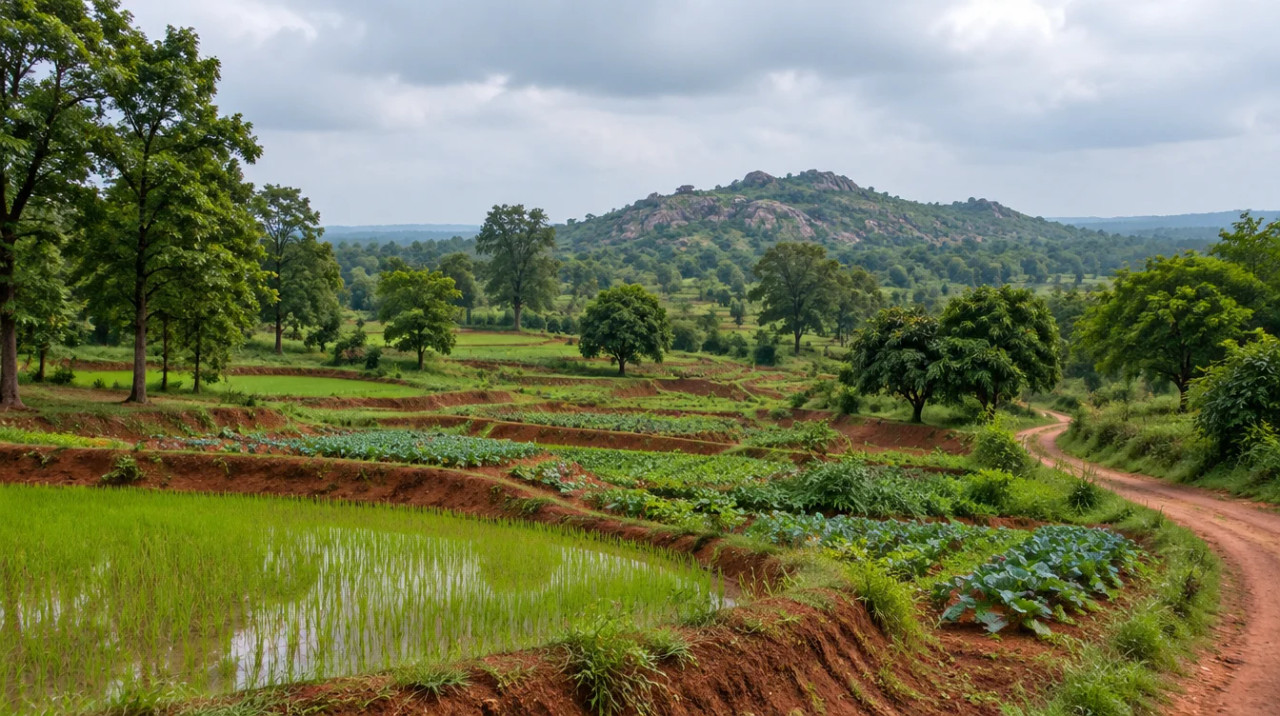
Ormanjhi is a block of Ranchi district[4] on the north-eastern side of the city, on the road that runs on to Ramgarh and Hazaribagh. Our Ranchi district page places it in the ring-road belt with Kanke, Namkum and Ratu, the part of the district where farm plots are being sold for homes and farmhouses (The Telegraph[2]). The ground is rolling red lateritic upland, with terraced paddy in the valley floors and maize, pulses and vegetables on the slopes.
The infrastructure story is the expressway. The Union transport ministry cleared a four-lane, 59.94 km road from Ormanjhi to Jainamore in Bokaro, through Gola in Ramgarh, at Rs 2,224 crore in June 2023; NHAI said work would begin soon and noted controlled blasting permissions for hard rock in the Sikidiri valley (NBM&CW[8]). A November 2026 report still lists the project as proposed, adds five underpasses and flyovers for elephant movement, and gives no start or completion date (Indian Masterminds[9]). Read it as an approved road whose build status you must confirm, not as a road you can drive.
Land law decides who can buy and sell here. Ranchi is a Scheduled Area, and in the Chotanagpur division the Chota Nagpur Tenancy Act, 1908 (CNT Act) controls transfers. Under section 46 a tribal raiyat may sell only to a tribal member living in the same police-station area and only with the Deputy Commissioner’s prior sanction, and Scheduled Caste and Backward Class raiyats are similarly limited to their own group in the district; a deed made against these rules cannot be registered, and land can be restored to the original owner without compensation (CNT Act[1]). The practical rule: find out who the recorded raiyat is before talking price.
A workable order of checks runs like this. First, get the khatiyan and plot map and read the raiyat’s category and the land’s nature (agricultural, homestead, or other) from the record. Second, ask the Circle Officer whether the plot lies inside a notified area, a road-widening line or a forest or elephant-movement zone. Third, find out whether the seller’s community needs a Deputy Commissioner’s sanction, and ask for the order before you pay more than a token advance. Fourth, compare recent registered deeds in the same village and the circle rate, because there is no published price series for Ormanjhi. Fifth, ask a local lawyer who has registered land in Ranchi to read the deed. None of this is exciting, but in a Scheduled Area it is the work that protects the purchase.
For buyers who clear the title question, Ormanjhi is a farm-use buy rather than a plotting play. Soils are thin and acidic on slopes and better in terraced valleys, borewells can fail on neighbouring plots, and the average holding in the state is small, so assembling a block means dealing with several owners (Department of Agriculture[5]). Start from the Jharkhand land buying guide, and use the Jharbhoomi guide and Bhu-naksha guide to read the khatiyan (record of rights) and plot map before you go to the circle office.
- Plateau farmland
- Scheduled Area
- Expressway corridor
- CNT Act check
- NRI barred
Connectivity
How Ormanjhi connects
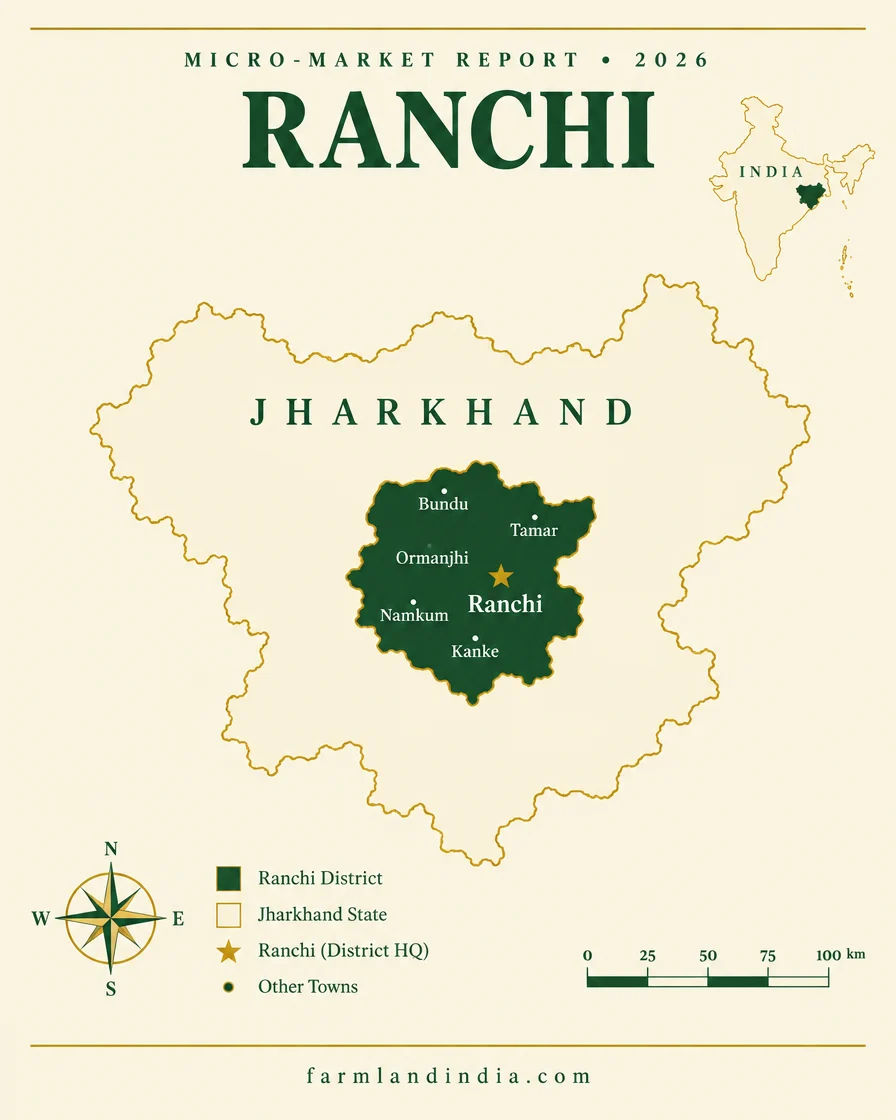
Ormanjhi lies on the Ranchi–Ramgarh road to the north-east of the city. Distances are not route-checked.
By road and rail
By air and rail
Growth catalysts
Upcoming infrastructure & developments
One approved expressway, one open highway and the ring road. Only the last two are in use.
02Open
Operational or in use
03Catalysts
Built, building or reported
Agriculture & terrain
Soil, crops & water in Ormanjhi
Upland farming on thin soil, with water as the main constraint.
Soil & crops
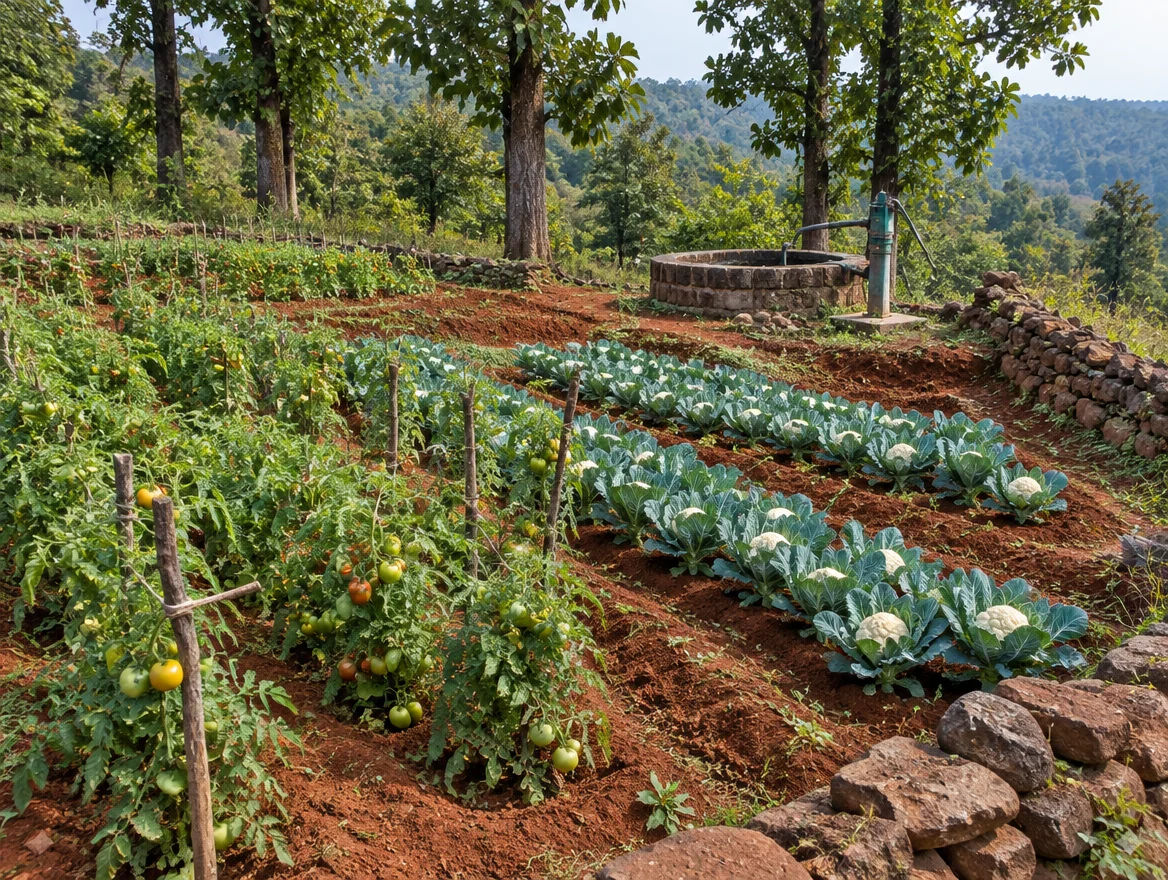
The Ranchi plateau farms in steps: upland fields (tanr) with maize, millets, pulses and niger on thin red soil, and terraced lowland fields (don) that hold water for transplanted paddy. Vegetables around Ranchi supply markets as far as Kolkata (Department of Agriculture, 2018[5]). Soil tests and compost are the first costs for any new owner, because the upland soils are low in organic matter.
- Paddy on don land
- Maize, millets, pulses
- Vegetables
- Small orchards
Water
CGWB’s 2024 assessment puts Jharkhand’s groundwater extraction at 31.42%, with 240 of 263 assessment units safe, but it flags heavy use in Ranchi and several other towns[6]. The hard-rock aquifer under the plateau yields little, so a borewell that works on one plot can fail on the next.
Rainfall and holdings
Average rainfall across Jharkhand is about 130 cm a year, mostly June to September, and the average holding is 1.58 hectares[5]. Expect to buy from several owners for a consolidated block.
Farmland India view
Why buyers look at Ormanjhi
Why buyers look at Ormanjhi, and what to weigh.
An approved expressway
The Ormanjhi–Jainamore road is approved at Rs 2,224 crore but has no confirmed start date in recent reports. Pay for the land you can use today, not for the road.
Ring-road belt demand
Plots along the Ranchi ring road are sold for homes and farmhouses, so Ormanjhi competes with Kanke, Namkum and Ratu for the same buyers.
Clean title is the premium
In a Scheduled Area, a plot with a clear non-protected seller, an unambiguous khatiyan and a registered deed is worth more than a cheaper plot with a CNT question.
Farm use needs soil work
Thin, acidic soil means compost, soil testing and a water plan before any crop; budget for it.
Day-trip farm use
A plot beside the Ramgarh road suits a small orchard, nursery or weekend farm within reach of Ranchi, but it still needs a reliable road, power and water to be worth more than its crop.
Smaller risk of speculation lock-in
With the expressway date unclear, a buyer who treats Ormanjhi as farm land first and a road bet second has less to lose if the schedule slips again.
Listing data is not legal advice. Confirm the raiyat category, CNT sanction and zone with the Circle Officer and the Ranchi Regional Development Authority.
STRAIGHT TALK
Risks & challenges specific to Ormanjhi
Check these before paying an advance on Ormanjhi land.
CNT Act and Scheduled Area
Transfers by tribal and protected raiyats need Deputy Commissioner sanction, and a deed in breach cannot be registered; land can be restored without compensation and offenders can be jailed up to three years (CNT Act s.46, s.71-A, s.71-B[1]).
Expressway status
The road is approved but a November 2026 report calls it proposed[9]. Ask NHAI for the alignment and any acquisition notice that touches your village.
Elephant and forest zones
The expressway plan includes five underpasses and flyovers for elephant movement[9]. Plots near forest or elephant routes may carry use limits; ask the forest office.
Borewell failure
Hard-rock ground means water is a gamble on each plot[6]; test before you buy.
Master plan and road-widening lines
Ranchi’s Master Plan 2037 zones and any road-widening line along the Ramgarh road can limit what you build; the Jharkhand High Court heard a challenge to discrepancies in the plan in September 2022[3]. Ask for the zone and the setback for the village before you pay.
Stamp duty and urban surcharge
Cabinet approved a 10% surcharge on duty plus fee for transfers in municipal and notified urban areas on 27 October 2026; the start date was not reported[11]. Check whether Ormanjhi land falls in a notified area.
NRIs and OCIs
FEMA bars NRIs and OCIs from buying agricultural land, except by inheritance; see the NRI guide.
COMMON QUESTIONS
Frequently asked questions
Everything buyers, NRIs and investors ask before their first reviewed farmland purchase in Ormanjhi.
Visit full wiki01 of 04
Can an outsider buy farm land in Ormanjhi?
It depends on who owns it. Ranchi is a Scheduled Area and the CNT Act limits transfers by tribal and other protected raiyats, so ask the Circle Officer for the plot’s category and any required Deputy Commissioner sanction before paying an advance.
02 of 04
What is the Ormanjhi expressway?
A four-lane, 59.94 km road from Ormanjhi to Jainamore in Bokaro through Gola, cleared by the Union transport ministry in June 2023 at Rs 2,224 crore. A November 2026 report still calls it proposed, so confirm the build status.
03 of 04
What are the stamp duty and fees on a sale deed?
The state schedule shows 4% stamp duty and 3% registration fee, and cabinet cleared a 10% surcharge on duty plus fee for urban transfers in October 2026. Check the current rate at the sub-registrar before signing.
04 of 04
Is there a price per acre for Ormanjhi?
None is shown. Ask for recent registered deeds in the same village and the circle rate.
Transparency
Sources for this page
- [1]Chota Nagpur Tenancy Act, 1908 (LBSNAA copy) — lbsnaa.gov.in
- [2]The Telegraph: Ranchi Ring Road arm opened, 22 February 2019 — telegraphindia.com
- [3]Jharkhand High Court: Dr. Rajesh Kumar v. State (LPA 132 of 2012, Ranchi Master Plan 2037), 7 Sep 2022 — indiankanoon.org
- [4]Ranchi district portal — ranchi.nic.in
- [5]Department of Agriculture: Agriculture Scenario in Jharkhand, Oct 2018 — indianembassywarsaw.gov.in
- [6]CGWB: Dynamic Ground Water Resources of Jharkhand, 2024 — cgwb.gov.in
- [7]Jharkhand stamp duty and registration fee schedule (ICSI copy) — icsi.edu
- [8]NBM&CW: MoRTH clears Rs 2,224-cr highway widening in Jharkhand, 23 Jun 2023 — nbmcw.com
- [9]Indian Masterminds: Ramgarh road infrastructure and highway projects, 2 Nov 2026 — indianmasterminds.com
- [10]Indian Masterminds: Birsa Munda Airport expansion, 20 May 2026 — indianmasterminds.com
- [11]Indian Masterminds: Jharkhand cabinet approves transfer surcharge, 28 Oct 2026 — indianmasterminds.com
General information, not legal advice. Report inaccuracies to wiki@farmlandindia.com.
For developers
Ready to explore Ormanjhi farmland?
Browse reviewed projects and individual land parcels across Ormanjhi — or if you own land here, list it with platform review and reach serious buyers.