
District guide
Buying Land in Ranchi
Jharkhand’s capital district: an 85 km ring road, a plateau vegetable belt and a Scheduled Area where tribal title decides what can be bought.
5,097 sq km
Area (district portal)
29.1 lakh
Population (Census 2011)
85.55 km
Ring Road length
4% + 3%
Stamp duty + registration
*Indicative range across districts and land types. Stamp duty, registration and conversion charges are additional. Local measurement units vary — every listing states the unit it is priced in. Not a valuation or an offer.
District land record — Ranchi
Rev. 2026 · Farmland India desk
State
Jharkhand (state capital district; South Chotanagpur division)
Sub-divisions
Two sub-divisions, Ranchi and Bundu, with 18 blocks (14 in Ranchi, 4 in Bundu) and 305 panchayats (district portal[3])
Key markets
Kanke · Ormanjhi · Namkum · Ratu · Bundu · Tamar
Demand anchors
The state capital and its government offices, Birsa Munda Airport, the Ring Road, Heavy Engineering Corporation land at Dhurwa, and institutions such as IIM, BIT Mesra, NUSRL and RIMS (district portal[3]; ORF, 2019[12])
Rail
Ranchi and Hatia stations, with links to Delhi, Kolkata and Odisha
Size and population
5,097 sq km and 29,14,253 people at the 2011 Census, a density of 572 a sq km (district portal[4]). The city corporation covers 175.12 sq km and held 10.7 lakh people (ORF, 2019[12])
Pricing unit
No newspaper or official price series was found, so no per-acre figure is quoted
Local units
Deeds use decimal (dismil), katha and bigha beside acres. Convert from the area stated in the Khatiyan before comparing any two plots
Land records portal
Jharbhoomi for Register II and Khatiyan; JharBhunaksha for village maps. See our Jharbhoomi guide
Land law is state law. These rules are maintained on the Jharkhand page and apply to every district within it.
Ranchi — land purchase legal rules
Jharkhand’s land law turns on the seller, not the buyer. Two tenancy laws, the Chota Nagpur Tenancy Act, 1908 and the Santhal Parganas Tenancy Act, 1949, decide whether a raiyati plot can be sold at all and to whom. Get this wrong and a registered sale can be annulled, with no refund, decades later.
Who can buy: There is no farmer-only rule in Jharkhand. The restriction runs the other way: the tenancy laws decide which land may be sold, and to whom, according to the community of the person who owns it. Land held by a raiyat (occupancy tenant) who is not Scheduled Tribe, Scheduled Caste or Backward Class can be sold to anyone under the CNT Act. Land held by a tribal, Dalit or backward-class raiyat cannot be bought by an outsider, whatever price is offered.
CNT Act, Section 46: Any sale, gift or lease of more than five years by a raiyat is void except as the section allows. A Scheduled Tribe raiyat may sell, exchange, gift or bequeath land only to another Scheduled Tribe member who lives within the same police-station area, and only with the Deputy Commissioner’s prior sanction. A Scheduled Caste or Backward Class raiyat may transfer, with the same sanction, only to a member of the same group living in the same district. Transfers to registered cooperative societies and specified banks are allowed. Sub-section (3) bars the registration of a deed made in breach of these rules, and no court may recognise one (CNT Act text, LBSNAA copy).
Restoration and penalties: Section 46(4-A) lets the Deputy Commissioner annul a transfer of tribal land made in breach of the section and evict the buyer. Section 71-A goes further: where tribal land was transferred unlawfully or by fraud, the Deputy Commissioner can restore it to the original owner or his heirs without paying the buyer compensation. Section 71-B makes knowingly holding such land an offence punishable with up to three years in prison. A registered deed and long possession are no defence.
Industrial and mining use: Section 49 is the one route through which raiyati land can pass to an outsider for an industrial or mining purpose, or for access to such land. The deed must be registered, the Deputy Commissioner must consent in writing before registration, the land may be used only for the stated purpose, and for Scheduled Tribe land the state can annul the consent within twelve years if it was obtained by fraud. It does not open the land to farm or farmhouse buyers.
Santhal Pargana (SPT Act): In Dumka, Deoghar, Godda, Pakur, Sahibganj and Jamtara (carved out of Dumka), the SPT Act, 1949 is stricter still. Under Section 20 a raiyat cannot transfer his holding by sale, gift, mortgage, will or lease unless the right to transfer is recorded in the record of rights, and only to the extent recorded. Where a right is recorded for an aboriginal raiyat, the land can go only to a bona fide cultivating aboriginal raiyat of the same pargana, taluk or tappa. Deeds in breach cannot be registered, and the Deputy Commissioner can evict the buyer. In practice raiyati farmland in Santhal Pargana is close to unsaleable.
Scheduled Areas: Under the Fifth Schedule, the Scheduled Areas (State of Jharkhand) Order, 2007 covers Ranchi, Lohardaga, Gumla, Simdega, Latehar, East Singhbhum, West Singhbhum, Saraikela-Kharsawan, Sahibganj, Dumka, Pakur and Jamtara along with parts of Palamu, Garhwa and Godda (Jharkhand High Court judgment citing the 2007 Order). Khunti was carved out of Ranchi later the same year and remains Scheduled Area. Here gram sabhas have a say on land and tribal protections are enforced most strictly.
Attempts to relax the law: In November 2016 the assembly passed amendments to the CNT and SPT Acts that would have allowed tribal land to be put to commercial use. Governor Droupadi Murmu returned the bills in May 2017 and the government withdrew them in August 2017 (Business Standard (PTI), 9 August 2017). The original protections stand.
Ceiling and government land: Jharkhand continues to apply the Bihar Land Reforms (Fixation of Ceiling Area and Acquisition of Surplus Land) Act, 1961, which caps family holdings by land class, as on our Bihar page. Plots recorded as gair-mazurwa (government land), forest or khas land cannot be bought at all, however long a family has occupied them.
Documents to check: The Khatiyan for the village survey (it records the raiyat’s caste or tribe and any transfer right), the current Register II entry and rent receipts, the mutation order from the circle office, a 30-year encumbrance search at the sub-registrar, the plot on the village map and a Deputy Commissioner’s sanction where the seller belongs to a protected group. Our Jharbhoomi guide explains each record.
NRI and OCI buyers: Under the RBI Master Direction on immovable property, NRIs and OCIs may not acquire agricultural land, a farmhouse or plantation property in India except by inheritance. In Jharkhand the tenancy laws narrow the field further. Our NRI guide covers the options.
- No farmer-only rule
- CNT Act: Section 46
- ST buyers: same police station
- SC/BC buyers: same district
- Restoration: Section 71-A
- Santhal Pargana: SPT Act Section 20
- Scheduled Areas: 2007 Order
- NRIs: inheritance only
Ranchi — district-specific notes
Ranchi is the state capital and the most-searched land market in Jharkhand, but the whole district is a Scheduled Area under the Chota Nagpur Tenancy Act. The points below are specific to Ranchi; the state-wide law is in the block above.
⚠ Tribal title runs under the city’s growth belt. Under Section 46 of the CNT Act a Scheduled Tribe raiyat can sell only to a Scheduled Tribe member living in the same police-station area, with the Deputy Commissioner’s prior sanction (CNT Act, 1908[1]). The villages along the Ring Road, in Kanke, Ormanjhi, Namkum and Ratu, are where the city is spreading, but most are in the Scheduled Area and many plots are held by tribal raiyats (The Telegraph, 22 Feb 2019[9]).
⚠ Master Plan 2037 does not always match the ground. In 2022 the Jharkhand High Court recorded submissions from the Ranchi Municipal Corporation and RRDA that the plan had inconsistencies: road widths, plot numbers that do not match village survey and revenue maps, disputed boundary lines and water bodies that no longer exist (High Court order, 9 May 2022[2]). Check the zoning, the survey plot number and any road-widening line for the exact plot.
⚠ Acquisition for roads can lapse, but not automatically. The same order notes that under Section 29 of the RRDA Act, land the state does not acquire within six months of notice is treated as outside the plan for road, drainage or widening (High Court order, 9 May 2022[2]). Ask the authority in writing what status a plot has.
⚠ HEC and government land is not for private sale. Heavy Engineering Corporation holds about 7,200 acres in Ranchi, part of which now carries the Legislative Assembly, the Secretariat and the Smart City site (ORF, 2019[12]). Land recorded as government, gair-mazurwa or khas cannot be bought from a private seller.
⚠ Urban transfers may carry a surcharge. A 10% surcharge on stamp duty plus fee for transfers in municipal and notified urban areas was approved on 27 October 2026; the start date was not reported (Indian Masterminds, 28 Oct 2026[11]). It matters for plots inside the corporation limit.
Check the Khatiyan for the owner’s community and any transfer sanction first; in Ranchi it matters more than the road frontage.
- State capital
- Scheduled Area
- CNT Act s.46
- Master Plan 2037
- RRDA
- Municipal surcharge
District overview
Ranchi — the state capital, an 85 km ring road and a plateau vegetable belt
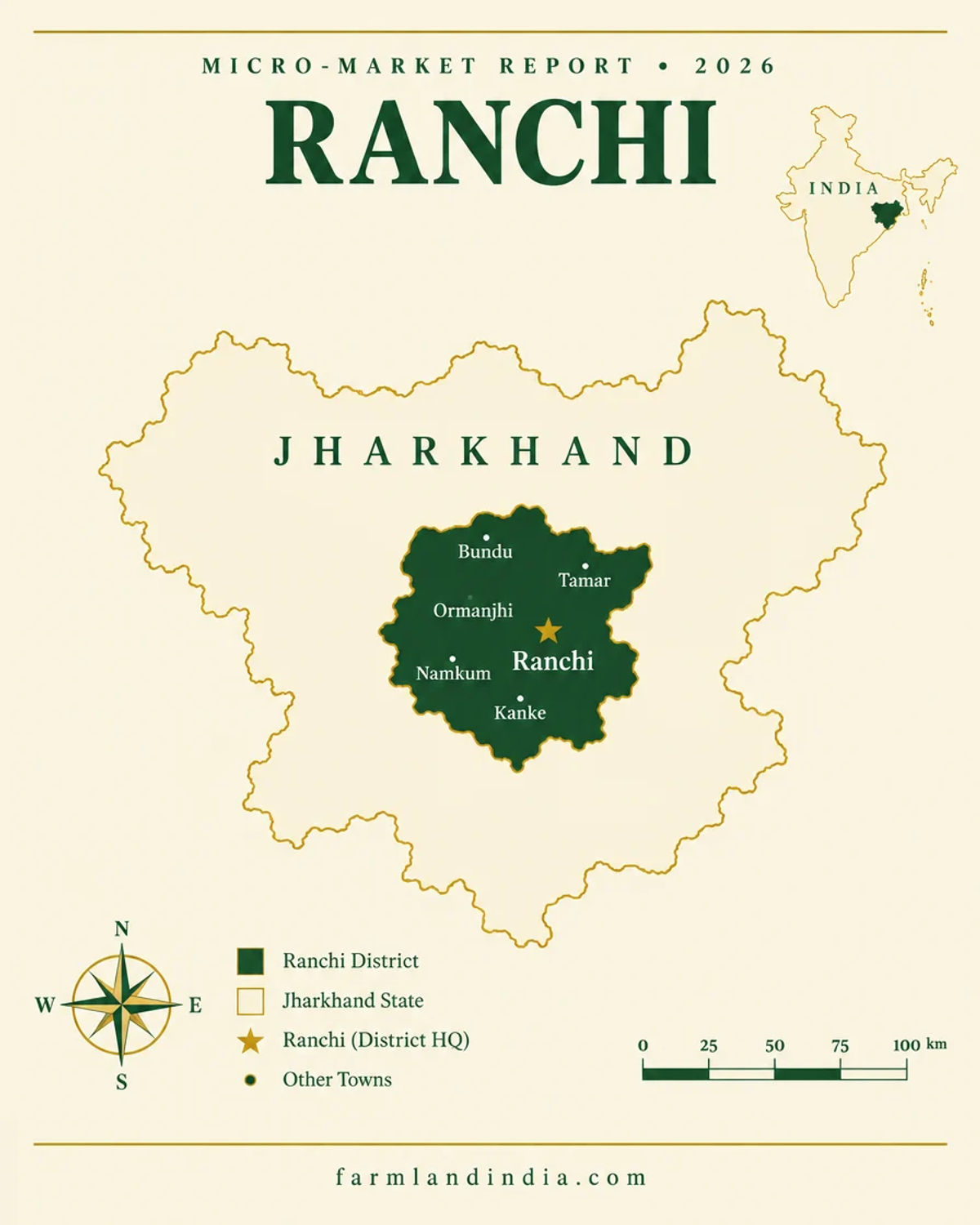
Ranchi is Jharkhand’s capital and, by population, its biggest district: 5,097 sq km and 29,14,253 people at the 2011 Census (district portal[4]). It was the summer capital of undivided Bihar until Jharkhand was formed in 2000 (district portal[3]). The Ranchi Municipal Corporation covers 175.12 sq km and 55 wards; Kanke, Arsande, Ara, Bargarwa and Tundiul are census towns on its edge (ORF, 2019[12]).
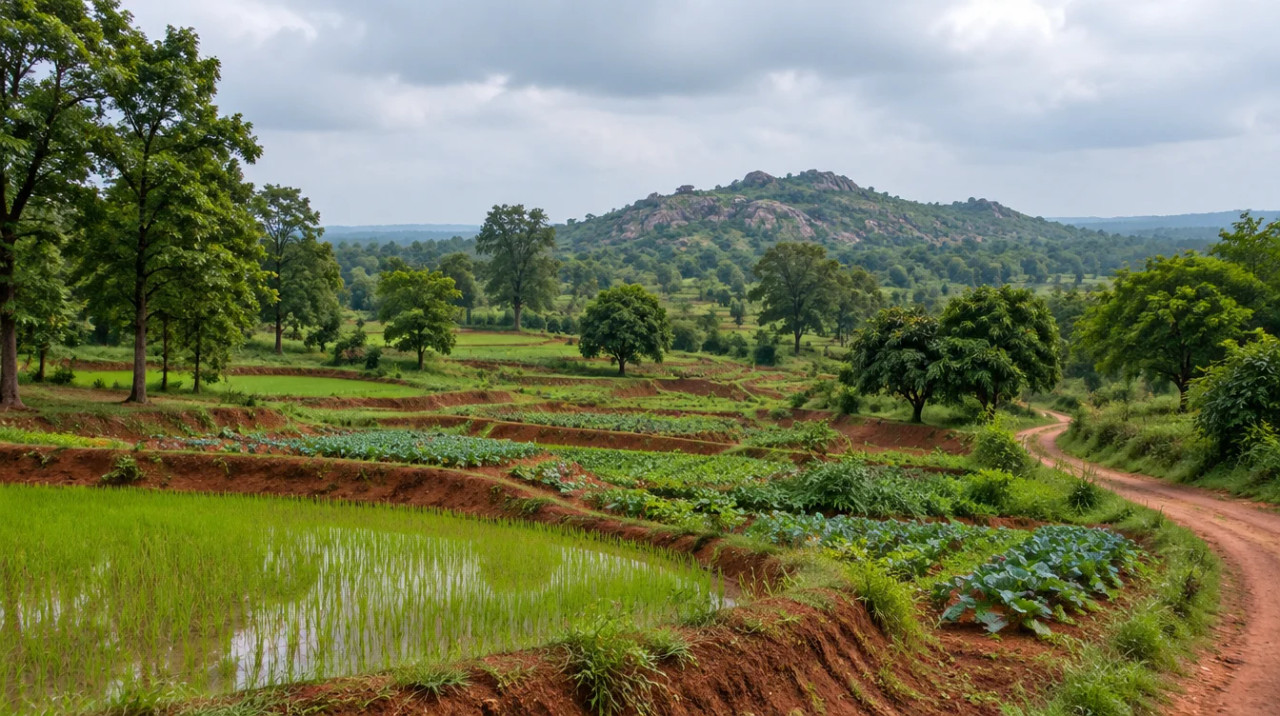
Beyond the city the district is the Chota Nagpur plateau in its most farmed form. Fields run in steps: thin red upland (tanr) for maize, millets and pulses, and terraced lowland (don) that holds water for paddy. Vegetables grown around Ranchi reach markets as far as Kolkata, and Jharkhand ranks second in the country for tomato (Department of Agriculture, 2018[5]).
Buyers fall into three groups. City families, mostly salaried in government, HEC, Central Coalfields and SAIL, which have head offices here (district portal[3]), look for weekend plots and small orchards on the Khunti, Ormanjhi and Ghatshila roads. Institutions and developers buy where roads are widened. Investors from outside the state come for the capital’s long-term growth, but find that the supply of freely saleable land is a small share of what looks available.
The honest summary for a buyer is that Ranchi has the best infrastructure and the most legal friction in Jharkhand. A plot beside the Ring Road may be non-tribal, mutated and in order; the plot next to it may sit in the Scheduled Area, in a tribal raiyat’s name and outside any lawful market. Every purchase starts from the Khatiyan.
Ranchi rewards patience and paper. Ask for the Khatiyan, Register II entry, rent receipt, mutation order and a 30-year encumbrance search before you pay an advance.
- State capital
- Scheduled Area
- Ring Road
- Kanke
- Ormanjhi
- Vegetable belt
Transaction costs
Stamp duty & registration in Ranchi
4% + 3%
Stamp duty + registration fee
On a sale deed, plus Rs 30 a page, per the state schedule
+10%
Urban surcharge (reported)
Of stamp duty and fee in municipal areas; start date not reported
No series
Circle-rate table
No newspaper or official source was found; ask the registry for the minimum land value
Ranchi follows the Jharkhand schedule: 4% stamp duty and 3% registration fee on a sale deed, with a small per-page charge (state schedule, ICSI copy[7]). The cabinet approved a surcharge of 10% of stamp duty plus fee for transfers in municipal and notified urban areas on 27 October 2026 (Indian Masterminds, 28 Oct 2026[11]); with the corporation covering 175 sq km, it could apply to many plots on the city side of the district. No newspaper or official source gives a Ranchi circle-rate table, so ask the sub-registrar for the minimum land value of your mauza and compare registered deeds beside the plot. Confirm every figure at the registry before you pay.
Know the belt
What is moving prices in Ranchi
Where lawful, buildable or farmable land is found in Ranchi; no listing-site prices are used.
Ring Road belt: Kanke, Ormanjhi, Namkum and Ratu
Where the city is spreading
The 85.55 km Ring Road ties the highways to Hazaribagh, Jamshedpur, Daltonganj and Gumla, and the villages along it are where plots are being sold for homes and farmhouses (The Telegraph, 2019[9]). It is the most active belt in the state, and also the one with the thickest layer of tribal title and zoning questions.
Check: the owner’s community and the transfer sanction, the Master Plan 2037 zone, and any road-widening line.
Dhurwa and the capital core
Government and HEC land
The Legislative Assembly, the Secretariat and the Smart City site sit on land that belonged to Heavy Engineering Corporation, which was set up here in 1958 on about 7,200 acres (ORF, 2019[12]). Private farmland is scarce here; what is on offer is often leasehold, allotted or disputed.
Check: who holds title, whether the land is allotted or leasehold, and whether the sale needs the authority’s consent.
Bundu and Tamar
The eastern sub-division on the Jamshedpur road
Bundu is the district’s second sub-division, with four blocks (district portal[3]). The road east towards Jamshedpur gives it easy access to the steel belt, and farmland here is cheaper to hold than near the Ring Road, with more forest and more tribal title.
Check: forest boundaries, tribal raiyat status and the access road in the monsoon.
Farm belt beyond the Ring Road
Vegetables, don and tanr
The outer blocks grow vegetables for city and Kolkata markets, with paddy on terraced don land and maize or pulses on tanr (Department of Agriculture, 2018[5]). Don land with assured water is the better farm asset, and groundwater is under pressure around Ranchi town (CGWB, 2024[6]).
Check: borewell yield on the plot itself, since hard-rock aquifers vary within metres.
Connectivity
How Ranchi connects — road, rail and air
A radial highway hub, a ring road, the state’s main airport and two stations. Drive times to villages are not given because no source was found.
🚗 By road
✈️ By air
🚆 By rail
No drive times are given because no source was found for village-level distances. Corridor costs and targets are the July 2025 review figures and may move; confirm road condition and widening plans at the NHAI or Road Construction Department office.
Growth catalysts
Upcoming infrastructure & developments
Status labels reflect sources as of November 2026. Government-announced timelines are not guaranteed; items with a single or older source say so.
01Open
07Catalysts
Agriculture & terrain
Soil, crops & water in Ranchi
A plateau of terraced paddy and vegetables on thin red soil, irrigated mostly from rain, ponds and hard-rock borewells.
Crops
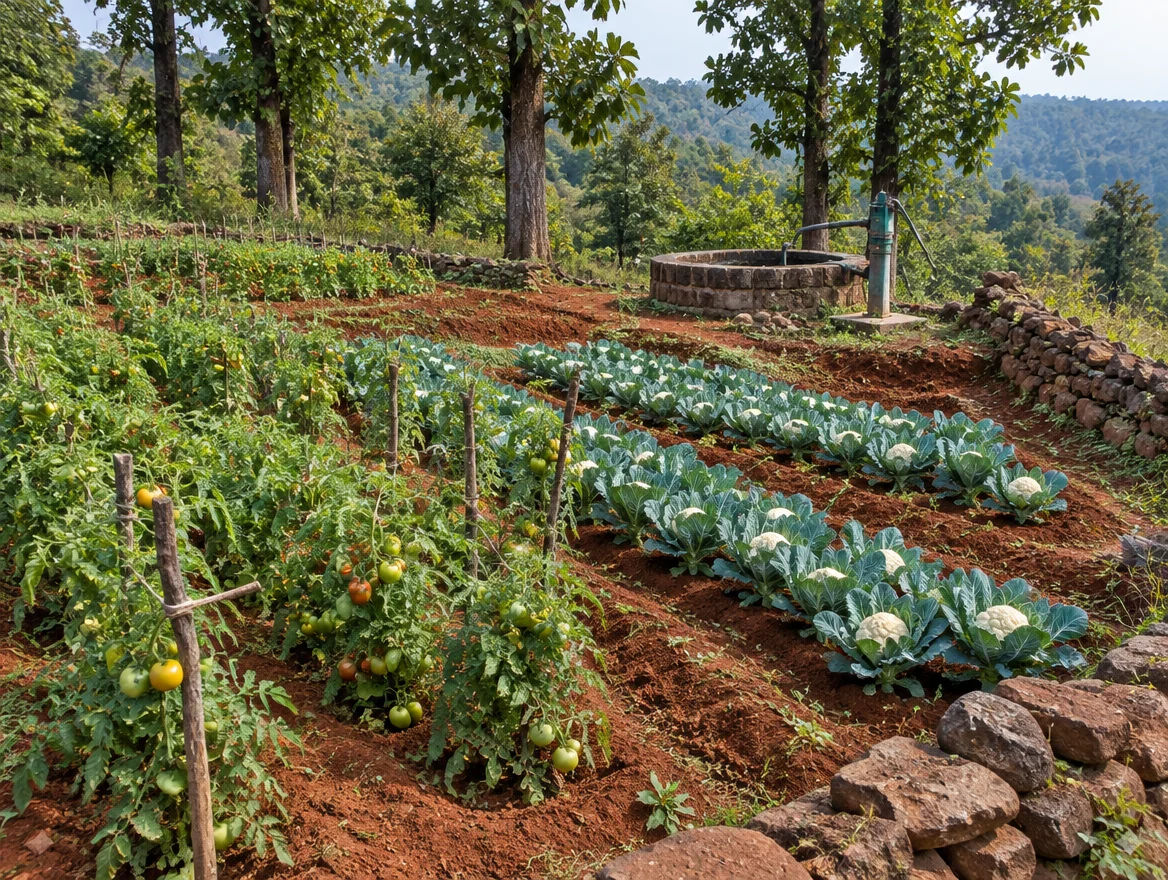
Ranchi sits in the part of the state that farms in steps: upland fields (tanr) with maize, millets, pulses and niger on thin red soil, and terraced lowland fields (don) that hold water for transplanted paddy. Vegetables grown around Ranchi supply markets as far as Kolkata (Department of Agriculture, 2018[5]).
- Kharif paddy on don land
- Maize, millets and pulses on tanr
- Tomato, cauliflower and other vegetables
- Fruit and small orchards near the city
Soils
The plateau is rolling upland of red and lateritic soil. These soils are acidic and thin on the slopes, deeper and better in the terraced valley floors, and low in organic matter, so soil testing and compost are the first costs for any new owner.
- Red lateritic upland soil
- Deeper loam in terraced valleys
- Rocky ground on hill slopes
- Soil tests needed before planting
Horticulture and nurseries
Because the capital is the nearest big market, small vegetable and fruit growers, nurseries and poultry units cluster along the city roads. These add value to a plot only if it has a reliable road, power and water.
- Vegetables for city markets
- Nurseries and orchards
- Poultry and dairy units
Water and irrigation
The CGWB’s 2024 assessment puts Jharkhand’s groundwater extraction at 31.42%, with 240 of 263 assessment units safe, but flags heavy use in Ranchi and several other towns (CGWB, 2024[6]). The hard-rock aquifer under the plateau yields little, so a borewell that works on one plot can fail on the next; test before you buy.
Rainfall and holdings
Average rainfall across Jharkhand is about 130 cm a year, most of it in the June–September monsoon, and the average holding is 1.58 hectares (Department of Agriculture, 2018[5]). Expect to buy from several owners for a consolidated block, and to deal with forest boundaries in the outer blocks.
At a glance
Ranchi vs. nearby districts
| District | Land and water | What links it to Ranchi |
|---|---|---|
| Khunti (south) | Tribal plateau and forest | Carved out of Ranchi in 2007 and still Scheduled Area, with the same CNT Act rules |
| Ramgarh (north-east) | Coal, Patratu and the Damodar valley | The Ranchi–Patna corridor and the Varanasi–Ranchi–Kolkata route both pass through it (The Week, 2025[8]) |
| Lohardaga (west) | Plateau paddy and bauxite country | Wholly Scheduled Area under the 2007 Order; the Ranchi–Varanasi road leaves Ranchi in this direction |
| Saraikela-Kharsawan (south-east) | Steel and auto-parts cluster at Adityapur | Linked by the Jamshedpur road from Bundu and Tamar; wholly Scheduled Area |
No newspaper or official source gives price series for Ranchi or these neighbours, so this table compares law and land, not rates. Buyers priced out of the Ring Road belt often look at Ramgarh or the Bundu side, but the tenancy rules are the same CNT Act, so the check is the same.
Farmland India view
Why investors look at Ranchi
Five reasoned points for Ranchi, each tied to a source on this page.
The capital supplies steady demand
Ranchi has the state government, the Legislative Assembly and Secretariat, institutions such as IIM, BIT Mesra, NUSRL and RIMS, and the head offices of HEC, CCL and SAIL (district portal[3]). That base of salaried buyers is why weekend plots and small orchards sell here and nowhere else in the state.
Roads are improving in every direction
The ring road is largely open, and Rs 12,800 crore and Rs 16,500 crore corridors to Varanasi and Raipur–Dhanbad were under construction in July 2025 with January 2028 targets (PTI via The Week[8]). Look for land near junctions, not along fenced carriageways.
Airport expansion is a plan, not a build
Rs 100 crore has been allocated for Birsa Munda Airport, and the land transfer was still to be done in May 2026 (Indian Masterminds[10]). It supports long-term interest in Namkum and Hatia but no construction timetable exists.
Vegetables and don land add a farm case
The farm belt around the city supplies vegetables as far as Kolkata, and don land with assured water is the better farm asset (Department of Agriculture, 2018[5]). A working plot with a proven borewell is worth more than bare upland.
Clean title carries the premium
Because tribal title and zoning disputes are common, plots with a clear Khatiyan, mutation and RRDA zoning are the ones that keep value. Budget for legal checks and a 7% base transaction cost plus any urban surcharge.
Confirm Jharbhoomi entries, mutation, tribal-land status and the Deputy Commissioner’s sanction directly — these are not certified by Farmland India’s review.
STRAIGHT TALK
Risks & challenges in Ranchi
District-specific risks. Read the state page for the general Jharkhand risks on tribal land, ceiling and records.
Tribal land and the Deputy Commissioner’s sanction
A Scheduled Tribe raiyat may sell only to another Scheduled Tribe member in the same police-station area, with prior sanction, and a deed in breach cannot be registered (CNT Act, 1908[1]). Sections 46(4-A) and 71-A let the Deputy Commissioner annul such transfers and restore the land without compensation to the buyer.
Master plan and road-widening mismatches
The High Court recorded that Master Plan 2037 had road width and plot-number mismatches with village maps (High Court order, 2022[2]). Ask the authority for the zone and widening line in writing.
HEC, government and khas land
HEC’s 7,200 acres include land now used for the Assembly, the Secretariat and the Smart City, and government, gair-mazurwa and khas plots cannot be bought privately (ORF, 2019[12]). Verify the Khatiyan category of the plot.
Groundwater and borewell failure
The CGWB flags heavy groundwater use in Ranchi, and the hard-rock aquifer is patchy (CGWB, 2024[6]). A neighbour’s borewell tells you little about yours.
Boundary and double-sale disputes
Old survey boundaries, partition among large families and repeated sales of the same plot are common in growth belts. Match the Khatiyan, Register II, rent receipt and JharBhunaksha map on plot number and area, and run a 30-year encumbrance search.
Urban surcharge and project-induced costs
The reported 10% surcharge on stamp duty and fee applies in municipal and notified urban areas (Indian Masterminds[11]). Add legal, survey and mutation costs when you compare plots.
Who to contact
Local revenue & planning offices
The Deputy Commissioner’s office in Ranchi runs the district, with two sub-divisions, Ranchi and Bundu, and 18 blocks (ranchi.nic.in[3]). Circle offices in each block handle mutation (dakhil-kharij), rent receipts and record corrections; the sub-registrar offices register deeds and issue encumbrance searches. For plots in the urban area, the Ranchi Municipal Corporation and the Ranchi Regional Development Authority hold the zoning and building rules. For village maps use JharBhunaksha; our Bhu-Naksha Jharkhand guide shows how to search a plot.
KEEP EXPLORING
Explore more areas
Micro-markets in Ranchi
Other districts in Jharkhand
COMMON QUESTIONS
Frequently asked questions
Everything buyers, NRIs and investors ask before their first reviewed farmland purchase in Ranchi.
Visit full wiki01 of 04
Can I buy farmland in Ranchi?
Yes if the raiyat who owns it is not a Scheduled Tribe, Scheduled Caste or Backward Class member; land held by those groups can pass only to the same group, with the Deputy Commissioner’s sanction. The whole district is Scheduled Area, so check the Khatiyan for the owner’s community and the sanction before you pay.
02 of 04
What does the Ring Road mean for land prices?
The 85.55 km Ring Road makes Kanke, Ormanjhi, Namkum and Ratu the most active belt, but no newspaper or official source gives a price series, so none is shown. Most of these villages are Scheduled Area, and plots need clean title and the right Master Plan 2037 zone.
03 of 04
What is the stamp duty for land in Ranchi?
Under the state schedule it is 4% stamp duty plus 3% registration fee on a sale deed, with a small per-page charge. A 10% surcharge on that total for municipal and notified urban areas was approved in October 2026, but its start date was not reported, so confirm with the sub-registrar.
04 of 04
Is Ranchi Master Plan 2037 reliable for zoning?
Use it as a guide, not as final proof. In 2022 the Jharkhand High Court recorded that the plan had road width, plot number and boundary inconsistencies with village maps. Ask the authority for the zone and any road-widening line for your plot in writing.
Transparency
Sources and references
Law and courts
- [1]Chota Nagpur Tenancy Act, 1908 (LBSNAA copy) — lbsnaa.gov.in
- [2]Jharkhand High Court: Dr. Rajesh Kumar v Ranchi Regional Development Authority, LPA 132 of 2012, order of 9 May 2022
Government
- [3]Ranchi district portal — ranchi.nic.in
- [4]Ranchi district portal: Demography — ranchi.nic.in
- [5]Department of Agriculture: Agriculture Scenario in Jharkhand, Oct 2018 — indianembassywarsaw.gov.in
- [6]CGWB: Dynamic Ground Water Resources of Jharkhand, 2024 — cgwb.gov.in
- [7]Jharkhand stamp duty and registration fee schedule (ICSI copy) — icsi.edu
News and research
- [8]PTI via The Week: Gadkari on Jharkhand highway projects, 3 July 2025 — theweek.in
- [9]The Telegraph: Ranchi Ring Road arm opened, 22 February 2019 — telegraphindia.com
- [10]Indian Masterminds: Birsa Munda Airport expansion, 20 May 2026 — indianmasterminds.com
- [11]Indian Masterminds: Jharkhand cabinet approves transfer surcharge, 28 Oct 2026 — indianmasterminds.com
- [12]ORF: Towards inclusive and sustainable smart cities, the case of Ranchi, 5 March 2019 — orfonline.org
For developers
Ready to explore Ranchi farmland?
Browse reviewed projects and individual land parcels across Ranchi — or if you own land here, list it with platform review and reach serious buyers.