
District guide
Buying Land in Sahibganj
The Ganga port district of the Santhal Pargana, with a river terminal, rail and hills, where the SPT Act limits what can be sold.
About 1,700 sq km
Area (district portal)
11.5 lakh
Population (Census 2011)
9
Blocks
30 lakh t a year
Terminal capacity (PIB, 2019)
*Indicative range across districts and land types. Stamp duty, registration and conversion charges are additional. Local measurement units vary — every listing states the unit it is priced in. Not a valuation or an offer.
District land record — Sahibganj
Rev. 2026 · Farmland India desk
State
Jharkhand (Santhal Pargana division)
Sub-divisions
Nine blocks: Sahibganj, Mandro, Borio, Barhait, Taljhari, Rajmahal, Udhwa, Pathna and Barharwa, with 1,349 villages and 8 towns (district portal[2])
Key markets
Sahibganj town · Rajmahal · Barhait · Mandro · Taljhari · Udhwa
Demand anchors
The Ganga multi-modal terminal on National Waterway-1, the rail station and stone and coal logistics (PIB, Sep 2019[3])
Rail
Sahibganj railway station is the district’s main station (district portal)
Size and population
About 1,700 sq km (the portal gives 1,702 and 1,599 in two tables) and 11,50,567 people, 86% rural, 26.8% Scheduled Tribe (Census 2011, district portal[2])
Pricing unit
No newspaper or official price series was found, so no per-acre figure is quoted
Local units
Deeds use bigha, katha and decimal (dismil). Convert from the area stated in the Khatiyan before comparing any two plots
Land records portal
Jharbhoomi for Register II and Khatiyan; JharBhunaksha for village maps. See our Jharbhoomi guide
Land law is state law. These rules are maintained on the Jharkhand page and apply to every district within it.
Sahibganj — land purchase legal rules
Jharkhand’s land law turns on the seller, not the buyer. Two tenancy laws, the Chota Nagpur Tenancy Act, 1908 and the Santhal Parganas Tenancy Act, 1949, decide whether a raiyati plot can be sold at all and to whom. Get this wrong and a registered sale can be annulled, with no refund, decades later.
Who can buy: There is no farmer-only rule in Jharkhand. The restriction runs the other way: the tenancy laws decide which land may be sold, and to whom, according to the community of the person who owns it. Land held by a raiyat (occupancy tenant) who is not Scheduled Tribe, Scheduled Caste or Backward Class can be sold to anyone under the CNT Act. Land held by a tribal, Dalit or backward-class raiyat cannot be bought by an outsider, whatever price is offered.
CNT Act, Section 46: Any sale, gift or lease of more than five years by a raiyat is void except as the section allows. A Scheduled Tribe raiyat may sell, exchange, gift or bequeath land only to another Scheduled Tribe member who lives within the same police-station area, and only with the Deputy Commissioner’s prior sanction. A Scheduled Caste or Backward Class raiyat may transfer, with the same sanction, only to a member of the same group living in the same district. Transfers to registered cooperative societies and specified banks are allowed. Sub-section (3) bars the registration of a deed made in breach of these rules, and no court may recognise one (CNT Act text, LBSNAA copy).
Restoration and penalties: Section 46(4-A) lets the Deputy Commissioner annul a transfer of tribal land made in breach of the section and evict the buyer. Section 71-A goes further: where tribal land was transferred unlawfully or by fraud, the Deputy Commissioner can restore it to the original owner or his heirs without paying the buyer compensation. Section 71-B makes knowingly holding such land an offence punishable with up to three years in prison. A registered deed and long possession are no defence.
Industrial and mining use: Section 49 is the one route through which raiyati land can pass to an outsider for an industrial or mining purpose, or for access to such land. The deed must be registered, the Deputy Commissioner must consent in writing before registration, the land may be used only for the stated purpose, and for Scheduled Tribe land the state can annul the consent within twelve years if it was obtained by fraud. It does not open the land to farm or farmhouse buyers.
Santhal Pargana (SPT Act): In Dumka, Deoghar, Godda, Pakur, Sahibganj and Jamtara (carved out of Dumka), the SPT Act, 1949 is stricter still. Under Section 20 a raiyat cannot transfer his holding by sale, gift, mortgage, will or lease unless the right to transfer is recorded in the record of rights, and only to the extent recorded. Where a right is recorded for an aboriginal raiyat, the land can go only to a bona fide cultivating aboriginal raiyat of the same pargana, taluk or tappa. Deeds in breach cannot be registered, and the Deputy Commissioner can evict the buyer. In practice raiyati farmland in Santhal Pargana is close to unsaleable.
Scheduled Areas: Under the Fifth Schedule, the Scheduled Areas (State of Jharkhand) Order, 2007 covers Ranchi, Lohardaga, Gumla, Simdega, Latehar, East Singhbhum, West Singhbhum, Saraikela-Kharsawan, Sahibganj, Dumka, Pakur and Jamtara along with parts of Palamu, Garhwa and Godda (Jharkhand High Court judgment citing the 2007 Order). Khunti was carved out of Ranchi later the same year and remains Scheduled Area. Here gram sabhas have a say on land and tribal protections are enforced most strictly.
Attempts to relax the law: In November 2016 the assembly passed amendments to the CNT and SPT Acts that would have allowed tribal land to be put to commercial use. Governor Droupadi Murmu returned the bills in May 2017 and the government withdrew them in August 2017 (Business Standard (PTI), 9 August 2017). The original protections stand.
Ceiling and government land: Jharkhand continues to apply the Bihar Land Reforms (Fixation of Ceiling Area and Acquisition of Surplus Land) Act, 1961, which caps family holdings by land class, as on our Bihar page. Plots recorded as gair-mazurwa (government land), forest or khas land cannot be bought at all, however long a family has occupied them.
Documents to check: The Khatiyan for the village survey (it records the raiyat’s caste or tribe and any transfer right), the current Register II entry and rent receipts, the mutation order from the circle office, a 30-year encumbrance search at the sub-registrar, the plot on the village map and a Deputy Commissioner’s sanction where the seller belongs to a protected group. Our Jharbhoomi guide explains each record.
NRI and OCI buyers: Under the RBI Master Direction on immovable property, NRIs and OCIs may not acquire agricultural land, a farmhouse or plantation property in India except by inheritance. In Jharkhand the tenancy laws narrow the field further. Our NRI guide covers the options.
- No farmer-only rule
- CNT Act: Section 46
- ST buyers: same police station
- SC/BC buyers: same district
- Restoration: Section 71-A
- Santhal Pargana: SPT Act Section 20
- Scheduled Areas: 2007 Order
- NRIs: inheritance only
Sahibganj — district-specific notes
Sahibganj lies wholly in the Santhal Pargana and the Scheduled Area, so the strictest tenancy rules in Jharkhand apply here, even though the district has a Ganga river terminal. The points below are specific to the district; the state-wide law is in the block above.
⚠ The SPT Act decides what can be sold. Under Section 20, a raiyat cannot transfer land unless the record of rights records a right to transfer, and an aboriginal raiyat may sell only to a cultivating aboriginal raiyat of the same pargana, taluk or tappa; a deed in breach cannot be registered (SPT Act, 1949[1]). Scheduled Tribes are 26.8% of the district (district portal[2]), but the Act covers raiyati land regardless of the seller’s community.
⚠ Ganga-side land can shift. Land on the riverbank and on char or diara strips can flood or erode. Ask the circle office whether the Khatiyan records the plot as river or char land, and walk the boundary in the monsoon.
⚠ Terminal and freight-village land may be acquired. A freight village was proposed on 335 acres next to the Sahibganj terminal (PIB, Sep 2019[3]). Land near the terminal can be notified for acquisition, so check for notices before an advance.
⚠ Hill and forest land is outside the market. The Rajmahal hills (Tinpahar, Borio) and forest areas carry restricted land. Plots recorded as forest, gair-mazurwa or khas cannot be bought.
⚠ Town plots may carry a surcharge. A 10% surcharge on stamp duty and fee for transfers in municipal and notified urban areas was approved on 27 October 2026; the start date was not reported (Indian Masterminds, 28 Oct 2026[10]).
Check the record of rights for the transfer-right entry first; in Sahibganj it matters more than the distance to the river port.
- Santhal Pargana
- SPT Act s.20
- Scheduled Area
- Ganga floodplain
- Terminal acquisition
District overview
Sahibganj — the Ganga port district of the Santhal Pargana, with hills, rail and strict tenancy law
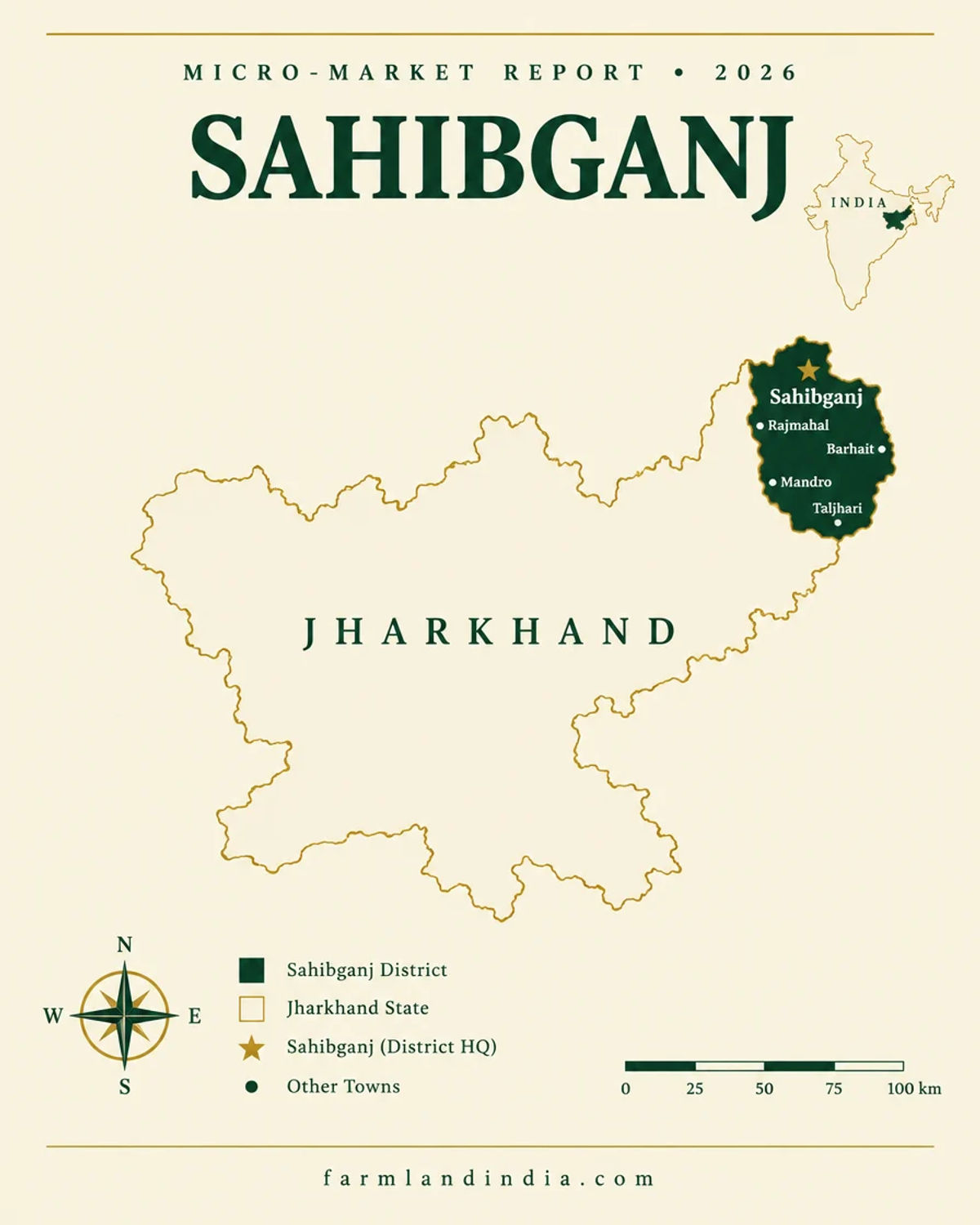
Sahibganj is the north-eastern edge of Jharkhand, where the Rajmahal hills meet the Ganga. The district was carved out of the old Santhal Pargana on 17 May 1983, and the Pakur sub-division was split from it on 28 January 1994 (district portal[2]). It has nine blocks, 1,349 villages and eight towns, and the 2011 Census counted 11,50,567 people, about 86% of them rural.
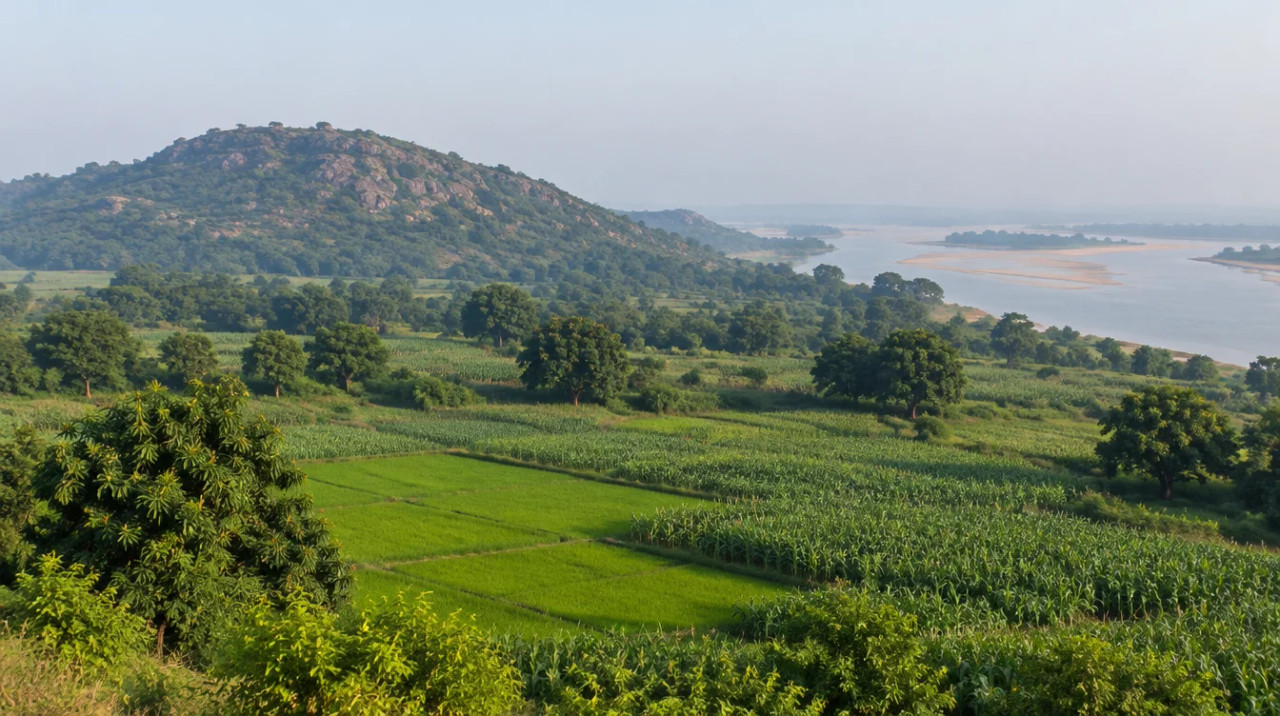
The district portal’s own list of sights shows the landscape: the Ganga at Rajmahal, the Mandro fossil park, a waterfall at Taljhari, a lake at Udhwa and the hills near Borio (district portal[2]). The state page notes that Santhal Pargana farming is hilly, with paddy in the valleys and maize and pulses on the slopes, largely rain-fed (Department of Agriculture, 2018[7]).
What sets Sahibganj apart is the river. The Sahibganj multi-modal terminal on National Waterway-1 (the Ganga) cost Rs 290 crore in its first phase and was designed for 30 lakh tonnes a year, with coal, stone chips, fertilisers and cement as the main cargo; the release also proposed a freight village on 335 acres next to it (PIB, Sep 2019[3]). Logistics firms, traders and contractors are the natural buyers.
Outside farmland buyers face the same wall as in Pakur: the SPT Act. The honest advice is to buy only where the record of rights shows a transfer right and the seller can prove title, and to treat riverside and terminal land as legal-risk land until the circle office says otherwise.
Start with the record of rights and the circle officer’s opinion on transfer rights, then check river and acquisition status before you look at the plot.
- Santhal Pargana
- Ganga bank
- Rajmahal hills
- River terminal
- SPT Act
- Scheduled Area
Transaction costs
Stamp duty & registration in Sahibganj
4% + 3%
Stamp duty + registration fee
On a sale deed, plus Rs 30 a page, per the state schedule
+10%
Urban surcharge (reported)
Of stamp duty and fee in municipal areas; start date not reported
No series
Circle-rate table
No newspaper or official source was found; ask the registry for the minimum land value
Sahibganj follows the Jharkhand schedule: 4% stamp duty and 3% registration fee on a sale deed, with a small per-page charge (state schedule, ICSI copy[9]). The cabinet approved a surcharge of 10% of stamp duty plus fee for transfers in municipal and notified urban areas on 27 October 2026 (Indian Masterminds, 28 Oct 2026[10]); the district has eight towns, so ask the sub-registrar whether your plot is covered once a start date is notified. No newspaper or official source gives a Sahibganj circle-rate table, so ask the registry for the minimum land value of your mauza and compare registered deeds beside the plot. Confirm every figure at the registry before you pay.
Know the belt
What is moving prices in Sahibganj
Where lawful, farmable or commercial land is found in Sahibganj; no listing-site prices are used.
Sahibganj town and the terminal belt
River port, rail station and freight plans
The terminal, the station and the town are the district’s commercial core (PIB, Sep 2019[3]). Commercial plots here are more likely to be non-raiyati and registrable than farmland in the villages.
Check: acquisition notices for the freight village and the Khatiyan category of the plot.
Rajmahal and the Ganga bank
Old river town below the hills
Rajmahal sits where the hills reach the Ganga, and the portal lists the river sunset there as a local sight (district portal[2]). Land on the bank is exposed to flooding and bank shift.
Check: river or char entries in the Khatiyan, and flood history from the circle office.
Barhait, Pathna and Barharwa
Southern blocks towards Pakur and Godda
These blocks lie on the side of the district nearest Pakur and the Godda coalfield, where mining and stone processing shape land use. Plots are cheap to hold but often small and legally tangled.
Check: SPT transfer rights, lease and quarry maps, and forest status.
Mandro, Taljhari and Udhwa
Hill, lake and fossil-park country
The portal lists the Mandro fossil park, the Taljhari waterfall and the Udhwa lake (district portal[2]). Tourism is small-scale; land is farm and forest, with restrictions near protected sites.
Check: forest and protected-area status before any plot is considered.
Connectivity
How Sahibganj connects — road, rail and air
A river port, a rail station and a national highway under improvement. Drive times are not given because no source was found.
🚗 By road
✈️ By air
🚆 By rail and river
No drive times are given because no source was found for village-level distances. Confirm road condition and project status with the Road Construction Department or NHAI.
Growth catalysts
Upcoming infrastructure & developments
Status labels reflect sources as of November 2026. Government-announced timelines are not guaranteed; items with a single or older source say so.
01Open
03Catalysts
Agriculture & terrain
Soil, crops & water in Sahibganj
A hilly Santhal Pargana district where paddy fills the valleys and maize and pulses take the slopes, with Ganga-side plains to the north.
Crops
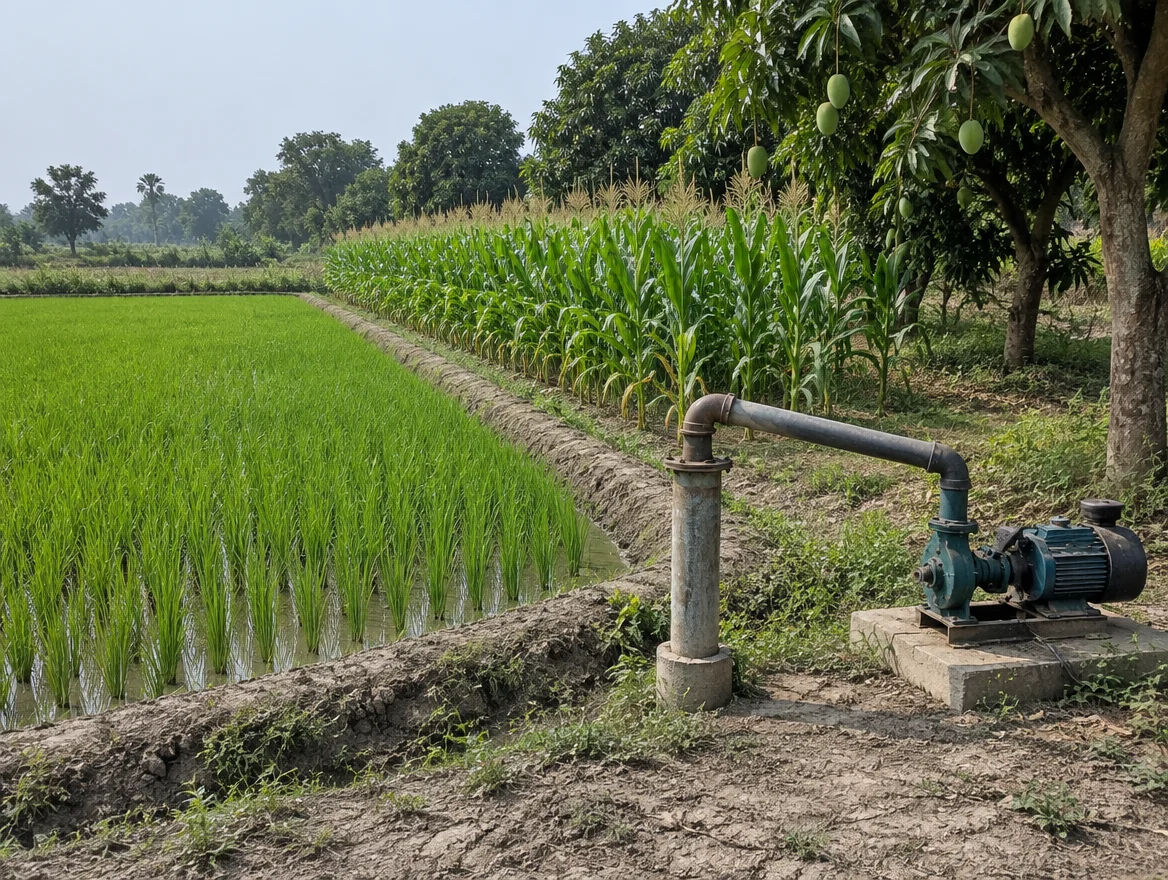
Santhal Pargana farming is hilly, with paddy in the valleys and maize and pulses on the slopes, and is largely rain-fed (Department of Agriculture, 2018[7]). The Sahibganj district portal gives no crop table, so check local yields with the block agriculture office.
- Kharif paddy in valleys
- Maize and pulses on slopes
- Vegetables near towns
- Mango and other orchard trees
Soils
The Ganga plain to the north has alluvial soil, and the hills carry thin, stony upland soil; the Pakur profile shows how the alluvial strip gives way to older sedimentary soil nearby (MSME brief industrial profile, Pakur[6]). Test the plot rather than trusting the village average.
- Alluvial soil on the Ganga plain
- Thin, stony hill soil
- Older sedimentary soil near the Pakur border
- Soil test before planting
Hills and forest
The Rajmahal hills, Tinpahar near Borio and the fossil park at Mandro are on the district portal’s list of places (district portal[2]). Forest and protected areas limit use on adjoining plots.
- Hill forest
- Fossil park at Mandro
- Village ponds and lakes
Water and irrigation
The Ganga bounds the district on its northern side and gives the lowland blocks water, with flood risk. The CGWB’s 2024 assessment finds Jharkhand’s groundwater extraction at 31.42%, with 240 of 263 assessment units safe (CGWB, 2024[8]); the hard-rock hills are patchy for borewells, so test before you buy.
Rainfall and holdings
Jharkhand’s average rainfall is about 130 cm a year, mostly in June–September, and the average holding is 1.58 hectares (Department of Agriculture, 2018[7]). Expect small plots and many owners per consolidated block.
At a glance
Sahibganj vs. nearby districts
| District | Land and water | What links it to Sahibganj |
|---|---|---|
| Pakur (south) | Alluvial strips, black stone and coal | Split from Sahibganj as a sub-division in 1994; same SPT Act and Scheduled Area (Pakur portal[5]) |
| Godda (south-west) | Coal-bearing plateau and paddy | Shares the Rajmahal coal and the SPT Act; the Godda–Hansdiha rail line was electrified in 2022 |
| Bhagalpur side of Bihar (north-west, across the Ganga) | Ganga plain | A different land law; our Bihar page explains the rules |
| Malda and Murshidabad (east, West Bengal) | Bengal alluvial plain | The Ganga and Farakka separate the districts; different tenancy law and land records |
No newspaper or official source gives a price series for Sahibganj or its neighbours, so this table compares law and land, not rates. All the Jharkhand neighbours share the SPT Act, so the practical comparison is by documents and access.
Farmland India view
Why investors look at Sahibganj
Five reasoned points for Sahibganj, each tied to a source on this page.
A real river port exists
The Sahibganj terminal on National Waterway-1 is built for 30 lakh tonnes a year, with a freight village proposed on 335 acres (PIB, Sep 2019[3]). Whether volumes have grown was not checked, but the infrastructure is in place.
Rail, river and road meet
The district portal lists Sahibganj railway station, and the terminal is designed to link road, rail and river (PIB[3]). That mix is rare in the Santhal Pargana.
The legal scarcity supports clean land
Because raiyati land is largely out of the market under the SPT Act (SPT Act, 1949[1]), plots a stranger can lawfully buy are few; documented ones near the town hold value better than undocumented ones.
Highway upgrade is listed, not proven
The NH-80 Mirzachowki–Farakka four-laning is listed in the National Infrastructure Pipeline (India Investment Grid[4]), but its progress was not checked, so do not pay for it yet.
A known cost to transact
The state schedule is 4% stamp duty plus 3% registration fee (state schedule[9]), with a municipal surcharge reported for 2026. Add legal checks.
Confirm Jharbhoomi entries, mutation, tribal-land status and the Deputy Commissioner’s sanction directly — these are not certified by Farmland India’s review.
STRAIGHT TALK
Risks & challenges in Sahibganj
District-specific risks. Read the state page for the general Jharkhand risks on tribal land, ceiling and records.
Santhal Pargana transfer bar
A deed in breach of Section 20 cannot be registered and the Deputy Commissioner can evict the buyer (SPT Act, 1949[1]). An agreement to sell or a power of attorney does not cure this. Ask the seller for the original deed, the latest rent receipt and a written statement of who has been in physical possession for the last twelve years, and compare all three with the circle office records before paying any token amount.
Ganga flooding and erosion
Riverside and char land can flood or shift. Ask the circle office for river and char entries, and visit in the monsoon. Keep every receipt, the signed consent letter and the registered deed together in one file, and photograph the boundary marks with a dated timestamp on the day of purchase, because most later disputes in rural Jharkhand turn on who can show the oldest paper and the clearest possession.
Acquisition near the terminal
A freight village on 335 acres was proposed beside the terminal (PIB, Sep 2019[3]). Check for notices before buying nearby.
Forest, hill and government land
Hill forest and government land cannot be bought. Match the Khatiyan category with the village map (JharBhunaksha) on plot number.
Mining and stone processing
Stone and coal logistics move through the district (PIB, Sep 2019[3]). Check for quarry, crusher or haul-road impacts beside any plot.
Mismatched records
Old survey entries, unpartitioned family land and incomplete mutation are common. Take a 30-year encumbrance search and check Register II against the Khatiyan. Buyers should also visit the plot in the monsoon, because access tracks and low fields that look fine in winter can be cut off or waterlogged from July to September, and talk to two neighbouring cultivators about boundaries, water and past disputes.
Who to contact
Local revenue & planning offices
The Deputy Commissioner’s office at Sahibganj runs the district of nine blocks (sahibganj.nic.in[2]). Circle offices in the blocks handle mutation (dakhil-kharij), rent receipts and record corrections, and the Sahibganj sub-registrar registers deeds and issues encumbrance searches. For village maps use JharBhunaksha; our Bhu-Naksha Jharkhand guide shows how to search a plot.
COMMON QUESTIONS
Frequently asked questions
Everything buyers, NRIs and investors ask before their first reviewed farmland purchase in Sahibganj.
Visit full wiki01 of 04
Can an outsider buy farmland in Sahibganj?
Rarely. The district is in the Santhal Pargana, where Section 20 of the SPT Act lets a raiyat sell only if the record of rights records a right to transfer, and then only to a cultivating aboriginal raiyat of the same area. A deed in breach cannot be registered. Check the record of rights and take legal advice before any payment.
02 of 04
What is the Sahibganj multi-modal terminal?
It is a river terminal on National Waterway-1 on the Ganga. PIB’s 2019 release gave Phase I as Rs 290 crore and capacity as 30 lakh tonnes a year, and proposed a freight village on 335 acres beside it. Current traffic was not checked.
03 of 04
What is the stamp duty for a land sale in Sahibganj?
Under the state schedule it is 4% stamp duty plus 3% registration fee on a sale deed, with a small per-page charge. A 10% surcharge for municipal and notified urban areas was approved in October 2026, but its start date was not reported, so confirm with the sub-registrar.
04 of 04
Is Ganga-side land safe to buy?
Not without checking. Riverbank and char land can flood or shift, and entries in the Khatiyan may show it as river land. Ask the circle office and visit during the monsoon before you pay.
Transparency
Sources and references
Law and courts
Government
- [2]Sahibganj district portal: About district — sahibganj.nic.in
- [3]PIB: PM to inaugurate India’s second Multi Modal Terminal on Ganga at Sahibganj, Sep 2019 — pib.gov.in
- [4]India Investment Grid: 4-laning of Mirzachowki–Farakka section of NH-80 (NIP project listing) — indiainvestmentgrid.gov.in
- [5]Pakur district portal: About district — pakur.nic.in
- [6]MSME-DI Dhanbad: Brief industrial profile of Pakur district — dcmsme.gov.in
- [7]Department of Agriculture: Agriculture Scenario in Jharkhand, Oct 2018 — indianembassywarsaw.gov.in
- [8]CGWB: Dynamic Ground Water Resources of Jharkhand, 2024 — cgwb.gov.in
- [9]Jharkhand stamp duty and registration fee schedule (ICSI copy) — icsi.edu
News
- [10]Indian Masterminds: Jharkhand cabinet approves transfer surcharge, 28 Oct 2026 — indianmasterminds.com
For developers
Ready to explore Sahibganj farmland?
Browse reviewed projects and individual land parcels across Sahibganj — or if you own land here, list it with platform review and reach serious buyers.