
District guide
Buying Land in Koderma
The mica district on the Patna–Ranchi corridor: a rail junction, a four-lane, a planned 1,600 MW plant and the CNT Act limiting who can buy tribal land.
1,655.61 sq km
Area (district website)
1,135 mm
Normal rainfall (ICAR-CRIDA)
133 km
Koderma–Barkakana doubling (Jun 2025)
4% + 3%
Stamp duty + registration (state schedule)
District land record — Koderma
Rev. 2026 · Farmland India desk
State
Jharkhand
Sub-division and blocks
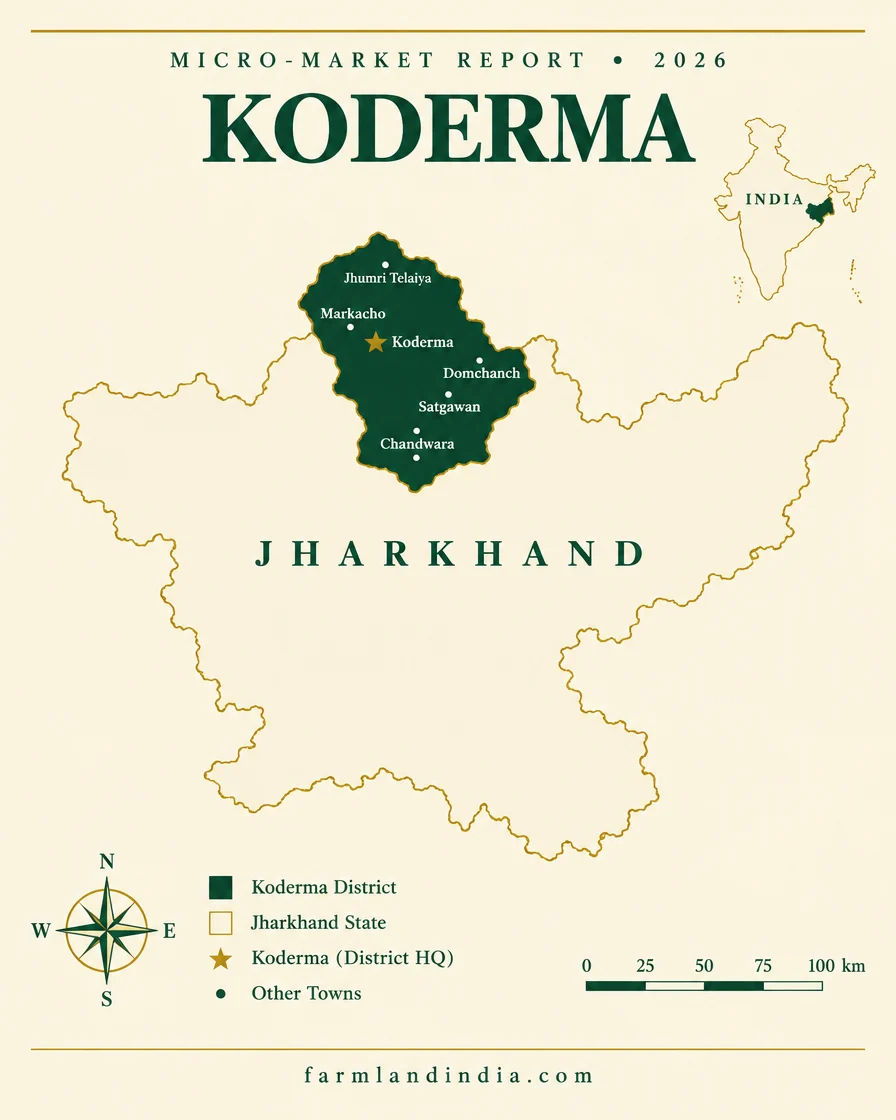
One sub-division, six revenue circles and six blocks (Koderma, Jainagar, Chandwara, Markachho, Satgawan, Domchanch), with 717 villages and 105 panchayats (district website[3])
Key markets
Koderma town · Jhumri Telaiya · Domchanch · Markachho · Satgawan · Chandwara · Ranchi–Patna highway belt
Demand anchors
Ranchi–Patna four-lane · DVC Koderma thermal power plant, phase II · mica and mineral trade · Nawada–Giridih rail survey
Rail
Koderma is a rail junction on the Patna–Ranchi route; the 133 km Koderma–Barkakana doubling was cleared by the Union Cabinet in June 2025 (NBMCW[10])
Size and population
About 1,655.61 sq km, 717 villages and a district headquarters about 165 km from Ranchi (district website[3]); a population figure was not on the page
Pricing unit
No official price series is published; ask the sub-registrar for recent registered sale values in the village. quote any land per acre and confirm the area from the Khatiyan
Local units
Deals in Jharkhand are often described in bigha, katha or dhur or by local custom. Ask for the area in acres or decimals from the record of rights before comparing offers; these local units are explained here, not used for pricing.
Land records portal
Jharbhoomi for the Khatiyan (record of rights) and Register II, with maps on JharBhunaksha; see our Jharbhoomi guide and Bhu-Naksha Jharkhand guide
Land law is state law. These rules are maintained on the Jharkhand page and apply to every district within it.
Koderma — land purchase legal rules
Jharkhand’s land law turns on the seller, not the buyer. Two tenancy laws, the Chota Nagpur Tenancy Act, 1908 and the Santhal Parganas Tenancy Act, 1949, decide whether a raiyati plot can be sold at all and to whom. Get this wrong and a registered sale can be annulled, with no refund, decades later.
Who can buy: There is no farmer-only rule in Jharkhand. The restriction runs the other way: the tenancy laws decide which land may be sold, and to whom, according to the community of the person who owns it. Land held by a raiyat (occupancy tenant) who is not Scheduled Tribe, Scheduled Caste or Backward Class can be sold to anyone under the CNT Act. Land held by a tribal, Dalit or backward-class raiyat cannot be bought by an outsider, whatever price is offered.
CNT Act, Section 46: Any sale, gift or lease of more than five years by a raiyat is void except as the section allows. A Scheduled Tribe raiyat may sell, exchange, gift or bequeath land only to another Scheduled Tribe member who lives within the same police-station area, and only with the Deputy Commissioner’s prior sanction. A Scheduled Caste or Backward Class raiyat may transfer, with the same sanction, only to a member of the same group living in the same district. Transfers to registered cooperative societies and specified banks are allowed. Sub-section (3) bars the registration of a deed made in breach of these rules, and no court may recognise one (CNT Act text, LBSNAA copy).
Restoration and penalties: Section 46(4-A) lets the Deputy Commissioner annul a transfer of tribal land made in breach of the section and evict the buyer. Section 71-A goes further: where tribal land was transferred unlawfully or by fraud, the Deputy Commissioner can restore it to the original owner or his heirs without paying the buyer compensation. Section 71-B makes knowingly holding such land an offence punishable with up to three years in prison. A registered deed and long possession are no defence.
Industrial and mining use: Section 49 is the one route through which raiyati land can pass to an outsider for an industrial or mining purpose, or for access to such land. The deed must be registered, the Deputy Commissioner must consent in writing before registration, the land may be used only for the stated purpose, and for Scheduled Tribe land the state can annul the consent within twelve years if it was obtained by fraud. It does not open the land to farm or farmhouse buyers.
Santhal Pargana (SPT Act): In Dumka, Deoghar, Godda, Pakur, Sahibganj and Jamtara (carved out of Dumka), the SPT Act, 1949 is stricter still. Under Section 20 a raiyat cannot transfer his holding by sale, gift, mortgage, will or lease unless the right to transfer is recorded in the record of rights, and only to the extent recorded. Where a right is recorded for an aboriginal raiyat, the land can go only to a bona fide cultivating aboriginal raiyat of the same pargana, taluk or tappa. Deeds in breach cannot be registered, and the Deputy Commissioner can evict the buyer. In practice raiyati farmland in Santhal Pargana is close to unsaleable.
Scheduled Areas: Under the Fifth Schedule, the Scheduled Areas (State of Jharkhand) Order, 2007 covers Ranchi, Lohardaga, Gumla, Simdega, Latehar, East Singhbhum, West Singhbhum, Saraikela-Kharsawan, Sahibganj, Dumka, Pakur and Jamtara along with parts of Palamu, Garhwa and Godda (Jharkhand High Court judgment citing the 2007 Order). Khunti was carved out of Ranchi later the same year and remains Scheduled Area. Here gram sabhas have a say on land and tribal protections are enforced most strictly.
Attempts to relax the law: In November 2016 the assembly passed amendments to the CNT and SPT Acts that would have allowed tribal land to be put to commercial use. Governor Droupadi Murmu returned the bills in May 2017 and the government withdrew them in August 2017 (Business Standard (PTI), 9 August 2017). The original protections stand.
Ceiling and government land: Jharkhand continues to apply the Bihar Land Reforms (Fixation of Ceiling Area and Acquisition of Surplus Land) Act, 1961, which caps family holdings by land class, as on our Bihar page. Plots recorded as gair-mazurwa (government land), forest or khas land cannot be bought at all, however long a family has occupied them.
Documents to check: The Khatiyan for the village survey (it records the raiyat’s caste or tribe and any transfer right), the current Register II entry and rent receipts, the mutation order from the circle office, a 30-year encumbrance search at the sub-registrar, the plot on the village map and a Deputy Commissioner’s sanction where the seller belongs to a protected group. Our Jharbhoomi guide explains each record.
NRI and OCI buyers: Under the RBI Master Direction on immovable property, NRIs and OCIs may not acquire agricultural land, a farmhouse or plantation property in India except by inheritance. In Jharkhand the tenancy laws narrow the field further. Our NRI guide covers the options.
- No farmer-only rule
- CNT Act: Section 46
- ST buyers: same police station
- SC/BC buyers: same district
- Restoration: Section 71-A
- Santhal Pargana: SPT Act Section 20
- Scheduled Areas: 2007 Order
- NRIs: inheritance only
Koderma — district-specific notes
The Jharkhand state page applies to Koderma in full. The district is in the North Chotanagpur division, so the Chota Nagpur Tenancy Act governs raiyati land. Koderma is not among the districts named in the Scheduled Areas Order, 2007 (High Court judgment listing the Order[2]), but the CNT transfer bar still applies to tribal and other protected raiyats.
⚠ Section 46 of the Chota Nagpur Tenancy Act, 1908 lets a Scheduled Tribe raiyat transfer holding land only to another Scheduled Tribe member who lives in the same police-station area, with the Deputy Commissioner’s prior sanction. Scheduled Caste and Backward Class raiyats can transfer only within the same group in the same district, also with sanction. A deed in breach cannot be registered, the Deputy Commissioner can annul the transfer, and sections 71-A and 71-B allow restoration without compensation and up to three years’ imprisonment (CNT Act text[1]).
⚠ Section 49 allows a transfer for industry or mining only with the Deputy Commissioner’s consent. Ask which category the plot and its holder fall in before any discussion of price. The Indian Minerals Yearbook lists mica, feldspar, silica sand, granite and talc/steatite for Koderma (IBM, 2022[5]), so check whether a plot lies on or beside a lease, a dump or an old mica working before looking at price.
⚠ Before paying any advance, ask for four papers: the current Khatiyan and Register II extract from Jharbhoomi, the JharBhunaksha map sheet for the plot, the last mutation (dakhil-kharij) order and the latest rent (lagan) receipt. A seller who cannot produce the receipt or the mutation order is telling you the record is not in his name.
⚠ Rail doubling and a proposed new line, and a power plant that is moving towards construction, all need land. Ask the Circle Officer whether any notification covers the plot or its access road before you pay an advance.
⚠ The Jharkhand cabinet approved a surcharge of 10% of stamp duty plus registration fee on transfers in municipal and notified urban areas on 27 October 2026; the start date was not reported (Indian Masterminds, 28 Oct 2026[12]). Koderma and Jhumri Telaiya are the main urban areas; ask the sub-registrar whether it applies on the day you register.
NRI and OCI buyers should read can NRIs buy agricultural land in India before shortlisting any farmland; the FEMA bar applies in every district.
- CNT Act transfer bar
- Not on the Scheduled Areas list
- Mica and mineral land
- Rail and road acquisition
- Urban surcharge (reported)
District overview
Koderma — the mica district on the Patna–Ranchi corridor
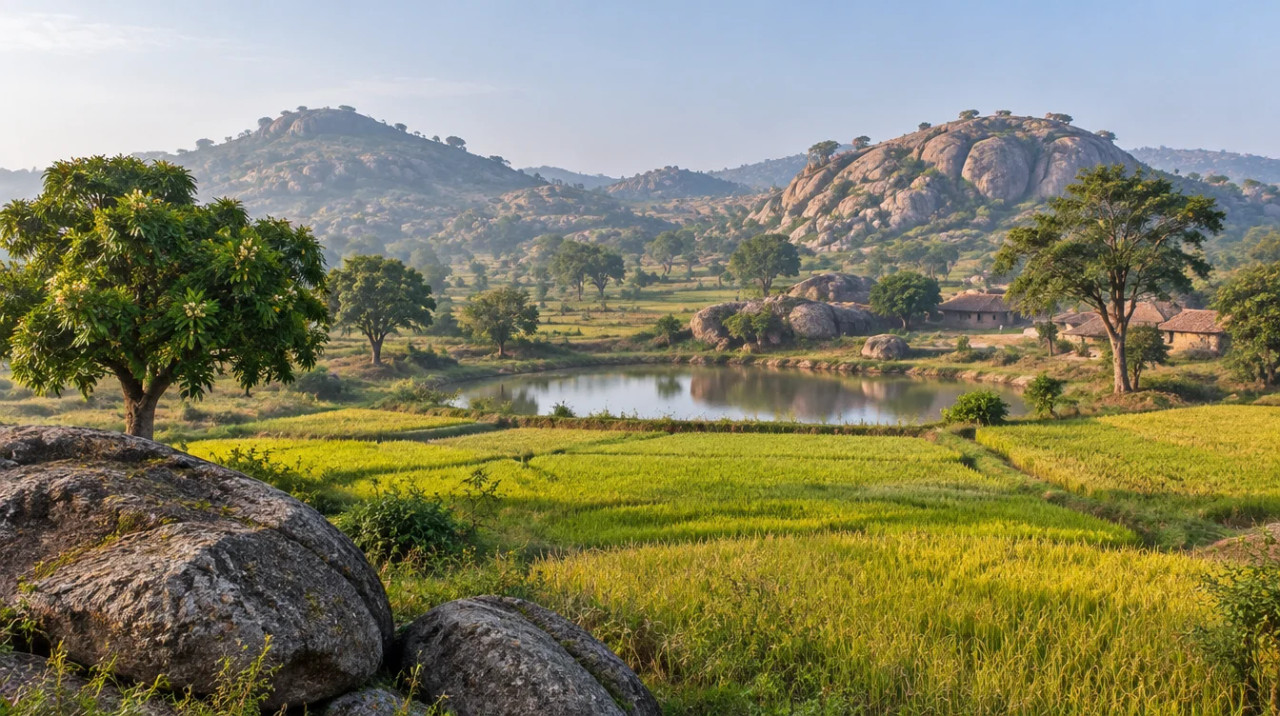
Koderma is a small district in northern Jharkhand, about 165 km from Ranchi, nicknamed “Mica city” on the district website. It covers about 1,655 sq km with six blocks and 717 villages; Jhumri Telaiya is its main city, and the Barakar, Barsoi and Sakri rivers drain it (district website[3]).
Farmland is a plateau mix of rice, maize and wheat. The ICAR-CRIDA plan lists rice on 4,800 ha, maize on 3,900 ha, wheat on 3,000 ha and pigeonpea on 2,500 ha, with a net sown area of only 18,400 ha, because so much of the district is rocky or forested (ICAR-CRIDA Koderma plan[4]). Normal rainfall is about 1,135 mm.
Minerals are the district’s identity. The Indian Minerals Yearbook lists mica, feldspar, silica sand, granite and talc, and notes Geological Survey of India lithium exploration at Pihra in 2021-22 (IBM, 2022[5]). The exploration is a survey, not a mine.
Power and rail add to this. DVC reached financial closure in September 2024 for a 1,600 MW phase II thermal plant at Koderma costing Rs 14,357.74 crore (The Print, 11 Sep 2024[9]). The Ranchi–Patna four-lane passes through Koderma and was 88% complete in October 2025 (Indian Masterminds[8]).
Who can buy: Koderma is not a Scheduled Area district, so non-tribal and general land is more open than in Gumla or Khunti, but tribal and protected raiyat land still carries the CNT bar. Always check the holder in the record before negotiating.
Compare Koderma with Hazaribagh, Giridih and Nawada (Bihar) on the Jharkhand state page. Treat it as a mining-and-corridor market where the title and lease checks decide value.
- Mica district
- Ranchi–Patna four-lane
- DVC power plant
- Rail junction
- Koderma town
Transaction costs
Stamp duty & registration in Koderma
4%
Stamp duty on a sale deed
per the state schedule (undated ICSI copy); confirm at the registry
3%
Registration fee
on the same value, per the state schedule
10%
Urban surcharge (reported)
of duty plus fee in municipal areas; cabinet approval 27 Oct 2026, start date not reported
The state schedule lists stamp duty of 4% and a registration fee of 3% on a sale deed, with a service fee of Rs 30 a page (Jharkhand schedule, ICSI copy[7]). The Re 1 registration for women, introduced in 2017, was withdrawn in 2020. Duty is charged on the higher of the deed value and the district minimum value register, so ask the Koderma sub-registrar for the rate that applies to your village and land class. In Koderma and Jhumri Telaiya the surcharge may add to the bill once it starts (Indian Masterminds[12]).
Know the belt
What is moving prices in Koderma
Reported projects and land types only; no listing-site prices are used.
Koderma and Jhumri Telaiya
District headquarters and main city
The Collectorate, courts, rail junction and mica trade keep demand in the two towns. Buyers mostly look for house plots and small commercial land inside the municipal areas, where the urban surcharge may apply.
Check: the plot’s recorded land class, the holder’s status in the record of rights and whether it lies inside the notified town limit.
Ranchi–Patna highway belt
Roadside villages
The four-lane is the main reason to look at roadside land. Widening brings acquisition notices as well as demand.
Check: the NH alignment, any acquisition or service-road notice and legal access to the road.
Power-plant and mica pockets
Industrial and mining edge
The DVC plant phase II and mica workings shape land use in parts of the district. Land near leases is subject to section 49 and to acquisition.
Check: lease maps, section 49 consent history and whether the plot is recorded as raiyati or as forest.
Satgawan, Markachho, Domchanch and Chandwara
Farming blocks
These blocks carry rice, maize and wheat land. Satgawan sits on the alignment of the proposed Nawada–Giridih rail line, which is at survey stage.
Check: the holder’s status, the irrigation source and the plot number against JharBhunaksha.
Asking prices
No official price series is published for Koderma farmland. Use the minimum value register for the village and compare it with recent registered deeds in the same mouza. Treat any rate quoted by a seller without a registered deed as unproven.
Connectivity
How Koderma connects — road, rail and air
A highway, a rail junction and rail projects at different stages; no drive times are given because no source was found.
🚗 By road
✈️ By air
🚆 By rail
Doubling and a new line both mean acquisition. Ask the Circle Officer whether any notification covers the plot or its access before you pay an advance.
Growth catalysts
Upcoming infrastructure & developments
Four catalysts at different stages; none has a published land-price effect.
00Open
04Catalysts
Agriculture & terrain
Soil, crops & water in Koderma
A small, rocky plateau district with little irrigation.
Crops
The ICAR-CRIDA plan lists rice (4,800 ha), maize (3,900 ha), wheat (3,000 ha), pigeonpea (2,500 ha), blackgram (1,200 ha), pea (1,040 ha) and lentil (1,010 ha). Net sown area is 18,400 ha. These figures date from 2012.
- Rice
- Maize
- Wheat
- Pigeonpea
- Pea and lentil
Water and irrigation
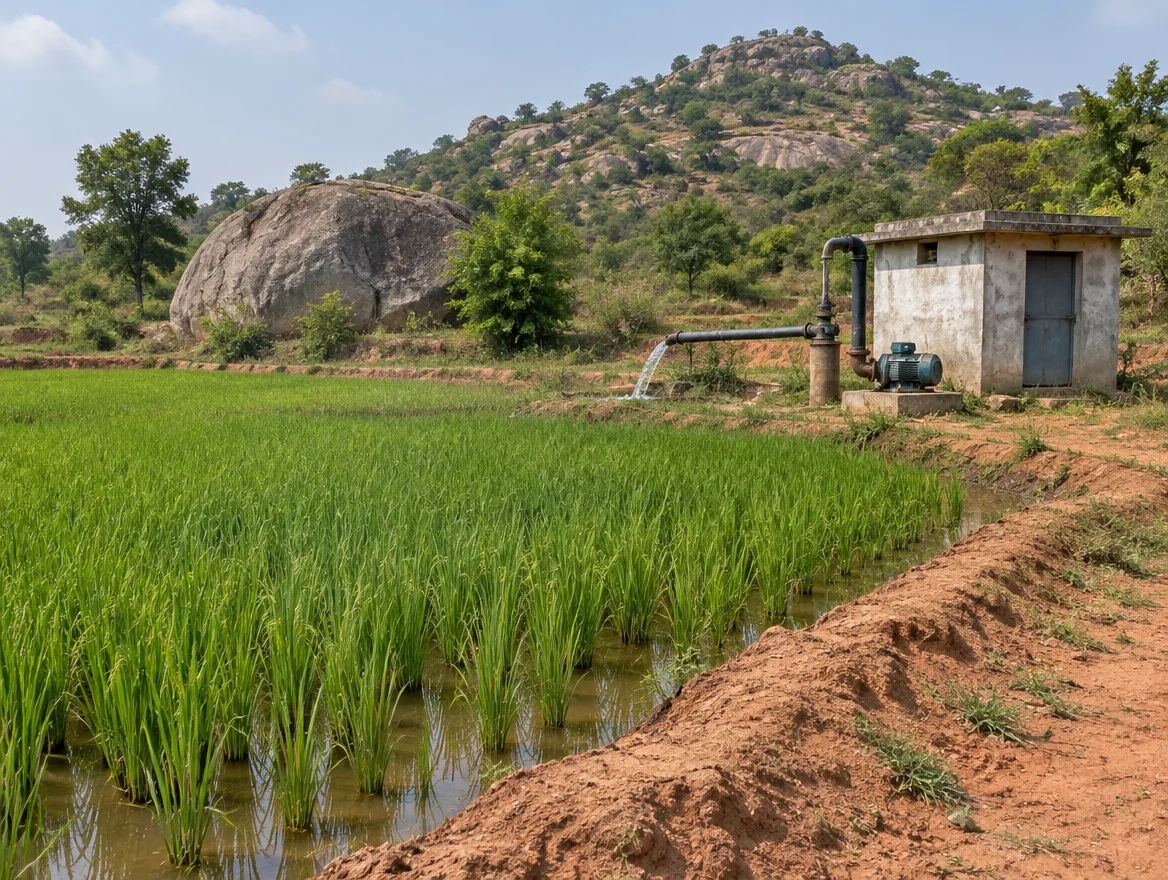
Net irrigated area was 1,900 ha against a net sown area of 18,400 ha, about 10%, from open wells, check dams, tanks and canals (ICAR-CRIDA[4]). State-wide, groundwater extraction was 31.42% in 2024 (CGWB[6]); a Koderma-specific category was not found.
Soils and rainfall
The plan names red lateritic, loam, fine loam and fine mixed loam soils and a normal rainfall of 1,135 mm, of which about 956 mm falls in the south-west monsoon. Rain-fed fields depend on that season.
At a glance
Koderma vs. nearby districts
| District | Land and water | What links it to Koderma |
|---|---|---|
| Hazaribagh (south) | Plateau district on the Ranchi–Patna road | Shared four-lane and rail corridors |
| Giridih (east) | Mining and plateau district | The proposed Nawada–Giridih line passes through Satgawan |
| Nawada and Gaya (Bihar, north) | Gangetic plain across the state border | Rail and road links towards Patna; Bihar rules apply there |
No price series exists for any of these areas that we could read, so no rates are compared. Compare the minimum value registers and recent deeds on each side of a district line.
Farmland India view
Why investors look at Koderma
Five reasoned points for Koderma, each tied to a source on this page.
The corridor is the case
The Ranchi–Patna four-lane and the Koderma rail junction make this a corridor district. Roadside land gets the demand and the notices.
A power plant is announced, not built
DVC’s phase II reached financial closure in 2024. Treat it as a catalyst only once construction is reported.
Mica and minerals cut both ways
Mining brings activity but also leases, dumps and section 49 consents. Land near workings needs extra checks.
Little irrigation, small farm base
Only about a tenth of the sown area is irrigated, so farm yield is not the reason to buy.
Plan for a long hold
With no published price series, expect slow resale and underwrite on documents and use.
Confirm the RoR (Khatiyan), mutation, zoning and acquisition status directly — these are not certified by Farmland India’s review.
STRAIGHT TALK
Risks & challenges in Koderma
District-specific risks. Read the Jharkhand state page for the general risks on ceiling, conversion and records.
Tribal and protected raiyat land
A deed that breaks section 46 cannot be registered and can be annulled; restoration is without compensation. Check the holder’s recorded status first.
Mining land and old workings
Mica workings, dumps and leases can sit under or beside raiyati land. Ask the District Mining Office for lease maps.
Acquisition for rail, road and power
Doubling, a new line, highway widening and a power plant all acquire land. A sale after a notification is a risk to the buyer.
Forest and government land
Parts of the district are forest or recorded as government land that cannot be sold. Match plot numbers and boundaries with the Khatiyan and the map.
Records and mutation
Old records may not match occupation. After registration apply for mutation at the Circle Office and keep the receipt.
Powers of attorney and remote sellers
Do not pay on a power of attorney or a photocopy. Insist on a registered deed and visit the plot.
Who to contact
Local revenue & planning offices
Start with the Deputy Commissioner’s office at Koderma for sanction and acquisition questions, the Circle Officer of the block for the record of rights and mutation, and the District Sub-Registrar at Koderma for the deed, the minimum value register and stamp duty. The district website[3] lists the administration; the record guides are linked in the district land record table above.
COMMON QUESTIONS
Frequently asked questions
Everything buyers, NRIs and investors ask before their first reviewed farmland purchase in Koderma.
Visit full wiki01 of 04
Can an outsider buy farmland in Koderma?
Yes, where the land is not held by a protected raiyat. Under section 46 of the CNT Act, tribal land can go only to a tribal member of the same police-station area with the Deputy Commissioner’s sanction. Check the record of rights.
02 of 04
What are the stamp duty and registration charges in Koderma?
The state schedule lists 4% stamp duty and 3% registration fee on a sale deed, plus Rs 30 a page. A 10% surcharge on duty plus fee for municipal areas was approved in October 2026; the start date was not reported.
03 of 04
Is Koderma a Scheduled Area?
It is not among the districts listed in the 2007 Scheduled Areas Order, but the CNT Act applies throughout. Confirm any village-level status with the circle office.
04 of 04
What infrastructure affects Koderma land?
The Ranchi–Patna four-lane (88% complete in October 2025), the 133 km Koderma–Barkakana doubling, DVC’s planned 1,600 MW plant and a Nawada–Giridih line at survey stage.
Transparency
Sources and references
Law and courts
- [1]Chota Nagpur Tenancy Act, 1908 (text) — lbsnaa.gov.in
- [2]Jharkhand High Court on the Scheduled Areas Order, 2007 (the Act text)
Government
- [3]Koderma district website — koderma.nic.in
- [4]ICAR-CRIDA: Koderma district agriculture contingency plan — icar-crida.res.in
- [5]Indian Bureau of Mines: Indian Minerals Yearbook 2022, Jharkhand — ibm.gov.in
- [6]CGWB: groundwater resources, Jan 2025 — cgwb.gov.in
- [7]Jharkhand stamp duty and registration schedule (ICSI copy) — icsi.edu
News
- [8]Indian Masterminds: Jharkhand national highway projects, 25 Oct 2025 — indianmasterminds.com
- [9]The Print: DVC financial closure for Koderma plant, 11 Sep 2024 — theprint.in
- [10]NBMCW: Cabinet approves Koderma–Barkakana doubling — nbmcw.com
- [11]Indian Infrastructure: Nawada–Giridih survey, 12 Jun 2026 — indianinfrastructure.com
- [12]Indian Masterminds: cabinet decisions, 28 Oct 2026 — indianmasterminds.com
Data-currency note: sources are as of November 2026. Project status, the benchmark valuation and land rules change often; check the linked source and the relevant office before relying on any figure.
For developers
Ready to explore Koderma farmland?
Browse reviewed projects and individual land parcels across Koderma — or if you own land here, list it with platform review and reach serious buyers.