
District guide
Buying Land in Lohardaga
A small Scheduled Area district west of Ranchi with an open rail line and new rail plans, where the CNT Act limits who can buy and bauxite shapes land use.
1,502 sq km
Area (district website)
4.62 lakh
Population (district website)
1,228 mm
Normal rainfall (ICAR-CRIDA)
4% + 3%
Stamp duty + registration (state schedule)
*Indicative range across districts and land types. Stamp duty, registration and conversion charges are additional. Local measurement units vary — every listing states the unit it is priced in. Not a valuation or an offer.
District land record — Lohardaga
Rev. 2026 · Farmland India desk
State
Jharkhand
Formation and division
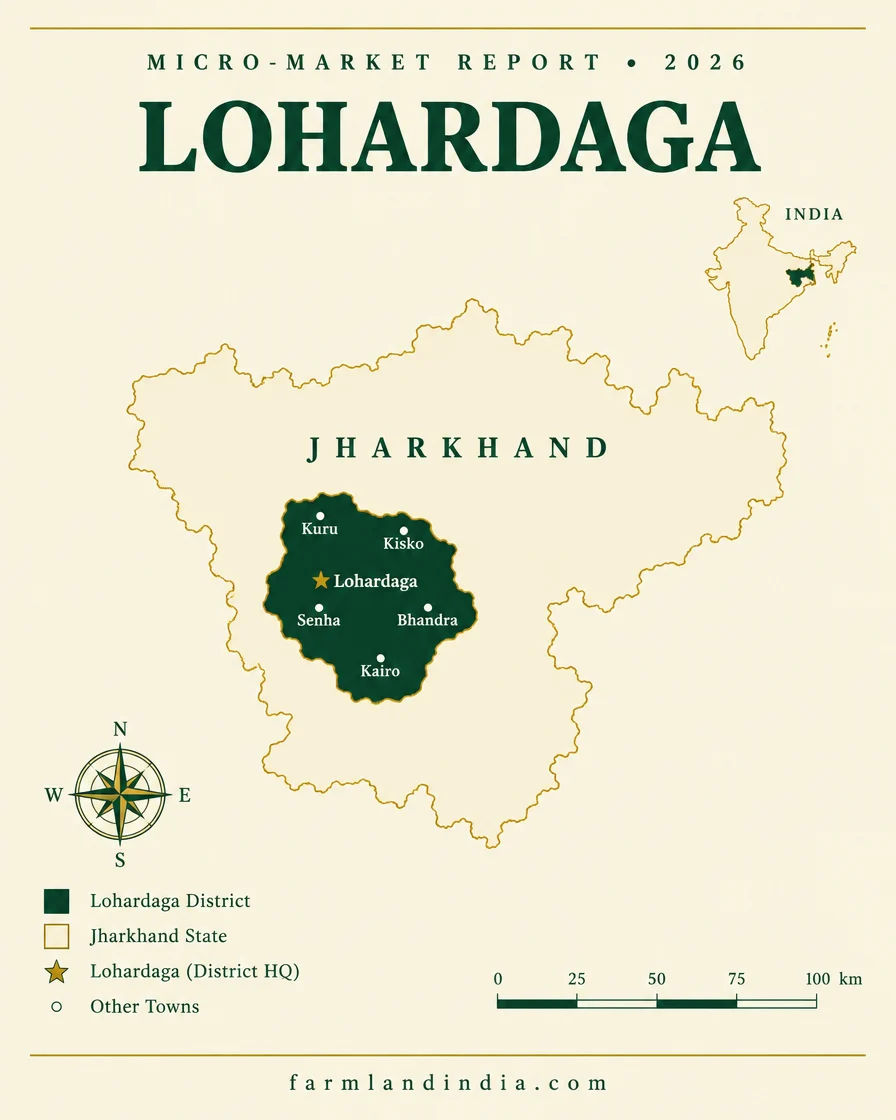
Carved out of Ranchi in 1983 and named after its headquarters town; in the South Chotanagpur division (district website[3])
Key markets
Lohardaga town · Kuru · Kisko · Senha · Bhandra · Kairo · the Ranchi–Lohardaga road and rail belt
Demand anchors
Closeness to Ranchi · Ranchi–Varanasi corridor · Lohardaga–Tori rail line · bauxite and china clay
Rail
The Lohardaga–Tori line is open; a Ranchi–Chopan train runs on it (Pioneer[8]). A 291 km Dharamjaigarh–Pathalgaon–Lohardaga line has been notified and a 55 km Lohardaga–Gumla link is planned
Size and population
1,502 sq km, 4,61,790 people and 354 villages (district website[3])
Pricing unit
No official price series is published; ask the sub-registrar for recent registered sale values in the village. quote any land per acre and confirm the area from the Khatiyan
Local units
Deals in Jharkhand are often described in bigha, katha or dhur or by local custom. Ask for the area in acres or decimals from the record of rights before comparing offers; these local units are explained here, not used for pricing.
Land records portal
Jharbhoomi for the Khatiyan (record of rights) and Register II, with maps on JharBhunaksha; see our Jharbhoomi guide and Bhu-Naksha Jharkhand guide
Land law is state law. These rules are maintained on the Jharkhand page and apply to every district within it.
Lohardaga — land purchase legal rules
Jharkhand’s land law turns on the seller, not the buyer. Two tenancy laws, the Chota Nagpur Tenancy Act, 1908 and the Santhal Parganas Tenancy Act, 1949, decide whether a raiyati plot can be sold at all and to whom. Get this wrong and a registered sale can be annulled, with no refund, decades later.
Who can buy: There is no farmer-only rule in Jharkhand. The restriction runs the other way: the tenancy laws decide which land may be sold, and to whom, according to the community of the person who owns it. Land held by a raiyat (occupancy tenant) who is not Scheduled Tribe, Scheduled Caste or Backward Class can be sold to anyone under the CNT Act. Land held by a tribal, Dalit or backward-class raiyat cannot be bought by an outsider, whatever price is offered.
CNT Act, Section 46: Any sale, gift or lease of more than five years by a raiyat is void except as the section allows. A Scheduled Tribe raiyat may sell, exchange, gift or bequeath land only to another Scheduled Tribe member who lives within the same police-station area, and only with the Deputy Commissioner’s prior sanction. A Scheduled Caste or Backward Class raiyat may transfer, with the same sanction, only to a member of the same group living in the same district. Transfers to registered cooperative societies and specified banks are allowed. Sub-section (3) bars the registration of a deed made in breach of these rules, and no court may recognise one (CNT Act text, LBSNAA copy).
Restoration and penalties: Section 46(4-A) lets the Deputy Commissioner annul a transfer of tribal land made in breach of the section and evict the buyer. Section 71-A goes further: where tribal land was transferred unlawfully or by fraud, the Deputy Commissioner can restore it to the original owner or his heirs without paying the buyer compensation. Section 71-B makes knowingly holding such land an offence punishable with up to three years in prison. A registered deed and long possession are no defence.
Industrial and mining use: Section 49 is the one route through which raiyati land can pass to an outsider for an industrial or mining purpose, or for access to such land. The deed must be registered, the Deputy Commissioner must consent in writing before registration, the land may be used only for the stated purpose, and for Scheduled Tribe land the state can annul the consent within twelve years if it was obtained by fraud. It does not open the land to farm or farmhouse buyers.
Santhal Pargana (SPT Act): In Dumka, Deoghar, Godda, Pakur, Sahibganj and Jamtara (carved out of Dumka), the SPT Act, 1949 is stricter still. Under Section 20 a raiyat cannot transfer his holding by sale, gift, mortgage, will or lease unless the right to transfer is recorded in the record of rights, and only to the extent recorded. Where a right is recorded for an aboriginal raiyat, the land can go only to a bona fide cultivating aboriginal raiyat of the same pargana, taluk or tappa. Deeds in breach cannot be registered, and the Deputy Commissioner can evict the buyer. In practice raiyati farmland in Santhal Pargana is close to unsaleable.
Scheduled Areas: Under the Fifth Schedule, the Scheduled Areas (State of Jharkhand) Order, 2007 covers Ranchi, Lohardaga, Gumla, Simdega, Latehar, East Singhbhum, West Singhbhum, Saraikela-Kharsawan, Sahibganj, Dumka, Pakur and Jamtara along with parts of Palamu, Garhwa and Godda (Jharkhand High Court judgment citing the 2007 Order). Khunti was carved out of Ranchi later the same year and remains Scheduled Area. Here gram sabhas have a say on land and tribal protections are enforced most strictly.
Attempts to relax the law: In November 2016 the assembly passed amendments to the CNT and SPT Acts that would have allowed tribal land to be put to commercial use. Governor Droupadi Murmu returned the bills in May 2017 and the government withdrew them in August 2017 (Business Standard (PTI), 9 August 2017). The original protections stand.
Ceiling and government land: Jharkhand continues to apply the Bihar Land Reforms (Fixation of Ceiling Area and Acquisition of Surplus Land) Act, 1961, which caps family holdings by land class, as on our Bihar page. Plots recorded as gair-mazurwa (government land), forest or khas land cannot be bought at all, however long a family has occupied them.
Documents to check: The Khatiyan for the village survey (it records the raiyat’s caste or tribe and any transfer right), the current Register II entry and rent receipts, the mutation order from the circle office, a 30-year encumbrance search at the sub-registrar, the plot on the village map and a Deputy Commissioner’s sanction where the seller belongs to a protected group. Our Jharbhoomi guide explains each record.
NRI and OCI buyers: Under the RBI Master Direction on immovable property, NRIs and OCIs may not acquire agricultural land, a farmhouse or plantation property in India except by inheritance. In Jharkhand the tenancy laws narrow the field further. Our NRI guide covers the options.
- No farmer-only rule
- CNT Act: Section 46
- ST buyers: same police station
- SC/BC buyers: same district
- Restoration: Section 71-A
- Santhal Pargana: SPT Act Section 20
- Scheduled Areas: 2007 Order
- NRIs: inheritance only
Lohardaga — district-specific notes
The Jharkhand state page applies to Lohardaga in full. Lohardaga is in the South Chotanagpur division, so the Chota Nagpur Tenancy Act governs raiyati land, and the whole district is a Scheduled Area under the 2007 Order (High Court judgment listing the Order[2]).
⚠ Section 46 of the Chota Nagpur Tenancy Act, 1908 lets a Scheduled Tribe raiyat transfer holding land only to another Scheduled Tribe member who lives in the same police-station area, with the Deputy Commissioner’s prior sanction. Scheduled Caste and Backward Class raiyats can transfer only within the same group in the same district, also with sanction. A deed in breach cannot be registered, the Deputy Commissioner can annul the transfer, and sections 71-A and 71-B allow restoration without compensation and up to three years’ imprisonment (CNT Act text[1]).
⚠ Lohardaga is a tribal-majority plateau district, so a large part of its farmland is likely to be held by Scheduled Tribe raiyats. An outside buyer should assume that an agricultural plot carries the section 46 bar until the record shows otherwise, and should ask the Circle Officer for the holder’s recorded status.
⚠ Section 49 allows a transfer for industry or mining only with the Deputy Commissioner’s consent. Ask which category the plot and its holder fall in before any discussion of price. The Indian Minerals Yearbook lists bauxite, china clay and granite for the district (IBM, 2022[5]), so check whether a plot lies in or beside a lease or a mining road.
⚠ The 291 km Dharamjaigarh–Pathalgaon–Lohardaga line has been notified as a special railway project, and a 55 km Lohardaga–Gumla link is planned. Neither has a fixed alignment on the public record, so ask the Circle Officer whether any notification covers the plot and treat any “future rail line” sales pitch with care.
⚠ Before paying any advance, ask for four papers: the current Khatiyan and Register II extract from Jharbhoomi, the JharBhunaksha map sheet for the plot, the last mutation (dakhil-kharij) order and the latest rent (lagan) receipt. A seller who cannot produce the receipt or the mutation order is telling you the record is not in his name.
⚠ The Jharkhand cabinet approved a surcharge of 10% of stamp duty plus registration fee on transfers in municipal and notified urban areas on 27 October 2026; the start date was not reported (Indian Masterminds, 28 Oct 2026[12]). Lohardaga town is the main urban area; ask the sub-registrar whether it applies on the day you register.
NRI and OCI buyers should read can NRIs buy agricultural land in India before shortlisting any farmland; the FEMA bar applies in every district.
- Whole district Scheduled Area
- CNT Act transfer bar
- Bauxite and mineral land
- Rail acquisition
- Urban surcharge (reported)
District overview
Lohardaga — a small Scheduled Area plateau district on the Ranchi rail line
Lohardaga is a small district on the Chota Nagpur plateau of Jharkhand, west of Ranchi. It was carved out of Ranchi in 1983 and covers 1,502 sq km, with 4.6 lakh people and 354 villages (district website[3]).
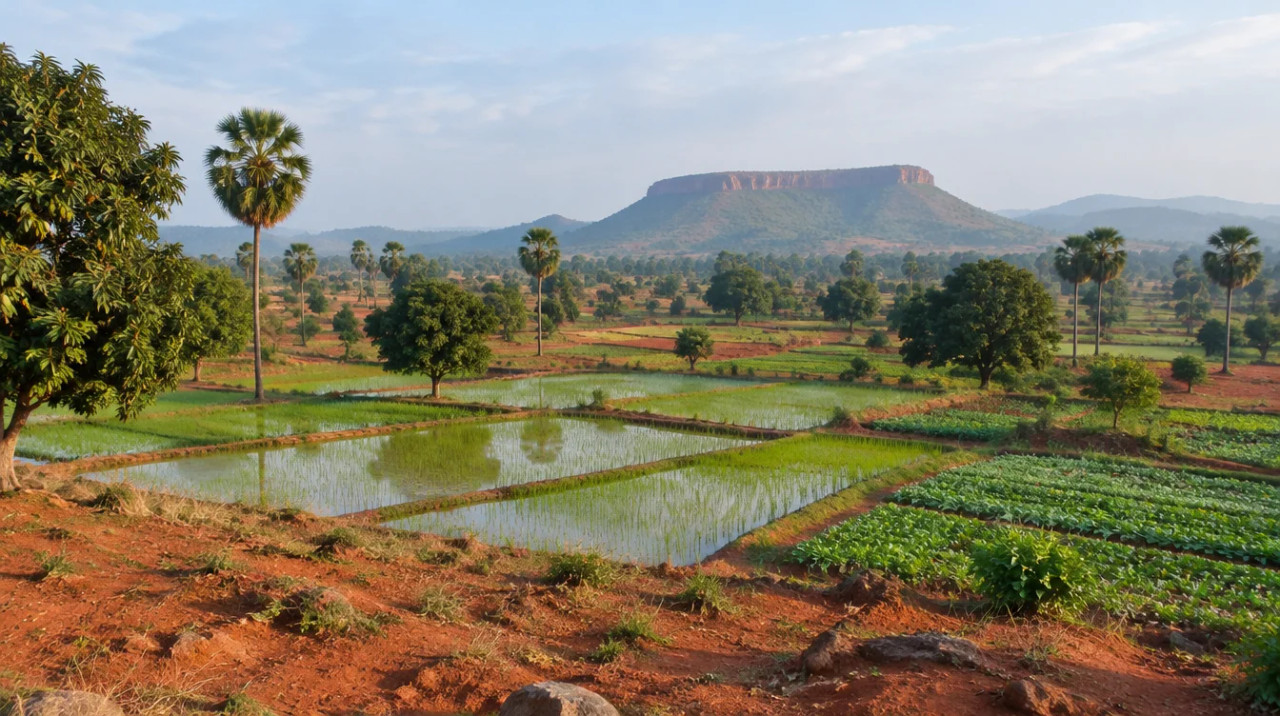
It is a rain-fed district. The ICAR-CRIDA plan lists rice on 28,800 ha, with maize, pea, blackgram, pigeonpea and wheat as minor crops, a net sown area of 39,300 ha and a normal rainfall of about 1,228 mm (ICAR-CRIDA Lohardaga plan[4]). About 14% of the sown area is irrigated.
The Indian Minerals Yearbook lists bauxite, china clay and granite (IBM, 2022[5]). Bauxite mining and its roads shape land use in parts of the district.
Rail is already a strength. The Lohardaga–Tori line is open, and a Ranchi–Chopan train runs on it (Pioneer[8]). A 291 km Dharamjaigarh–Pathalgaon–Lohardaga line was notified in June 2026 (Construction World, 24 Jun 2026[9]). The Ranchi–Varanasi corridor, a 413 km four-lane about 60% complete in October 2025, names Lohardaga among districts expected to benefit (Indian Masterminds[10]).
Who can buy is set by law. As a wholly Scheduled Area, Lohardaga is not an open market: tribal land may move only to another tribal member of the same police-station area with the Deputy Commissioner’s sanction. Outside investors should look at non-tribal holdings, non-agricultural land and plots in Lohardaga town.
Compare Lohardaga with Ranchi, Gumla and Latehar on the Jharkhand state page. Treat it as a small, document-first, long-hold market.
- Scheduled Area
- Ranchi–Lohardaga rail
- Bauxite belt
- Rice and pulses
- Lohardaga town
Transaction costs
Stamp duty & registration in Lohardaga
4%
Stamp duty on a sale deed
per the state schedule (undated ICSI copy); confirm at the registry
3%
Registration fee
on the same value, per the state schedule
10%
Urban surcharge (reported)
of duty plus fee in municipal areas; cabinet approval 27 Oct 2026, start date not reported
The state schedule lists stamp duty of 4% and a registration fee of 3% on a sale deed, with a service fee of Rs 30 a page (Jharkhand schedule, ICSI copy[7]). The Re 1 registration for women, introduced in 2017, was withdrawn in 2020. Duty is charged on the higher of the deed value and the district minimum value register, so ask the Lohardaga sub-registrar for the rate that applies to your village and land class. In Lohardaga town the surcharge may add to the bill once it starts (Indian Masterminds[12]).
Know the belt
What is moving prices in Lohardaga
Reported projects and land types only; no listing-site prices are used.
Lohardaga town
District headquarters market
The Collectorate, courts, trade and the railway keep demand in the town. Buyers look mainly for house plots and small commercial land inside the notified area, where the urban surcharge may apply.
Check: the plot’s recorded land class, the holder’s status in the record of rights and whether it lies inside the notified town limit.
Ranchi–Lohardaga belt
Road and rail towards the capital
Villages between Lohardaga and Ranchi draw Ranchi-based buyers for weekend and small farm plots. Tribal land in the belt still carries the CNT bar.
Check: the holder’s status, the acquisition notices and legal access to the road.
Kisko, Kuru and the mining side
Bauxite and plateau blocks
Bauxite and china clay are listed for the district. Land near leases is subject to section 49 and to acquisition and forest clearances.
Check: lease maps, section 49 consent history and whether the plot is recorded as raiyati or as forest.
Senha, Bhandra and Kairo
Farming blocks
These blocks carry rain-fed rice and pulses. They are the likeliest to be tribal-held.
Check: the holder’s status, the irrigation source and the plot number against JharBhunaksha.
Asking prices
No official price series is published for Lohardaga farmland. Use the minimum value register for the village and compare it with recent registered deeds in the same mouza. Treat any rate quoted by a seller without a registered deed as unproven.
Connectivity
How Lohardaga connects — road, rail and air
An open rail line, a four-lane corridor and new rail plans; no drive times are given because no source was found.
🚗 By road
✈️ By air
🚆 By rail
New lines mean acquisition. Ask the Circle Officer whether any notification covers the plot or its access before you pay an advance.
Growth catalysts
Upcoming infrastructure & developments
Four catalysts at different stages; rail is the strongest.
01Open
04Catalysts
Agriculture & terrain
Soil, crops & water in Lohardaga
A rain-fed rice and pulses district with limited irrigation.
Crops
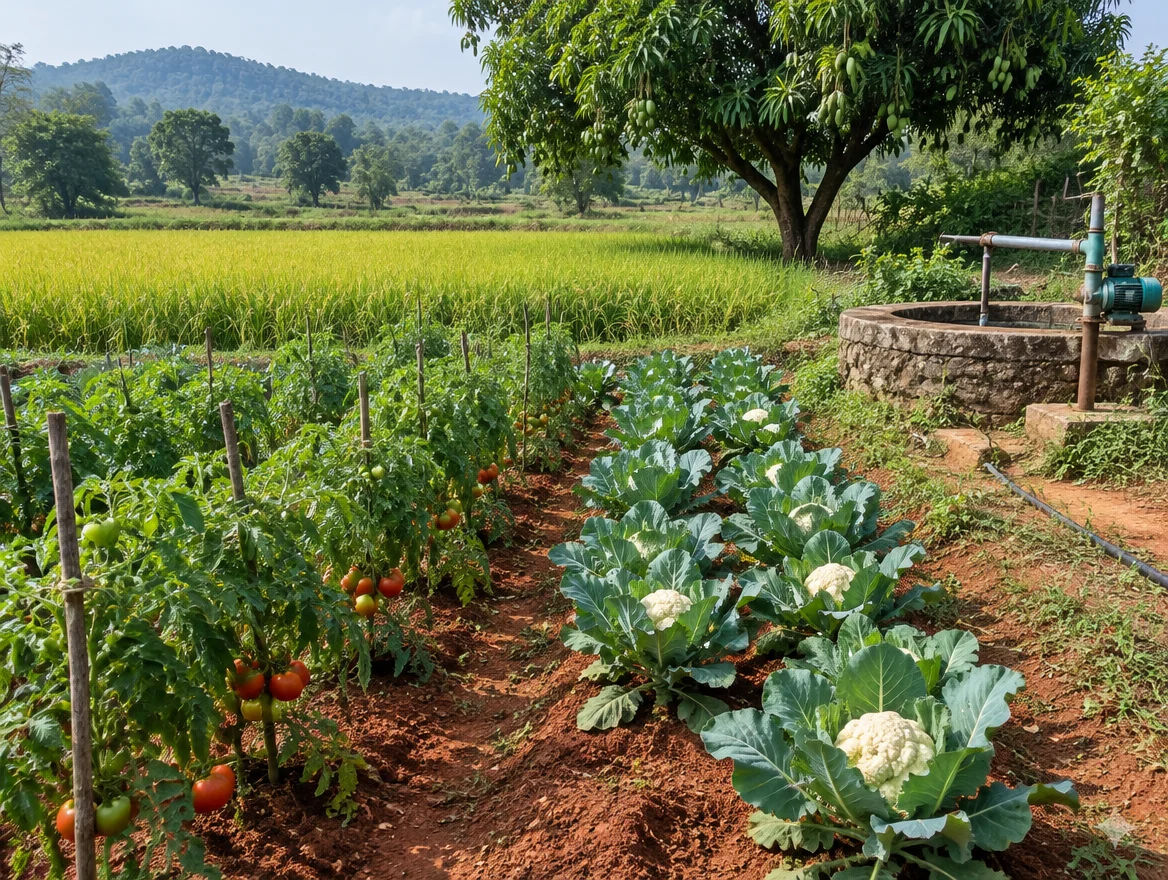
The ICAR-CRIDA plan lists rice (28,800 ha), maize (7,200 ha), pea (4,000 ha), blackgram (3,800 ha), pigeonpea (3,400 ha) and wheat (2,900 ha). Net sown area is 39,300 ha at 108% cropping intensity. These figures date from 2012.
- Rice
- Maize
- Pea
- Blackgram
- Pigeonpea
Water and irrigation
Net irrigated area was 5,700 ha against a net sown area of 39,300 ha, about 14%, from bore wells, open wells, check dams, canals and tanks (ICAR-CRIDA[4]). State-wide, groundwater extraction was 31.42% in 2024 (CGWB[6]); a Lohardaga-specific category was not found.
Soils and rainfall
The plan names red lateritic, loam, fine loam and fine mixed loam soils and a normal rainfall of 1,228 mm, of which about 1,011 mm falls in the south-west monsoon. Rain-fed fields depend on that season.
At a glance
Lohardaga vs. nearby districts
| District | Land and water | What links it to Lohardaga |
|---|---|---|
| Ranchi (east) | State capital district with the main airport | Lohardaga is reached by road and rail from Ranchi |
| Gumla (south-west) | Scheduled Area plateau district | Planned 55 km rail link; the same Scheduled Area regime |
| Latehar (north-west) | Forest and Scheduled Area district | Both lie on the Ranchi–Varanasi corridor |
No price series exists for any of these areas that we could read, so no rates are compared. Compare the minimum value registers and recent deeds on each side of a district line.
Farmland India view
Why investors look at Lohardaga
Five reasoned points for Lohardaga, each tied to a source on this page.
The law decides who can buy
With the whole district a Scheduled Area, outside buyers can reach only land recorded as freely transferable. Establish that first.
Rail is the real asset
The Lohardaga–Tori line is open, unlike in most of the plateau. New lines are notified or planned, but only the open line is a fact on the ground.
Corridor and Ranchi spill-over
The Ranchi–Varanasi corridor and the road to Ranchi support plot demand near the highway. Expect acquisition notices as well.
Bauxite shapes pockets
Mining brings roads and activity but also section 49 consents and acquisition risk near leases.
Plan for a long hold
With a thin market and community-bound transfers, expect slow resale and underwrite on documents.
Confirm the RoR (Khatiyan), mutation, zoning and acquisition status directly — these are not certified by Farmland India’s review.
STRAIGHT TALK
Risks & challenges in Lohardaga
District-specific risks. Read the Jharkhand state page for the general risks on ceiling, conversion and records.
Tribal land and Scheduled Area rules
A deed that breaks section 46 cannot be registered and can be annulled; restoration is without compensation. Check the holder’s recorded status first.
Mining and acquisition
Bauxite and china-clay leases and new rail and road work can acquire land. Ask for lease and acquisition maps.
Rail promises
Two of the four rail projects are notified or planned only. Do not pay a premium for a future line.
Forest and government land
Parts of the district are forest or recorded as government land that cannot be sold. Match plot numbers and boundaries with the Khatiyan and the map.
Records and mutation
Old records may not match occupation. After registration apply for mutation at the Circle Office and keep the receipt.
Powers of attorney and remote sellers
Do not pay on a power of attorney or a photocopy. Insist on a registered deed and visit the plot.
Who to contact
Local revenue & planning offices
Start with the Deputy Commissioner’s office at Lohardaga for Scheduled Area and sanction questions, the Circle Officer of the block for the record of rights and mutation, and the District Sub-Registrar at Lohardaga for the deed, the minimum value register and stamp duty. The district website[3] lists the administration; the record guides are linked in the district land record table above.
COMMON QUESTIONS
Frequently asked questions
Everything buyers, NRIs and investors ask before their first reviewed farmland purchase in Lohardaga.
Visit full wiki01 of 04
Can an outsider buy farmland in Lohardaga?
Rarely land held by Scheduled Tribe raiyats. Under section 46 of the CNT Act it can go only to a tribal member of the same police-station area with the Deputy Commissioner’s sanction. Non-tribal and urban land is a document question.
02 of 04
What are the stamp duty and registration charges in Lohardaga?
The state schedule lists 4% stamp duty and 3% registration fee on a sale deed, plus Rs 30 a page. A 10% surcharge on duty plus fee for municipal areas was approved in October 2026; the start date was not reported.
03 of 04
Is Lohardaga a Scheduled Area?
Yes. The whole district is listed in the Scheduled Areas (State of Jharkhand) Order, 2007. Confirm a plot’s status with the circle office.
04 of 04
What rail and road projects affect Lohardaga?
The open Lohardaga–Tori line, the notified 291 km Dharamjaigarh–Pathalgaon–Lohardaga line, a 55 km Lohardaga–Gumla link at survey stage and the Ranchi–Varanasi four-lane corridor.
Transparency
Sources and references
Law and courts
- [1]Chota Nagpur Tenancy Act, 1908 (text) — lbsnaa.gov.in
- [2]Jharkhand High Court on the Scheduled Areas Order, 2007 (the Act text)
Government
- [3]Lohardaga district website — lohardaga.nic.in
- [4]ICAR-CRIDA: Lohardaga district agriculture contingency plan — icar-crida.res.in
- [5]Indian Bureau of Mines: Indian Minerals Yearbook 2022, Jharkhand — ibm.gov.in
- [6]CGWB: groundwater resources, Jan 2025 — cgwb.gov.in
- [7]Jharkhand stamp duty and registration schedule (ICSI copy) — icsi.edu
News
- [8]Pioneer: Ranchi–Chopan Express on the Lohardaga–Tori route — dailypioneer.com
- [9]Construction World: Dharamjaigarh–Lohardaga special railway line, 24 Jun 2026 — constructionworld.in
- [10]Indian Masterminds: Jharkhand national highway projects, 25 Oct 2025 — indianmasterminds.com
- [11]India TV: rail links, 19 Jan 2025 — indiatvnews.com
- [12]Indian Masterminds: cabinet decisions, 28 Oct 2026 — indianmasterminds.com
Data-currency note: sources are as of November 2026. Project status, the benchmark valuation and land rules change often; check the linked source and the relevant office before relying on any figure.
For developers
Ready to explore Lohardaga farmland?
Browse reviewed projects and individual land parcels across Lohardaga — or if you own land here, list it with platform review and reach serious buyers.