

District guide
Buying Land in Khunti
A tribal heartland district 40 km south of Ranchi where the CNT Act and Scheduled Area rules limit who can buy, with a four-lane programme and lac farming.
2,611 sq km
Area (KVK profile)
5.32 lakh
Population (Census 2011)
73%
Tribal share (KVK profile)
4% + 3%
Stamp duty + registration (state schedule)
*Indicative range across districts and land types. Stamp duty, registration and conversion charges are additional. Local measurement units vary — every listing states the unit it is priced in. Not a valuation or an offer.
District land record — Khunti
Rev. 2026 · Farmland India desk
State
Jharkhand
Formation and blocks
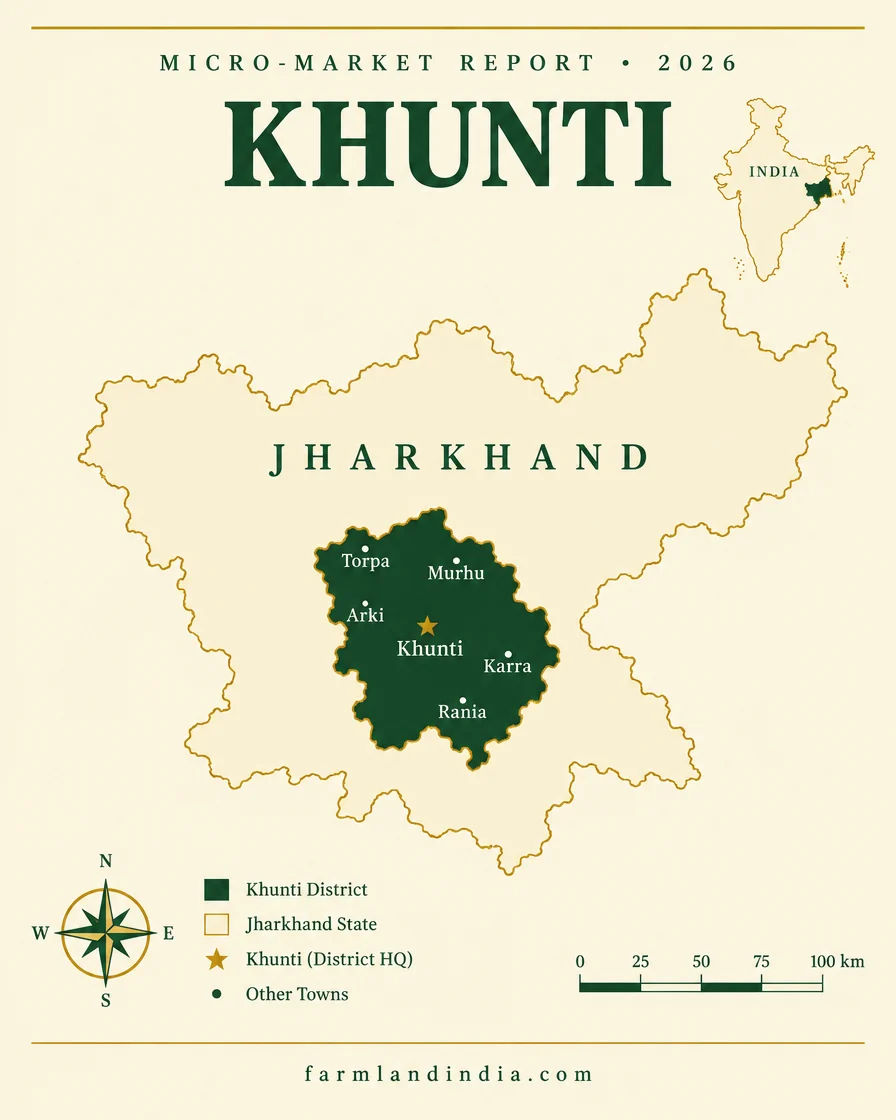
Created on 12 September 2007 from Ranchi as the state’s 23rd district, in the South Chotanagpur division, with six blocks (Khunti, Murhu, Torpa, Karra, Rania, Arki) and about 40 km south of Ranchi (district website[3])
Key markets
Khunti town · Torpa · Murhu · Karra · Rania · Arki · the Ranchi–Khunti road belt
Demand anchors
Closeness to Ranchi · Tupudana–Kundiabartoli four-lane with a Khunti bypass · planned Hatia–Khunti rail link
Rail
No passenger line is documented inside the district; a 20 km Hatia–Khunti link is planned (India TV, 19 Jan 2025[8])
Size and population
2,611 sq km, 5,31,885 people at the 2011 Census (73% tribal), 86 gram panchayats and 756 villages (KVK district profile[4])
Pricing unit
No official price series is published; ask the sub-registrar for recent registered sale values in the village. quote any land per acre and confirm the area from the Khatiyan
Local units
Deals in Jharkhand are often described in bigha, katha or dhur or by local custom. Ask for the area in acres or decimals from the record of rights before comparing offers; these local units are explained here, not used for pricing.
Land records portal
Jharbhoomi for the Khatiyan (record of rights) and Register II, with maps on JharBhunaksha; see our Jharbhoomi guide and Bhu-Naksha Jharkhand guide
Land law is state law. These rules are maintained on the Jharkhand page and apply to every district within it.
Khunti — land purchase legal rules
Jharkhand’s land law turns on the seller, not the buyer. Two tenancy laws, the Chota Nagpur Tenancy Act, 1908 and the Santhal Parganas Tenancy Act, 1949, decide whether a raiyati plot can be sold at all and to whom. Get this wrong and a registered sale can be annulled, with no refund, decades later.
Who can buy: There is no farmer-only rule in Jharkhand. The restriction runs the other way: the tenancy laws decide which land may be sold, and to whom, according to the community of the person who owns it. Land held by a raiyat (occupancy tenant) who is not Scheduled Tribe, Scheduled Caste or Backward Class can be sold to anyone under the CNT Act. Land held by a tribal, Dalit or backward-class raiyat cannot be bought by an outsider, whatever price is offered.
CNT Act, Section 46: Any sale, gift or lease of more than five years by a raiyat is void except as the section allows. A Scheduled Tribe raiyat may sell, exchange, gift or bequeath land only to another Scheduled Tribe member who lives within the same police-station area, and only with the Deputy Commissioner’s prior sanction. A Scheduled Caste or Backward Class raiyat may transfer, with the same sanction, only to a member of the same group living in the same district. Transfers to registered cooperative societies and specified banks are allowed. Sub-section (3) bars the registration of a deed made in breach of these rules, and no court may recognise one (CNT Act text, LBSNAA copy).
Restoration and penalties: Section 46(4-A) lets the Deputy Commissioner annul a transfer of tribal land made in breach of the section and evict the buyer. Section 71-A goes further: where tribal land was transferred unlawfully or by fraud, the Deputy Commissioner can restore it to the original owner or his heirs without paying the buyer compensation. Section 71-B makes knowingly holding such land an offence punishable with up to three years in prison. A registered deed and long possession are no defence.
Industrial and mining use: Section 49 is the one route through which raiyati land can pass to an outsider for an industrial or mining purpose, or for access to such land. The deed must be registered, the Deputy Commissioner must consent in writing before registration, the land may be used only for the stated purpose, and for Scheduled Tribe land the state can annul the consent within twelve years if it was obtained by fraud. It does not open the land to farm or farmhouse buyers.
Santhal Pargana (SPT Act): In Dumka, Deoghar, Godda, Pakur, Sahibganj and Jamtara (carved out of Dumka), the SPT Act, 1949 is stricter still. Under Section 20 a raiyat cannot transfer his holding by sale, gift, mortgage, will or lease unless the right to transfer is recorded in the record of rights, and only to the extent recorded. Where a right is recorded for an aboriginal raiyat, the land can go only to a bona fide cultivating aboriginal raiyat of the same pargana, taluk or tappa. Deeds in breach cannot be registered, and the Deputy Commissioner can evict the buyer. In practice raiyati farmland in Santhal Pargana is close to unsaleable.
Scheduled Areas: Under the Fifth Schedule, the Scheduled Areas (State of Jharkhand) Order, 2007 covers Ranchi, Lohardaga, Gumla, Simdega, Latehar, East Singhbhum, West Singhbhum, Saraikela-Kharsawan, Sahibganj, Dumka, Pakur and Jamtara along with parts of Palamu, Garhwa and Godda (Jharkhand High Court judgment citing the 2007 Order). Khunti was carved out of Ranchi later the same year and remains Scheduled Area. Here gram sabhas have a say on land and tribal protections are enforced most strictly.
Attempts to relax the law: In November 2016 the assembly passed amendments to the CNT and SPT Acts that would have allowed tribal land to be put to commercial use. Governor Droupadi Murmu returned the bills in May 2017 and the government withdrew them in August 2017 (Business Standard (PTI), 9 August 2017). The original protections stand.
Ceiling and government land: Jharkhand continues to apply the Bihar Land Reforms (Fixation of Ceiling Area and Acquisition of Surplus Land) Act, 1961, which caps family holdings by land class, as on our Bihar page. Plots recorded as gair-mazurwa (government land), forest or khas land cannot be bought at all, however long a family has occupied them.
Documents to check: The Khatiyan for the village survey (it records the raiyat’s caste or tribe and any transfer right), the current Register II entry and rent receipts, the mutation order from the circle office, a 30-year encumbrance search at the sub-registrar, the plot on the village map and a Deputy Commissioner’s sanction where the seller belongs to a protected group. Our Jharbhoomi guide explains each record.
NRI and OCI buyers: Under the RBI Master Direction on immovable property, NRIs and OCIs may not acquire agricultural land, a farmhouse or plantation property in India except by inheritance. In Jharkhand the tenancy laws narrow the field further. Our NRI guide covers the options.
- No farmer-only rule
- CNT Act: Section 46
- ST buyers: same police station
- SC/BC buyers: same district
- Restoration: Section 71-A
- Santhal Pargana: SPT Act Section 20
- Scheduled Areas: 2007 Order
- NRIs: inheritance only
Khunti — district-specific notes
The Jharkhand state page applies to Khunti in full. Khunti is in the South Chotanagpur division, so the Chota Nagpur Tenancy Act governs raiyati land, and the district, carved from Ranchi, is a Scheduled Area under the 2007 Order (High Court judgment listing the Order[2]).
⚠ Section 46 of the Chota Nagpur Tenancy Act, 1908 lets a Scheduled Tribe raiyat transfer holding land only to another Scheduled Tribe member who lives in the same police-station area, with the Deputy Commissioner’s prior sanction. Scheduled Caste and Backward Class raiyats can transfer only within the same group in the same district, also with sanction. A deed in breach cannot be registered, the Deputy Commissioner can annul the transfer, and sections 71-A and 71-B allow restoration without compensation and up to three years’ imprisonment (CNT Act text[1]).
⚠ About 73% of Khunti’s people are tribal (KVK district profile[4]), so most farmland is held by Scheduled Tribe raiyats. An outside buyer should assume that any agricultural plot carries the section 46 bar until the record of rights shows otherwise, and should ask the Circle Officer for the holder’s recorded status.
⚠ Much of Khunti’s land is held under older community tenures recorded in the Khatiyan, such as Khuntkatti and Mundari Khuntkatti village land. Ask the Circle Officer whether any part of the plot falls under such a tenure; the rules on transfer are stricter and a plain sale deed may not be valid.
⚠ Section 49 allows a transfer for industry or mining only with the Deputy Commissioner’s consent. Ask which category the plot and its holder fall in before any discussion of price.
⚠ Before paying any advance, ask for four papers: the current Khatiyan and Register II extract from Jharbhoomi, the JharBhunaksha map sheet for the plot, the last mutation (dakhil-kharij) order and the latest rent (lagan) receipt. A seller who cannot produce the receipt or the mutation order is telling you the record is not in his name.
⚠ The Jharkhand cabinet approved a surcharge of 10% of stamp duty plus registration fee on transfers in municipal and notified urban areas on 27 October 2026; the start date was not reported (Indian Masterminds, 28 Oct 2026[9]). Khunti is the only sizeable urban area; ask the sub-registrar whether it applies on the day you register.
NRI and OCI buyers should read can NRIs buy agricultural land in India before shortlisting any farmland; the FEMA bar applies in every district.
- Whole district Scheduled Area
- CNT Act transfer bar
- 73% tribal population
- Forest and Munda-Khuntkatti land
- Urban surcharge (reported)
District overview
Khunti — a tribal heartland district 40 km south of Ranchi
Khunti is a small district in the middle of the Chota Nagpur plateau, about 40 km south of Ranchi. It was carved out of Ranchi in 2007 and has six blocks. It covers 2,611 sq km, had 5.3 lakh people in 2011 and is 73% tribal (KVK district profile[4]). The area is associated with Birsa Munda, whose movement shaped tribal land law in this region.
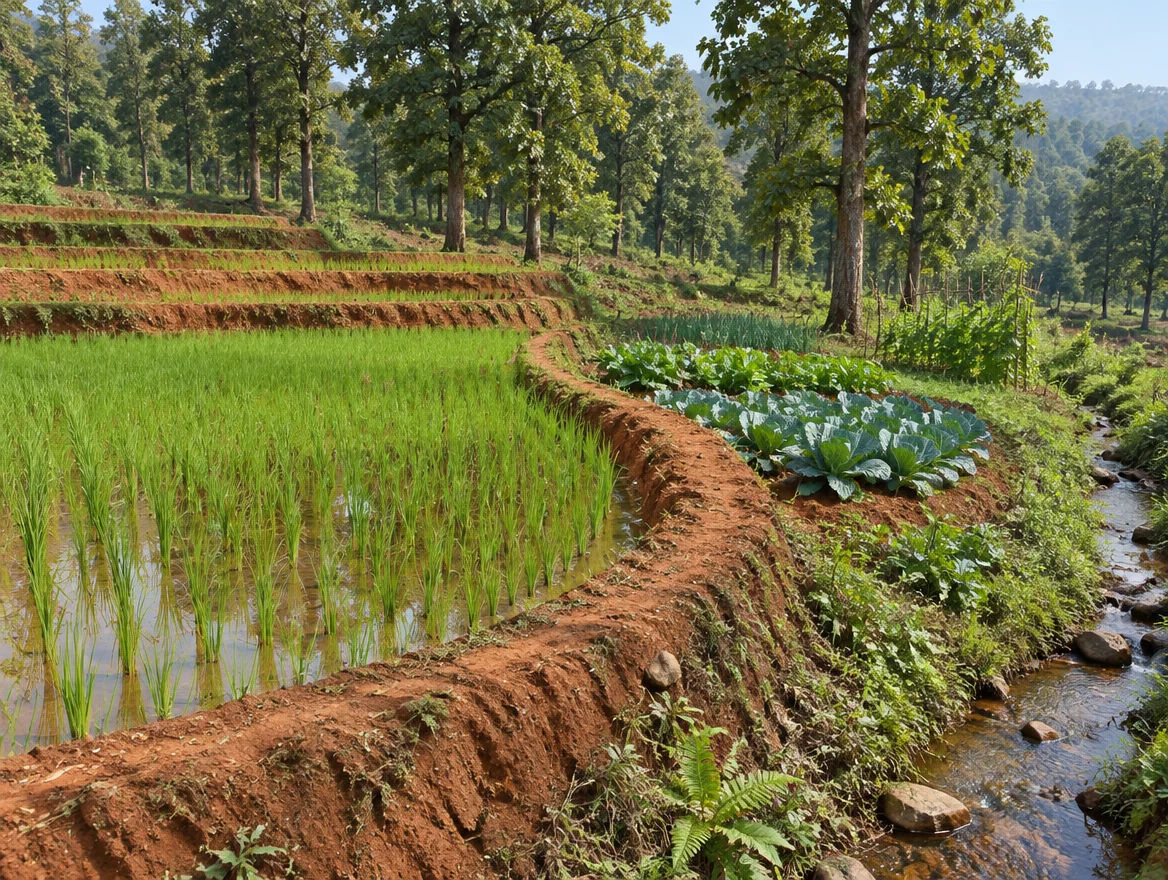
Farmland is mostly rain-fed on sandy red loam with an acidic pH of about 4.9 to 6.2. About 66% of the area is cultivable and 104,440 ha is forest. Paddy and finger millet are the main cereals, with niger, mustard and linseed as oilseeds, and mango, jackfruit and guava among the horticulture crops (KVK district profile[4]).
Khunti is also a lac district: about 2,000 tonnes a year, or about 29% of Jharkhand’s production according to the same profile. Lac grows on host trees such as palas and ber, which is one more reason to check whether a plot’s trees are recorded or claimed by the community.
The road story is Ranchi’s spill-over. In March 2024 foundation stones were laid for the four-laning of Tupudana to Kundiabartoli, including a Khunti bypass, and for the Bero–Khunti widening, together worth over Rs 2,500 crore (NBMCW, 12 Mar 2024[7]). A 20 km Hatia–Khunti rail link is at survey stage.
Who can buy is set by law. With the whole district a Scheduled Area and most land tribal-held, tribal land may move only to another tribal member of the same police-station area, with the Deputy Commissioner’s sanction. Outside buyers should look at non-tribal holdings, non-agricultural land and plots in Khunti town, and verify each in the record.
Compare Khunti with Ranchi, Gumla and West Singhbhum on the Jharkhand state page. Treat it as a patient, document-heavy market.
- Scheduled Area
- 40 km from Ranchi
- Lac and paddy
- Four-lane under way
- Khunti town
Transaction costs
Stamp duty & registration in Khunti
4%
Stamp duty on a sale deed
per the state schedule (undated ICSI copy); confirm at the registry
3%
Registration fee
on the same value, per the state schedule
10%
Urban surcharge (reported)
of duty plus fee in municipal areas; cabinet approval 27 Oct 2026, start date not reported
The state schedule lists stamp duty of 4% and a registration fee of 3% on a sale deed, with a service fee of Rs 30 a page (Jharkhand schedule, ICSI copy[6]). The Re 1 registration for women, introduced in 2017, was withdrawn in 2020. Duty is charged on the higher of the deed value and the district minimum value register, so ask the Khunti sub-registrar for the rate that applies to your village and land class. In Khunti town the surcharge may add to the bill once it starts (Indian Masterminds[9]).
Know the belt
What is moving prices in Khunti
Reported projects and land types only; no listing-site prices are used.
Khunti town
District headquarters market
The Collectorate, courts and trade keep demand in the town. Buyers look mainly for house plots and small commercial land inside the notified area, where the urban surcharge may apply.
Check: the plot’s recorded land class, the holder’s status in the record of rights and whether it lies inside the notified town limit.
Ranchi–Khunti road belt
Tupudana to Kundiabartoli
The four-laning, with a Khunti bypass, is the main reason to look at roadside land. Widening brings acquisition notices as well as demand, and tribal land along the road still carries the CNT bar.
Check: the alignment, any acquisition or bypass notice and legal access to the road.
Torpa, Murhu and Arki
Forest-edge farming blocks
These blocks mix rain-fed paddy, millet and forest. They are the likeliest to be tribal-held, and community tenures are common.
Check: the holder’s status, any Khuntkatti entry and the plot number against JharBhunaksha.
Karra and Rania
Plateau farming blocks
These blocks carry rice, vegetables and horticulture land. They are closer to the Bero–Khunti widening side of the district for some villages, so check the alignment.
Check: the acquisition notices, the irrigation source and the holder’s community.
Asking prices
No official price series is published for Khunti farmland. Use the minimum value register for the village and compare it with recent registered deeds in the same mouza. Treat any rate quoted by a seller without a registered deed as unproven.
Connectivity
How Khunti connects — road, rail and air
A short road link to Ranchi and a rail link on paper; no drive times are given because no source was found.
🚗 By road
✈️ By air
🚆 By rail
Because the rail link is only planned, no alignment is fixed. Be wary of anyone selling land as being on a future rail line.
Growth catalysts
Upcoming infrastructure & developments
Two catalysts: a highway programme with foundation stones laid and a rail link on paper.
00Open
03Catalysts
Agriculture & terrain
Soil, crops & water in Khunti
A rain-fed paddy, millet and lac district on acidic red loam.
Crops
The KVK profile names paddy and finger millet as the main cereals, niger, mustard and linseed as oilseeds, and peas, gram, pigeon pea, urd and horse gram as pulses, with mango, jackfruit, custard apple, tamarind and guava in horticulture. Crop-wise areas were not given.
- Paddy
- Finger millet
- Oilseeds (niger, mustard, linseed)
- Pulses
- Mango and jackfruit
Lac
About 2,000 tonnes a year, or 28.9% of Jharkhand’s lac, according to the KVK profile. Lac depends on host trees, so tree ownership matters.
- Palas and ber hosts
- Seasonal crops
Water and rainfall
Average rainfall is 1,323 mm (KVK district profile[4]). State-wide, groundwater extraction was 31.42% in 2024 (CGWB[5]); a Khunti-specific category was not found. Confirm the plot’s water source before paying for irrigated land.
Soils and land use
Soil is sandy red loam, acidic at about pH 4.9 to 6.2. About 66% of the area is cultivable and 104,440 ha is forest, so a plot next to forest may have forest-rights or boundary issues.
At a glance
Khunti vs. nearby districts
| District | Land and water | What links it to Khunti |
|---|---|---|
| Ranchi (north) | Capital district with the main airport | Khunti sits about 40 km south; Ranchi’s growth spills over |
| Gumla (west) | Scheduled Area plateau district | Also a CNT Act and Scheduled Area district; planned rail links |
| West Singhbhum and Seraikela (south and east) | Forest, mining and tribal districts | Same Scheduled Area regime; Chaibasa side |
No price series exists for any of these areas that we could read, so no rates are compared. Compare the minimum value registers and recent deeds on each side of a district line.
Farmland India view
Why investors look at Khunti
Five reasoned points for Khunti, each tied to a source on this page.
The law decides who can buy
With the whole district a Scheduled Area and most land tribal-held, outside buyers can reach only land recorded as freely transferable. Establish that first.
Ranchi spill-over is the case
Khunti’s case is its closeness to Ranchi and the four-lane programme. Roadside land gets demand and notices.
Rail is paper-stage
The Hatia–Khunti link has a preliminary survey only. Do not pay a premium for a rail promise.
Lac and horticulture are the farm story
Lac makes Khunti distinctive. Value farmland on its crops and trees, not on a district average.
Plan for a long hold
With a thin market and community-bound transfers, expect slow resale and underwrite on documents.
Confirm the RoR (Khatiyan), mutation, zoning and acquisition status directly — these are not certified by Farmland India’s review.
STRAIGHT TALK
Risks & challenges in Khunti
District-specific risks. Read the Jharkhand state page for the general risks on ceiling, conversion and records.
Tribal land and Scheduled Area rules
A deed that breaks section 46 cannot be registered and can be annulled; restoration is without compensation. Check the holder’s recorded status first.
Community tenures
Khuntkatti and other community tenures carry stricter rules. Ask the Circle Officer whether any part of the plot is covered.
Forest and government land
A large share of the district is forest. Match plot numbers and boundaries with the Khatiyan and the map, and check forest-rights claims.
Acquisition for roads
Widening and bypass work may acquire land. A sale after a notification is a risk to the buyer.
Records and mutation
Old records may not match occupation. After registration apply for mutation at the Circle Office and keep the receipt.
Powers of attorney and remote sellers
Do not pay on a power of attorney or a photocopy. Insist on a registered deed and visit the plot.
Who to contact
Local revenue & planning offices
Start with the Deputy Commissioner’s office at Khunti for Scheduled Area and sanction questions, the Circle Officer of the block for the record of rights and mutation, the Sub-Divisional Officer, and the District Sub-Registrar at Khunti for the deed, the minimum value register and stamp duty. The district website[3] lists the administration; the record guides are linked in the district land record table above.
COMMON QUESTIONS
Frequently asked questions
Everything buyers, NRIs and investors ask before their first reviewed farmland purchase in Khunti.
Visit full wiki01 of 04
Can an outsider buy farmland in Khunti?
Rarely land held by Scheduled Tribe raiyats. Under section 46 of the CNT Act it can go only to a tribal member of the same police-station area with the Deputy Commissioner’s sanction. Non-tribal and urban land is a document question.
02 of 04
What are the stamp duty and registration charges in Khunti?
The state schedule lists 4% stamp duty and 3% registration fee on a sale deed, plus Rs 30 a page. A 10% surcharge on duty plus fee for municipal areas was approved in October 2026; the start date was not reported.
03 of 04
Is Khunti a Scheduled Area?
Yes. Khunti, carved from Ranchi, is listed in the Scheduled Areas (State of Jharkhand) Order, 2007. Confirm a plot’s status with the circle office.
04 of 04
What infrastructure affects Khunti land?
The Tupudana–Kundiabartoli four-lane with a Khunti bypass and the Bero–Khunti widening (foundation stones March 2024) and a 20 km Hatia–Khunti rail link at survey stage.
Transparency
Sources and references
Law and courts
- [1]Chota Nagpur Tenancy Act, 1908 (text) — lbsnaa.gov.in
- [2]Jharkhand High Court on the Scheduled Areas Order, 2007 (the Act text)
Government
- [3]Khunti district website — khunti.nic.in
- [4]KVK Khunti: district profile — khunti.kvk4.in
- [5]CGWB: groundwater resources, Jan 2025 — cgwb.gov.in
- [6]Jharkhand stamp duty and registration schedule (ICSI copy) — icsi.edu
News
- [7]NBMCW: foundation stones for NH projects, 12 Mar 2024 — nbmcw.com
- [8]India TV: rail links for Khunti, Gumla, Simdega, Chatra, 19 Jan 2025 — indiatvnews.com
- [9]Indian Masterminds: cabinet decisions, 28 Oct 2026 — indianmasterminds.com
Data-currency note: sources are as of November 2026. Project status, the benchmark valuation and land rules change often; check the linked source and the relevant office before relying on any figure.
For developers
Ready to explore Khunti farmland?
Browse reviewed projects and individual land parcels across Khunti — or if you own land here, list it with platform review and reach serious buyers.