
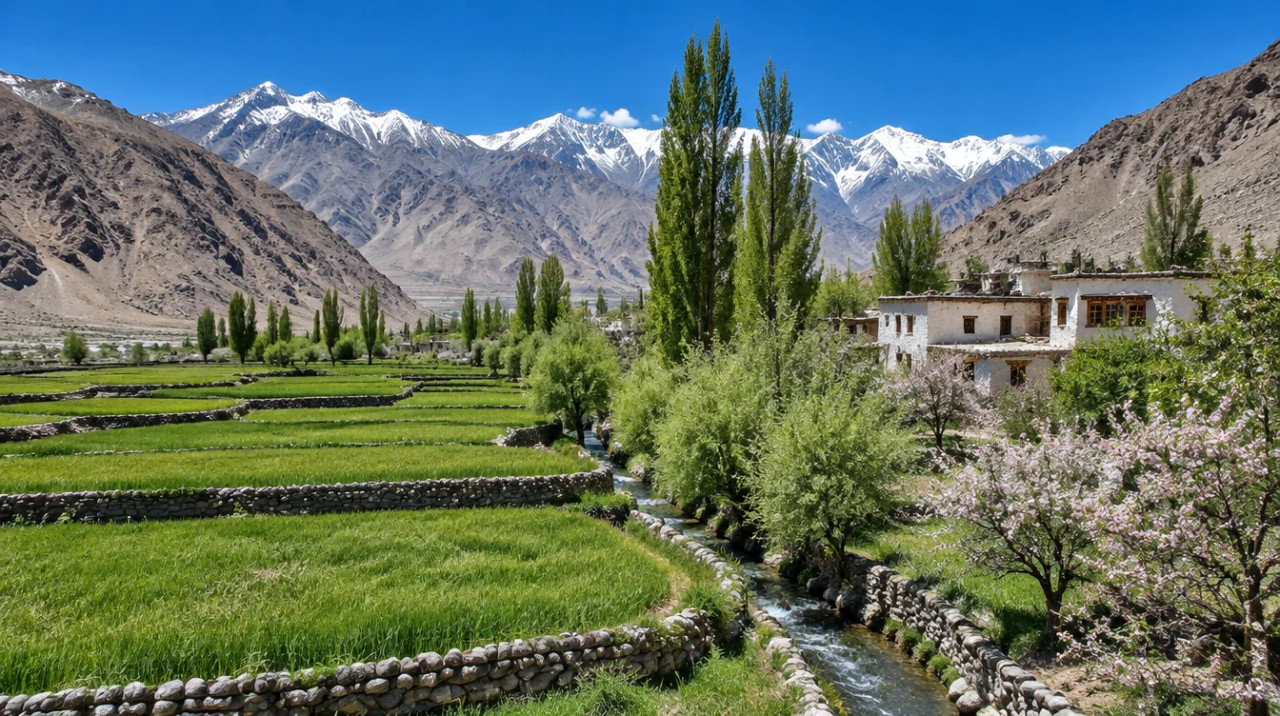
State guide
Buying Land in Ladakh
Eight new districts, an unsettled law on outside buyers, nautor regularisation and the Zojila and Shinkun La tunnels: what to check first.
8 (2026)
Districts
250
Revenue villages
2,300–5,000 m
Altitude
17 of 18
Groundwater units safe
UT land record — Ladakh
Rev. 2026 · Farmland India desk
Status
Union Territory without a legislature since 31 October 2019, administered by a Lieutenant Governor, with elected Autonomous Hill Development Councils (LAHDC) in Leh and Kargil
Districts
Eight: Leh and Kargil, five created on 27 April 2026 (Nubra, Sham, Changthang, Zanskar, Drass) and Sankoo, notified in October 2026
Revenue units
250 revenue villages in the April 2026 notification; tehsils raised from 15 to 32 in July 2026 and further reorganised in October
Land records
Jamabandi (record of rights), fard (certified extract) and girdawari (crop inspection) kept by the patwari; 18 services on the Ladakh Land Records Web GIS Portal (landrecords.ladakh.gov.in) since December 2025
Governing law
Jammu and Kashmir Land Revenue Act, Samvat 1996, as applied to Ladakh by the J&K Reorganisation Act, 2019; the October 2020 J&K land orders were not extended to Ladakh
Outside buyers
Legal position for agricultural land is unsettled; take local legal advice and check with the Deputy Commissioner and the hill council before any deal
Stamp duty
Rate: ask the sub-registrar before you budget
Registration
Deeds through NGDRS at the sub-registrar office; 14 registration offices (2 registrars, 12 sub-registrars) when NGDRS went live in 2022
Ladakh — land purchase legal rules
Ladakh is the hardest place in the country to give a straight answer about land. It is a Union Territory with no legislature, more than 97% of its people belong to Scheduled Tribes, and the rules on whether an outsider can buy land have not been settled since 2019. It applies to every district page in Ladakh.
Where the law stands: Ladakh became a Union Territory on 31 October 2019, carrying over the land laws of the former state of Jammu and Kashmir, including the Jammu and Kashmir Land Revenue Act, Samvat 1996, which still governs tehsils, revenue villages and records. When the Centre rewrote J&K’s land laws in October 2020, repealing a dozen Acts and letting any Indian citizen buy non-agricultural land in J&K, those orders were not extended to Ladakh (The Kashmir Walla, 27 October 2020). Ask the Deputy Commissioner’s office in writing which of the older J&K restrictions on transferring land to outsiders still apply in Ladakh today, and how the sub-registrar applies them.
Outside buyers and farmland: The legal position for a buyer from outside Ladakh who wants agricultural land is unsettled. Do not rely on a seller or an intermediary for a legal conclusion. Before you pay anything, take advice from a lawyer practising in Leh or Kargil, and ask the Deputy Commissioner’s office and the hill council of the district in writing whether the transfer can be registered and mutated in your name.
The 2025 regulations: In June 2025 the Centre notified four regulations for Ladakh: an 85% reservation in jobs, domicile rules for civil service posts, official languages, and changes to the hill councils. They deal with jobs, languages and councils, not land. Reports at the time noted that they place no specific restriction on outsiders owning land, and that the demand for Sixth Schedule protection, made by a population that is more than 97% Scheduled Tribe, remained open (Scroll, 9 June 2025). The absence of a new rule is not the same as permission.
Talks on safeguards: Local bodies from Leh and Kargil have been negotiating with the Union Home Ministry for constitutional safeguards over land, jobs and culture. A special provision under a new Article 371(K) was under discussion in October 2026, but no draft had been published and it would need a constitutional amendment (Business Standard, 23 October 2026). Any settlement could change who may buy land, so check the position again before you sign.
Nautor land: Nautor is state land that has been brought under cultivation by a private occupant. On 4 September 2026 the Ladakh Autonomous Hill Development Council (Nautor Regularisation) Rules, 2026 were approved: occupants who were in possession before 27 October 2020 can be given proprietary rights over up to 10 acres, with larger areas offered on lease, and more than 60,000 acres are recorded as nautor (Kashmir Life, September 2026). Until a plot is regularised in the occupant’s name, the occupant has nothing he can lawfully sell you.
Industrial land is leased: Under the Ladakh Industrial Land Allotment Policy, 2025-35 (notified February 2025), industrial land is allotted on lease, initially for 30 years and extendable to 60, by lottery through district or UT-level single-window committees. All entrepreneurs are eligible, with preference for local applicants. It is the one formal route by which an outside business can secure land in Ladakh.
NRI and OCI buyers: Under the RBI Master Direction on immovable property, NRIs and OCIs may not acquire agricultural land, a farmhouse or plantation property anywhere in India except by inheritance. Our NRI guide explains the options.
- UT since 2019
- 2020 J&K land orders not extended
- Outsider purchase unsettled
- Nautor Rules 2026
- Take local legal advice
UT overview
Ladakh — from the Indus valley to the Changthang plateau
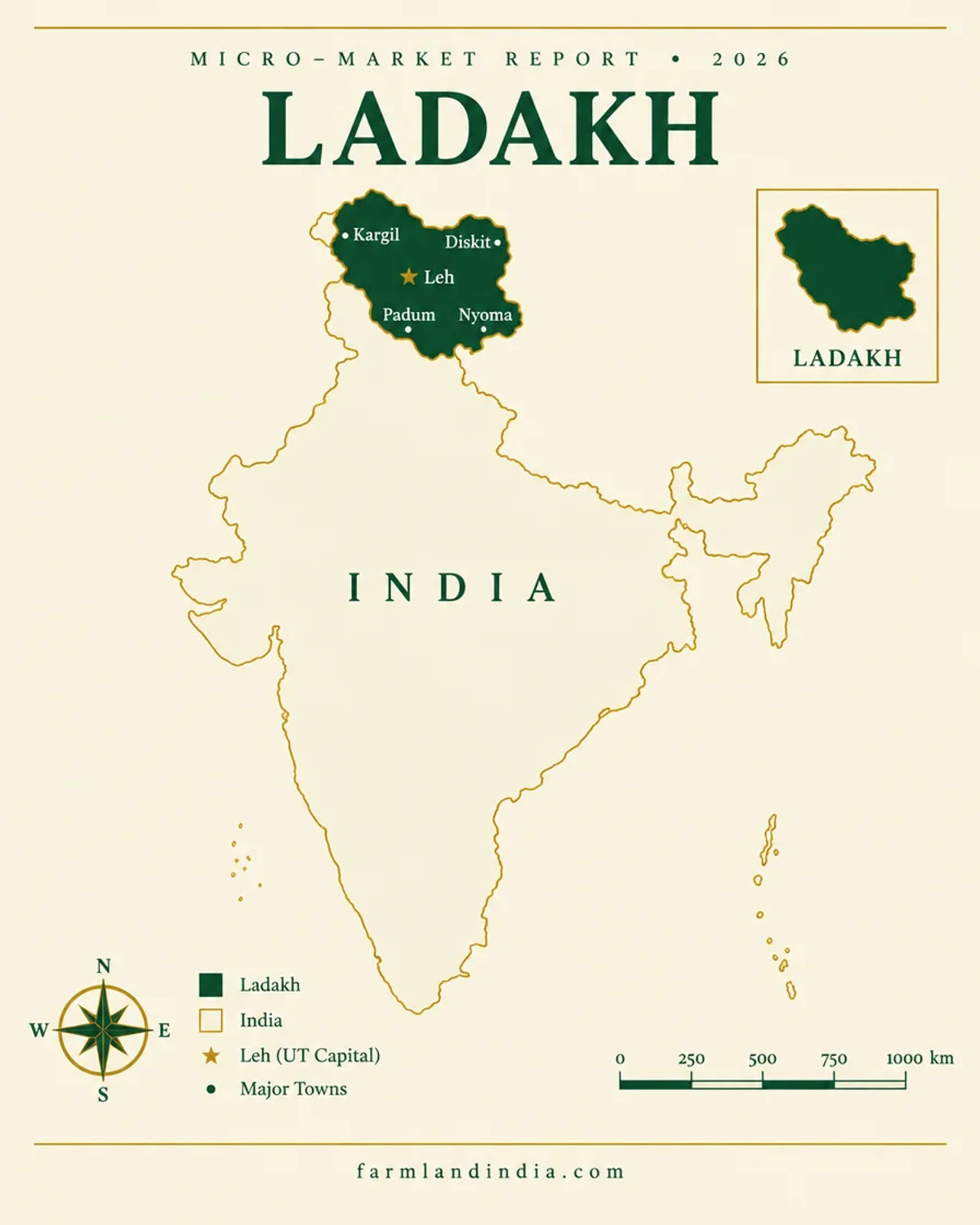
Ladakh is a high cold desert between the Karakoram and the Great Himalaya, with villages at altitudes from about 2,300 m to 5,000 m. The old Leh district alone covered about 45,100 sq km, which made it one of the largest districts in India, and Leh town is 434 km by road from Srinagar and 474 km from Manali (Leh district administration[6]). People live in the valleys of the Indus, the Shyok, the Suru and the Zanskar, where glacier melt is led through stone channels onto terraced fields. The 2011 Census counted about 2.74 lakh people across the old Leh and Kargil districts, and more than 97% of them belong to Scheduled Tribes. Leh is largely Buddhist; Kargil is largely Shia Muslim; both have their own elected hill councils.
The map changed in 2026. Five new districts, Nubra, Sham and Changthang from Leh and Zanskar and Drass from Kargil, were notified on 27 April 2026 (UT Ladakh, April 2026[2]), and Sankoo was carved out of Kargil in October (Deccan Chronicle, 16 October 2026[9]). Tehsils were reorganised so that every revenue village now sits in a single tehsil and every tehsil in a single district (UT Ladakh, July 2026[3]). Land records, registration offices and hill councils for the new districts are still being set up, so a buyer may find that the office responsible for a village has changed within the last year.
There is very little land here, and very little of it is for sale. Farming is limited to irrigated oases below the snowline: barley and wheat, apricot and apple orchards, vegetables in greenhouses, fodder, and pashmina goats on the Changthang plateau. Demand comes from three directions: local families buying from each other, hotels and homestays on the tourist circuits around Leh, Nubra and Pangong, and government projects such as the 13 GW renewable energy park planned at Pang. Buyers from Himachal or the plains often compare Ladakh with Himachal Pradesh, which has its own strict rules on non-agriculturists.
Before price, before views and before roads, settle whether you can lawfully hold the land at all. In Ladakh that question has no settled answer for outsiders, and the burden of finding out falls on the buyer.
- 8 districts
- 250 revenue villages
- Capital: Leh
- 2,300–5,000 m
- Over 97% Scheduled Tribe
Market bands
Reported cost reference points — Ladakh
The table lists the cost items for Ladakh; ask the sub-registrar for current farmland rates.
| Item | Scope | Reported figure* | Source |
|---|---|---|---|
| Stamp duty | Conveyance (sale deed) | Ask the sub-registrar | Rate from the sub-registrar |
| Registration | Sale deed through NGDRS | Fee: ask the sub-registrar | Reach Ladakh, 12 March 2022[14] |
| Industrial land | Lease under the 2025-35 policy | Premium set by the policy schedule; land leased, not sold | UT Ladakh, February 2025[1] |
| Nautor land | Regularisation of occupied state land | Proprietary rights up to 10 acres for eligible occupants; larger areas on lease | Kashmir Life, September 2026[8] |
| Farmland price series | UT or district level | None published | Not published |
*No newspaper or official source publishes a farmland price series for Ladakh or any of its districts, and open-market sales of farmland are rare. Ask the sub-registrar what valuation is used for duty in the village, look at registered deeds for nearby plots, and treat any quoted rate per kanal with suspicion until you have seen the deed it comes from.
Transaction costs
Stamp duty & registration in Ladakh
14
Registration offices
Two registrars and 12 sub-registrars when NGDRS went live in March 2022
18
Online land record services
On the Web GIS portal launched on 29 December 2025
—
Stamp duty rate
Ask at the sub-registrar
Rates published for Jammu and Kashmir do not automatically apply to Ladakh, which has been a separate Union Territory since 2019; ask the sub-registrar for the rate and the valuation basis on the day you register. Documents are registered through the National Generic Document Registration System (NGDRS), which the Department of Land Resources launched in Ladakh in March 2022, when the UT had 14 registration offices: two registrars and 12 sub-registrars (Reach Ladakh, 12 March 2022[14]). Expect new sub-registrar arrangements as the 2026 districts get their own offices. Registration is only half the job: the sale must also be entered as a mutation in the jamabandi by the tehsil, and in Ladakh that step is where questions about the buyer’s eligibility are most likely to surface. Do not treat a registered deed as proof that the land is yours until the mutation is attested and the fard shows your name.
Connectivity
How Ladakh connects: road, rail and air
Two highways over high passes, a year-round airport at Leh and no railway yet.
🚗 By road
✈️ By air
🚆 By rail
❄️ Seasons decide access
Distance in Ladakh is measured in passes, not kilometres. The Zojila on the Srinagar road and the passes on the Manali road close for weeks or months each winter, and villages in Zanskar and Changthang can be cut off by snow. That shapes everything from when you can inspect a plot to when you can build on it. The two big works under way, the Zojila tunnel on NH-1 and the Shinkun La tunnel on the Zanskar road, are meant to make these links usable all year (Deccan Chronicle, June 2026[10]). Until they open, check whether the land you are looking at can actually be reached in January.
Growth catalysts
Upcoming infrastructure & developments
Status as of November 2026, with the date and source of the latest report for each item.
02Tunnels under construction
Zojila and Shinkun La
06Catalysts
Agriculture & terrain
Soil, crops & water across Ladakh
Irrigated oases in a cold desert: barley, apricots, fodder and pashmina pasture.
Indus and Shyok valleys
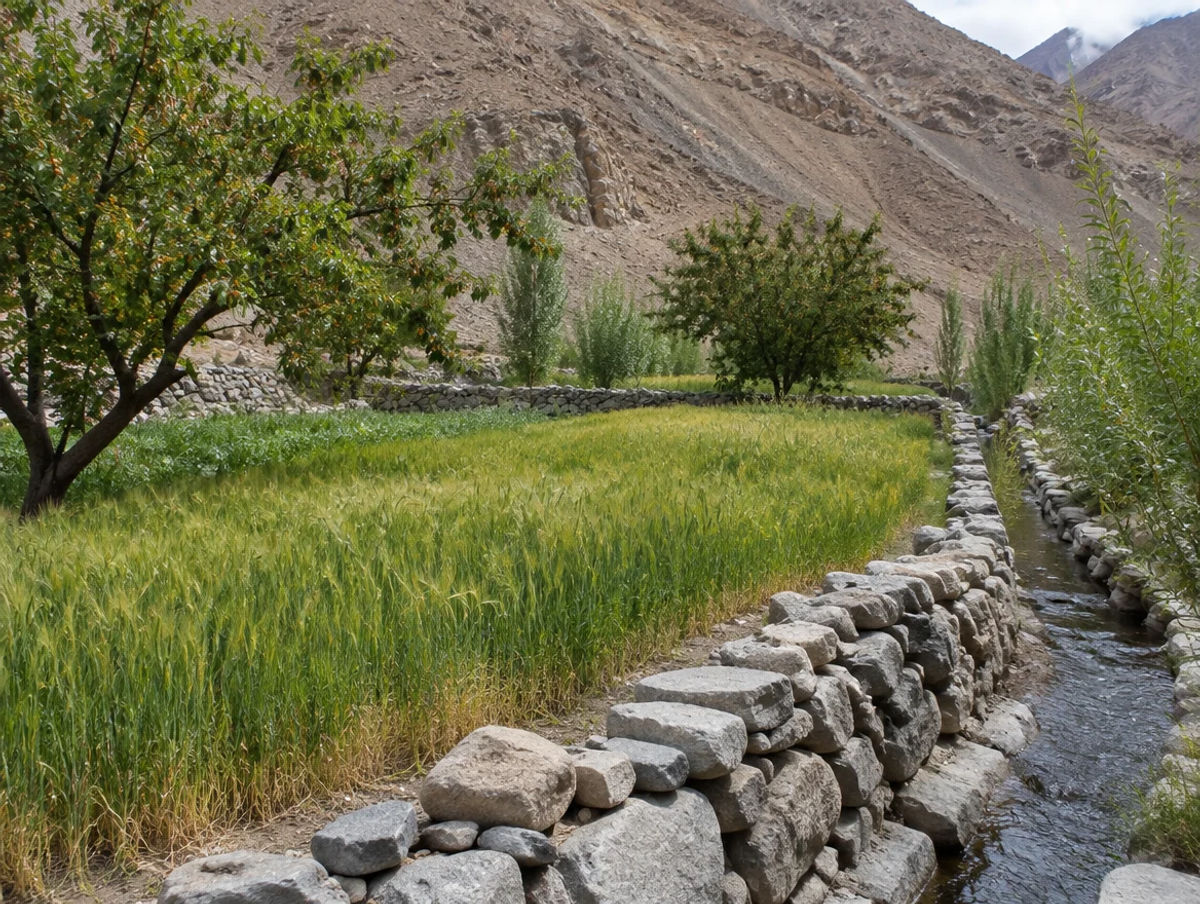
Leh, Sham and Nubra farm the terraces and alluvial fans along the Indus and the Shyok. Fields are small, walled with dry stone and watered by channels fed from side streams and glaciers. Barley and wheat are the staples, with peas, potatoes and fodder, apricot and apple orchards in the lower and warmer villages, and sea-buckthorn along the rivers. Polythene greenhouses now extend the vegetable season around Leh.
- Barley, wheat, fodder
- Apricot and apple
- Greenhouse vegetables
Suru, Drass and Zanskar
Kargil, Sankoo, Drass and Zanskar sit on the western, snowier side. The Suru valley and Kargil are known for apricots; Drass, among the coldest inhabited places in India, is meadow and fodder country; and Zanskar grows barley and peas in a short single season and is snowbound for months. Holdings are small and almost entirely family land.
- Apricot orchards
- Hay and fodder
- Single short season
Changthang plateau
The high plateau south-east of Leh, around Nyoma, Hanle and the Tso Moriri and Pangong lakes, is pasture rather than farmland. Herding families raise pashmina goats, sheep and yak on common grazing land. This is also where the largest solar and renewable projects are planned, which puts state land and pasture under new pressure.
- Pashmina goats and yak
- Common grazing land
- Renewable energy sites
Groundwater
Ladakh’s groundwater is assessed in 18 units. In the 2025 national compilation, 17 were rated safe and one semi-critical (Kashmir Life, 3 August 2026[13]). That figure says little about a particular plot: most farming depends on surface channels fed by snow and glaciers, and a dry winter shows up as a short summer. Ask how the field is irrigated, from which channel, and what share of water the village grants it, before you look at anything else.
Apricots
Apricots are Ladakh’s best-known crop. In 2019 about 2,303 hectares were under apricot across Leh and Kargil, and Kargil’s horticulture department put production at about 11,067 tonnes a year in 2022. Fresh apricots could not be sent out of Ladakh at the time because of a codling moth quarantine, so most of the crop left as dried fruit (The Tribune, 3 May 2022[15]).
Land use
Cultivated land is a thin green line along the rivers, and every irrigated field carries a share of water fixed by custom. A plot without a recognised water share is effectively dry land. Much of the rest is state land, common pasture or nautor, which is why land records and the patwari’s knowledge of the village matter more here than almost anywhere else in India.
At a glance
Ladakh’s eight districts side by side
| District | Headquarters | Carved from | Revenue villages | Note |
|---|---|---|---|---|
| Leh | Leh | Remaining Leh district | 44 | UT headquarters; tourism and services; Indus valley farms |
| Nubra | Diskit | Leh | 30 | Shyok and Nubra valleys; sea-buckthorn; tourism on the Khardung La route |
| Sham | Khaltse | Leh | 27 | Lower Indus; apricot villages; on the Srinagar–Leh highway |
| Changthang | Nyoma | Leh | 24 | High plateau; pashmina herding; renewable energy sites |
| Kargil | Kargil | Remaining Kargil district | 80 | Second town of Ladakh; apricots; Sankoo since taken out |
| Zanskar | Padum | Kargil | 26 | Remote valley; Shinkun La tunnel road |
| Drass | Drass-Ranbirpura | Kargil | 19 | Meadows; first stop after the Zojila tunnel |
| Sankoo | Sankoo | Kargil | Not stated | Suru valley; four tehsils; created October 2026 |
Revenue village counts are from the April 2026 notification (UT Ladakh[2]); Kargil’s count was reduced when Sankoo was created in October. No source publishes a farmland price series for any district. For records in neighbouring Jammu and Kashmir, which still share the same jamabandi and fard system, see our J&K land records guide.
Farmland India view
Why investors look at Ladakh
New districts, new tunnels and tourism, set against an unsettled law on who can own land.
New districts need land
Six new headquarters, at Diskit, Khaltse, Nyoma, Padum, Drass and Sankoo, need offices, housing, schools and markets. The first and surest demand is from government departments themselves, followed by local traders and service businesses. Land close to a headquarters town, with a road and a water share, is the type most likely to gain.
Tunnels change the calendar
The Zojila tunnel, due around 2028, and the Shinkun La tunnel would turn Drass, Kargil and Zanskar from seasonal into year-round destinations. Tourism and trade follow access. But a tunnel is a reason to watch a valley, not a reason to buy before you know whether the law lets you hold the land.
Tourism is the real market
Homestays, guesthouses and camps around Leh, Nubra, Pangong and Tso Moriri drive most private demand for land. Many such businesses are run by local families on their own land, and leasing from them is often the only practical arrangement for an outsider. A lease drafted by a local lawyer and recorded properly is safer than any informal purchase.
Industry is lease-only
The 2025-35 Industrial Land Allotment Policy gives land on 30-year leases, extendable to 60, with preference to local entrepreneurs. Food processing, apricot and sea-buckthorn products, and services for the renewable energy projects are the obvious fits.
The law may move
Talks on constitutional safeguards for Ladakh were still going on in late 2026. Whatever emerges is likely to firm up local control over land rather than open it. Anyone planning a long-term holding should price in that the rules could become stricter.
Confirm in writing that the transfer can be registered and mutated in your name, then check the jamabandi, the fard, the water share and the land class before you pay a token amount.
STRAIGHT TALK
Risks & challenges in Ladakh
What can undo a land purchase in Ladakh
No settled rule for outsiders
The October 2020 J&K land orders did not extend to Ladakh, the 2025 regulations did not deal with land, and constitutional talks were unfinished in late 2026. A sale that a local intermediary says is “no problem” may fail at registration or mutation, or be challenged later. Get a written view from a local lawyer and the district administration first.
Benami and proxy deals
Buying in the name of a local resident, taking a power of attorney, or signing an “agreement to sell” that is never registered are the usual workarounds. None of them gives you title, and all of them leave you dependent on someone else’s goodwill and heirs.
State land and nautor
Much land that looks private is state land under cultivation. Under the 2026 rules only eligible occupants in possession before 27 October 2020 can be regularised, and only up to 10 acres as owners. Do not pay for nautor that has not been regularised in the seller’s name.
Water rights
A field without its customary water share is close to worthless. Water is allotted by village custom and channel, not by the sale deed. Ask the village and the patwari how much water the plot gets and whether the sale carries it.
Records in transition
Districts, tehsils and revenue villages were all redrawn in 2026, and digitisation is still going on village by village. Check which tehsil now holds the village’s record, and ask for a fresh fard rather than relying on an old one.
Defence and border areas
Large areas near the Line of Actual Control and the Line of Control carry military and security restrictions, and some need permits even to visit. Ask the district administration whether the village is in a restricted or strategic area.
Climate and hazards
Flash floods and cloudbursts, glacial lake outbursts, landslides and heavy snow are real risks; Leh was badly hit by a cloudburst in 2010. Avoid fans and channels below side valleys, and look at where water ran in past floods before choosing a site.
Who to contact
Local revenue & registration offices
Land administration in Ladakh runs through the UT Revenue Department in Leh and the Deputy Commissioner of each district, who also serves as chief executive officer of the district’s hill council. In each revenue village the patwari keeps the jamabandi, the girdawari and the village map and issues the fard. Each tehsil is headed by a Tehsildar or Naib Tehsildar, who attests mutations and decides boundary questions; since July 2026 a Naib Tehsildar in charge of a tehsil holds the powers of an Assistant Collector Class I (UT Ladakh, July 2026[3]). Deeds are registered at the sub-registrar office through NGDRS. The Ladakh Autonomous Hill Development Councils in Leh and Kargil, and the new council for Sankoo, deal with land use and the allotment of state land, and councils for the other new districts are planned. The new districts were still setting up offices in late 2026, so confirm which Deputy Commissioner, tehsil and sub-registrar now cover your village before you visit. Records can be checked on the Ladakh Land Records Web GIS Portal, and the district websites (leh.nic.in and kargil.nic.in) list officers and tehsils.
COMMON QUESTIONS
Frequently asked questions
Everything buyers, NRIs and investors ask before their first reviewed farmland purchase in Ladakh.
Visit full wiki01 of 04
Can someone from outside Ladakh buy agricultural land there?
The legal position is unsettled. The 2020 orders that opened land in Jammu and Kashmir were not extended to Ladakh, and the 2025 regulations dealt with jobs and councils, not land. Take advice from a local lawyer and ask the Deputy Commissioner and the hill council in writing before paying anything.
02 of 04
Can NRIs or OCIs buy farmland in Ladakh?
No. Under RBI rules, NRIs and OCIs cannot acquire agricultural land, farmhouses or plantation property anywhere in India except by inheritance.
03 of 04
How do I check land records in Ladakh?
The Ladakh Land Records Web GIS Portal (landrecords.ladakh.gov.in), launched in December 2025, offers 18 services including the fard. Records are being digitised village by village, so also ask the patwari and tehsil for the current jamabandi.
04 of 04
What is nautor land, and can I buy it?
Nautor is state land brought under cultivation by an occupant. Under the 2026 rules, eligible occupants in possession before 27 October 2020 can get ownership of up to 10 acres. Until a plot is regularised in the seller’s name, it cannot be lawfully sold.
Transparency
Sources and references
Law and government
- [1]UT Ladakh: Industrial Land Allotment Policy, 2025-35 (February 2025) — cdnbbsr.s3waas.gov.in
- [2]UT Ladakh: five new districts notified (27 April 2026) — ladakh.gov.in
- [3]UT Ladakh: reorganisation of tehsils and revenue villages (July 2026) — ladakh.gov.in
- [4]UT Ladakh: Land Records Web GIS Portal launched (December 2025) — ladakh.gov.in
- [5]PMO: first blast of the Shinkun La tunnel (July 2024) — pmindia.gov.in
- [6]Leh district administration: about the district — leh.nic.in
News
- [7]The Kashmir Walla: Ladakh exempted from new J&K land laws (27 Oct 2020) — thekashmirwalla.com
- [8]Kashmir Life: Ladakh approves rules to regularise nautor land (Sep 2026) — kashmirlife.net
- [9]Deccan Chronicle: Sankoo created as a new district (16 Oct 2026) — deccanchronicle.com
- [10]Deccan Chronicle: Zojila tunnel breakthrough (Jun 2026) — deccanchronicle.com
- [11]Deccan Herald: Cabinet approves transmission line for 13 GW Ladakh project (18 Oct 2023) — deccanherald.com
- [12]Kashmir Life: survey for Bilaspur–Leh railway completed (17 Dec 2025) — kashmirlife.net
- [13]Kashmir Life: groundwater units in J&K and Ladakh (3 Aug 2026) — kashmirlife.net
- [14]Reach Ladakh: NGDRS launched in Ladakh (12 Mar 2022) — reachladakh.com
- [15]The Tribune: Ladakh eyes more apricot production (3 May 2022) — tribuneindia.com
Further reading
Data-currency note: sources were read in November 2026. District boundaries, offices, fees and infrastructure timelines in Ladakh are changing quickly; check the linked source and the district office before relying on any figure.
For developers
Ready to explore Ladakh farmland?
Browse reviewed projects and individual land parcels across Ladakh — or if you own land here, list it with platform review and reach serious buyers.