
District guide
Buying Land in Leh
The UT headquarters after the 2026 split: 44 villages, new rules for small municipal plots and land-use changes, and an unsettled law on outside buyers.
44 (Apr 2026)
Revenue villages
5 (Jul 2026)
Tehsils
Up to 2 kanals
Municipal plot, no prior approval
434 km
Distance to Srinagar
District land record — Leh
Rev. 2026 · Farmland India desk
Union Territory
Ladakh; Leh is the UT headquarters
Formation
One of the two original districts of Ladakh; Nubra, Sham and Changthang were carved out of it on 27 April 2026
Headquarters
Leh
Revenue units
44 revenue villages after the April 2026 split; 5 tehsils from July 2026
Key markets
Leh town, Choglamsar, Shey and Thiksey, Spituk and Phyang, Stok
Demand anchors
UT offices, tourism, the airport, army and air force establishments
Access
Leh airport all year; Srinagar–Leh (NH-1) and Manali–Leh roads, both closed by snow for part of the winter
Local units
Kanal and marla: 20 marla make a kanal and 8 kanals make an acre. Prices are discussed per kanal locally; ask for every figure per acre as well
Land records portal
Ladakh Land Records Web GIS Portal (landrecords.ladakh.gov.in), live since 29 December 2025 with 18 services (UT Ladakh[4])
Land law is state law. These rules are maintained on the Ladakh page and apply to every district within it.
Leh — land purchase legal rules
Ladakh is the hardest place in the country to give a straight answer about land. It is a Union Territory with no legislature, more than 97% of its people belong to Scheduled Tribes, and the rules on whether an outsider can buy land have not been settled since 2019. It applies to every district page in Ladakh.
Where the law stands: Ladakh became a Union Territory on 31 October 2019, carrying over the land laws of the former state of Jammu and Kashmir, including the Jammu and Kashmir Land Revenue Act, Samvat 1996, which still governs tehsils, revenue villages and records. When the Centre rewrote J&K’s land laws in October 2020, repealing a dozen Acts and letting any Indian citizen buy non-agricultural land in J&K, those orders were not extended to Ladakh (The Kashmir Walla, 27 October 2020). Ask the Deputy Commissioner’s office in writing which of the older J&K restrictions on transferring land to outsiders still apply in Ladakh today, and how the sub-registrar applies them.
Outside buyers and farmland: The legal position for a buyer from outside Ladakh who wants agricultural land is unsettled. Do not rely on a seller or an intermediary for a legal conclusion. Before you pay anything, take advice from a lawyer practising in Leh or Kargil, and ask the Deputy Commissioner’s office and the hill council of the district in writing whether the transfer can be registered and mutated in your name.
The 2025 regulations: In June 2025 the Centre notified four regulations for Ladakh: an 85% reservation in jobs, domicile rules for civil service posts, official languages, and changes to the hill councils. They deal with jobs, languages and councils, not land. Reports at the time noted that they place no specific restriction on outsiders owning land, and that the demand for Sixth Schedule protection, made by a population that is more than 97% Scheduled Tribe, remained open (Scroll, 9 June 2025). The absence of a new rule is not the same as permission.
Talks on safeguards: Local bodies from Leh and Kargil have been negotiating with the Union Home Ministry for constitutional safeguards over land, jobs and culture. A special provision under a new Article 371(K) was under discussion in October 2026, but no draft had been published and it would need a constitutional amendment (Business Standard, 23 October 2026). Any settlement could change who may buy land, so check the position again before you sign.
Nautor land: Nautor is state land that has been brought under cultivation by a private occupant. On 4 September 2026 the Ladakh Autonomous Hill Development Council (Nautor Regularisation) Rules, 2026 were approved: occupants who were in possession before 27 October 2020 can be given proprietary rights over up to 10 acres, with larger areas offered on lease, and more than 60,000 acres are recorded as nautor (Kashmir Life, September 2026). Until a plot is regularised in the occupant’s name, the occupant has nothing he can lawfully sell you.
Industrial land is leased: Under the Ladakh Industrial Land Allotment Policy, 2025-35 (notified February 2025), industrial land is allotted on lease, initially for 30 years and extendable to 60, by lottery through district or UT-level single-window committees. All entrepreneurs are eligible, with preference for local applicants. It is the one formal route by which an outside business can secure land in Ladakh.
NRI and OCI buyers: Under the RBI Master Direction on immovable property, NRIs and OCIs may not acquire agricultural land, a farmhouse or plantation property anywhere in India except by inheritance. Our NRI guide explains the options.
- UT since 2019
- 2020 J&K land orders not extended
- Outsider purchase unsettled
- Nautor Rules 2026
- Take local legal advice
Leh — district-specific notes
The Ladakh legal block above applies here in full: the legal position for an outsider buying agricultural land is unsettled, and nothing on this page is a legal conclusion. Leh adds a second layer, because it is the only part of Ladakh with real urban land demand, and the rules on using land for building changed twice in 2026.
⚠ On 7 July 2026 the Lieutenant Governor approved an interim land-use framework for Municipal Committee areas. Plots of up to two kanals inside municipal limits may be used for residential, commercial, industrial or mixed use without prior approval. Some uses still need approval: red and orange category industries in commercial areas, and in residential or mixed areas any industry, slaughterhouses, commercial animal rearing, quarries, storage of inflammable material, and burial grounds or cremation grounds (Daily Excelsior, 8 July 2026[5]). The framework applies only until master plans and zonal plans are notified; none has been, and Ladakh has no urban development authority yet. Building permission is regulated under the Ladakh Building Bye-laws, 2025.
⚠ Outside municipal limits, a change of land use for development works now goes to different levels by size. Since August 2026 the Divisional Commissioner decides plots over two and up to four kanals, the Chief Secretary decides land above four kanals and up to two acres, and the Lieutenant Governor still decides anything larger (Reach Ladakh, 3 August 2026[6]). Detailed operating guidelines were to follow from the Revenue Department, so ask the tehsil what the current procedure is before you buy farmland intending to build.
⚠ Leh lost three-quarters of its territory in April 2026, when Nubra, Sham and Changthang became districts. It kept 44 revenue villages (UT Ladakh, April 2026[2]) and was given five tehsils in July. If the village you are looking at was in Leh district before 2026, check that it still is.
⚠ Most land around Leh town is family land held for generations, and a good deal of the open ground is state land, army land or nautor. The 2026 nautor rules let eligible occupants in possession before 27 October 2020 seek ownership of up to 10 acres (Kashmir Life, September 2026[7]); until that is done, an occupant cannot sell.
NRI and OCI buyers cannot acquire agricultural land or a farmhouse in India except by inheritance; see our NRI guide.
- UT headquarters district
- Municipal plots up to 2 kanals
- CLU above 2 kanals needs approval
- No master plan notified
- Outside buyers: unsettled
District overview
Leh — the UT headquarters, the Indus valley and the gateway to the rest of Ladakh
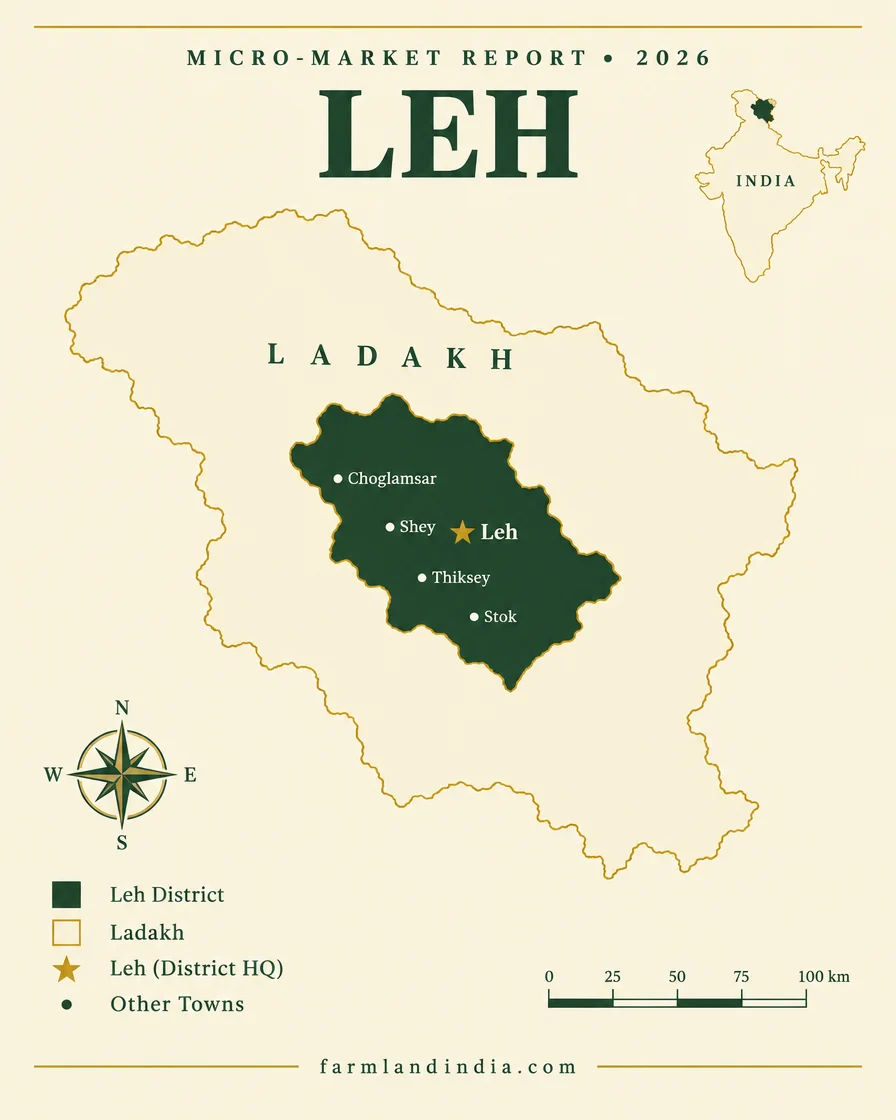
Leh is the headquarters of the Union Territory and its largest town, set on a side valley above the Indus at about 3,500 m. Before 2026 Leh district covered about 45,100 sq km, among the largest districts in India, at altitudes from about 2,300 m to 5,000 m; Leh town is 434 km by road from Srinagar and 474 km from Manali (Leh district administration[1]). Since 27 April 2026 the district is much smaller: Nubra to the north, Sham down the Indus to the west and Changthang to the south-east are now districts of their own, and Leh keeps 44 revenue villages around the town and the central Indus valley.
This is the one part of Ladakh with an urban land market. The UT secretariat, the hill council for Leh, the airport, army and air force establishments, and the tourist trade all concentrate here, and the town has grown out along the Indus towards Choglamsar, Shey and Thiksey on the Manali road and towards Spituk and Phyang on the Srinagar road. Demand comes mainly from local families building houses, guesthouses and shops, and from businesses serving tourism.
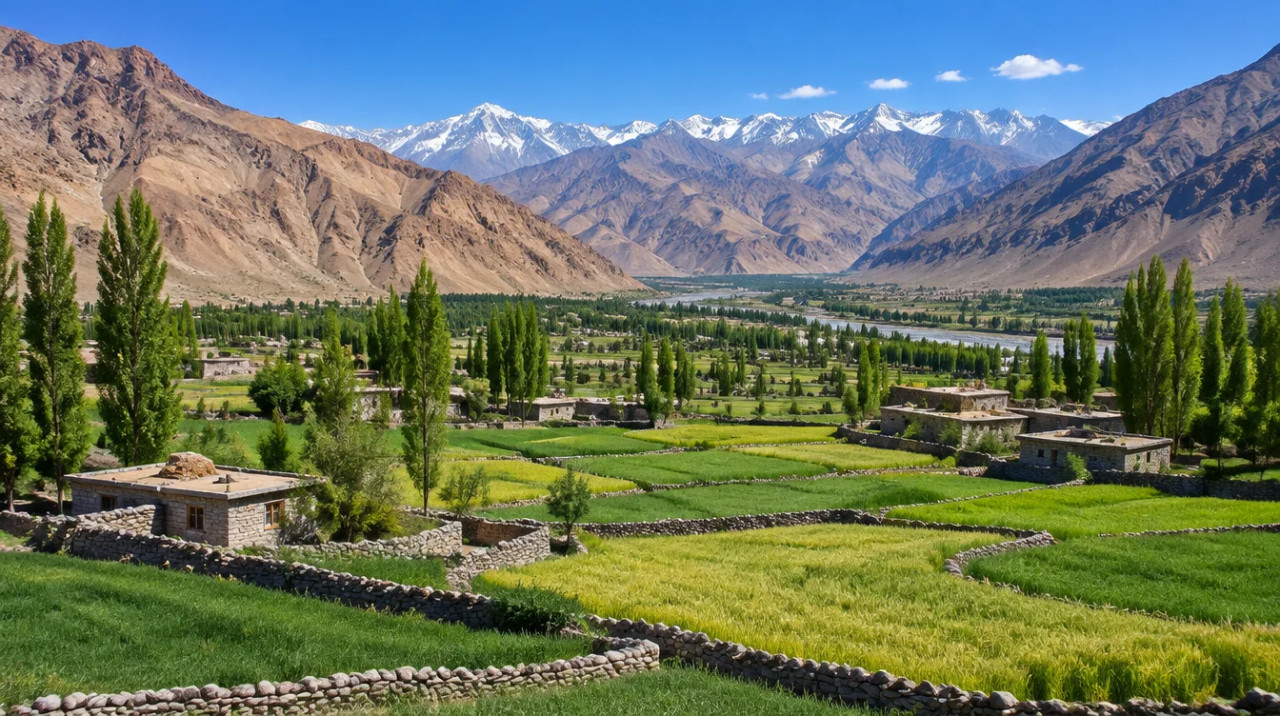
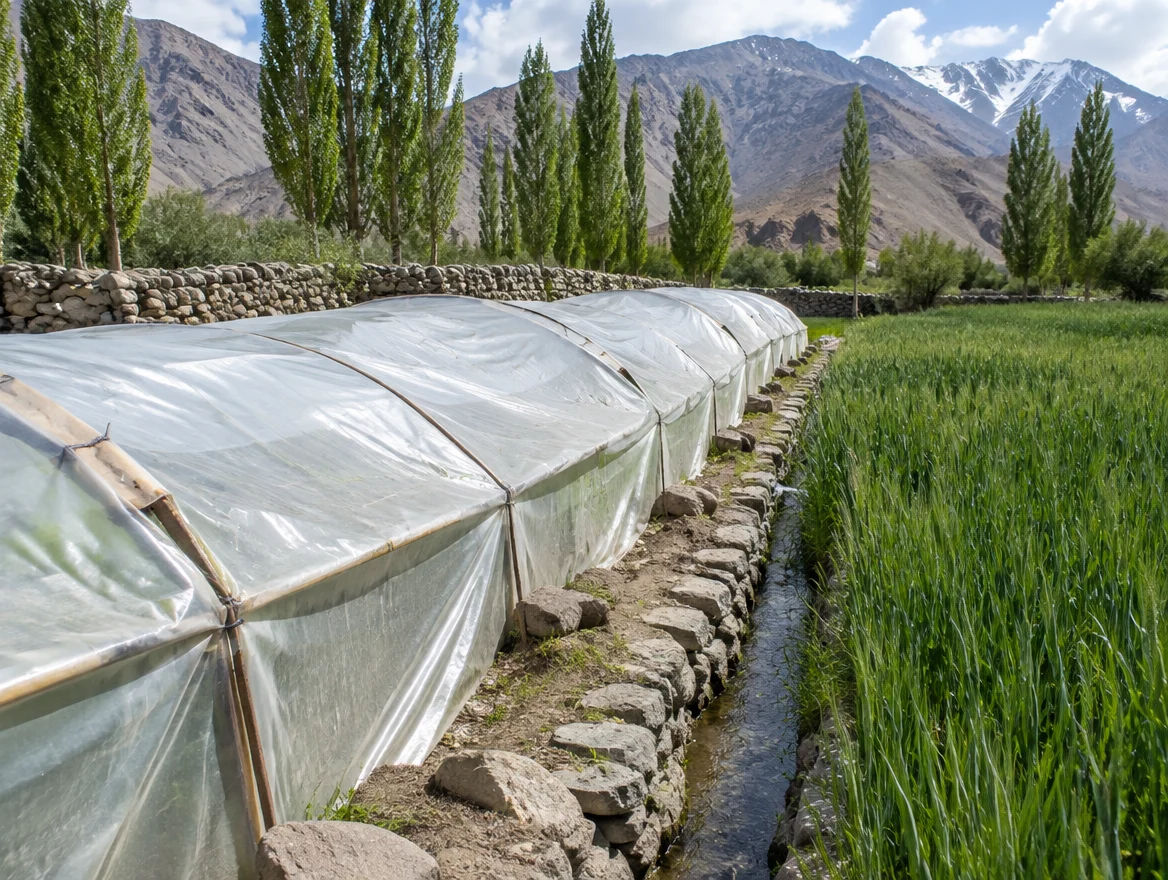
Farming survives in the villages around the town: barley and wheat on walled terraces, vegetables in polythene greenhouses that stretch the season, apricots and apples in the warmer spots, and lines of poplar and willow along the irrigation channels. Each field draws water from a channel by village custom, and the water share matters as much as the land itself.
For an outside buyer the important point is what Leh does not have. There is no notified master plan, no development authority, and no settled rule on whether a person from outside Ladakh can hold agricultural land. The interim framework of July 2026 makes small municipal plots easier to use, but it says nothing about who may own them.
Read this page with the Ladakh UT page, which sets out the legal position in full.
- UT headquarters
- Indus valley
- 44 revenue villages
- 5 tehsils
- Year-round airport
- Tourism hub
Transaction costs
Stamp duty & registration in Leh
2 kanals
Municipal plots
May be used for homes, shops or mixed use without prior approval (July 2026)
4 kanals
Divisional Commissioner
Decides change of land use outside municipal limits above 2 and up to 4 kanals
—
Stamp duty
Ask the sub-registrar for the rate in force.
This page does not quote a rate. Ask the sub-registrar in Leh. Deeds are registered through NGDRS, which went live in Ladakh in March 2022 (Reach Ladakh, March 2022[12]). For Leh the bigger cost question is often land use: within municipal limits, plots up to two kanals can now be built on without prior approval, while larger plots and anything outside the Municipal Committee need a change of land use from the Divisional Commissioner, the Chief Secretary or the Lieutenant Governor depending on size. Budget time as well as money for that approval, and check that the mutation follows the deed into the jamabandi.
Know the belt
What is moving prices in Leh
Where land changes hands around Leh, and what to check in each pocket.
Leh town
Municipal area
Old town, the market and the hotel and guesthouse belt. Land here is small, expensive and almost never sold to outsiders. The July 2026 interim framework covers plots up to two kanals within municipal limits.
Check: whether the plot is inside Municipal Committee limits, and the use permitted on it
Choglamsar, Shey and Thiksey
Indus valley, Manali road
The town’s growth belt along the Indus to the south-east, with institutions, housing and farmland mixed together. Flat land by the river is attractive but some of it lies in flood channels.
Check: flood history and the plot’s water share
Spituk and Phyang
Airport and Srinagar road
West of the town around the airport and on the road towards Sham. Defence land and airport limits shape what can be built.
Check: any defence or airport restriction on the plot
Stok and the left bank
Villages across the Indus
Quieter farming villages across the river, with orchards and terraced fields; homestays are the main commercial use.
Check: road access and the jamabandi entry for the field
Asking prices
Ask the sub-registrar for the valuation used in the village and look at registered deeds for nearby plots before agreeing to anything.
Connectivity
How Leh connects — road, rail and air
Leh is the hub: the airport, two highways and the roads into every other district start here.
🚗 By road
✈️ By air
🚆 By rail
Leh is reachable by air all year, which is why it holds most of Ladakh’s offices and businesses. Road access depends on the season: both highways cross high passes that close in winter. The Zojila tunnel on NH-1, whose two ends met in June 2026, will make the Srinagar road more reliable when it opens (Deccan Chronicle, June 2026[8]).
Growth catalysts
Upcoming infrastructure & developments
Status as of November 2026, with the date and source of the latest report.
01Open
05Catalysts
Agriculture & terrain
Soil, crops & water in Leh
Walled terraces, irrigation channels and greenhouses in a cold desert.
Crops and water
Barley and wheat are the traditional crops, with peas, potatoes, fodder and vegetables; apricots and apples grow in the warmer villages. Every field is irrigated from a channel fed by snow and glacier melt, and water is shared by village custom. Ladakh’s groundwater is assessed in 18 units, 17 of them safe and one semi-critical (Kashmir Life, August 2026[11]), but farms here depend on surface water first.
- Barley and wheat
- Greenhouse vegetables
- Apricot and apple
- Channel irrigation
- Fodder for winter
Season
There is one main growing season, from spring sowing to an autumn harvest. Winter is long and fields lie frozen, which is why greenhouses have spread around Leh.
Pressure on farmland
As the town spreads along the Indus, fields near the road are being turned into houses and guesthouses. Farmland next to built-up land often loses its water share as channels are blocked or diverted, so check the channel is still working.
At a glance
Leh vs. nearby districts
| District | Land and water | What links it to Leh |
|---|---|---|
| Nubra (north) | Shyok and Nubra valleys; sea-buckthorn, barley | Road over the Khardung La; district since April 2026 |
| Sham (west) | Lower Indus; apricot villages | Srinagar–Leh highway; district since April 2026 |
| Changthang (south-east) | High plateau pasture | Indus road to Nyoma; district since April 2026 |
| Kargil (west) | Suru valley; apricots | NH-1 via Sham |
Each of these districts has its own page. No source publishes comparable farmland prices for any of them.
Farmland India view
Why investors look at Leh
Five reasoned points for Leh, each tied to a source on this page.
The only real urban market
Leh holds the UT administration, the airport and most of the tourist trade, so demand for land here is steadier than anywhere else in Ladakh.
Small plots are easier to use
Since July 2026 municipal plots up to two kanals can be built on without prior approval, and CLU for larger rural plots is now decided below the Lieutenant Governor.
Leasing is often the realistic route
Most land is held by local families who rarely sell. For an outside business, a properly drafted and recorded lease is usually more workable than a purchase.
Projects bring services demand
The renewable energy park at Pang and new district offices across Ladakh will lean on Leh for services, housing and supplies.
Law first, location second
However good the plot, an outsider’s purchase of agricultural land rests on an unsettled legal position. Get that answered in writing first.
Confirm the jamabandi and fard, the attested mutation, the water share and whether the transfer can be registered in your name directly — these are not certified by Farmland India’s review.
STRAIGHT TALK
Risks & challenges in Leh
District-specific risks. Read the Ladakh UT page for the general risks on outside buyers, nautor land and records.
Outside buyers
The legal position for an outsider buying agricultural land is unsettled. Get a written view from a lawyer in Leh and ask the Deputy Commissioner whether the deed can be registered and mutated in your name.
Proxy and benami deals
Buying in a local person’s name, on a power of attorney, or through an unregistered agreement gives you no title and can be undone.
State, army and nautor land
Open ground near Leh may be state land, defence land or unregularised nautor. Check the land class in the jamabandi and match it on the village map.
Flood channels
Leh was struck by a cloudburst and flash floods in August 2010. Avoid alluvial fans and dry channels below side valleys, however flat and convenient they look.
Water share
A field without its water share is close to worthless. Ask the village and the patwari which channel feeds it and whether the sale carries the right.
Records in transition
The district was split in April 2026 and tehsils were redrawn in July. Ask for a fresh fard from the tehsil that now holds the village record.
Who to contact
Local revenue & planning offices
Land matters in Leh run through the Deputy Commissioner, Leh, who also serves as chief executive officer of the Ladakh Autonomous Hill Development Council, Leh. The district has five tehsils since July 2026, each headed by a Tehsildar or a Naib Tehsildar with the powers of an Assistant Collector Class I (UT Ladakh, July 2026[3]). In each village the patwari keeps the jamabandi, girdawari and village map and issues the fard. Deeds are registered at the sub-registrar office through NGDRS. Change of land use outside municipal limits goes to the Divisional Commissioner, the Chief Secretary or the Lieutenant Governor depending on the plot size. The UT Revenue Department and the district website (leh.nic.in) list current officers.
COMMON QUESTIONS
Frequently asked questions
Everything buyers, NRIs and investors ask before their first reviewed farmland purchase in Leh.
Visit full wiki01 of 04
Can someone from outside Ladakh buy agricultural land in Leh?
The legal position is unsettled. Take advice from a lawyer in Leh and ask the Deputy Commissioner in writing whether the deed can be registered and mutated in your name before paying anything.
02 of 04
Can I build on a small plot in Leh town without permission?
Since July 2026, plots up to two kanals within Municipal Committee limits may be used for residential, commercial or mixed use without prior approval, with listed exceptions. Building permission under the 2025 bye-laws still applies.
03 of 04
Who approves change of land use outside the town?
Since August 2026 the Divisional Commissioner decides plots over two and up to four kanals, the Chief Secretary up to two acres, and the Lieutenant Governor anything larger.
04 of 04
Is Leh still a large district?
No. Nubra, Sham and Changthang were carved out on 27 April 2026, leaving Leh with 44 revenue villages around the town and the central Indus valley.
Transparency
Sources and references
Government
- [1]Leh district administration: about the district — leh.nic.in
- [2]UT Ladakh: five new districts notified (27 Apr 2026) — ladakh.gov.in
- [3]UT Ladakh: reorganisation of tehsils and revenue villages (Jul 2026) — ladakh.gov.in
- [4]UT Ladakh: Land Records Web GIS Portal launched (Dec 2025) — ladakh.gov.in
News
- [5]Daily Excelsior: interim land-use norms for municipal areas (8 Jul 2026) — dailyexcelsior.com
- [6]Reach Ladakh: change-of-land-use approvals decentralised (3 Aug 2026) — reachladakh.com
- [7]Kashmir Life: rules to regularise nautor land (Sep 2026) — kashmirlife.net
- [8]Deccan Chronicle: Zojila tunnel breakthrough (Jun 2026) — deccanchronicle.com
- [9]Deccan Herald: transmission line for 13 GW Ladakh project (18 Oct 2023) — deccanherald.com
- [10]Kashmir Life: survey for Bilaspur–Leh railway completed (17 Dec 2025) — kashmirlife.net
- [11]Kashmir Life: groundwater units in J&K and Ladakh (3 Aug 2026) — kashmirlife.net
- [12]Reach Ladakh: NGDRS launched in Ladakh (12 Mar 2022) — reachladakh.com
Further reading
Project status, the benchmark valuation and land rules change often; check the linked source and the relevant office before relying on any figure.
For developers
Ready to explore Leh farmland?
Browse reviewed projects and individual land parcels across Leh — or if you own land here, list it with platform review and reach serious buyers.