
District guide
Buying Land in Zanskar
A new district in a remote valley: Padum as headquarters, 26 villages, the Shinkun La tunnel and NH-301, and an unsettled law on outside buyers.
27 April 2026
District created
26
Revenue villages
4 + Phey
Tehsils
4.1 km, under way
Shinkun La tunnel
District land record — Zanskar
Rev. 2026 · Farmland India desk
Union Territory
Formation
New district, carved out of Kargil on 27 April 2026
Headquarters
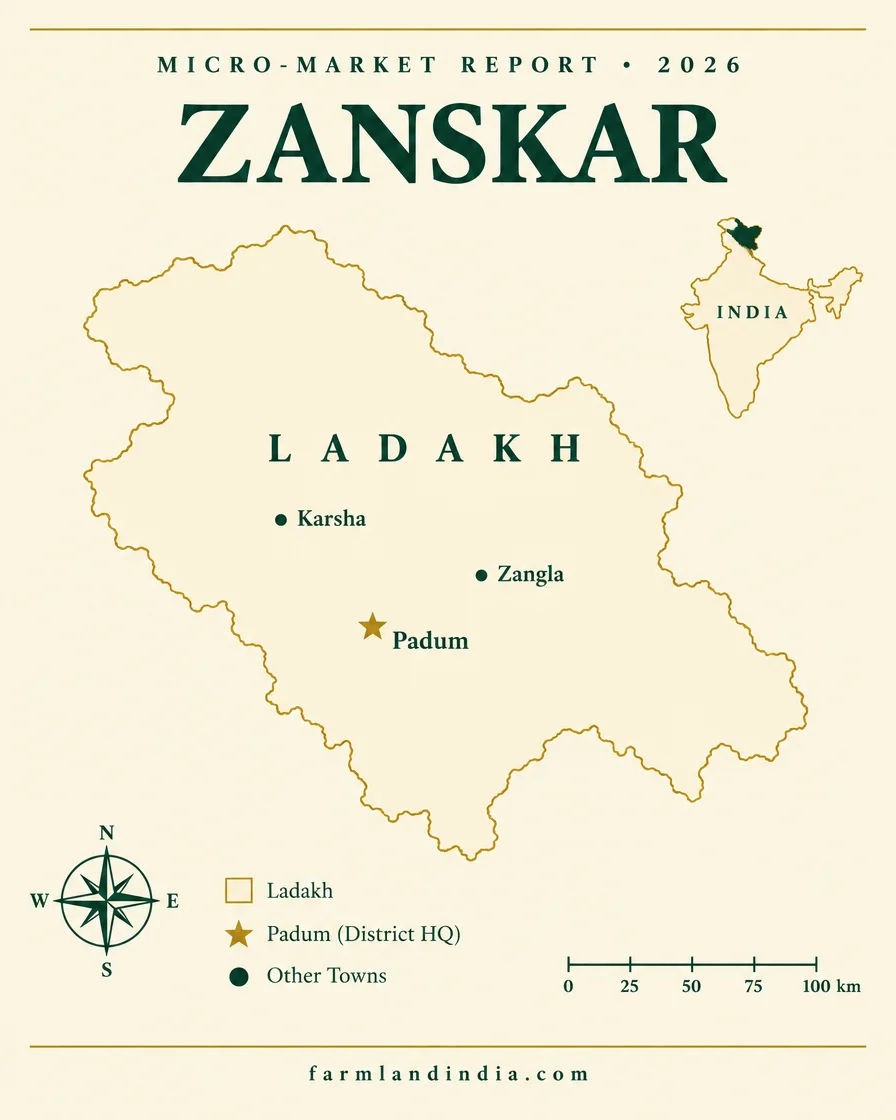
Padum
Revenue units
26 revenue villages (April 2026); 4 tehsils from July 2026, plus Phey tehsil from October 2026
Key places
Padum, Karsha, Zangla
Hill council
Hill council for the district planned; LAHDC Kargil covered the area before 2026
Access
Kargil–Zanskar road (NH-301) over the Pensi La; Nimu–Padum–Darcha road; snowbound for months
Local units
Kanal and marla: 20 marla make a kanal and 8 kanals make an acre. Prices are discussed per kanal locally; ask for every figure per acre as well
Land records portal
Ladakh Land Records Web GIS Portal (landrecords.ladakh.gov.in), live since 29 December 2025 with 18 services (UT Ladakh[6])
Land law is state law. These rules are maintained on the Ladakh page and apply to every district within it.
Zanskar — land purchase legal rules
Ladakh is the hardest place in the country to give a straight answer about land. It is a Union Territory with no legislature, more than 97% of its people belong to Scheduled Tribes, and the rules on whether an outsider can buy land have not been settled since 2019. It applies to every district page in Ladakh.
Where the law stands: Ladakh became a Union Territory on 31 October 2019, carrying over the land laws of the former state of Jammu and Kashmir, including the Jammu and Kashmir Land Revenue Act, Samvat 1996, which still governs tehsils, revenue villages and records. When the Centre rewrote J&K’s land laws in October 2020, repealing a dozen Acts and letting any Indian citizen buy non-agricultural land in J&K, those orders were not extended to Ladakh (The Kashmir Walla, 27 October 2020). Ask the Deputy Commissioner’s office in writing which of the older J&K restrictions on transferring land to outsiders still apply in Ladakh today, and how the sub-registrar applies them.
Outside buyers and farmland: The legal position for a buyer from outside Ladakh who wants agricultural land is unsettled. Do not rely on a seller or an intermediary for a legal conclusion. Before you pay anything, take advice from a lawyer practising in Leh or Kargil, and ask the Deputy Commissioner’s office and the hill council of the district in writing whether the transfer can be registered and mutated in your name.
The 2025 regulations: In June 2025 the Centre notified four regulations for Ladakh: an 85% reservation in jobs, domicile rules for civil service posts, official languages, and changes to the hill councils. They deal with jobs, languages and councils, not land. Reports at the time noted that they place no specific restriction on outsiders owning land, and that the demand for Sixth Schedule protection, made by a population that is more than 97% Scheduled Tribe, remained open (Scroll, 9 June 2025). The absence of a new rule is not the same as permission.
Talks on safeguards: Local bodies from Leh and Kargil have been negotiating with the Union Home Ministry for constitutional safeguards over land, jobs and culture. A special provision under a new Article 371(K) was under discussion in October 2026, but no draft had been published and it would need a constitutional amendment (Business Standard, 23 October 2026). Any settlement could change who may buy land, so check the position again before you sign.
Nautor land: Nautor is state land that has been brought under cultivation by a private occupant. On 4 September 2026 the Ladakh Autonomous Hill Development Council (Nautor Regularisation) Rules, 2026 were approved: occupants who were in possession before 27 October 2020 can be given proprietary rights over up to 10 acres, with larger areas offered on lease, and more than 60,000 acres are recorded as nautor (Kashmir Life, September 2026). Until a plot is regularised in the occupant’s name, the occupant has nothing he can lawfully sell you.
Industrial land is leased: Under the Ladakh Industrial Land Allotment Policy, 2025-35 (notified February 2025), industrial land is allotted on lease, initially for 30 years and extendable to 60, by lottery through district or UT-level single-window committees. All entrepreneurs are eligible, with preference for local applicants. It is the one formal route by which an outside business can secure land in Ladakh.
NRI and OCI buyers: Under the RBI Master Direction on immovable property, NRIs and OCIs may not acquire agricultural land, a farmhouse or plantation property anywhere in India except by inheritance. Our NRI guide explains the options.
- UT since 2019
- 2020 J&K land orders not extended
- Outsider purchase unsettled
- Nautor Rules 2026
- Take local legal advice
Zanskar — district-specific notes
The Ladakh legal block above applies here in full: whether a person from outside Ladakh can buy agricultural land is unsettled, and this page does not offer a legal conclusion. Zanskar adds a practical problem of its own: it is a new district, and its offices and records were still being set up in late 2026.
⚠ Zanskar was created on 27 April 2026 (UT Ladakh, April 2026[1]), with its headquarters at Padum. It was carved out of Kargil with 26 revenue villages (UT Ladakh) and given four tehsils in July 2026 (UT Ladakh, July 2026[2]); a fifth, Phey, was assigned to Zanskar in October (Deccan Chronicle, 16 October 2026[7]). Until the new offices are fully staffed, expect some files to sit with Kargil, and ask both offices if a record seems to be missing.
⚠ Outside Municipal Committee areas, a change of land use for development is decided by the Divisional Commissioner for plots over two and up to four kanals, by the Chief Secretary up to two acres, and by the Lieutenant Governor above that, under an order of August 2026 (Reach Ladakh, 3 August 2026[8]). Detailed guidelines were to follow, so ask the Deputy Commissioner’s office what the current procedure is before buying land you mean to build on.
⚠ Much of the cultivated land in Zanskar is family land, and much of the open land is state land, pasture or nautor (state land brought under cultivation by an occupant). Under the 2026 nautor rules only occupants in possession before 27 October 2020 can be given ownership, of up to 10 acres (Kashmir Life, September 2026[9]); unregularised nautor cannot be sold.
NRI and OCI buyers cannot acquire agricultural land or a farmhouse in India except by inheritance; see our NRI guide.
- New district, April 2026
- HQ Padum
- 26 revenue villages
- Shinkun La tunnel
- Outside buyers: unsettled
District overview
Zanskar — a remote valley that roads and a tunnel are about to open
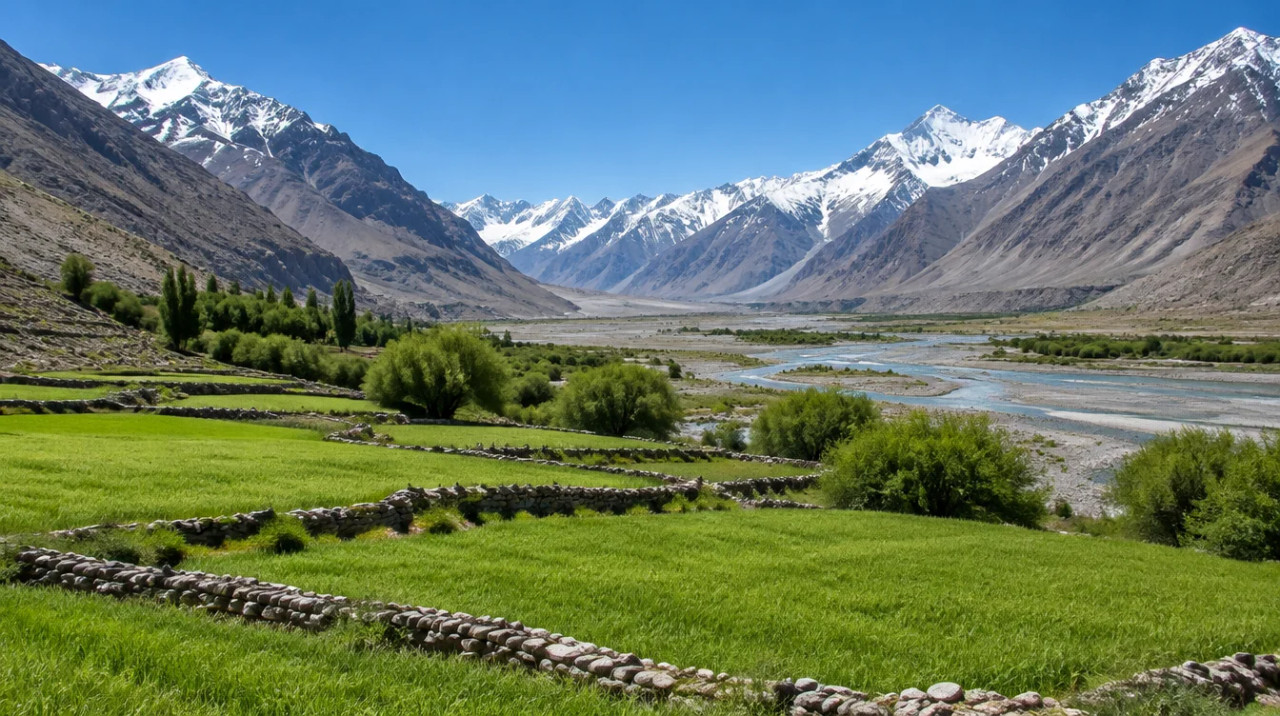
Zanskar is a high, wide valley south of Kargil, enclosed by the Great Himalaya and the Zanskar range and drained by the Stod and Lungnak rivers, which join near Padum to form the Zanskar river. For centuries it has been cut off for much of the winter, when snow closes the Pensi La on the road from Kargil. Villages such as Karsha, with its large monastery, and Zangla sit on fans and terraces around the central plain.
It became a district on 27 April 2026, carved out of Kargil with 26 revenue villages and its headquarters at Padum. Offices and records were being set up through 2026, and its area and population have not been published separately. A Deputy Commissioner was posted in April.
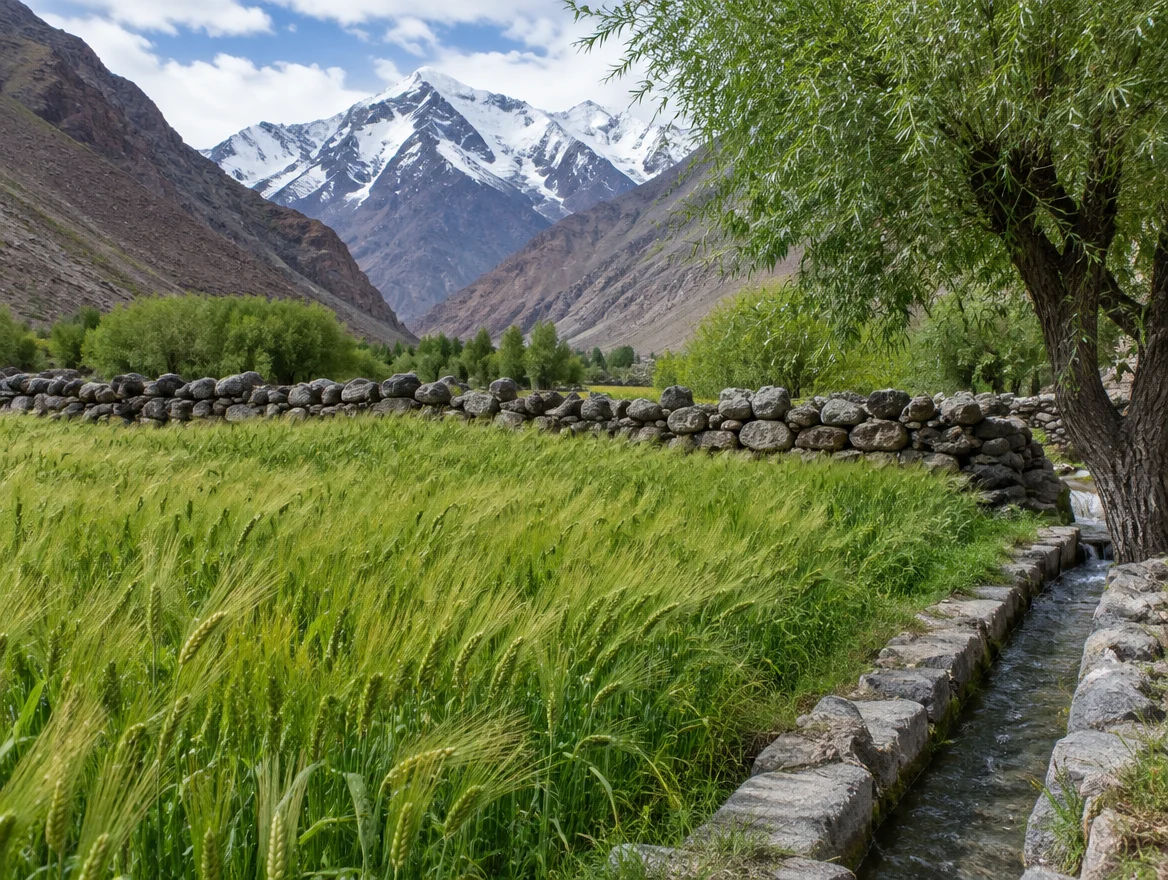
Farming is a single short season of barley, wheat and peas on walled fields watered by channels, with fodder cut and stored for the long winter. Land is held by families and almost never sold. Visitors come for the monasteries, trekking and, in winter, the frozen-river route, and homestays are the main commercial use of land.
Read this page with the Ladakh UT page, which sets out the legal position in full, and the Kargil and Leh pages for the parent districts.
- HQ Padum
- 26 revenue villages
- Barley and peas
- Snowbound winters
- NH-301
- Shinkun La tunnel
Transaction costs
Stamp duty & registration in Zanskar
New
District offices
Created April 2026; ask which sub-registrar now covers the village
4 kanals
Divisional Commissioner
Decides change of land use outside towns above 2 and up to 4 kanals
—
Stamp duty
Ask the sub-registrar.
No official farmland price series is published for Zanskar. Ask the sub-registrar for recent registered sale values in the village you are looking at. Deeds are registered through NGDRS at a sub-registrar office; Ladakh had 14 registration offices when NGDRS went live in 2022 (Reach Ladakh, March 2022[11]), before any of the new districts existed. Ask which office now registers deeds for Zanskar, and make sure the mutation is attested at the tehsil afterwards so that the jamabandi shows the new owner.
Know the belt
What is moving prices in Zanskar
The places in Zanskar where land matters most, and what to check in each.
Padum
District headquarters
The valley’s main town and now its district seat. New offices, staff housing and services will need land here first.
Check: which tehsil holds the record and the land class
Karsha
Monastery village
Across the valley from Padum, with a large monastery above the fields. Land near the monastery may belong to it.
Check: whether the land is private or monastery land
Zangla and the valley villages
Farming villages
Small farming villages on the Zanskar and its tributaries, reached by tracks; homestays are the main business.
Check: road access and the water share
Asking prices
Ask the sub-registrar for the valuation used in the village and compare registered deeds for nearby plots, if any exist.
Connectivity
How Zanskar connects — road, rail and air
Two roads link Zanskar to the outside; both are being improved, and a tunnel is under way.
🚗 By road
✈️ By air
🚆 By rail
NHIDCL lists eight packages on the Kargil–Zanskar road, three completed and five ongoing (NHIDCL, November 2025[5]). With the Shinkun La tunnel, Zanskar would get its first all-weather road link.
Growth catalysts
Upcoming infrastructure & developments
Status as of November 2026, with the date and source of the latest report.
01Open
03Catalysts
Agriculture & terrain
Soil, crops & water in Zanskar
One short season of barley and peas in a high, cold valley.
Crops and water
Barley, wheat and peas are sown in spring and harvested by early autumn, on walled fields watered by channels from the side streams. Hay and fodder are stored for a winter of six months or more. Across Ladakh, 17 of 18 groundwater assessment units were rated safe in 2025 (Kashmir Life, August 2026[10]), but farming here depends on snow-fed channels, not wells.
- Barley and wheat
- Peas
- Fodder
- Channel irrigation
- Single season
Long winters
Snow closes the passes for months. Any building or farm plan has to fit into a short summer.
At a glance
Zanskar vs. nearby districts
| District | Land and water | What links it to Zanskar |
|---|---|---|
| Kargil (north) | Suru valley; apricots | NH-301 over the Pensi La |
| Sankoo (north) | Suru valley fields | NH-301; district since October 2026 |
| Sham and Leh (north-east) | Indus valley | Nimu–Padum road |
| Lahaul, Himachal (south) | High valleys | Shinkun La |
Each of these districts has its own page. No source publishes comparable farmland prices for any of them.
Farmland India view
Why investors look at Zanskar
Five reasoned points for Zanskar, each tied to a source on this page.
Access is about to change
The Shinkun La tunnel and the widened NH-301 would end Zanskar’s winter isolation. That is the main long-term change for the valley.
A new district seat
Padum will need offices, housing and services for a district administration.
Tourism through families
Homestays and trekking are run by local families on their own land; partnerships and recorded leases suit outsiders better than purchases.
Law first
However attractive the valley, an outsider’s purchase of agricultural land rests on an unsettled legal position. Get that answered in writing before anything else.
Confirm the jamabandi and fard, the attested mutation, the water share and whether the transfer can be registered in your name directly — these are not certified by Farmland India’s review.
STRAIGHT TALK
Risks & challenges in Zanskar
District-specific risks. Read the Ladakh UT page for the general risks on outside buyers, nautor land and records.
Outside buyers
The legal position is unsettled. Get a written view from a local lawyer and ask the Deputy Commissioner in Padum whether a deed can be registered and mutated in your name.
Proxy deals
Buying in a local person’s name, on a power of attorney or through an unregistered agreement gives you no title and can be undone.
Records in a new district
Villages moved from Kargil in 2026 and tehsils were redrawn. Get a fresh fard from the tehsil that now holds the record, and check that older papers match it.
State land, pasture and nautor
Open land is often state land or common pasture. Check the land class in the jamabandi and do not pay for unregularised nautor.
Isolation
Until the tunnel opens, Zanskar is cut off for months; inspections, surveys and building can only happen in summer.
Who to contact
Local revenue & planning offices
Zanskar became a district on 27 April 2026 and its offices were inaugurated two days later, with a Deputy Commissioner and a Superintendent of Police posted on 28 April (UT Ladakh, April 2026[3]). Subordinate posts were still being filled, and the parent district’s offices were told to keep working with the new administration during the transition. Start at the Deputy Commissioner’s office in Padum, which also deals with revenue matters. In each revenue village the patwari keeps the jamabandi, the girdawari and the village map and issues the fard; the Tehsildar or Naib Tehsildar attests mutations. Deeds are registered at the sub-registrar office through NGDRS: ask which office now registers deeds for Zanskar, because arrangements for the new districts were still settling in late 2026. Records can be checked on the Ladakh Land Records Web GIS Portal. Zanskar had four tehsils from July 2026, and Phey was added in October.
COMMON QUESTIONS
Frequently asked questions
Everything buyers, NRIs and investors ask before their first reviewed farmland purchase in Zanskar.
Visit full wiki01 of 04
Can an outsider buy agricultural land in Zanskar?
The legal position is unsettled. Take advice from a local lawyer and ask the Deputy Commissioner in Padum in writing whether the deed can be registered and mutated in your name before paying anything.
02 of 04
When was Zanskar district created?
Zanskar was notified as a district on 27 April 2026, carved out of Kargil, with its headquarters at Padum and 26 revenue villages.
03 of 04
When will Zanskar have an all-weather road?
The Shinkun La tunnel on the Nimu–Padum–Darcha road, begun in July 2024, is meant to provide it. No completion date was given in the official release.
04 of 04
How do I reach Padum?
By the Kargil–Zanskar road (NH-301) over the Pensi La or the Nimu–Padum road from the Indus; both are seasonal. Leh is the nearest airport.
Transparency
Sources and references
Government
- [1]UT Ladakh: five new districts notified (27 Apr 2026) — ladakh.gov.in
- [2]UT Ladakh: reorganisation of tehsils and revenue villages (Jul 2026) — ladakh.gov.in
- [3]UT Ladakh: DCs and SPs appointed for new districts (28 Apr 2026) — ladakh.gov.in
- [4]PMO: first blast of the Shinkun La tunnel (Jul 2024) — pmindia.gov.in
- [5]NHIDCL: Kargil–Zanskar road (NH-301) packages — nhidcl.com
- [6]UT Ladakh: Land Records Web GIS Portal launched (Dec 2025) — ladakh.gov.in
News
- [7]Deccan Chronicle: Sankoo created as a new district (16 Oct 2026) — deccanchronicle.com
- [8]Reach Ladakh: change-of-land-use approvals decentralised (3 Aug 2026) — reachladakh.com
- [9]Kashmir Life: rules to regularise nautor land (Sep 2026) — kashmirlife.net
- [10]Kashmir Life: groundwater units in J&K and Ladakh (3 Aug 2026) — kashmirlife.net
- [11]Reach Ladakh: NGDRS launched in Ladakh (12 Mar 2022) — reachladakh.com
Further reading
Data-currency note: sources were read in November 2026. Project status, the benchmark valuation and land rules change often; check the linked source and the relevant office before relying on any figure.
For developers
Ready to explore Zanskar farmland?
Browse reviewed projects and individual land parcels across Zanskar — or if you own land here, list it with platform review and reach serious buyers.