
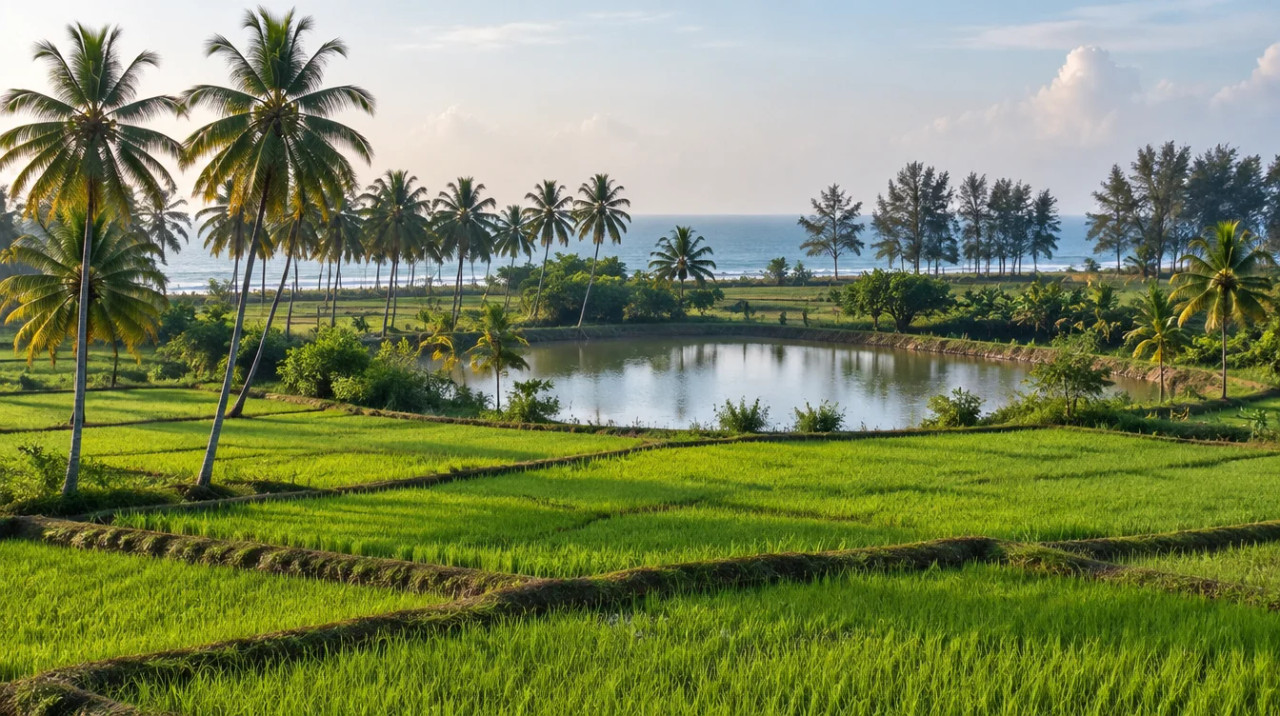
District guide
Buying Land in Karaikal
The Cauvery-delta region of the Union Territory: safe groundwater, rice land, and a port expansion that farmers and fishers are contesting.
160 sq km
Area (Puducherry statistics department)
2.00 lakh
Population, 2011 Census (statistics department)
12.43 million tonnes
Karaikal Port cargo, 2025-26 (Hellenic Shipping News)
10%
Stamp duty on a sale (Registration Department)
*Indicative range across districts and land types. Stamp duty, registration and conversion charges are additional. Local measurement units vary — every listing states the unit it is priced in. Not a valuation or an offer.
District land record — Karaikal
Rev. 2026 · Farmland India desk
State
Puducherry (Union Territory)
Region
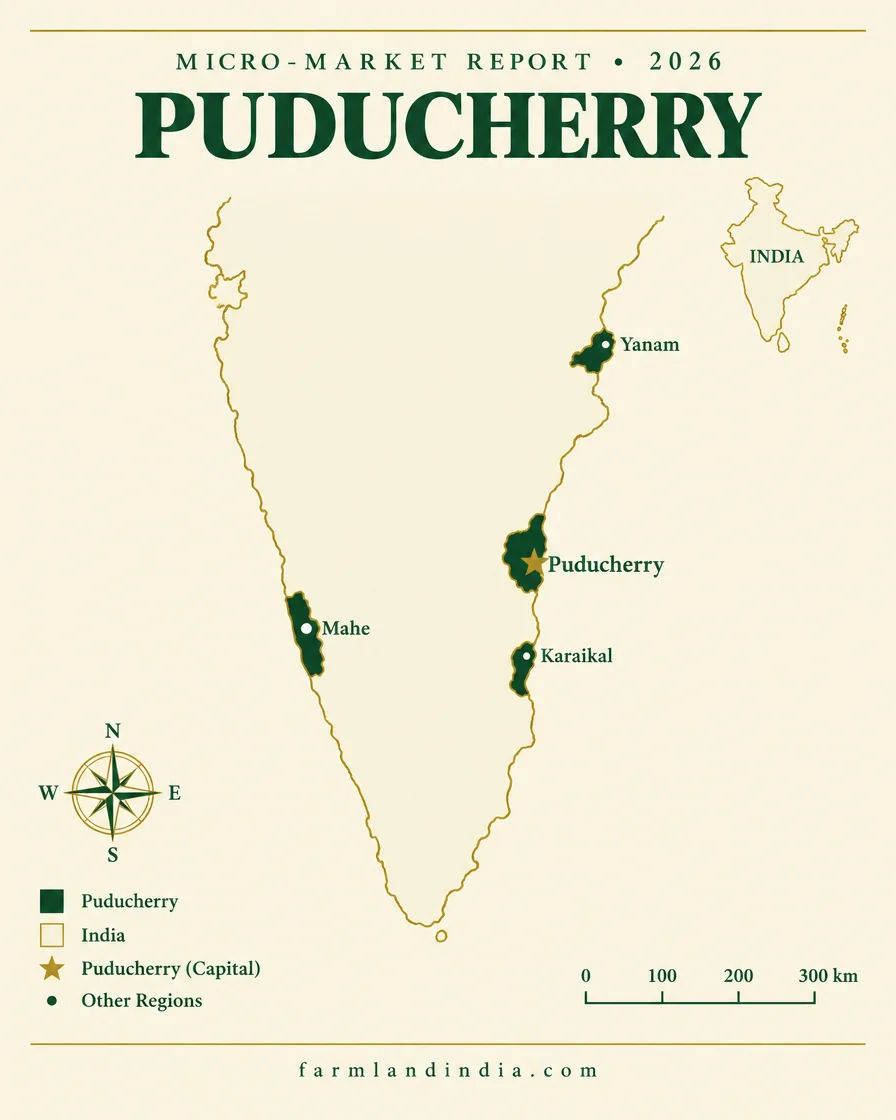
Karaikal is one of the UT’s four regions and districts, in the Cauvery delta on the Tamil Nadu coast; 160 sq km (area table[7]) and 200,222 people in the 2011 Census (Directorate of Economics and Statistics[6]).
Administration
The CGWB’s 2024 assessment treats Karaikal and Thirunallar as separate taluks, both with safe groundwater (CGWB 2024 UT report[4]). The UT has one District Registrar and 12 Sub-Registrar offices (Registration Department[2]).
Key markets
Karaikal · Thirunallar · Thirumalairayan Pattinam · Nedungadu · Kottucherry
Demand anchors
Karaikal Port · Cauvery-delta rice land · Thirunallar temple town · coastal plots
Land records
Nilamagal (Settlement and Chitta) covers Karaikal; patta and FMB extracts through Puduvai Sevai
Land law is state law. These rules are maintained on the Puducherry page and apply to every district within it.
Karaikal — land purchase legal rules
Puducherry has no tribal-land restrictions and no farmer-only rule, so the checks are about title, the 1973 ceiling, the Guideline value and zoning. Its four regions are scattered across three states, but one set of laws and one registration department cover them all. This block applies to every region page in the Union Territory.
Who can buy: No Puducherry law limits the purchase of agricultural land to farmers, so an Indian resident who does not farm can, in principle, buy and register farmland. Confirm the position for the specific parcel with a local advocate before you commit, since the Union Territory’s land laws are spread across several old regulations.
Ceiling on holdings: Under Section 4(1) of the Pondicherry Land Reforms (Fixation of Ceiling on Land) Act, 1973, a person or a family of up to five may hold 6 standard hectares, with 1.2 standard hectares more for each member above five, and no family may hold more than 12. A family means a person, the spouse and minor sons and unmarried daughters. A holder above the ceiling cannot transfer or partition land without the Authorised Officer’s written permission until the surplus is taken over, as the Supreme Court explained in Vengdasalam Pillai v Union Territory of Pondicherry (1985). The standard hectare is a weighted unit that depends on the class of land, so ask for the calculation for the plot.
No Scheduled Areas: Unlike Andhra Pradesh and Telangana, Puducherry has no Fifth Schedule areas, so there is no tribal-land bar on transfers. The usual checks still apply: government (poramboke) land, temple and Wakf land and land under acquisition cannot be bought from a private seller.
Guideline value: Duty and fee are charged on the higher of the deed price and the Guideline (GLR) value, which the Deputy Collector (Revenue) fixes each year for every area. If a party disputes the GLR value, the document is referred to the Sub or Deputy Collector (Revenue) to fix the market value, and unpaid differential duty attracts interest (Registration Department Citizen’s Charter).
Registration: Deeds must be presented within four months of execution at the sub-registrar office for the area where the land lies, or at the District Registrar’s office. The department’s fee table lists 10% stamp duty and a 1.5% registration fee on a sale, with stamp duty at 5% for women purchasers (Registration Department fee table). Encumbrance certificates are computerised from 2007; older records need a manual search.
Change of use: Building on farmland needs approval from the Town and Country Planning Department or the local planning authority, and coastal land may also fall under coastal regulation zone limits. Check the zoning before paying for “farm plots” marketed for houses.
NRI and OCI buyers: Under the RBI Master Direction on immovable property, NRIs and OCIs may not acquire agricultural land, a farmhouse or plantation property in India except by inheritance. Our NRI guide covers the options.
- No farmer-only rule found
- Ceiling: 6 standard ha
- No Scheduled Areas
- Stamp duty 10%
- Women buyers 5%
- GLR value applies
- NRIs: inheritance only
Karaikal — district-specific notes
The Puducherry state page applies to Karaikal in full. Karaikal is a delta region of the Union Territory surrounded by Tamil Nadu, so the UT’s own ceiling Act, Registration Department and Revenue Department apply, not Tamil Nadu’s.
⚠ Ceiling. The Pondicherry Land Reforms (Fixation of Ceiling on Land) Act, 1973 allows 6 standard hectares for a person or family of up to five, with 1.2 standard hectares more per extra member up to 12 standard hectares; the Supreme Court discussed section 22, which bars an excess holder from transferring land without the Authorised Officer's permission, in Vengdasalam Pillai v UT of Pondicherry[1]. Ask the seller whether the family holding is within limits.
⚠ Who can buy. No agriculturist-only purchase rule appears in the statutes. NRIs and OCIs cannot buy agricultural land, farmhouses or plantations under FEMA.
⚠ Records are split. The Settlement register and Chitta are on Nilamagal, and patta and FMB extracts come through Puduvai Sevai at Rs 40 each as digitally signed e-certificates (Revenue Department[3]). Match the R.S. number on the deed to the patta before paying.
⚠ Guideline value. Duty runs on the higher of the sale value and the Guideline Register value, which the Deputy Collector (Revenue) sets each year; disputes go to the Sub or Deputy Collector (Revenue) (Registration Department[2]). A low price in the deed will not reduce the duty.
⚠ Conversion. Changing farmland to non-agricultural use runs through the Town and Country Planning Department and the local planning authority under the 1969 Act. Get the permission and the land-use zone in writing before paying.
⚠ Coast and the port. Much of Karaikal is coastal. The port’s expansion papers place its facilities in CRZ IB, III, IVA and IVB, and the plan needs 112.07 ha of land acquisition and 137.14 ha of reclamation (Karaikal Port environmental summary[8]). Ask the planning authority for the coastal regulation zone and land-use status of any plot near the shore or the port.
Read the Puducherry land buying guide for the ceiling, records and NRI rules. NRIs should also read our FEMA guide.
- Union Territory rules
- Coastal regulation zone
- Port expansion
- Guideline Register value
- Check conversion in writing
District overview
Karaikal — a Cauvery-delta region built around a port
Karaikal is the Cauvery-delta region of the Union Territory of Puducherry. It covers 160 sq km and had 200,222 people in the 2011 Census (area table[7]; Directorate of Economics and Statistics[6]). The region’s own website describes a long maritime history under the Cholas and the French, and says Karaikal is the birthplace of the Nayanmar saint Karaikal Ammaiyar.
The land story is the port. Karaikal Port, owned by Karaikal Port Pvt Ltd, part of Adani Ports and Special Economic Zone, handled about 12.43 million tonnes in 2025-26 (Hellenic Shipping News, 2026[10]). Its master plan would lift capacity from 21.5 to 100.3 million tonnes a year, taking the port area to 492.21 ha with 249.21 ha of extra land, 137.14 ha of it reclaimed and 112.07 ha acquired, at an estimated Rs 19,743.88 crore (Karaikal Port environmental summary[8]).
Not everyone agrees. At the 9 September 2026 public hearing at Thirumalairayan Pattinam, more than 500 people took part and farmers, fishers and residents objected to dredging, reclamation, creek diversion, coal dust and the effect on farmland and water (India Sea Trade News, 11 Sep 2026[9]). No approval was reported. The same study counts 118 villages and 517,140 people within 15 km, including 32,632 fisherfolk.
Groundwater is in better shape than in most of the UT: the CGWB lists Karaikal and Thirunallar as safe (CGWB 2024 UT report[4]). The port’s baseline study found sandy clay loam soil, alkaline in reaction, and groundwater with total dissolved solids between 809 and 1,904 mg/l at five points, which is a reason to test the water on any coastal plot.
Buyers are local families, people of Karaikal origin living elsewhere, and a few investors looking at the port. The nearest big market is across the border in Tamil Nadu, in Nagapattinam, Mayiladuthurai and Thanjavur districts; compare them before you decide.
- Karaikal
- Thirunallar
- Thirumalairayan Pattinam
- Nedungadu
- Kottucherry
Transaction costs
Stamp duty & registration in Karaikal
10%
Stamp duty on a sale
On the higher of sale value or Guideline Register value; 5% for women purchasers ([Registration Department](https://regn.py.gov.in/services.html))
1.5%
Registration fee
Same basis, all buyers; plus a Rs 100 computer fee per transaction
Rs 75
Mutation, sub-division
Nil for a whole-land transfer; certified copies cost Rs 5 stamp duty plus fees
Duty and fees are charged on the higher of the sale value and the Guideline Register (GLR) value, which the Deputy Collector (Revenue) sets each year and you can check on the GLR portal[5]. Confirm the current rate with the sub-registrar before you pay. Check the Registration Department's fee table on the day you register, because the figure can change.
Know the belt
What is moving prices in Karaikal
Reported developments only; no listing-site prices are used.
Karaikal town
Regional market
The region’s town is its market for housing plots, and the Registration Department’s Guideline values set the duty floor. Land inside the municipality follows planning rules.
Check: Ask for the zoning and the Guideline value for the plot.
Thirumalairayan Pattinam and the port side
Port-led demand
The port sits south-east of Vanjore in this commune. The expansion plan gives the area both investment interest and acquisition and objection risk.
Check: Ask whether the survey number is in the port’s acquisition list.
Thirunallar and the temple belt
Pilgrim demand
Thirunallar is a taluk with safe groundwater and pilgrim traffic. Small plots near the temple sell for stays and shops.
Check: Check the land-use zone and conversion in writing.
Delta farm villages
Rice land
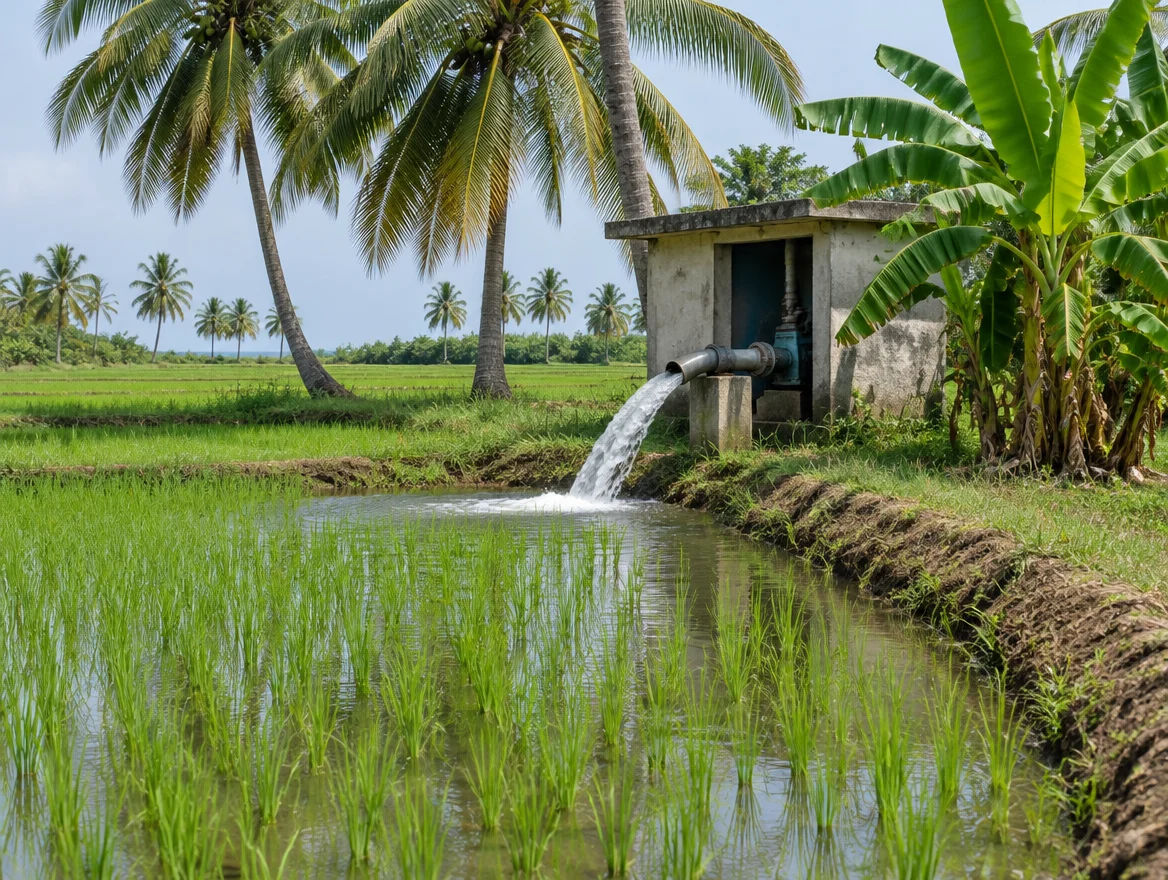
Villages inland on the delta are mainly paddy land, bought by local farmers. Value depends on canal water and drainage.
Check: Match the patta, the Settlement register and the deed.
Asking prices
No official farmland price series is published for Karaikal. Ask the sub-registrar for recent registered sale values in the village you are looking at. Compare the Guideline Register value, registered deeds in the same survey-number cluster, and a local valuer as three separate checks.
Connectivity
How Karaikal connects — road, rail and air
Drive times are not given because no official source was found.
🚗 By road
✈️ By air
🚆 By rail
Karaikal’s infrastructure story is the port; road and air links are modest.
Growth catalysts
Upcoming infrastructure & developments
Each item shows its status and a dated source; reported plans are labelled as such.
01Open
03Catalysts
Agriculture & terrain
Soil, crops & water in Karaikal
No official crop statement for Karaikal was read; the notes below are general and flagged.
Water and land
The CGWB 2024 assessment lists Karaikal and Thirunallar as safe, against a UT-wide stage of extraction of 75.91% (CGWB 2024 UT report[4]). The port study found sandy clay loam soil, alkaline in reaction, and groundwater total dissolved solids of 809–1,904 mg/l at five points.
- Rice on the delta
- Canal and borewell water
- Coastal coconut and casuarina
- Safe groundwater taluks
- Test water at the plot
Crops
Rice is the main crop of the Cauvery delta; the region’s own pages give no crop statistics.
Groundwater
Safe in both taluks, against 75.91% for the UT as a whole.
Coast
Parts of the region are in coastal regulation zones, which limits building near the shore.
At a glance
Karaikal vs. nearby districts
| District | Land and water | What links it to Karaikal |
|---|---|---|
| Puducherry | The UT’s main region and capital | Separate coastal region to the north; see its page |
| Nagapattinam (Tamil Nadu) | Delta farms and ports | Surrounds Karaikal; Tamil Nadu rules apply |
| Mayiladuthurai (Tamil Nadu) | Delta farms | Surrounds Karaikal; Tamil Nadu rules apply |
Karaikal is a small UT region inside Tamil Nadu; the UT’s duty and records rules apply here, not those of the surrounding districts.
Farmland India view
Why investors look at Karaikal
Five reasoned points for Karaikal, each tied to a source on this page.
Price the 10% duty in first
Duty is 10% of the higher of sale and Guideline value (5% for women purchasers), plus 1.5% registration.
Treat the port as a plan and a dispute
The expansion drew objections at the hearing and no approval was reported.
Test the water
The baseline study found total dissolved solids up to 1,904 mg/l; test before you pay.
Check the patta, not the agent
Match the Nilamagal Settlement and Chitta register, the patta and the R.S. number.
Keep the horizon long
The port’s growth depends on approvals; the airport proposal is from 2016 with no later report.
Confirm the Bhu Bharati record, patta, R.S. number, mutation, zoning and acquisition status directly — these are not certified by Farmland India’s review.
STRAIGHT TALK
Risks & challenges in Karaikal
District-specific risks. Read the Puducherry state page for the general risks on ceiling, conversion and records.
Port acquisition and objections
Land near the port may be acquired, and the expansion is contested.
Coastal regulation zones
Plots near the shore may be inside CRZ and limited in use.
High duty on the higher value
A low price in the deed does not reduce duty; the Guideline value sets the floor.
Ceiling and permission to transfer
An excess holder needs the Authorised Officer’s permission to transfer land.
Record gaps
Settlement register, patta and FMB must match the R.S. number.
Cross-border confusion
Karaikal is surrounded by Tamil Nadu; check which state’s rules apply to a survey number.
Price evidence
No official farmland price series is published for Karaikal. Ask the sub-registrar for recent registered sale values in the village you are looking at.
Who to contact
Local revenue & planning offices
Karaikal region: the District Collector’s office and the Sub-Registrar office at Karaikal (confirm on the Registration Department site). Land records: Nilamagal (Settlement and Chitta) and Puduvai Sevai for patta and FMB extracts (Revenue Department[3]). Guideline values: GLR portal.
COMMON QUESTIONS
Frequently asked questions
Everything buyers, NRIs and investors ask before their first reviewed farmland purchase in Karaikal.
Visit full wiki01 of 04
Is the Karaikal Port expansion approved?
Not in the report. A public hearing was held on 9 September 2026 at Thirumalairayan Pattinam, where farmers and fishers raised objections to dredging, reclamation and creek diversion. Authorities were to weigh the concerns; no approval was reported.
02 of 04
Is groundwater a problem in Karaikal?
The CGWB 2024 assessment lists the Karaikal and Thirunallar taluks as safe. Near the port, a baseline study found total dissolved solids of 809–1,904 mg/l at five sampling points, so test the water at the plot.
03 of 04
Who can buy farmland in Karaikal?
There is no agriculturist-only rule in the statutes, but ask a local lawyer to confirm. The UT ceiling Act applies, and NRIs and OCIs cannot buy agricultural land under FEMA.
04 of 04
What duty do I pay?
10% stamp duty on the higher of the sale value and the Guideline Register value (5% for women purchasers) plus a 1.5% registration fee, per the Registration Department fee table.
Transparency
Sources and references
Law and courts
- [1]Supreme Court: Vengdasalam Pillai v UT of Pondicherry, 18 Feb 1985
Government
- [2]Puducherry Registration Department: services and fees — regn.py.gov.in
- [3]Puducherry Revenue Department: land records modernisation — revenue.py.gov.in
- [4]CGWB: Ground Water Resources Assessment 2024, Puducherry — cgwb.gov.in
- [5]Puducherry GLR portal (NIC Puducherry) — pon.nic.in
- [6]Puducherry Directorate of Economics and Statistics: population data — statistics.py.gov.in
- [7]Puducherry Directorate of Economics and Statistics: area — statistics.py.gov.in
- [8]Puducherry DSTE: Karaikal Port Expansion, Executive Summary — dste.py.gov.in
News
- [9]India Sea Trade News: Farmers and fishers challenge Karaikal Port expansion, 11 Sep 2026 — indiaseatradenews.com
- [10]Hellenic Shipping News: Karaikal Port handles 12.43 million tonnes in 2025-26 — hellenicshippingnews.com
- [11]DT Next: Runway length of Karaikal airport to be reduced, 27 Nov 2016 — dtnext.in
Project status, the benchmark valuation and land rules change often; check the linked source and the relevant office before relying on any figure.
For developers
Ready to explore Karaikal farmland?
Browse reviewed projects and individual land parcels across Karaikal — or if you own land here, list it with platform review and reach serious buyers.