
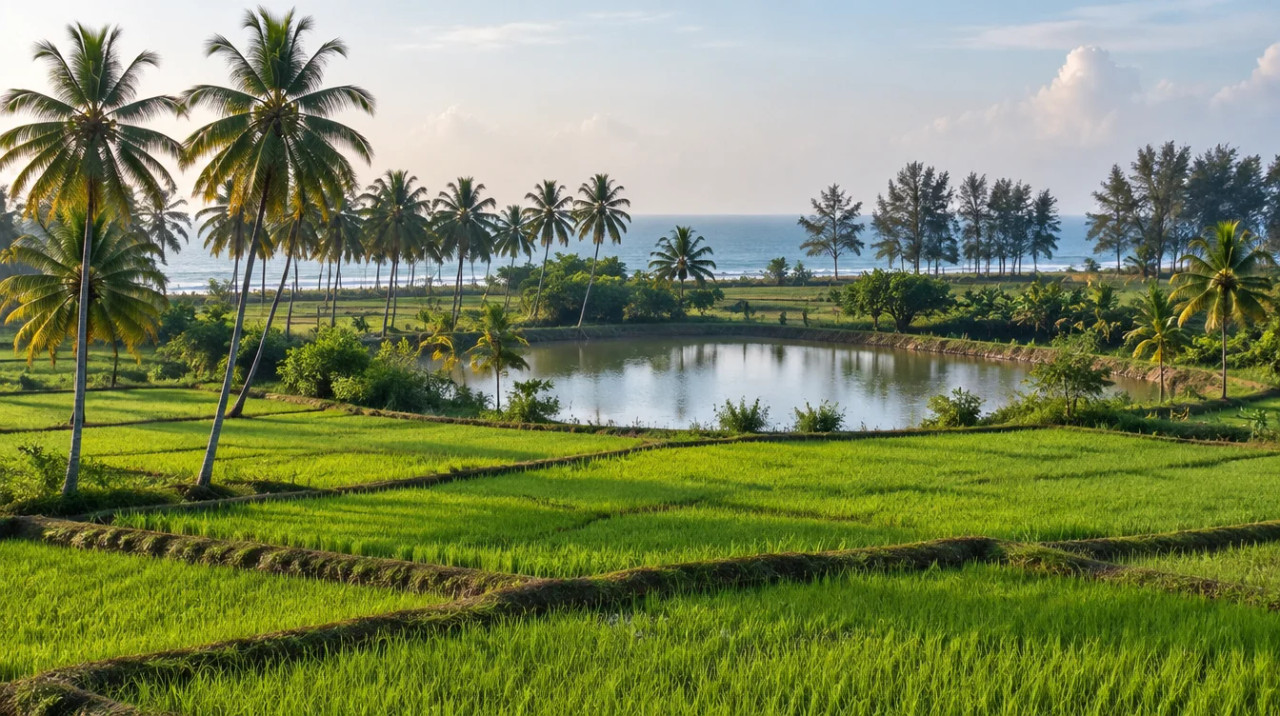
State guide
Buying Land in Puducherry
Ceiling limits, 10% stamp duty (5% for women), GLR values, Nilamagal records and groundwater stress: what to check before buying land in Puducherry.
4
Regions
10% (5% for women)
Stamp duty on sale
1.5%
Registration fee
75.91%
Groundwater extraction (2024)
Land record — Puducherry
Rev. 2026 · Farmland India desk
Regions
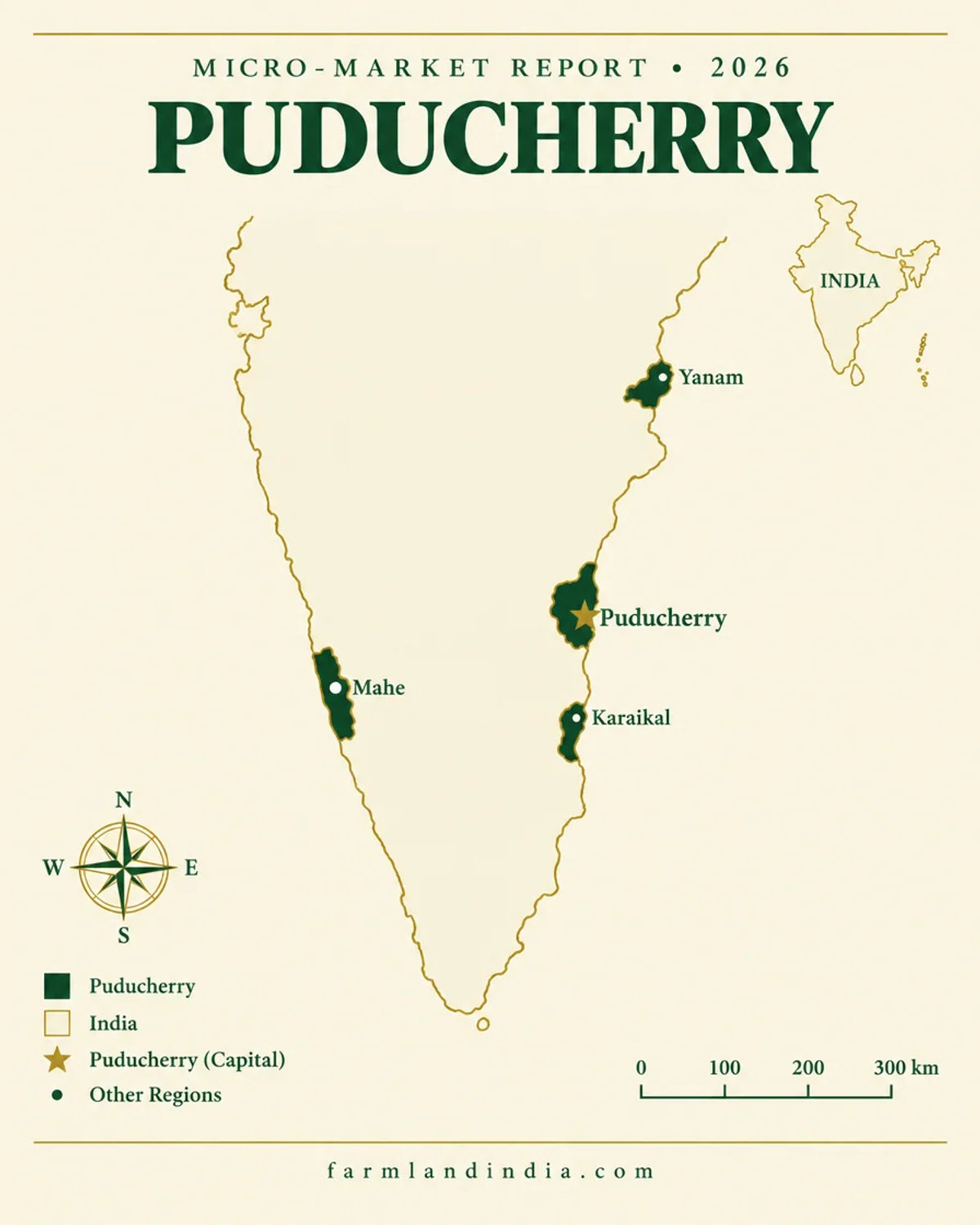
Four separate regions: Puducherry and Karaikal on the Tamil Nadu coast, Mahe on the Kerala coast and Yanam in the Godavari delta of Andhra Pradesh
Status
Union Territory with its own legislature; capital Puducherry
Groundwater extraction
75.91% in 2024; Puducherry taluk over-exploited, Ozhukarai, Villianur and Bahour semi-critical, Karaikal, Thirunallar and Mahe safe, Yanam saline (CGWB)
Land records
Settlement and Chitta register on Nilamagal; Patta (the register of rights) and FMB (field measurement) extracts through Puduvai Sevai e-services, searched by Re-Survey (R.S.) number
Ceiling law
Pondicherry Land Reforms (Fixation of Ceiling on Land) Act, 1973: 6 standard hectares for a family of up to five, at most 12
Sale deed charges
Stamp duty 10% (5% for women buyers) and registration fee 1.5% of the deed value or the Guideline (GLR) value, whichever is higher, plus Rs 100 computer fee
Registration offices
One District Registrar and 12 sub-registrar offices across the four regions
Puducherry — land purchase legal rules
Puducherry has no tribal-land restrictions and no farmer-only rule, so the checks are about title, the 1973 ceiling, the Guideline value and zoning. Its four regions are scattered across three states, but one set of laws and one registration department cover them all. This block applies to every region page in the Union Territory.
Who can buy: No Puducherry law limits the purchase of agricultural land to farmers, so an Indian resident who does not farm can, in principle, buy and register farmland. Confirm the position for the specific parcel with a local advocate before you commit, since the Union Territory’s land laws are spread across several old regulations.
Ceiling on holdings: Under Section 4(1) of the Pondicherry Land Reforms (Fixation of Ceiling on Land) Act, 1973, a person or a family of up to five may hold 6 standard hectares, with 1.2 standard hectares more for each member above five, and no family may hold more than 12. A family means a person, the spouse and minor sons and unmarried daughters. A holder above the ceiling cannot transfer or partition land without the Authorised Officer’s written permission until the surplus is taken over, as the Supreme Court explained in Vengdasalam Pillai v Union Territory of Pondicherry (1985). The standard hectare is a weighted unit that depends on the class of land, so ask for the calculation for the plot.
No Scheduled Areas: Unlike Andhra Pradesh and Telangana, Puducherry has no Fifth Schedule areas, so there is no tribal-land bar on transfers. The usual checks still apply: government (poramboke) land, temple and Wakf land and land under acquisition cannot be bought from a private seller.
Guideline value: Duty and fee are charged on the higher of the deed price and the Guideline (GLR) value, which the Deputy Collector (Revenue) fixes each year for every area. If a party disputes the GLR value, the document is referred to the Sub or Deputy Collector (Revenue) to fix the market value, and unpaid differential duty attracts interest (Registration Department Citizen’s Charter).
Registration: Deeds must be presented within four months of execution at the sub-registrar office for the area where the land lies, or at the District Registrar’s office. The department’s fee table lists 10% stamp duty and a 1.5% registration fee on a sale, with stamp duty at 5% for women purchasers (Registration Department fee table). Encumbrance certificates are computerised from 2007; older records need a manual search.
Change of use: Building on farmland needs approval from the Town and Country Planning Department or the local planning authority, and coastal land may also fall under coastal regulation zone limits. Check the zoning before paying for “farm plots” marketed for houses.
NRI and OCI buyers: Under the RBI Master Direction on immovable property, NRIs and OCIs may not acquire agricultural land, a farmhouse or plantation property in India except by inheritance. Our NRI guide covers the options.
- No farmer-only rule found
- Ceiling: 6 standard ha
- No Scheduled Areas
- Stamp duty 10%
- Women buyers 5%
- GLR value applies
- NRIs: inheritance only
UT overview
Puducherry — four regions, three coasts
Puducherry is a Union Territory made of four former French settlements that joined India in 1954: Puducherry itself on the Tamil Nadu coast south of Chennai, Karaikal further south in the Cauvery delta, Mahe on the Kerala coast and Yanam in the Godavari delta of Andhra Pradesh. Each region is surrounded by a different state, speaks a different main language and has a different farm economy, but all four follow the Union Territory’s land, registration and revenue rules. The land market is small. Puducherry region, with the capital, Ozhukarai, Villianur and Bahour, has most of the demand; Karaikal is a delta paddy market; Mahe and Yanam are tiny towns with little farmland to sell.
Buyers come from three directions. Chennai and Bengaluru families look for weekend land, farmhouses and orchards near the coast and along the roads into Puducherry; local families buy paddy, coconut and vegetable land in the villages; and investors watch the highway, the airport expansion and the new economic zones announced in the 2026-27 budget. Prices in Puducherry are often compared with the neighbouring Tamil Nadu villages a few kilometres away, which follow different laws and duty rates; read our Tamil Nadu page alongside this one, and the Kerala and Andhra Pradesh pages for the areas around Mahe and Yanam.
Title comes first. Before you discuss price, check that the plot lies inside the Union Territory and not in the Tamil Nadu village next door, that the Patta and Chitta on Nilamagal match the seller and the Re-Survey number, and that the land is not poramboke, temple land or under acquisition.
- 4 regions
- Capital: Puducherry
- Former French settlements
- 12 sub-registrar offices
- Groundwater 75.91% extracted
Market bands
Reported cost reference points — Puducherry
No official farmland price series is published for Puducherry. These are the official cost reference points a buyer will meet; actual prices come from registered deeds in the village.
| Item | Scope | Reported figure* | Source |
|---|---|---|---|
| Stamp duty | Conveyance (sale deed) | 10% of sale value or GLR value, whichever is higher | Registration Department fee table[4] |
| Stamp duty, women buyers | Conveyance (sale deed) | 5% of sale value or GLR value | Registration Department fee table |
| Registration fee | Conveyance (sale deed) | 1.5%, plus Rs 100 computer fee | Registration Department fee table |
| Guideline (GLR) values | All areas of the Union Territory | Fixed yearly by the Deputy Collector (Revenue) | Registration Department FAQ[5] |
| Farmland price series | Region level | None published | Not published |
*No newspaper or official source publishes a farmland price series for Puducherry’s regions. Duty is charged on the higher of the deed price and the Guideline value, which is fixed each year for every area. Ask the sub-registrar for the current GLR value for the exact Re-Survey number, and compare registered deeds in the same village before agreeing a price.
Transaction costs
Stamp duty & registration in Puducherry
10%
Stamp duty on a sale
On the higher of sale value and GLR value
5%
Stamp duty for women
For a woman purchaser, as listed in the fee table
1.5%
Registration fee
Plus a Rs 100 computer fee per transaction
Puducherry’s registration department lists stamp duty of 10% on a sale deed, charged on the sale value or the Guideline value, whichever is higher, and 5% where the purchaser is a woman; the registration fee is 1.5% on the same base, with a computer fee of Rs 100 (Registration Department, read November 2026[4]). That puts the total for a man buying in his own name at about 11.5%, well above most neighbouring states, so a purchase in a woman’s name saves a large share of the cost; make sure that choice also suits inheritance and any loan. Guideline values are fixed every year by the Deputy Collector (Revenue) for all areas of the Union Territory, and the department has one District Registrar and 12 sub-registrar offices (Registration Department FAQ[5]). Appointments can be booked online, encumbrance certificates are issued online for records from 2007, and documents are registered through the e-Pathiram system. Confirm the duty with the sub-registrar before you budget.
Connectivity
How Puducherry connects: road, rail and air
The East Coast Road, a four-laning to Marakkanam, a small airport and rail links in three states
🚗 By road
✈️ By air
🚆 By rail
🏭 Industry and ports
Industry is modest: estates around Puducherry, Mettupalayam, Thirubuvanai and Sedarapet, and a port at Karaikal. The 2026-27 budget announced an IT and ITES special economic zone at Thattanchavady and a multi-modal SEZ on 213.12 acres at Karasur (Deccan Chronicle, August 2026[9]). Neither is built yet, so treat them as announcements. For farmland buyers the more useful signal is the highway, which shortens the run from Chennai.
Growth catalysts
Upcoming infrastructure & developments
Status as of November 2026, with the date and source of the latest public update for each project
01Highway
Marakkanam–Puducherry four-laning approved
04Catalysts
Agriculture & terrain
Soil, crops & water across Puducherry
Tank-fed paddy near the capital, the Cauvery delta at Karaikal, and coconut and delta land in Mahe and Yanam
Puducherry region
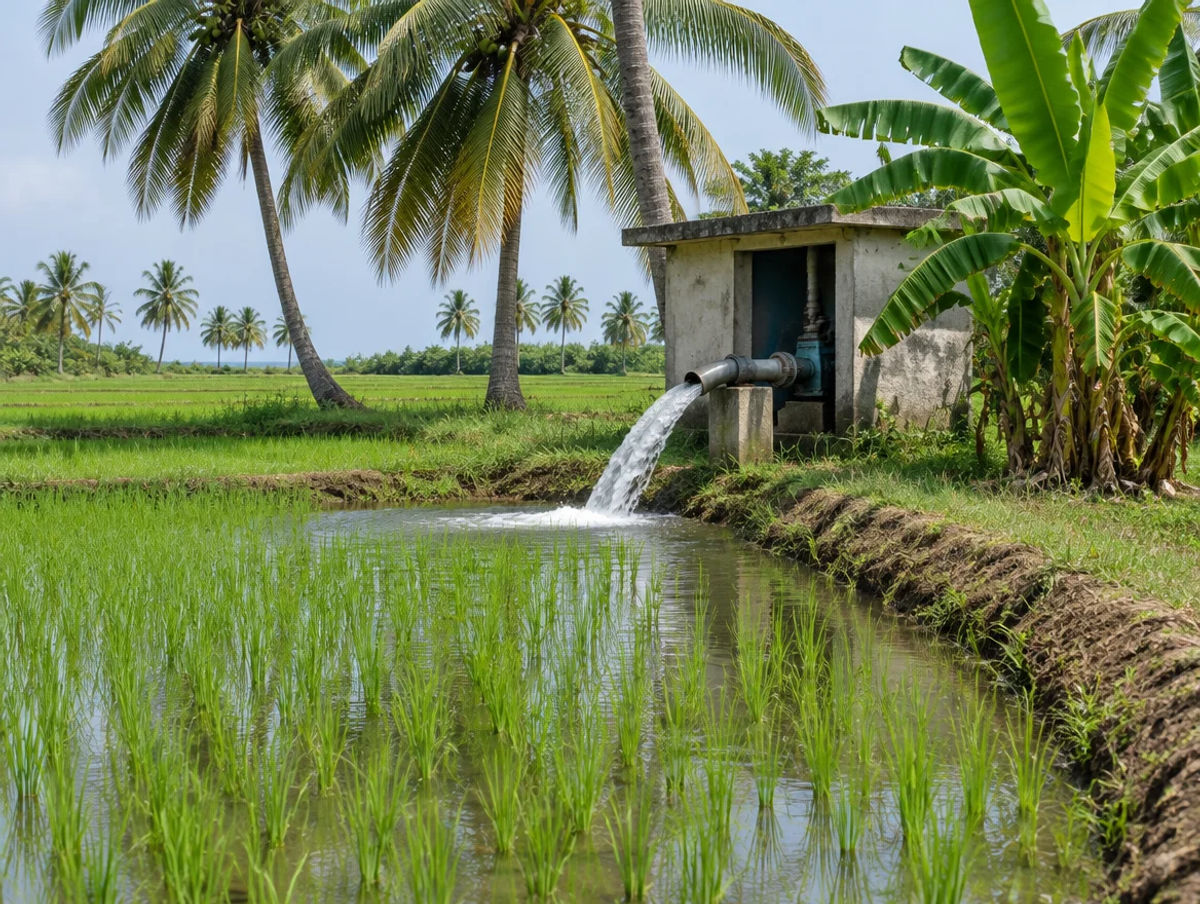
The Puducherry, Ozhukarai, Villianur and Bahour taluks grow paddy, sugarcane, groundnut, banana, vegetables and coconut, with tank and borewell irrigation. It is the most urban region and the one under the most groundwater stress.
- Paddy, sugarcane, banana
- Tanks and borewells
- Over-exploited and semi-critical taluks
Karaikal
Karaikal and Thirunallar lie at the tail end of the Cauvery delta, where paddy depends on canal water released from upstream in Tamil Nadu, with pulses after the paddy where moisture allows. Groundwater is rated safe, but the coast is low-lying and flood-prone.
- Delta paddy, pulses
- Cauvery canal water
- Safe groundwater
Mahe and Yanam
Mahe, a small town on the Kerala coast, has coconut and homestead gardens rather than field farms. Yanam, on the Godavari in Andhra Pradesh, has paddy, coconut and aquaculture on low land where groundwater is saline. Neither has much farmland on the market.
- Coconut, homesteads (Mahe)
- Paddy and aquaculture (Yanam)
- Saline groundwater in Yanam
Groundwater
Groundwater is the main constraint in the Puducherry region. The Central Ground Water Board put the Union Territory’s stage of extraction at 75.91% in its 2024 assessment, far above the national average; of eight taluks, Puducherry is over-exploited, Ozhukarai, Villianur and Bahour are semi-critical, Karaikal, Thirunallar and Mahe are safe and Yanam is saline (CGWB, 2024[3]). Near the coast, heavy pumping also draws sea water into the aquifer. Test a borewell for yield and salinity before you buy, and ask about restrictions on new wells.
Land use
Holdings are very small and much of the farmland around Puducherry town has already been converted to layouts. A consolidated block of several acres is rare, and the better farm parcels lie in the western villages of Villianur and Bahour and in Karaikal.
Crops
Paddy is the main field crop in Puducherry and Karaikal, with sugarcane, banana, groundnut, pulses and vegetables; coconut dominates in Mahe and along the coast. Most buyers from outside look for orchard, coconut or farmhouse land rather than paddy.
At a glance
Puducherry’s four regions side by side
| Region | Price series | Water and irrigation | Note |
|---|---|---|---|
| Puducherry (Puducherry, Ozhukarai, Villianur, Bahour taluks) | None published* | Tanks and borewells; over-exploited and semi-critical | Capital; highway, airport and SEZ plans; most of the market |
| Karaikal (Karaikal, Thirunallar) | None published* | Cauvery delta canals; safe groundwater | Delta paddy; port; flood-prone coast |
| Mahe | None published* | Kerala rainfall; safe groundwater | Small coastal town in Kerala; little farmland |
| Yanam | None published* | Godavari delta; saline groundwater | Small enclave near Kakinada; paddy and aquaculture |
*No newspaper or official source publishes a farmland price series for these regions. Groundwater categories are CGWB 2024 taluk ratings.
Farmland India view
Why investors look at Puducherry
Near Chennai, a simpler legal picture, but high duty and scarce water
Close to Chennai, with its own rules
The Puducherry region is a few hours from Chennai, and the four-laning of NH-332A will shorten the drive. Land here follows the Union Territory’s laws and duty rates, not Tamil Nadu’s, which matters when two plots a few kilometres apart are compared.
A simpler legal picture
There are no Scheduled Areas, no assigned-land regime of the Andhra kind and no farmer-only rule. The main checks are title, the ceiling, the Guideline value and zoning, which makes due diligence shorter than in most of the south.
Costs are high
At 10% stamp duty plus 1.5% registration fee for a man, the cost of a purchase is well above most neighbouring states. Registering in a woman’s name halves the stamp duty and is worth planning for early.
Water is scarce near the city
With the Puducherry taluk over-exploited, borewell-dependent farming near the capital is a risk. Karaikal’s canal-fed delta land, with safe groundwater, is a better farm proposition, though it carries flood risk.
Confirm the Patta, the Chitta, the Re-Survey number, the GLR value and the zoning before you pay a token amount.
STRAIGHT TALK
Risks & challenges in Puducherry
What can undo a land purchase in Puducherry
Border confusion
Puducherry’s boundary with Tamil Nadu winds through villages, and some plots marketed as “Pondicherry” lie in Tamil Nadu. Confirm the region, taluk and village on Nilamagal and on the Field Measurement Book before paying.
Government and temple land
Poramboke (government) land, temple and Wakf land are often occupied and offered for sale. Check the land classification in the Chitta and Settlement register.
Groundwater and salinity
Over-exploited aquifers near the capital and sea-water intrusion along the coast can leave a farm without usable water. Test before you buy.
Coastal regulation and erosion
Land near the shore may fall under coastal regulation zone limits, and parts of the coast are eroding. Check the CRZ status before buying coastal land for a farmhouse.
Unapproved layouts
Farmland cut into house plots without planning approval is common around Puducherry town. Such plots may not get building permission or services.
High duty and GLR disputes
Duty is charged on the GLR value if it is higher than the price, and disputes go to the Deputy Collector (Revenue). Budget on the GLR value for the exact parcel.
Who to contact
Local revenue & registration offices
Land administration in Puducherry runs through the Revenue Department, the District Collector, Deputy Collectors (Revenue) and Tahsildars for each taluk in the four regions. Survey and records are kept by the Directorate of Survey, Settlement and Land Records at the Revenue Complex, Saram, Puducherry, which publishes the Settlement and Chitta register on Nilamagal; Patta and FMB extracts are issued through Puduvai Sevai e-services and common service centres (Revenue Department[7]). The Tahsildar handles mutation of the Patta after a sale or inheritance, and the Deputy Collector (Revenue) fixes the annual Guideline values and decides valuation disputes. Deeds are registered at the sub-registrar offices of the Registration Department or at the District Registrar’s office, which also issue encumbrance certificates. Building and layout approval comes from the Town and Country Planning Department or the local planning authority.
COMMON QUESTIONS
Frequently asked questions
Everything buyers, NRIs and investors ask before their first reviewed farmland purchase in Puducherry.
Visit full wiki01 of 04
Can a non-farmer buy agricultural land in Puducherry?
No Puducherry law limits farmland purchases to farmers, and the Union Territory has no Scheduled Areas. The 1973 ceiling Act limits a family of up to five to 6 standard hectares. Confirm the position for a specific parcel with a local advocate.
02 of 04
What is the stamp duty on land in Puducherry?
The Registration Department lists 10% stamp duty on a sale deed, or 5% where the buyer is a woman, plus a 1.5% registration fee and a Rs 100 computer fee, all on the higher of the sale value and the Guideline (GLR) value.
03 of 04
Where can I check land records in Puducherry?
The Settlement and Chitta register is on Nilamagal, run by the Directorate of Survey, Settlement and Land Records, searchable by region, taluk, village and Patta or Re-Survey number. Patta and FMB extracts are issued through Puduvai Sevai e-services.
04 of 04
Is groundwater a problem for farmland in Puducherry?
Near the capital, yes. In the 2024 CGWB assessment the Puducherry taluk was over-exploited and Ozhukarai, Villianur and Bahour were semi-critical, while Karaikal, Thirunallar and Mahe were safe and Yanam saline. Test any borewell before buying.
Transparency
Sources and references
Law and courts
- [1]Supreme Court: Vengdasalam Pillai v Union Territory of Pondicherry (18 Feb 1985), on the 1973 ceiling Act — future.indiankanoon.org
- [2]RBI Master Direction: acquisition and transfer of immovable property — rbi.org.in
Government
- [3]CGWB: Dynamic Ground Water Resources of Puducherry, 2024 — cgwb.gov.in
- [4]Registration Department, Puducherry: services and fees — regn.py.gov.in
- [5]Registration Department, Puducherry: FAQ — regn.py.gov.in
- [6]Registration Department, Puducherry: Citizen’s Charter — regn.py.gov.in
- [7]Revenue Department, Puducherry: land records computerisation — revenue.py.gov.in
News
- [8]ThePrint (PTI): Cabinet approves four-lane Marakkanam–Puducherry highway (8 Aug 2025) — theprint.in
- [9]Deccan Chronicle: Puducherry budget 2026-27 infrastructure (25 Aug 2026) — deccanchronicle.com
Further reading
Data-currency note: sources were read in November 2026. Fees, Guideline values and infrastructure timelines change often; check the linked source and the relevant office before relying on any figure.
For developers
Ready to explore Puducherry farmland?
Browse reviewed projects and individual land parcels across Puducherry — or if you own land here, list it with platform review and reach serious buyers.