
District guide
Buying Land in Mahe
A 9 sq km Union Territory enclave in Kerala: very little farmland, high density, and Puducherry rules on a Malabar coast.
9 sq km
Area (Mahe tourism strategic plan)
41,816
Population, 2011 Census (statistics department)
4,646 per sq km
Density (Mahe tourism strategic plan)
10%
Stamp duty on a sale (Registration Department)
District land record — Mahe
Rev. 2026 · Farmland India desk
State
Puducherry (Union Territory)
Region
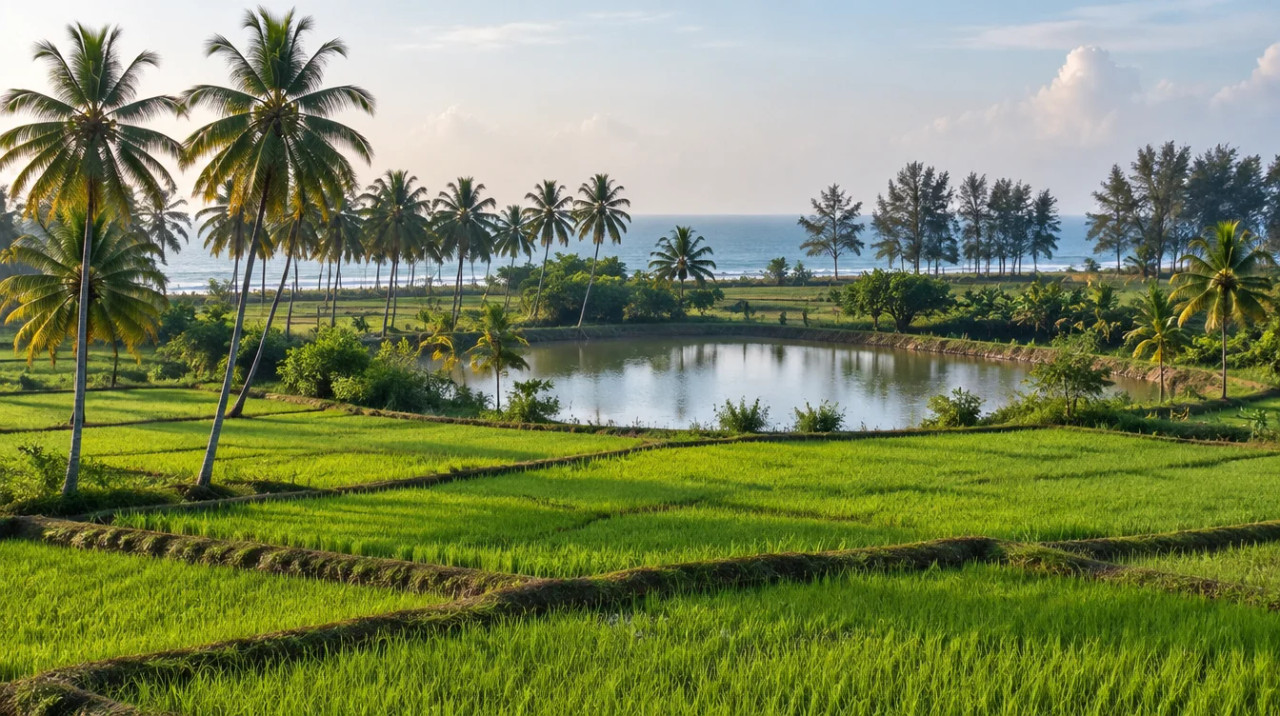
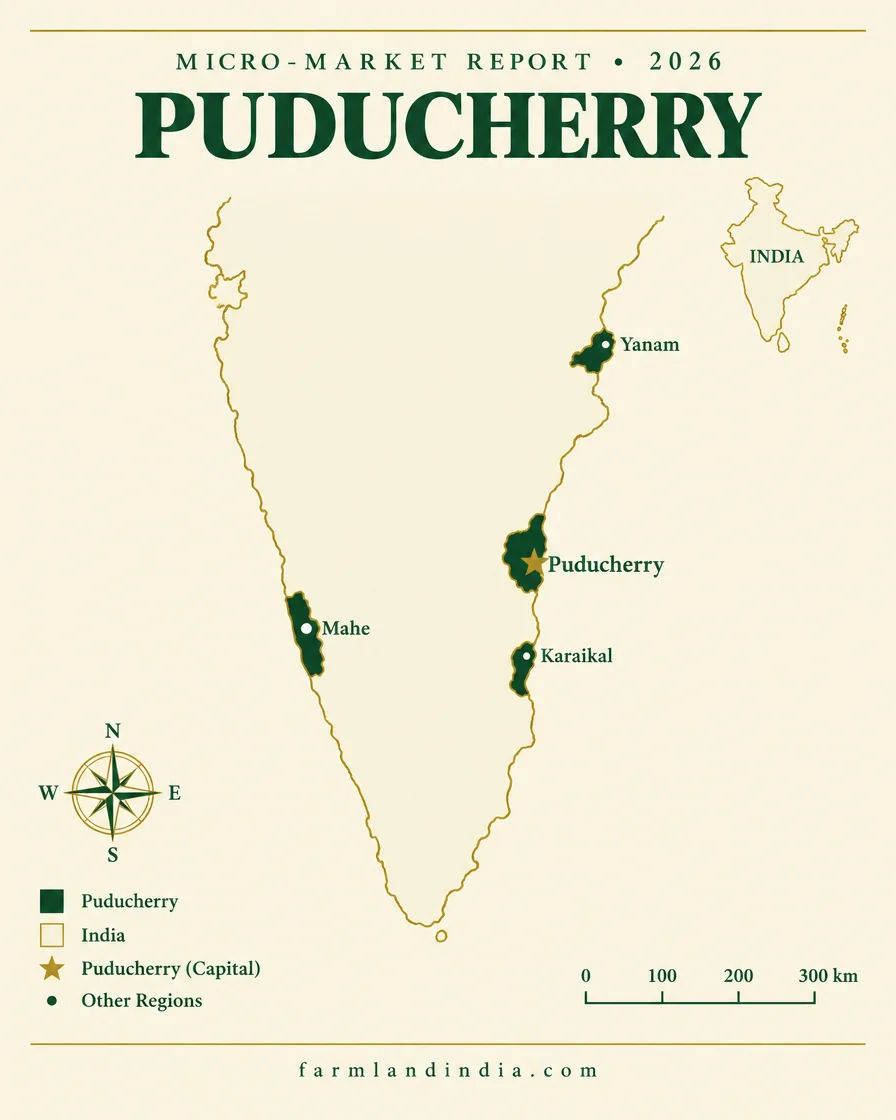
Mahe is one of the UT’s four regions and districts, an enclave on the Malabar Coast surrounded by Kerala and bordering Kannur and Kozhikode; about 9 sq km, 41,816 people in 2011 and a density of 4,646 per sq km (Mahe Tourism Strategic Plan[8]).
Administration
Mahe Municipality, made up of Palloor, Kallayye, Chalakkara, Pandakkal and Mahe (Mahe Tourism Strategic Plan[8]). The CGWB lists the Mahe taluk as safe for groundwater (CGWB 2024 UT report[4]).
Key markets
Mahe · Palloor · Chalakkara · Pandakkal · Kallayye
Demand anchors
Tourism and the Mayyazhi river front · Thalassery and Kannur access · local housing
Land records
Nilamagal covers all four regions; patta and FMB extracts through Puduvai Sevai
Land law is state law. These rules are maintained on the Puducherry page and apply to every district within it.
Mahe — land purchase legal rules
Puducherry has no tribal-land restrictions and no farmer-only rule, so the checks are about title, the 1973 ceiling, the Guideline value and zoning. Its four regions are scattered across three states, but one set of laws and one registration department cover them all. This block applies to every region page in the Union Territory.
Who can buy: No Puducherry law limits the purchase of agricultural land to farmers, so an Indian resident who does not farm can, in principle, buy and register farmland. Confirm the position for the specific parcel with a local advocate before you commit, since the Union Territory’s land laws are spread across several old regulations.
Ceiling on holdings: Under Section 4(1) of the Pondicherry Land Reforms (Fixation of Ceiling on Land) Act, 1973, a person or a family of up to five may hold 6 standard hectares, with 1.2 standard hectares more for each member above five, and no family may hold more than 12. A family means a person, the spouse and minor sons and unmarried daughters. A holder above the ceiling cannot transfer or partition land without the Authorised Officer’s written permission until the surplus is taken over, as the Supreme Court explained in Vengdasalam Pillai v Union Territory of Pondicherry (1985). The standard hectare is a weighted unit that depends on the class of land, so ask for the calculation for the plot.
No Scheduled Areas: Unlike Andhra Pradesh and Telangana, Puducherry has no Fifth Schedule areas, so there is no tribal-land bar on transfers. The usual checks still apply: government (poramboke) land, temple and Wakf land and land under acquisition cannot be bought from a private seller.
Guideline value: Duty and fee are charged on the higher of the deed price and the Guideline (GLR) value, which the Deputy Collector (Revenue) fixes each year for every area. If a party disputes the GLR value, the document is referred to the Sub or Deputy Collector (Revenue) to fix the market value, and unpaid differential duty attracts interest (Registration Department Citizen’s Charter).
Registration: Deeds must be presented within four months of execution at the sub-registrar office for the area where the land lies, or at the District Registrar’s office. The department’s fee table lists 10% stamp duty and a 1.5% registration fee on a sale, with stamp duty at 5% for women purchasers (Registration Department fee table). Encumbrance certificates are computerised from 2007; older records need a manual search.
Change of use: Building on farmland needs approval from the Town and Country Planning Department or the local planning authority, and coastal land may also fall under coastal regulation zone limits. Check the zoning before paying for “farm plots” marketed for houses.
NRI and OCI buyers: Under the RBI Master Direction on immovable property, NRIs and OCIs may not acquire agricultural land, a farmhouse or plantation property in India except by inheritance. Our NRI guide covers the options.
- No farmer-only rule found
- Ceiling: 6 standard ha
- No Scheduled Areas
- Stamp duty 10%
- Women buyers 5%
- GLR value applies
- NRIs: inheritance only
Mahe — district-specific notes
The Puducherry state page applies to Mahe in full. Mahe is a Union Territory enclave in Kerala, so the buyer’s first question is not price but which rules and offices apply to the survey number.
⚠ Ceiling. The Pondicherry Land Reforms (Fixation of Ceiling on Land) Act, 1973 allows 6 standard hectares for a person or family of up to five, with 1.2 standard hectares more per extra member up to 12 standard hectares; the Supreme Court discussed section 22, which bars an excess holder from transferring land without the Authorised Officer's permission, in Vengdasalam Pillai v UT of Pondicherry[1]. Ask the seller whether the family holding is within limits.
⚠ Who can buy. No agriculturist-only purchase rule appears in the statutes. NRIs and OCIs cannot buy agricultural land, farmhouses or plantations under FEMA.
⚠ Records are split. The Settlement register and Chitta are on Nilamagal, and patta and FMB extracts come through Puduvai Sevai at Rs 40 each as digitally signed e-certificates (Revenue Department[3]). Match the R.S. number on the deed to the patta before paying.
⚠ Guideline value. Duty runs on the higher of the sale value and the Guideline Register value, which the Deputy Collector (Revenue) sets each year; disputes go to the Sub or Deputy Collector (Revenue) (Registration Department[2]). A low price in the deed will not reduce the duty.
⚠ Conversion. Changing farmland to non-agricultural use runs through the Town and Country Planning Department and the local planning authority under the 1969 Act. Get the permission and the land-use zone in writing before paying.
⚠ Enclave and offices. Mahe is surrounded by Kerala but belongs to the Union Territory, which has one District Registrar and 12 Sub-Registrar offices (Registration Department[2]). Confirm which office registers the deed and which office issues the patta before you rely on a Kerala-side intermediary.
Read the Puducherry land buying guide for the ceiling, records and NRI rules. NRIs should also read our FEMA guide.
- Union Territory rules
- Enclave in Kerala
- Coastal and river limits
- Guideline Register value
- Check conversion in writing
District overview
Mahe — a Malabar-coast enclave of the Union Territory
Mahe is the smallest of Puducherry’s four regions: about 9 sq km on the Malabar Coast, wholly surrounded by Kerala, bordering the Kannur and Kozhikode districts, with 41,816 people in the 2011 Census and a density of 4,646 per sq km (Mahe Tourism Strategic Plan[8]). The Directorate of Economics and Statistics gives the same area and population (area table[7]; Directorate of Economics and Statistics[6]).
The strategic plan describes coastal plains, riverbanks, small hillocks and beaches around the Mayyazhi (Mahe) river, with a tropical humid climate. The municipality is made up of Palloor, Kallayye, Chalakkara, Pandakkal and Mahe. There is no official crop, rainfall or farmland statement for the region, and with this density there is almost no large agricultural parcel to buy.
What buyers actually trade is small house plots and urban or riverfront land. The CGWB’s 2024 assessment lists the Mahe taluk as safe (CGWB 2024 UT report[4]), but a taluk category does not guarantee the water at a given plot, which sits beside tidal river and sea.
Access is through Kerala. The strategic plan gives Thalassery railway station at 9 km, Kannur International Airport at 30 km and Kozhikode airport at 86 km. The six-lane Thalassery–Mahe bypass, the first six-lane road in Malabar, was dedicated by the Prime Minister (Kerala Kaumudi[9]).
Compare the surrounding Kerala districts of Kannur and Kozhikode if you want farmland, and compare Karaikal or Puducherry if you want UT land that is not an enclave. Remember that the UT’s duty and records rules follow the survey number, not the postal address.
- Mahe
- Palloor
- Chalakkara
- Pandakkal
- Kallayye
Transaction costs
Stamp duty & registration in Mahe
10%
Stamp duty on a sale
On the higher of sale value or Guideline Register value; 5% for women purchasers ([Registration Department](https://regn.py.gov.in/services.html))
1.5%
Registration fee
Same basis, all buyers; plus a Rs 100 computer fee per transaction
Rs 75
Mutation, sub-division
Nil for a whole-land transfer; certified copies cost Rs 5 stamp duty plus fees
Duty and fees are charged on the higher of the sale value and the Guideline Register (GLR) value, which the Deputy Collector (Revenue) sets each year and you can check on the GLR portal[5]. Confirm the current rate with the sub-registrar before you pay. Check the Registration Department's fee table on the day you register, because the figure can change.
Know the belt
What is moving prices in Mahe
Reported developments only; no listing-site prices are used.
Mahe town and the municipality
Urban plots
The municipality’s five areas hold most of the region’s housing demand. Plots are small and sell on location, road width and the Guideline value.
Check: Ask for the Guideline value, the patta and the road width.
Mayyazhi riverfront
Waterfront land
Land beside the Mayyazhi river and the sea is attractive for tourism. It is also where coastal and river-buffer rules bite hardest, and the strategic plan names the environmental sensitivity of coastal and river ecosystems as a threat.
Check: Ask for the coastal regulation zone status in writing.
Palloor, Chalakkara and Pandakkal
Residential edge
The outer areas are residential and sold in small lots. Buyers are mostly local families.
Check: Match the patta, the Settlement register and the deed.
Hillock plots
Slope land
Small hillocks carry some of the region’s few larger plots. Slope, access and drainage matter more than the headline price.
Check: Check access, slope and the land-use zone before paying.
Asking prices
No official farmland price series is published for Mahe. Ask the sub-registrar for recent registered sale values in the village you are looking at. Compare the Guideline Register value, registered deeds in the same survey-number cluster, and a local valuer as three separate checks.
Connectivity
How Mahe connects — road, rail and air
Distances are those the strategic plan gives; drive times are not quoted.
🚗 By road
✈️ By air
🚆 By rail
Mahe’s access is through Kerala’s roads and rail; the enclave itself has very little room for new infrastructure.
Growth catalysts
Upcoming infrastructure & developments
Each item shows its status and a dated source; reported plans are labelled as such.
01Open
02Catalysts
Agriculture & terrain
Soil, crops & water in Mahe
No official crop statement for Mahe was read.
Water and land
The CGWB 2024 assessment lists the Mahe taluk as safe, against a UT-wide stage of extraction of 75.91% (CGWB 2024 UT report[4]). The strategic plan describes coastal plains, riverbanks and small hillocks and a tropical humid climate with a monsoon.
- House plots and small gardens
- Riverbank land
- Hillock plots
- Safe groundwater taluk
- Test water at the plot
Crops
There is no official crop statement; with about 9 sq km and 4,646 people per sq km, farmland is minimal.
Groundwater
Safe at taluk level; check the plot, since tidal river and sea are close.
Coast and river
Coastal regulation and river buffers limit building near the water.
At a glance
Mahe vs. nearby districts
| District | Land and water | What links it to Mahe |
|---|---|---|
| Puducherry | The UT’s main region and capital | Separate coastal region far to the east; see its page |
| Kannur (Kerala) | Surrounding district, Kerala rules | Kerala law applies outside the enclave |
| Kozhikode (Kerala) | Surrounding district, Kerala rules | Kerala law applies outside the enclave |
Mahe is a UT enclave within Kerala; a plot a few hundred metres across the boundary is under different law, so confirm the boundary on the map.
Farmland India view
Why investors look at Mahe
Five reasoned points for Mahe, each tied to a source on this page.
Price the 10% duty in first
Duty is 10% of the higher of sale and Guideline value (5% for women purchasers), plus 1.5% registration.
Confirm the boundary
Check on the survey map and the patta that the plot is inside the enclave and not in the Kerala districts around it.
Treat the coast as a constraint
Riverfront and coastal plots may be limited by coastal and river rules.
Check the patta, not the agent
Match the Nilamagal register, the patta and the R.S. number.
Keep the horizon long
Mahe has little room to grow; value depends on location, not on new projects.
Confirm the Bhu Bharati record, patta, R.S. number, mutation, zoning and acquisition status directly — these are not certified by Farmland India’s review.
STRAIGHT TALK
Risks & challenges in Mahe
District-specific risks. Read the Puducherry state page for the general risks on ceiling, conversion and records.
Boundary confusion
The enclave is surrounded by Kerala; a plot across the line is under different rules.
Coastal and river limits
Coastal regulation and river buffers may restrict use of waterfront land.
High duty on the higher value
A low price in the deed does not reduce duty; the Guideline value sets the floor.
Ceiling and permission to transfer
An excess holder needs the Authorised Officer’s permission to transfer land.
Record gaps
Settlement register, patta and FMB must match the R.S. number.
Intermediary risk
A Kerala-side agent may not know UT rules; use a local lawyer familiar with Puducherry.
Price evidence
No official farmland price series is published for Mahe. Ask the sub-registrar for recent registered sale values in the village you are looking at.
Who to contact
Local revenue & planning offices
Mahe region: the regional administration office and the Sub-Registrar office serving Mahe (confirm on the Registration Department site). Land records: Nilamagal (Settlement and Chitta) and Puduvai Sevai for patta and FMB extracts (Revenue Department[3]). Guideline values: GLR portal.
COMMON QUESTIONS
Frequently asked questions
Everything buyers, NRIs and investors ask before their first reviewed farmland purchase in Mahe.
Visit full wiki01 of 04
Which state’s rules apply to land in Mahe?
Mahe is one of the four regions of the Union Territory of Puducherry, although it is surrounded by Kerala. The UT’s Registration Department fees and Revenue Department records apply, not Kerala’s; confirm the sub-registrar office for a survey number.
02 of 04
Is there farmland in Mahe?
Very little. The region covers about 9 sq km with a density of 4,646 per sq km, on coastal plains, riverbanks and small hillocks. There is no official crop or farmland statement for it.
03 of 04
Is groundwater safe in Mahe?
The CGWB 2024 assessment lists the Mahe taluk as safe. That is a taluk-level category, so check the water at the plot.
04 of 04
What duty do I pay?
10% stamp duty on the higher of the sale value and the Guideline Register value (5% for women purchasers) plus a 1.5% registration fee, per the Registration Department fee table.
Transparency
Sources and references
Law and courts
- [1]Supreme Court: Vengdasalam Pillai v UT of Pondicherry, 18 Feb 1985
Government
- [2]Puducherry Registration Department: services and fees — regn.py.gov.in
- [3]Puducherry Revenue Department: land records modernisation — revenue.py.gov.in
- [4]CGWB: Ground Water Resources Assessment 2024, Puducherry — cgwb.gov.in
- [5]Puducherry GLR portal (NIC Puducherry) — pon.nic.in
- [6]Puducherry Directorate of Economics and Statistics: population data — statistics.py.gov.in
- [7]Puducherry Directorate of Economics and Statistics: area — statistics.py.gov.in
- [8]Puducherry Planning and Research: Mahe Tourism Strategic Plan — pandr.py.gov.in
News
- [9]Kerala Kaumudi: PM dedicates Thalassery–Mahe bypass to nation — keralakaumudi.com
Project status, the benchmark valuation and land rules change often; check the linked source and the relevant office before relying on any figure.
For developers
Ready to explore Mahe farmland?
Browse reviewed projects and individual land parcels across Mahe — or if you own land here, list it with platform review and reach serious buyers.