
Area guide
Buying Land in Ajnala
A border-belt tehsil of Amritsar: land beyond the fence, 2025 floods, Punjab buying rules and an estimated price band*.
3,801
Amritsar fence-belt acres
21,600
Six-district acres
₹10,000/acre
Fence compensation
₹40 lakh–1.2 crore per acre*
Estimated price*
*Indicative range across districts and land types. Stamp duty, registration and conversion charges are additional. Local measurement units vary — every listing states the unit it is priced in. Not a valuation or an offer.
PLRS — Punjab Land Records SocietyMicro-market record — Ajnala
Rev. 2026 · Farmland India desk
District
Amritsar, Punjab (international border district)
Tehsil
Ajnala (confirm on the revenue record)
Planning authority
Punjab Town and Country Planning; confirm which authority covers the village
Main road
Ajnala Road from Amritsar; link roads to border villages
Border rule
Farmland beyond the border fence is a separate regime (see below)
Pricing unit
Farmland in acres; plots in sq yd, marla (30.25 sq yd) and kanal (605 sq yd)
Estimated land price*
₹40 lakh–1.2 crore per acre*
Land law is state law. These rules are maintained on the Punjab page and apply to every district within it.
Ajnala — land purchase legal rules
The Act text we read limits how much land a family may hold, not who may buy. The main check is land classification: village common land (Shamlat Deh) vests in the Gram Panchayat, and a private seller cannot pass title to it.
Who can buy agricultural land? Section 4 of the Punjab Land Reforms Act, 1972 (Act No. 10 of 1973) caps what a person or family may hold. We found no clause in the text we read that limits the buyer by domicile or occupation; the copy is a 2005 printout, so a Punjab revenue lawyer should confirm there is no later restriction.
Ceiling limits: under Section 4(2) the permissible area is 7 hectares of two-crop irrigated land, 11 hectares of one-crop irrigated land and 20.5 hectares of barani land, with other classes capped at 21.8 hectares. A family of more than five gets one-fifth extra per additional member, for at most three members. Section 12 makes a transfer beyond the limit void (Act text, Punjab Land Records Society). A 2017 amending Bill took land bought for housing, industry, tourism and institutions outside the Act and asks the buyer to tell the Collector of the change of use within a year (Punjab Vidhan Sabha, Bill 33-PLA-2017).
Shamlat Deh — the parcel that cannot be sold: under the Punjab Village Common Lands (Regulation) Act, 1961 this land vests in the Gram Panchayat, which may dispose of it only for the benefit of villagers and, under the rules, with prior government approval; the Collector decides disputes over its status. A private seller therefore cannot give a buyer title to it. Match every khasra number against the seller's current Jamabandi before paying any advance; the state reported in Tribune, June 2025 that its Easy Jamabandi portal issues free digitally signed copies with a QR code.
NRI Power of Attorney: a power-of-attorney sale does not transfer title; in Suraj Lamp & Industries v State of Haryana (Supreme Court, 2011) the Court held that only a registered deed of conveyance does, though an attorney may sign that registered deed for the owner. If the seller is abroad, read the PoA for an express power to sell and for its registration.
NRI & OCI buyers: the Reserve Bank's Master Direction under FEMA 1999 lets NRIs and OCIs buy immovable property other than agricultural land, plantation property or a farm house. That applies across India, Punjab included.
- Ceiling, not buyer class
- Ceiling: 7 / 11 / 20.5 ha
- Shamlat Deh: Panchayat land
- NRI PoA: registered deed
- NRI agri: barred (FEMA)
- Jamabandi check
Sub-area overview
Ajnala — a border-belt tehsil where the fence changes what land means
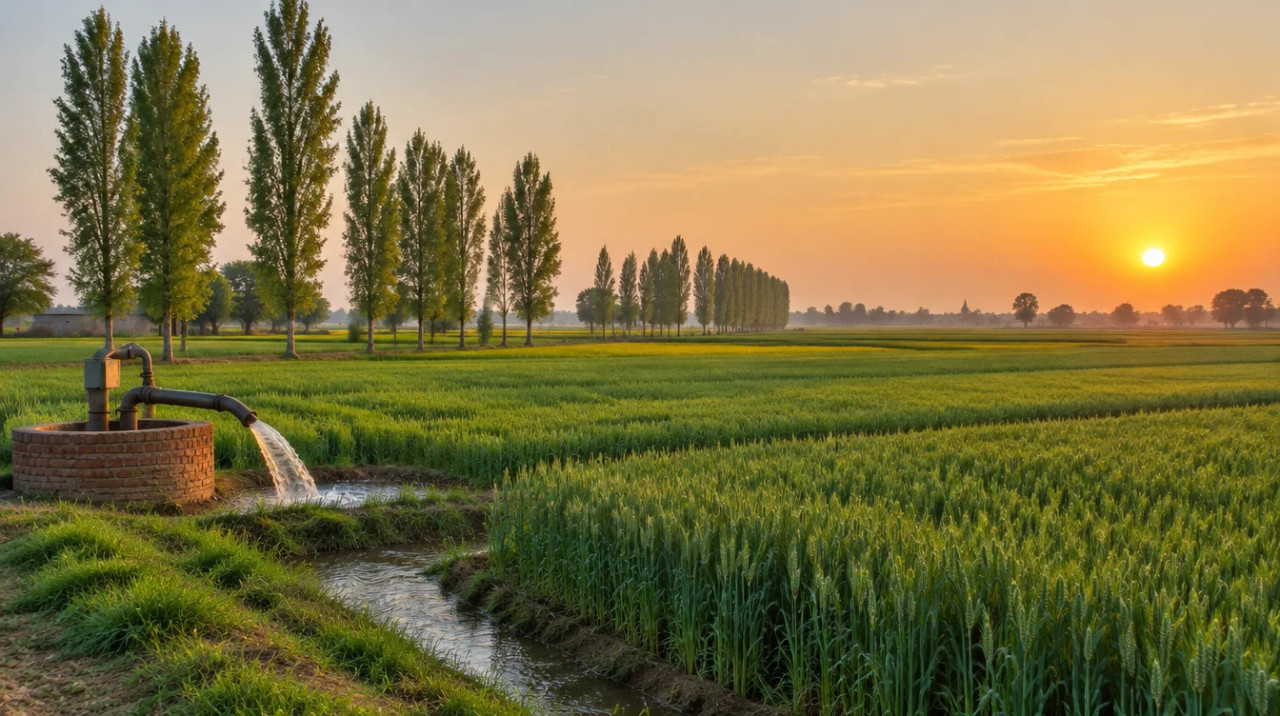
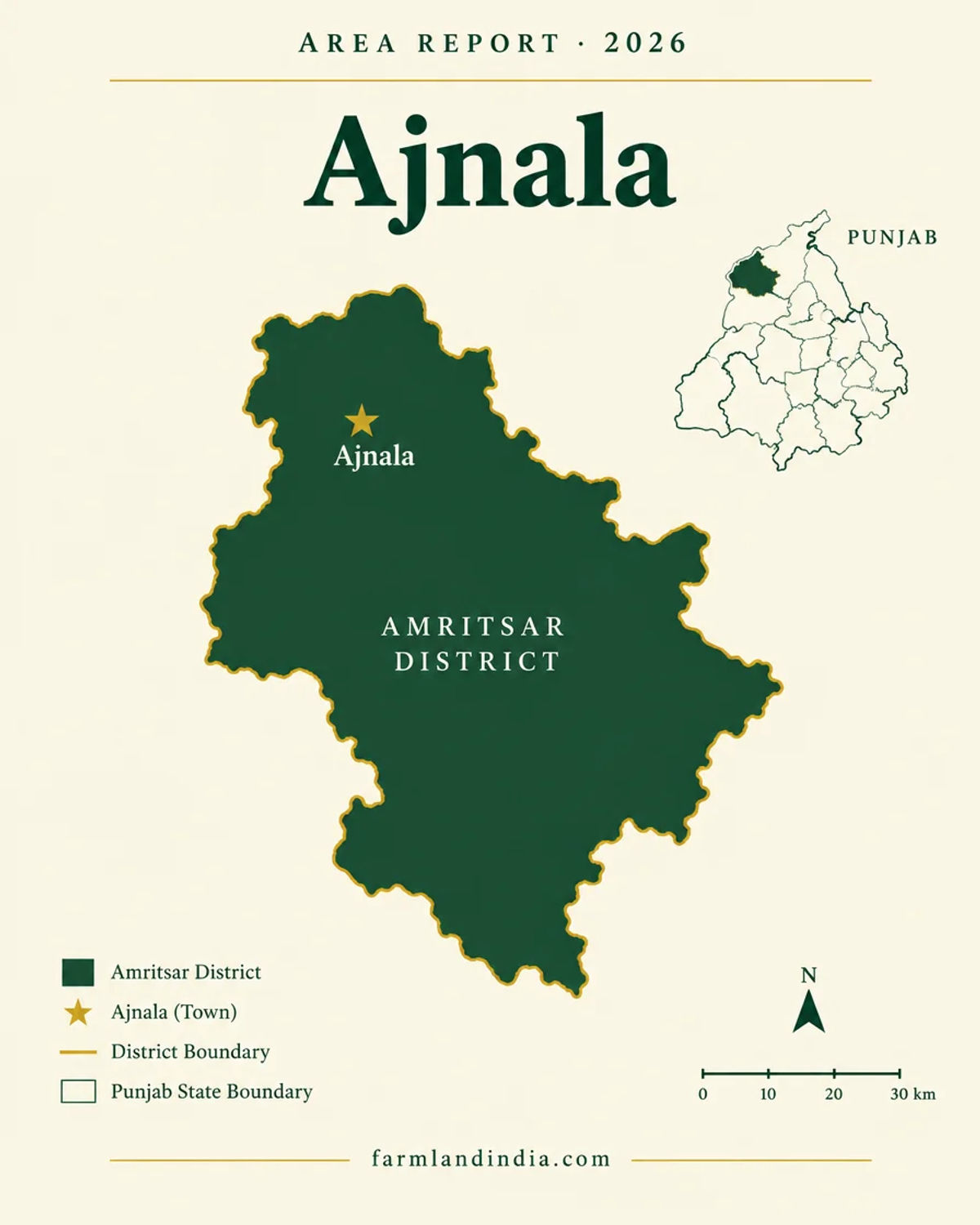
Buying land in Ajnala means buying in the north-western tehsil of Amritsar district, on the Ravi side of the plain and next to the India–Pakistan border. This is Majha farmland: wheat, basmati rice and village holdings, with a few small towns. Ajnala Road leads out of Amritsar. Farmland India's estimate* for farm land here is ₹40 lakh–1.2 crore per acre*; the table below gives the bands.
The border is the defining fact. In Burj village, 27 km from Ajnala town and about 50 km from Amritsar, Scroll reports that the village collectively owns about 300 acres beyond the border fence, that access is limited to roughly 9 am to 6 pm in summer and 10 am to 4 pm in winter, that farmers deposit identity cards at a BSF post and are escorted by Kisan Guards, that crops may not exceed about three feet, and that sugarcane and similar tall cash crops are not allowed. Across six border districts about 21,600 acres in 220 villages lie beyond the fence (Tribune, May 2024). Mongabay (May 2025) adds that in some villages the government treats this land as not registerable, and that a compensation of ₹10,000 per acre won by court order is paid late. A buyer should treat land beyond the fence as a different asset class from land inside it.
Even inside the fence the border shapes use. Read the Amritsar district page for the BSF-related height limits in the city's northern sectors, the sibling Attari page for the border-gate belt, and the state-wise land laws guide. Floods also matter: the 2025 floods affected all 23 Punjab districts, according to the Punjab government.
- Border district
- Land beyond the fence
- Basmati and wheat
- 2025 floods
- Estimated price*
Connectivity
How Ajnala connects
Ajnala is reached by road from Amritsar; the nearer a parcel is to the fence, the more BSF rules shape access.
Reference points (approximate)
Read this before relying on distances
We did not find a route-checked distance from Ajnala town to Amritsar. The Scroll figures (27 km from Ajnala town to Burj, about 50 km from Amritsar) relate to one village near the fence. Parcels beyond the fence are reached only through BSF-controlled gates, and the gate timings above are those reported for specific villages, not a district rule. Ask for the gate number and timings in writing before you value such land.
Growth catalysts
Upcoming infrastructure & developments
Status labels reflect sources read in October 2026. Government-announced timelines are not guaranteed; items marked confirm have single or conflicting sources.
00Operational
03In progress, pending, in dispute or regulatory
Agriculture & terrain
Soil, crops & water in Ajnala
Ajnala is Majha farmland; the border regime limits what grows on the fence side.
Soil & crops
Majha farmland is deep alluvial wheat, paddy and basmati country (our Punjab state page). Scroll reports that basmati rice (1509 variety) and wheat are the permitted crops in the Burj fence belt, with profits of about ₹40,000 to ₹50,000 per acre and no tall cash crops. We found no reviewed crop mix for the tehsil as a whole. Data: Soil Health Card portal.
- Wheat
- Basmati rice
- Fence-belt crop limits
Water
Groundwater in most Punjab blocks is over-exploited by CGWB standards, and the Ravi side may also be exposed to river floods. We did not find the Ajnala block category. Look it up on CGWB; beyond the fence a tube-well needs several permissions (Tribune).
Mandi price reference
Wholesale prices for wheat and basmati are published on Agmarknet. We have not confirmed which regulated market serves Ajnala best.
Farmland India view
Why buyers look at Ajnala
Reasons buyers look at this micro-market, stated with the evidence we have. Not a price forecast.
Basmati and wheat farmland
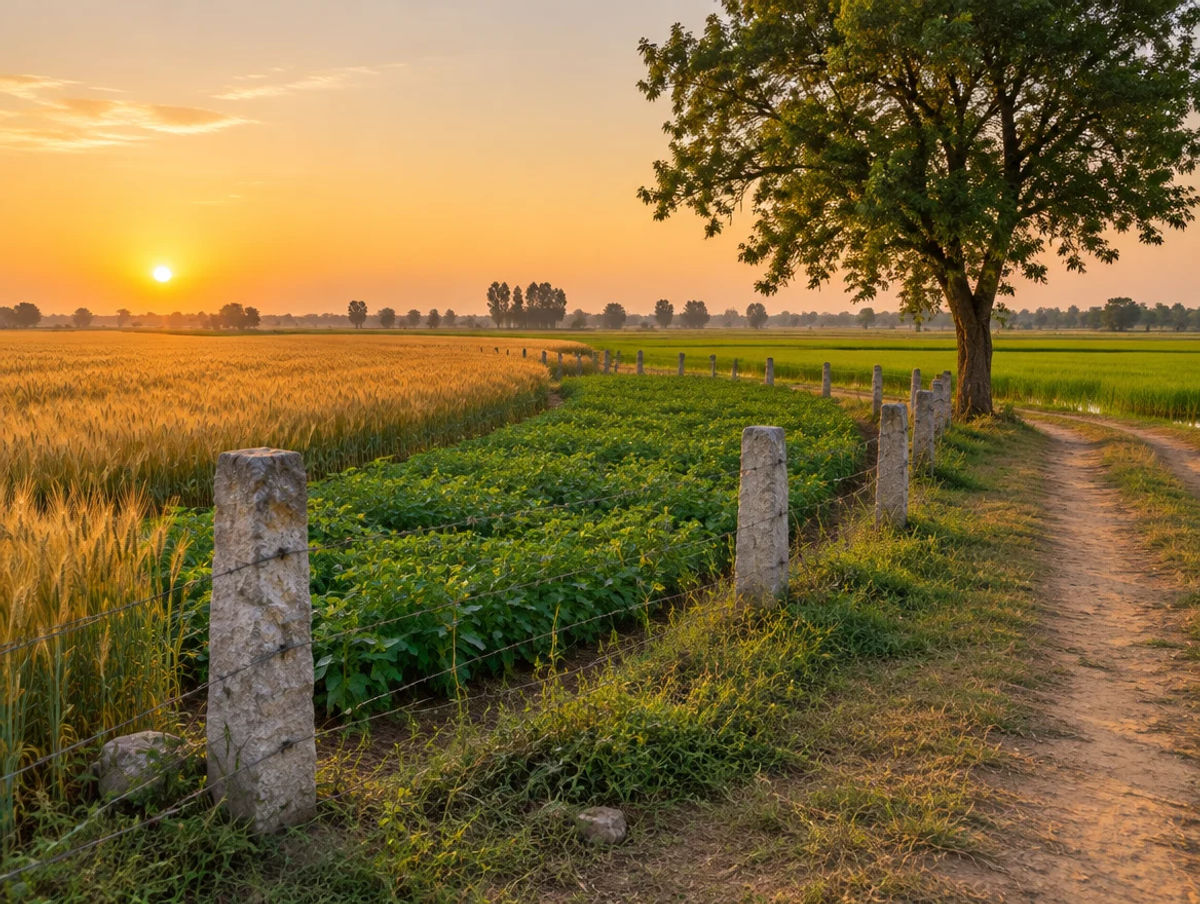
The Majha plain is highly productive, and basmati is a permitted fence-belt crop.
Low-price end of the district
Ajnala is far from Amritsar city's premium belts, so entry cost is expected to be lower, in line with the estimate* of ₹40 lakh–1.2 crore per acre*.
Border-belt infrastructure attention
The Delhi–Amritsar–Katra corridor is a national priority for the border region, though its alignment relevance is unproven.
Large holdings
Village holdings of tens or hundreds of acres are described in the fence belt, which suggests larger parcels in the tehsil.
Listing data is not legal advice. Confirm title, land use and eligibility with the sub-registrar.
STRAIGHT TALK
Risks & challenges specific to Ajnala
Specific to this micro-market, beyond the Amritsar district and Punjab-wide points.
Land beyond the fence
Land between the fence and the zero line is reached only through BSF gates at set hours, with crop limits and no clear registration in some villages (Mongabay). We would not describe it as investable land without a written legal opinion.
Security events can stop work
Mongabay (May 2025) reports that after the April 2025 Pahalgam attack BSF told farmers to harvest wheat within three days. Border tension can halt access with little notice.
Construction near the border
We found no published rule on building near the fence, and no official rule barring or requiring an NOC for buying land in border districts; this rests on absence only. In April 2026 the Ministry of Home Affairs asked the Deputy Commissioners of six border districts, including Amritsar, for a social impact survey on shifting the fence toward the zero line (All India Radio, 13 April 2026). Ask the Deputy Commissioner in writing before you plan a structure.
Flood history
The 2025 floods affected all 23 Punjab districts, according to the Rangla Punjab portal of the Punjab government; the Ministry of Home Affairs reported 40 deaths and 14,065 houses damaged in Punjab as of 27 November 2025. No official district ranking was found, so absence from a press list clears nothing. Test Ajnala land for flood history: ask for the village's 2025 damage record, check the distance to the nearest river or drain, and look at the parcel level against the road. We did not find village-level flood maps for Ajnala.
Unauthorised colonies and PAPRA
Plots sold in colonies without approval are the most common trap near Punjab towns. The 1995 plot and apartment regulation Act (PAPRA) requires licensed colonies, and The Tribune reported that the High Court struck down the 2024 NOC waiver in April 2025; we have not read the order. Ask for the colony licence and the NOC before paying any advance, and treat a plot sold from a farm field as unapproved until shown otherwise.
CLU before you build
Agricultural land stays agricultural until the competent planning authority grants a change of land use (CLU). An application receipt is not permission. We did not check Punjab's current CLU fee schedule, so ask the authority for the written fee and the zone shown in the master plan before you price a parcel for any non-farm use.
Groundwater
CGWB's Punjab report of December 2024 put the state's stage of groundwater extraction at 156.87% and classed 115 of 153 assessment units as over-exploited. Look up the block category on the CGWB portal and ask neighbouring farmers how deep borewells now go before you pay an irrigated-land rate. We did not find a block category for this tehsil in the sources we read.
Shamlat Deh and power of attorney
Village common land (Shamlat Deh) cannot be sold, whatever a seller claims. Match every khasra against the seller's jamabandi on the Punjab land records portal, and treat a power-of-attorney sale (common with diaspora owners) as valid only if the power is registered and authorises sale.
Who can buy
Section 4 of the Punjab Land Reforms Act 1972 limits how much land a person or family may hold; we found no clause in it limiting who may buy, so we found no non-agriculturist bar for non-Shamlat land. Under Section 4(2) the permissible area is 7 hectares of two-crop irrigated land, 11 hectares of one-crop irrigated land and 20.5 hectares of barani land, with an overall cap of 21.8 hectares for mixed land and family allowances above five members. Confirm with a Punjab revenue lawyer. NRIs and OCIs cannot buy agricultural land, plantation land or a farmhouse under FEMA, so this page is not a route for them.
Stamp duty and registration
Stamp duty, cess and a 1% registration fee (capped at ₹2 lakh) apply; the combined rate differs for urban and rural land and for women buyers, so confirm the current rate with the Sub-Registrar. Collector rates were raised in August 2024 (Patiala up to 100% in places) and by 5% to 50% in 12 districts by August 2025; a further statewide rise was put on hold in August 2025 (The Tribune). Confirm the current collector rate with the Sub-Registrar.
KEEP EXPLORING
Explore more areas
Other areas in Amritsar
Guides & research
- Kanal and Marla in Haryana and Punjab — Conversion GuideWiki · P01 Land Measurement Units
- Punjab Agricultural Land RulesWiki · P04 State-wise Land Laws
- Marla, Kanal and Killa in Punjab — What They MeanWiki · P01 Land Measurement Units
- Farmhouse Rules in Punjab (2026): Mohali and PAPRAWiki · P17 Farmhouse & Lifestyle Land
- Stamp Duty Calculator Punjab: Land Cost Method (2026)Wiki · P11 Taxation, Stamp Duty & Registration
- Bhu Naksha Punjab: Village Land Map Guide (2026)Wiki · P02 Land Records & Documentation
- Stamp Duty Punjab: Land Registry Charges (2026)Wiki · P11 Taxation, Stamp Duty & Registration
- Punjab CLU: Change of Land Use Explained (2026)Wiki · P06 Land Use, CLU & NA Conversion
COMMON QUESTIONS
Frequently asked questions
Everything buyers, NRIs and investors ask before their first reviewed farmland purchase in Ajnala.
Visit full wiki01 of 04
Can I buy agricultural land in Ajnala?
Yes if you are an Indian citizen: we found no clause in Section 4 of the Punjab Land Reforms Act 1972 limiting who may buy non-Shamlat land, subject to ceiling and FEMA limits for NRIs. Land beyond the border fence needs special legal care.
02 of 04
What happens to farmland beyond the fence?
Scroll and the Tribune report gate-controlled access at set hours, crop-height limits and no tall cash crops, with ₹10,000 per acre compensation paid late. Mongabay says some of this land is treated as not registerable.
03 of 04
What does land cost in Ajnala?
Farmland India's estimate* for farm and agricultural land in Ajnala is about ₹40 lakh–1.2 crore per acre*. *Indicative only, not a valuation; check registered sale deeds and the collector rate with the Sub-Registrar.
04 of 04
Were Ajnala villages hit by the 2025 floods?
All 23 Punjab districts were affected by the 2025 floods, according to the Punjab government. We did not find village-level data for Ajnala tehsil, so ask for the 2025 damage record of the specific village.
Transparency
Sources for this page
- Burj village rules and 300 acres — Scroll, 'Through war and peace and border lines'
- Fence-belt acreage, hours and compensation — The Tribune, 21-22 May 2024; Mongabay, 'Border village farmers navigate conflict and survival', May 2025
- Prices — Farmland India estimate*; collector rate to be obtained from the Sub-Registrar
- Amritsar context and expressway — Farmland India Amritsar and Punjab pages (secondary sources); PIB, 7 Feb 2024; NHAI Balance for Award list, 1 Mar 2026
- Punjab ownership and ceiling — Punjab Land Reforms Act 1972, s.4(2) (plrs.org.in, Act text); collector rates — The Tribune, 8 Aug 2024 and 13 Aug 2025 (secondary); stamp duty and registration rates not confirmed, ask the Sub-Registrar
- NOC waiver strike-down (reported April 2025) — The Tribune, 15 May 2025 (secondary); the High Court order was not read
- Floods of 2025 — Rangla Punjab portal (rangla.punjab.gov.in); Ministry of Home Affairs, Rajya Sabha reply of 3 Dec 2025; district-level damage not checked
General information, not legal advice. Report inaccuracies to wiki@farmlandindia.com.
For developers
Ready to explore Ajnala farmland?
Browse reviewed projects and individual land parcels across Ajnala — or if you own land here, list it with platform review and reach serious buyers.