
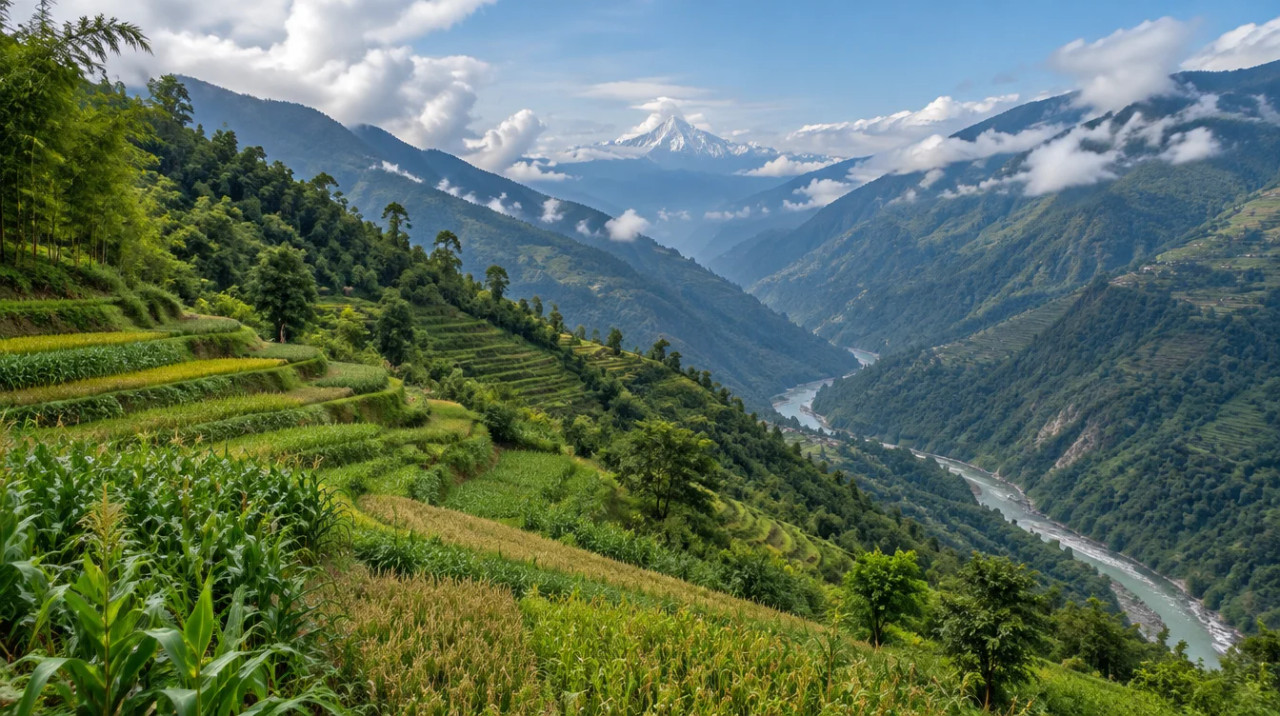
District guide
Buying Land in Gyalshing
Gyalshing (Geyzing), Pelling and Yuksom in west Sikkim: land is open mainly to Sikkimese, and the hill roads decide access.
836 sq km
Area (district portal)
4%
Registration fee (SDM Mangan)
1%
Stamp duty (SDM Mangan)
May–November
Rainy season (district portal)
District land record — Gyalshing
Rev. 2026 · Farmland India desk
State
Sikkim
Formation and division
Gyalshing district (formerly West Sikkim) since December 2021, with Gyalshing, Dentam and Yuksom subdivisions; Soreng was split off (India Today NE[6])
Key markets
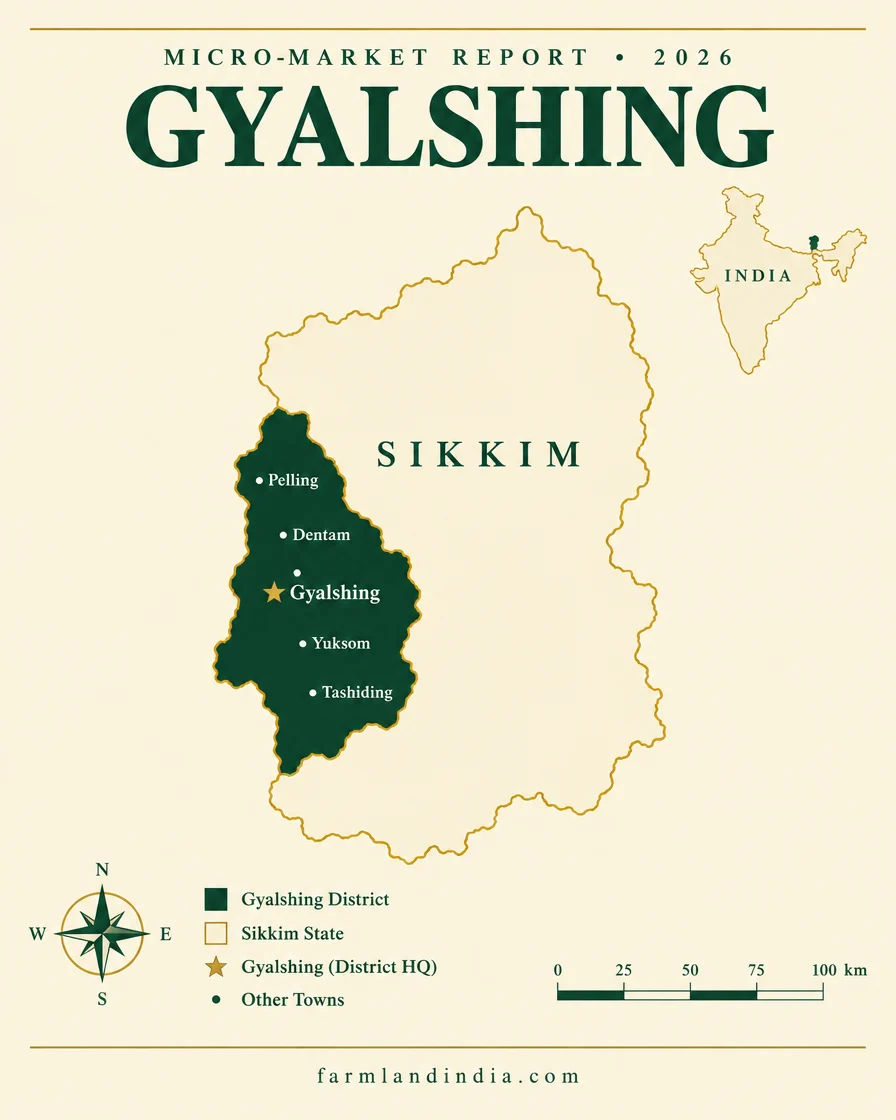
Gyalshing · Pelling · Yuksom · Dentam · Tashiding
Demand anchors
Trekking and heritage tourism around Pelling and Yuksom, and cardamom and terrace farming
Rail and road
No railway; the portal links Gyalshing by road to Gangtok and, via Jorethang, to Darjeeling and Kalimpong (district portal[5])
Size and population
836 sq km per the district portal, a figure that may predate the 2021 split of Soreng; population is not quoted
Pricing unit
No official farmland price series is published for Gyalshing. Ask the sub-registrar for recent registered sale values in the village you are looking at. Ask for plot area in square metres and acres in writing
Local units
Have the surveyed area written in the deed
Land records
Parcha and khazana receipt, with registration through the state registry portal[3]
Land law is state law. These rules are maintained on the Sikkim page and apply to every district within it.
Gyalshing — land purchase legal rules
Sikkim is one of the few states where most Indians cannot buy land at all. It joined India in 1975 on terms set out in Article 371F of the Constitution, which kept in force the laws that already applied in the kingdom. Those old laws, and the rules built on them, decide who may own land, and they protect the Bhutia and Lepcha communities in particular. What follows describes the rules as the courts and the government state them; it is not legal advice, and any purchase needs a local lawyer and the Sub-Divisional Magistrate’s office. This block applies to every district page in the state.
Article 371F(k): Clause (k) protects every law in force in Sikkim immediately before 26 April 1975. The Sikkim High Court restated in April 2026 that these old laws, including Revenue Order No. 1, are protected and cannot be set aside by a court; only the executive and the legislature can change them (Sikkim High Court, Puspa Mishra v State of Sikkim, WP(C) 45/2020, 6 April 2026).
Revenue Order No. 1 (1917): Issued on 17 May 1917 under the Chogyal, the order says that Bhutias and Lepchas may not sell, mortgage or sub-let any of their land to anyone other than a Bhutia or a Lepcha without express sanction. The High Court called the restriction community-based and “apparently discriminatory”, but held that it must be followed until it is amended or repealed.
Outsiders: Sikkim kept its restrictions on the sale of land to people from outside the state. In practice only Sikkimese can buy, with limited exceptions such as designated areas and land for industrial units, as the national press has reported (The Quint, 29 October 2020). The sale-deed checklist published by the SDM, Mangan asks for the buyer’s Certificate of Identification (COI), the document issued to Sikkimese since 1995. A buyer without a COI should assume that an ordinary purchase of land is not open to them.
Marriage and community: A 1969 notification (No. 28/LR) treats a woman as taking her husband’s community. A Bhutia or Lepcha woman who marries outside the community can sell only the land she acquired before the marriage. Families in mixed marriages should check how the rule applies before agreeing a sale.
Registration steps: A sale deed goes to the Sub-Registrar, who is the SDM of the subdivision. Notices are sent to the seller’s family, the gram panchayat, the owners of neighbouring plots and any bank that has lent on the land; if no objection arrives within a month, the deed is registered. The Registrar (the District Collector) handles special cases (SDM Mangan).
Documents: The SDM, Mangan lists the sale deed, a spot verification report, the buyer’s COI, the seller’s affidavit, the parcha of the land and the khazana (land revenue) receipt.
Leases and other routes: Leases, power-of-attorney deals and purchases in a Sikkimese person’s name are ways outsiders sometimes try to get round the rules. Do not rely on any of them without written advice from a Sikkim lawyer.
NRI and OCI buyers: Even where Sikkim’s own rules would allow it, the RBI Master Direction on immovable property bars NRIs and OCIs from acquiring agricultural land, a farmhouse or plantation property in India except by inheritance. Our NRI guide covers the options.
- Article 371F(k)
- Revenue Order No. 1, 1917
- Bhutia-Lepcha land protected
- COI needed to buy
- Outsiders generally cannot buy
- 1% stamp duty, 4% fee
- One-month objection period
- NRIs: inheritance only
Gyalshing — district-specific notes
The Sikkim state page applies to Gyalshing in full. Tourism pockets such as Pelling and Yuksom do not change who may hold land; they only raise the number of sellers and agents you will meet.
⚠ Land in Gyalshing is not open to general purchase. Article 371F(k) of the Constitution keeps in force the laws that applied in Sikkim before 26 April 1975. The Sikkim High Court held on 6 April 2026 that Revenue Order No. 1 of 17 May 1917 is such a protected law: Bhutias and Lepchas may not sell, mortgage or sub-let land to anyone other than a Bhutia or Lepcha without sanction, and the order stays binding until the legislature or executive amends or repeals it (Puspa Mishra v State of Sikkim, 6 Apr 2026[1]).
⚠ Beyond that order, Sikkim restricts sales of land to outsiders in general. The Quint reported in October 2020 that only Sikkimese can buy land except in some designated areas, with exceptions for certain industrial units (The Quint, 29 Oct 2020[7]). The documents listed for registration include the buyer’s Certificate of Identification (COI), so a buyer without one should not expect to complete a purchase. Confirm any exception with the District Collector and a Sikkim lawyer before paying.
⚠ A sale deed is registered by the Sub-Registrar (the SDM of the subdivision) after notices go to the seller’s family, the gram panchayat, boundary holders and banks, and registration follows if no objection arrives within a month (SDM Mangan: sale-deed procedure[2]). The state runs an online registration application on the Land Revenue and Disaster Management Department portal[3].
⚠ Because the old West Sikkim district was divided in 2021, a plot in the Soreng area may now sit under Soreng’s offices. Check that the deed, the parcha and the registering SDM all refer to the same district before you sign.
NRI and OCI buyers: see our guide on whether NRIs can buy agricultural land in India; in Sikkim the state rules above come first.
- Sikkimese buyers only
- Article 371F
- Bhutia–Lepcha land
- COI at registration
- One-month notice
District overview
Gyalshing — Geyzing, Pelling and the western ridges
Gyalshing, also called Geyzing, sits at about 1,900 m and is the district headquarters. The district portal gives an area of 836 sq km, calls it the second-largest in Sikkim, and names Pelling, Yuksom and Dentam as the other important towns. It borders Namchi to the east, Mangan to the north, Soreng to the south and Nepal to the west (district portal[5]). The 2021 reorganisation gave it three subdivisions, Gyalshing, Dentam and Yuksom (India Today NE[6]).
The portal describes an agrarian economy on steep, rocky slopes, with much of the land unsuitable for farming, and a trekking trade built on high elevations. The rainy season runs from May to November and peaks in August. There is no population or crop table for the district.
Groundwater is not the constraint: Sikkim’s extraction was 5.85% in 2024, with all 40 assessment units Safe, six of them in Gyalshing (CGWB, 2024[4]). Roads and slopes matter more, as the September 2026 landslide showed.
- Gyalshing
- Pelling
- Yuksom
- Dentam
- Tashiding
Transaction costs
Stamp duty & registration in Gyalshing
4%
Registration fee, paid by the seller
as published on the SDM Mangan sale-deed page; confirm the rate for your case
1%
Stamp duty on the consideration
Confirm the current rate with the sub-registrar before you pay.
1 month
Notice period before registration
the Sub-Registrar registers if no objection arrives; the Registrar (DC) handles special cases
Both rates come from the SDM Mangan procedure page and are quoted there as a share of the consideration. Ask the Sub-Registrar for a written computation before you sign.
Know the belt
What is moving prices in Gyalshing
Five places worth knowing, by what drives them and what to check.
Gyalshing (Geyzing)
District headquarters
The administrative centre, linked by road to Gangtok and Jorethang; plots near town are for homes and shops.
Check: title chain and the registering office
Pelling
Tourism town
A visitor pocket named by the district portal, so demand is for guest stays; there is no price source.
Check: land class and access road
Yuksom
Trek and heritage base
The northern end of the Geyzing–Pelling–Yuksom road, which was cut by a landslide in September 2026; access risk is part of the price.
Check: road reliability and slope
Dentam
Subdivision
A separate subdivision with its own revenue office, so records may sit there.
Check: which office holds the record
Tashiding
Named on our map
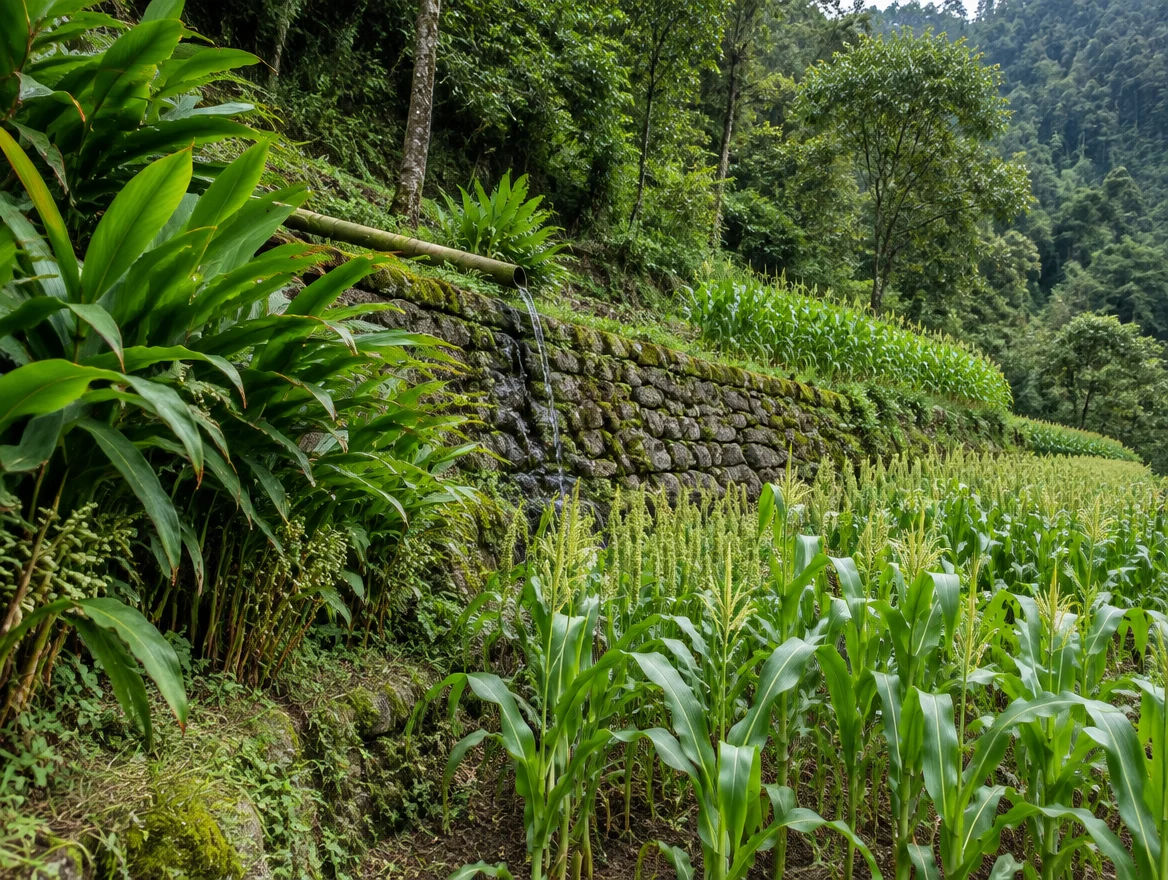
A smaller pocket with terrace farming; confirm its subdivision before relying on any listing.
Check: who holds the land
Asking prices
No official farmland price series is published for Gyalshing. Ask the sub-registrar for recent registered sale values in the village you are looking at. Treat a agent’s figure as an opening ask until it is matched with a registered deed.
Connectivity
How Gyalshing connects — road, rail and air
One hill road ties the district together; it was cut in September 2026.
🚗 By road
✈️ By air
🚆 By rail
Growth catalysts
Upcoming infrastructure & developments
No project confirmed; the September 2026 landslide is the live road issue.
00Open
01Catalysts
Agriculture & terrain
Soil, crops & water in Gyalshing
Terraced millet, maize and cardamom.
Land and water
Sikkim’s groundwater extraction was 5.85% in 2024 and all 40 assessment units were Safe, six of them in Gyalshing (CGWB, 2024[4]). CGWB lists normal pre-monsoon rainfall of 1,511.3 mm and post-monsoon 530.4 mm for the Gyalshing and Soreng units.
- Groundwater extraction: 5.85% (state, 2024)
- Six assessment units, all Safe
- Rainy season May to November, peaking in August (portal)
Typical crops
The portal describes an agrarian economy but names no crops.
Steep and rocky
The portal notes that much of the land is too steep and rocky to farm. Check slope, drainage and a water source.
At a glance
Gyalshing vs. nearby districts
| District | Land and water | What links it to Gyalshing |
|---|---|---|
| Namchi | East; Namchi, Jorethang | Hill district with Ravangla and Temi |
| Mangan | North | Largest district with remote land |
| Soreng | South | New district split from West Sikkim in 2021 |
| Nepal | West | International border |
The neighbours come from the Gyalshing district portal’s own boundary list. No official farmland price series is published for Gyalshing. Ask the sub-registrar for recent registered sale values in the village you are looking at.
Farmland India view
Why investors look at Gyalshing
Five reasoned points for Gyalshing, each tied to a source on this page.
Tourism pull, thin evidence
Pelling and Yuksom draw trekkers, but no price series exists, so returns are a guess.
Eligibility first
Only Sikkimese buyers can generally register; Bhutia and Lepcha land needs sanction to leave the community.
Check the district
The 2021 split means some villages now belong to Soreng; match the deed and the registering office.
Road risk
Landslides can cut access for weeks; visit in the rains before you pay.
Confirm the parcha, khazana receipt, mutation, zoning and acquisition status directly — these are not certified by Farmland India’s review.
STRAIGHT TALK
Risks & challenges in Gyalshing
District-specific risks. Read the Sikkim state page for the general risks on ceiling, conversion and records.
Ineligible buyer
A buyer without a COI cannot complete registration under the procedure.
Bhutia–Lepcha land
A sale outside the community without sanction conflicts with Revenue Order No. 1 of 1917, as upheld in April 2026.
Landslide
The September 2026 Rimbi slip shows how the Pelling–Yuksom road can be cut.
Steep, rocky plots
The portal itself says much of the land is unsuitable for farming.
Old district names
Records dated before 2021 may say West Sikkim; confirm the current district.
Objection window
Notices go to family, panchayat and banks, and any objection can delay registration.
Who to contact
Local revenue & planning offices
Start with the Collector’s office at Gyalshing and the Sub-Registrar (SDM) of the subdivision, who register sale deeds and issue notices. Use the state’s online registration application on the Land Revenue and Disaster Management Department portal, and ask for a written fee and duty computation.
COMMON QUESTIONS
Frequently asked questions
Everything buyers, NRIs and investors ask before their first reviewed farmland purchase in Gyalshing.
Visit full wiki01 of 04
Can an outsider buy land in Gyalshing or Pelling?
In general, no. Sikkim keeps in force the laws that applied before 1975 under Article 371F(k), and registration documents include the buyer’s Certificate of Identification. Some exceptions for designated areas or industrial units have been reported; confirm any with the District Collector and a Sikkim lawyer.
02 of 04
What is the West Sikkim district called now?
Gyalshing. In December 2021 the old West Sikkim district was renamed Gyalshing and the new Soreng district was carved out of it, so a record dated before then may say West Sikkim.
03 of 04
How reliable is the road to Pelling and Yuksom?
A landslide at Rimbi on 2 September 2026 cut the Geyzing–Pelling–Yuksom road, with a 30-metre stretch including a bridge section damaged. Temporary restoration was expected in three to four days and full reconstruction in three to four months.
04 of 04
What does registration cost?
The SDM Mangan procedure page gives a registration fee of 4% and stamp duty of 1% of the consideration, paid by the seller. Ask the Sub-Registrar for a written computation.
Transparency
Sources and references
Law and courts
Government
- [2]SDM Mangan: sale-deed registration — mangan.nic.in
- [3]Sikkim land registration portal — registry.sikkim.gov.in
- [4]CGWB: Ground Water Resources of Sikkim, 2024 — cgwb.gov.in
- [5]Gyalshing district portal — gyalshing.nic.in
News
- [6]India Today NE: Sikkim gets two new districts, 22 Dec 2021 — indiatodayne.in
- [7]The Quint: states where outsiders cannot buy land, 29 Oct 2020 — thequint.com
- [8]India Today NE: Rimbi landslide, 2 Sep 2026 — indiatodayne.in
Project status, the benchmark valuation and land rules change often; check the linked source and the relevant office before relying on any figure.
For developers
Ready to explore Gyalshing farmland?
Browse reviewed projects and individual land parcels across Gyalshing — or if you own land here, list it with platform review and reach serious buyers.